Shownotes
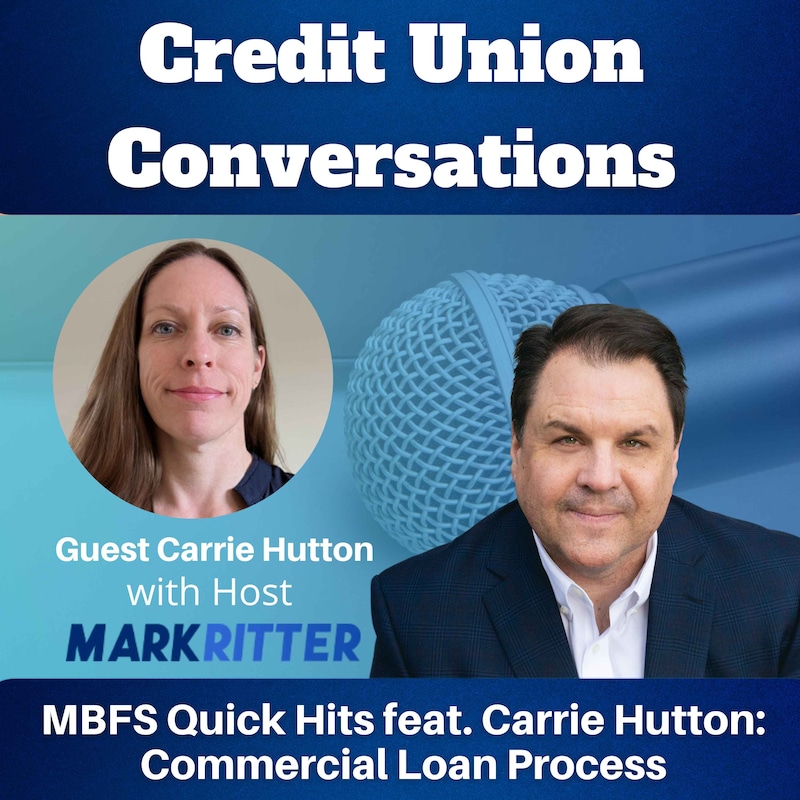
Business lending expert Carrie Hutton shares her journey from military spouse to VP of documentation services at MBFS in this episode of Credit Union Conversations. Host Mark Ritter explores the critical components of the loan closing process, including essential entity documents, title work, and collateral valuations. Hutton reveals how proper documentation requirements for credit union business lending can dramatically reduce closing delays. From managing loan approvals to coordinating environmental due diligence, listeners gain insider knowledge on how to achieve faster, more efficient closings in commercial lending.
What You Will Learn In This Episode:
✅ The realistic timeline for closing commercial real estate loans versus equipment financing deals, and why business lending professionals should expect three to four weeks for real estate transactions, while non-real estate loans can close in under a week.
✅ The four critical loan documentation requirements that consistently delay closings include entity documents with correctly spelled names, title work for correct vesting, accurate collateral valuation, and detailed loan approval documentation.
✅ How credit union operations can avoid common mistakes in the loan closing process, including missing authorized signers on documents and delays caused by incomplete environmental due diligence or appraisal process issues.
Subscribe to Credit Union Conversations for the latest credit union trends and insights on loan volume and business lending! Connect with MBFS to boost your credit union’s growth today.
TIMESTAMPS:
00:00 Introduction to business lending expert Carrie Hutton and her debut on the Credit Union Conversations podcast
01:10 Carrie's banking career journey from military spouse employment at Bank of America in Japan to credit union roles
04:05 Carrie's role managing the documentation services team and onboarding credit unions
05:46 The ideal loan closing process timeline and managing appraisal process, flood certification, and environmental due diligence
09:07 Common mistakes that delay closings, from missing authorized signers to incomplete loan approval details
KEY TAKEAWAYS:
💎 Successful business lending depends on accurate entity documents with names spelled exactly as filed at the state level. Missing or incorrect operating agreement details and authorized signers are the most common causes of delays, sometimes rendering entire loan documents invalid.
💎 Understanding loan type impacts closing speed significantly. Commercial vehicles, UCC filings, and equipment financing deals close in under a week, while real estate transactions require three to four weeks due to appraisal and environmental due diligence timelines.
💎 Effective team management in documentation services requires clear procedural manuals and systematic tracking of construction loans, change in terms requests, and tickler systems to ensure nothing falls through the cracks during high-volume loan processing periods.
RESOURCES MENTIONED:
SEO KEYWORDS:
Credit Union Conversations, Mark Ritter, MBFS, Credit Unions, CUSO, Business Lending, Loan Documentation, Loan Closing Process, Documentation Requirements for Credit Union Business Lending, Title Work, Collateral Valuation, Loan Approval, Commercial Real Estate, Equipment Financing, Environmental Due Diligence, Appraisal Process, Operating Agreement, Loan Processing
Transcripts
[00:00:22] Carrie Hutton: doing wonderful. It's very snowy and cold outside.
[:[00:00:35] Carrie Hutton: Zero.
[:[00:00:51] You have been with us a long time, and even with QSO before that, why don't you give people, for those of [00:01:00] you who enjoy your service over the years, but don't know your story, tell people your whole background and career journey and the places you've lived.
[:[00:01:15] Mark Ritter: Yeah, sure.
[:[00:01:25] Mark Ritter: This would've been your husband in the military as you were a military spouse back then,
[:[00:01:31] Mark Ritter: All right,
[:[00:01:41] And then we moved to Warner Robins, Georgia. Started working for Robins Federal Credit Union, now called Robins Financial Credit Union. And there again, I started out as a teller, eventually worked my way up to being the lead vault teller. And started learning how to open up new accounts. [00:02:00] At that point it, we were on our final move to Pennsylvania, and that was about October of 2005.
[:[00:02:25] So clearing judgements, requesting payoffs, gathering hazard insurance, et cetera. I was there for just a short period of time and I actually received a call back from Clearview Federal Credit Union. Their HR department called me regarding a potential position for a new business lending QSO Keystone Business Lending Solutions.
[:[00:03:17] Also sent out annual review letters and tax statements. Pulled and sent out reports to lenders and handled the bookkeeping. Keystone merged with MBFS in March, 2016, and I've been here ever since.
[:[00:03:41] We've had a lot of success with that. When you were in the military, you had to get a job, husband moves, and then you go get another job. But we've had the luck of hiring military spouses who, when they move, get to stay with their job. Not too many remote jobs were open 25 years ago.
[:[00:03:59] Mark Ritter: So [00:04:00] you had to hop around.
[:[00:04:05] Carrie Hutton: Sure. I am the VP of the documentation services team. I manage and mentor a team of eight employees. Uh, I create and edit our procedural manuals to keep us up to date on the services and duties that we perform for our lenders. I assign out new loans to the closing team so that they can work with their credit unions on preparing files and documentation.
[:[00:04:58] Ordering their laser Pro [00:05:00] license, getting that set up and guiding them through, you know, the low process, just to get an idea of what services they're going to need from us so our team can prepare to assist them.
[:[00:05:23] What I find is that the process from we have a loan approval to the loan gets funded. That's one of the reasons I wanted to have you talk about what you see in this world. What would you say is the ideal process? A realistic timeframe for people to get a loan closed. In today's marketplace,
[:[00:06:02] Then the lender can obtain like the title insurance, hazard insurance, make sure the entity documents are there, et cetera. And then once everything's in file, we prepare the documents and the loan closes. Timeframe kind of harder to determine. It just kind of depends on the type of loan. So I guess loans for commercial vehicles, UCCS equipment, things like that.
[:[00:06:45] There can be delays with that, especially, you know, maybe the appraiser can't get access for inspection, so that delays the appraisal coming in. Or maybe, you know, something happens, there's an environmental issue that's noted that needs to be mitigated, and we weren't anticipating that if [00:07:00] everything's in file and the loan is ready to close, it doesn't take us long to prepare the documents for that.
[:[00:07:25] Mark Ritter: What are those critical documents you're always asking for? We need this to create the loan documents. What are those top few items you find yourself repeating?
[:[00:07:49] We also need to verify that we have the correct authorized signers listed on the documents. If we don't do that, then there's a risk that those documents are invalid. We have seen [00:08:00] some cases for like smaller loans where the borrower does not have an operating agreement. We can notate the risk of, you know, not having that document in file to the lender, but it is ultimately their decision if they, you know,
[:[00:08:14] Carrie Hutton: closing it.
[:[00:08:47] All the rate information and term information, any covenants that they're gonna require us to set into those documents.
[:[00:09:08] Carrie Hutton: Not getting the proper entity documents that'll hold up a transaction and they need to have.
[:[00:09:41] Mark Ritter: Yeah, I, I, you know, when, when I review, sometimes I just see where. Things change and everybody understands what's going on, but it's really just not documented or approved in the file. Everybody just says, oh yeah, go ahead and do it. Two years from now, [00:10:00] three years from now, when everybody's gone, nobody ever remembers that stuff.
[:[00:10:16] Mark Ritter: Harry, you have overseen thousands upon thousands and thousands of loans, closings. Anything sticks out as like the one that you remember the most and tell people about at dinner?
[:[00:10:44] Mark Ritter: so well, Carrie. I appreciate everything you do here at MBFS. Our clients. Appreciate it.
[:[00:10:56] Carrie Hutton: Thank you very much.
[:[00:11:11] So check us [email protected] and please subscribe to the podcast on your favorite audio platform. We release every Tuesday. Thanks a lot.