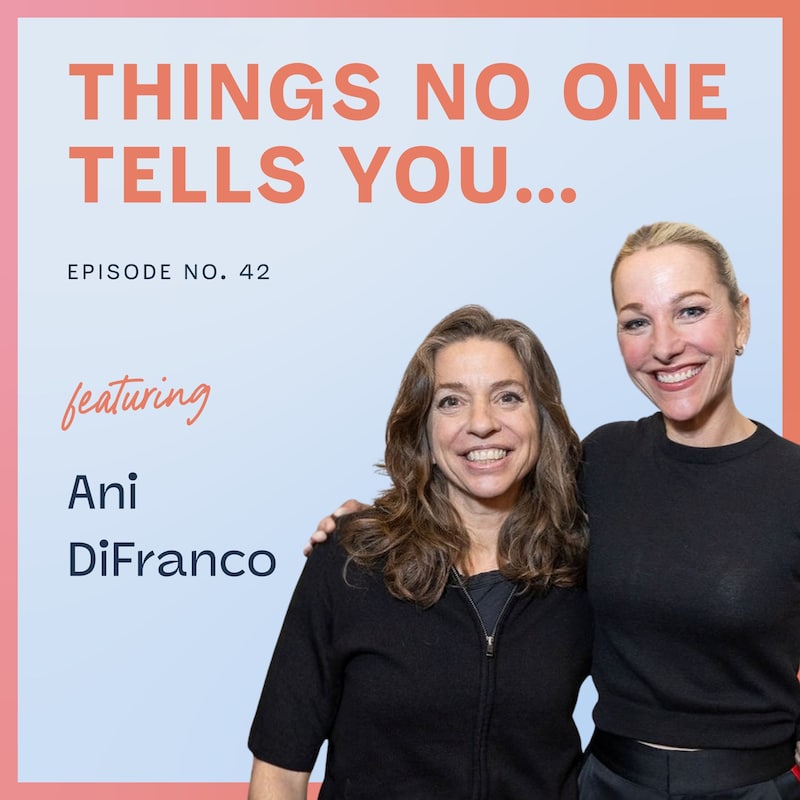
Shownotes
If you had told me as a student at James Madison University that one day, decades later, I'd be waiting to go onstage for a conversation with Ani DiFranco, I would've NEVER believed you.
Her songs were on repeat on our playlist. Somehow, as my roommates and I danced to her music in our dorm or as I listened through my headphones making my way across campus, I felt like her lyrics were intended specifically for me. Turns out that’s exactly how all of her fans have felt for decades. That ability to connect through vulnerability is what has always made Ani DiFranco so special as an artist.
This live conversation with Ani started as a look at her journey and new book, The Spirit of Ani, but it quickly turned into an impromptu talk about her views on life after death, her longstanding fight against the patriarchy, and yes, even donkeys. The powerful connection within the room was palpable from the moment she took her shoes off to sit cross legged at the start of our conversation. It felt like we were at a sleepover with 150 plus of our closest friends listening in and that vibe was certainly because of her ability to be so present in the moment.
Many thanks to the Westport Library and Verso Studios for creating the environment to have such a memorable evening and for hosting this conversation as part of VersoFest 2026.
We spend so much time thinking about where we’re going. We rarely stop to ask if we’re already where we need to be. Ani DiFranco has spent decades doing exactly that, choosing presence over pressure, connection over convention.
Ani reflects on building a career rooted in independence, turning down the traditional music industry, and learning to trust her instincts from a young age.
What I loved most is how honest she is about the process. The exhaustion, the doubts, and the realization that fulfillment isn’t waiting somewhere ahead, it’s in the moment you’re in.
What You’ll Discover:
- How vulnerability became Ani’s superpower (00:09:56)
- Being on her own at 15 and finding her path (00:22:05)
- Turning down record labels and choosing independence (00:25:29)
- What success meant early in her career (00:30:36)
- The moment Ani realized music connected people (00:31:03)
- Why presence is everything (00:32:45)
This conversation is about more than music. It’s about identity, intuition, and the courage to choose your own way, even when it doesn’t look like anyone else’s.
If you’re enjoying these conversations, don’t forget to subscribe, rate, and review, and share this episode with a friend. It helps us keep bringing these conversations to you.
This live event interview was recorded at Verso Studios in the Westport Library as part of VersoFest 2026.
You can watch this interview on YouTube: https://youtu.be/3C6891Vpvf4
For a full transcript and more, check out our blog post: https://www.lindsaycz.com/show-notes/ani-difranco-42
Check out more from Ani DiFranco:
Follow Ani DiFranco on Instagram https://www.instagram.com/anidifranco/
Check out Ani DiFranco’s label Righteous Babe Records https://www.righteousbabe.com/
Discover Ani DiFranco’s last book The Spirit of Ani: Reflections on Spirituality, Feminism, Music, and Freedom https://www.akashicbooks.com/catalog/the-spirit-of-ani-reflections-on-spirituality-feminism-music-and-freedom/
Support this podcast:
Follow Things No One Tells You on Instagram: https://www.instagram.com/thingsnoonetellsyoupod/
Stay connected with Lindsay https://www.lindsaycz.com/ and follow her on Instagram https://www.instagram.com/lindsaycz/
Subscribe to my YouTube channel https://www.youtube.com/@lindsaycz
Transcripts
[00:00:32] I felt it. I felt it. I felt really thrilled, despite not being a success by anyone's measure. If I connected with somebody who was like the goal. And it started happening immediately. So immediately, I was a success as far as I was concerned.
[:[00:01:21] her songs ‘Untouchable Face’, ‘Both Hands’, and ‘32 Flavors’. They were like anthems of my time at James Madison University. I don't know why, but here's the deal. The library in my town, Westport Library. They get some just insanely talented people to come and speak at the library to perform. I mean, Wyclef Jean just performed there as part of their Brow Fest.
[:[00:02:18] And to be able to talk to her about her songs, about her life, I was so excited. I was also very nervous because I thought that at the end of the day. I just wanted to bring forth all these things in this connection as I could. And the reality was, there was so much to talk about and to ask her. Our focus was really on this book, which is paying attention to her spirituality and her journey in terms of how she views it.
[:[00:03:11] So anyway, all I know is that Ani DiFranco came to connect with every single person in that audience. And this is a conversation about her journey, about why she believes the thing no one tells you is really the importance of connection and being present, and how she applies that in her life. So I hope you love this conversation.
[:[00:03:52] Crystal: Tonight, we gather in community inside the walls of this dynamic library to spend time with Ani DiFranco and offer gratitude for the gifts she has given us over a prolific multi-decade career, gifts that include over 20 albums, countless artistic and charitable collaborations, several books, and even a stint on Broadway as Persephone in Hades Town.
[:[00:04:51] Please join me in welcoming to the stage Lindsay Czarniak and Ani DiFranco.
[:[00:05:23] Ani: Oh. Oh no. I'm, I just, I gotta take a seat. This is too beautiful. What a beautiful spot. What a beautiful group. Your introduction made me cry.
[:[00:05:43] You get yourself in the mindset, and you drop the veil. You say drop the ego. Really just be, and I really think that's what this is.
[:[00:05:58] Lindsay: It's the connection, you know. It is what your music is, and for those of us in this room who are very aware of your music, it's what people feel collectively when they listen to it.
[:[00:06:16] Ani: Thank you, Lindsay. It's great to be here. Yeah, I'm gonna, I'm gonna get comfortable.
[:[00:06:24] Ani: Okay. You know that baby
[:[00:06:31] Ani: Maybe we'll trade shoes by the end of the night.
[:[00:06:51] Ani: Well, yeah, I've gotten to the place in my life. I am grateful to say that it means everything.
[:[00:07:29] And I cried all the way back to my hotel, 'cause it means that much. And I'm finally at a place where I'm ready to receive it and reciprocate and just feel that back, feel so grateful back for that connection.
[:[00:07:54] Ani: Oh yeah.
[:[00:08:12] You know what's so funny? Friends of mine in this town, whom I did not know when I started listening to your music, I'm on a text chain, and one of my friends said," Girls, I took a train from Paris to Germany in the early nineties all by myself to see Ani. She was in high school, I think. Oh, I love that. And there's, so the list, it went on and on.
[:[00:08:49] Ani: Right away. I mean, I mean in a, you know, in my little way in, you know, in a little bar in Buffalo, that's just, I mean, maybe I'm, making it up, but my memory is that the minute that I open my mouth and just shared my truth, there was always somebody, there was somebody in the room, there was some chick, like two beers in that would just start crying and then there was hugging to do and there was a like, you know, it just that, that's been my experience that the minute you just show up as your authentic self, somebody else does that back.
[:[00:09:56] Ani: Well, I was gonna say, I don't know, and I don't need to know, but I think maybe, I do know, actually, it just took me a second in my little brain. The word vulnerability has come up so much over the decades, and I don't think I really understood that until recently. That word that kept coming back to me, thank you for your, I was like, what does that even mean? I don't, and now I get it. Now I get it. Do we have Brene’ Brown fans? Yeah, she's a badass and just, yeah.
[:[00:10:47] Lindsay: She wrote the book, Daring Greatly. For those of you that I know, everyone here probably knows her, but just in case, Melvin, I think you know her. That's my husband, by the way.
[:[00:10:59] Lindsay: But so this book and this The Spirit of Ani, why, I mean, first of all, there are so many, I think different, themes of course, but different lessons to take from this, which is really you sharing.
[:[00:11:26] Ani: Well, it's showing up now because it took two years to get it from the conversation that it centers around to this Little package. So it's funny for you to talk about the now 'cause this, I feel I can feel the distance between what I've already put between myself and this ani that's talking in this book.
[:[00:12:05] Lindsay: Lauren Coyle Rosen,
[:[00:12:07] Lindsay: Who co-wrote.
[:[00:12:30] So that was her proposition. And I think she imagined that we would have a series of conversations and then she would write a book. And instead, you know, I got involved, and I didn't, you know, I never, I didn't leave the guests that wouldn't leave, so, so we rose, sort of put it together, I mean, we worked on it together, and we kept it conversational. It was kind of a, it was hard because the publishers, we were sort of shopping the book around, and publishers were like, and they were trying to encourage us to just make it, you know, pontificating on the page. And we felt that it was right to keep it as a conversation because so much of what we were talking about was that existence is a conversation that's.
[:[00:13:54] So yeah. So we just, we had these conversations, and then we collaborated, sort of editing them down to what you have. Yeah.
[:[00:14:10] Ani: I don't know. I really don't sort of spend time reflecting on my own. Voice and what comes outta my face, you know?
[:[00:14:38] Lindsay: Have you always been that way?
[:[00:14:45] Lindsay: Wait, so I have questions. Okay. So yeah, I know that, I know you picked up a guitar for the first time when you were nine, right?
[:[00:14:56] Lindsay: I know, but it kind of feels good. It's like we're in our buffer cars. We're ready to take off. When you were nine, I was talking to my daughter because I was making her listen to some of your albums the past week, and she actually fell in love with the song, both hands.
[:[00:15:21] Ani: That's fair.
[:[00:15:23] Ani: That's probably good.
[:[00:15:31] What was your hope?
[:[00:16:00] It was just, I think it was just more of me trying to find homeostasis, you know? To just find peace, I was in a house that was full of bad vibes, and making art instantly felt like medicine. So really it was just about a healing process and, you know, still is. So what happened next? Well, I met this guy named Michael.
[:[00:16:43] Lindsay: Michael Meldrum.
[:[00:17:17] He was also brilliant. He was a reader. He was a thinker. He was a songwriter. Oh, there he is. There's Michael. Yeah. Yeah. And, there we are in this gig. He got me involved in that, which was my 11th birthday. Wow. We played the " Save the Whales and Dolphins benefit. Yeah, we saved them too. They still exist. But, yeah, Michael, I met him at this guitar shop where my parents humored me and bought me a guitar.
[:[00:18:17] And we just. Started talking to each other, and it was on. He was, we were best friends, we were an odd couple, but for sure he would spring me, you know, so there, he was a songwriter as well, among his many talents and activities. And so I started writing songs, 'cause you know, my pal was doing it, it seemed like the thing you do, like really young.
[:[00:18:53] Lindsay: How?
[:[00:19:12] Lindsay: What was that like?
[:[00:19:37] Lindsay: And so from that, how much of that timeframe and experience did you take into your music moving forward?
[:[00:20:31] Lindsay: What do you feel like types of things were you discovering spiritually even at that point?
[:[00:20:43] Ani: What was it? Oh, goddess forbid. I don't know those early songs. I'm sure they're, oh, see, no, but here's the thing. Here's the thing, and I shouldn't even say this, but you don't know the first, we're all right here.
[:[00:21:08] But you know, I think I made a hundred copies and whatever. I was just, you know, finding my voice, you know, person. And, but yeah, on the first tape, there are all those songs about social issues, you know, I mean. Right. So how old was I? You know, I don't know. A teenager and, you know, I remember there was a song called aids, just called aids.
[:[00:21:45] Lindsay: Yeah. What were the most important things to you at that time? What were the things that were most on your mind that you felt like you wanted to be singing about? Writing about?
[:[00:22:05] You know, I was on my own when I was 15, starting at 15. So a lot of what was on my mind was being a teenage girl alone in a man's world, holding down the open mic in a bar full of dudes drinking, you know, survival was on my mind. And we talk about it actually in this book, Lauren and I. It's funny, she caught me a couple of funny moments in this conversation.
[:[00:22:55] Lindsay: Yeah.
[:[00:23:08] But just over the course of the conversation, it came up a few times. Like, okay, so the reality is I was not that at all. I was really singing my spells. I was singing to myself that I am strong and I am capable, and I am not to be fucked with, you know.
[:[00:24:03] Ani: Well, it's hard to, you know, even for myself to put myself back there. You know, for those of us that were around, you know, whatever, the eighties, I guess, is when I started opening my mouth and yeah. Singing, in a big way. And it was just so different. The women's voices were not so audible.
[:[00:25:16] I was on a visceral mission, you know?
[:[00:25:29] Lindsay: When the record labels started reaching out, how did you handle that?
[:[00:26:15] And it just was apparent that the interests of those businesses and the interests of art and culture and people and human evolution were often contradictory, you know, in conflict. So I was suspicious. I was just suspicious, and I did not have a plan. You know, I had no plan. I had no, I was naive in many ways.
[:[00:26:50] Don't you think naivety looking back is like Sure. A blessing.
[:[00:27:02] Can be a blessing. Because often, how it goes sucks. So, but yeah, I think in the beginning I was really dealing with some very basic, the difference between attraction and aversion.
[:[00:27:50] And it was not a happy Ani, it was not a fulfilled Ani.
[:[00:28:06] Ani: I mean, you know, when I was young, I, and even say, okay, so fast forward a bunch of years, I've started Righteous Babe.
[:[00:28:42] and my manager at the time put it to me like, okay, if you wanna hire somebody to help you drive and maybe do a sound check, that doesn't involve electroshock therapy every day. You have to sell T-shirts. We gotta make a t-shirt.
[:[00:29:11] Lindsay: And why did you say ew? Like, why didn't,
[:[00:29:29] It's just a face. I'm not gonna even get worked up, getting all that embarrassed feels great, picture, kind of self-involved. Thank you. Yeah. But somebody else came up with all of this, and I'm like, sure. I am over even worrying about that. But at the time, that girl. I looked into the music business, and I just felt mortified by the game.
[:[00:30:07] Lindsay: And you wanted the same end game, though, right? I mean, to be able to do your music and to do that for a living. So who did you have in your corner that was giving you the confidence to do that and create your own label? And were they giving you the type of confidence that convinced you that it was going to work?
[:[00:30:36] Ani: Yeah. No, the one I had was that girl crying into her beer. That's who I had. And I think I was, no, but for real, I think I was blessed. One of my biggest graces, I think, that has carried me is that it thrilled me in the Essex Street Pub with five people in the room, three of them listening.
[:[00:31:36] And I just feel, but it, I didn't have to think that, or I didn't have to try to get there. I felt it. I felt it. I felt really thrilled, even though I was not a success by anyone's measure, if I connected with somebody who was like the goal, and it started happening immediately. So immediately, I was a success as far as I was concerned.
[:[00:32:36] Translates to you. So how do other people get that? Like, how do you describe that? And I know it's part of Yeah. What you share in the book.
[:[00:33:07] That's telling you' you're supposed to get anywhere. You know, will you share your story of your grandma right before she passed?
[:[00:33:36] And there are just many reasons, but I love them, and my husband likes them, please stop talking. I recently did this donkey meditation that was at this place where you can go. Anyway, I went into the room up there where they had me sitting, and on the wall, there's a picture of a donkey. Yeah. It's like they don't, they didn't know.
[:[00:34:20] My mom said, " Mom, to my grandma, it seems like you've gotten so much more relaxed and calm. And she was making the point that my grandmother used to get worked up and anxious about things that weren't going the way she wanted. And, my grandma said, super calm. You know what I've started doing? I've started putting myself with the animals, and my mom and I looked at each other like," What is she talking about?
[:[00:35:09] And it, it sounded so. Bizarre, but really it was. I mean, she was dead serious, and it was a piece that she was describing, you know,
[:[00:35:43] Every other animal is in that state right now, and always, and as humans think we are so special for being able to destroy our host planet for being able to transform ourselves from mammal to parasite. You know, like. So, yeah. And this human culture that teaches you, you need to get there when really you need to get back there.
[:[00:36:30] Ani: I mean, I'm not able, the way some are, to actually think to share. Well, that's not true. I know what my dogs think, and sometimes, and I know she knows my mind. In fact, if I'm sitting at the computer and she starts, she'll start whimpering.
[:[00:37:26] Only now are they starting to get anything other than excommunicated. You know, and thrown off the planet, and d Whatevered. But you know, your dog knows when you're coming home, not 'cause they can smell you 20 miles away when you make that turn, but because there's thought sharing happening between all other species, and it can be happening with us.
[:[00:38:41] So, yeah. Is that what we were talking about?
[:[00:38:56] Ani: I just love that's what your grandma said.
[:[00:39:11] And one of them was the experience with the donkeys. And my friends were mortified that I did that. But I was like, come on. And my one friend came with me,e and I was like, see, but it, they have them in this ring, ng and you, just go, and you just are with them. And the thing about donkeys is, I'm so sorry.
[:[00:39:53] So that was mind-blowing.
[:[00:40:05] Crystal: I'm so sorry.
[:[00:40:20] And she said, I am so ready. And she said," Do you see the footprints there again? We were like, what? And she saw footprints on the side of her room. So that was a magical, awesome experience. But I think it's so incredible, and really, it is what you share about just that and getting, still getting to that part of who you are, and really what you're saying is, this is really all we need.
[:[00:41:09] Ani: Yeah. Yeah. My dad passed when I was in my mid-thirties, and he, i.e., Oh sure. There he is. There we are. Yeah. We are really soul-bonded, my dad and I, and when he passed, I was not in the room. I was recording an album in LA, and I got the call from my brother. You know, Dad's not well.
[:[00:42:28] I lay in his bed in the home with him. But tonight it was time to go. Kicking you out, time. So I went home, and at about three in the morning, you know, I'm not much of a sleeper. and especially not at this moment, right? And at three in the morning, I was suddenly stricken because it got quite chilly that night.
[:[00:43:26] transformation of my whole state of being. It was like a tidal wave of peace, bliss. Bliss, like a feeling I've not had before or since.
[:[00:44:15] So yeah, I'm all about death. I love me to death.
[:[00:44:26] Ani: Girl? It is not the end. Woo. This word is very destructive. This idea that we have, I mean, it is a loss for those who are left behind, and that is, that's the word, grief is the word that we need to contend with. Death is an adventure. Death is on to the next adventure. It never ends. And if you're like me, you fall asleep listening to near-death experience stories every night.
[:[00:45:13] Ani: That's what I do. That is what I do. I highly recommend it.
[:[00:45:30] Yeah. And knowing that,
[:[00:45:31] Lindsay: That was going to happen. I knew that she knew and felt good about where she was going.
[:[00:45:52] First person of people who have died near-death experience is a sucky term 'cause it's a death experience. Some people die for three minutes, some people die for 40 minutes, and then come back to the same body. This has happened. This is where all of us are. All the religious ideas, you know, I've never been one for organized religion because of the patriarchy aspect, really?
[:[00:46:57] And one of them that you will hear is how expansive, how thrillingly expansive it is to be out of the body, how no one wants to come back in the body.
[:[00:47:29] I was, I needed to come back. But it's excruciating because to actually be one with the infinite and to go home as we all get to do after every adventure, is the real thrill.
[:[00:47:51] Ani: Yes.
[:[00:47:54] Ani: Yes.
[:[00:47:59] Ani: I mean, can I have been, you know, so I'm writing a musical, supposedly, maybe.
[:[00:48:08] Lindsay: This is so exciting.
[:[00:48:25] Lindsay: Right.
[:[00:48:26] Lindsay: Let's just share.
[:[00:49:09] Probably a lot of, you know, for people who come back into the same body, there is often, you know, they are clairvoyant, they are pre-cognizant, they are, you know, there are all these things open up for them. Other levels of consciousness, which are typically embodied, neurotypical people don't generally achieve.
[:[00:49:45] Which. Has anybody heard the Telepathy Tapes? Yeah, baby. Another super highly recommended podcast from your folk singer, soon to be a documentary film as well. But it begins by unpacking the telepathic abilities of these non-speakers, which we are coming to understand more fully now that they have ways of communicating with Pellers.
[:[00:50:51] In many cases, they've spent so many years. Some of them, you know, some of these children are in their twenties before their parents meet them through assisted communication and stories. Like my kid knows several languages. My kid knows history, my kid, because they are graced with experiences like tapping into the Akashic record of all of human thought, of the history of human ideas.
[:[00:52:06] They have these whole other existences that most of us knew nothing of, you know? So yeah, like my kid goes into his room and covers himself in pillows, and then I hear him in there laughing. He's hanging out with his friends. Anyway, what a cool world. And it's only just beginning.
[:[00:52:39] We, it's real quick before, 'cause we do wanna have some audience q and a, but I do wanna ask you, gosh, I, there's so much I wanna ask you about your songs and also about your creative right-brain thought process. I love how you look at that in terms of right brain, left brain. That's fascinating to me.
[:[00:53:08] Ani: Yeah, we unpack that a little bit here. I believe that the brain is not just up here. This is a brain to me. And, yeah, like, like when you were asking about me coming up and me trying to find my path, and should I take the record deal?
[:[00:54:09] And that 's becoming our understanding. And I'm just all about it, knowing that this was the brain that guided me.
[:[00:54:31] Ani: Sure. And they were not wrong.
[:[00:54:54] Lindsay: I love it. Are we, Carrie, we are going to take some audience q and a.
[:[00:55:11] It's not as intimidating as it looks, I promise.
[:[00:55:20] I see someone coming over. Yes. Here comes a brave soul. Hello.
[:[00:55:36] proud dad, and just. Of Winston Brown. He is in the Telepathy Tapes film. He's here in Westport, Connecticut, and he is fluent in Mandarin. He is fluent in Spanish. He has a girlfriend in Fairfield, Connecticut who is a non-speaking autistic. And our lives have changed so much from Kai Dickens, who I know is your bud and who adores you.
[:[00:56:06] Ani: I adore you back. I have watched you for so many hours. Wow.
[:[00:56:27] Being on her podcast, and he was on a soap opera last week.
[:[00:56:34] Question 1: So his life is changing because people like you who are tapping into what's changing this year, next year, this awareness that it's not just what we see. If you look at this guy, you have no understanding of what's going on inside.
[:[00:57:15] Ani: Thank you. You've changed my life, too.
[:[00:57:30] Ani: Oh, I love you so much. Thank you.
[:[00:57:42] Lindsay: That's awesome.
[:[00:58:06] Lindsay: That's a good question
[:[00:58:12] Ani: Yeah. Yeah. I might start there, too, oh, yes. And then I guess if it was.
[:[00:59:00] The way that we are policing each other to do it my way is the only way, I guess. I would just put my hat in for, let's allow. Our differences. Recognize other people trying, even if their methods are their exact way, their exact words are not yours. Thank you.
[:[01:00:02] Like how, what I imagine it would look like reciprocity. The state of being of mutual gift giving, where it's a fricking love contest, and the one who gives the most wins. Yes. Thank you.
[:[01:00:27] Ani: Hi.
[:[01:00:53] Could she know any differently? I'm like, what is that? She's like Asani. DiFranco. And that was how we first bonded. So I wanna thank you for that, 'cause eight years, eight years, eight years later, she's sitting beside me, bawling her eyes out all night. oh. So I thank you for that. My question to you, Ani, is that there's so much negativity in the news, I can't watch it.
[:[01:01:44] Ani: I hear you are not able to watch the news. And I do believe that it's a very powerful truth that we give energy where we put our attention, and I think the way we got here was by following that guy around with microphones and cameras. So if your instinct is to turn your attention on all the good people around you, all the bad asses doing cool shit, and give them your attention and your energy, and get involved with that, I'm for it.
[:[01:02:36] Question 4: Hi. So, as someone who's been listening to your music for 30-something years, what is that self-editing process like? What makes you, I must, maybe instinct or the thoughts of poetry, to do what we get to listen to? I mean, there must be so much, especially with the world and everything going on, but you can't sing about everything.
[:[01:03:02] Lindsay: That's a really good question. '
[:[01:03:05] Ani: Yeah, you
[:[01:03:06] Ani: Yeah. Yeah. I mean, for me, I feel like it's just spaghetti gets the wall, it's just experiments. One experiment after the other.
[:[01:03:45] And, you know, that guides me.
[:[01:03:50] Ani: Yeah.
[:[01:03:53] Lindsay: What is that part of the process like for you when you're writing a song and seeing it through to fruition? How is it, 'cause you've described it as it's sort of a moment of feeling. It's right.
[:[01:04:10] I mean, I guess, it's a flow state. It's not a thing that I'm conscious of when it's happening. It's a thing that I wake up from.
[:[01:04:31] Ani: Thank you.
[:[01:04:41] Ani: Thanks so much.
[:[01:04:51] Ani: Oh, we're
[:[01:04:54] Ani: Oh.
[:[01:04:55] Ani: Right? Yes. I'll be out and about in April. The musical. Who knows? Long time, but yeah.
[:[01:05:02] Ani: All right. Thanks so much.
[:[01:05:04] This is amazing.
[:[01:05:42] You know, I think I just wanted her to like me, like I wanted her to like, feel good about what we were about to do. But what I realized was. I was sort of looking for this validation when I was like, Hey, so here's what I think, I'd love to talk to you about, what did you talk about in prior conversations?
[:[01:06:21] I really think the biggest thing I took away from that conversation with Ani was. The power of just being in the present. And we hear that so much, but really, we have the power to do that. And I really felt that from her. And the other thing I will leave you with is that I had no idea that people were telling me after, oh my gosh, people were crying in the audience.
[:[01:07:02] Even if she looked out in the audience and saw just one person who was reacting to her songs, that was enough for her. It didn't have to be the big record label bringing her millions of screaming fans. You know, I think there's such a lesson and a gift in that thought. So I hope you loved this conversation.
[:[01:07:45] Thanks so much for joining me. I can't wait to see you back here next week. Please don't forget, follow and subscribe to things no one tells you. And of course, if you're listening to Apple Podcasts, don't forget to leave a five-star review because that's really what helps people get more. Listeners, we would love to grow this community.
[:



