Shownotes
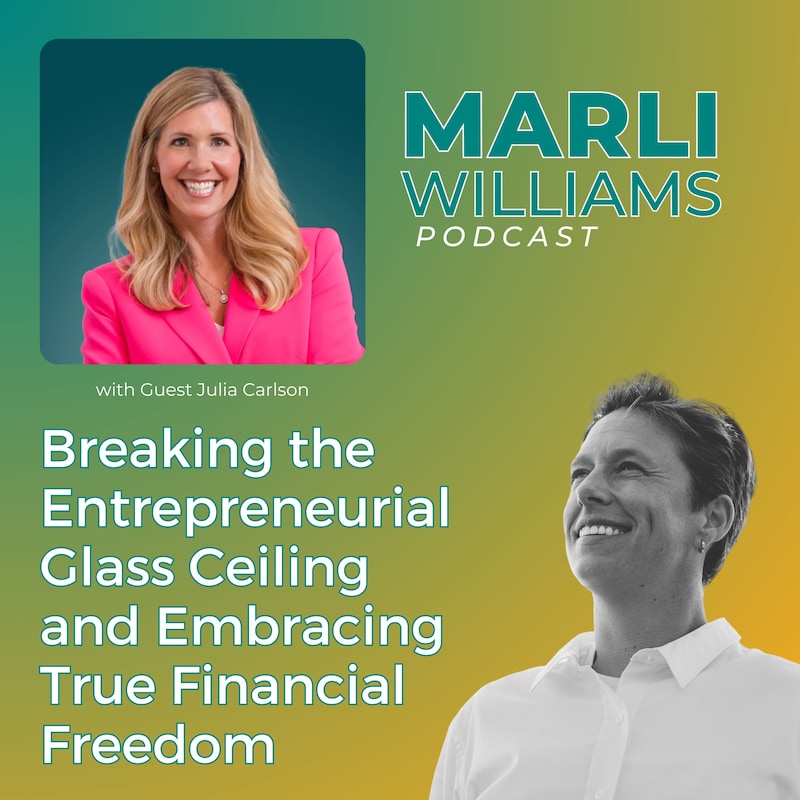
Ever felt trapped by your own beliefs around money and entrepreneurship? In this episode of the Marli Williams Podcast, Marli Williams sits down with Julia Carlson, CEO of Financial Freedom Wealth Management Group, to spark a powerful conversation on breaking through your inner glass ceiling. Curious about how to move beyond “toxic hustle” and scale your business without burning out? They explore the entrepreneurial spiral, the importance of self-awareness, and why evolving your mindset is just as vital as having a killer business strategy. Plus, you’ll hear about Julia Carlson’s unique approach to budgeting—hint: it’s not what you think. If you’re ready to rethink success, sharpen your financial management, and discover what it really takes to step into your next level as a leader, this is a must-listen.
Julia Carlson is an 8-figure entrepreneur, bestselling author, and sought-after keynote speaker who has spent more than two decades building and scaling businesses with freedom and purpose. Recognized as an award-winning leader in financial services, Julia activates entrepreneurs to grow beyond the hustle and step into harmony, showing them how to scale smarter, live freer, and make a lasting impact.
She is the author of two transformative books. Her first book, Money Loves You, reveals how to transform your relationship with money to grow wealth, offering a holistic and practical approach that challenges conventional financial norms. Her upcoming one, Let’s Get YOU Fired, is more than a business playbook, it’s a movement. It's a call for entrepreneurs to fire themselves from the hustle, step into visionary leadership, and scale to 8 figures with freedom and generosity.
Through her Fire Yourself Framework and Entrepreneurial Spiral™, Julia equips and guides business owners with tools to shatter mental glass ceilings, build companies that thrive without their constant presence, and live their legacy. Her mission is bold: to help 1,000 entrepreneurs scale to 8 figures while giving $1 million each to causes they care about—fueling a $1 billion movement for good.
With her down-to-earth style and proven track record, Julia has become a trusted voice for those ready to redefine success and wealth. When she’s not on stage or working with her clients, you’ll find her adventuring with her husband and three kids, traveling the world, and giving generously to causes closest to her heart.
Learn more at www.thejuliacarlson.com and www.financialfreedomwmg.com
Marli Williams is an international keynote speaker, master facilitator, and joy instigator who has worked with organizations such as Nike, United Way, Doordash, along with many colleges and schools across the United States. She first fell in love with transformational leadership as a camp counselor when she was 19 years old. After getting two degrees and 15 years of leadership training, Marli decided to give herself permission to be the “Professional Camp Counselor” she knew she was born to be. Now she helps incredible people and organizations stop waiting for permission and start taking bold action to be the leaders and changemakers they’ve always wanted to be through the power of play and cultivating joy everyday. She loves helping people go from stuck to STOKED and actually created her own deck of inspirational messages called StokeQuotes™ which was then followed by The Connect Deck™ to inspire more meaningful conversations. Her ultimate mission in the world is to help others say YES to themselves and their big crazy dreams (while having fun doing it!) To learn more about Marli’s work go to www.marliwilliams.com and follow her on Instagram @marliwilliams
Stay Connected to The Marli Williams Podcast
Follow us on Instagram: @marliwilliams
Our Website: www.podcast.marliwilliams.com
Hire Marli to Speak at your next event, conference, workshop or retreat!
Really love the podcast and want to share it??
Give us a review on your favorite platform and share this (or any) episode with a friend.
Let's Lead Together and reach more people - we appreciate your support!!
Transcripts
We feel it is important to make our podcast transcripts available for accessibility. We use quality artificial intelligence tools to make it possible for us to provide this resource to our audience. We do have human eyes reviewing this, but they will rarely be 100% accurate. We appreciate your patience with the occasional errors you will find in our transcriptions. If you find an error in our transcription, or if you would like to use a quote, or verify what was said, please feel free to reach out to us at [email protected].
Julia Carlson [:When you're inside the jar, you can't read the label when you're inside the jar. And so 90% of our beliefs every day are subconscious. So it's like you have to get in there and mind that subconscious and figure out what are the beliefs that are keeping me from doing something different.
Marli Williams [:Hey, everyone, what's happening? I am super stoked to welcome you to the Marli Williams Podcast, where we will explore authentic leadership, transformational facilitation, and how to create epic experiences for your audiences every single time. I am your host, Marli Williams, bringing you thought provoking insights, expert interviews, and actionable strategies to unlock your potential as a leader, facilitator, and speaker. Thank you for joining me on this journey of growth, transformation, and impact. Let's lead together. The Marli Williams Podcast begins now. Let's dive in. Well, hey, everybody, what is happening? I'd love to welcome you back to the Marli Williams Podcast, where this week we're talking about money with Julia Carlson. Welcome to the show, my friend.
Julia Carlson [:Thank you. I'm so happy to be here. Marli.
Marli Williams [:Oh, my gosh. I am so stoked to have you as an entrepreneur. Someone who's worked for myself for the past 10 years. I think that money can be amazing and it can be one of the biggest challenges that we have to build our businesses, to grow our businesses, which is what you're really known for, right? How do we scale these things without sabotaging ourselves, without sacrificing ourselves? So I would love for you to just maybe, as we begin this conversation, to give people a little bit of a. A taste of who you are and the journey that brought you to, you know, being the CEO of Financial Freedom Wealth Management Group and really getting to support incredible entrepreneurs around, scaling these businesses and like, taking it to a whole another level that maybe they didn't even know was possible.
Julia Carlson [:Yeah, I love that. Because where I'm at, I didn't know it was possible. So it is possible.
Marli Williams [:It is possible.
Julia Carlson [:And first, I want to say congratulations on 10 years of being an entrepreneur. So that's amazing.
Marli Williams [:10 years. I know it's wild to think about. Every single dollar that has come into my bank account over the past 10 years was something that I. I created. I have not received a paycheck from a salaried position for 10 years. And it is wild to think about. And I'm like, okay.
Julia Carlson [:And that is success. So congratulations, because most entrepreneurs don't make it that long.
Marli Williams [:Yeah.
Julia Carlson [:It is a ride.
Marli Williams [:It's a journey.
Julia Carlson [:Yeah. So to share a little Bit about my background. I grew up in a household that money was talked about. And now after a almost 30 year career in the money business, I realized how rare that was. And so my first job was at McDonald's making $5 an hour. And my dad sat me down and was like, okay, you need to save and you need to invest. And he helped me open up my very first mutual fund with 25.
Marli Williams [:Wow.
Julia Carlson [:And I don't think there's been a month since then that I haven't invested. It just like instilled this habit in me.
Marli Williams [:Yeah. That's incredible.
Julia Carlson [:Yeah, it's. It is a huge gift that my parents gave me that I don't think I appreciated until way later in life.
Marli Williams [:Mm.
Julia Carlson [:Yeah. And so, you know, from there I started working at a local bank. So I always was drawn to investments in finance and money. I was licensed as a financial advisor basically when I was 20 years old. So before I could legally drink. Wow. And then at 23, I. I found the glass ceiling of the bank and I went to my.
Julia Carlson [:The branch manager and I'm like, I'm ready to be an advisor. And they said, great, as soon as the advisor you support leaves, you can have that position. Which would have been 10 years later because I'm in a very rural town on the Oregon coast. So at 23, I left the bank and started what is now Financial Freedom Wealth Management Group.
Marli Williams [:Amazing. That is incredible.
Julia Carlson [:Yeah, that's. That's the short story, but it comes with a lot of ups and downs of that entrepreneur roller coaster. And I. No regrets, but I've learned a lot. And now my passion is coming and helping other entrepreneurs, like, not only from a money angle and helping them with their finances, but also from a strategy perspective and how to scale and grow a company. Because they're both two different things.
Marli Williams [:Yeah. And we're going to dive into both today because I think that, again, I think entrepreneurs tend to. They start a business because they have a passion for helping people in some capacity. Typically, like a lot of folks that are listening to this and they're not coming in with like a degree in business or economics or financial planning or financial advice, you know, all of these things that we have to learn as we go on the fly. And yet, like you said at the beginning, it's like a lot of businesses don't succeed because we don't maybe have this knowledge or have this education. And so I am curious. You said I've learned a lot along the way and I would love for you to just maybe start with like, what are some of the. The lessons you learned that you now use with the entrepreneurs you work with From.
Marli Williams [:Again, it sounds like there's both this. There's a strategy piece to the puzzle around our money and our finances, but then there's this, like a scaling piece and taking it to the next level.
Julia Carlson [:Yeah. So two different. There's a framework for how businesses grow and scale that I've developed, but then also it's who we become as an entrepreneur that's honestly, like, the best gift of all. Like, yes, I'm financially independent. Yes, I've done all these things, but who I've become in the process of that is the most powerful. And I call that the entrepreneurial spiral. Right. Like, we don't grow in a straight line.
Julia Carlson [:We come back around. We have to learn lessons more than once. We have to grow and evolve and plateau and evolve some more and reflect. Like, all of that, which is a really. I think as entrepreneurs, we're wired a little crazy. We're wired to want to go for something bigger and take the risk. And so I think in that you become who you're supposed to be in that process. So for me, I feel like it's just really purposeful in going through all of those journeys on your road of being an entrepreneur.
Marli Williams [:Yeah, I love that question. Right. Like, who do you get to become along the way and how do we grow? And, you know, I really think that, like, building a business is this, like, invitation to expand, to evolve, to really understand, like, that becoming process. And sometimes we think it's going to be again, like, this linear path from point A to point B. It's going to be this very straightforward thing. And it's like, it goes up, it goes down. There's plateaus, there's lessons that we. We learn along the way.
Marli Williams [:And I think it's important for wherever people are at who are listening to this is to not make yourself wrong. Wherever you're at.
Julia Carlson [:Yeah. Especially when it comes to money, because there's so much shame and guilt and regret in money in past money stories, like, none of us are perfect with our money. And so I think it's really important that there is no judgment, there is no shame. And it's just like, it's just a lesson. Hey, I. I learned from that failure. Now I'm going to move forward and do things better. And I think then the framework that you put on top of that entrepreneurial spiral is then, like, the stages of business.
Julia Carlson [:So I don't know about you, but the first couple years in business was like, super hustle for me. I was. I stayed in that stage way too long, and I actually got my identity tied into doing and the success and the achievements. And so when I wasn't doing, I felt guilt. And so for me, I was, like, in this rat race of, like, yes, being very successful on the outside, but. But feeling like it was never enough on the inside. And I call that toxic hustle. So there's good hustle.
Julia Carlson [:Yeah. You're going to work all the time. You leave your day job, a secure day job, and now you have a 247 job as a business owner. There's some healthy hustle. But also what I have found in working with entrepreneurs is sometimes there can be some toxicity in that, some burnout, some overwhelm, some just like, you're working all the time to try to make it, and it's just not healthy. Often your body will burn out. Your body will tell you you're working too hard. So it's just like, where I come in, in helping my entrepreneurs is usually they are at the end of the hustle, which I have found is typically like half a million to a million in revenue.
Julia Carlson [:So it's like they may have four or five team members or employees or independent contractors. They're feeling successful, they're making good money, but they're just at the end of themselves. And what I always like to say, what gets you to a million in revenue are the exact same things that will hold you back on your way to 10 million in revenue. It's a mind game.
Marli Williams [:Yeah, that's. That is a mindset. I am so curious. Yeah, like the mindset shift that you help people navigate. Because again, kind of that quote of like, what got you here won't get you there. Of you have done so much up to this point to build a business that, you know, some people listening to this, they're like, oh, my God, I would. It would be amazing to be making a half a million dollars in my business. You know, you're.
Marli Williams [:And you're like, so today it's like, I think the invitation is just to blow even our own expectations of what's possible. And defining like, well, what does success look like for you too? And how important it is to know what that is?
Julia Carlson [:And you could even take that down to, like, okay, I'm just reaching six figures. Like, I'm just coming up on a hundred thousand in revenue. And now, oh, to get to 500, I'm gonna have to do things differently. I can't do it all by Myself. And so the concept, the actual. The name of my new book is called let's get you fired. And the whole idea is that you can't do it by yourself. Like, I am who I am.
Julia Carlson [:I've built what I've built because of my team, because of the people that have surrounded me, because of my mentors and guides and coaches that I've invested in. And so it's. I think it's just really important that it's like, at whatever level you're at, the things that get you to one level are probably going to. You have to evolve from. You have to go up that spiral. Right. And get to that next level.
Marli Williams [:Yeah, I think that piece, you know, as someone who has been a solopreneur for 10 years, it's like, I've dabbled in, like, hiring people, and then I realized, like, ooh, I'm not great at managing them and I don't know how to do this. I'm like, bye, I'll just do it myself. And I know that I am holding myself back 100%. We can even do, like a mini case study. It's like, all right, let's go. You know, it's like real time, real life coaching here. Because I think that it's like, no one can do it as good as me. What are all of the barriers that block people and stop people right from, like, letting go of this? Like, I need to do it all myself and realizing, like, if I keep doing it all myself, I'm not actually going to be able to grow and be able to scale.
Marli Williams [:And how do you help people shift that mindset and, like, get to a place where is it skills that they learn again? I've, like, I've tried to hire people. It hasn't worked out. And then I've just given up on that. And I'm like, okay, well, here's where I'm at. And then I guess I'm going to just be here forever.
Julia Carlson [:Well, I have found founding entrepreneurs are not the best managers. Like, I am really bad at managing people. I just assume that they're going to do work like me. I have 23 employees. I have one direct report. So I have someone, and number two, I call him that is in charge of all of the team. And I can then be more in that visionary role. But how do you do that when you're growing from 1:1 to 2? So the advice I would say is when I was going from one to two to three, I was still holding on to all of the outcomes in My business, which meant that I was a drive by delegator.
Julia Carlson [:I'd be saying, okay, can you do this? Can you call this person? Can you make this trade? Can you do this email? I still owned it all. For as you grow, you have to actually think about bringing in people that are aligned with your vision, that see where you're going, that have the same core values as, and then actually give them ownership over different parts of your business. So instead of saying, hey, schedule this person for next Tuesday, you could say, hey, Jessica is in charge of my schedule. I'm going to have her reach out to you and schedule something. So that way someone owns a whole project, a whole end result, a whole piece of your business, where their job, their reward, their income, all of that is dependent on them doing a really good job, owning that end result. So we call it like owning outcomes versus delegating tasks. It's a big shift as you grow, like, then it becomes, okay, someone's in charge of marketing, someone's in charge of finance, someone's in charge of operations. And that's normally not the entrepreneur.
Marli Williams [:Yeah. And it's like again, realizing like, what are the things that only you can do and realizing there are other people that like doing those other things that you hate doing. Right. And it's like I think sometimes we can get in that toxic hustle because we're trying to do all of the things and some of those really can be like so energetically draining and depleting and, and they're taking time and energy away from like you sharing your gifts with people in the way that like lights you up and energizes you and fuels you.
Julia Carlson [:Yeah. There's a whole like a hustle audit that I have a tool in the, in the book that's exactly that. Exactly. Helping you identify what's your superpower and how you should be operating in that. And oh, by the way, that's going to change over time as you grow, as you evolve. So you have to keep revisiting that as you level up. And I like to say, fire yourself from areas of your business to then take you to the next level.
Marli Williams [:Yeah, I love an assessment where it's like, okay, we gotta check ourselves. Right? And be like, okay, what, what are the behaviors? What am I doing that may not be working anymore?
Julia Carlson [:Yeah. And that simple self awareness. You will start self correcting. Like if you write down everything I'm doing in A, in 15 minute increments. Yeah. It's a pain in the butt to do. But if you do that you're like, you'll start self correcting, you'll know, Be like, okay, I do not need to be doing this activity. I can have someone else help me with that.
Marli Williams [:Yeah, 100%. So I'm curious when you work with business owners who I'm guessing service based, product based, you do all of it?
Julia Carlson [:Yeah, primarily. It does seem that more that come to me is, is service based, but yeah, or like an online coaching program or coursework or a publishing house or. I'm just thinking of, we do have a hospitality company. So it's like, it is a mix. It's getting broader, but they do seem to be service based businesses.
Marli Williams [:I'd be so curious again because a lot of people listening, they're, they're coaches, they're speakers for me. I'm like, I'm kind of like a personal brand with like, okay, I'm selling speaking. Right. You're like, well, how do I scale that? Or you know, if we're doing coaching programs that are live or whatever. Right.
Marli Williams [:So it's like, it can be hard to think about like that what's possible and breaking through. And you said something earlier that I think is powerful, like, where are we limiting ourselves and what we believe is possible and creating our own internal glass ceilings? Where do you see people, you know, again from like the mindset piece, there's, there's the strategy, but the mindset of like, what could I build? What could I create as a thought leader, personal brand, someone who has a message on my heart to share? What do you wish people like could see that maybe they don't always see in this journey of kind of moving from that hustle space or you know, maybe like the six figures to a half a million. You know, again, there's, there's steps along that journey. But where do people, you know, again from a mindset and strategy perspective kind of limit themselves in what's possible?
Julia Carlson [:Okay. The first thing that comes to mind is like for me, my own experience, I'm from a very small town. Like the population is 2,000. My office is in Newport where there's 10,000 people. And for probably 10 years, my mindset was, oh, I'm never going to be able to build a big business here because the population is so small. And fast forward now and we are in the top 1% of the nation. And so it was that mindset of I have to get out of the box and think differently, think strategically. It's like that, I love that quote.
Julia Carlson [:It's like when you're inside the Jar. You can't read the label when you're inside the jar. And so our beliefs are so internal, our subconscious that it's like you have, they're 90% of our beliefs every day are subconscious. So it's like you have to get in there and mine that subconscious and figure out what are the beliefs that are keeping me from doing something different. And so I think getting into communities, having mentors, having coaches that are challenging your beliefs, I think is so powerful. I mean, I think, you know, even what I've learned from you, Marli, in the speaking world, it's like, oh, I have to think about this totally differently from how I once was thinking about it. And then you start thinking, oh, maybe it's, you know, group programs, maybe it's developing my IP into a process that I'm selling. There's so many ways now that we have opportunity with social, with the Internet, with AI.
Julia Carlson [:It's like it's, there's just so much opportunity. So how do you can I find something and really focus in on one direction?
Marli Williams [:Yeah. And I think it's again, there's beliefs that stop us and there's beliefs that serve us. And I think it's important. Again, going back to that self awareness piece of like, what are the stories that I'm telling myself? You know, and I, and I hear people say it all the time. You know, things like, oh, marketing is hard, or nobody wants to buy this, or people can't afford it, or my retreat is too expensive.
Julia Carlson [:I can't launch during the holidays.
Marli Williams [:Yeah, like, this isn't the right time. And so it's just like, what are the stories that we're telling ourselves about ourselves? And I think that, you know, like believing in our work so fiercely that we're willing to share it and believe in the value that we offer in the marketplace. And I think a lot of people that I've seen either undercharge or undervalue or don't believe in themselves enough to quote, unquote, people say things, I'll charge what you're worth or whatever. Right. Maybe this could be a good question to explore. Is like helping people understand the value of their offering, the value of their service and helping people understand that value and then again, like scale it. Because sometimes the value is in like the intimacy. Oh, it's valuable because it's a small group of people.
Marli Williams [:But how am I going to deliver this if there's a hundred people in this group, if there's 200 people in this group and then again we like limit or we cap what's possible or who we can impact because of a belief around what the value is, you know?
Julia Carlson [:Yeah, absolutely. And it's also like, for me, I think about what is the transformation that I'm going to deliver to them and thinking about the value of that. And so, I mean, there's lots of different ways to look at it. Number one, though, it's like, what is the cost of doing business? What is your hourly rate? Like, what are the costs that you have in your business? I mean, a lot of my work, when we do a deep dive with an entrepreneur, is looking at their profit margins and understanding the cost to serve their clients. And even that we're finding people are way undercharging themselves. I think it comes down to their money story. Like, once they can understand what is their beliefs about money and either healing that or understanding where that's like helping them connect the dots. And I think that's so powerful when people can connect the dots of how they're thinking that way.
Julia Carlson [:That's that awareness and then they can understand, hey, that's brought me to here, that served me in this way. This is the gift of that. But now I'm moving here. It takes a lot of courage to say, I'm charging a thousand dollars an hour, like, this is my value. Or like, Speaking, I want $15,000 for this engagement. But also, people respect those boundaries. You know that you're going to show up as your best self, and the audience is going to expect that. And so that's where that value exchange happens.
Julia Carlson [:So if you're showing up, hey, I'll do this, you know, I'll give you this deal energetically. It's not going to be a match. And so you need that scary number to say, oh, I got to show up as my best self to charge this amount and rise to that occasion.
Marli Williams [:You know, it's like you both have skin in the game because it's like they want to get the value out of it, and you want to deliver the value and create that transformation. And it's like, I think that exchange is what creates that transformation. And I think it's like, what's a number that feels edgy and stretchy? And then how do we keep pushing our own boundaries of what we believe is possible? Right? Like, when I first started, speaking of out the gate, you know, I was charging 2500 bucks, and at that moment in time, I was like, that's how much I pretty much made in a month. I made like three grand a month. At that point. And so in my head, that was wild. Like, I had no idea that that could be even possible. And then what happened was I remember asking my speaking coach at the time, I was like, when am I going to believe that I'm worth 2,500 bucks or something like that? And he's like, when you ask for it and they say, yes.
Julia Carlson [:Absolutely.
Marli Williams [:And when, how much is it? 2,500. And then they said yes. It's like, okay. And that sense of like, oh my gosh, I don't want to disappoint them, or like, I don't want to let them down. Or like, from a good perspective of like, I want to deliver. And some of my first speeches and presentations were not the best. And had I come out the gate saying I'm a $15,000 speaker, it was like I would have blowed out my nervous system or whatever, right? It's like it would have been like completely out of alignment and completely out of integrity. I think it's just like letting you.
Marli Williams [:It's like sometimes I just say like, say a number out loud. See how it feels like, you know, I'm like some. I say, who would you need to be in order to receive a check for $5,000 to give an hour long keynote? Noticing, like, how does that feel in your body and your nervous system? Like, are you like, okay, I'm here, I'm ready, I'm open to receiving that and like playing with that number. Okay, well, how does 3,000 feel? How does 2,500 feel? What about 10?
Julia Carlson [:Yeah, and I think you have to earn the right. So it's like you can't come out of the gates just saying, Hey, 15,000. No, it's like it's again, who you become in earning that money and stepping into your worth and delivering it in a way that is transformational for the audience. Everyone has to start somewhere, but you just gotta start. You just gotta go for it.
Marli Williams [:You just gotta start. Yeah, there's a great ebook out there that I don't know if people Google it, they can find it, but it's called Breaking the time Barrier. And it's actually about getting out of the mindset of like hour for dollar mentality. Especially when it comes to like a service based business or even like a keynote speaker. Someone could say, oh, 15,000 for one hour or one day or something like that. And it's like really what it was saying was like, they're paying for 40 years of every book you've read, every training you've Gone to everything that you've learned, who you have become, in order to get on stage and deliver a powerful message. And I've heard people say, too, you know, especially at bigger conferences, they're like, they spend more than $15,000 just on coffee. You're not that big of a deal.
Julia Carlson [:Not for these bigger budgets. No way.
Marli Williams [:For the bigger budget, you know, for the bigger events. Right. They're like, you know, and there are some Mel Robbins, what, she charges like $300,000 or something for a keynote now?
Julia Carlson [:Well, you think about the time, right? Meaning the, like, there's only one Marli. Right. And so you can only go. The value is only going to go up as you hone your craft and your messaging and your expertise, all of that. Right. And so, you know, on one hand, it's like, you do have to charge a lot because you only have so much time in the day.
Marli Williams [:Yeah. One of the jokes that I make sometimes is like, the speaking's free, but you have to pay for my travel because, you know, people, it's like, I have to. If I have to get on a plane and pack my bag and have someone watch my dog and like, you know, I'm gone away from home for three, you know, two or three days, I'm not able to speak other places or deliver other work or whatever. Right. So, like, there is a. There is a value to that. And I appreciate what you said, too, is, again, it's not the hour for a dollar, but it's really like, what is the transformation that you deliver for your client? And really, that's what they're paying for. Instead of like, oh, charge what you're worth.
Marli Williams [:It's like, can I really understand the impact that my coaching or speaking has on a team, a business, a company, an organization? And understanding that piece of the puzzle, I think is so important. You mentioned something earlier that I'm like, I want to know more about. I'm super curious about this thing in your book that you call the anti budget, because everybody talks about budget, budget, budget, budget, but there's an anti budget. I want to know what that's all about.
Julia Carlson [:Okay, well, this isn't my first book that's out there now. You can. You can get it on Amazon called Money loves you. Yes. So this is all about our personal relationship with money. We all have to have a relationship with money, so why not make it a great one? And so the idea of budgeting, or, hey, I'm going to restrict my spending, which basically is how people interpret that word. It's Just like. Just like the energy of that is no fun.
Julia Carlson [:And this is basically out of, like, 15 years of the way that I've done money or with me and my partner. But we know about how much money is flowing in every month. And if you're an entrepreneur, that changes all the time. But yet we know money's coming in and we know what we love to do. Like, everyone is going to spend money on what they value, right? Which is probably a housing of some sort. It's probably cell phones. It's probably a car. Like, we all get to spend money on things that make us happier.
Julia Carlson [:And so the way I like to think about spending money is maybe looking back and say, okay, over the last month, look at your credit card statement, look at your bank statement, and what did you spend money on? Did it bring you joy? Did it bring you comfort? Or are you looking at anything and saying, I don't even remember what that was for? Which happens to be a lot like, oh, I probably ate out way too much, or I went to Target, and I don't even remember what I spent money on. And so the way I like to teach it is, hey, everyone, you get to spend the money the way. It's like freedom and how you spend money. But freedom comes from discipline and discipline in spending money on things that make you happy. So that's how it's like, let's put money towards those things that you do value. And my hope is that the future you, the future you that wants financial independence, that wants financial freedom, is in that priority bucket of what you're spending money on.
Marli Williams [:I love that. Looking back and asking that question, I think is so powerful because sometimes we spend so mindlessly at times, right? If we don't have a budget. And like myself, I was like, I don't want to have a budget like I want. I'm an entrepreneur because I love freedom, right? And it's like, don't tell me what to do or what I can spend my money on or cancel my money on. But recognizing like, oh, what were those moments or those things that brought me joy? And am I spending money in alignment with my values and what matters to me? You know, and some people really value. It's like, I value personal growth. And if you look at, like, how much I spend on that or building my business or travel or, you know, you know, going out to meals with friends or whatever it is, and it's like, okay, tracking that. And are you.
Marli Williams [:Is it that in alignment?
Julia Carlson [:Yeah. And the awareness of the joy of that, right? As opposed to being something of, like, that's something you have to do, right?
Marli Williams [:Yeah. And even, like, the joy. And I've heard this too, about, like, paying your bills. Like, you mentioned, like, housing. It's like, oh, when we pay or mortgage or a rent or whatever, or utilities, it's like, oh, my gosh, I'm so happy and grateful that I have this beautiful home that I get to live in. And that, like, I feel warm and I feel cozy and I feel, you know, all of these. It's like gratitude for when we receive it, but also gratitude for, like, spending it on the things that we love. Like, I'm so grateful we got to go on that trip versus going on that trip.
Marli Williams [:And looking back, I'm like, oh, my God, I can't believe we spent all, like, spent this money on this thing. Yeah, it's like, well, we did that because that's something that is important and.
Julia Carlson [:Something I. I share with my entrepreneurial clients is like, you are always your best investment. A lot of financial advisors are be, like, diversify, have all of this. But when you are starting a business and growing a business, like, especially in that hustle, like, go all in on you. Like, it is a time to invest in yourself, invest in your business, and then as that grows and your business goes into different stages, then you can diversify, then you can make other investments. But that first one, to really make a business work, it takes, yeah, a lot of hustle and hard work and passion, but also takes money and resources. And so it's okay to go all in on you.
Marli Williams [:Yeah. Time and time again, every time I invest in myself and, like, it pays off in dividends. And I think that it's. It's important, you know, along the way to, like, you mentioned having coaches, having communities, having people to support you. It can be, you know, again, if you're a solopreneur, working for yourself, like, it can be a lonely road, and we tend to be our own worst enemy when it comes to, like, getting in our own way. And I was just curious. It made me think. I've been in business now for 10 years.
Marli Williams [:What do you think? You know, I think that there are so many people that I. That I meet, that I see, that I work with. They have huge hearts and they're here to make a difference. And the money piece tends to. It's like, they could be the best coach, practitioner, healer, and are still feeling like they're on the struggle bus when it comes to money. You know, I know you work with people kind of that are at like a whole new realm of reality or like they're kind of at this point to scale. But those people that are like, should I, you know, at this point, where should I keep doing this? Why isn't it working? Why is this so hard? Like, this money, you know, it's like, I know I'm good at what I do, but the money part feels like it's in the way. And I'm about to go get a job and say, and give up on my dreams.
Marli Williams [:I just want to speak to that person because I think that there may be people out there listening, that they're like, well, this all sounds great, but how do I actually do this?
Julia Carlson [:Yeah. So I, I would say the first question I would ask, like, are they taking action? Like, for me, it's like, you know, as entrepreneurs, we're, I mean, we're all spiritual beings, but it's like we get a lot of downloads and inspiration. So are we taking action from that inspiration? Because oftentimes if we know we should be doing something and we're not doing it, that's where fear lives. That's where the drudgery, the overwhelm, the stuckness is. So taking imperfect action is the most important thing in the startup phase of a business of you just gotta keep taking action and it doesn't have to be perfect. And it's like course correcting as you go. That would be one thing. And then the other thing I would be, is it a worthiness question? Is it like, are you charging the what you should be charging? Are you discounting? Like, I see so many business owners that are discounting and that becomes like, they're doing that all the time as opposed to keeping the integrity of the business of, this is the value of my services.
Julia Carlson [:If someone asks for a discount, the answer is no. Now, I may go and do pro bono work. I may have a client that I'm helping and not charging, but that's the exception. That's the mission, that's the giving generously piece of it. But for the most part, it's like, are you treating your business like a business and giving it that energy?
Marli Williams [:Yeah, I think it's so important. Right. Like, again, it's like when there's so many people that said, I would just do this for free or like, I would just do that, you know, because it's like my purpose and my calling and my mission and all of these things. And it's like, but that doesn't pay the rent. And like, a lot of people do Trades and like, nothing, you know, if trades are great, but it's like, can you pay your rent or mortgage with a trade? And then like, those are great to do when you have that foundation. And I think that that's so important whether it's a worthiness thing, not giving discounts. And, and, you know, I think it's interesting too, is, you know, when I was newer in coaching and I would say my price and it's like it's this, you know, it's. It's $1700 or something like that.
Marli Williams [:And it's like. And then you. And you get this, and you get this and you get this and it's like. And then we're trying to like, really justify it.
Julia Carlson [:Yeah.
Marli Williams [:Or convince people of the value. It's like we're trying to convince ourself of the value sometimes. And it's like, I heard this one quote one time that I love from a coach that said, get your hands out of other people's pockets. Like, stop making the decision for them in advance. Oh, if you are walking around saying, no one can afford this, guess what? Every call you get on, it's like everything is a mirror.
Julia Carlson [:Yes. Yes. I was just thinking that.
Marli Williams [:Yeah. It's like if you're seeing that it's a reflection of something in you that needs to be maybe nurtured or healed or looked at. And whether it's a worthiness, he's a value. You know, looking at your money stories, I, I love, you know, money loves you. Pick up the book if you got, you know, if you want to change. You know, it's like we have to change our, our beliefs about money and what's possible in order to be able to receive.
Julia Carlson [:Yeah. I mean, giving us stories of possibility and wonder and also too, like, money is just a resource and more good people need money to change the world. And so if you're discounting your stuff or you're not, sometimes I, I go to, you know, like startup entrepreneurs and I go to their social media and I'm like, where's the offer? Are you closed for business? Like, outside looking in? So it's like sometimes we live in our own head so much that we assume we're putting ourselves out there and you have to ask for the business. You have to ask consistently. I mean, I just remember being in my 20s and going, you know, like pounding the pavement and asking for business, and I just got really comfortable with people telling no to me, and that just became a muscle that I had to build. But, you know, now we have social media. We didn't have that back then, but it's like, are you asking enough? Are you following up? Like, that is just. So much of the work in the early stages is planting all of those seeds, knowing at some point they're going to harvest.
Julia Carlson [:Yeah.
Marli Williams [:Building and nurturing those relationships and being willing to. I think being visible is vulnerable, you know, whether that's knocking on doors or posting on social media. And I think sometimes people. You're right. Like, people post one time and they think everybody about their offer or their coaching or their services, and then they think everybody has seen it. And, you know, people need to hear and see stuff now. I mean, with just all of the noise and all of the distractions, like, 15, 20, 30 times, you know, you think about, like, when. When was the last time you bought something on Instagram? How many times of that did you see that ad before you actually click the button and said, okay, Instagram, you got my number.
Julia Carlson [:And to the lost art of phone calls, like picking up and calling people or writing a handwritten note, like, these are all the things that are. Those are easy things that you can do that make you stand out in a very electronic world.
Marli Williams [:Yeah. The power of a personal invitation. Right. People ask me all the time, how do I fill a retreat, invite people? I'm like, no one can hire you or no one can sign up for your retreat unless they know it exists. Unless they know they can. Right. And so, you know, I think that, you know, the invitation today is really. It's like, where.
Marli Williams [:How can we remove the glass ceiling from ourselves? Where are we limiting what's possible? So what would you say, as we bring things home today to help people take that glass ceiling off, experience a new reality around wealth, around abundance, around their money and in their business. And what advice would you give to folks out there listening right now?
Julia Carlson [:What comes to mind is like, trusting yourself. You have this special vision for how you want to help people. And sometimes when we're doing new things, we think the answers are outside of ourselves, but it's like the answers are within. So many times, like, I learn this lesson all the time, and I'm like, I think I have to go hire this person to get the answer or join this program, where really it's like, no, I just need to go for a walk in the woods and, like, see what my inner self is saying and trust that. That feels really important to share. And then also I'll say, like, spend time with your future self. A lot of times we don't connect Emotionally to who we're going to be in the future. There's a visualization exercise I have in my book that is, how do I spend some time through this visualization meditation with my future self and then come back and then be able to make decisions today from that future self? Because that's usually when you look at psychologists and reports, it's like they can't stick to the diet or they can't stick to the plan because they're emotionally not connected to who they're going to be in the future.
Julia Carlson [:And so really get to know her, spend time with her, and visualize and make decisions today from that future self.
Marli Williams [:Yeah, I think that that's so powerful, right? That inner mentor, that future self, that version of you. It's like that believes in the life that you're building. And, you know, it's like, if we don't know where we're going, it's hard to get there. And I think it's putting pen to paper. I think it's so powerful to, like, set intentions of, like, what do you want to make every month? What do you want to bring in annually? Like, what does that look like? And like, I always say, it's like clarity and action are the languages of the universe. Are you clear on what you want, what you're building, what you're creating? And then are you taking action on behalf of that future self and to create a compelling vision for your future that. That moves you, that inspires you? Because there are days where we're not going to feel like it and we're not gonna. You know, it's like, I think sometimes we wait to feel motivated to pick up the phone or make the invitation or make the call.
Marli Williams [:And it's like, motivation is not coming to save you. It's that future self. It's that vision. It's like, and what will that do for you? What will that create for you? Right. So it's not just about the number on the page, but it's like, okay, if I were making that much money a month or a year, how would my life feel? What would be different? What's the most exciting part about that for you? Like, what would light you up? And it's like, are you committed? Like, we get what we're committed to. And sometimes people are committed to their old stories and their old. Because that's what feels safe, you know? So I don't want to make people wrong. It's how our brains are wired.
Marli Williams [:They're wired to keep us safe. And so it's like, if your brain knows I know what it feels like to make $4,000 a month, that feels safe. That feels comfortable. What would it feel like if I made $40,000 a month? That is like, whoa. Yeah.
Julia Carlson [:And you have to, like, that's one thing I do with my entrepreneurs. Like, actually having them write out their monthly income and actually do projections with them to say, okay, if you do this, this is how it's gonna happen. And actually get used to, oh, if I make $100,000 a month, how does that feel? Like, I don't want them to freak out once they get there. I want them to be comfortable.
Marli Williams [:Yeah. 100%. And, like, what is that number for you? What is that like again? Fun, playful, edgy, stretchy number. And for those of you out there listening, information without implementation isn't enough. So I would encourage everybody. Get it a pen. Write it down. Write the number down that comes to your mind, whether it's a monthly number, it's an annual number, whatever.
Marli Williams [:One, like, speaks to your heart and souls. Like, 10k a month. Great work backwards. What do I need to do? Okay, I charge a thousand bucks a month for coaching. Okay, that's 10 clients. Great. Break it down. Set a goal.
Marli Williams [:Break it down. And like, again, take that aligned, inspired action in service of your future self and in service of your dreams and your goals. And I think, again, knowing that it's possible, other people every day are doing it. And so it's like, why not you? And like you said, more people, more good people with money will do good in the world. And, like, there is research behind this.
Julia Carlson [:Yeah. That's the ticket out of this situation we're in. Right? Is more good people doing good things in the world with more money.
Marli Williams [:Yes. So thank you so much, Julia, for sharing your. Your knowledge, your heart, your love, your wisdom with all of us today. And to learn more about Julia, check out her books. Money loves you, and let's get you fired. Is there anywhere else that you want to send people or for them to learn more about you and your work in the world?
Julia Carlson [:Sure. Yeah. My website is thejuliacarlson.com and my favorite social is Instagram. So you can find me @thejuliacarlson, and you can hit me up in the DMs. I'll be there.
Marli Williams [:I love it. Well, thank you so much. And all of you out there who are listening, here's to your success, your financial freedom, your abundance. We're here for you. Seeing you, believing you, supporting you. Let's break that glass ceiling. One step at a time. Thank you, Julia. Appreciate you.
Julia Carlson [:Yeah, thanks for having me.
Marli Williams [:All right, thank you all so much. Take care. Thank you for joining us on another inspiring episode of the Marli Williams Podcast. We hope you're leaving here with renewed energy and valuable insights to fuel your leadership coaching and speaking endeavors. I'd love to invite you to subscribe, rate, and review this podcast to help us reach more aspiring leaders and speakers like you. We have more exciting episodes and remarkable guests lined up, so make sure to tune in next time. Until then, keep leading with purpose, coaching with heart, and speaking with conviction. This is Marli Williams signing off. See you next week.



