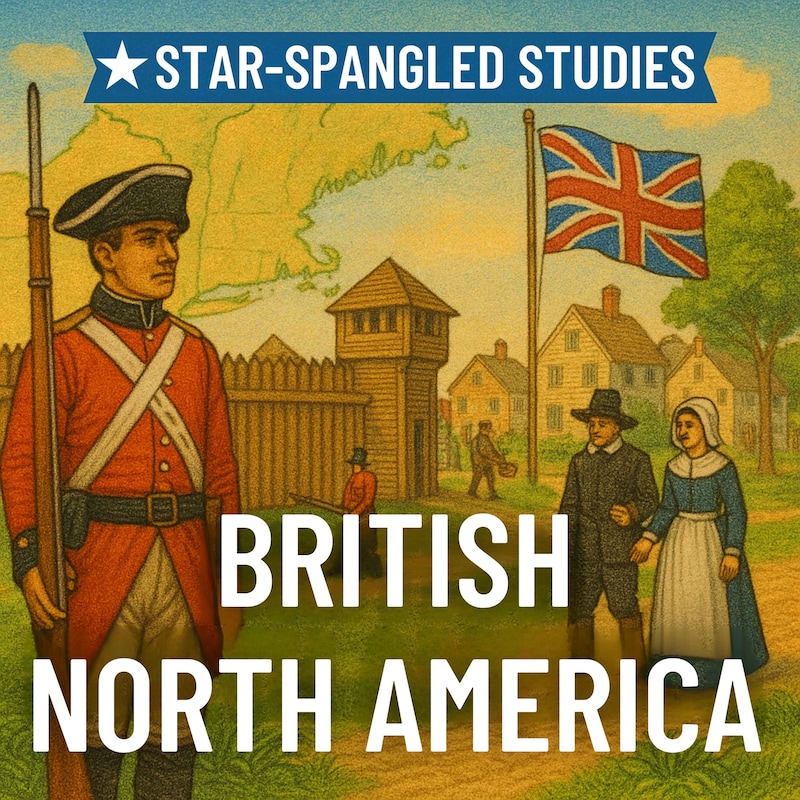
Shownotes
In Episode 3 of Star-Spangled Studies, Dr. G dives into how the English colonies evolved from fragile footholds into brutal slave societies and fierce defenders of liberty. We cover:
- The rise of race-based chattel slavery and the Middle Passage horrors
- Legal codification of hereditary bondage and the invention of “race” in law
- Atlantic-world turmoil: Civil War, Cromwell’s Commonwealth, the Restoration, and the Glorious Revolution
- New proprietary colonies: Carolina’s feudal dreams versus Pennsylvania’s “Holy Experiment"
- King Philip’s War, Bacon’s Rebellion, the Pueblo Revolt, and Salem Witch Trials
- How slavery and liberty emerged side-by-side to forge distinct colonial identities
🔗 Resources & Links
- Instagram: @star_spangled_studies
- Facebook: Star-Spangled Studies Page
Perfect for U.S. history students, educators, and lifelong learners.
Historian Dr. G examines the brutal evolution of race-based slavery, the codification of racial law, and the simultaneous birth of a fierce English-colonial attachment to liberty. From the Middle Passage to King Philip’s War, Bacon’s Rebellion to the Glorious Revolution, discover how conflict and conviction shaped the 17th-century British American world.
Keywords: U.S. History podcast, British North America, race-based slavery, Middle Passage, Bacon’s Rebellion, King Philip’s War, Glorious Revolution, Pennsylvania “Holy Experiment,” Carolina proprietors
Transcripts
Hello y'all.
2
:It's me.
3
:It's me.
4
:It's Dr.
5
:G, and welcome back to
Star-Spangled Studies.
6
:Last time we watched as Spain's
rivals, the French, the Dutch,
7
:and finally the English.
8
:Jump into the race for
colonies in the Americas.
9
:We saw how their different goals created
radically different colonial societies.
10
:The French built a vast trading
empire based on mostly partnership.
11
:With Native Americans in what was been
termed the middle ground, the Dutch
12
:created a bustling tolerant commercial
hub in New Amsterdam, and the English
13
:planted two very different colonial seeds.
14
:A profit, hungry, chaotic settlement
in Jamestown, as well as a rigid
15
:religious city on a hill in New England.
16
:But these were just the beginnings.
17
:The 17th century was an era
of violent, chaotic growth on
18
:both sides of the Atlantic.
19
:The English colonies were
not isolated outposts.
20
:They were deeply entangled in these
larger Atlantic world issues, and they
21
:were rocked by turmoil in both the mother
country as well as those within their
22
:own internal conflicts in the Americas.
23
:This was a century when the vague labor
arrangements of the early colonies.
24
:Hardened into the brutal race-based
chattel slavery that would define
25
:America for centuries to come.
26
:It was a century of riot, rebellion
and revolt as colonists fought with
27
:Native Americans with their governors.
28
:I.
29
:And with each other.
30
:So today we're diving into that
chaotic century and we're going to ask
31
:simple questions with complex answers.
32
:How did the English colonies mature
from desperate footholds into
33
:complex and violent societies?
34
:How did two of the most consequential
forces in US history, race-based
35
:slavery and a fierce attachment
to liberty, develop side by side?
36
:This is the story of
British North America.
37
:I.
38
:How it was forged in that fire.
39
:So let's go.
40
:Do you understand the
story of the United States?
41
:We have to understand the
story of United States slavery.
42
:But it didn't arrive fully formed.
43
:Slavery wasn't the same
throughout its entire history.
44
:In the early 17th century, the line
between an indentured servant and an
45
:enslaved person could often be blurry.
46
:They were both unfree
laborers, both could be bought.
47
:Sold.
48
:But over the course of the 16 hundreds
and especially after:
49
:leaders began to deliberately create
a new legal and social category.
50
:One that was permanent, one that was
hereditary, and one that was based
51
:on one thing and one thing only race.
52
:The demand for labor, especially for
the profitable tobacco and later rice
53
:and indigo plantations of the South
was insatiable when colonists enslaved
54
:thousands of Native Americans, often
as a direct result of wars like the
55
:Pequot War in Kings Phillips War, which
we'll get into the plantation economy.
56
:Had not survived, and soon it
had to turn to a different labor
57
:source, and this turned out to
be the transatlantic slave trade.
58
:The journey across the Atlantic,
the middle passage, was a horror
59
:of unimaginable proportions.
60
:We are fortunate in the grim sense to
have the words of those who survived
61
:it so we could fully understand it and
hear it in all its grotesque horror.
62
:Laa Ano, who is kidnapped from his
home in West Africa as a boy, published
63
:his narrative of this capture in 1789.
64
:His first sight of a slave ship captures
the terror of that moment, quote.
65
:The first object, which saluted my eyes
when I arrived on the coast was the sea.
66
:And a slave ship, which was then riding
at anchor and waiting for its cargo.
67
:These filled me with astonishment,
which was soon converted into terror.
68
:When I was carried on board, I was
immediately handled and tossed up to
69
:see if I were sound by some of the crew.
70
:And I was now persuaded that I had
gotten into a world of bad spirits
71
:and they were going to kill me.
72
:The conditions were even worse
when you went below deck.
73
:Alexander Falcon Bridge, a
surgeon who worked on slave
74
:ships, described the scene there.
75
:The men Negroes on being brought
aboard the ship were immediately
76
:fastened together two by two
by handcuffs on their wrists.
77
:By irons riveted on their legs.
78
:They are then sent down between the
decks and placed in an apartment
79
:partitioned off for that purpose.
80
:The deck that is the floor of their
rooms was so covered with the blood
81
:and mucus, which had proceeded from
them in consequence of the flux
82
:that it resembled a slaughterhouse
83
:between 1526 and 1867.
84
:An estimated 12.5
85
:million Africans were forced
onto ships like these.
86
:Roughly 10.7
87
:million survived while the vast
majority were taken to Brazil and
88
:to the islands of the Caribbean.
89
:Roughly 450,000 landed in British
North America with Charleston,
90
:South Carolina becoming the leading
entry point on the mainland.
91
:As the number of enslaved Africans
grew, colonial leaders, particularly
92
:in Virginia, faced a problem.
93
:How could they justify a system
of permanent hereditary bondage
94
:in a society that was supposedly
built on English liberties?
95
:Their solution was to invent a new logic.
96
:The logic of race.
97
:Write it into law.
98
:The 1660s then wass a critical
turning point in this evolution.
99
:Before 1660, an enslaved person
who converted to Christianity might
100
:be able to sue for their freedom.
101
:But in 1667, the Virginia Assembly slammed
the door on that loophole, passing a law
102
:that declared, quote, the conferring of
baptism doth not alter the condition.
103
:Of the person as to his
bondage or freedom end quote.
104
:Perhaps the most significant and
devastating legal innovation came
105
:in 1662 in English common law.
106
:A child status followed that of the
father, but this created a problem
107
:for slave holders who fathered
children with their enslaved women.
108
:Would these children be free?
109
:The Virginia Assembly provided a chilling
answer quote, whereas some doubts
110
:have arisen whether children got by.
111
:An English man upon a Negro woman
should be slave or free, be it therefore
112
:enacted and declared by this present
grand assembly that all children
113
:born in this country shall be held
bond or free only according to the
114
:condition of the mother end quote.
115
:This act was revolutionary.
116
:It overturned centuries of English
precedent and made slavery A
117
:hereditary condition passed down
through the maternal line, no longer
118
:taking the status of one's father.
119
:It also then legally incentivized the
rape of enslaved women by their masters as
120
:their children would become more property,
more capital in their households.
121
:Over the next few decades, a web of
laws was spun to create what historian
122
:Ira Berlin calls a slave society.
123
:And this is important because
the United States after the:
124
:turns into a slave society rather
than just a society with slaves.
125
:In 1643, law made African women typable
or taxable, associating their labor with
126
:hard agricultural work and distinguishing
them from white women who were ideally
127
:confined to the domestic sphere.
128
:1669 law declared that if a slave died
while resisting his master, the master
129
:could not be charged with a felony.
130
:By 1705, Virginia Law explicitly
stated that all negro mulatto and
131
:Indian slaves shall be held, taken,
and ajudicated to be real estate.
132
:End quote.
133
:Essentially, they were now by 1705.
134
:Property.
135
:This is a crucial point for
us as students of history.
136
:Race, as we understand it
is not a biological reality.
137
:As this sh has shown, and I've
only shown you a few of the
138
:laws, there were many more.
139
:It was a social idea, law after
law, continuing to codify.
140
:What was a slave and what was not?
141
:What was considered black and
what was considered white.
142
:And here in these Colonial court
records, we can watch it being
143
:constructed brick by brick as one source.
144
:Notes quote, race was never
just a matter of how you look.
145
:It was about how people assign meaning.
146
:To how you look in 17th century
Virginia, the planter class assigned
147
:a devastating meaning to stem color,
to justify exploitation, and create
148
:a permanent enslaved labor force.
149
:While the colonies were forging
these new brutal social orders,
150
:the mother country descended into
chaos for much of the 16 hundreds.
151
:England was racked by intense
political and religious conflict.
152
:Starting in the 1640s, a bloody civil war
erupted between the forces of Parliament
153
:and King Charles, the first, who was seen
by many radical Protestants or Puritans as
154
:being far too sympathetic to Catholicism.
155
:The colonies reacted in different
ways, Virginia and Maryland, with
156
:their Anglican planter elites.
157
:Tended to sympathize with the crown,
the fiercely Puritan Massachusetts
158
:Bay, on the other hand, favored the
parliament, but for the most part,
159
:the colonies tried to remain neutral,
hoping to avoid being drawn into the
160
:conflict on the other side of the ocean.
161
:That all changed in 1649 when
Parliament did the unthinkable.
162
:They executed the King England
was declared a republic a
163
:commonwealth under the rule of the
Puritan General Oliver Cromwell.
164
:Suddenly the colonies could no
longer stay on the sidelines.
165
:Parliament arguing that the colonies
were quote, planted at the cost and
166
:settled by the English nation end quote,
demanded their allegiance to a force.
167
:Its will it passed the
Navigation Act of:
168
:This powerful piece of legislation
mandated that all goods shipped
169
:to and from the colonies must be
transported on English ships and
170
:that valuable enumerated, as they
called them, goods like tobacco
171
:and sugar, could only be shipped to
England or to another English colony.
172
:This was a direct shot at the
economies of the Dutch particularly.
173
:England's chief commercial rival,
and it was the first major step in a
174
:long process of tightening imperial
control over the colonial economies.
175
:Now the monarchy was restored in 1660
with King Charles ii, but the turmoil
176
:was far from over Charles II and his
brother, who would later succeed him.
177
:James II continued to tighten
the screws on the colonies.
178
:They passed more navigation
acts and created new bodies.
179
:Like the Lords of trade and plantations
to oversee colonial affairs.
180
:James II was an open and devout Catholic,
and particularly feared by his Protestant
181
:subjects in both England and the Americas.
182
:He took the Jurassic step of
consolidating the Northern Colonies,
183
:Massachusetts, Connecticut, Rhode
Island, New Hampshire, New York, and
184
:New Jersey into a single mega colony.
185
:Called the Dominion of New England.
186
:He abolished their local assemblies and
placed them under the direct control
187
:of Royal Governor Sir Edmund Andros to
the colonists who had enjoyed a century
188
:of so of significant self-government.
189
:This was an act of tyranny.
190
:And then in 1688 came the news that
sent shock waves across the Atlantic.
191
:A group of English nobles, terrified of
a permanent Catholic dynasty, invited
192
:the Dutch Prince William of Orange, who
married James's Protestant daughter Mary,
193
:to invade England and seize the throne.
194
:This was known as the glorious revolution.
195
:It was a bloodless coup in England,
but in America it lit a fuse.
196
:When the news of the
revolution reached Boston.
197
:In April of 1689, the colonists rose up.
198
:They arrested Governor Andros and
other officials and triumphantly,
199
:overthrew the dominion of New England.
200
:Similar rebellions erupted
in New York and Maryland.
201
:The colonists declared their allegiance
to William and Mary framing their
202
:actions, not as a rebellion against
England, but as a defense of their
203
:fundamental rights as Englishmen against
the absolutism of the deposed king.
204
:The glorious revolution had a
profound impact across the Atlantic.
205
:It destroyed the dominion, restored
the individual colonial governments,
206
:and reinforced a powerful idea
in the minds of the colonists.
207
:Specifically that they were part
of a great Protestant Empire of
208
:Liberty, and that they had the
right to resist a government that
209
:infringed upon their freedoms.
210
:It was a lesson they would not forget.
211
:The turmoil in Britain didn't
stop the Colonial project.
212
:It kept on rolling.
213
:In fact, the restoration of the monarchy
in:
214
:King Charles ii eager to reward his
supporters and to pay off his debts.
215
:Granted huge tracks of
American land to lo loyal.
216
:Proprietors.
217
:This led to the founding of a new
set of colonies, the Carolinas,
218
:New Jersey, Pennsylvania, and
the English takeover of New York.
219
:The charter for Carolina, which
originally stretched from Virginia to
220
:Florida, was granted to eight powerful
noblemen the Lord's proprietors.
221
:Their vision for the colony was
something out of the Middle Ages.
222
:With the help of philosopher John
Locke, they drafted the fundamental
223
:Constitutions of Carolina, a bizarrely
complex document that tried to establish a
224
:feudal society complete with a hereditary
nobility of land, graves and CZs.
225
:Our sovereign Lord the king having
out of his royal grace and bounty
226
:granted onto us, the province of
Carolina, for the better settlement
227
:of the government of the said place.
228
:We, the said lords and proprietors
have agreed to this following form of
229
:government to be perpetually established
amongst us, onto which we will oblige
230
:ourselves, our heirs and successors.
231
:In the most binding ways that we can
be devised and quote, this futile
232
:dream, of course, never came to pass.
233
:The reality of Carolina was shaped by
something much more practical and brutal.
234
:Many of its early settlers came from the
overcrowded English sugar plantation.
235
:In Barbados, and they brought the
Barbadian model of colonization with them.
236
:This meant large scale plantation
agriculture, empowered by enslaved black
237
:labor from Africa to attract settlers.
238
:The proprietors offered alluring
incentives, including large land
239
:grants, 150 acres per family member,
a grant that explicitly included.
240
:Enslaved people.
241
:This created a society dominated
by a wealthy planter class who grew
242
:rich off the cultivation of rice
and indigo worked by a massive and
243
:growing enslaved African population.
244
:In stark contrast to the Carolinas
stood Pennsylvania, the Holy
245
:Experiment of William Penn.
246
:Penn was a member of the Society of
Friends, better known as the Quakers,
247
:a radical Protestant sect that believed
in passivism in social equality
248
:and in inner light in every person.
249
:He received a massive land grant
from King Charles II to settle a
250
:debt the king owed to his father.
251
:Penn envisioned his colony.
252
:As a haven for those facing
religious persecution.
253
:His 1701 Charter of Liberties
established a remarkable degree
254
:of religious freedom for the time.
255
:In his own words, quote, almighty,
God being the only Lord of conscious,
256
:father of light and spirits, and
the author as well as object of all
257
:divine knowledge, faith, and worship.
258
:Who only does enlighten the
minds and persuade and convince
259
:the understandings of people?
260
:I hereby I do hereby grant and declare
that no person or persons inhabiting this
261
:province or territories who shall confess
and acknowledge one almighty God shall
262
:be, in any case, molested or prejudiced
because of his or their conscientious
263
:persuasion or practice end quote.
264
:Penn actively recruited settlers
from all over Europe and Pennsylvania
265
:quickly became one of the most
diverse and prosperous colonies.
266
:He also initially sought peaceful
relations with the local Lenny Le
267
:Indians, famously acquiring land
through purchases rather than conquest.
268
:However, this holy experiment was
not without its contradictions.
269
:Slavery existed in Pennsylvania and it
was a deep source of unease for many
270
:Passivist Quakers, who in 1688 issued a
the first formal protest against slavery
271
:as an institution in American history.
272
:And as the colony grew, the pressure for
land would lead Penn's own sons to abandon
273
:his principles in coercive and fraudulent
deals like the infamous walking purchase
274
:of 1737, as discussed in your textbook.
275
:The 17th century was also an
age of staggering violence.
276
:The English colonies were built on
a precarious foundation, and the
277
:deep tension simmering within them
frequently erupted into open warfare.
278
:King Phillips war was the fight to the
death in New England in:
279
:the colony exploded, not literally.
280
:Figuratively speaking, the conflict.
281
:King's Philip War was one of the deadliest
wars per capita in American history.
282
:It was triggered by the relentless
pressure of English expansion
283
:into Native American lands.
284
:The Wampanoag leader MetCom, whom
the English called King Philip,
285
:led a coalition of Native American
nations into a desperate last ditch
286
:effort to drive the English out.
287
:The war was horrifically
brutal on both sides.
288
:Meta's forces attacked more than
half of New England's 90 towns.
289
:The English in turn responding with
overwhelming force, culminating in events
290
:like The Great Swamp Fight where they
attacked a massive Narragansett fort
291
:and killed nearly a thousand people.
292
:Most of them women and children.
293
:The war ultimately broke the
back of Native American resistant
294
:in Southern New England.
295
:Thousands of Native Americans were
killed, and many of the survivor,
296
:including Meta's own wife and son, were
sold into slavery in the West Indies.
297
:The war left a deep and lasting legacy
of racial hatred that would poison
298
:relations for generations to come.
299
:As New England burned Virginia was
about to ignite into its own civil war.
300
:This was Bacon's Rebellion in 1676.
301
:A complex and confusing conflict.
302
:This chaotic mix of a frontier
war against Native Americans and
303
:a civil war between colonists.
304
:Collided on one side was the
governor, sir William Barkley.
305
:It's spelled Berkeley, but whatever.
306
:He represented the interests of the
wealthy, the established tobacco
307
:planters of the Tidewater region.
308
:On the other was a man named Nathaniel
Bacon, a charismatic and ambitious
309
:young planter who became the leader of a
frustrated coalition of landless frontier
310
:settlers, as well as indentured servants.
311
:Even enslaved Africans bacon and his
followers, this motley crew were furious
312
:at Barclay's refusal to authorize a
full scale war to exterminate all Native
313
:Americans on the frontier whom they
blame for a series of raids, as well
314
:as a lack of land for bacon and others.
315
:Bacon's forces decided to defy
the government and they attacked
316
:both hostile and allied Native
American nations indiscriminately.
317
:They then turned their
ire to the governor.
318
:They marched on Jamestown.
319
:They forced Barkley to flee, and they
burned the colonial capital to the ground.
320
:The rebellion only collapsed because
bacon suddenly died of disease.
321
:I.
322
:But the legacy of the rebellion
is what's truly profound, and it
323
:brings us back to this initial
question of race that we started.
324
:Today's episode, historians argue that
Bacon's Rebellion was a pivotal moment
325
:in the hardening of racial slavery.
326
:The planter elite were terrified by the
sight of armed landless white servants.
327
:Fighting alongside armed enslaved black
people to prevent such a cross racial
328
:alliance from ever happening again.
329
:They made a deliberate choice.
330
:They began to pass more laws that gave
new rights and privileges to poor whites,
331
:creating a common white identity defined.
332
:By its opposition to a now even
more oppressed black population,
333
:they accelerated the shift away from
white indentured servitude towards
334
:exclusively a labor force that was
entirely African and entirely enslaved.
335
:In the ashes of Jamestown, a new
social order was born, one built
336
:on a racial bribe that secured the
power of the elite and entrenched
337
:the system of chattel slavery.
338
:While the English colonists were
fighting each other, the Spanish
339
:Empire to the South experienced the
single most successful Native American
340
:uprising in North American history.
341
:In 1680, the Pueblo Peoples of New Mexico
United under a religious leader named Pope
342
:Rose up against their Spanish colonizers.
343
:For decades, the Spanish had brutally
suppressed Pueblo religious practices.
344
:The revolt was a coordinated
and stunning success.
345
:The Pueblo Warriors killed over 400
Spaniards, destroyed every Catholic church
346
:in the region, and drove the Spanish
completely out of New Mexico for 12 years.
347
:The Pueblo Revolt stands as a
powerful testament to indigenous
348
:resistance and resilience.
349
:And finally, no discussion of the
17th century would be complete
350
:without mentioning the Salem witch
trials In:
351
:Village of Salem, Massachusetts
was consumed by a wave of paranoia.
352
:And hysteria that led to the
execution of 20 people for witchcraft.
353
:The trials were fueled by a perfect
storm of anxieties, the trauma of
354
:the recent Indian wars, the political
instability after the glorious
355
:revolution, local rivalries, the
introduction of slavery, and a genuine
356
:belief in the power of the devil.
357
:The accusations began with a group of
young women who claim to be affected
358
:by a West Indian servant named
Tuba, and it quickly spiraled out of
359
:control, a dark and tragic chapter
in the story of a city on a hill.
360
:The 17th century was a
brutal foundational period.
361
:The English colonies
were not born in peace.
362
:They were forged in conflict out
of the desperate need for labor.
363
:Colonial elites constructed a system
of race-based chattel slavery.
364
:A system codified into law and built
on the horrors of the middle passage.
365
:Out of the chaos of the Civil War and
revolution in England, the colonists
366
:developed a fierce attachment to
their liberties as Englishmen in a
367
:deep suspicion of centralized power.
368
:And outta the violent clashes
with Native American nations
369
:and the internal rebellions that
shook the colonies to their core.
370
:A new, more complex and more
divided society began to
371
:emerge by the 17 hundreds.
372
:These were no longer
just tenuous outposts.
373
:They were maturing societies
with unique religious cultures,
374
:with unique economic ties.
375
:And with unique political
traditions, they had survived a
376
:century of desperation and war.
377
:The very forces that shaped them in this
tumultuous century, the institution of
378
:slavery and the ideology of liberty,
were now set on a collision course.
379
:Next time on Star Spangled Studies,
we move into the 18th century.
380
:We'll see how these colonies grow
and change how a wave of religious
381
:revivalism known as the Great Awakening
sweeps through them and how they are
382
:drawn ever deeper into the global
power struggles of the British Empire.
383
:I.
384
:This will forge a new American
identity, but it will also set them
385
:on a different collision course.
386
:This one with the mother country itself,
the road to the revolution is being
387
:paved and you won't wanna miss it.
388
:I'm Dr.
389
:G, and I'll see y'all in the past.