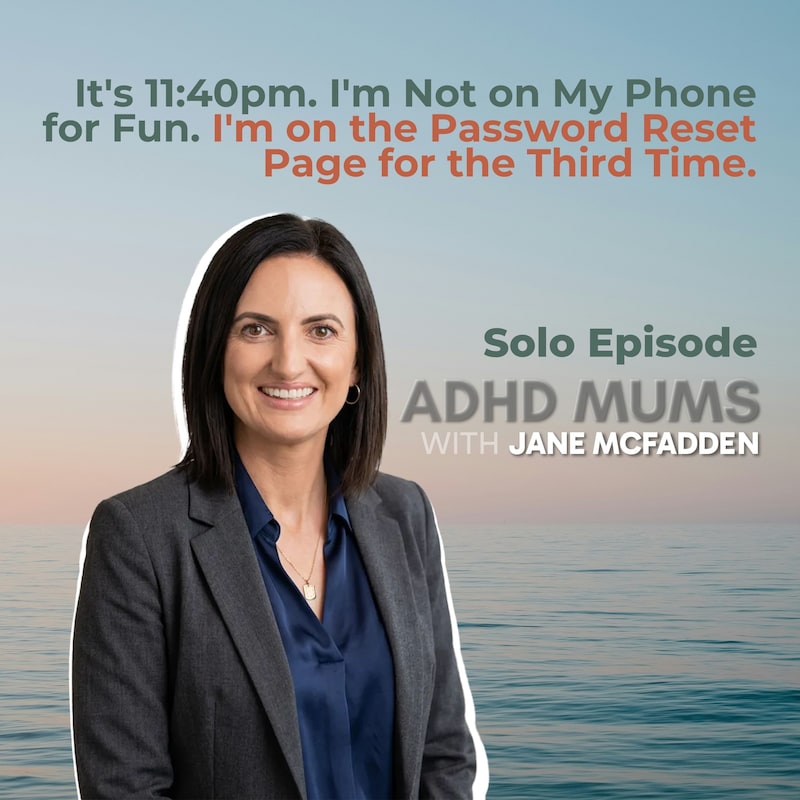
You're at the dinner table you fought to make happen. Your phone lights up — school app, swimming's been moved, the bag has to be packed tonight. You know in your bones that if you don't write it down right now, it's gone by morning. You pick up your phone. Your kid says, you said no phones at dinner, I'm getting my iPad then. The parenting advice has told you you've just damaged everyone. The research says you've just used the exact tool your brain needs.
What We Cover
- The dinner table, the school app, the swimming change, the kid line — and the impossible decision in the middle of it
- Why 'phones down at dinner' advice was written for a woman who doesn't need the advice
- Cognitive offloading — the research-backed reason your phone is your external hard drive, not your hobby
- The 11:40pm password reset window — the unpaid admin job nobody sees, and the morning question from your kid (why were you up so late?) you can't answer
- The co-regulation gap — what happens when the advice assumes a regulated parent and a regulated child, and neither one is in your house at 5pm
- The flip — your daughter isn't watching you on a phone. She's watching you teach her how to externalise her working memory before her brain needs to do it too.
- Why the most important thing she sees you do is recover from being overwhelmed, not put down a device
Related Episodes
📬 Listener Questions & Community
🎙️ Ask a Listener Question (voice)
Voice notes are preferred when possible — hearing your voice helps add context — but you’re very welcome to submit a written question instead.
Send a WhatsApp voice or written on 0403 457 313
Send a SMS voice or written on 0403 457 313
👥 Join the ADHD Mums Facebook Group
For community, shared language, and conversations with other mums who get it.
https://www.facebook.com/groups/adhdmumspodcast
References
Risko, E. F., & Gilbert, S. J. (2016). Cognitive offloading. Trends in Cognitive Sciences, 20(9), 676–688. https://doi.org/10.1016/j.tics.2016.07.002
Alderson, R. M., Kasper, L. J., Hudec, K. L., & Patros, C. H. G. (2013). Attention-deficit/hyperactivity disorder (ADHD) and working memory in adults: A meta-analytic review. Neuropsychology, 27(3), 287–302. https://doi.org/10.1037/a0032371
Feldman, R. (2007). Parent–infant synchrony and the construction of shared timing; physiological precursors, developmental outcomes, and risk conditions. Journal of Child Psychology and Psychiatry, 48(3–4), 329–354. https://doi.org/10.1111/j.1469-7610.2006.01701.x