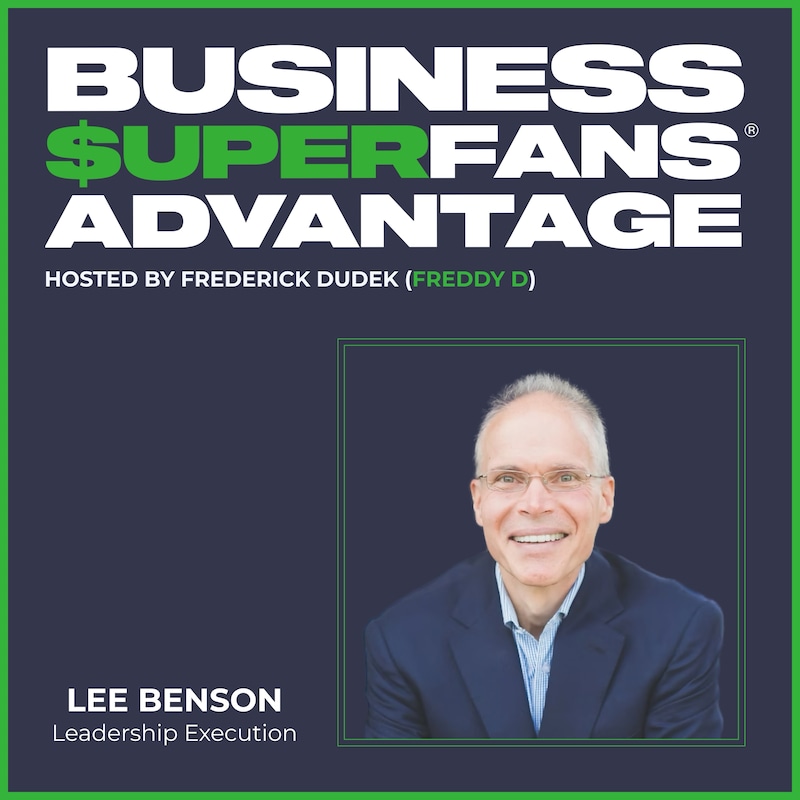
Shownotes
Episode 185 Frederick Dudek | Business Prosperity Advisor
Business leadership execution isn’t about motivation posters—it’s about creating measurable value, aligning teams, and winning the long game with intention and discipline.
Business leadership execution takes center stage as Lee Benson joins Freddy D to break down how elite leaders execute to win by increasing enterprise value—not just chasing goals.
Too many companies rely on hustle, hope, and culture buzzwords without alignment. Lee reveals why leaders must stop virtue signaling and start connecting clarity, structure, and culture to measurable value creation.
From frontline empowerment to his Most Important Number™ framework, Lee shares how CEOs, nonprofits, and even families can scale impact by aligning every role to value creation.
The result? Stronger teams, higher valuations, and emotional loyalty that turns stakeholders into true superfans.
Discover more with our detailed show notes and exclusive content by visiting: https://linkly.link/2Zf7a
Key Takeaways
- Execution beats motivation every time — Winning leaders focus on systems that create value, not slogans.
- The CEO’s real job — Continually and responsibly increase the value of the business. Period.
- Your Most Important Number™ — One metric per team that drives the right behaviors and outcomes.
- Frontline teams create the most value — Empower them like owners, not task-doers.
- Culture must earn its keep — If it doesn’t increase value, it’s just noise.
- Emotional loyalty > brand loyalty — Superfans are built through connection, not marketing spend.
- Families are value-creation systems too — Leadership starts at the dinner table.
Kindly Consider Supporting Our Show: Support Business Superfans® Advantage: Predictable Growth for Service Entrepreneurs
Guest Bio:
Lee Benson is a serial entrepreneur, investor, and founder of Execute to Win (ETW). He has built and scaled eight companies, including exits in the nine-figure range, and advises organizations from startups to $100B market-cap enterprises. Lee is the author of Your Most Important Number and hosts the Show Your Value podcast, helping leaders execute with clarity, alignment, and purpose.
Freddy D’s Take
Listening to Lee Benson is like watching a championship coach break down game film. He doesn’t talk about “trying harder”—he talks about running the right plays.
This episode nails a core Superfans principle: value creation must be intentional and visible. Lee’s clarity–alignment–structure–culture sequence mirrors what I see in elite organizations that scale without burning out their people.
Think of your business like a rowing team. Everyone’s pulling hard—but if they’re not aligned to the same finish line, you’re just splashing water. Lee’s frameworks turn chaos into cadence, helping teams execute like pros and win consistently.
This is exactly the type of strategy I help clients implement through my SUPERFANS Framework™ inside Prosperity Pathway™ coaching—turning employees, partners, and clients into emotionally invested advocates.
The Action:
The Action: Identify your Most Important Number
Who: Business owners & leadership teams
Why: Focus drives execution; execution drives value.
How:
- Define one metric that reflects value creation
- List behaviors it encourages (and discourages)
- Align every role to influence that number
- Review progress weekly
Guest Contact
Resources & Tools
- Your Most Important Number – Lee Benson’s leadership book
- Execute to Win (ETW) – Value creation consulting & masterminds
- DinnerTable.com – Families raising value-creating kids
This podcast is hosted by Captivate, try it yourself for free.
Companies mentioned in this episode:
- Execute to Win
- Dinner Table
- Ninja Prospecting
- Harley Davidson
- Apple
Copyright 2026 Prosperous Ventures, LLC
This podcast uses the following third-party services for analysis:
OP3 - https://op3.dev/privacy
Podtrac - https://analytics.podtrac.com/privacy-policy-gdrp
Podcorn - https://podcorn.com/privacy
Transcripts
I see leaders in companies.
Speaker A:When times get tough, they act like victims.
Speaker A:But I am the world's biggest super fan.
Speaker A:You're like a super fan.
Speaker B:Welcome to the Business Superfans Podcast.
Speaker B:We will discuss how establishing business superfans from customers, employees and business partners can elevate your success exponentially.
Speaker B:Gain insightful knowledge from the experts who create applications to help you create passionate superfans.
Speaker B:This is the Business Superfans Podcast with your host, Freddy D. Freddy, Freddy.
Speaker C:Hey super fans.
Speaker D:Freddy D. Here in this episode 185, we're joined by Lee Benson, bestselling author, founder and CEO of Execute to Win and CEO of Dinner Table.
Speaker D:Lee tackles a challenge that quietly stalls growth for many service based businesses.
Speaker D:Leaders are working hard, but without clear value creation, Aligned execution and a shared strategy effort doesn't translate into results.
Speaker D:From his early career building companies to advise leaders at the highest level, Lee made it his mission to help organizations close the gap between intention and impact.
Speaker D:Featured in the Wall Street Journal, Forbes and Inc. And trusted by executives worldwide, Lee brings practical, no nonsense approach to leadership and execution.
Speaker D:If your business feels busy, but not breaking through, this conversation shows you how to change that.
Speaker C:Welcome Lee to the Business Superfans Advantage podcast.
Speaker C:Great conversation that we had prior to starting recording.
Speaker C:We were just down the street from one another, so welcome to the show.
Speaker E:Good to be here.
Speaker A:Thanks Freddie.
Speaker C:So before we talked you were a little bit into musician and did all kind of that stuff before we started recording.
Speaker C:But so let's go back to kind of the beginning.
Speaker C:I mean I know that that's your hobby and your passion, but you're also into business and working with a lot of executives and stuff like that.
Speaker C:So how did that all come about?
Speaker C:What's the backstory?
Speaker A:Yeah, you know what's interesting?
Speaker A:People ask me, hey, where'd you get your start?
Speaker A:Such a typical question.
Speaker A:And I now I say I got my start pulling weeds at 25 cents an hour at six years old and that was just riding my bike through the neighborhood.
Speaker A:A neighbor that I didn't know, not a friend or family member, said, hey, would you be willing to do this in my garden?
Speaker A:I said sure.
Speaker A:And back then in the late 60s, you could buy two candy bars and have change.
Speaker A:But it felt really cool.
Speaker A:I came from a super low income family and it's like I traded my best efforts.
Speaker A:I got some money for it.
Speaker A:And then that went on to shoveling snow, mowing lawns and paper out dishwasher, busboy, cook.
Speaker A:By the time I was kicked out of the house the beginning of my senior year in high school I was making six bucks an hour working at a Coco's restaurant as a cook.
Speaker A:It was a non event for me to be able to afford an apartment.
Speaker A:I spent one night in my truck, no big deal.
Speaker A:And then from there.
Speaker A:In high school I was teaching guitar lessons.
Speaker A:I've been in bands since before junior high school.
Speaker A:Started playing when I was about 5 years old.
Speaker A: a band in the first half the: Speaker A:When I got out of high school we played over a thousand nights in clubs.
Speaker A:Made most of my money doing that.
Speaker A:I don't count it as one of the eight businesses that I've started from scratch so far, but it was like a business.
Speaker A:We had a sound crew, light crew, a manager, rhythm sections, changing people out, booking all the gigs.
Speaker A:Boy was that a lot of fun.
Speaker A:And again made most of my money doing that.
Speaker A:I had other jobs but it was quite, quite a ride, A lot of fun and I've kept it all the way through.
Speaker A:As you can see my background, this is my full blown music music recording studio.
Speaker A:Put out an album last year.
Speaker A:My band is called Landed the current band and you can find that on music anywhere.
Speaker A:It's streaming so yeah, it's a power hobby.
Speaker E:It's just a blast.
Speaker C:Wow.
Speaker C:We have similar background in one aspect and that was that I didn't start my own business until I was in my late teens but I started pumping gas at 15 for a dollar an hour at the local gas station.
Speaker C:And then in 11th grade I was living on my own.
Speaker C:I was paying rent in 12th grade and I moved back beginning of 12th grade but that didn't last long.
Speaker C:I was out by my 18th birthday and basically rented a bedroom again in some other's house and was drafting work for engineering stuff and was getting started out at $2 an hour.
Speaker C:And then I think I got myself up at end of high school like about 4, 4 50, something like that an hour.
Speaker C:So yeah, you and I have some similar background from the good old days.
Speaker A:There were a lot of challenges in my family.
Speaker A:A lot of family members in and out of jail.
Speaker A:It was a strange environment but it taught me so much about how I didn't want to show up in the world.
Speaker A:And I wouldn't trade any life experience so far, good, bad or indifferent.
Speaker A:There's healthy struggles, there's unhealthy struggles.
Speaker A:But I like how I see the world, I like how it's shaped me.
Speaker A:And I guess one lesson through all that.
Speaker A:Freddie, I'm curious what you think about it.
Speaker A:Is that I believe all the opportunity in the world is in the struggle.
Speaker A:We're taking with the best of intentions more and more away from the kids.
Speaker A:I see leaders in companies, when times get tough, they act like victims rather.
Speaker A:Wait a minute, I'm a leader.
Speaker A:That's why we have you.
Speaker A:If the world was perfect, we wouldn't need you here.
Speaker A:So what's your take on this whole.
Speaker C:I totally agree.
Speaker C:That's usually as a leader, that's the time when you're supposed to step up and lead and pull your people and you know, be the stopping block.
Speaker C:You know, in the sense of you're the cornerstone, you're keeping everything together and people are looking up to you for that.
Speaker C:At that point, especially in business when things are getting a little bit difficult, cash flows nuts up and down.
Speaker C:You need to be what I call the coxswan of the racing rowing team and be the person that's going to keep everybody in line and keep everybody going and says, you know what, we're going to get through this thing.
Speaker A:Yeah.
Speaker A:Every day when I come in, you know, I've hired my different businesses, thousands of employees over the years.
Speaker A:It's never perfect across the board.
Speaker A:For me it's just really important to be able to see the business.
Speaker A:And I look at it as like a value creation flow structure.
Speaker A:So everything from awareness, how do people even know about us?
Speaker A:Do they know about us walking through, generating marketing, qualified leads.
Speaker A:Sales qualified leads, closing those leads, producing the product or service, delivering on it, ongoing customer experience.
Speaker A:And every business is a little bit to a lot different.
Speaker A:But when I look at that flow, there's red, green and yellow and all those links in the chain or this flow structure and then you've got a support structure to that.
Speaker A:It could be hr, legal, engineering, quality, finance, et cetera.
Speaker A:How well are they supporting that value creation flow so they can do their best work the highest percentage of the time when you can clearly see that you know exactly what to do every day when you get into work.
Speaker A:Here's where I need to focus to create the most value for the business.
Speaker A:Because I think the number one job of a CEO or a founder or president of an organization is to continually and responsibly increase the value of that organization.
Speaker A:That's it.
Speaker A:And by proxy, the entire leadership team should be doing that collectively, together.
Speaker E:That's their goal.
Speaker A:And their job is to align every one of the non supervisory team members to that goal as well.
Speaker A:Doing the best work.
Speaker A:That's how I think about creating value.
Speaker A:We can get into that.
Speaker A:But I look at value as material, emotional and spiritual.
Speaker A:And I've always run all my companies that way.
Speaker A:Money's super important.
Speaker A:Everybody gets it.
Speaker A:Emotional energy value is the X factor for leaders.
Speaker A:We create the environment from which everyone creates value.
Speaker A:And then the spiritual value creation bucket is about connectedness.
Speaker A:So what are we doing to make sure employees are strengthening relationships?
Speaker A:Being more connected with our customers, their counterparts over there with our suppliers, the communities that we touch.
Speaker A:The more we lean into that connectedness bucket, that spiritual value creation bucket, the faster the companies grow and absolutely higher the multiples we sell.
Speaker A:Yeah, yeah.
Speaker C:I mean, you get momentum going because everybody, you know, again, I'll use the racing rowing boat.
Speaker C:To me, I look at the leader as, first off, you got a team that has a single or not two, one.
Speaker C:So you got to get everybody in sync onto the mission, know what the objectives are, and then getting everybody to row together.
Speaker C:And more importantly, they're rolling backwards.
Speaker C:If you're familiar with the racing rolling team, they're rowing backwards.
Speaker C:So they got to trust the guy up front to keep them on direction of what's going on and everything else.
Speaker C:And that's where a leader really needs to step up.
Speaker C:And as you say, is, you know, empower that team.
Speaker C:Because a lot of times, and I've seen it, and I'm sure you have too, stepping into diverse companies, you know, the front line is not treated like the most important asset in the company.
Speaker C:They're the customer support people.
Speaker C:But the reality is that's the front line to the customers, the suppliers, the distributors, complementary businesses.
Speaker C:That's your most important asset.
Speaker C:Yeah.
Speaker A:And again, every business is different.
Speaker A:But I've always thought of, especially my companies that have had a lot of employees, the frontline team members are the ones that are collectively creating the most value.
Speaker A:And so when you see everybody rowing together, same goals, they understand all this stuff.
Speaker A:Like, we can use that language in business.
Speaker A:They still don't really fully get it.
Speaker A:So what I do with my leadership development work at ETW is I sync every leader up with helping increase the value of the business.
Speaker A:So having a goal and a target and everybody going in a direction, I still think we need to fully connect the dots to the end.
Speaker A:The reason we're doing this is to increase the value of the business.
Speaker A:And this is why it is good for all the stakeholders, especially the internal team members, like, rather than just goals and that direction.
Speaker A:And isn't this amazing?
Speaker A:We're talking about concepts, we're not fully connecting the dots.
Speaker D:Right.
Speaker A:Employee engagement and all.
Speaker A:This, you keep saying that over and over again.
Speaker A:How are you actually using it to increase the value the business Once you start doing that, it doesn't take very long to get people in the groove of doing it and out of the again making a half joke about it.
Speaker A:But out of this business virtue signaling.
Speaker C:Language model because everybody's got is emotionally connected.
Speaker C:Everybody's into the equation of where the visions are and they have ownership of their responsibilities.
Speaker C:They're empowered.
Speaker C:So you get a team that's empowered for one with a mission of creating more value for the company.
Speaker C:They look at things differently, they handle things differently.
Speaker C:One of my quotes in my book Creating business Superfans is people will crawl through broken glass for appreciation, recognition.
Speaker C:And unfortunately it's not given enough.
Speaker C:And I think that once you do that, and more importantly, it's one thing to say, hey, Lee, really appreciate the great effort that you did on that particular project versus hey, I want to take a moment everybody to recognize Lee for going above and beyond that project.
Speaker C:You feel like a rock star.
Speaker C:Everybody else sees that you appreciate the extra effort.
Speaker C:Everybody levels up.
Speaker F:Let's take a quick pause to thank our sponsor.
Speaker F:This episode is brought to you by our friends at Ninja Prospecting, the outreach team that makes cold connections feel warm.
Speaker D:Here's the deal.
Speaker F:Most service business owners are drowning in spammy DMs and cookie cutter LinkedIn messages that never get a response.
Speaker F:Sound familiar?
Speaker F:Ninja Prospecting flips that script.
Speaker F:They craft human first outreach that actually sounds like you and more importantly, gets results.
Speaker F:No bots, no fluff, just real conversations that open doors.
Speaker F:If you want to stop wasting time on dead end messages and start filling your pipeline with qualified leads, talk to my friend Adam Packard and his team.
Speaker F:Head over to ninjaprospecting.com to schedule chat today and be sure to mention you heard about it right here on the business super fans, the service provider's edge.
Speaker F:And hey, if you're the kind of person who likes to get started right away, you can join their free community at school.
Speaker F: K-O-O-L.com Ninja Prospecting: Speaker F:All right, let's get back to our conversation.
Speaker A:Yeah, well, for sure, I think we should be acknowledging and I think there's a ton of power in that.
Speaker A:I agree with you what we're acknowledging.
Speaker A:I think we can take that even to another level.
Speaker A:And I think it feels amazing to be on a winning team, like accomplish challenging things.
Speaker A:Self esteem, all of that internal fulfillment starts to climb.
Speaker A:And so I wrote a book titled your most important number.
Speaker A:And there's something I call the mind management systems M I n d Most important number and drivers.
Speaker A:And it's about getting every single team in the organization fully aligned to the value they were designed to create and doing their best work to actually create it.
Speaker A:And this most important number you have one, for the overall organization that does two things.
Speaker A:It's reflective of the value of the business.
Speaker A:And two, it will drive the majority.
Speaker E:Of the right behaviors.
Speaker A:Because you can have numbers that sound pretty good, but if you make a list of we all drive this number, what are behaviors that it will drive that will help the organization, and what's the list of behaviors that could be.
Speaker E:Harmful to the organization?
Speaker A:So we want the one that drives the majority of them.
Speaker E:Most helpful behaviors.
Speaker A:But as you go through all the different teams in the company, whether there's three additional teams, one additional team, a thousand additional team, it doesn't matter.
Speaker A:Every team has one number that above all others describes the value that we're designed to create and will drive the.
Speaker E:Majority of the right behaviors.
Speaker A:And so when you have a team that's locked in, you've got this number.
Speaker A:Let's just say it's cash flow.
Speaker A:We're starting here, we want to go there over the next 12 months and here's what it's going to look like.
Speaker A:We want to be at or above plan on cash flow, and we're doing our best work to make that happen.
Speaker E:If it's hr, it's different.
Speaker A:If it's engineering or quality or operations or sales, marketing, they all have different numbers.
Speaker A:But we want the whole team around that.
Speaker A:And when we accomplish challenging things because we're working together really well to increase the value of the business, that feels great.
Speaker A:And I like creating an environment where every single team member, supervisory or non supervisory, they're acting like the CEO of their own role inside the business doing this.
Speaker A:And so once that foundation is in place and we're really knocking it out of the park and we're objectively seeing who's winning, who's losing, who we need to help and who we need to learn from, the recognition becomes three times more powerful.
Speaker E:When that.
Speaker A:Does that make sense?
Speaker C:Oh, absolutely.
Speaker C:A couple years ago, I stepped in as a general manager for a organization here in Mesa, and the company had been in business for 30 years and was basically a little below a million, 1.2 million up and down.
Speaker C:And it was kind of a lifestyle business.
Speaker C:The goal Was they were going to retire and I was going to run the company and they were going to go travel the world.
Speaker C:Unfortunately, he had a heart attack and passed away.
Speaker C:I took it over and there was a lot of turnover.
Speaker C:Every 90 days somebody was quitting because of the management style that they were doing.
Speaker C:And I took it over and started.
Speaker A:To set up goals.
Speaker C:Here's our objectives.
Speaker C:Changing our mindset, changing the way we looked at the company completely.
Speaker C:And these were simple things.
Speaker C:But for this type of a company, it was very important.
Speaker C:And I started empowering people.
Speaker C:Something I had learned in Dale Carnegie management stuff is you created.
Speaker C:I got everybody to create their own job description and what they deemed would be successful for doing their particular job.
Speaker C:And my job was to, once we agreed upon the metrics, was to keep them accountable for what they said that they were going to accomplish.
Speaker C:And collectively, we scaled that company in 12 months by about a million dollars because of the fact that we completely changed our mindset.
Speaker C:We started.
Speaker C:I didn't call it values at the time, but I'd really like your term.
Speaker C:But we set up milestones that we wanted to accomplish and got everybody onto the same direction.
Speaker C:And then we started recognizing when we hit a certain threshold, you know, we threw a little lunch in and celebrated because you gotta celebrate those W's to keep that momentum going.
Speaker A:Yeah, I love it.
Speaker A:My goal, when I work with clients, I've got etw, which stands for Execute to Win.
Speaker A:There's a lot of things that we do there.
Speaker A:We invest in companies.
Speaker A:We've got quite a bit out that way.
Speaker A:It's our own private fund.
Speaker A:It's basically my money doing that.
Speaker A:I run CEO mastermind groups.
Speaker A:I've got three full groups that I lead.
Speaker A:I've been doing the three of them for about three years.
Speaker A:But before that, I've been in lots of groups since the mid-90s.
Speaker A:I just wanted a better evergreen format focused on increasing the value of everybody's business.
Speaker A:We also have a platform and a DIY mind management system.
Speaker A:So companies sign up quite regularly to start doing this, and they get all the tools and everything around it.
Speaker A:But all of it's designed to help companies intentionally increase their value.
Speaker A:And I think the ultimate state that we're all looking for with our businesses.
Speaker A:And I'm currently CEO of two different companies.
Speaker A:One is etw, the other one is called Dinner Table.
Speaker A:And I think the ultimate situation we want to be in is that we reach this level where we're continually and responsibly increasing the value of the business because of how everything is set up.
Speaker A:And when I work with companies, I basically take them through and I still stay on the front lines like I am wicked busy.
Speaker A:But I'm always going to have two or three companies I'm working with directly to keep doing this.
Speaker A:So I know what's relevant every single day.
Speaker A:But there's four stages when I work with these companies to get them from just getting started with it all the way to this continually increasing the value of the business.
Speaker A:And I think about as like, clarity, alignment, structure and culture.
Speaker A:So the clarity piece, when you sit down with a senior team, again, it's easy to say goals and objectives and strategy.
Speaker A:Wait a minute, what are we really trying to do?
Speaker A:Getting agreement that the number one job of the CEO and by proxy the leadership team's job is to continually increase the value of the business is huge.
Speaker A:Like, why are you coming to these meetings?
Speaker A:What are you doing?
Speaker A:There's no plan, right?
Speaker A:Most of the time.
Speaker A:And what's cool, the businesses are doing fine most of the time and some well, but they can do so much better than they do.
Speaker A:And then we look at it and say, okay, if we look at the value creation flow, from awareness to ongoing customer experience and all the support, let's objectively rank that and see where the bottlenecks are.
Speaker A:Great, we know where to focus now.
Speaker A:Let's set a few strategic initiatives, like, what are the two, three or four things that we really have to get done to move the needle and build our foundational readiness for growth so we can go for it.
Speaker A:So that first sort of clarity, why we're here, what we're doing, what we're going to do, that's that first stage.
Speaker A:And then alignment, you're taking it out a little bit further.
Speaker A:And this applies to startups, to the biggest companies I work with, around $100 billion, market cap, it doesn't matter.
Speaker A:It's just scale, more zeros, more people.
Speaker A:But even the largest companies are just collections of teams.
Speaker A:You take it to the next level and you establish these most important numbers, you establish goals for all of those.
Speaker A:You get the right operational meeting cadence going.
Speaker A:All of this I talk about in my book, your most important number, but it's just about building this all the way out.
Speaker A:And I've got culture towards the end, we've got structure and how things are laid out, but culture towards the end, because I think order really matters.
Speaker A:We might be doing a little bit of work building in that direction out of the gate, but I really dig into it at the end because a lot of companies say, hey, things aren't right.
Speaker A:Let's bring in an expert, give them a bunch of money to do a culture exercise.
Speaker A:And you walk in the conference room.
Speaker E:And there's stickies everywhere.
Speaker A:The employees are like, what the hell is this?
Speaker A:And I think everything we do as a company should be done to intentionally make us measurably better.
Speaker C:At least key word right there.
Speaker C:Intentional.
Speaker A:Yeah.
Speaker A:With that intent.
Speaker A:So if we're going to do culture or leadership development, I want to know how we expect it to make the company measurably better before we even start going down that road.
Speaker A:Goal when it comes to culture is to connect culture to creating value, increasing your business's value.
Speaker A:So how is that going to work and going through it?
Speaker A:We can't do that until everybody's fully aligned on the main direction.
Speaker A:Let's say we want to go from, hey, we're worth 5 million this year, we're going to be worth 15 million at the end of next year.
Speaker A:And that's not uncommon for the companies I work with to take those big of a jumps.
Speaker A:But if we don't have the structure and the roles defined and everybody knows where to lock in, how are we going to apply cultural alignment tools to increasing the value of the business?
Speaker A:Right.
Speaker C:If nobody's a.
Speaker C:It goes back to my robo racing robo.
Speaker C:If nobody's in line with division and bought in, doesn't matter, it's irrelevant.
Speaker A:What's the culture exercise going to do and the trust fall exercises and all the other stuff.
Speaker A:Again, making a joke there.
Speaker A:But order really matters.
Speaker A:But there's so much I'm calling a business virtue signaling out there.
Speaker A:Oh, you need to have this culture consultant come in or somebody getting you to.
Speaker A:Everybody needs to trust faster and do all of that.
Speaker A:Like all this stuff is there.
Speaker A:So let's start there before we're even aligned on the value that this company was designed to create.
Speaker C:Can you share a story, Lee, of where you walked into a company and they were in a little bit of a chaotic situation and you kind of straightened them out and what was the result?
Speaker C:And how did they become super fans of the work that you did and promoted you to other businesses that could use the services that you provide?
Speaker A:Yeah, I have a lot of examples.
Speaker A:I never.
Speaker A:Now usually the only way I describe a company as a hot mess or chaos is when there's bad acting going on.
Speaker A:But when that's not going on, I just look at it and say, okay, you're at this level of creating value.
Speaker E:Now let's Organize it so faster.
Speaker A:And one, a few years ago was a virtual staffing company.
Speaker E:I got involved.
Speaker A:They had 67 virtual staff members that were placed.
Speaker A:And six months later, we just organized the work that I've been describing here.
Speaker A:Six months later we had 350 placed.
Speaker A:20 months later they had over 2,000 placed.
Speaker A:And so if you put in perspective.
Speaker E:When I got started with them, before it was all being cleaned up was 67.
Speaker E:Six months later we did a valuation, $1.7 million valuation.
Speaker E:20 months later, $48.6 million valuation.
Speaker A:And it was just simply cleaning it.
Speaker E:Up and going through this.
Speaker E:One of the individuals left the company and started his own business and said, hey, I want to do this too.
Speaker E:So he's just gotten started and only a few months in.
Speaker A:And I think there are about 100.
Speaker E:Virtual staff members and it'll be the same thing.
Speaker E:I think it'll even be better.
Speaker A:The other company's doing fine, and I.
Speaker E:Think this one could even be better.
Speaker A:So that's interesting how it all kind of spreads out.
Speaker E:Other clients, supplies and nonprofits.
Speaker E:Had one here in Phoenix.
Speaker E:Never raised more than just under $2 million in donations for impact they want to have.
Speaker A:And we got involved at the end.
Speaker E:Of the next year it was 4 million, then it was 8 million, then it was 20 million.
Speaker A:And it kept climbing.
Speaker E:And then that person left to go work with a friend, a CEO running that nonprofit.
Speaker E:And then he said, I really want to.
Speaker E:I really want a business.
Speaker E:And he actually happened to be in one of my CEO mastermind groups.
Speaker A:So we helped him buy a construction company.
Speaker E:And so we're just going through cleaning all that up.
Speaker A:And the company was doing fine.
Speaker A:But like a lot of small companies.
Speaker E:They build houses of cards based on tribal malware.
Speaker E:There's no set processes or anything really in place.
Speaker E:And if Mary leaves, then all this falls apart.
Speaker E:So cleaning all that up.
Speaker E:And we put a sort of a slogan in here directionally with all the team members, we implemented all hands meetings and and 3x in three years.
Speaker E:So we're going to take this 50, $60 million small construction company and we're going to shoot for 180 million and 3x plus the it to increase the value of the business.
Speaker E:3x in three years.
Speaker E:I don't see any issues being able to accomplish that.
Speaker E:And then that leads to other people watching what's going on.
Speaker E:Well, I had one last week.
Speaker E:Join.
Speaker E:I've only got two spots left in my three groups.
Speaker E:I'm just too packed at another group.
Speaker E:Each group six is full Eight is the max because every two months I want to be able to do a deep dive on everybody's business to keep us on track.
Speaker A:All of these interactions, when we lean.
Speaker E:In as service partners and we really get great results, that's all I care about.
Speaker E:Our mission is increasing the value of our clients business.
Speaker E:That's all we do at etw.
Speaker E:On the consulting side of it, when.
Speaker A:You do that, others are watching it.
Speaker E:And they want to be part of it.
Speaker D:Yeah.
Speaker C:And the people that you worked with, I call them, you know, they become your super fans because they're the ones that are going out and sharing the success that they experience, working through your mentoring programs and your mastermind and stuff like that.
Speaker C:And you can't buy that kind of PR because now that person is out there and that shortcuts it.
Speaker C:Oh, you need to talk to my friend Lee.
Speaker C:And that's.
Speaker C:That key word is friend.
Speaker C:It's no longer oh yeah, you need to talk to my business coach.
Speaker C:No, it's actually my friend.
Speaker C:And that's how that dynamic changes.
Speaker C:And so you're now creating your own sales team of those people have gone through your programs promoting you and that starts to get the machine rolling and propelling and they're happy to do it.
Speaker D:Yeah.
Speaker A:So let me set this up a little bit.
Speaker A:It's going to be a question for you because I 100% agree what you're talking about there.
Speaker A:I think more than ever it's about the trusted relationship network that we have and the value that we're giving, getting, and it's mutually beneficial all the way through.
Speaker A:So I have a podcast titled show youw Value.
Speaker A:And I just interviewed yesterday, a gentleman, Ken Schmidt, who came into Harley Davidson.
Speaker E:Was a big part of turning that around.
Speaker A:And when he came into it, they had quality reliability issues.
Speaker A:They were on the edge of bankruptcy.
Speaker A:And then you start looking at what do we have that we can leverage.
Speaker A:And when you think about Hardley, it's the only company in the world I know where a lot of the buyers of the product tattoo their logo on.
Speaker C:Those are die hard super fans.
Speaker A:Yet they weren't leveraging it.
Speaker A:The question is, that was so obvious, but it wasn't being leveraged.
Speaker A:They thought the answer was we'll just build a better bike and then somehow that'll fix everything.
Speaker A:I think having super high quality, reliable stuff and all that, just barely a ticket to play.
Speaker A:It's about building community.
Speaker A:So what's your advice for companies identifying the things they have to leverage that they didn't even realize My guess is.
Speaker C:It'S all, yeah, well, you bring up an important part because you just like Harley Davidson.
Speaker C:Look at Apple.
Speaker C:Apple sells a lifestyle.
Speaker C:And that's really what they're doing.
Speaker C:It's not the technology.
Speaker C:I mean, we can argue up and down, left and right, whether, you know, Windows or Apple and blah, blah, blah.
Speaker C:The bottom line is Apple sells a lifestyle, Harley Davidson sells a lifestyle.
Speaker C:And so when you can connect people emotionally to what is happening, that's how you create those super fans that will line up to buy the product.
Speaker C:It's the same thing with the rock band.
Speaker C:Rock band gets super fans where they will buy the.
Speaker C:Soon as that album is out.
Speaker C:Back in the old days, you know, people would line up at the record store to buy them.
Speaker C:It's the same thing with the sports team.
Speaker C:You know, they create their super fans.
Speaker C:It's the fact that they belong to something and they support something.
Speaker C:So I think once a company can create that level of engagement to where people get emotionally connected, and that's going to be the key word there is emotionally connected to the mission.
Speaker C:It takes off by itself.
Speaker A:Yeah.
Speaker A:We're not trying to set up brand loyalty in the normal sense.
Speaker A:I think what we're vying for is emotional loyalty.
Speaker C:Correct.
Speaker C:There you go.
Speaker A:And I've heard this over and over.
Speaker A:I was just at a business conference in Austin.
Speaker A:There were 500 chief executives there.
Speaker A:It's a CEO conference, and probably 65, 70% were actually CEOs of varying size companies.
Speaker A:And I'm listening to one talk, and here's three people, the president and a couple of senior leaders from an architectural firm, about 200 employees.
Speaker A:And they said, hey, our biggest challenge is with just finding good people.
Speaker A:We just don't have that sexy of a business.
Speaker A:And so, like, who's really going to want to work here?
Speaker A:Like, oh, my gosh, what a limiting belief that is.
Speaker A:I'm thinking you're designing these amazing buildings that are creating so much value with the teams that go in there and the things that they do.
Speaker A:You don't have to be Harley Davidson and your customers are tattooing your logo all over their bodies.
Speaker A:All of us can build that emotional loyalty around what's going.
Speaker A:Because it's people dealing with people, right?
Speaker D:Sure.
Speaker C:Well, I got one guest on my show episodes back talked about they worked with hospital people and changing their mindset in a hospital.
Speaker C:And they had asked a janitor, you know, what was his role?
Speaker C:And the answer was their job was to assist the medical professionals, save lives by keeping the rooms clean.
Speaker C:So that the patients wouldn't get any infections.
Speaker C:Talk about a mindset.
Speaker C:Shift complete.
Speaker C:He's not a janitor.
Speaker C:He's saving lives because he's helping make sure that the rooms are clean so that the doctors can operate so the patient.
Speaker C:That's the magic right there.
Speaker A:And that's a good point.
Speaker A:I think every company can do that for every position.
Speaker A:I've always thought of the receptionist when I've had those in different businesses.
Speaker A:You're the ambassador of first impressions.
Speaker C:Somebody else called that exactly.
Speaker C:Funny you bring that up, because that is absolutely correct.
Speaker A:And the janitorial maintenance staff, they're ambassadors of second impressions.
Speaker A:If they get past the front desk, they're walking through the facility.
Speaker A:And all of the roles, they're all creating value.
Speaker A:And the more we can align that and make it.
Speaker A:I don't want to say something cute to sound meaningful.
Speaker A:I want to create the right environment to where it just happens.
Speaker A:Right.
Speaker A:It releases that intrinsic motivation from team members.
Speaker A:If they're on the bus.
Speaker A:We're all working together.
Speaker A:We're on this developmental journey.
Speaker A:Let's go for it.
Speaker A:Let's create as much value as can.
Speaker A:And some people go really fast.
Speaker A:Some people go really slow.
Speaker A:I always tell my team members, I've told them over the years that as of right now, I guess I'm on my 45th year of my overnight success story, and I'm feeling like I'm barely getting started.
Speaker A:I'm having so much fun.
Speaker A:I tell them, hey, some of you can do it in less than half the time it took me to do what I've done.
Speaker A:If the financial piece is important, one of my eight companies I sold for well into nine figures.
Speaker A:I sold two others one for eight figures.
Speaker A:And others of you are on track to do it in 300 years.
Speaker A:Like, it's really up to you if you want to do that.
Speaker A:But I really like creating value holistically, which is the material, the emotional and connectedness or spiritual.
Speaker A:And so I'm doing it in for profits and nonprofits of all sizes.
Speaker A:And then the second company that I'm CEO of called Dinner Table and you can get [email protected], it's about building a community of families, raising kids that create value in the world.
Speaker A:And we have over 40,000 parents in our dinner table family community from 67 countries.
Speaker A:It's really cool.
Speaker A:And we have a community platform and we're getting more and more partners coming on board that have their partitioned off sub communities in there.
Speaker A:K12 schools are really good where the Families of the students are part of this.
Speaker A:And I believe the purpose of an education is to create value in the world.
Speaker A:And I also believe that every single family would love to intentionally create value in a more effective way and a family balance sheet.
Speaker A:For me, you've got the material piece so you want to what's the goal for the family but also for the kids?
Speaker A:You want to increase your net worth 5%, 10%, 20% over the next year.
Speaker A:And then when you look at the emotional and spiritual value creation buckets is leading.
Speaker A:Participating or not participating in efforts to improve emotionally what it feels like to be in the family and spiritually what it feels like to be connected to the family appropriately, to communities, a higher power, whatever's important to each family.
Speaker A:And then you just have this list and foundationally in there, what's the monthly family meeting you have where you refine.
Speaker E:Your family goals, you review everybody's job.
Speaker A:For the family, you review what it means to be a leader in the family.
Speaker A:And oh by the way, every one of the kids can be a leader in the family.
Speaker A:And just having that conversation and having them participate in what those characteristics look like, it's incredible.
Speaker A:And then the same thing with each kid.
Speaker A:And I do this even with my sister's grandkids, four of them.
Speaker A:Once a month we get together individually and with a six year old who just turned seven last weekend, this is a 10 or 15 minute meeting with a 16 year old.
Speaker A:It's about an hour meeting, but we're going through her goals, her job for the family, what it means to be a leader and her balance sheet and wow, is it cool.
Speaker A:And it's so effective with so many different families.
Speaker C:You're preparing them for life.
Speaker C:I mean it's really the important part is you're really helping those individuals step into life prepared versus wow, I'm here now what do I do?
Speaker C:So they have a purpose, they have confidence in themselves.
Speaker C:And so those are some great things that you're doing.
Speaker C:Let's go back to the book a little bit and let's talk about your book.
Speaker D:Okay.
Speaker A:The reason I wrote your most important number is just to outline things that I've used that have been really successful.
Speaker A:A refined operating methodology that took me a couple of decades to really refine and keep everybody focused on what's most important.
Speaker A:And there's a lot of operating methodologies out there.
Speaker A:I'm sure you've heard of EOS, there's OKRs, there's GX or scaling up.
Speaker A:There's all of it.
Speaker A:And What I find in most systems out there that are popular, there are thousands of other systems designed by individual consultants and large consulting firms is that especially the popular ones, teams get caught up in doing the elements of the operating system, I. E. Making process more important than what is most important.
Speaker A:And in the mind management system, we never take our eye off what's most important, which is creating more and more value with each team so we can collectively increase the value of the business.
Speaker A:And that's really what it's all about.
Speaker A:I go through my larger aerospace company as a case study.
Speaker A: I even had in: Speaker A: Actually before that,: Speaker E:Business management system I've ever seen.
Speaker A: And in: Speaker A:I still stay in touch with his wife Susie, just on the same journey.
Speaker A:How do we get companies to create more and more value?
Speaker A:And I think like all of us.
Speaker E:He evolved a lot over the years.
Speaker E:And how we thought about it like.
Speaker A:The numbers are really important, but how we make the numbers really matters.
Speaker E:You want to sustain this for the long haul.
Speaker A:That's really what this is.
Speaker A:How do we keep everybody focused on creating value and collectively increasing the value of a business?
Speaker E:And that's what the mind management system is all about.
Speaker A:And I do have another book that'll be coming out probably April next year on leadership and how to assess the strengths of an organization and match that to leadership development.
Speaker A:So we're doing surgical leadership development with every leader where they need to develop.
Speaker E:The most value in the business that they work for.
Speaker A:We're doing that work now.
Speaker A:And now that I've got quite a.
Speaker E:Few years of doing this, I'm going to summarize it in a book to make it easy for more people to DIY it.
Speaker D:Yeah.
Speaker C:Because you know, I have told people that you can get 20 years of experience in a week by just buying a book and reading it.
Speaker C:And I too am working on my next book which is going to be much more story based.
Speaker C:So I've got some quite interesting adventures that I've gone through and I'll be sharing those and then tying those into how they apply into business.
Speaker C:So.
Speaker C:And that's same thing.
Speaker C:Looking to Q1 of 26, I'm looking to have that released.
Speaker A:That's great.
Speaker A:By the end of this year I'll have another book out called Value Creation Family and it outlines all this stuff.
Speaker E:And so much more that I talk to you about there.
Speaker C:We got a couple more minutes.
Speaker C:You want to talk about that book?
Speaker A:Yeah, it's really about how do we intentionally create value as a family and then how do we lean into being part of a community of families that are intentionally raising kids that create value in the world?
Speaker A:The way I got the idea around this, and it probably started 10 years ago.
Speaker A:I've been in involved in K12 education in Arizona for a while and the primary non profit was called A for Arizona.
Speaker A:There was a 1.0 version, a 2.0 version.
Speaker A:I put probably a couple million dollars of my own money into it.
Speaker A:We raised over a hundred million additional dollars and we had transportation programs.
Speaker A:If you lived in a rural area, your low income family, you only had one option.
Speaker A:But we helped them have an option to go to.
Speaker A:Could be a failing school as their option.
Speaker A:Now you can get to five or six schools so you can pick a better school.
Speaker A:But what I realized is every time we went to the state legislature to push for legislation to improve conditions for the kids, it was almost always adults fighting over money.
Speaker A:It was never about the kids.
Speaker A:And so I thought, you know what, we have to come up with a way to come in from outside the system.
Speaker A:So what if we build communities of families raising kids that create value in the world?
Speaker A:Because again, that is the purpose of an education, to create value in the world, not go through a conveyor belt system and come out the other side with hundreds of thousands of dollars in debt.
Speaker A:But I think what's different about this work is we're creating this foundational culture of creating value within families.
Speaker A:Whereas everybody else, in my opinion, there's a few exceptions out there, but everybody else, in my opinion, they're just giving little tools saying, oh, kids are just financially literate, it'll change the world.
Speaker A:Well, even if you are good with money, it doesn't mean you're going to be a good person.
Speaker A:And I think one of the biggest deficits on the planet, and I think the biggest deficit is having enough leaders that are both capable and moral.
Speaker A:And you can see that manifesting as.
Speaker E:Problems everywhere in government, business.
Speaker A:It's all over the place.
Speaker A:I don't want to change.
Speaker A:This is really what it's about, doing it more intentionally as a family when it comes to creating value, interacting with other families, sharing in all that practical family wisdom, to let it rip.
Speaker A:I've got five, six communities that I lead myself four in person to online.
Speaker A:I just consolidated four into two online.
Speaker A:And then I've got coaches popping up all over the planet that have their own communities that they lead.
Speaker A:And whenever we meet, it's so amazing how the members share their practical wisdom.
Speaker A:Some are having challenges, but all of them have dealt with something in a more effective way than the others have.
Speaker A:So the book is based on all of that work and I feel like it's in a lot of ways the.
Speaker E:Most important work that I'm doing right now.
Speaker A:Freddie sure it has.
Speaker C:Well, as we wrap up here, because I know you've got the time crunch, so I want to respect that great conversation that you and I had and I'm sure you and I could talk about this for at least another five minutes.
Speaker C:Thank you so much for your time.
Speaker C:We'd love to have you on the show down the road again, Lee.
Speaker A:My pleasure.
Speaker A:Happy to do that.
Speaker D:Great conversation with Lee today.
Speaker D:One key takeaway is this Real growth doesn't come from working harder.
Speaker D:It comes from intentionally creating value.
Speaker D:Value for your customers, your team and your business with leaders align people around clear purpose and measurable impact.
Speaker D:Momentum follows and that's how service based businesses scale sustainably.
Speaker D:If this episode brought you value, I'd really appreciate if you left a quick 5 star review.
Speaker D:It helps other service based business owners discover the show.
Speaker D:And before you go, join the Entrepreneur Prosperity Hub on School.
Speaker D:It's free to join and get your free Service Provider Prosperity playbook at school.
Speaker D:S K-O-O L.com eProsperity Hub Insider Tools, weekly growth plays and live virtual networking events that help you connect, collaborate and build a business that runs smoothly, predictably and profitably.
Speaker C:Thanks for tuning in today.
Speaker D:I'm grateful you're part of the Business Superfans movement.
Speaker D:Every listen and every action brings you closer to building your own superfans.
Speaker D:Be sure to subscribe to the show.
Speaker D:We've got another great guest coming up.
Speaker D:Focus on what really moves the needle.
Speaker D:I'll talk to you in the next episode.
Speaker D:Remember, one action, one stakeholder, one Superfan Closer to Lasting Prosperity.
Speaker B:We hope you took away some useful knowledge from today's episode of the Business Superfans Podcast.
Speaker B:Join us on the next episode as we continue guiding you on your journey to achieve flourishing success in business.






