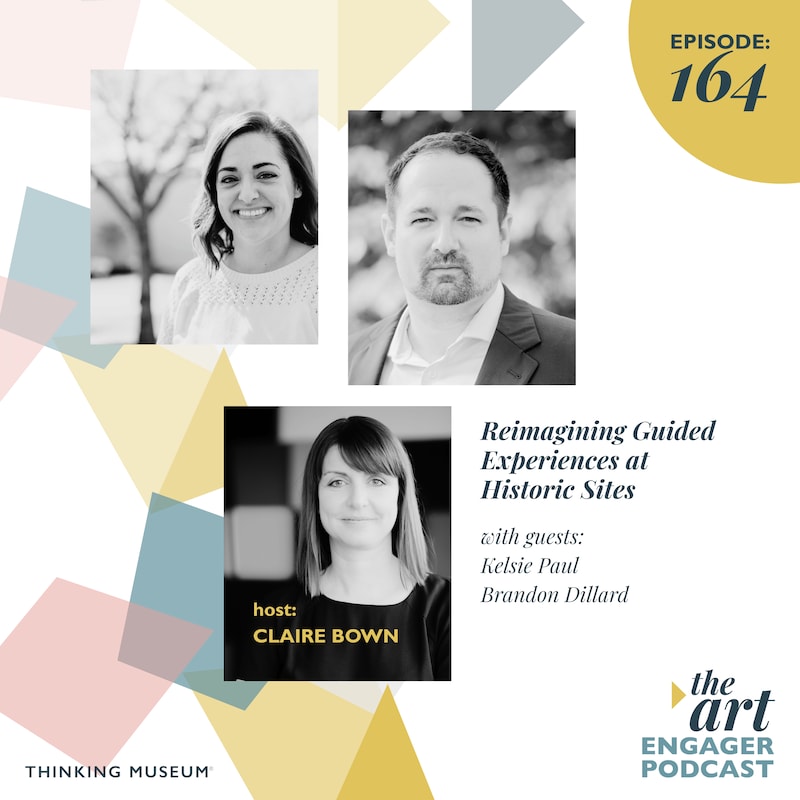
Shownotes
What does it take to guide visitors through histories that are genuinely contested and emotionally charged? In this episode, I'm joined by Brandon Dillard, Director of Historic Interpretation and Audience Engagement at Thomas Jefferson's Monticello, and Kelsie Paul, Director of Learning and Visitor Experience at the Frick Pittsburgh, to explore how both institutions have reimagined their guided experiences in response to the complicated legacies of their central historical figures.
We talk about the long evolution of interpretation at Monticello, from the site's earliest tours to the integration of slavery and the story of Sally Hemings into the core narrative. Kelsie shares the process behind the Frick's "Gilded, Not Golden" tour - a ground-up redesign of Clayton's 30-year-old house tour that involved consultants, an advisory board, difficult internal conversations and a willingness to start from scratch.
We also dig into what it means to support guides doing this work: hiring for empathy, investing in training, facilitating ongoing dialogue, and empowering guides to be facilitators rather than lecturers. And we reflect on the civic role of historic sites in a polarised moment, including how Monticello is approaching the 250th anniversary of the Declaration of Independence.
Whether you're working at a historic house, leading tours in any kind of museum or cultural space, or thinking about how to hold space for complexity in your guided programmes, I think you'll find a great deal to take away from this conversation.
The Art Engager is written and presented by Claire Bown. Editing is by Matt Jacobs and Claire Bown. Music by Richard Bown. Support on Patreon
Episode Links:
LinkedIn Kelsie: https://www.linkedin.com/in/kelsie-paul-39561b199/
Frick website: www.thefrickpittsburgh.org
Frick Instagram: @frickpittsburgh
Recent article on Clayton: https://www.pittsburghmagazine.com/places-we-love-clayton/
LinkedIn Brandon: www.linkedin.com/in/brandonmdillard
Monticello website: https://www.monticello.org/
Monticello Instagram: @tjmonticello
Show Links:
✨ If you've enjoyed this episode, please consider supporting The Art Engager on Patreon: https://www.patreon.com/c/TheArtEngager
Or pick up a copy of my book, The Art Engager, for step-by-step guidance on creating meaningful, interactive guided experiences https://www.theartengager.com/
Buy it here on Amazon.com: https://tinyurl.com/buytheartengager
Transcripts
Hello and welcome to The Art Engager podcast with me, Claire Bown.
Claire Bown:I'm here to share techniques and tools to help you engage with your audience
Claire Bown:and bring art objects and ideas to life.
Claire Bown:So let's dive into this week's show.
Claire Bown:Hello and welcome back to the Art Engager podcast.
Claire Bown:I'm Claire Bown, and today we're exploring what it takes to design and lead guided
Claire Bown:experiences in places shaped by powerful and complex figures from the past.
Claire Bown:I'm joined by Brandon Dillard, director of historic interpretation and audience
Claire Bown:engagement at Monticello in Virginia.
Claire Bown:And Kelsie Paul, director of Learning and Visitor Experience
Claire Bown:at the Frick Pittsburgh.
Claire Bown:Monticello is the historic home of Thomas Jefferson, third president of
Claire Bown:the United States and principal author of The Declaration of Independence.
Claire Bown:It is also a site where hundreds of people were enslaved during his lifetime.
Claire Bown:Clayton at the Frick Pittsburgh was the home of industrialist, Henry
Claire Bown:Clay Frick, whose wealth was built in coal and steel and whose name,
Claire Bown:particularly in Pittsburgh, remains closely associated with a violent labor
Claire Bown:conflict in the late 19th century.
Claire Bown:In our conversation, we look at how both institutions have reimagined
Claire Bown:their guided experiences in response to those complicated legacies.
Claire Bown:Brandon traces the long evolution of interpretation at Monticello,
Claire Bown:including how the history of slavery and Jefferson's relationship with
Claire Bown:Sally Hemmings moved from the margins of their tour to the center of it.
Claire Bown:Kelsie shares the redesign of Clayton's longstanding house tour into what
Claire Bown:is now called 'Gilded, Not Golden'.
Claire Bown:I also had the chance to experience this tour for myself when I was in
Claire Bown:Pittsburgh last year, and she talks about the process, one that involved
Claire Bown:research advisory, input, community response, and a great deal of
Claire Bown:conversation within the organization.
Claire Bown:We talk about moving from lecture style guiding to facilitating dialogue and
Claire Bown:conversations about hiring for empathy and investing seriously in guide training
Claire Bown:about supporting guides to navigate disagreement, and about what it means
Claire Bown:to hold space for complexity when visitors sometimes with sharply opposing
Claire Bown:perspectives, share the same room.
Claire Bown:Brandon and Kelsie also speak honestly about what it took to make those changes.
Claire Bown:The many long internal conversations, the resistance they
Claire Bown:encountered, the restructuring of teams, and the recognition
Claire Bown:that this work is never finished.
Claire Bown:Finally, we also reflect on how this work sits within the present moment.
Claire Bown:In 2026, the United States marks the 250th anniversary of the Declaration
Claire Bown:of Independence, and institutions like Monticello are thinking carefully
Claire Bown:about what that milestone asks of them.
Claire Bown:So if you are working with complicated histories, thinking about redesigning
Claire Bown:a tour or reflecting on the civic role of museums in times of polarization,
Claire Bown:I think you'll find lots and lots of useful insights in this episode.
Claire Bown:Enjoy.
Claire Bown:Hi, Kelsie and Brandon, welcome to The Art Engager Podcast.
Brandon Dillard:Thank you for having us.
Claire Bown:So I wonder if you could both briefly introduce
Claire Bown:yourselves and where you are working.
Claire Bown:Let's start with Brandon, and then we'll move to Kelsie.
Brandon Dillard:Sure.
Brandon Dillard:My, my name is Brandon Dillard and I am the director of Historic
Brandon Dillard:Interpretation and Audience Engagement at Thomas Jefferson's Monticello,
Brandon Dillard:which is in Central Virginia.
Brandon Dillard:It's a historic house museum and plantation.
Brandon Dillard:And Thomas Jefferson was the third president of the United States
Brandon Dillard:and the author of the American Declaration of Independence.
Brandon Dillard:I've been here for 16 years and I've done all kinds of jobs over those
Brandon Dillard:16 years, but my role now is to really help the institution think
Brandon Dillard:about how we talk about the past.
Brandon Dillard:And so I spend a lot of time thinking about audiences and how
Brandon Dillard:people think about public memory and how people think about history.
Brandon Dillard:I'm also, from the American South, from a long line of
Brandon Dillard:American southern storytellers.
Brandon Dillard:I'm a enrolled citizen of Cherokee Nation, so my whole life has been spent
Brandon Dillard:thinking about identity and memory and race and what that means, and just to
Brandon Dillard:really, uh, prove that I actually mean that I'm interested in all that stuff,
Brandon Dillard:i'm also back in school yet again.
Brandon Dillard:I took two gap decades over my educational career, but I'm working on a PhD at the
Brandon Dillard:University of North Carolina in Chapel Hill in American Studies with a focus
Brandon Dillard:on indigenous memory and public history.
Kelsie Paul:I am Kelsie Paul.
Kelsie Paul:I am the Director of Learning and Visitor Experience at the Frick Pittsburgh.
Kelsie Paul:We are a museum campus on the east end of, Pittsburgh in Pennsylvania.
Kelsie Paul:Uh, we have a lot going on over there.
Kelsie Paul:We're about a 10 acre campus.
Kelsie Paul:We have three museums.
Kelsie Paul:Um, we have an art museum, a car and carriage museum, and then our Historic
Kelsie Paul:House Museum, which is Clayton, which was the historic home of Henry Clay
Kelsie Paul:Frick, who was a well-known industrialist in Pittsburgh during the gilded age of
Kelsie Paul:the second half of the 19th century.
Kelsie Paul:And so we interpret a lot of different things.
Kelsie Paul:But for the purpose of our conversation today, I'll primarily
Kelsie Paul:be talking about our work in Clayton.
Kelsie Paul:As the director of Learning at the Frick.
Kelsie Paul:I oversee all of the educational programming and initiatives on our site.
Kelsie Paul:I have an incredible team that helps me do that.
Kelsie Paul:Um, we program for learners all the way from the teeny tiny pre-K
Kelsie Paul:all the way up to senior adults.
Kelsie Paul:And that also includes our interpretation program.
Kelsie Paul:So.
Kelsie Paul:I'm fairly new to my role as the department head, but I've been
Kelsie Paul:in the education department for the full eight and a half years
Kelsie Paul:that I've been at the Frick.
Kelsie Paul:And before this I was, our manager of interpretation, which meant that
Kelsie Paul:I directly oversaw our, oversaw our interpretive programs and initiatives.
Kelsie Paul:I trained and hired all of our guides, our front facing interpreters,
Kelsie Paul:and I was the program lead for the project that created our current
Kelsie Paul:public tour offering in Clayton, which we call 'Gilded, Not Golden'.
Kelsie Paul:And you'll probably hear me talk a lot about today.
Kelsie Paul:Um, and, uh, you know, like Brandon, you know, I spend a lot of time thinking about
Kelsie Paul:how we make the past accessible to the people of the present, um, how we make
Kelsie Paul:that feel relevant to our current lives.
Kelsie Paul:And how we just have more honest conversations about
Kelsie Paul:the complexities of the past.
Kelsie Paul:Um, and that is a big part of what we do in Clayton and guides a lot
Kelsie Paul:of our thinking across our campus.
Claire Bown:Thank you both for introducing yourselves
Claire Bown:so wonderfully there.
Claire Bown:I have to say that I met you both last year, May, 2025 at the American
Claire Bown:Alliance Museums Conference.
Claire Bown:You did a fantastic presentation there, um, called In the Shadow of Imperfect Men.
Claire Bown:I seem to recall.
Claire Bown:And the theme of that conference was about trust.
Claire Bown:So you know, the ideas that museums are these amazingly trusted institutions and
Claire Bown:how we can kind of continue to grow that trust or get it back when it's lost.
Claire Bown:And I think for your presentation you talked about how you kind of engender that
Claire Bown:trust with your audience, your public.
Claire Bown:And especially when the name of your institution and the subjects
Claire Bown:of your interpretation have a bit of a complicated legacy.
Claire Bown:Now.
Claire Bown:I'd love to talk about that today in terms of your guided programs.
Claire Bown:So maybe we could start by talking about and giving a little bit of
Claire Bown:an introduction to the individuals at your respective sites.
Claire Bown:So Brandon, would you like to go first?
Brandon Dillard:I think there's probably, uh, no one in the lexicon of American
Brandon Dillard:letters or the historic figures of the United States who gets people to be
Brandon Dillard:more involved in a conversation about contested history than Thomas Jefferson.
Brandon Dillard:Uh, obviously I'm biased about that because I've worked here for such
Brandon Dillard:a long time, but Thomas Jefferson, he was the author of the American
Brandon Dillard:Declaration of Independence.
Brandon Dillard:He wrote the National Creed for the United States, and he is so
Brandon Dillard:well known and largely regarded for his political messaging.
Brandon Dillard:You know, this man, his rhetoric said that government should be representative.
Brandon Dillard:It should be for the people, and it should be based on human rights, and that that
Brandon Dillard:is a rhetoric that is laudable and that we have aspired towards for 250 years.
Brandon Dillard:Thomas Jefferson was also an enslaver.
Brandon Dillard:He kept more than 600 human beings captive throughout the course of his life.
Brandon Dillard:Monticello itself was a place where those enslaved people were forced to labor
Brandon Dillard:for the benefit of his white family.
Brandon Dillard:And Jefferson wrote about slavery.
Brandon Dillard:He called it wrong, but Jefferson also wrote about the differences of people
Brandon Dillard:based on the colors of their skin.
Brandon Dillard:He wrote about his suspicions about a racial hierarchy, and of course,
Brandon Dillard:Jefferson was also responsible for some of the first early musings about legal
Brandon Dillard:policy in the United States that would dispossess native peoples of their land.
Brandon Dillard:So it's really complicated.
Brandon Dillard:Um, people have a lot of different ideas about who Jefferson was and
Brandon Dillard:who they want Jefferson to be.
Brandon Dillard:And so people come here and on the same tour, we will have people who
Brandon Dillard:are there because they adore Thomas Jefferson, love Thomas Jefferson,
Brandon Dillard:and they, they want to hear this story about what a great hero he was.
Brandon Dillard:At the same time, we'll have people who hate Thomas Jefferson and
Brandon Dillard:they're not there to hear about him.
Brandon Dillard:They're there to hear about the lives of the people who were held
Brandon Dillard:in bondage on the plantation.
Brandon Dillard:And we've spent the last several decades making sure that we elevate
Brandon Dillard:the stories of enslaved people.
Brandon Dillard:We talk about the Hemmings family, the Hubbard family, the
Brandon Dillard:herns, the faucets, and more.
Brandon Dillard:And then there's a whole host of people who are like Thomas Jefferson.
Brandon Dillard:Yeah, he was important.
Brandon Dillard:He did something.
Brandon Dillard:I'm not sure what, maybe he invented the light bulb.
Brandon Dillard:Maybe he wrote the Constitution.
Brandon Dillard:I don't know.
Brandon Dillard:I got dragged here and I'm here.
Brandon Dillard:Uh, and that's, that's okay too, right?
Brandon Dillard:We wanna make sure that everybody who's there gets something outta the experience.
Brandon Dillard:And we've been doing a lot of survey work for a long time.
Brandon Dillard:And one of the things that we also know about the people who visit our site
Brandon Dillard:is that on any given program, about half the people will self-identify
Brandon Dillard:as liberal, and half of them will self-identify as conservative.
Brandon Dillard:And in a moment of intensely divisive politics in the United States of America,
Brandon Dillard:where the algorithm of our online lives is increasingly putting us in echo chambers.
Brandon Dillard:This kind of in-person activity with people who you disagree with fundamentally
Brandon Dillard:politically, is increasingly rare.
Brandon Dillard:And so not only is it about the ideas of the past and the public
Brandon Dillard:memory, and I would argue this is always true, it is also about.
Brandon Dillard:The world in which we live and the world that we hope to create for the future.
Brandon Dillard:And we are trying to make sure that when people come with all those
Brandon Dillard:different ideas, we can have a fruitful conversation together that
Brandon Dillard:is honest, complicated, and nuanced.
Claire Bown:And Kelsie, would you like to talk a little bit about, the
Claire Bown:Frick and, uh, about the complicated individuals associated with it?
Kelsie Paul:Yes.
Kelsie Paul:We have our own complicated man, who is kind of at the center of our story.
Kelsie Paul:So, but a man that I think is more regionally recognized than
Kelsie Paul:perhaps nationally recognized.
Kelsie Paul:You know, Henry Clay Frick.
Kelsie Paul:Some people might recognize him as an art collector.
Kelsie Paul:If you've been to the Frick Collection in New York City, you
Kelsie Paul:might recognize him in that context.
Kelsie Paul:Um, but in Pittsburgh, Frick's name is synonymous with industry.
Kelsie Paul:He was one of many leading industrialists who made their home
Kelsie Paul:and made their start in Pittsburgh in the second half of the 19th century.
Kelsie Paul:He made his fortune primarily in Coke, which is a byproduct of coal.
Kelsie Paul:Um, and then segued that into the steel industry.
Kelsie Paul:Worked with Andrew Carnegie, and the complexity of his legacy
Kelsie Paul:in Pittsburgh really relates to his relationship to labor.
Kelsie Paul:Pittsburgh is still largely a blue collar town and steel is still
Kelsie Paul:synonymous with our city's identity.
Kelsie Paul:There's a reason our football team is called the Steelers, right?
Kelsie Paul:And so even though the steel making landscape looks quite different in
Kelsie Paul:Pittsburgh than it did at its height, during the Gilded Age Frick's name
Kelsie Paul:is still synonymous with that, and in particular, a particularly violent and
Kelsie Paul:bloody and contentious labor dispute that took place in the summer of 1892.
Kelsie Paul:And so in previous iterations of our tours of Clayton Frick's family
Kelsie Paul:home, which we ran for about 30 years, somewhat unchanged, that
Kelsie Paul:was part of the story, but it was certainly not the center of the story.
Kelsie Paul:The idea with previous tours of Clayton was that, hey, this
Kelsie Paul:is this guy's family home.
Kelsie Paul:We're gonna interpret this as a family home.
Kelsie Paul:We're gonna talk about him as a family man and the lives of his family here.
Kelsie Paul:Um.
Kelsie Paul:It was not a focus on his professional life.
Kelsie Paul:When we redid our Clayton tour, we realized that had to change.
Kelsie Paul:And partially why that had to change was because we got very valid.
Kelsie Paul:You wanna call it critique, you wanna call it just response from
Kelsie Paul:primarily folks in our community and in Pittsburgh at large that said, I'm not
Kelsie Paul:interested in hearing what Henry Clay Frick's fancy life was like, right?
Kelsie Paul:I am, I'm not interested in that.
Kelsie Paul:I wanna understand why this guy did what he did, and I wanna understand
Kelsie Paul:what that means for us more at large.
Kelsie Paul:And so we realized that we needed to be taking that head on.
Kelsie Paul:And so, our tour now, which we call 'Gilded, Not Golden'.
Kelsie Paul:Really seeks to contextualize frick, right?
Kelsie Paul:We're trying to understand who Henry Clay Frick was, but also who he was
Kelsie Paul:within the industrial capitalist system that was growing and being
Kelsie Paul:born at the end of the 19th century, which we're all still living in now
Kelsie Paul:and is very relevant to our lives now.
Kelsie Paul:And so, we have reworked the way that we interpret Frick to have
Kelsie Paul:more of those honest conversations with our visitors to say yes, let's
Kelsie Paul:talk about Frick as a family man.
Kelsie Paul:Let's talk about what was happening with inside the walls of this
Kelsie Paul:family's home in the summer of 1892.
Kelsie Paul:But let's make sure that we're also talking about what was happening publicly.
Kelsie Paul:Let's talk about the decisions that Henry Clay Frick made and the
Kelsie Paul:ripple effect of those decisions all the way to the present day.
Kelsie Paul:And then we sort of give our visitors the space to say, you get to feel
Kelsie Paul:however you want to feel about that.
Kelsie Paul:It's not our responsibility to force you to make a moral judgment on Frick
Kelsie Paul:or on the people of the past in general.
Kelsie Paul:Our responsibility is to tell you as complete of a story as we can, um, and
Kelsie Paul:then you decide how you wanna make meaning of that and how you wanna sort of bring
Kelsie Paul:that into your understanding of the past.
Kelsie Paul:And that, that was a big shift for us over the last four to five years.
Kelsie Paul:Um, but it's a shift that has largely been very welcomed.
Kelsie Paul:We have seen our audience and Clayton grow as a result of it.
Kelsie Paul:And by and large, we have people who are telling us, Hey, thank you for
Kelsie Paul:having these more honest conversations and helping me to understand him.
Kelsie Paul:We still have some people who say, you're being really harsh on the guy whose
Kelsie Paul:name is on the front of your building.
Kelsie Paul:And to that we say we're not trying to be harsh.
Kelsie Paul:We're trying to be honest, and we're trying to have a more complex conversation
Kelsie Paul:about the totality of who he was as a person rather than just one aspect of it.
Claire Bown:And given the complex and complicated histories of both of those
Claire Bown:individuals and the fact that you've mentioned Brandon, you were mentioning
Claire Bown:that, you know, you can have people in your guided tours who have very
Claire Bown:opposing views on the same subject.
Claire Bown:And Kelsie, you were talking about the fact that you wanted to move
Claire Bown:away from a certain kind of content delivery of a certain view, a
Claire Bown:certain perspective of Frick's life.
Claire Bown:And I'd really love to kind of dig into the process behind re-imagining
Claire Bown:your guided experiences, because I'm sure some of the things you're
Claire Bown:talking about will resonate with lots of people listening . So can you tell
Claire Bown:me a little bit about the process?
Claire Bown:What were the sort of questions that were guiding you early on?
Kelsie Paul:We are about, I would say at this point we're about
Kelsie Paul:five years into this process.
Kelsie Paul:The real watershed moment for us was 2020, and that's for a
Kelsie Paul:couple of different reasons.
Kelsie Paul:Certainly it had to do with the pandemic.
Kelsie Paul:The fact that we had, you know, we had to shut our doors like everyone else did.
Kelsie Paul:It gave us a moment to kind of pause and reflect on the
Kelsie Paul:work that we had been doing.
Kelsie Paul:But 2020 was also an interesting reflective point for us as an institution
Kelsie Paul:because it was the 30th anniversary year of Clayton being open to the public.
Kelsie Paul:And so it was a natural time for us to just sort of be looking back at
Kelsie Paul:what we had done and thinking about what we wanted to do in the next 30.
Kelsie Paul:Um, but really what it came down to was as the pandemic was starting to wind down
Kelsie Paul:and we were starting to think about what reopening our campus was going to look
Kelsie Paul:like, and particularly what reopening Clayton to the public was gonna look like.
Kelsie Paul:It felt impossible to us to just open the house back up and just
Kelsie Paul:go back to the way that we had been doing things for 30 years.
Kelsie Paul:And when I, what I mean by that is that it felt disingenuine given all of the
Kelsie Paul:conversations that, you know, people were having about social justice and
Kelsie Paul:reform and the way we talk about race and the way that we talk about our past
Kelsie Paul:and our country and all of these things.
Kelsie Paul:It felt disingenuous to us to open that house back up and just go back to talking
Kelsie Paul:about the fancy furniture in this house.
Kelsie Paul:And to be talking about this rich family in the 19th century.
Kelsie Paul:We felt like we weren't, we couldn't do that.
Kelsie Paul:And so we actually kept Clayton closed longer than the rest of the campus.
Kelsie Paul:The rest of the campus opened up and we kept Clayton closed.
Kelsie Paul:And it gave us the opportunity to start having these conversations.
Kelsie Paul:And so the decision was made to sort of take our previous iteration, our
Kelsie Paul:original iteration of the Clayton Public Tour and basically throw it
Kelsie Paul:out the window and start from scratch.
Kelsie Paul:Um, and, we started the process.
Kelsie Paul:We eventually were lucky and lucky enough to get some grant funding to help us kind
Kelsie Paul:of take that work to the next level, which allowed us to hire, um, two incredible
Kelsie Paul:interpretive consultants Michelle Moon and Rainey Tisdale to come in and help us
Kelsie Paul:guide our thinking because as a staff, we had never done something like that before.
Kelsie Paul:Um, we assembled an advisory board of, I think.
Kelsie Paul:12 to 14 scholars, historians, artists, writers, museum professionals,
Kelsie Paul:to help us with our thinking.
Kelsie Paul:And then we just started going out into the museum community and reaching out
Kelsie Paul:to people who were working at sites that we admired for their interpretation.
Kelsie Paul:Brandon is included in that group.
Kelsie Paul:And we just started talking about what was possible.
Kelsie Paul:And alongside that, we had some really difficult but honest conversations
Kelsie Paul:with our staff internally, particularly the people who were, giving our
Kelsie Paul:tours, about why this was necessary and why this change needed to happen.
Kelsie Paul:That was a difficult process, and those conversations happened over
Kelsie Paul:the course of about two years over and over and over again.
Kelsie Paul:And that was probably the hardest part of the process.
Kelsie Paul:Um, and to give some extra context, at the time that we started this, we had
Kelsie Paul:about 40 part-time tour guides who were giving tours in Clayton, some of whom
Kelsie Paul:had been there for 10, 15, 20 years.
Kelsie Paul:And so we were asking them to suddenly do something fundamentally different
Kelsie Paul:than what they had been hired to do.
Kelsie Paul:And of course, we couldn't tell them what the end was gonna look like, right?
Kelsie Paul:We were in the middle of it.
Kelsie Paul:I couldn't tell them what the end result was going to be.
Kelsie Paul:And so it was a leap of faith on their part that I fully
Kelsie Paul:feel I have to recognize.
Kelsie Paul:As the process developed, some of those folks recognized that
Kelsie Paul:where we were going was not.
Kelsie Paul:For them and they chose to leave.
Kelsie Paul:Um, others stuck around and had had to relearn how to be a tour guide.
Kelsie Paul:Giving a tour, um, now in Clayton is a totally different experience
Kelsie Paul:than it what it was before.
Kelsie Paul:They had to learn, not only new content and new ways of telling
Kelsie Paul:stories, but they had to learn how to be facilitators, not just lecturers.
Kelsie Paul:And that was probably the hardest part of this process.
Kelsie Paul:Um, but yeah, it took us about two years to get the tour
Kelsie Paul:to where we wanted it to go.
Kelsie Paul:We launched it in May of 2023, and then really considered it in
Kelsie Paul:a prototype phase for about a year where we were still trying things out.
Kelsie Paul:We were still adjusting things.
Kelsie Paul:Yeah, I mean the work is never done.
Kelsie Paul:Also we're always reevaluating it and we're always checking in to make
Kelsie Paul:sure that it's still resonating.
Kelsie Paul:Um, but it was a long process, but worth it in the end.
Claire Bown:Brandon, do you wanna jump in there and tell us about your experiences?
Brandon Dillard:Sure.
Brandon Dillard:And I wanna begin with a couple of caveats.
Brandon Dillard:The first is that there is never a moment of my professional career that I do not
Brandon Dillard:understand the great privilege of the size of the organization where I work,
Brandon Dillard:and the funding for that organization.
Brandon Dillard:And, our longevity is, uh, for a historic house museum.
Brandon Dillard:You know, we've been here since 1923.
Brandon Dillard:We've been offering tours for more than a century, so
Brandon Dillard:obviously over a hundred years.
Brandon Dillard:That has changed quite a bit.
Brandon Dillard:And, uh, the second is just to say that I stand on the shoulders of giants.
Brandon Dillard:Like there is no way that I would have been able to fall into the great work
Brandon Dillard:that I get to do if it hadn't been for literally generations of people
Brandon Dillard:prior to me ever coming here who have been dedicating their lives to making
Brandon Dillard:sure that this story was told in a way that was engaging and complex.
Brandon Dillard:So that being said I want to underscore something that Kelsie just said,
Brandon Dillard:which is that the work is never done.
Brandon Dillard:And I think even though Monticello has been doing this for a hundred years,
Brandon Dillard:and we have changed our programming quite a bit, especially over the last
Brandon Dillard:three, four decades, it never stops.
Brandon Dillard:And one of the pillars of our strategic plan, one of our organizational values
Brandon Dillard:is continuous improvement, right?
Brandon Dillard:That's built into who we are as an institution.
Brandon Dillard:So it's constant.
Brandon Dillard:And you know, I mentioned survey work earlier.
Brandon Dillard:I believe evaluation is a big piece of that.
Brandon Dillard:But to, to tell the, the key changes in monticello's interpretive history.
Brandon Dillard:Some of it started way before I was even born.
Brandon Dillard:Uh, the first tour guides at Monticello, they were African American men.
Brandon Dillard:They worked for gratuities.
Brandon Dillard:And there's a long, complicated history that you can put together through
Brandon Dillard:the pieces of the archive and through community engagement and talking with
Brandon Dillard:people who, uh, their families remember when, you know, their grandfathers worked
Brandon Dillard:here at Monticello and it's obvious that the tours that were led in the
Brandon Dillard:twenties, thirties, and forties by they were called hosts were really engaging.
Brandon Dillard:And the reason I know this is because in the 1950s, Monticello followed the
Brandon Dillard:field of public history throughout the United States broadly, and, um, began to
Brandon Dillard:quote 'professionalizing' unquote, right?
Brandon Dillard:Which means that they started to focus on a more decorative arts
Brandon Dillard:themed material culture theme.
Brandon Dillard:And they switched the way that, uh, interpretation was done, and they
Brandon Dillard:switched from a staff of tour guides made up of African American men to a staff
Brandon Dillard:of tour guides made up of white women.
Brandon Dillard:And you can see where this is actually written into some of
Brandon Dillard:the archives very explicitly.
Brandon Dillard:Like we're talking about race and gender directly and some
Brandon Dillard:of the makeup of the people.
Brandon Dillard:This is 75 years ago.
Brandon Dillard:Obviously this would never be done today.
Brandon Dillard:But my favorite part about this shift is that there are a lot of
Brandon Dillard:complaints that you can also see from visitors who thought that the tours
Brandon Dillard:were boring, uh, because they focused on, you know, art and furniture.
Brandon Dillard:Now, and if anyone is listening to this and you're a curator, you're
Brandon Dillard:somebody who works in material culture, please understand that.
Brandon Dillard:I love stuff, okay?
Brandon Dillard:I am not making fun of stuff.
Brandon Dillard:But I do think there's a way to talk about the past and there's a
Brandon Dillard:way to talk about material culture.
Brandon Dillard:And I think that the 1950s to the 1970s way of doing that is a
Brandon Dillard:way that that dominated how house museums worked for a long time.
Brandon Dillard:And I think a lot of people can remember being on one of those tours
Brandon Dillard:that just seemed to never, ever end where they heard about every
Brandon Dillard:detail of every doilie in the house.
Brandon Dillard:And I'm not making fun of the people who were the tour guides in the
Brandon Dillard:fifties to the seventies either.
Brandon Dillard:Uh, I think that it's important to note that everybody who's ever been a tour
Brandon Dillard:guide at Monticello does it because they love history, every generation, right.
Brandon Dillard:They do it because they love history.
Brandon Dillard:They can make more money doing something else, right?
Brandon Dillard:And that's just a reality of the field is that even those who pay the
Brandon Dillard:best don't pay as well as other jobs.
Brandon Dillard:Over time, that began to shift and it began to shift more,
Brandon Dillard:more, uh, of a natural attrition.
Brandon Dillard:More men began to take on the job, and by the late 20th century, it
Brandon Dillard:was mostly a group of retired people who were working for an hourly wage,
Brandon Dillard:and they did it because they were interested in history and, and many
Brandon Dillard:of them were incredible tour guides, which is true all the way back and some
Brandon Dillard:probably were not, which is also true.
Brandon Dillard:Right?
Brandon Dillard:That's just a piece of it.
Brandon Dillard:But the biggest piece I think of the narrative history at Monticello has
Brandon Dillard:been the way that we interpret slavery.
Brandon Dillard:I share all that back history because I think it's really important for us
Brandon Dillard:to imagine how those black men talked about slavery with white visitors in
Brandon Dillard:the 1920s and thirties in Virginia.
Brandon Dillard:I can find very little evidence of this in the archives, but I
Brandon Dillard:can find that conversations about the quote 'servants' took place.
Brandon Dillard:It was part of their narrative.
Brandon Dillard:So it, it did happen.
Brandon Dillard:And what I wouldn't give to know the kinds of innuendo and nonverbal
Brandon Dillard:communication within this milieu of lost cause southern public memory, which is
Brandon Dillard:this time period when after the Civil War, white Southerners are trying to
Brandon Dillard:rewrite the past as though slavery wasn't that bad, and it became the dominant
Brandon Dillard:way that people thought about the past.
Brandon Dillard:And so a plantation like Monticello would become influenced by that.
Brandon Dillard:And so much the same throughout the 20th century.
Brandon Dillard:Thomas Jefferson as an enslaver.
Brandon Dillard:Always known, never debated.
Brandon Dillard:Thomas Jefferson also fathered children with a woman he held in bondage.
Brandon Dillard:Her name was Sally Hemmings.
Brandon Dillard:She had, uh, six children that we know of at least, and those
Brandon Dillard:children were fathered by Jefferson.
Brandon Dillard:And that is something that goes back in the historical record to 1802 when the
Brandon Dillard:man was present in the United States.
Brandon Dillard:But Monticello as an institution did not talk about that until the late 1990s.
Brandon Dillard:As a matter of policy, A DNA test in 1998 showed that there is a genetic
Brandon Dillard:link between the descendants of Sally Hemings and the descendants
Brandon Dillard:of the male Jefferson line.
Brandon Dillard:That in conjunction with all of the statistical evidence and the fact
Brandon Dillard:that Thomas Jefferson wrote down where he was every single day, and we
Brandon Dillard:know he was the only male, Jefferson definitively with Sally Hemmings
Brandon Dillard:exactly nine months before she gave birth to all of her known children.
Brandon Dillard:It means that most historians would say Jefferson was the
Brandon Dillard:father of those children.
Brandon Dillard:And that's been a requirement for us to discuss on tour since the year 2000.
Brandon Dillard:So for 26 years, this has been a piece of what we talk about, and that's the
Brandon Dillard:big public piece that people know about.
Brandon Dillard:And it was a sea change in our interpretation, but I would say
Brandon Dillard:an even more important piece happened some years prior.
Brandon Dillard:In 1993, when two scholars at Monticello, Diane Swan Wright, and Cinder Stanton
Brandon Dillard:began the Getting Word African American oral history project, where they began
Brandon Dillard:searching out descendants of people who descended from those who were enslaved
Brandon Dillard:here, so that they could record their oral histories so that we would have
Brandon Dillard:a better archive of those things, that the enslave would not write down
Brandon Dillard:the daily lives of enslaved people.
Brandon Dillard:Incidentally, the archive didn't actually fill that out for us.
Brandon Dillard:And, uh, the Vice President of research here at Monticello today himself
Brandon Dillard:a descendant, Andrew Davenport, says that it's more an archive of
Brandon Dillard:freedom than an archive of slavery.
Brandon Dillard:'cause the descendants of people who were enslaved here would share stories
Brandon Dillard:of their lives after slavery and their families and generations after
Brandon Dillard:generations fighting to achieve those very ideals that Jefferson espoused
Brandon Dillard:in the Declaration of Independence.
Brandon Dillard:Uh, the Getting Word project has since developed from an oral history project
Brandon Dillard:into the Getting Word African-American History Department, and it's a huge
Brandon Dillard:part of our research here, which informs our interpretation and research-Backed
Brandon Dillard:interpretation is key to what we do.
Brandon Dillard:We have an archeology department, we have a papers department, we have historians
Brandon Dillard:on site, and all of this works in tandem to try and tell a more nuanced story.
Brandon Dillard:, Became conversations that people were having on the street.
Brandon Dillard:Which means that people would come and take a tour and they would, they would
Brandon Dillard:demand that we connect this legacy of race-based slavery to a legacy of
Brandon Dillard:racism in the United States today.
Brandon Dillard:And so we had those conversations and we would encourage people
Brandon Dillard:to have those conversations.
Brandon Dillard:And just like Kelsie said, we're not providing any kind
Brandon Dillard:of moral guidance on this.
Brandon Dillard:We are sharing facts so that people can then develop their own.
Brandon Dillard:Opinions about how they feel that these histories inform who we are today.
Brandon Dillard:We just share the histories and we try to share them as honestly as possible.
Brandon Dillard:We began offering a facilitated dialogue program around that same time.
Brandon Dillard:We worked with the International Coalition of Sites of Conscience, which
Brandon Dillard:we are a member site to have training.
Brandon Dillard:We did much exactly what Kelsie outlined for their programming,
Brandon Dillard:and we continue to do it today.
Brandon Dillard:We worked with external experts, we worked with internal experts, and
Brandon Dillard:the one thing I'll say that is a real echo of what, uh, happened at
Brandon Dillard:the Frick is we closed too in 2020.
Brandon Dillard:Uh, the pandemic was catastrophic for tourist sites, and we used that
Brandon Dillard:time to restructure our guide team.
Brandon Dillard:And prior to the pandemic, we had some five or six full-time guides,
Brandon Dillard:and then like 70 part-time guides.
Brandon Dillard:Uh, after the pandemic we began to focus on full-time.
Brandon Dillard:Guides who do this as a profession.
Brandon Dillard:And so now we have 17 full-time guides.
Brandon Dillard:We have some 40 part-time guides 'cause it's still a lot of seasonal hours.
Brandon Dillard:But those full-time guides are people with graduate level degrees, often
Brandon Dillard:in public history or museology.
Brandon Dillard:And these are people who dedicate their lives to studying this work.
Brandon Dillard:That doesn't mean that they're automatically better than the
Brandon Dillard:part-time guides who do it.
Brandon Dillard:And as retired people, there are great guides who come from all
Brandon Dillard:walks of life, but it does mean that they are constantly working
Brandon Dillard:on that improvement professionally.
Brandon Dillard:It's their life, it's what they do.
Brandon Dillard:And I think that creates a level of nuance at our site
Brandon Dillard:that is hard to find elsewhere.
Brandon Dillard:And it's something of which I think we're all really proud.
Claire Bown:And you're both talking there about navigating these changes.
Claire Bown:With your guide teams, knowing that guided experiences in both of your
Claire Bown:locations can probably surface powerful responses from people from time to time.
Claire Bown:So how do you support guides in navigating these moments?
Claire Bown:Now, we know, I was just reading some research today that we tend to
Claire Bown:overestimate how badly contentious conversations will go in our heads.
Claire Bown:So how do we support the guides who are there facilitating these
Claire Bown:conversations in your historic spaces?
Kelsie Paul:Oh boy.
Kelsie Paul:Well, it starts from the hiring process for us.
Kelsie Paul:I feel like it's important to note in our case, you know, the ways in which.
Kelsie Paul:'Gilded Not Golden' as an experience, necessitates a different
Kelsie Paul:type of skillset as a guide.
Kelsie Paul:And it's, to Brandon's point, it's not about one being better than the other.
Kelsie Paul:It's just that I have very honest conversations at the
Kelsie Paul:interview phase with folks.
Kelsie Paul:You know, I'll say that, we have all paid guides, we don't have any volunteers, so,
Kelsie Paul:um, that does change the nature of who we can, you know, get to do this work.
Kelsie Paul:But I, at the interview phase, I have very honest conversations with prospective
Kelsie Paul:guides about what this tour is.
Kelsie Paul:I'm very honest with them that it's not easy, it's not an easy job.
Kelsie Paul:First of all, being a tour guide, one of the hardest jobs in the
Kelsie Paul:world I've done it is it doesn't get enough credit as a difficult job.
Kelsie Paul:Um, and so that's baseline, you know, if you're gonna get into it.
Kelsie Paul:But I have honest conversations about the fact that these tours are
Kelsie Paul:mentally and sometimes emotionally and physically exhausting to give.
Kelsie Paul:Our tour guides give usually at minimum, three tours a day.
Kelsie Paul:And 'Gilded, Not Golden' Tours are scheduled to be 75 minutes long.
Kelsie Paul:Like that.
Kelsie Paul:They are long tours.
Kelsie Paul:Um, so we have those honest conversations up front, but we've also changed what
Kelsie Paul:we look for in potential candidates.
Kelsie Paul:Um, we really are looking for people at this point.
Kelsie Paul:Who are naturally gifted communicators.
Kelsie Paul:We look for people who, yes, if they are interested in history and if
Kelsie Paul:maybe they know a little bit about Pittsburgh history, that's a plus for us.
Kelsie Paul:Um, but what I've always said when hiring guides is I can teach you the content.
Kelsie Paul:I can teach anybody the content.
Kelsie Paul:I can't teach you to have an innate ability to craft a story for someone.
Kelsie Paul:Um, I can give you tips and tricks.
Kelsie Paul:I can, you know, I can sort of help mold you as a storyteller.
Kelsie Paul:Um, but there are a lot of people in this world who just innately have that ability.
Kelsie Paul:Um, and we also look honestly for less people who necessarily have
Kelsie Paul:experience doing this already.
Kelsie Paul:That's not like an end all, be all for us.
Kelsie Paul:Like, if you've never given a tour in a historic house, I'm not automatically
Kelsie Paul:throwing your resume out, right?
Kelsie Paul:Um, we wanna talk to you, we wanna understand how you look at the past.
Kelsie Paul:We wanna understand how you might talk about it with people.
Kelsie Paul:Um, so that's first and foremost.
Kelsie Paul:But then as far as you know, the support that we give them.
Kelsie Paul:It's integrated all through their training.
Kelsie Paul:They shadow tours, they talk to other veteran guides.
Kelsie Paul:They watch them happen.
Kelsie Paul:We give them very concrete strategies around, how to craft a good question,
Kelsie Paul:how to respond to that question.
Kelsie Paul:And we give them a lot of guidance around, when to shut the conversation
Kelsie Paul:down, to be totally honest.
Kelsie Paul:And I will say, like to your point, Claire, it doesn't happen as often as,
Kelsie Paul:you know, we prepare for it to happen.
Kelsie Paul:It's very rare.
Kelsie Paul:Um, but we give them a lot of tips and tricks and tools in their toolbox for,
Kelsie Paul:um, how to move a conversation along.
Kelsie Paul:And we empower our guides to truly be the facilitators, which means that
Kelsie Paul:they are empowered to understand that it is their responsibility to guide
Kelsie Paul:this entire experience for their entire group, not just for the loudest or the
Kelsie Paul:most contentious or whatever it is.
Kelsie Paul:And then of course, you know, we do have.
Kelsie Paul:Like a built-in procedure around it, when it does happen that you've got
Kelsie Paul:someone who is very loudly and very perhaps angrily or negatively sort
Kelsie Paul:of impacting the tour experience.
Kelsie Paul:We have procedures around that.
Kelsie Paul:And it kind of comes down to like, the door is always open for you to exit.
Kelsie Paul:Um, you know, and so empowering guides to invite folks to leave
Kelsie Paul:if they're not interested.
Kelsie Paul:I think that has hap, I can count on one hand like the number
Kelsie Paul:of times that has happened.
Kelsie Paul:Um, but I think it really does come to down to empowerment and support.
Kelsie Paul:And I really try to make it clear to my guides, you know, even in my role
Kelsie Paul:as a, as the department head, you know, to kind of two steps removed from them,
Kelsie Paul:um, of saying like, I wanna hear anytime something like this happens and I wanna
Kelsie Paul:talk to you about it, and I wanna check in with you afterwards and if you wanna
Kelsie Paul:talk about it, because it can be a really, like emotionally charged, like
Kelsie Paul:off-putting, feeling like even if you just wanna download to me what happened
Kelsie Paul:because it was, you know, intense.
Kelsie Paul:That's fine.
Kelsie Paul:Um, and so it always comes from a place of, we are here
Kelsie Paul:to support you through that.
Kelsie Paul:And we also we don't subscribe to the idea of like, the customer is always right.
Kelsie Paul:We believe that there is a level of like decorum and respect that needs
Kelsie Paul:to happen from the guide to the visitors, to the staff, to whatever.
Kelsie Paul:Um, and so, we try to, to give our staff the sort of support
Kelsie Paul:that they need if they need it.
Kelsie Paul:But it doesn't happen very often, but it does have to be built in from the
Kelsie Paul:beginning, um, when you are hiring them.
Brandon Dillard:Kelsie, I, I find myself nodding along as usual to
Brandon Dillard:everything that you're saying.
Brandon Dillard:And a little personal background before I just echo everything you said is I'm
Brandon Dillard:a first generation college student with a degree in philosophy, so that means
Brandon Dillard:I was a bartender for about 20 years.
Brandon Dillard:Uh, I spent a lot of time in the service industry and, uh, over the years,
Brandon Dillard:I, I learned the ethos of service that I think guides my career today.
Brandon Dillard:And so one of the things that you mentioned is just because you
Brandon Dillard:have done this work before doesn't necessarily mean that you're
Brandon Dillard:gonna be the person that I hire.
Brandon Dillard:Uh, sometimes yeah.
Brandon Dillard:But, but it's really more about performance in the interview and I
Brandon Dillard:find that often the people who make the best guides are people who come
Brandon Dillard:from service, people who come from teaching, uh, classroom teaching, K 12.
Brandon Dillard:You know, there's this sense of engagement that is key to all of this.
Brandon Dillard:And so to, to underscore that, some of the stuff that you said, again,
Brandon Dillard:uh, during the hiring process, the key thing we look for is empathy.
Brandon Dillard:Can you show that you have empathy for people who disagree with you?
Brandon Dillard:Can you show that you have empathy for people who don't have the same level
Brandon Dillard:of education that you do, who come from a different part of the world,
Brandon Dillard:or who lived in a different time and whose lives were very different.
Brandon Dillard:The, how can we have those kinds of conversations?
Brandon Dillard:And I think empathy is key to all of that.
Brandon Dillard:Uh, and it's much harder to have empathy for someone who you very much
Brandon Dillard:disagree with than it is to have empathy for someone who you do agree with.
Brandon Dillard:Uh, you also noted that all your guides are paid, so are ours.
Brandon Dillard:I think that that is a very important piece of interpretation and I listen
Brandon Dillard:to a lot of museum professionals talk about how, uh, there are challenges
Brandon Dillard:with getting varied groups of people, you know, people with, uh, different
Brandon Dillard:kinds of backgrounds, uh, people with different racial identities,
Brandon Dillard:different socioeconomic backgrounds.
Brandon Dillard:Of course there are if we are seeking only volunteers, uh, and that doesn't
Brandon Dillard:really say anything about, the institution as much as it is a reflection of
Brandon Dillard:the long economic processes and the intersections of race and power, right?
Brandon Dillard:Which, uh, like is obvious.
Brandon Dillard:So of course if you pay your guides, you're gonna attract
Brandon Dillard:different kinds of people, and I think that's really important.
Brandon Dillard:Uh, our training program is, it's really one of a kind and I feel good gushing
Brandon Dillard:about it because I didn't create it, so I don't feel like I'm bragging.
Brandon Dillard:Uh, but I will talk briefly about the people who did, who are no longer at
Brandon Dillard:Monticello, but our training program was created by, Gary Sandling and Lanaya Grim.
Brandon Dillard:And they created this training program that invests in our
Brandon Dillard:guides in a way that I've never heard of at another institution.
Brandon Dillard:We require a hundred hours of training before a guide ever leads a tour.
Brandon Dillard:It's equally split between technique and content.
Brandon Dillard:People think that it's just gonna be constant lecturing
Brandon Dillard:on the historical figures.
Brandon Dillard:It's really not.
Brandon Dillard:We recommend what books you should read.
Brandon Dillard:We recommend, conversations about how to determine what books you should read.
Brandon Dillard:And we, we have conversations about what does it mean in
Brandon Dillard:this digital age to find truth.
Brandon Dillard:That's one of our interview questions.
Brandon Dillard:So you read something online and you wanna find out if it's true or not.
Brandon Dillard:What do you do?
Brandon Dillard:And this teaches us about historical literacy and it teaches us about the
Brandon Dillard:kinds of, curiosity that underscore the work of a great tour guide, right?
Brandon Dillard:If you are not a curious person who likes people, this is not the right job for you.
Brandon Dillard:You could still find a job in a museum.
Brandon Dillard:There's plenty of museum jobs where you can do other work that you don't have
Brandon Dillard:to be, you know, working with everybody from eight to 80 from all over the world.
Brandon Dillard:But if that sounds like it's not fun to you, you shouldn't be a tour guide.
Brandon Dillard:Uh, and then finally, you know, to really get to your point, Claire,
Brandon Dillard:the, the conversation about support, those are the foundations upon
Brandon Dillard:which the support is built right.
Brandon Dillard:And if those foundations are not in place, then the support can't be there.
Brandon Dillard:But our support is ongoing.
Brandon Dillard:And a good example of this is we just had a couple of round tables
Brandon Dillard:last week where we invited the entire interpretive staff to come together
Brandon Dillard:and we facilitated a dialogue.
Brandon Dillard:We used the arc of dialogue model, and we were working through some of the national
Brandon Dillard:dialogues in the United States right now about the interpretation of the past.
Brandon Dillard:And that's not all, right.
Brandon Dillard:We were also just talking about the politically divisive
Brandon Dillard:times in which we lived.
Brandon Dillard:And we do this in a way that we recognize it's political, but it is never partisan.
Brandon Dillard:We are quite clear that we don't want to have contemporary partisan
Brandon Dillard:conversations, but we have to have conversations that involve the ways
Brandon Dillard:that people feel about politics.
Brandon Dillard:And so allowing our guides to get together and process some of that
Brandon Dillard:stuff with each other makes them better at hearing whatever might
Brandon Dillard:come from any group at any time.
Brandon Dillard:And Charlottesville, Virginia, uh, this is where Monticello is located.
Brandon Dillard:People probably know like this is a place that that has had a, a troubled few years.
Brandon Dillard:You know, in 2017 there was a, a white supremacist attack in Charlottesville
Brandon Dillard:that was hurt around the world and our guides processed that, right?
Brandon Dillard:They had feelings about that.
Brandon Dillard:And there was the need to have a conversation about what does it mean
Brandon Dillard:when something that was supposedly, you know, set off by a conversation about
Brandon Dillard:public memory, because it was about the removal of historical statues.
Brandon Dillard:Uh, what does that mean for people?
Brandon Dillard:And you know, we had to have conversations about what is the difference between
Brandon Dillard:a monument and a historic site?
Brandon Dillard:And they're very different things, right?
Brandon Dillard:And what is our obligation as a historic site searching truth?
Brandon Dillard:So those kinds of conversations between guides, I think are the most
Brandon Dillard:important support from the top down.
Brandon Dillard:Our president was at that round table.
Brandon Dillard:Jen Kaminsky was there, vice President Steve White was there.
Brandon Dillard:And at the same time, knowing that even from the highest levels of the hierarchy,
Brandon Dillard:the people who are actually gonna say the most useful and supportive things are
Brandon Dillard:the other people who do the same work.
Brandon Dillard:, Claire Bown: Great reflections there, I think, which will be
Brandon Dillard:really useful for anyone listening.
Brandon Dillard:Uh, you mentioned, I think both of you at the start, that this work
Brandon Dillard:is never done it's never finished.
Brandon Dillard:Are there some things that you've learned along the way?
Brandon Dillard:Are there some things that you would've done differently?
Brandon Dillard:Can you reflect back now and sort of think about the process and what you
Brandon Dillard:might have done in a different way?
Kelsie Paul:Oh gosh.
Kelsie Paul:How much time do you have?
Kelsie Paul:I think.
Kelsie Paul:That one of the things that we talked about early on after we had launched
Kelsie Paul:the new tour and we were kind of in that immediate reflective moment of looking
Kelsie Paul:back at the previous two years and, and talking about how we did things.
Kelsie Paul:We had a lot of conversations about the fact that we actually wish that we
Kelsie Paul:had been or we look back and think we should have been perhaps like a little
Kelsie Paul:firmer with our part-time guide staff about where this direction was headed.
Kelsie Paul:You know, I mentioned that we had some really intentional conversations,
Kelsie Paul:about why, and we brought our seats, we brought our data about the ways in which,
Kelsie Paul:historic house museums are a dime a dozen.
Kelsie Paul:It is a struggling industry, um, from a business sustainability standpoint.
Kelsie Paul:Historic house museums like Clayton are drains on institutions if they can't
Kelsie Paul:support themselves with their own, you know, visitorship and things like that.
Kelsie Paul:We tried to make the argument that this was as much of a sort of like
Kelsie Paul:socio-cultural tradition in terms of a decision in terms of making sure
Kelsie Paul:that we were staying relevant, um, in sort of our current moment, but
Kelsie Paul:it was also a business decision and we tried to have these conversations
Kelsie Paul:with our guide staff about that.
Kelsie Paul:But I think in our effort to be empathetic with them in terms of
Kelsie Paul:like what we were asking them to do and like our understanding that,
Kelsie Paul:hey, like change is hard always, you know, like it is always hard.
Kelsie Paul:And again, like I, I said it earlier, like recognizing that we
Kelsie Paul:were really asking them to kind of jump into the unknown with us.
Kelsie Paul:We had a lot of empathy around that.
Kelsie Paul:But I do think that there was probably a point where we needed to draw the
Kelsie Paul:hard line in the sand and say like.
Kelsie Paul:The train is leaving the station, you are invited to get on the train with
Kelsie Paul:us, or you are welcome to get off.
Kelsie Paul:And so I, I think we look back at that as just saying, you know, I think that
Kelsie Paul:was probably like a lack of confidence on our end as a staff, as a leadership
Kelsie Paul:staff of just not, you know, having gone through this process ourselves.
Kelsie Paul:So we look back on that and kind of think like maybe we could have been a
Kelsie Paul:little bit more decisive in that respect.
Kelsie Paul:But as far as the whole process goes, there's very little that we would change.
Kelsie Paul:Um.
Kelsie Paul:We are incredibly grateful for all of the people who helped guide us along the way,
Kelsie Paul:who were willing to give us their time and their expertise and their energy, um,
Kelsie Paul:to help us kinda shape what this became.
Kelsie Paul:And as far as like what we're thinking about next 'Gilded Not
Kelsie Paul:Golden' was designed as part of an interpretive plan for Clayton.
Kelsie Paul:So it is our sort of guiding interpretive principle that we now apply to our
Kelsie Paul:other museums and across our site.
Kelsie Paul:Um, but it is designed to be a living document, which means that, it is
Kelsie Paul:never, it's not really set in stone.
Kelsie Paul:It's designed to be flexible to allow us to meet the moment.
Kelsie Paul:Um, and so, you know, 'Gilded, Not Golden' in particular, we will always
Kelsie Paul:be watching it closely and we're always paying attention to what conversations
Kelsie Paul:our guides are having as part of the tour.
Kelsie Paul:What is resonating with people.
Kelsie Paul:And what that means is that we are constantly on our toes a little bit
Kelsie Paul:to make sure that we are shaping the tour, but also preparing the
Kelsie Paul:guides to have those conversations.
Kelsie Paul:Um, you know, Brandon touched on this just a minute ago, this idea that, you sort
Kelsie Paul:of have to be able to anticipate what the current moment is gonna necessitate and
Kelsie Paul:then you have to keep training the guides and you have to keep giving them the
Kelsie Paul:resources and the tools that they need.
Kelsie Paul:So a specific example that I have you know, is that part of what happens
Kelsie Paul:to Frick in 1892 as a part, as like fallout from this labor dispute that
Kelsie Paul:he's involved in, is that there is an assassination attempt on his life,
Kelsie Paul:um, that summer that he survives.
Kelsie Paul:I. Quite frankly, didn't think that I was going to have to give a lot of
Kelsie Paul:resource and time to my guides about how to talk about political killings
Kelsie Paul:in this country, um, until about two years ago when we started having
Kelsie Paul:them happen, like fairly regularly.
Kelsie Paul:Um, both political figures and private citizens, business people, you know, like
Kelsie Paul:very close ties to what happened to Frick.
Kelsie Paul:And so, we have to be prepared at any moment to bring the guides together
Kelsie Paul:and have conversations and give them tools to talk about it because if
Kelsie Paul:we don't, the visitors will, like, the visitors will bring it up.
Kelsie Paul:Um, and I never wanna send my guides into a situation where they feel
Kelsie Paul:like they are kind of on their heels and can't meet that moment.
Kelsie Paul:Um, and so that is a challenge, but it has to happen.
Kelsie Paul:As sort of like a quality control feature on the tour itself.
Kelsie Paul:Like we're really proud of the tour and, and what it does and what it stands for
Kelsie Paul:and what it's done for our institution.
Kelsie Paul:You know, we've won some awards for it.
Kelsie Paul:All of that stuff is great, right?
Kelsie Paul:But it means nothing if we can't maintain the quality and we
Kelsie Paul:can't maintain the relevance.
Kelsie Paul:And so that is what I mean when I say that.
Kelsie Paul:Like the work will never be done with 'Gilded, Not Golden', and we will
Kelsie Paul:always have to be reevaluating it.
Kelsie Paul:And then of course we'd like to sort of do something similar in our other spaces
Kelsie Paul:and, and make sure that we're bringing aspects of that tour experience into
Kelsie Paul:our other spaces as well, which is an ongoing effort for us for the future.
Brandon Dillard:Y you know, I've been sitting here racking my brains about
Brandon Dillard:trying to find something, uh, that's useful to say for other people because
Brandon Dillard:of course there, there's so much that I wish I had done differently.
Brandon Dillard:Uh, there's so many things that I've seen the institution do that now, in
Brandon Dillard:retrospect, I would say, oh, I wish we'd done that a little differently.
Brandon Dillard:Um.
Brandon Dillard:But I think, you know, Monticello is a place where
Brandon Dillard:it's big, which is a privilege.
Brandon Dillard:It's also big, which has its disadvantages.
Brandon Dillard:Uh, you know, we're not nimble, we don't make quick decisions,
Brandon Dillard:and sometimes that's really good.
Brandon Dillard:Um, but I think that.
Brandon Dillard:To something Kelsie just said, you know, this ongoing support is necessary.
Brandon Dillard:You know those round tables, they're scheduled at Monticello, like every month.
Brandon Dillard:We get people together constantly.
Brandon Dillard:We have to, but what does that actually mean for our interpretation?
Brandon Dillard:What does it mean for our exhibit space?
Brandon Dillard:In 2026, this is the 250th anniversary of the founding of the United States
Brandon Dillard:of America, which just to remind all of the listeners means that
Brandon Dillard:it's the 250th anniversary of Thomas Jefferson's Declaration of Independence.
Brandon Dillard:Like that is the moment that the United States of America begins.
Brandon Dillard:And so at Monticello, we've been thinking about this moment for a very long time,
Brandon Dillard:a very long time, years and years, and I think that we have some really
Brandon Dillard:exciting programming focused on this.
Brandon Dillard:And one of the things that I'm really proud of is that we've been planning
Brandon Dillard:this programming for years, which means that it's not a response to the political
Brandon Dillard:moment, but it turns out to fit really well to the contemporary political
Brandon Dillard:moment where we have a tour right now called Founding Friends, Founding Foes.
Brandon Dillard:That is a tour that focuses on the relationship between Thomas Jefferson
Brandon Dillard:and John Adams, the third and second presidents who were, uh, famously
Brandon Dillard:friends and famously political not friends is a nice way of putting it.
Brandon Dillard:Uh, they disagreed on a lot of points, but they have this beautiful correspondence
Brandon Dillard:that we can read today and get insights into the ways that both men thought
Brandon Dillard:and the ways that both men eloquently and civilly disagreed with one another.
Brandon Dillard:And in a moment when our politics has become rancorous to a point that there
Brandon Dillard:is no civil discourse, it's just moral certainty and screaming at one another,
Brandon Dillard:usually in all caps from behind the safety of a computer screen, it seems
Brandon Dillard:that, uh, people really want this kind of conversation and they need to be
Brandon Dillard:reminded of this civic virtue and this value that democracy requires discourse.
Brandon Dillard:All that is to say.
Brandon Dillard:I think that over the years we've all been pretty guilty of that.
Brandon Dillard:I think a lot of people are really upset and mad and have been for a long time.
Brandon Dillard:And I think that, whether that's a combination of social media or political
Brandon Dillard:divisiveness, or the aftermath of a pandemic or any number of things
Brandon Dillard:that you want to talk about in a world that is constantly changing.
Brandon Dillard:And we're dealing with things like climate change while we're watching
Brandon Dillard:you know, children grow up as digital natives who don't know the difference
Brandon Dillard:between fact and fiction, although they're better at it than like older people.
Brandon Dillard:I, I think that it's a moment for us to remember the importance of just, we
Brandon Dillard:do this work because we love this work.
Brandon Dillard:And sometimes I wish that we would focus on that more.
Brandon Dillard:That the love of this work comes from the need to be inspired by
Brandon Dillard:the things that happened before.
Brandon Dillard:The need to remember that calamity is a part of being human.
Brandon Dillard:And this is not to downplay the the challenges of our times, which are great.
Brandon Dillard:I wouldn't want to downplay the challenges of the late 18th century
Brandon Dillard:in the United States, either nor would I want to downplay the challenges of
Brandon Dillard:the mid 19th century and for Native American people in this country.
Brandon Dillard:Those challenges have been ongoing for five centuries and for black people those
Brandon Dillard:challenges have been ongoing since the dawn of the transatlantic slave trade.
Brandon Dillard:Right?
Brandon Dillard:These conversations are integral to who we are, but can we take
Brandon Dillard:inspiration from 'em in a way that.
Brandon Dillard:Will lead us to really create a better future.
Brandon Dillard:And I think, yes, I wish that over the years I've been able to
Brandon Dillard:lean into that a little bit more.
Brandon Dillard:Sometimes, uh, sometimes it gets me down, but I think that it has
Brandon Dillard:to necessarily get everybody down.
Brandon Dillard:If it's not, you're not really paying attention.
Brandon Dillard:But I think that we can use that as a real strength.
Brandon Dillard:And I would like to see us do that more because I think people need it.
Brandon Dillard:And I think that when people go to a historic site, they say they go
Brandon Dillard:to learn, but there's all kinds of research that shows us no, they don't.
Brandon Dillard:They go 'cause they wanna be affirmed in something that they already believe.
Brandon Dillard:And is there a way that we can still deliver that nuanced truth, that we
Brandon Dillard:can still talk about this complicated version of a fraught past that
Brandon Dillard:nonetheless meets that need and that affirmation and that can do both
Brandon Dillard:of those things at the same time.
Brandon Dillard:And again, I think the answer is yes, people are far more complex than
Brandon Dillard:pundits would want us to believe and.
Brandon Dillard:When people come to Monticello and I see people who will openly identify
Brandon Dillard:one way politically or the other and then completely latch onto the
Brandon Dillard:part of the narrative that should contradict what they want to hear about.
Brandon Dillard:I'm reminded time and time again that people have capacity within them
Brandon Dillard:and that each one of us, my boss, is fond of saying, can be a founder.
Brandon Dillard:And I think that's right, and I think we have to remember that, and I hope
Brandon Dillard:Monticello does that more in the future.
Claire Bown:I think that's, uh, some very wise words to end on.
Claire Bown:I'd love to tell people, we'll put some links in the show notes for
Claire Bown:everyone, but how can people find out more about you and your work?
Claire Bown:Kelsie, would you like to start?
Kelsie Paul:Oh gosh.
Kelsie Paul:Well, you can certainly find out, everything you would wanna know about our
Kelsie Paul:work at the Frick and with Clayton, on our website, you know, frick pittsburgh.org.
Kelsie Paul:And honestly, the best way to get ahold of me is I am happy to talk to anyone,
Kelsie Paul:who wants to about this type of work.
Kelsie Paul:And, can reach me via email.
Kelsie Paul:My contact information is on our website.
Kelsie Paul:Because I, I consider that a sort of a way to pay it forward.
Kelsie Paul:I mentioned the fact that, you know, this work that we've done at the Frick that
Kelsie Paul:we're very proud of, it didn't happen in a silo and it didn't happen alone.
Kelsie Paul:There were so many people, Brandon included, who, were
Kelsie Paul:willing to chat with us.
Kelsie Paul:And so, I take that very seriously to just be a sounding board
Kelsie Paul:or to be able to give advice.
Kelsie Paul:So I'm happy to talk to anybody who wants to about this type of work.
Kelsie Paul:I am on LinkedIn.
Kelsie Paul:I'm not as good at LinkedIn as Brandon is, but I am there.
Brandon Dillard:Uh, thank you for that.
Brandon Dillard:Kelsie.
Brandon Dillard:I look like I'm good at LinkedIn.
Brandon Dillard:I'm not actually, so, uh, if you do find me on LinkedIn and send me a
Brandon Dillard:message, please don't be offended if I don't respond for a while.
Brandon Dillard:I'm not all that good at technology in general, but I do try to keep some updates
Brandon Dillard:on LinkedIn about our ongoing work.
Brandon Dillard:I would echo the same thing, uh, that Kelsie said.
Brandon Dillard:monticello.org is the best place to find out information
Brandon Dillard:about our ongoing programs.
Brandon Dillard:We have a social media presence that's pretty strong, Monticello.
Brandon Dillard:You can follow us on Facebook or Instagram.
Brandon Dillard:And, uh, I will plug this one personal thing that I'm very excited about.
Brandon Dillard:The 250th anniversary is a time that people are just interested
Brandon Dillard:in the past in a different way.
Brandon Dillard:And for Native American.
Brandon Dillard:People, that's a really complicated conversation.
Brandon Dillard:How do we commemorate the two 50th of a country that's built on lands that
Brandon Dillard:were taken from, uh, native people?
Brandon Dillard:And so one of the projects that I'm really honored to have been working on is I
Brandon Dillard:played a small part in the development of an exhibit that will be opening soon
Brandon Dillard:at the Museum of the Cherokee people in, uh, Cherokee, North Carolina.
Brandon Dillard:So if anyone is interested in learning about a Cherokee perspective
Brandon Dillard:on the American Revolution and the founding of the United States, uh,
Brandon Dillard:go check out that exhibit and you can, uh, find the Museum of the
Brandon Dillard:Cherokee people online at motcp.org.
Brandon Dillard:And again to echo Kelsie, like I'll talk to anybody.
Brandon Dillard:I think the best thing we do at Monticello is collaborative work,
Brandon Dillard:and I think it's really important.
Brandon Dillard:So, uh, yeah, LinkedIn and, and, shoot me an email.
Brandon Dillard:I'm easy to find.
Claire Bown:Brilliant.
Claire Bown:Um, that just leaves me time to thank you both for coming on the podcast today.
Kelsie Paul:Thank you so much.
Brandon Dillard:Yeah, thank you.
Brandon Dillard:It was a pleasure.
Claire Bown:So a huge thank you to Brandon and Kelsie
Claire Bown:for being on the show today.
Claire Bown:You can find out more about their work, Monticello, the Frick Pittsburgh,
Claire Bown:and the 'Gilded, Not Golden' Tour via the links in the show notes.
Claire Bown:If you've enjoyed this episode or if any previous episodes of The Art
Claire Bown:Engager have supported your practice, please consider supporting the podcast.
Claire Bown:You can become a friend of the podcast on Patreon, or you can pick up a copy
Claire Bown:of my book, The Art Engager Reimagining Guided Experiences in Museums Available
Claire Bown:now, wherever you buy your books.
Claire Bown:That's it for today.
Claire Bown:Thank you so much for listening, and I'll see you next time.
Claire Bown:Thank you for listening to The Art Engager podcast with me, Claire Bown.
Claire Bown:You can find more art engagement resources by visiting my website,
Claire Bown:thinking museum.com, and you can also find me on Instagram at Thinking
Claire Bown:Museum, where I regularly share tips and tools on how to bring art
Claire Bown:to life and engage your audience.
Claire Bown:If you've enjoyed this episode, please share with others and subscribe to the
Claire Bown:show on your podcast player of choice.
Claire Bown:Thank you so much for listening, and I'll see you next time.


