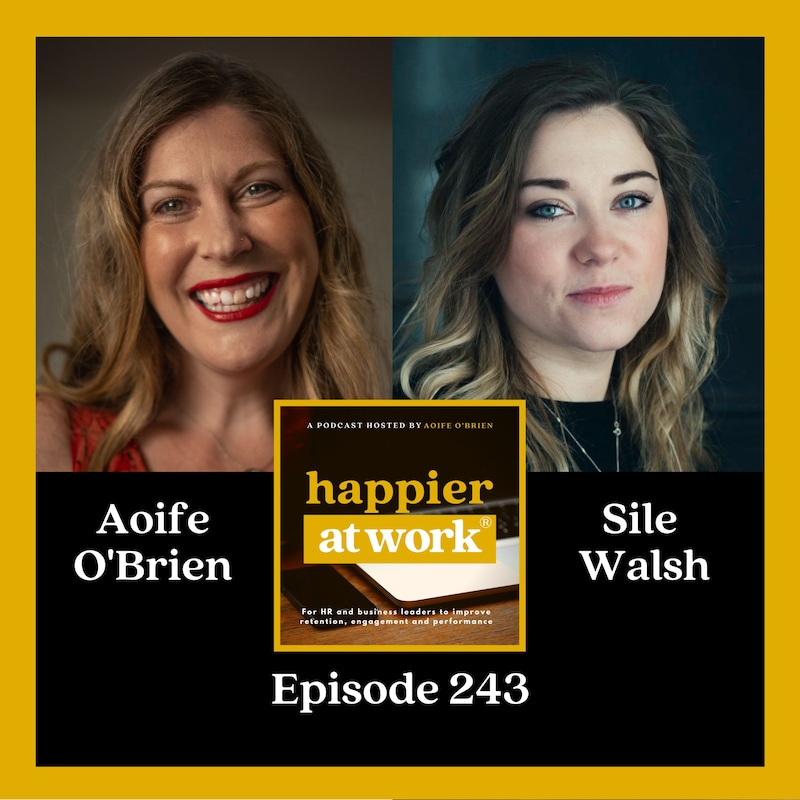
Shownotes
How can mental health conversations reshape your workplace?
In the latest episode of the Happier at Work podcast, I had an insightful conversation with Sile Walsh, a leadership expert and author, to discuss her exploration of inclusive leadership and its impact on organisational success. Based in Dublin and active across Europe, Sile brings a wealth of experience in leadership and organisational development, with her new book shedding light on this crucial subject. Her transformative approach to inclusive leadership emphasises practical application, cultural considerations, and the importance of balancing workplace needs with individual empowerment.
During our conversation, we navigate the complexities of diversity, equity, and inclusion, addressing common misconceptions and ineffective practices while highlighting the importance of adaptability and understanding in varied regional contexts. Through candid discussions on leadership, personal responsibility, and maintaining authenticity and boundaries in professional settings, they provide actionable insights for leaders committed to fostering more inclusive and effective workplaces.
The main points include:
- Understanding inclusion from an organisational perspective and clarifying common misconceptions.
- Challenges and cultural considerations in applying DEI principles across different geographical contexts.
- The importance of actionable practice over knowledge in diversity and inclusion training.
- Workplace boundaries and the significance of balancing personal and organisational values.
- Recognising personal responsibility in fostering workplace engagement and inclusion.
- The crucial role of diverse perspectives and effective decision-making without enforcing homogeneity.
- Strategies for inclusive leadership focusing on unmet needs and avoiding reliance on capability alone.
- The pitfalls of unconscious bias training and the need for effective implementation.
- Embracing divergent views for effective work practices without necessitating belief adoption.
Do you have any feedback or thoughts on this discussion? If so, please connect with Aoife via the links below and let her know. Aoife would love to hear from you!
Connect with Sile
Connect with Happier at Work host Aoife O’Brien:
Previous Episodes:
Episode 88: Why DIsability inclusion in the workplace is important with Seonaid O’Murchadh
Episode 137: The journey to diversity inclusion and belonging with Siobhán Sweeney
Episode 167: Embracing diversity and inclusion at work with Donna O’Connor
Episode 207: Gender Equality and inclusive leadership with Robert Baker
Transcripts
Sile, you're so welcome to the Happier at Work podcast. I know we've been connected for a long time, and this conversation has been on the cards for ages. And I've just finished reading your book, so I'm so excited to have this conversation. Do you want to let listeners know a little bit about your background and how you got into doing what you're doing today?
Sile Walsh [:Thanks so much, Aoife. You're right. It's been on the cards for a very long time. It's really good that it's now kind of aligned up. So my name is Sheila Walsh and I'm based in Dublin, Ireland, but I work kind of across Ireland, the UK and Europe. And I do work with global organisations, but it's usually entering in through like a European or UK or an Irish office. I specialize in leadership and organizational development. And this has led me into kind of thinking about inclusion leadership in a couple of different ways.
Sile Walsh [:First of all, I'm in my final year of a PhD looking at inclusion leadership and organisations with a kind of Irish and UK focus ultimately, because a lot of the conversations we're having are, centric to other places with other realities in terms of legislation, societal preferences, and all of those things. It's interesting because inclusive leadership isn't something that I picked out of the air 1 day. I've been engaging in community development and with marginalized communities Since I was 15, I was I've been volunteering in different ways. And then in my work, the disparity became really obvious. So I was working with really senior leaders in very privileged positions, even if that wasn't their background, who had lots of power. And then I was going into community settings with very little power. And I had this dilemma that I'm walking from 1 room to another room with completely different abilities for change, not because the individuals aren't motivated, but because the access and the whole context around them. And so I remember fighting with this a little bit and saying, I need to think about what's happening in organisations around inclusion, because I'm out in society doing it in spaces from a voluntary position or a very low paid position.
Sile Walsh [:But there's lots of wisdom that isn't coming from communities into organisations. But there's also lots of knowledge from organisations and professionals that aren't coming out into communities that don't have access to that lingo, that education, that network. And so there's a couple of things led me specifically to use the word inclusive leadership. But before I use the word, I was always using inclusive leadership. And this is something a lot of people don't know. So my background is coaching psychology and organizational development. Whenever a coach is working with you on any topic, they have an underlying assumption about that topic, whether they're conscious of it or unconscious. I happen to have a conscious informed assumption based on understanding participatory management, co creation, co design, inclusion, thinking about anti oppressive practice and power.
Sile Walsh [:So I was bringing that into my work all the time, but I wasn't using the language because inclusion didn't really mean what I meant by it. And that's kind of how the book came about as well as people kept thinking inclusion was, oh, they would say I have a diverse team. And I'd say, what do you mean by diverse? And they'd like roll out somebody who was different to everyone else on the team and say, see, we're diverse. And I'm like, okay, we're having very different conversations here. So the book came about because I was like, I need to define it so that people understand it from an organizational perspective. So leaders who want to do good work but are preoccupied with deliverables know how to utilize inclusion, but also deliver outcomes. So that's kind of how I got into this, but I had been using it long before I used the language. And I have this joke.
Sile Walsh [:The day I said I do inclusion leadership was the day my overt clientele who hadn't worked with me changed. So previously I came through referrals and I'd have all sorts of people come to me. But once I use the word inclusive, unless you came through referral, you had a preconception about what work I did. And this became a really interesting thing. The minute I put the word inclusive beside leadership, people thought I was talking about inclusion only and not about effective leadership, utilising the science of inclusion ultimately. And so I've kind of got here in a roundabout way. But you know that kind of old saying, when you look back, it all makes sense? Well,
Aoife O'Brien [:when I
Sile Walsh [:look back, it all makes sense.
Aoife O'Brien [:Yeah. You you can't join the dots looking forward. You can only join the dots looking back. Steve Jobs said that. I love it. Sheila, 1 of the things that I loved from the book was just simply your definition of what does inclusion mean. I think you sort of alluded to how you got to that place and what it's not. Do you wanna talk to us a bit more about you? Like, how do you actually define inclusion? And maybe, as you've said, like someone wrote out someone who's different to everyone else, talk about the broader context of DEI DEI.
Aoife O'Brien [:Maybe. Yeah.
Sile Walsh [:Okay. So the first thing is that, inclusion ultimately means a sense of belonging and an experience of one's uniqueness. Right? So what that means is I feel like this is the space that I belong in, so this is the right space for me and I don't have to conform. I'm allowed to be myself within boundaries. We can get into that and the book has a big rant about that. But 1 of the big issues is that people think about inclusion from a societal lens and not an organizational lens. So in society, everybody who exists in society, it's my belief from a human rights perspective, has a right to be inclusion, and has a right for their human needs to be met in that society. And there's legislation and there's kind of international protocols.
Sile Walsh [:But in organizations, I can't just rock up to the Law Society of Ireland and say, DEI, let me be a judge. Because there's rules to ensure that the purpose of the law society does its job. And so organizations, we only join because we have something to add. There is something that we bring. We don't have automatic membership to organizations. We have optional, which means we pick the organization, but also they pick us. So there's a mutual piece. Most people don't have choices about what society they're in.
Sile Walsh [:And so when we take some societal efforts and we just automatically apply them to organizations, we miss a really big thing, which is organizations have a purpose and the purpose is to produce whatever its outcome. Education is education. Government, societal, good. Private organisations, profit, not for profit, social impact. So every organisation exists for a purpose. It doesn't exist just by being there, whereas societies DEI, they exist by us being present. And so when we take a
Aoife O'Brien [:distinction, I think. So maybe we take a pause there
Sile Walsh [:that, like
Aoife O'Brien [:Yeah. The assumption is that, oh, we've created this organization, and we want to have people who are different. So we'll bring different people, and that creates such a diverse team. Actually, what you're saying is an organization exists for a purpose. And I think we'll expand on on the idea of, like, this idea of capability and having the right people in the organization. And it's not just a kind of a free for all. I think you've made some really good points there about, like, you can't just rock up to the law society and say, hey. I wanna become a judge.
Aoife O'Brien [:It's like there are rules in place as well. Sorry.
Sile Walsh [:Don't get me wrong. No. Don't get me wrong. If if the law society would like a judge and they're willing to waive all the rules, I'm here and they can contact me. No problem. Be delighted not to. Right? But it it's it's just this kind of basic assumption. And then the other thing that causes a bit of confusion is we're taking a lot of understanding about diversity, equity, inclusion from certain points.
Sile Walsh [:I would say USA centric and sometimes even UK centric. And what we're not doing is understanding that different geographical locations have different reasons that they're using certain approaches to DNI. And 1 of the reasons is legislation. So in Ireland, in the UK and in Europe it's variable but there is actually a baseline for discrimination. So when you're in a workplace, there is legislation to say that you should not be discriminated against and you can act on that legislation. So that's the baseline. But when we look across at the US, we know that that baseline is not as clear or structured and can easily be undermined. And so it makes sense that maybe in the likes of the US, there's more of a social movement.
Sile Walsh [:Whereas in the likes of Ireland, the UK and Europe, what we really need to think about is what is the point of this work in an organization? And the point is, from my point of view, we know that if you increase diversity and inclusion, and we'll talk about the difference, you can improve performance. So you can improve organizational performance, team performance. But there's another layer to it, which is if you were going into the marketplace and it's becoming more globalized and your groups are homogeneous, meaning that they're all very similar to each other, then you're going to miss vital data in development, in working with clients, in decision making. And so while I deeply believe in societal inclusion, right, like I have to say it because people think I'm saying it doesn't matter, it does. I'm just saying that it's the wrong context when we think about organizations. Organizations have boundaries. They exist for a purpose. We have some legislation we have to adhere to.
Sile Walsh [:But also diversity, equity and inclusion can really offer an opportunity to organizations to thrive. I have a bit of pushback on some of the common ways that we're doing it. I don't think they're helping people. But then there are other ways that people are doing it really well. And so I think that what kind of irks me is when people think inclusion means that really awful training that was done in your organisation, or it means you should or shouldn't say this or that, or it means quotas. And I have, you know, this isn't a lecture, so I won't go on about, there's a good time and place for quotas. But what ends up happening is people think about it in terms of their negative experience of it. And leaders think about it as a distraction.
Sile Walsh [:They don't want to say that, but that's the reality. They think if I'm being inclusive, I'm somehow going to be less effective. Whereas I'm repositioning inclusion as how we do work really well. Whereas I'm repositioning inclusion as how we do work really well. And the evidence is there. I'm just changing the narrative. It's not that it's my idea. It's that I've accumulated all of the research.
Sile Walsh [:I've looked at it in practice. And it's really evident that it can really lend to good performance in organisations. But it means we need to make some adaptions to how we understand inclusion, inclusive leadership, and also our ideas about it. Because my position is that a lot of people have attended bad diversity and inclusion efforts rather than good ones. And not all, but many.
Aoife O'Brien [:Yeah. Yeah. I love that. But this idea I just want to, I suppose, reiterate this idea of quotas. And, like, I've seen, again, evidence of like, oh, we have quotas. To me, it leads to tokenism and, oh, she was only promoted because she's a diversity number or something like that. That there there's something coming. It just it just makes people think that it's only in order to meet a quota.
Aoife O'Brien [:It's not because it's the best person for the job or it's the right person to do, you know, anything like that. So that's kind of my perception. I was gonna come back to this idea of, like, wrong is the wrong word to use, but, like, maybe the the experiences that people have had up to now of DEIB and I and the not so helpful experiences. Can you talk a little bit more about what those are?
Sile Walsh [:Yes. So 1 thing is not making it contextually appropriate. So people coming from 1 country to another and teaching it through their own geographical lens, their own kind of cultural view, and then wondering why it doesn't land. I hear this frequently for global organizations that have any kind of central decision making, in 1 geographical area. Whether it's the UK or it's the US or it's parts of Asia. Like wherever there's a central decision making, it often can be a really big issue because the examples can be bad. The metaphors can be bad. There's also can be an ignoring of how culture and legislation influences it.
Sile Walsh [:So that's 1. And then the other 1 is when people teach it as good and bad or morally superior. So 1 of my pushbacks is that there's an awful lot of liberal positioning within diversity, equity, and inclusion work. And I don't actually have an issue with anybody having any political position. But in the workplace, if we're talking about inclusion of all, but the practitioners are ideally or politically liberal and they teach in a way that harnesses liberal values, they're going to create this pushback that we've seen happening internationally at the moment where people think DNI is, you know, it's woke. And I mean that in a negative way when they use the word it's too much. But then there's also been some really terrible decisions. Like I was in a training and somebody in the training told me, this is how autistic people want to be spoken about, and this is how dyslexics want to be spoken about.
Sile Walsh [:And in the training, I was like, excuse me. Where did you get that data? And they said, what do you mean? This charity and that charity. Well, both those charities are not lived experience led, first of all. The second thing is you didn't ask anyone in the room what's their position on this. You've decided what's right and wrong. And we would call that an oppressive way of teaching inclusion. Because when you're in a room and you're saying you should listen to people and you should create space for what their experience is so that we can work together well, but then you come in and you dictate to people what it is, it becomes very counterproductive. And I think a lot of people aren't always reacting to the content, but how the content's being taught.
Sile Walsh [:And also, inclusion in an organization means including people you disagree with. Like, people don't want to talk about that. It means including people who have different worldviews to you. That doesn't mean that you have to discuss those worldviews. It doesn't mean that you have to accept discriminatory behavior from those people. But it doesn't mean that they have to adopt the same beliefs as you. If they do, that's not diversity. That's like we have something else happening there.
Sile Walsh [:And then there's some other really bad examples where people have used non evidence based interventions. Like, people are going to hate me to say this, but a lot of unconscious bias training, while the intention is good, the people who benefit from it probably don't need to attend. They probably read the articles or watched the videos already. The people who will benefit most from it probably don't want to go. Yeah. And there's something That's a good point actually, Sheila.
Aoife O'Brien [:That's such a good point. That the people who like, I've done I'm trying to think if I've done any training. I've certainly taken the test to show that I'm marginally biased against women. I was like, oh, that's quite interesting. I didn't know that about myself, but now that I'm more aware of it Mhmm. And I think you you really bring this point home, it's the awareness of it doesn't mean that you're going to necessarily act differently. So it's the awareness and the action together that that really needs to happen.
Sile Walsh [:Yeah. And and I think imagine if if I came in to tell you your beliefs 1st of all, unconscious bias is a natural part of the human function. So you're going to spend the rest of your life Consultants like me will get a lot of work out of this because I can spend the rest of my life training you about unconscious bias because it will never be enough. But what we can do in workplace, we do need addressing of awareness and unconscious bias in society because that has a different context. But in organizations, we can actually build processes that prevent bias taking hold. And in an organization, that's nearly more effective from a very basic reason, which is you're assuming people thinking or knowing their biases stops them being biased. The research is really contradictory. There's lots of research to say unconscious bias training can be more harmful, but there's also training to suggest that it can, leave people more sure of their biases and use it as an excuse.
Sile Walsh [:So there's a lot of
Aoife O'Brien [:That's just the way I am or it's okay all the time. I have a label for it.
Sile Walsh [:Yeah. And it's unconscious. Well, it's not unconscious the minute you know about it, but, you know, oh, it's a bias. It's natural. Oh, sorry. Instead of being, well, actually, how do I change the behavior so this bias doesn't create discrimination or inequity in my organization? Because there's lots of biases that we should have and we do have that we do not want to change because they keep us alive. But there are biases that create inequity or hold back opportunities that we do want to address. And that's the types of unconscious bias focus on.
Sile Walsh [:But unfortunately, it leaves people feeling morally superior or feeling less than, or thinking that they can interrupt all these unconscious biases rather than create behavioral or practice interventions that don't allow these biases to take hold of a situation. So we're using a societal approach of changing people's minds in the workplace. And there's a bit of an ethical issue. Imagine I brought you into work and I wanted to change your mind about something and you didn't have a choice about that training. I find that a little bit challenging. And I do understand that people are doing their best. So unconscious bias training has been around a long time. It comes from a societal or social model.
Sile Walsh [:But there's actually a piece about saying that's not enough in workplaces because you can do the training and still be wildly biased. So we need to be a bit more accountable in workplaces for how we do that.
Aoife O'Brien [:So it's about the practice as opposed to the knowledge. Then. You're like, oh, I went to this training. I ticked the box. And again, in your book, I know you have this whole kind of thing about it's not just about ticking the box. You know? It's about implementing change, and it's about practicing inclusion as opposed to now that we know about it. Oh, great. We we we know what there is to know.
Aoife O'Brien [:Just because you're knowing doesn't necessarily mean that you're doing. I'd love to take a slight detour Mhmm. Into something that you mentioned a second ago, which was this idea that if we are I'm trying to think of of how best to explain this, but it's really this idea that we're bringing all of these people and we want to be inclusion, and diversity, equity, inclusion is perceived as being something quite liberal and, to use that term in a derogatory way, the term woke as well. And how do we how do we make sure that it we're not kind of forcing our opinions on other people or that we are including people who who have different opinions to ourselves, for example. Or, like, you know, I'd I'd love to explore that whole idea because it is something that it it struck a chord with me when I was reading the book, and I was like, oh, that's actually oh, that's tapping into something, and I'd I'd I'd love to explore it a little bit more with you.
Sile Walsh [:Mhmm. So the first thing is, everybody's political beliefs are their their right to have. Right? So I believe like, I believe in inclusion in a way that that often people don't because they believe in inclusion, which is I'll include you when it aligns with my political belief system. So in the workplace, we have a boundary, which is we go to work to help the work proceed. And in a workplace, we don't have to have the same beliefs, but we have to have agreed ways of working. And when we're thinking about inclusion, an organization, it is appropriate to set standards and leaders about how we are going to hire people, how we are going to manage performance, how we are going to intervene with societal inequity that shows up in the organization. Leaders and organizations can make those decisions about the boundaries of how we do our work because we do it all the time. I can't walk into a kitchen today without my hair in a net, Right? I might not believe in hairnets, but if I want to be in that environment, then I need to agree to that code of conduct or that way of working.
Sile Walsh [:And so for me, it's not about trying to change people's beliefs. It's about making sure that we have ways of working that actually are inclusive. So for instance, people and I you know, the saying, bring your whole self to work. Well, please don't. That's very dodgy. Not a good idea. Because when people say That's another thing I took from your book. Like when
Aoife O'Brien [:people say authenticity, show up as your authentic self and Yeah.
Sile Walsh [:Yeah. But the reality is that if you're saying that, then you're saying that the racist, homophobic person should show up as their authentic self.
Aoife O'Brien [:Yeah.
Sile Walsh [:Bring bring that bring all of that to work. The reality is that in the workplace, we're contributing to the task. Task. We're contributing to the purpose. And we need to have ways of agreeing that. And so I don't want everyone's whole self. I don't want the way I talk to a lover or I talk to a nephew or I talk to my parents to be how I talk in a meeting at work Or how I banter with my brothers might not be appropriate for how I banter with someone at work or I talk to a senior leader. So we've to decide what's appropriate.
Sile Walsh [:The reason that they have this big story about belonging your authentic self to work is because originally people who are marginalized had to hide their identity and mask. So really what we're trying to do is say you don't need to mask. But we've now said bring your whole self to work, be authentic. And people are bringing very inappropriate things into the workplace and using that line. And there's a case in the UK where somebody was told, it's okay to make mistakes here. This is only this year. It's okay to make mistakes here. It was on a live recorded event with a consultant like me.
Sile Walsh [:It's okay to make mistakes. He used a highly derogatory term that was universally agreed to be derogatory. It was a racial term. He got fired. He then got compensation because he was told it was a safe space. And that was not safe because there's a consequence to what he said. And so we have to be really clear. If you're bringing someone into the workplace, there's a baseline in most countries, which is discrimination legislation.
Sile Walsh [:Everything above that line is up for discussion, but that's our baseline. We do not promote discrimination here. That's the baseline. And then you need to say appropriate for work. Because 1 thing managers are coming back to me with a lot and senior leaders is, I'm trying to be empathetic, but how do I cope with people who are just using me as a therapist? And that's not appropriate in the workplace either because A, they're not trained. So let's be really honest, you're telling someone who doesn't know how to help you. But B, you've now made yourself really vulnerable to somebody who has aligned responsibility to you.
Aoife O'Brien [:Yeah.
Sile Walsh [:And so we need boundaries in the workplace. We need to be able to not have to mask, but we also need to be really clear that inclusion doesn't mean I just include people like me or people that agree with me because that's actually the foundation to exclusion. Inclusion is I find ways to work with people that I disagree with, but we have an agreed way of working.
Aoife O'Brien [:That's that's a huge challenge for people, I I would say. And, you know, myself included when I was, employed, working with people who disagree with you can be really, really hard. And I love how you share this idea that it it's a practice. Like, it's not something that we'll ever get to a destination. It's something that we need to continue to keep doing. Any thoughts on how to work with people who you find DEI let's say, if you disagree with them or you you find them difficult to work with or don't necessarily have the same beliefs or whatever it might be.
Sile Walsh [:Yeah. So I I love this. So the the first thing is I don't want anyone listening thinking that I'm really good at working with people that I disagree with. I do an awful lot of processing, an awful lot of therapy. I have 2 different supervisors with slightly different practices. Like I go to coaching. I'm very active in processing so that I don't get stuck because I think that's what's happening for people. We're getting stuck in this work and it's then getting people People are leaving organizations, they're burning out.
Sile Walsh [:There's kind of feuds, there's polarisation happening. So 1 of the first things I do is I work through how it feels to disagree with someone. Right? So, you know, Sheila number 2 believes in this and Sheila number 1 believes in that. Well, I think about how I got to my belief and I understand that people got to theirs through their lived experience that often they don't have responsibility for. So we're not at fault of Sorry. We have responsibility for what we do with it, but we don't necessarily have control over the lived experience that we've inherited often. The other thing I do is I honestly look for the value in what they're saying. I listen to podcasts I highly disagree with.
Sile Walsh [:I listen to YouTubes I really disagree with because I'm trying to understand what the unmet need is that this person is responding to. And there's some really big influencers who I have a really big disagreement with. And I listen and watch them because I know that they are meeting someone's need. And if I understood that need, I might be more effective in my work. So I find being able to regulate and tolerate an opposing position. Now that's really hard when the person is opposing someone I love or an identity that I have or someone I love has, or just anyone because I kind of have a very strong sense of humanity in this work. But the reality is that if I can't hold that space, I'm going to dehumanize them. I'm going to split off for them and put them in the bad person category.
Sile Walsh [:I'm then going to act out against them. Like this happens all the time. I'm going to act out against them and feel justified. Build a narrative in my head about how terrible they are and how great I am. And I am going to feed the feud. I'm going to feed the problem. Whereas if I step aside and I think, what do we share here? Do we have any shared goal in this activity? What can I listen to, to influence that person or to support that person getting into alignment and partnering me in whatever we're doing? But it often means that as the inclusive leader, as the inclusive practitioner, the work is on our end. And what we try to do, and this is really normal in workplaces, we blame the other.
Sile Walsh [:We want the other to change. And I'm first in the queue with that. I'm like,
Aoife O'Brien [:that person's
Sile Walsh [:Yeah. But then I have to backtrack.
Aoife O'Brien [:You this book that you need to read because you need to change. That means
Sile Walsh [:Exactly. Exactly. And I know a couple of people that bought my book as a hint, hint, nudge, nudge, insult to people. Yes. And I put out a little post saying, please don't do that because the people reading it, you know, you you might be the 1 who actually needs to read it if you think other people need to change. And don't get me wrong. There's lots of things that are not appropriate. And I say this when I'm lecturing.
Sile Walsh [:I am not talking about bullying, harassment. I'm not talking about discrimination. I'm talking about the line above those, interacting with people that we just disagree with. We do in most countries have good legislation. Okay. Different countries. In Ireland, the UK, most European countries, we have some good legislation. Wider field, it gets a bit more complex.
Sile Walsh [:But it's really about first having a reaction, which is reasonable, but regulating yourself so you're not acting it out on the person. The second is, what's the most effective thing I can do here? And I teach this in leadership all the time. Not what's right, not what's fair, not what I think should happen. How can I be most effective in this reality? And this reality is people have different worldviews, people have different experiences. We might have something to learn from the person we dislike and reject. They might have something to learn from us. But for me, it's about being effective. So what can I do in this reality to be effective? And that moved me away from kind of projecting onto them, blaming, cutting them off, shaming them, all of that.
Sile Walsh [:And then the other part that I really think is powerful is instead of saying, they are a difficult person, I say, I find this person difficult. And the person difficult. And the reason I do that is the minute I say they're a difficult person, the only solution is them changing. The minute I say I find them difficult, I now I have an opportunity to be part of the inclusion. And the relationship between us might actually help us solve the problem too. Whereas the minute I put it in them, we're all stuck. They just either get I either fire them, I either avoid them, I either criticize them, but there's no effectiveness out of that. There's just splitting occurring.
Aoife O'Brien [:It's the shift saying I'm now taking responsibility. I find this person. So what is it in me that finds this person difficult, and what can I do about it as opposed to relinquishing total control and just putting that that's a bad person? I'm so glad, Sheila, that you said that you find it difficult as well because it you know, it's you're not exactly preaching from the pulpit saying, oh, yes, and I have all the answers. It's like, no. This stuff is hard, but there are tools in place that are that can help you to to understand more about yourself and and kinda what's going on for you. We kind of touched on or at least I mentioned this idea of capability earlier, and that was also something that I it probably wasn't a huge chunk of your book, but it was something that really resonated with me specifically. And I suppose in the context of the difference between capability and feeling included and being included versus this whole idea that you're saying about, like, an organization exists for a purpose, so you need to have the capability in order to function in that workplace. Can we unpick that a little bit, this idea of capability versus inclusion? And I suppose the reason I'm saying it is it resonated because I've worked in some organizations, and I always felt it was because I was, being excluded, let's say, in in 1 sense.
Aoife O'Brien [:But then it was like, is it just because I'm in the wrong place? I am not going to thrive in this environment that I'm in because it's the wrong place for me.
Sile Walsh [:Okay. So it's there there's kind of a couple of layers. The the first layer, I would say, there's an underlying assumption the right person for the right job is about capability. And I just wanna be really clear. I absolutely believe in the the best person for the job. That's the kind of saying. My issue with that is that actually how we're measuring the best is highly limited. And there's a bit of research to say if we want the best person for the job, then actually if we diversify how we make that decision, we will find a variety of different identities in the final stages.
Sile Walsh [:And with the role, we have some limited ways of doing that. Why I'm saying that is that relates to capability in terms of a couple of things. To be included is not to have everyone who has an opinion being held equally. So let me give you an example. If I'm in surgery, I don't want the janitor's opinion about my surgery to be the deciding factor of whether they make the the hole this big or or this big. You know, small or big, whatever. But that doesn't mean that the janitor doesn't have value to add in the conversation. And having worked with some hospitals, it's really clear that often roles you don't expect to have value do, but we need to know where they're appropriately placed.
Sile Walsh [:So that's internally 1 of the things we have to think about. The second thing is inclusion is including what is required, what and who is required to get the best outcome. So if I'm pulling somebody from accounts to a meeting about innovation and the person is bored in the meeting and doesn't feel connected to it, and we are not even looking for the input, then can we stop inviting people to the meeting to pretend we're inclusive because we're just wasting time? That's a piece. And then in terms of-
Aoife O'Brien [:So I'd be glad not to have that invitation as well to save themselves a couple of others.
Sile Walsh [:Exactly. And then the other thing about capability for, let's say, choosing an organization is really compatibility is really important. I'm vegetarian. I wouldn't work in an avatar or slaughterhouse. Right? For a very fundamental reason. The work they do feels really in contrast to me as a person, like highly in contrast to me as a person. Right? Would I work with staff who work in a slaughterhouse? Yeah. Because that's not in contrast.
Sile Walsh [:It is not in contrast for me to support people in organizations to thrive and do their work well, even if I don't align with the actual work. I have some boundaries around that personally, but I'm giving an example roughly. There are some boundaries if it's related to human rights and animal rights. I might have additional questions. But generally, compatibility is about DEI you generally align with the organisation? A lot of organizations try to say, you have to buy into our values. And I have a big pushback on that. That's ridiculous because you'll have homogeneity, you won't have diversity. What we need to do when we sign up to an organization is to agree to work and make decisions using their values, not our own.
Sile Walsh [:Mhmm. And people are like, but I want to use my own values. Well, it's great when they align and you're using the organization's values, you're going to find more flow in your work. Brilliant. But this idea that you must have the same values as the organization is a bit naive really. Because the reality is you're a person. You're probably not walking around going, inclusion is my personal value. It's probably not everybody's personal value.
Sile Walsh [:The other part is that some workplaces are designed for certain people to thrive and others not. And that's not conscious often. Sometimes it is because we have more organizational psychology engineering these structures. But often what happens is you're in a particular industry, so certain types of people are drawn to that industry. Or you're in a particular organization and that draws certain types of people. And those types of people, when they have similar ways of working, that way of working becomes the dominant way of working. And so unless an organization goes through transformation process, whatever the dominant way of working is, will just be the default. And then you'll get people who do not thrive with that work environment.
Sile Walsh [:And they have to make some decisions. So 1 decision is, can I work within this way of working effectively? So can I do a good job within this way of working effectively? Can I stay well if I can do it effectively? But there's lots of environments I could work in, that I'm not set up to thrive in, but I can be effective because I read the context, I work with people. I do lots of workarounds. I can make it work. The next question is, does that have an impact on my well-being? So my mental health, my sense of purpose, like who I am as a person, my self esteem. If it's taking a lot from that, we might not be compatible.
Aoife O'Brien [:Yeah.
Sile Walsh [:And that's a responsibility that individuals have and organizations have to say, and I don't believe in culture fits, I believe in culture compliments. So I don't think you have to go into an organization and immediately feel like it's designed for you. That's not what I think belonging is. Belonging is that when I go here, I have places within meetings or relationships or context where I can thrive and flow. Mhmm. But let's let's
Aoife O'Brien [:DEI realistic.
Sile Walsh [:That probably isn't a
Aoife O'Brien [:100% of the time
Sile Walsh [:for 100% of the people in any setting. No. It's never going to
Aoife O'Brien [:be 100% of the time. That's for sure. No. But I think the question is
Sile Walsh [:the impact. There's clients I've worked with as a coach. And when we've gone through the assessment of their work needs, their effectiveness, where they add the most value, and then we look at their experience, my question to them is, are you willing to pay this current price? Because you're paying a price right now that has brought you to me. There's other people I work with and I can see that they're not being as effective in the reality. And if they were to change some things, they actually could be well at work without the workplace being wildly different. And so it's not about toxic workplace or toxic culture or good or bad. It's about, have I done everything to be effective within this reality? Am I addressing some of the stuff I'm bringing? Like, do I ever believe everyone should be a certain way and because they're not, it's causing me harm? It's causing me burnout because I'm frustrated. Am I processing my frustrations properly? Do I have other things outside of work that are good for me that I connect into when I feel that work is too much? If we've done all of those things and someone is saying, I'm still paying a high price and you can assess it, you don't have to actually have the bad experience being burnt out, then you have a decision to make.
Sile Walsh [:But a lot of people come because they say they don't want to make the decision. What they want is the organization to be different. And unless I'm brought in to do the organizational change, which sometimes I am, then that isn't what's on the table. What's on the table is, can you be effective and remain well within this reality?
Aoife O'Brien [:It's it's coming back to that link that you made earlier where when we have a problem with someone else or we want to buy the book and hand it over to someone else, We're relinquish we're relinquishing the responsibility of that and the accountability to ourselves. And people are probably reluctant to make that decision because it is a hard decision to make, isn't it? Especially if it's somewhere where you previously thrived, but something has changed. And if you've kind of done everything that you can to to perform, to thrive, and to be well at work and it's still not working out, it's still it's a hard decision to make, I think, to leave an organization. I probably skipped ahead a few chapters and I didn't try and rectify things, or at least in the knowledge I had at the time, I did what I could do best at that time, but I left 2 organizations that weren't where I wasn't really thriving. And I look back, and I'm grateful now for the experience because it's brought me on this journey that I'm on now. But that's kind of how I coped with it. I I left, and I did try and do like I say, I did try and remedy it to the degree that I was aware at the time. But listening to you now, it's like, wow, there's so many other things that I could have done to remedy those situations.
Sile Walsh [:Yeah. And I want to be sure that people listening, don't use this to, like, rip themselves with, right? Because fight, flight and freeze are really normal responses when we're kind of in a system, an organizational system, when something happens. Fight is to go around kind of advocating and demanding, but maybe not effectively. Flight is to leave either physically or emotionally because both of those things can happen. And freeze is to almost just be reactive and not know what to do. So you're just kind of frozen and staying in the job.
Aoife O'Brien [:Yeah. And not contributing, not thriving, just sort of doing the bare minimum almost probably as well.
Sile Walsh [:Yeah. And so what I would say to people is that the effective part, which most of us want to skip because we just like if places were the way we'd like them to be, The effective part is first acknowledging what our reaction is to the workplace and how we are contributing or co creating some of our experience. And then the next part is when we look at it kind of from that objective place and we're able to have thought about and implemented some effectiveness strategies, then the next part is making a decision. And if we choose to stay, which lots of people do, and I have no issue with that, that's your choice. You make the choice to stay with the reality of what you've just worked through and what you know. If you make the choice to leave, you make the choice to leave with the reality. My biggest pushback about belonging, as somebody who's left lots of organizations, I've done long stints, I've done short stints. My issue with leaving is if it becomes your only strategy for staying safe in the workplace, it's not helpful.
Sile Walsh [:Because you end up having to keep leaving environments that you might be able to work through something in. But also you keep building a narrative. I don't mean you, Naomi. I mean, we keep building a narrative. Yeah. Yeah. We. I didn't mean you.
Sile Walsh [:I meant like we. We build narratives that then say workplaces are good or bad or toxic or We create this kind of splitting again on polarization rather than saying that they're deeply flawed places. Systems with humans are deeply flawed. Now, what level of flaw can I work with without it costing me as a person? And what level of flaw might I even be able to harness to be more effective? So a lot of the best workarounds that happen in organisations happen because there's a flaw within the organisation that exists for good reason. People hate when I say that. Things in organisations, even if they're bad, there's a reason behind them existing. And sometimes that reason isn't able to be changed or that process isn't. So some of the best workarounds have come from people sitting through it and saying, I need to be effective.
Sile Walsh [:I don't want to accept it as it is, but I do need to accept the reality to be able to make some decisions about what I'm going to do in this situation. And so for me, you build grit. Now I'm saying that, so the people who leave a lot need to hear build grit. The people who stay too long need to hear, you've built too much grit. You might want to do a bit of an assessment of your workplace. So for me, it's all about balance. There isn't 1 right answer. There is, how well can you stay within a setting while developing your effective strategies and contributing to the work? And when that's out of balance, we have to make some decisions.
Sile Walsh [:But even if we decide to stay and do nothing, that's still a more empowered decision because we've dealt with the reality and we've taken responsibility for our way of being effective than it is if we just stay and resent it, which is what tends to happen when people first come to me. They're staying and resenting. Whereas you can stay and not resent it if that's your choice.
Aoife O'Brien [:Or just I mean, even staying and switching off, that you don't really care. You're not that engaged in the work. You're showing up, you're doing your job, but you're not you're highly engaged. Like, I know that's a term that's that's thrown out thrown about a lot, but really showing up and enjoying and thriving in the place that you are. Sheila, I'd love to to talk about some of the barriers to this stuff that we're talking about. What are the kind of things that get in the way?
Sile Walsh [:So I think 1 of the things that get 1 of the biggest things is we always think it's someone else's fault and problem. So when I go into
Aoife O'Brien [:when talking.
Sile Walsh [:Yeah. As as we go into whenever I talk about inclusion or inclusive leadership, people tell me if someone else does something differently, I can be inclusive or I can be happier at work. And the reality is that that might be true. It might be easier for you if they did it. But the reality is they're probably not going to do it because you're the 1 who benefits. So the first thing I think of a biggest barrier is this kind of wanting other people to make things better for us and not really thinking about our responsibility to ourselves. I don't even mean to the workplace, but to ourselves. The second thing is we often think we're doing much better at this stuff than we are.
Sile Walsh [:So the amount of people that say I'm very inclusion, and then I say, of whom? And then they list out some identity group. And I say to them, do you share an identity with that group? No. To someone you love? Yes. Like a sibling or a parent or a child. I said, so that's not really inclusive because that's your in group. Your in group might look different to other people's in group. And in group is just the group that are like us. Right? And out groups are the people not like us.
Sile Walsh [:And so very basically, people think they're being far more inclusive than they are. So that's a bit of a barrier. But then around kind of well-being, I think a big issue at work is so many of us have our identity so tightly entwined with our work Yeah. That it becomes really hard to see that your work is something you choose to do or you do. But also it isn't all of who you are. And for me, the more connected people are to their work identity, the harder it is for them to process when work isn't satisfactory. Because actually they've got too many chips in their workplace. And I say this as someone who has far too many chips in my workplace.
Sile Walsh [:Like inclusion is all over my personal identity and what my values and my beliefs. And then leadership is all over what I think about the effective part of me, the part that thinks about systems progress. I'm very deeply intertwined. But the issue with that is that means that we don't always take perspective and step back and make good decisions because we're really kind of stuck in an ego or identity based kind of piece. The other barrier is, and people hate me when I say this, is a lot of non evidence based interventions in the workplace. So, oh, we'll give them pizza. Well, was pizza their unmet need? No. Teamwork was their unmet need.
Sile Walsh [:Well, could we go onto that? What does teamwork mean to them? What are they actually talking about? A lot of the time we don't get the right data to make the decision. So when I work with people and organizations and they say, oh, we have a communications issue. And I'm like, that doesn't mean anything. Give me examples of what you mean by that. And then when we look at examples, it may be something very specific within communication. And so people love to do big strategies and big interventions before they even understand what the unmet need is.
Aoife O'Brien [:And
Sile Walsh [:inclusion is about unmet needs. So when I work with people in the workplace and I'm talking about inclusion, I am saying, how do I include you? What are your unmet needs to inclusion so that I can make an environment or support you or co create an environment with you that allows you to perform? So what are the things getting in the way of your performance? And sometimes it's how we measure performance is done badly. Sometimes it's that we haven't linked an unmet need to inclusion. So we're busy thinking about identity. So there's so many And then the other thing is people are so sure they're right. So sure they're right that there's no room for multiple truths. And that would be kind of an anti oppressive principle. Myra Chan wrote a book about it.
Sile Walsh [:But there's a piece about saying, I understand from your point of view, how you're seeing the situation is your truth, but there are multiple points of view on this situation.' And when people are so sure about being right and they don't leave room for dialogue and maturing the conversation and understanding each other, we get really, really stuck in righteousness and right fighting and proving ourselves. And we kind of create unnecessary interpersonal and organizational conflicts.
Aoife O'Brien [:Brilliant. I love that. Is there anything that we haven't talked about? About? Like, we've gone we've covered so many different areas that we kind of expanded even beyond the book, I think, in terms of the the depth that we've gone to. But is there anything in particular that you think you would like to get across that we haven't necessarily covered?
Sile Walsh [:So there's 1 thing, and it's it's about the term inclusive leadership because I imagine that people are listening and they have ideas. And I've done loads of research for my PhD in it. Everyone has ideas about what it means. When I'm talking about inclusive leadership, I'm talking about effective leadership. So leaders who are effective, belonging inclusion strategies and practices to be more effective, to improve performance. I am not talking about ticking boxes, putting on flags and parades about our inclusion. I'm talking about creating, co creating with others an environment where we are effective through utilizing inclusive measures. And inclusion can be as simple as, what do you think? Someone pushed back on this point of view.
Sile Walsh [:Who are we forgetting? Are we defaulting here? Is there anything we're ignoring? Like inclusion doesn't have to be attending a training or being unbiased all the time or being perfect. It can actually be a way that you approach being effective because it allows you to have a wider scope for your effectiveness. And to me, I just like people to leave with inclusion and also inclusion is for everybody in the workplace. It is not just certain identities. Yes, some identities are marginalized and we need to put specific attention on how we rectify that. But if your inclusion efforts and your inclusive leadership is just thinking about people who are marginalized, you're going to lose a large portion of your workforce and their buy in, which is what's happening. So inclusion is for everybody in the workplace to help everybody thrive, but their needs may be different and it's needs led.
Aoife O'Brien [:Yeah. Love that. Sheila, the again, that's something I took from your book, the idea that it's an everyday practice that and you can do it as part of your job. It's not something that's, oh, here's another thing that I need to add to my to do list, another thing that I have to do. It's no. It's learn these strategies and implement them in the job that you're already doing. So it's not taking extra time. It's just a different approach.
Aoife O'Brien [:And then also this idea that it's not just a group of people who are responsible for inclusion. It's actually a practice that everyone needs to make at work so that everyone else does feel included. So just wanted to reiterate that point, and that is something that was really clear from the book as well. The question I ask everyone who comes on the podcast, what does being happier at work mean to you?
Sile Walsh [:So I really love that. So for me, being happier is having more good moments than bad. And I say that because it's not about being all good. It's about being able to thrive in some way. So feeling like I'm in the flow, I'm doing something interesting. It's feeding me some of the time, at least half of the time. And it's also a little bit about my responsibility towards my attitude towards my work. Am I looking at it as a burden? Because it can be a burden.
Sile Walsh [:Some of the tasks are very dull. Or am I having a relationship with my work that supports me being happier? And so for me, it's about being able to thrive at work at least half of the time. Brilliant.
Aoife O'Brien [:Love that.
Sile Walsh [:I'd like more, I would say.
Aoife O'Brien [:Yeah. Yeah. Yeah. Yeah. More.
Sile Walsh [:But, you know, I think we need to have a bit of reasonable because I think sometimes people think happier at work means I get everything I want. I'm always content. Work fulfills everything. No. For me, happier is I engage with work in a way that's good for me.
Aoife O'Brien [:Yeah. Yeah. Yeah. I love that. I love that redefinition. And if people want to find out about you, if they want to get the book, if they want to connect, if they wanna work with you, what's the best place to to do that?
Sile Walsh [:Brilliant. So my website, which is currently sheilawalsh.com and myself and Aoife were joking. So Sheila is spelled the Irish way. So it's SILE. You can also pick up the book, which is called Inclusive Leadership Navigating Organisational Complexity from Waterstones, Amazon, and a number of other, providers. And then you can also follow me on LinkedIn because that's where I have kind of living conversations for want of a better description.
Aoife O'Brien [:Brilliant. Love that. Thank you so much for your time today. We have covered so much, and I've taken so much from this conversation. And I know that listeners are gonna take some really practical things from it as well, so really appreciate that. Thank you.
Sile Walsh [:Brilliant. Thank you so much for having me for and the questions were brilliant. I find them really interesting, so thank you.






