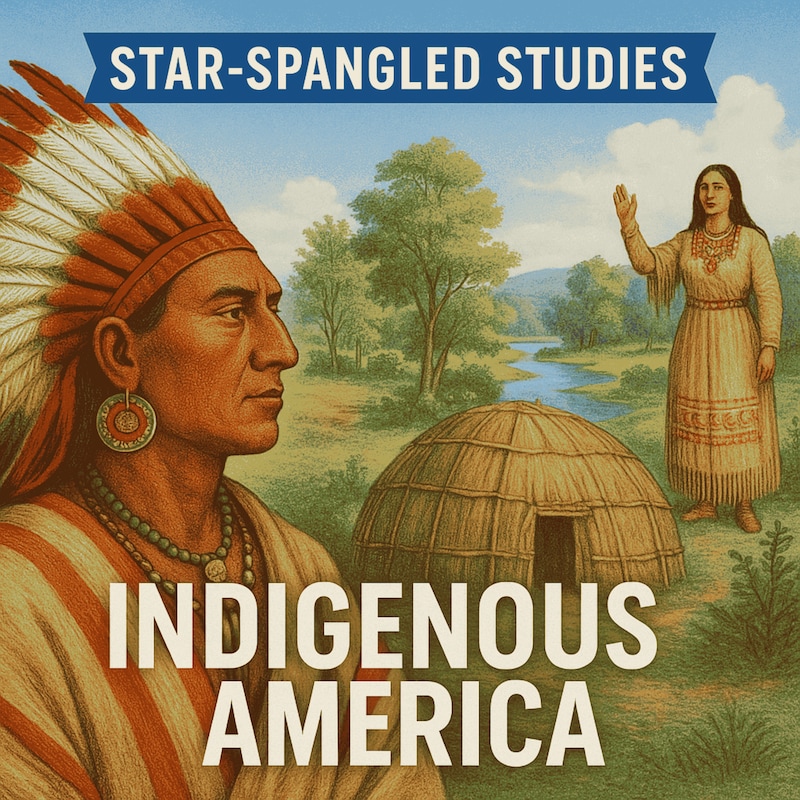
Shownotes
Welcome to Star-Spangled Studies, where U.S. history gets the depth it deserves! In this premiere episode, historian Dr. G kicks off Season 1 by dismantling the myth of the "New World" and exploring the vibrant, complex civilizations that existed in the Americas before 1492.
You’ll learn about:
- Native American origin stories and Indigenous worldviews
- Monumental cities like Cahokia and democratic systems like the Iroquois Confederacy
- Columbus’s journals and the violent logic of conquest
- The Columbian Exchange and the greatest demographic collapse in human history
- The Spanish conquest, the Black Legend, and the rise of cultural syncretism
🔗 Resources & Links
Instagram: @star_spangled_studies
Facebook: Star-Spangled Studies Page
📚 Subscribe & follow along each week as Dr. G walks you through the story of America
A profound exploration of the pre-Columbian Americas invites listeners to reevaluate their understanding of the continent's history, challenging the long-held notion of the Americas as a mere 'New World' discovered by European explorers. Dr. G eloquently articulates the rich tapestry of indigenous cultures that flourished long before the arrival of Columbus, emphasizing that for Native Americans, this land was their ancestral home, imbued with a profound historical significance that spanned thousands of years. By dismantling the misleading narratives that have historically marginalized these civilizations, we are compelled to recognize the Americas as a vibrant and complex landscape, teeming with diverse societies, languages, and cultural practices.
The episode delves deeply into the migration theories that suggest the first Americans traversed the Bering land bridge over 12,000 years ago, but it equally respects the indigenous perspective that sees their histories as rooted in the very land they inhabit. This duality of understanding invites listeners to appreciate the myriad origin stories of Native peoples, such as the rich narratives of the Selenium and Lanap, which reveal not only their connection to the land but also their sophisticated worldviews.
Further, the podcast illuminates the bustling societies that existed prior to European contact, such as Cahokia, a remarkable urban center that boasted a population exceeding that of contemporary London, and the Iroquois Confederacy, which exemplified a complex political structure based on consensus and matrilineal heritage. Through this juxtaposition of societies, we grasp the immense diversity and sophistication of pre-contact Americas, reshaping our perception of indigenous peoples not as 'savages' but as intelligent and capable stewards of their land, setting the stage for a nuanced discussion of the subsequent European incursions and their catastrophic impacts on these rich civilizations.
Takeaways:
- The podcast begins by challenging the Eurocentric narrative of the Americas as the 'New World', emphasizing that for Native Americans, this land was home with a rich history spanning over 10,000 years.
- We explore the profound complexity of pre-colonial societies, illustrated through the urban marvel of Cahokia and the democratic principles of the Iroquois Confederacy, showcasing diverse forms of governance.
- The advent of European contact marked not merely an exchange of goods but a catastrophic collision of cultures, leading to the apocalyptic decline of indigenous populations due to disease and conquest.
- Columbus's journey is portrayed not as a discovery, but as a violent invasion, revealing the duality of admiration and exploitation present in his accounts of indigenous peoples, thus setting the stage for future colonial narratives.
- The podcast also delves into the consequences of the Columbian Exchange, which reshaped global ecosystems and diets, highlighting how American crops fueled a population boom in Europe while devastating indigenous communities.
- Finally, the discussion reflects on the emergence of new identities and cultures in the Americas, born from the tragic fusion of European and indigenous peoples, a testament to resilience amidst destruction.
Transcripts
Hello, y'.
Speaker A:All, it's me, it's me, it's Dr. G. And welcome back to another season of Star Spangled Studies.
Speaker A:I'm so thrilled to be back at the mic with you.
Speaker A:And we're kicking off this season by going back, way back, way, way back, to a time before the United States, before the colonies, before the ships even set sail across the Atlantic.
Speaker A:We're starting with the very first chapter of the American story, a chapter that is often titled the New World.
Speaker A:But here's the first and maybe the most important question we have to ask.
Speaker A:New to whom?
Speaker A:The textbook we're using to guide our season, the open source American yop, puts it perfectly.
Speaker A:It says, quote, europeans called the Americas the New World.
Speaker A:But for the millions of Native Americans they encountered, it was anything but end quote.
Speaker A:For them, this was home.
Speaker A:A world with a history stretching back over 10,000 years.
Speaker A:A world of dynamic, diverse peoples who spoke hundreds of languages and had created thousands of distinct cultures from coast to coast.
Speaker A:So today, we're going to tear down that old misleading signpost, the New World, and try to understand the Americas on their own terms.
Speaker A: Before: Speaker A:This is the real beginning of the American yawp, that loud, barbaric yawp that Walt Whitman wrote about.
Speaker A:A sound of history that is both complex and contradictory and still echoes today.
Speaker A:So to understand American history, we have to begin with the first Americans.
Speaker A:But where exactly does that story start?
Speaker A:This question itself raises a fundamental tension in how we approach the past from a scientific perspective.
Speaker A:The story begins with migration.
Speaker A:The most widely accepted theory holds that between 12 and 20,000 years ago, during the last Ice Age, lower sea levels exposed a land bridge called Beringia connecting Asia to America.
Speaker A:Over the centuries, people migrated across this bridge and perhaps along the coastline in small boats.
Speaker A:And they populated the continent from the Arctic ice at the tip of the South America.
Speaker A:This is the archaeological story written in some stone tools and ancient DNA.
Speaker A:But for Native American peoples themselves, their stories don't start with a journey to a place.
Speaker A:They start in place.
Speaker A:Their histories are rooted in the American soil, emerging from the land itself through sacred acts of creation.
Speaker A:These origin stories are not just myths.
Speaker A:They are foundational historical texts that reveal the deepest values and worldview of a people.
Speaker A:Now, our textbook reader shares two beautiful examples.
Speaker A:The Selenium people of present day California for instance, tell of a bald eagle, the chief of the animals, who saw an incomplete world and decided to make human beings.
Speaker A:The eagle quote, took some clay and molded the figure of a man, but as yet he had no life.
Speaker A:Seeing that the man should not be alone, the eagle quote, pulled out a feather and laid it beside the sleeping man.
Speaker A:And from that feather a woman was formed.
Speaker A:Meanwhile, the Lanap tradition from the Northeast tells of a watery world where the earth was made.
Speaker A:Sky woman fell from the heavens and with the help of a muskrat and a beaver, she landed safely on a turtle's back.
Speaker A:That turtle's back became North America, a place many indigenous people still call Turtle Island.
Speaker A:The Cherokee tell of an earth as a, quote, great island floating in a sea of water and suspended at each of the four cardinal points by a cord hanging down from a sky vault, end quote.
Speaker A:Presenting these two ways of knowing the past, the scientific and the indigenous, isn't about choosing one over the other.
Speaker A:It's about recognizing that history is more than just a timeline of events.
Speaker A:It's also a conversation about meaning.
Speaker A:For thousands of years before Europeans arrived, Native Americans had their own profound understanding of their origins, their place in the cosmos and their history in America.
Speaker A:A history that began long before human memory.
Speaker A:So let's permanently erase the old tired image and idea of a vast empty wilderness sparsely popped populated by a few nomadic tribes.
Speaker A: The Americas in: Speaker A:The pre contact populations were enormous.
Speaker A:They fiercely debated with one another as we'll see later.
Speaker A:But no one disputes that these were millions of people living in thousands of distinct societies.
Speaker A:From a massive urban centers to sophisticated political confederacies.
Speaker A:To understand this diversity, let's put two of these societies under a microscope so we can better understand the diversity of the continent.
Speaker A:So first we're going to travel to the heart of the continent near modern day St. Louis.
Speaker A: Here, around the year: Speaker A:Today we call that Cahokia.
Speaker A: It at its Peak around: Speaker A:At the same time, it was the center of the Mississippian culture, a network of agricultural societies that spanned the Midwest and the Southeast.
Speaker A:Cahokia was a masterwork of urban planning.
Speaker A:Covering six square miles, featuring a grand plaza the size of 35 football fields and and surrounded by a formidable two mile long defense stockade wall that was built from 20,000 timber logs, the city was dominated by over 100 massive man made earthen mounds.
Speaker A:The largest, now called Monck's mound, was a four terraced pyramid that stood 100ft tall and covered 15 acres at its base.
Speaker A:Atop these mounds sat the temples and residences of the city's rulers.
Speaker A:This was a highly stratified society, a theocratic chiefdom where power was concentrated in the hands of priest rulers.
Speaker A:At the very top was a paramount chief, the great sun, who was believed to be a living God descended from the sun itself.
Speaker A:Below him was an elite class of priests and nobles who oversaw religious rituals, trade and massive public works projects.
Speaker A:And then the vast majority of which of the population were the commoners who farmed the fields, built the mounds and served the elites.
Speaker A:This hierarchy wasn't just political, it was spiritual.
Speaker A:The elites power came from their perceived ability to mediate with the supernatural world to ensure the rains came and the harvests were bountiful.
Speaker A:But even this picture of a rigid top down hierarchy is being complicated by new research.
Speaker A:Historian Gail Fritz in her book Feeding Cahokia, challenges the idea that the city was run entirely by a small group of male elites obsessed with corn.
Speaker A:She argues that since women were the primary farmers, the ones with the critical knowledge of crops and wild plants, they would have held significant positions of power and respect.
Speaker A:Fritz points to a small flint clay statues of women found at Cahokia, suggesting they represented a powerful earth mother or godmother deity.
Speaker A:She proposes that women's farming collectives, perhaps like the sort of goose societies of later Siouan tribes, were central to Cahokia's spiritual and economic life.
Speaker A:This place is quote the farmer themselves as key players, rather than placing them under the control of an elite centered priesthood.
Speaker A:Now let's shift our focus to the other side in the northeast, to the eastern woodlands, and look at a completely different model of social political organization.
Speaker A:The Iroquois Confederacy.
Speaker A:Formed centuries before European contact, the confederacy was a sophisticated alliance of initially five and then later six distinct the Mohawk, Oneida, Onondaga, Cayuga and Seneca.
Speaker A:Their system of government was codified in the great law of peace, a remarkable constitution that established a federal system with clear checks and balances.
Speaker A:While each nation managed its own internal affairs, a grand council of chiefs or sachems met to deliberate on matters of common concern, like war and diplomacy.
Speaker A:Crucially, decisions were not made by majority rule but by consensus, A process that required extensive debate and compromise to ensure unity.
Speaker A:This political structure was so effective and enduring that it drew the admiration of American colonists, including Benjamin Franklin.
Speaker A: In: Speaker A:Franklin pointed to the Iroquois Confederacy as a model writing quote.
Speaker A:It would be a very strange thing if six nations of ignorant savages could be capable of forming a scheme for such a union.
Speaker A:And yet that, like a union, should be impracticable for ten or a dozen English colonies.
Speaker A:The social structure of the confederacy was as distinct as it was political.
Speaker A:It was a matrilineal society.
Speaker A:So this means that the family identity, the property and the clan membership were all passed down through the female line, through the mothers.
Speaker A:Women therefore held enormous influence.
Speaker A:While men served as the sachems on the council.
Speaker A:It was the clan mothers who selected them for office and who could also remove them if they failed to represent the people's interests.
Speaker A:A man's status and influence were often dependent on his relationship to the women in his family.
Speaker A:So just in these two examples, we see the incredible diversity of the pre contact Americas.
Speaker A:On the one hand, you have Cahokia, a centralized, hierarchical, theocratic urban state.
Speaker A:On the other hand, the Iroquois Confederacy, a decentralized, federalist, consensus based democracy with strong matrilineal traditions.
Speaker A:There was no single native American experience.
Speaker A:The hemisphere was a laboratory of political and social experimentation.
Speaker A:A reality that would profoundly shape the various ways indigenous peoples would later respond to the arrival of Europe.
Speaker A:Europeans.
Speaker A:But one thing is for sure, they were not savages, they were not ignorant.
Speaker A:And maybe most importantly, it wasn't a wide open place with nobody living on it.
Speaker A:These were smart, sophisticated and very complex societies that the Europeans just did not know anything about.
Speaker A:So if the Americas were indeed this complex world, which they were, what was happening on the other side of the Atlantic that propelled a handful of ships across a vast unknown ocean?
Speaker A: th century, the: Speaker A:For centuries, European access to the riches of Asia, including spices, silks and other luxury goods not found in Europe, was controlled by a complex network of overland trade routes.
Speaker A:The famous Silk Road.
Speaker A:But this trade was dominated by Muslim empires and Italian city states like Venice and Genoa, who charged exorbitant prices for those spices, silks and luxury goods.
Speaker A:Ambitious new monarchies on the Atlantic coast, particularly new naval powers like Portugal and Spain, were desperate to find a new all water route to Asia to bypass all these middlemen and and difficulties of the Silk Road and seize control of the lucrative trade for themselves.
Speaker A:These economic ambitions were fueled by intense political and religious energy in Spain.
Speaker A: The year: Speaker A:It marked the end of the reconquista.
Speaker A:The centuries long Christian campaign to drive Muslim rulers from the Iberian peninsula.
Speaker A:With the fall of Granada, which was the last Muslim kingdom, King Ferdinand and queen Isabella had consolidated a powerful unified Spanish state Infused with a militant catholic faith.
Speaker A:They were now eager to project that power outward, to continue the crusade against the non believers and to reap the economic rewards of an empire.
Speaker A:The technological advances in sailing like new caravel ships and the astrolabe finally made long distance ocean travel voyages feasible.
Speaker A:The stage was now set.
Speaker A:All they needed was a man with a bold, if flawed plan.
Speaker A:And that's what brings us to that man himself, Christopher Columbus.
Speaker A:It's easy to paint him as a one dimensional hero or villain, but as historians, our job is to understand him in his own context, through his own words.
Speaker A: als from that first voyage in: Speaker A:And oh boy, does that give us a stunningly clear window into the mind of a colonizer, both brutal and ambitious.
Speaker A:When Columbus and his men first made landfall on an island in the Bahamas, his description of the local Taino people at first glance was full of admiration.
Speaker A:He describes them as a, quote, very handsome people, all of good stature and remarkably generous.
Speaker A:To him, he writes, quote, they brought skeins of cotton thread, parrots, darts and other small things, and they give all in exchange for anything that may be given to them.
Speaker A:They took all and gave what they had with goodwill, end quote.
Speaker A:But this perception of gentleness and generosity is immediately and chillingly processed through the lens of power and exploitation.
Speaker A:The Taino's lack of familiarity with European weaponry is not seen as a sign of peace, but of weakness.
Speaker A:Columbus notes, quote, they neither carry nor know anything of arms, For I showed them swords and they took them by the blade and cut themselves through ignorance.
Speaker A:This observation leads directly to a cold strategic calculation.
Speaker A:In his letter to the Spanish monarchs, he declared that the land could easily be conquered.
Speaker A:And in his journal he makes one of the most revealing statements in the history of colonialism.
Speaker A:Listen to this quote.
Speaker A:They should be good servants and intelligent, for I observe that they quickly took in what was said to them.
Speaker A:With 50 men they could all be subjugated and made to do what is required of them, end quote.
Speaker A:In other words, they would make good slaves.
Speaker A:This dual vision, seeing the indigenous people as both innocence to be converted and resources like slaves to be exploited, runs through his entire account.
Speaker A:The two motives, God and gold, are inextricably then linked.
Speaker A:He sees them as a people without religion, ripe for conversion.
Speaker A:Writing, quote, I believe that they would easily be made Christians, as it appears to me that they had no religion, end quote.
Speaker A:But that, of course, was incorrect.
Speaker A:But this spiritual mission is constantly shadowed by his primary objective, to make slaves.
Speaker A:He writes to his patrons that their highnesses will see that I can give them as much gold as they desire.
Speaker A:In a later letter, he makes the connection, explicitly stating, he who has gold makes and accomplishes whatever he wishes in the world and finally uses it to send souls to paradise.
Speaker A:In Columbus own words, we see foundational logic for European colonization laid bare.
Speaker A:It is a logic that simultaneously appraises and dehumanizes the indigenous peoples in which they found themselves in contact with the very qualities he seems to admire in the Taino.
Speaker A:Their generosity, their gentleness, their lack of guile are the same qualities that make them, in his eyes, suitable for subjugation and servitude as slaves.
Speaker A:So it's not a simple contradiction, but it's two sides of the same colonial coin.
Speaker A:The language we use to describe these events matters immensely because it shapes how we understand them.
Speaker A:For a long time, textbook talked about the discovery of America, but discovery is a profoundly Eurocentric term.
Speaker A:You can't discover a place that's already home to millions of people.
Speaker A:In response, historians and activists began to use stronger words like invasion or conquest, which rightly centers the violence and power dynamics of the event.
Speaker A:More recently, some scholars, like Colin Calloway and Gary Nash, have framed it as an encounter, an event that created new worlds for all.
Speaker A:Those are their terms.
Speaker A:This term highlights the cultural exchanges and transformations that affected everyone involved.
Speaker A:But encounter feels for me too gentle, too neutral for an event that led to such catastrophic consequences.
Speaker A:Perhaps the most powerful and accurate term comes from the title of our textbook, second chapter, Colliding Cultures.
Speaker A:A collision implies force, momentum, a shattering impact.
Speaker A:It suggests that two separate complex worlds, moving on their own historical trajectory, suddenly and violently crashed into one another.
Speaker A:And in the aftermath, neither world would be recognizable.
Speaker A:Everything was broken, and from the wreckage, something entirely new, violent and global would be born.
Speaker A:When these two worlds collided, they didn't just exchange ideas and goods, they exchanged biology.
Speaker A:For the first time in at least 10,000 years, the ecosystems of the Americas and Afro Eurasia were suddenly and violently reunited.
Speaker A:Scholars call this process the Colombian exchange, and its consequences were so profound that historian Charles Mann has argued it was, quote, arguably the most important event since the death of the dinosaurs, end quote.
Speaker A:It irrevocably homogenized the world's biological landscape, remaking the population of not just people, but also of plants and animals.
Speaker A:For the People of the Americas.
Speaker A:The biological collision was a catastrophe on an unimaginable scale.
Speaker A:Europeans and Africans that they enslaved brought with them a host of diseases that were entirely new to those living in the Western Hemisphere.
Speaker A:And these include diseases like smallpox, measles, influenza, typhus, chickenpox, cholera and more.
Speaker A:These were diseases that had co evolved for centuries in the Old World alongside domesticated animals like cattle, pigs and sheep, animals that did not exist in the Americas.
Speaker A:Over generations, Eurasians had developed some measure of immunity.
Speaker A:But don't get me wrong, Smallpox, measles, influenza and the like killed thousands of people in Europe, if not millions on a year to year basis.
Speaker A:But Native Americans had no immunity whatsoever.
Speaker A:They were living on what epidemiologists call virgin soil.
Speaker A:When these pathogens arrived, they swept through indigenous communities with terrifying speed and enormous lethality.
Speaker A:An infected person could travel along trade routes unknowingly carrying a virus to dozens of communities before even showing symptoms.
Speaker A:The results was apocalyptic.
Speaker A:Entire villages often were wiped out.
Speaker A:Some estimates suggest that in the decades following the first European contact, up to 90 or even 95% of the indigenous population of the Americas perished.
Speaker A:Our textbook did not mince words when it said this was the greatest biological terror the world had ever seen, end quote.
Speaker A:This demographic collapse wasn't just a loss of life.
Speaker A:It was the destruction of entire societies.
Speaker A:Social structures, political leadership, and millennia of cultural knowledge transmitted by elders were all shattered, leaving communities profoundly vulnerable to the European conquest that followed.
Speaker A:To truly grasp the scale of this tragedy, we have to ask a question that has sparked one of the most intense debates in early American history.
Speaker A: lly living in the Americas in: Speaker A:For much of the 20th century, the consensus, which was led by scholars, you know, anthropologist Alfred Kroeber, held that the pre contact population was actually quite low, perhaps only 8 to 9 million people in the entire hemisphere.
Speaker A:These low estimates were actually rooted in the implicit and sometimes explicit racist assumption that so called quote, primitive societies simply could not have sustained large populations.
Speaker A:But that view has been dramatically challenged.
Speaker A:Starting in the 60s, a new generation of scholars, most notably anthropologists like Henry Dobbins, began using different methods to try to calculate the number.
Speaker A:They argue that the populations Europeans first encountered were already the ravaged survivor of initial waves of disease.
Speaker A:Dobins took in population estimates from the post epidemic period and extrapolated backwards, arguing that diseases that had killed as much as 95% of the population.
Speaker A:His conclusion was staggering.
Speaker A:He proposed that there was not 8 or 9 million people, but actually more than 10 times that.
Speaker A: ion people in the Americas in: Speaker A:Today, while most historians find Dobin's 95% mortality rate too high, maybe for the entire hemisphere, the scholarly consensus has shifted decisively towards the high counters, as they call them.
Speaker A:Geographer William Denevan, synthesizing many regional studies, Arrived at a consensus count of about 54 million people.
Speaker A: e recent studies, like one in: Speaker A:The numbers themselves are staggering, but the implications of this debate are what's truly profound.
Speaker A:Shifting the estimated population from 8 million to 60 million completely changes the story of early American history.
Speaker A:It transforms the narrative of one year, you know, one of Europeans settling a vast, empty wilderness to one of Europeans building their societies atop the graveyard of the single greatest demographic disaster in human history.
Speaker A:The exchange itself was a two way street.
Speaker A:And while it brought death to the Americas, it brought a population explosion to the rest of the world, Primarily through the transfer of plants.
Speaker A:American crops were calorie rich and could often grow in soils where European staples themselves struggled.
Speaker A:The potato, originally from the Andes, revolutionized agriculture in northern Europe, Especially Ireland, Fueling a massive population boom after contact.
Speaker A:Maize, or later corn, became a staple food for both humans and livestock across Africa and Europe.
Speaker A:As historian Alfred Crosby wrote, quote, if maize were the only gift the American Indian ever presented to the world, he would deserve undying gratitude.
Speaker A:End quote.
Speaker A:And it's hard to imagine Italian cuisine without tomatoes, Thai food without chili peppers, or Swiss culture without chocolate, all of which are western hemisphere American in origin.
Speaker A: ically in the centuries after: Speaker A:In the other direction, Europeans introduced animals that itself would also radically transform American life.
Speaker A:Pigs, which were set loose by explorers, ran rampant and became an invasive species, reshaping many landscapes.
Speaker A:But no animal had a greater impact than the horse.
Speaker A:For plains Indian groups, the reintroduction of the horse, which had gone instinct in the Americas thousands of years earlier, was revolutionary.
Speaker A:It allowed them to hunt buffalo with incredible efficiency, transforming many groups from settled agriculturalists into nomadic hunting societies with new levels of wealth and military power.
Speaker A:The Colombian exchange thus created a powerful and deeply unequal feedback loop.
Speaker A:American crops strengthened European populations, enabling them to send more colonists across the Atlantic.
Speaker A:Those colonists arrived in American lands that had been, tragically and conveniently for the Europeans, Emptied by the diseases the Europeans brought.
Speaker A:The potato in an Irish field is inextricably linked to the smallpox virus in the Aztec capital.
Speaker A:That is the complex and often brutal legacy of our interconnected world.
Speaker A:This demographic collapse, what people call the great dying, made the Spanish military conquest of the great Aztec and Incan empires shockingly swift.
Speaker A:With populations weakened and societies in turmoil, small bands of conquistador were able to topple entire empires.
Speaker A:And in the wake of such conquests, Spain established a brutal blueprint for empire.
Speaker A:One designed to extract maximum wealth from the land at its people, at maximum violence.
Speaker A:The cornerstone of this system was called the encomienda.
Speaker A:Under this system, the Spanish crown granted conquistadors and officials control over native communities and the right to demand tribute and forced labor from them.
Speaker A:In theory, the encomendero, or grant holder, was supposed to protect the Native Americans and instruct them in Christianity.
Speaker A:In practice, it was basically a system of slavery or near slavery, leading to historic abuse, violence and exploitation and death on a large scale.
Speaker A:We don't have to guess the brutality of this system.
Speaker A:We actually have a powerful first hand account from a most unlikely source, a Spanish Dominican priest named Bartolome de la Casas.
Speaker A:La Casas had come to the Americas as a colonist and even held one of these encomiendas himself.
Speaker A:But he underwent a profound crisis of consciousness and he gave up his holdings.
Speaker A:And he dedicated the rest of his life to documenting the atrocities and fighting for the rights of these indigenous peoples.
Speaker A: In: Speaker A:The language is searing.
Speaker A:He describes the Spanish colonists as they entered the Americas.
Speaker A:Quote into and among these gentle sheep endowed by their Maker, did creep the Spaniards, who no sooner had knowledge of these people than they became like fierce wolves and tigers and lions who have gone many days without food or nourishment.
Speaker A:End quote.
Speaker A:He was unflinching about the Spanish motives, quote Their reason for killing and destroying such an infinite number of souls is that the Christians have an ultimate aim, which is to acquire gold and to swell themselves with riches in a very brief time.
Speaker A:End quote.
Speaker A:Perhaps his most damning indictment was this quote.
Speaker A:The Spaniards have shown not the slightest consideration for these people, treating them not as brute animals.
Speaker A:Indeed, I would to God had they done and shown them the consideration they afford to their animals so much as piles of dung in the public squares.
Speaker A:End quote.
Speaker A:La Casas hoped his shocking account would lead to some form of reform, and to a degree it did.
Speaker A: the New Laws of the Indies in: Speaker A:But his book had another, much larger and entirely unintended consequences.
Speaker A:Thanks to the new technology of the printing press, a short account of the destruction of the Indies was quickly translated and became a massive bestseller across Europe, especially in Protestant countries like England and the Netherlands, where Spain's greatest political rivals and religious rivals were located.
Speaker A:These rival powers seized upon La Casa's work using his own words as the perfect propaganda tool.
Speaker A:They used it to construct what historians now call the Black Legend, a narrative that portrayed the Spanish as a uniquely cruel, bigoted, depraved and tyrannical people.
Speaker A:This propaganda wasn't born out of a genuine concern for the indigenous peoples.
Speaker A:It was a geopolitical weapon.
Speaker A:It allowed Spain's rivals to paint their own colonial ambitions in a more noble light.
Speaker A: , Richard hacklite, argued in: Speaker A:The historian Aviva Chomsky summarizes this narrative perfectly.
Speaker A:Quote.
Speaker A:The British, in contrast, according to their own account, were hard working, forward looking colonists who industrially set up self sufficient farming villages on empty lands.
Speaker A:End quote.
Speaker A:The Black Legend therefore served to justify other supposedly more benevolent forms of colonization.
Speaker A:Spoiler alert.
Speaker A:They weren't more benevolent.
Speaker A:This raises difficult historiographical questions that scholars still debate today.
Speaker A:How should we think about the Black Legend?
Speaker A:On one hand, some argue that it is, as the Chilean scholar Alejandro Lipschultz called it, quote, malicious propaganda that unfairly singles out Spain for brutal practices that were common to all empires.
Speaker A:But on the other hand, historians like Charles Gibson have argued that while it was certainly used as propaganda, quote.
Speaker A:The substantive content of the Black Legend asserts that the Indians were exploited by Spaniards, and in empirical facts they were, end quote.
Speaker A:He calls it a, quote, great but essentially inaccurate interpretation, end quote.
Speaker A:The debate continues, with some scholars today arguing the legend has largely faded, while others insist it still subtly shapes modern perceptions of Spain and Latin America.
Speaker A:What this debate teaches us is that historical narratives are battlegrounds.
Speaker A:La Casa's plea for reform, written for an internal Spanish audience, was hijacked and repurposed into a weapon of international conflict.
Speaker A:It's a powerful lesson in how the meaning of a text is often determined more by its audience than by its author.
Speaker A:And it complicates any simple narrative of good colonizer versus bad colonizer.
Speaker A:It pushes us towards a more systemic critique of Colonialism itself, forcing us to ask, not quote, which empire was worse, but what were the brutal logistics common to all empires?
Speaker A:Those are questions that we still have to grapple with today.
Speaker A:Despite the violence, the disease, the exploitation, out of the crucible of this contact, new cultures and new peoples with new identities began to form.
Speaker A:Now, this process was not one of simple replacement, but it's rather something of synchronism, a blending of different beliefs and practices together.
Speaker A:In the Spanish colonies, the vast majority of colonists were men.
Speaker A:This led to widespread intermarriage and relationships between Spanish men and indigenous women.
Speaker A:Their children, known as mestizos, quickly became a huge part of the colonial population, creating a new colonial cultural hierarchy that was racially as much as it was unique to the Americas.
Speaker A:This blending was also religious.
Speaker A:While Spanish missionaries worked to eradicate indigenous beliefs, native peoples found ways to adapt and merge Catholicism with their own traditions.
Speaker A:The most powerful symbol of this story is the Virgin of Guadalupe.
Speaker A: In: Speaker A:The Virgin of Guadalupe became a uniquely Mexican and indigenous symbol of Christianity, a powerful fusion of two worldviews that remains a central icon of Mexican identity to this day.
Speaker A:These new peoples and new faiths were unexpected as well as enduring, products of a world turned upside down.
Speaker A:So we're going to end this first look where we began, with a world utterly and permanently transformed.
Speaker A:The Americas were not discovered.
Speaker A:They were invaded, conquered, and remade.
Speaker A:The collision of these two worlds unleashed centuries of violence and possibly the greatest biological catastrophe in human history.
Speaker A:But the conclusion also remade Europe, Africa, and Asia.
Speaker A:Global diets, economies and populations were reshaped by American crops.
Speaker A:European empires were built on American gold and silver, shifting the center of global power from the east to the Atlantic.
Speaker A:And new peoples, new cultures, new ideas were born from the violent fusion of these once separated hemispheres.
Speaker A:As our textbook so powerfully concludes after this global exchange of people, animals, plants, and microbes, quote, neither world would ever again be the same.
Speaker A:End quote.
Speaker A:But the story was far from over.
Speaker A:Spain's stunning wealth and the horrifying stories of its conquest.
Speaker A:The black legend didn't just shock its rivals, it actually inspired them.
Speaker A:The Spanish experience was both a warning and a tantalizing invitation.
Speaker A:Other Europeans saw the immense potential of the Americas, and they believed they could do it better.
Speaker A:Better, or at least more profitably and perhaps in their own eyes, more humanely.
Speaker A:So next time we get together on Star Spangled Studies, we'll watch as new players enter the colonizing game and the collision of cultures intensifies.
Speaker A:The French will push deep into the heart of the continent in search of furs, building a vast trading empire that relied on alliances and a cultural middle ground with Native American nations.
Speaker A:The Dutch, the masters of global commerce at the time, will turn a small island at the mouth of a river into a bustling, diverse hub of trade called New Amsterdam.
Speaker A:And the English, well, they arrive with very different ideas about land, religion, and empire, setting the stage for a new and even more consequential phase of colonization.
Speaker A:The race for North America was on, and you won't want to miss it.
Speaker A:I'm Dr. G, and I'll see y' all in the past.