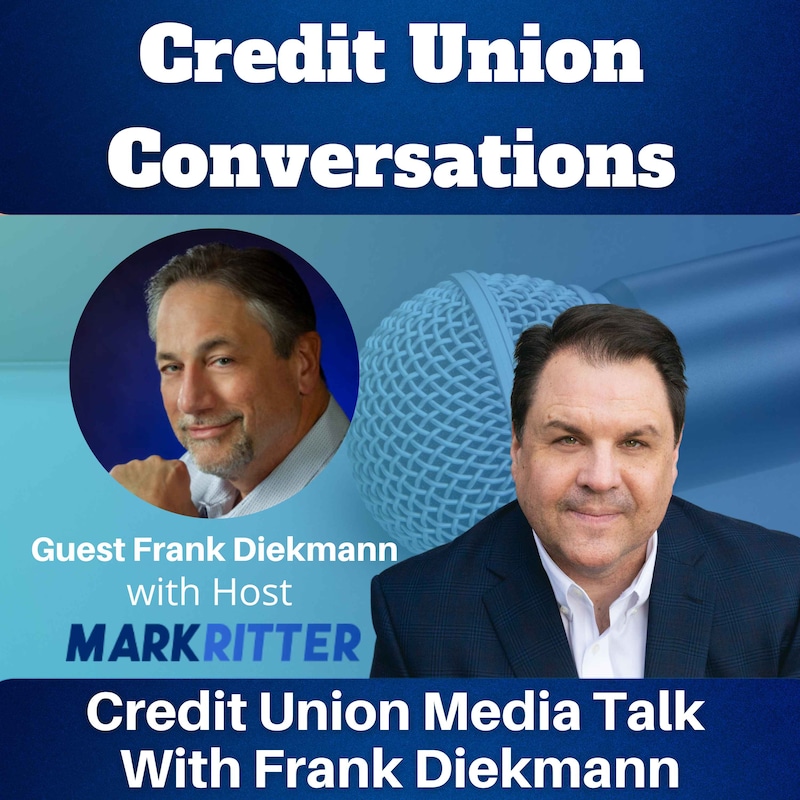
Shownotes
Want to stay ahead in the Credit Union industry? Curious about how Frank Diekmannn has shaped Credit Union Media? Join Mark Ritter on Credit Union Conversations and Frank Diekmannn, the visionary behind CU Daily, to unpack the evolution of Credit Union Media. From Trade Publications to navigating Press Releases, this episode uncovers the grit behind Credit Union Success. Expect a candid discussion on Conferences, Press Releases, and the power of the Opinion Section in driving the Credit Union industry forward.
IN THIS EPISODE:.
- (00:00) Intro: Meet Frank Diekmannn
- (02:24) Frank’s career journey from sports reporting to launching trade publications
- (03:27) Frank discusses the different credit union news media he has founded
- (05:30) From laborious phone sourcing to now journalism and press releases in the credit union's online media
- (09:21) Journalists need thick skin and curiosity to be successful
- (10:48) The evolution of the business model from print to digital, which is now ad-driven
- (14:54) Effective press releases must provide reader value for credit union success
- (18:07) Frank talks about his book, “501 Name Tags: How Everything You Need to Know About Business can be Learned at a Conference and Forgotten in the Trade Show.”
- (23:25) Discussion of what makes a valuable trade conference
- (27:45) Promotes CU Daily as the top news source with daily items, Opinion Section, and video for credit union success
KEY TAKEAWAYS:
- Journalism in credit union media has evolved from labor-intensive reporting during the era of Credit Union Week to the digital CU Daily, requiring Frank Diekmannn to adapt to industry consolidation and modernize press releases for the success of credit unions.
- Effective press releases must answer "why should readers care?" to engage audiences, as Mark Ritter and Frank Diekmannn emphasize providing value over corporate puffery in conferences and trade publications.
- Frank Diekmannn highlights how credit union conferences have shifted from content for credit union success to vacation-like events.
RESOURCE LINKS:
BIOGRAPHY:
Frank is a longtime credit union journalist and has founded various publications throughout the years. In 2025, he formed The CU Daily, which amassed a strong following in its first year.
KEYWORDS: Credit Unions, Frank Diekmann, CU Daily, Credit Union Media, Business Lending, Conferences, Journalism, News Junkie, Trade Publications, Press Releases, Marketing Director, Industry Consolidation, Sponsor Companies, Opinion Section, Credit Union Success
Transcripts
Credit Union Conversations Ep. 96 - Credit Union Media Talk With Frank Diekman
[:[00:00:26] Yesterday, I just finished up conference season for the year. I'm very, very happy about that. I still get to make a couple trip to meet with some friends in some smaller groups, but my days sitting out of sitting in a booth and handing out pens to board members has come to an end for 2025. Praise be.
[:[00:01:13] In the credit union space, I am also a news jug junkie. I love reading about our business. I love reading what's going on. I love hitting all the different sites. So I am very excited today to have Frank Deman joining us today. Frank, how are you?
[:[00:01:35] Mark Ritter - Host: Alright, uh, I, I, I, I love to talk about the business of the business of credit unions.
[:[00:01:56] Frank Diekmann - Founder of The CU Daily: That's, uh, if I handed the do all over again, I would, I would definitely have you.
[:[00:02:01] Mark Ritter - Host: So, so Frank, I, I've been reading up on your background and, and you're probably the most well-known person that a lot of people in our industry might not know. So if you could give people your background and career journey and what you're up to today, I'd appreciate it.
[:[00:02:24] I've had a long, long career in credit union reporting. I fell into it accidentally, like so many things. Um, I was originally a sports reporter. I was working in Cincinnati as a sports reporter. I was doing some freelance writing. I had an opportunity to join a publication in Florida that was also accidental that I ever found it.
[:[00:03:07] At the time, there were about 20,000 credit unions in the United States. There was no real news publication. I knew absolutely nothing about credit unions other than the fact that there were 20,000 of them and it was a large audience. So in, in around 1989. We launched what was called Credit Union Week.
[:[00:03:54] I sold that publication and started publishing Credit Union Journal in 1997. [00:04:00] I sold that publication in 98, but I stayed on with the publishing company till around 2014, uh, when I started CU today. And then, uh, this year, earlier this year, 2025, I started, uh, the CU Daily.
[:[00:04:21] Frank Diekmann - Founder of The CU Daily: I have thought about that before. I'm good with the CU Daily. That's, that's where we finish that. That's the finish line. It is.
[:[00:04:44] In those days, credit unions, you know, many of them were much smaller. We, we were filled with corner of the factory credit unions. Did you find yourself, you bringing [00:05:00] the information to them. Were they feeding you, Hey, this is what's happening at our credit union. Kind of what was the dynamics way back then when you were deal, you know, right now you're dealing with PR firms and marketing departments and press releases probably flooding you weight as we record this, but what was it like dealing with the credit union industry and the trade associations when it was so many more people with much less sophistication?
[:[00:05:56] The other thing you have to keep in mind at that time, to your point, is that [00:06:00] credit unions were much smaller and the marketing, uh, the president of a credit union was also the marketing director at a credit union union. When I, you know, I started out covering credit unions, was really just in the post deregulation days, and most credit unions didn't even have a marketing person.
[:[00:06:30] Mark Ritter - Host: and the guy who shoveled the snow and that's extended statements and everything.
[:[00:06:36] Frank Diekmann - Founder of The CU Daily: That, yeah, that's the, you know, the kind of, the joke in the cliche Beth, when it was true for a lot of credit unions and uh, and very often the president of the creating also worked for the sponsor company, which people don't recall, but he was on the payroll of the sponsor company. So it was a different universe in terms of how credit unions saw themselves, uh, who ran credit unions.
[:[00:06:59] Mark Ritter - Host: [00:07:00] Yeah. Would, would you say one of the biggest differences of, you know, I'll say 30, we just go back 30 years, nineties to today. Is that you were seeking out the news either through the trade associations, the N-C-U-A-I-I would imagine You're even trying to get information from the NCUA as far as what the heck was going on.
[:[00:07:47] Frank Diekmann - Founder of The CU Daily: It's certainly, it's certainly one of the biggest differences and it required you as a reporter. To be aggressive, to go after the news and to, uh, work the phones. As we would say, you had to be on the phone making calls, [00:08:00] and that was if you were able to reach someone, and so it was a much more laborious process.
[:[00:08:28] Yeah. At that time you were faxing, you were working the phones and um, you were counting on, you had to really work to develop sources.
[:[00:08:55] Where the journalists may come out of Syracuse or Columbia [00:09:00] School of Journalism and, and much more of a white collar, highly educated job versus the blue collar gritty or finding your new, you know, I think of the old school sports reporters, uh, you know, hunting for the news. And it was the same thing in the credit union space.
[:[00:09:21] Frank Diekmann - Founder of The CU Daily: That it has changed. Um, you, you didn't need a, uh, college degree, probably as old school, as you say. I don't really personally think you need one. Now, to be perfectly honest, if, if you're wanna be a good journalist, but you need more than anything, there are two things.
[:[00:09:52] But the trade side just isn't as high profile as is what you know people are familiar with what they see online or or in television [00:10:00] broadcasting.
[:[00:10:14] I always took it to work, you know, read the newspaper, regional newspaper cover to cover it at my credit union. I subscribed to the Wall Street Journal and then was mailed the, and it showed up every day and I liked folding that out on my desk and reading it till till people made fun of me. You have been through multiple credit union and trade journalism businesses.
[:[00:10:48] Frank Diekmann - Founder of The CU Daily: It has evolved drastically and it has becoming much tougher business. Initially, you know, I worked in, uh, print publications. We were glossy, tabloid, size, print At the first three [00:11:00] publications I was with.
[:[00:11:22] I took a lot of pride in it. I loved doing it. Um, I'm, I'm a bit, uh, I was obsessed with page design and the way stories are placed and imbalance and symmetry on page, and a lot of skills that are basically obsolete at this point. Um, so that, that part of it disappeared, but so did a huge cost. It was very expensive to mail 10,000 copies of a print publication every week.
[:[00:12:11] You know, we started way back when, uh, this credit times was $99 a year, and that was a subscription price about a couple of dollars a week. And for a lot of credit unions, they, they thought at that time, that's pretty expensive. Not sure we can swing that two bucks a week and probably your credit union's not in great shape if you can't swing two bucks a week.
[:[00:12:52] You used to have, um, the budgets are much smaller and you need to work longer to be perfectly honest and, and be leaner. And the [00:13:00] business has changed a great deal.
[:[00:13:17] And I would also tended to read more. Then if it was just an on, if it was an i I, you know, if it's an email, I might scroll through it for 10 minute, for 10 seconds and read one article, but I was always much more engaged with online or paper content versus online. In today's world,
[:[00:13:40] We deliver, uh, this, the CU Daily delivers, uh, 15 to 18 news items every day. I am completely aware that people are, a lot of people are consuming that on a mobile device. Uh, we try to put content in front of them that's compelling and we'll stop them and get them to click and read on a, on a, uh, a mobile device.
[:[00:14:09] Mark Ritter - Host: Now, I'm the CEO of a qso. We think everything, or I should say my marketing people think everything's important, and I'm always like, eh, that's not really important.
[:[00:14:54] Frank Diekmann - Founder of The CU Daily: A good industry partner a, a good news source, answers the question, why should I [00:15:00] care? I often say that to people, and if I speak on this issue. I'd say, you know, you need to answer the question. You know, who gives a and fill in the blank, whatever blank you want to use. And you need to be able to answer that question, you know, and you need to look at to be a good partner, you need and, and news releases to look from the outside in, not the inside out.
[:[00:15:37] It's someone who provides content that would be of interest to readers, and it answers the question for readers why should they care? I, I will tell you, as an editor, I am constantly on the search, on the lookout for content that would be of benefit to the reader, not because it makes a company or a credit union feel good.
[:[00:16:15] Something will help me create efficiencies that something of value to the reader, and, and you have to bring some humility to the process if you're the one issuing the press release. So that's what makes for a good partner. What makes for a, a pain in the butt, as you said earlier, would be those that just send out just cotton candy press releases that are, just, have no nutritional value whatsoever, but they look good.
[:[00:16:55] But when I started out in this business way back when, uh, there was a state, there was an old [00:17:00] line that. News editors read, press releases standing next door, garbage can. 'cause then you were opening the mail and pitching them. Now you just read press releases with your finger on a delete button and it's much easier to delete.
[:[00:17:24] Mark Ritter - Host: Yeah, I, I go to, uh, a lot of conferences like yourself and you see a lot of the same things, and I, I have really gotten much better at determining, uh, you know, what's the wheat and what's the chaff?
[:[00:18:01] It's just puffer. It's just corporate puffery.
[:[00:18:24] And very often you'd be in a conference and you would hear some really smart, intelligent entrepreneur who had been successful. They would share what had differentiated them and made them a success. And then you would walk out into the trade show and it was just a, a sea of mediocrity. It was like the opposite of what I had just heard and I was always struck by that contrast.
[:[00:19:04] What I did was treat what really drew this contrast. I was able to feature a lot of really, uh, insightful people I had interviewed or spoken to or heard speak, and then contrast that with what happened in the real world market where I often also just like yourself, have spent a lot of time in a booth. I was so struck by the contrast and I'm, I'm kind of glad to hear you raise that point.
[:[00:19:35] Mark Ritter - Host: Yeah, it's, it's really amazing. You know, one of the pieces, so about seven or eight years ago, I got into audio and video, and I was the last person you would ever imagine who would get into audio and video.
[:[00:20:16] I tell people, well, that if that would be so boring to me, it's probably boring to a lot of other people. So keep it entertaining, keep it conversational, and keep it so that you're providing some value to people and it all comes back to you in the end. 'cause they remember me and my name and it works out well.
[:[00:20:55] Frank Diekmann - Founder of The CU Daily: well. The other, the, um, the point that you're making that also strikes me too, is.[00:21:00]
[:[00:21:16] It sounds great. This is the point I made earlier. It may sound great internally, but the only people reading it are the people internally. No one else is reading. As soon as you feel like you're sold to, you either scroll to another story, change the channel, turn the page, uh, whatever example you want to use.
[:[00:21:52] Content that's valuable to them and educational versus just, well, let me tell you why am every time I say [00:22:00] something, why MBFS is the best business lending qso.
[:[00:22:10] Yes. And, and we're all turned off by those people. And the same thing is true. You know, I say this with press releases often get to the point, I don't care about you. What I care about is what's in it for the reader. Get, get to the point.
[:[00:22:43] Now with due diligence and choices, and I can Google up different options, people aren't shopping for. For vendors as much at conferences. I meet my, I meet my clients, I put our name out there a little bit. I, I honestly probably spend as much time [00:23:00] talking to others in the industry, uh, to find out what's going on, you know?
[:[00:23:25] Frank Diekmann - Founder of The CU Daily: It, it's a good question. And part of that is based on experience and having been to meetings where you just know, and this, this conference is either really solid or it's not. But the other piece of that is I, I, I have found that the more focused a conference is, the better the content for readers. You know, the, um, uh, used to be the UNA Councils, now the America's Credit Union Councils conferences, uh, which are focused around niche, uh, areas such as lending or marketing.
[:[00:24:10] As an attendee, you can walk out, uh, as a reporter, you're there, you're, you're looking to, to report this story and you kind of find yourself thinking, Ugh, I'm just. We're, I'm writing about mud here. There's, there's nothing really any that's of any value to our readers. So I look for specific content. The narrower, often the better, and I look for things that are really pragmatic.
[:[00:24:51] Mark Ritter - Host: about how to inspire people.
[:[00:25:05] Mark Ritter - Host: Yeah, there, there's just some conferences that I go to where it's designed around being a vacation and not providing content.
[:[00:25:32] I get why they, you know, board members, you try to get board members there, drive up the revenue, I get that. But it doesn't have to come at the expense of the content. It's just the content so often is. Buzz phrase, session names and, and no real stuff, so to speak.
[:[00:25:55] Your business is shrinking every, you know, their business is shrinking, but much of [00:26:00] it's become pay for play as opposed to quality speakers. And, and that is
[:[00:26:25] And then the audience member doesn't really get anything out of that.
[:[00:26:47] And from an educational standpoint, I'm just kind of wince a little bit and say, what, what's it, what's in this for anybody other than, you know, a nice sunny trip somewhere.
[:[00:27:03] Mark Ritter - Host: Well, well, Frank, we, we could have a, uh, uncensored.
[:[00:27:20] Frank Diekmann - Founder of The CU Daily: I'm ready.
[:[00:27:32] You know, my bookmark has changed to, changed to Credit Union daily. And so give people a plug on where they can connect with you. Feel free to plug your book, uh, anything you like that where people can connect with you.
[:[00:27:54] We report about anywhere between a hundred and 115 different news items per week. We [00:28:00] produce a daily newsletter that's free. E Headlines, newsletter goes out every morning, uh, summarizes everything we're reporting that day. We have the Movement Minutes, which is a video broadcast that just wraps up the news of the week.
[:[00:28:34] We've also really worked to build a strong viable opinion section and, and try and get more viewpoints included because you just don't see as the kind of viewpoints he used to see being shared. So, work to build strong, vibrant viewpoints section, but the, the CU Daily is really there to be a, a resource.
[:[00:29:01] Mark Ritter - Host: Well, joining me today is Frank Deman from Credit Union Daily. Check 'em out online every day. Subscribe to the email. So this is Mark Ritter, your host of Credit Union Conversations.
[: