The internet is a global network that connects computers so people can share information. The web is a collection of websites you access through a browser. Browsers work by sending requests to servers, receiving website data, and displaying it on your screen. Search engines scan billions of pages, store them, and show results based on what matches your keywords. To stay safe online, use strong passwords, avoid suspicious links, keep accounts private, and never share personal information with strangers.
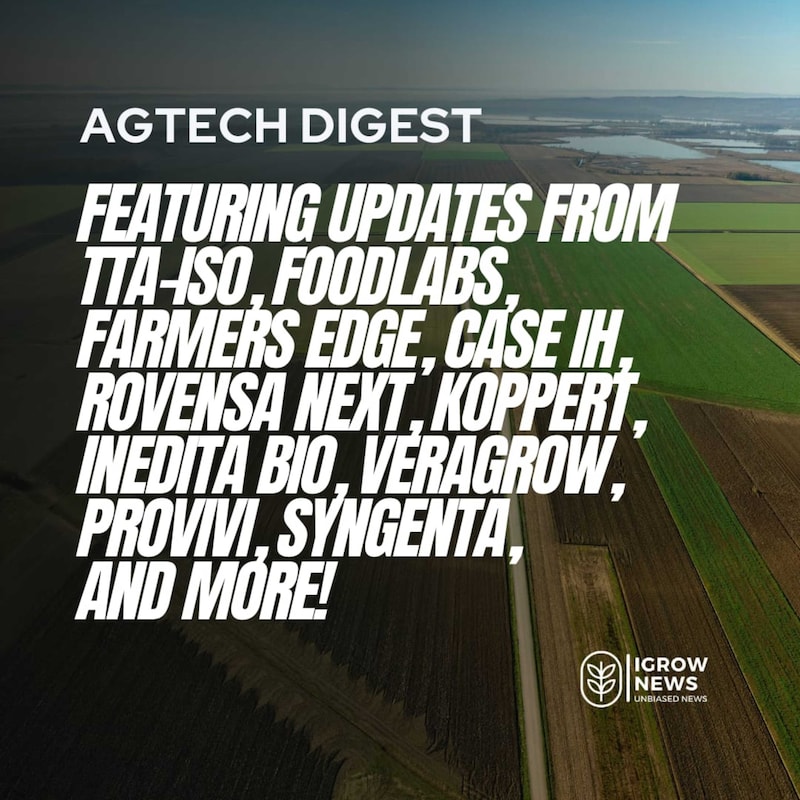
Here’s a Quick Snapshot of What’s Making Headlines:
Livestock startups scale with nearly two hundred eighty-nine million dollars raised across fifteen rounds.
Indoor Farming Trends Report twenty twenty-five released with global CEA and vertical farming insights.
Rob Ward stresses scaling through Minimum Viable Ecosystems and interoperable tech stacks.
FoodLabs secures one hundred twenty-one point eight million dollars; Locus Fermentation Solutions raises twenty million dollars.
Farmers Edge launches Corvian; TTA-ISO receives EU support for automated chrysanthemum harvesting.
Case IH rolls out C five hundred Series headers; Phoenix Manufacturing debuts Agricool AG forty-two S cooling system.
Rovensa Next launches Myndra biostimulant; Provivi and Syngenta partner on fall armyworm pheromone.
Welcome to another episode of AgTech Digest, your go-to source for the latest in agricultural technology. In today's episode, we're diving into the latest developments shaping the future of agriculture. We'll explore funding rounds supporting agri-food innovation, automated greenhouse systems and enterprise technology platforms, crop protection partnerships and biological product launches, biomanufacturing expansion and smart horticulture tools, as well as indoor farming market developments. There's a lot to cover, so let's get started.
Anna:
Livestock innovation in twenty twenty-five shows a shift from validation to deployment, with two hundred eighty-eight point nine million dollars raised across fifteen funding rounds, largely at Series A to D. Capital concentrated on methane mitigation, digital grazing, diagnostics, and biologics, led by growth-stage companies in virtual fencing and feed management. Investment was strongest in New Zealand, Norway, Australia, France, and the United States, reflecting clearer regulation and established emissions-reduction use cases, while early-stage funding remained limited. The data also shows divergence in adjacent feed segments, particularly insect farming, where several companies entered bankruptcy as others advanced partnerships and digital tools. Outside this segment, no livestock startup bankruptcies were recorded, with consolidation occurring through targeted acquisitions. Overall, investment is favoring proven, scalable technologies, with twenty twenty-six likely to hinge on performance reliability, cost efficiency, and regulatory fit.
Anna:
As we sharing the latest news that the Indoor Farming Trends Report twenty twenty-five is now available to the community. The report provides a data-driven overview of global indoor farming and CEA activity, based on verified announcements tracked in the iGrow News database. The analysis covers twenty twenty-five funding rounds, partnerships, facility expansions, mergers and acquisitions, and restructurings across both vertical farming and high-tech greenhouse systems. Year-over-year comparisons highlight shifting market signals, areas of sustained activity, and the growing convergence between greenhouse production and vertical farming. Overall, the data points to a sector focused less on rapid expansion and more on integration, operational efficiency, and hybrid production strategies. The report is designed to support informed decision-making across investment, strategy, and operations.
Anna:
In this week's interview, Rob Ward argues that AgTech scaling is limited less by technology performance than by the lack of a validated operating system. He defines the Minimum Viable Ecosystem or MVE as the core set of partners required for reliable real-world deployment. Most AgTech pilots demonstrate the science, but few prove the system, he said, highlighting the need for standardized delivery and partner-led execution. Ward also points to performance-linked pricing and embedded finance as important tools for reducing adoption barriers, alongside partnerships built on shared commercial incentives and clear governance. He sees the sector moving toward interoperable technology stacks, with ecosystem fit, regulatory alignment, and operational discipline becoming central to scale and international expansion. Investor focus, he notes, is increasingly on repeatability, cohort-based ROI, and operational metrics. Ward uses a Commercial Readiness Score or CRS framework to assess sales maturity and predictability beyond pilot stages.
Anna:
As we dive into what's going on in the AgTech sector, FoodLabs closed one hundred twenty-one point eight million dollars to back early-stage European agri-food and climate-tech startups. Moving forward, Farmers Edge introduced Corvian to deliver enterprise data integration and advisory services. Additionally, Case IH released new corn headers with their C five hundred Series designed to increase capacity and harvesting efficiency. Furthermore, Phoenix Manufacturing introduced a high-capacity cooling unit for agricultural facilities with the Agricool AG forty-two S Cooling System. Transitioning to partnerships, Provivi and Syngenta agreed to distribute a sprayable pheromone for fall armyworm pending regulatory approval in Brazil. Moreover, DENSO and DELPHY are developing automated crop-growth data and yield prediction tools through their smart horticulture models partnership. In biomanufacturing, Locus Fermentation Solutions raised twenty million dollars to expand production of bio-based surfactants. Subsequently, Rovensa Next introduced Myndra, a seaweed-based biostimulant validated under EU regulation for woody perennials.
Anna:
Meanwhile, in the CEA, TTA-ISO and Partners received EU support to fund automated greenhouse harvesting and processing in the Dutch floriculture sector, specifically for chrysanthemum harvesting. Simultaneously, Egypt's indoor farming sector continues gradual growth focused on cost-effective solutions through targeted adoption.
Anna:
In other news, this week's newsletter highlights funding activity, automation initiatives, and product launches across AgTech, plant science, and controlled-environment agriculture. Updates span greenhouse automation, enterprise data platforms, crop protection systems, biological inputs, and biomanufacturing, reflecting continued focus on operational scalability, efficiency, and resilience across the agricultural value chain.
Anna:
Three major agriculture events are scheduled for early twenty twenty-six: the Agri Expo International Exhibition and Conference for Agriculture Supplies, the Future of Food Summit on February ten in London, United Kingdom, and Indoor Ag-Con held February eleven to twelve in Las Vegas, United States of America.
Anna:
That wraps up today's episode of AgTech Digest. We explored the latest developments in agricultural technology. From significant funding rounds supporting European agri-food innovation to enterprise technology platforms and automated greenhouse systems, to biological inputs and biomanufacturing expansion, it's clear that the agtech sector is making strides in sustainability and innovation. With significant funding rounds totaling over four hundred thirty million dollars and impactful partnerships spanning crop protection and smart horticulture, the future of agriculture is shaping up to be smarter and more sustainable than ever before. Thanks for joining me, I'm Anna, signing off. Stay inspired and keep pushing the boundaries of what's possible!