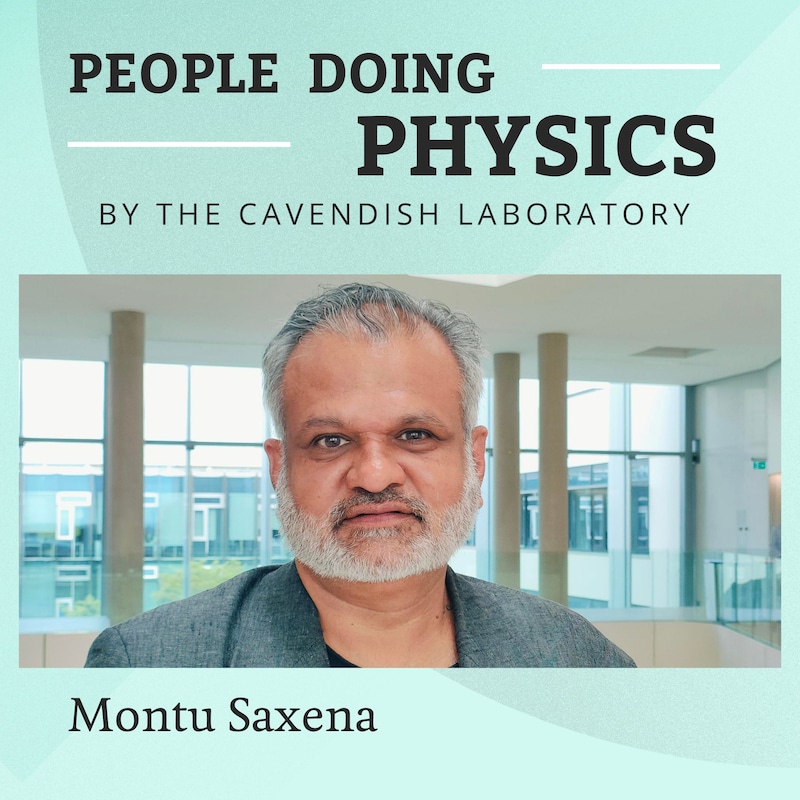
Shownotes
Today we are delighted to be joined by Siddharth Shanker Saxena, known to friends and colleagues as Montu, a condensed-matter physicist at the Cavendish Laboratory and head of the Cambridge Central Asia Forum. By Montu’s own admission, he was never able to pick a side, and so has spent his whole life exploring the world of superconductivity, all the while advocating for international relations and anthropology.
Together we talk about the moments that shape a scientific life: learning to believe you belong, the role of mentoring, and what “failure" can teach you. We also dig into the enduring puzzle of superconductivity: how to explain it simply, why it continues to captivate physicists, and how to stay comfortable saying “we don’t know.”
Useful Links:
- Montu talked in depth about superconductivity in this podcast for Quanta Magazine: Will Better Superconductors Transform the World? | Quanta Magazine
- He was also recently featured in this Varsity article: Meet the Cambridge physicist who advocates for the humanities | Varsity
- To explore Montu's work : Siddharth Saxena | Jesus College in the University of Cambridge
- And finally, to learn more about the Cambridge Central Asia Forum, visit Cambridge Central Asia Forum |
Share and join the conversation
- Help us get better by taking our quick survey. Your feedback will help us understand how we can improve in the future. Thank you!
- If you like this episode don’t forget to rate it and leave a review on your favourite podcast app. It really helps others to find us.
- Any comment about the podcast or question you would like to ask our physicists, email us at [email protected] or join the conversation on Twitter using the hashtag #PeopleDoingPhysics.
Episode credits
Hosts: Charlotte Lane and Vanessa Bismuth
Recording and editing: Chris Brock
This podcast uses the following third-party services for analysis:
OP3 - https://op3.dev/privacy
Transcripts
And you would be shocked, right?
Speaker A:You would say, why?
Speaker A:Everything tells.
Speaker A:Your whole life has been prepared for you to melt instantly.
Speaker A:And it doesn't.
Speaker A:It's there.
Speaker A:So for us, room temperature superconductivity is that thing, like, why is it there?
Speaker A:And we want to know.
Speaker A:We have made it to happen.
Speaker A:We have done that part, but we don't know why.
Speaker B:Welcome to People Doing Physics three podcast that explores the personal side of physics at the Cavendish Laboratory, University of Cambridge.
Speaker B:Hi, I'm Vanessa Bismuth, the communications manager at the Cavendish.
Speaker C:Hello, I'm Charlotte Lane, a PhD student in quantum optics.
Speaker B:Today, we're delighted to be joined by Siddharth Shankar Saxena, known to his friends and colleagues as Montu.
Speaker B:Montu is a condensed matter physicist at the Cavendish and head of the Cambridge Central Asia Forum.
Speaker B:By his own admission, Montu was never able to pick a side, and so he spent his whole life exploring the world of superconductivity, all the while advocating for international relations and anthropology.
Speaker B:Together, we talk about the moments that shape a scientific life.
Speaker B:Learning to believe you belong, the role of mentoring, and what failure can teach you.
Speaker B:We also dig deep into the enduring puzzle of superconductivity.
Speaker B:What is it?
Speaker B:Why it continues to captivate physicists and how to stay comfortable saying, we don't know.
Speaker B:Stay with us.
Speaker B:Welcome, Mondou.
Speaker B:Thank you very much for being with us today.
Speaker C:Yes, thank you very much for coming.
Speaker A:Thank you, Anisa, for inviting me.
Speaker A:Thank you, Sharat, for talking to me about this.
Speaker A:I'm delighted to be here.
Speaker C:We always start with the same question.
Speaker C:How did your journey into physics begin?
Speaker C:And when we spoke before this interview, you said that there was a moment when you realized, I can actually do this.
Speaker C:Can you walk us through those first formative years and to that turning point?
Speaker A:Thank you.
Speaker A:Yes, it was quite a while ago.
Speaker A:And while speaking about it, one imagines those moments.
Speaker A:And this was a journey started as a school student, and I was faced with an interesting challenge where we did not have a teacher in my school in the United States who was trained to teach physics.
Speaker A:And I had the opportunity or luck to have been exposed to more advanced physics while being in India or the Soviet Union or in Europe.
Speaker A:So I offered to help.
Speaker A:And then I realized I could actually not only do it myself, I could excite others into doing it.
Speaker A:And that's where it all began.
Speaker C:So the key was that you were confident in what you can do.
Speaker C:How much did it matter that someone else believed in your ability to do physics?
Speaker A:Yes, it was.
Speaker A:It was more the Moment that you realized that what you were doing not only made sense to you, but you could unpack it for others and bring them on board.
Speaker A:And that was an extremely thrilling moment.
Speaker A:Especially at that young age when you don't know much about anything at all and you are a student.
Speaker A:You need to learn, but you could teach.
Speaker A:Was bizarre and exciting.
Speaker A:And it continues has never left me.
Speaker B:What young age are we talking about?
Speaker A:So it's the age of 15.
Speaker B:And was it about understanding physics or was it about like confidence in general?
Speaker A:I don't think I knew or understood what confidence meant at that age.
Speaker A:This is a phenomena that we discuss now.
Speaker A:It was more about that I could actually explain the process and somebody could follow it and then join in your excitement that oh, this could be solved.
Speaker A:So today we'll call it confidence.
Speaker A:Then there was journey.
Speaker A:It was more important.
Speaker A:Yeah.
Speaker B:Early in your career you experienced what most people will call failure.
Speaker B:But you said it became formative.
Speaker B:How do you think about failure now as a scientist?
Speaker A:Yeah, I said I could go back and then jump back to today that one of the first moments when I did physics, when I realized physics was something interesting, was the first failure was when I actually failed my first physics exam I ever took as a much younger child.
Speaker A:This is something that didn't factor in later.
Speaker A:But when a teacher took interest in my development and that has played at a personal level a role to see that if people fail to do the task in front of you, that doesn't mean they will fail at that task again or other things.
Speaker A:You have to consider the factors around it to analyze how this failure happened.
Speaker A:And failure may not be a failure itself.
Speaker A:It may be actually something totally new.
Speaker A:And I think that is where I am now because one looks to see what hasn't worked or what people have thought couldn't work to drive your new research areas.
Speaker A:Again, the failure is another word that is very loaded.
Speaker A:It's about seeing how things work or don't work the way you believe they could have worked.
Speaker A:And that could be seen as a failure or could open new doors.
Speaker B:What sort of other factors would you say can have some impact on your failure?
Speaker B:On non failure?
Speaker A:I think that it's like a Venn diagram of different things which shift backward and forwards.
Speaker A:It's your own performance or thinking on the day.
Speaker A:It could be the factors, your stress levels, your other distractions and your life.
Speaker A:It could be your own lack of preparation for the task that you are about to embark on.
Speaker A:But it also matters that how.
Speaker A:And I would get more specific in what I do or what we do as physicists.
Speaker A:So we experimental physicists work in teams and teams range from people of different skill set level people from different experience levels.
Speaker A:And you need to bring them together in some sense.
Speaker A:So sometimes it's your own failure to bring them together in the right way when you are at the center of driving it.
Speaker A:But you have to also remember sometimes you're part of another person's team and your own lack of performance or thinking or simply the moment could make that team fail in that particular task.
Speaker A:So there are factors which are.
Speaker A:I would put it, I'm becoming here more of an anthropologist.
Speaker B:Well, that's your other side, isn't it?
Speaker A:That's my other side indeed.
Speaker A:Yeah.
Speaker A:So you look at what are the.
Speaker A:You have to think through why people are doing what they're doing rather than why they claim they're doing something.
Speaker A:So we need to go behind the scenes.
Speaker B:So how do you make space for failure in your own group?
Speaker B:For example,.
Speaker A:In my group, which includes myself, my own thing is that there is no failure.
Speaker A:We must look at what hasn't worked, why it hasn't worked.
Speaker A:In fact, and this sounds a little bit perverse in the modern day, but I get more excited by failure sometimes because it seems that I have now I need to solve this.
Speaker A:The part of my personality kicks in like, oh, okay, how are we going to do this?
Speaker A:And also I love bringing people together.
Speaker A:So the nights I have to say, oh, who I can talk to, who I can bring on board, how we're going to solve this.
Speaker A:So that's so to me, it's always a positive.
Speaker A:Having said that, I have to be very careful.
Speaker A:Not everybody sees things like that and you cannot force them to think like that.
Speaker A:So if they're younger students or person, the center of things, something hasn't worked.
Speaker A:You can't just tell them, oh, look, this is exciting.
Speaker A:You have failed.
Speaker A:You cannot do that.
Speaker A:You have to be, you know, your emotional intelligence needs to kick in.
Speaker A:You need to bring them on board, talk them through and see how we can move forward.
Speaker A:Yeah.
Speaker C:Teaching others was a key turning point in your, your journey through physics.
Speaker C:And now you're a group leader and mental.
Speaker C:Lots of young people.
Speaker C:Why is good mentoring important and how do you try and achieve this?
Speaker A:I. Mentoring, obviously, in general, we.
Speaker A:It's an accepted notion that it's important because people with bigger experience set or skill set or different skill set or experience can draw people out, realize certain things that they can do which they haven't done before.
Speaker A:So I Would say two brief examples.
Speaker A:The first one is that in experimental physics of our kind, the one we do in Cavendish, which is at the.
Speaker A:And I can slightly bold in saying it's a cutting edge always.
Speaker A:And we don't follow trends set by others.
Speaker A:We don't.
Speaker A:We create what is fashionable rather than be the part of the fashion that is.
Speaker A:And that is very difficult at times, especially for younger people, to know that this is.
Speaker A:They come into physics by what is known, what is exciting or described to be exciting by others.
Speaker A:Then you come back and then you say, look, we're starting a new PhD program, your new PhD project rather, or something, and we're not going to do any of that because that's what other people do.
Speaker A:We have something here which we completely don't understand, but we have instinct, we have some hints, it's exciting and let me help you to do that.
Speaker A:And that's the mentoring process.
Speaker A:Mentoring process is that you can be part of the bandwagon and fall off it at some point, or can we create a new bandwagon altogether and let it roll on its own kind of a thing?
Speaker A:That's what to me, Camvlage has always meant.
Speaker A: I've been here since: Speaker A:So that's why mentoring is important.
Speaker A: e as a physics FELLOW Back in: Speaker A:And there's a long story, but the one kernel which is important for your question is that what stood out was that very bright students coming in wanting to do physics didn't have someone to explain to them that there's a body of knowledge which you need to learn and to find, to stand on the famous Cambridge phrase, standing on shoulders of giants.
Speaker A:You know, it is out there and it's true.
Speaker A:So a young student reading Shakespeare can give his own opinion on Shakespeare and write their first essay on Shakespeare.
Speaker A:It's not likely you can do that when you turn on Einstein or anybody else.
Speaker A:And it's not that you will replicate the work, but you need to understand what they did so you could do what you do need to do.
Speaker A:And that's where the mentorship becomes extremely important.
Speaker B:Excellent.
Speaker B:So you said it yourself, you're an experimentalist physicist, and So a lot of your story is about making things and building equipment and learning by doing.
Speaker B:Why is that so central, do you think, to how you think about physics?
Speaker A:Yeah.
Speaker A:Thank you.
Speaker A:That in a sense, in many ways is legacy of Maxwell setting up this lab that how he was a theorist, but at the same time he built a whole machine tool workshop in the lab so you could build your ideas into realities kind of thing.
Speaker A:And that connects even back to your earlier question, that the idea that you have in your head or your team has, that you need to now build it into evidence, working, you know, machinery that will not be a flash in the sky, but will be systematic, will be consistent, and then we can say it's science.
Speaker A:And my particular work, which involves extreme conditions of high pressure, low temperatures and high magnetic electrical fields and similar, similar things, demands that reliability is very important.
Speaker A:At the same time, pushing the boundaries is very important.
Speaker A:And you need to be able to calibrate that.
Speaker A:Have you pushed boundary or you just don't know what are you doing?
Speaker A:And that edge is what's excitement where it lies.
Speaker A:We need to always build that resolution, that thinking, but also theoretical understanding of what has happened.
Speaker A:So although I'm an experimentalist, but my fundamental drive is to we have a microscopic understanding of the universe at the end of what my experiment has finished.
Speaker B:So it's a little bit of a more general question, but do you think there should be more done to highlight the diversity of roles within physics?
Speaker B:Because as you said, it's not just the theory, but there's a lot of building and thinking about concepting something.
Speaker B:Do education systems focus too much on theoretical teaching?
Speaker A:Do you think so?
Speaker A:That's an extremely important point you make there.
Speaker A:And it's a dilemma in some sense and in many ways.
Speaker A:So it harks back to what I just explained a little bit, that the teaching is very much about building on knowing what is there.
Speaker A:So you're not replicating, you must understand, you must know, you must know it competently and thoroughly.
Speaker A:But how do you use that to go forward is where the teaching needs to turn around a little bit.
Speaker A:It cannot simply be about learning what was in the past, what you can do with this, and I don't mean applications of practical matter, economic or social consequences.
Speaker A:It's about how you can do with the knowledge.
Speaker A:What can you progress this understanding?
Speaker A:Can we have a new paradigm altogether?
Speaker A:And that is where the problem happens.
Speaker A:People think that can be only theoretical.
Speaker A:The language defeats itself.
Speaker A:The English language perhaps is less equipped.
Speaker A:So people often confuse fundamental.
Speaker A:They say fundamental and Practical, fundamental is as practical and practical is as fundamental as it can be.
Speaker A:And the difference between theoretical and experimental is also sort of weak.
Speaker A:So as physicists, we're trying to solve a problem, we deploy all possible tools to solve that problem.
Speaker A:Be experimental theory.
Speaker A:Each of us as individuals may be more or less competent at each step in it.
Speaker A:That's why we need the collaboration, we need the teams to be able to bring that together.
Speaker A:So we do need to highlight how we make our understanding testable and also repeatable and reproducible.
Speaker A:It's important, the paramount in what we do.
Speaker B:Science is very much its team effort, isn't it?
Speaker C:You've said that Cavendish, by focusing on cutting edge work, necessarily has to work on problems that might not work or solutions that might not work.
Speaker C:Why is that kind of freedom and put for science?
Speaker C:And what is lost when science becomes too cautious?
Speaker A:The underlying story is with a formulation which is kind of intrinsically understood by scientists who do this, but not necessarily by the larger society, particularly the people who fund them.
Speaker A:And that there is science similar to art and music, which is about understanding fundamental principles of nature through your own curiosity and through your own interest and engagement.
Speaker A:Then comes engineering, which is systemizing those principles, and then comes so called innovation, using those principles to produce something for public good or commercial gain.
Speaker A:And unless you build this reservoir of knowledge through science, any society would always be lacking.
Speaker A:If you start to look for vaccine when you have pandemic, you need to know that you understand the body, you understand the chemistry, that knowledge exists.
Speaker A:If you haven't done that, then you'll be lost.
Speaker A:And the problem that happens is that the problems which are not understood, which are risky, which are unclear, which are seen as not able to produce instant commercial or public appeal, are often lost these days.
Speaker A:And places like Cavendish have protected us to follow those problems historically.
Speaker A:But we, like anybody else, are facing a challenge from whether it's the governments, whether it's public.
Speaker A:So we really need to connect.
Speaker A:I think your podcast hopefully will play that important role to connect to public, because we cannot guarantee an answer, but you need to trust us that we will give you answers that will be available when you need them.
Speaker C:Thinking more on an individual level, how can individual scientists, particularly early career scientists, take intellectual risks whilst trying to progress in their own careers?
Speaker C:There seems to be need for balance there.
Speaker A:Yes.
Speaker A:And I think that's where very well thought out question from you about mentorship comes in.
Speaker A: d say very confidently, since: Speaker A:But this will become less and less and become rather more and more of a luxury as you progress further in your careers.
Speaker A:When there is more bureaucratic demand and other things, I can protect you to do this and how Cambridge has produced one after another student who could go to the next job without having 66 papers or 36 books or whatever else.
Speaker A:Metrics don't matter.
Speaker A:Metrics is the disease that hits us later.
Speaker A:But it's our network, our standing in the community.
Speaker A:If I say that you are good researcher, my colleagues are likely to believe me because I have a history of Cavendish to back that behind me.
Speaker A:And of course my own credibility indeed is important as well.
Speaker A:So for early career scientists, it's very, very important to work with those who can vouch for their.
Speaker A:So it's a team again, it's not a pyramid, it's a team thing.
Speaker A:Maybe this hasn't resulted in the big Nature paper.
Speaker A:Right now I can simply give my own examples.
Speaker A:My big nature paper came three years after my PhD, but it was something that started there and it was my ecosystem.
Speaker A:Both my PhD supervisor and my postdoctoral supervisor, who was completely different field, different country, helped me to still finish that work.
Speaker A:Because it's a task that's not going to happen because I want it to happen or they want it to happen.
Speaker A:It's gone.
Speaker A:It's science is going to happen when it gets done.
Speaker A:And that's where this mentorship ecosystem always becomes relevant.
Speaker B:So let's dig a bit deeper about your research area of superconductivity.
Speaker B:How would you explain what superconductivity is to a non expert like me and why physicists find it so compelling?
Speaker A:Yes, it's a million, literally a million dollar question.
Speaker A:So one way to approach the problem is that like when you walk into a room and you flick a switch and lights go on, the music turns on, or a variety of things happen and to imagine how that happens and why that happens, and the physicist version of that is that a circuit is completed, you have circuits now, have electricity going through it.
Speaker A:So what does that mean?
Speaker A:It means how electrons are flowing through the wire.
Speaker A:And normally what happens is that when the electrons, when they flow through the wire, they encounter other electrons, protons, neutrons, all kinds of things, defects, dirt, cracks, and they slow down and you need to keep pumping more and more power into, keep pushing them.
Speaker A:And that's a big part of your electricity bill that you pay.
Speaker A:Because if it could just flow through, the only money you'll be paying for is generation of electricity, not transmission of it.
Speaker A: In: Speaker A:And this was absolutely spooky, like, why?
Speaker A:How could this happen?
Speaker A:And in many ways we now have a very reasonable understanding of why that happens, but not in any way comprehensive understanding of happening.
Speaker A:It remains a mystical phenomena.
Speaker A:So what broadly speaking, happens is that it's not a single electron which, which does this.
Speaker A:Electrons find a way, because of conditions around them, to pair up so they then they can go through this mess without anyone challenging them.
Speaker A:So I always use the joke analogy of like, now it's two bullies, you know, on the scene, and they're able to scare everyone away and they can just, just go through, overcome the resistance because people don't want to mess with them.
Speaker A:But the question remains that why do they pair?
Speaker A:Why do they choose to do that?
Speaker A:It's almost a sociology of electrons.
Speaker A:Why do they want to be together?
Speaker A:And there are different conditions?
Speaker A:Because everything says they shouldn't be together, they're the same charge and they should part ways.
Speaker A:Which is the mystique, which is our human side compels us to question, why are they together?
Speaker A:And we find conditions in which they are together.
Speaker A:Then we say, well, conditions cannot, in these other conditions, they cannot be together.
Speaker A:And then someone finds that they can be.
Speaker A:And this is still what keeps the physicists running to answer why this can happen, these other conditions.
Speaker A:So now, over more than 100 years of the work, there are certain trends we have.
Speaker A:So we say, okay, for these trends, we can follow this.
Speaker A:I'm going to park on the side the idea that if you do solve it, of course it's going to be hugely relevant for energy industry.
Speaker A:But on the other side, I would like to also say that what we have solved is already very much.
Speaker A:It's not a mystical thing.
Speaker A:Your MRI scanners, your maglev trains, your tokamak plasma containment things use this technology on a daily basis.
Speaker A:This is not something pie in the sky.
Speaker A:The question is how we can, on one side, how we can make it more practical.
Speaker A:But that cannot happen unless we understand how it actually works.
Speaker A:So one of the reasons why it works at low temperatures is that the thermal motion, the heat which makes electrons vibrate or move around in A random way gets contained because it's not there anymore.
Speaker A:It's not affecting your electrons as much as it would do at higher temperatures.
Speaker A:But we're finding more and more conditions in which it can happen at higher, higher temperatures, including now we can have it at room temperatures under very high pressures.
Speaker A:And that is where we are now, right now.
Speaker A:And it's like saying to you, a person who doesn't do experimental physics, that if you hold an ice cube over a big flame, it doesn't melt.
Speaker A:And you like.
Speaker A:And you would be shocked, right?
Speaker A:You would say why?
Speaker A:Everything tells your whole life has been prepared for you to melt instantly.
Speaker A:And it doesn't.
Speaker A:It's there.
Speaker A:So for us, room temperature superconductivity is that thing like why is it there?
Speaker A:And we want to know we have made it to happen, we have done that part, but we don't know why still.
Speaker B:Is it true to say that it's as much about finding the search of the conditions in which this kind of phenomena happens as it is about the materials in which it happens?
Speaker A:And here we return back to that whole team effort.
Speaker A:So there are different approaches to this story.
Speaker A:So theoretically and fundamentally we think about the conditions in which it can happen and we try to work out the energies and the purity and other things, but then we need our chemists and material science friends to say, well, this condition or these conditions can occur in this chemical environment, or it can almost happen here, but then we can push it by using pressure or field or temperature towards what you want it to do.
Speaker A:And we may need further ingredients like magnetism, like ferroelectricity or other things which we need there to supporting, as you have in the film, the supporting actors which buttress the main act.
Speaker A:So you need those things to happen and then you need people who understand those things to be involved in the work to help us.
Speaker A:And so equally around that you say it's not working.
Speaker A:And they say that's because you haven't thought about this wrong kind of magnetism in wrong kind of electronic sight or right kind of fellow city in the right sort of structure that can help you.
Speaker A:So it works both ways.
Speaker B:So if you go back to the origin stories, your origin stories briefly, could you tell us what first drew you to the world of superconductivity?
Speaker A:My very first moment was as an undergraduate student in the US the so called high temperature superconductivity, the one that could happen now we can go higher, but then from very low temperatures, it could be done at temperatures which are more accessible in technical world at liquid nitrogen temperatures or above was just discovered.
Speaker A:And this is the time I started my undergraduate degree.
Speaker A:And this was the big, big buzz.
Speaker A:And nobody understood this.
Speaker A:Very soon, Nobel Prize was given.
Speaker A:And again, my mentor was talking to who came from a slightly different field from field of magnetism, Professor Jinkitang.
Speaker A:He said, why don't you make one and we'll study it.
Speaker A:These words didn't mean anything to me, like, make one.
Speaker A:How do you make one?
Speaker A:What happens?
Speaker A:And so we talked and me and another colleague, we got the chemicals together and we baked our little thing and we made probably the first superconductor in that whole region, or certainly that university.
Speaker A:And there it was, sitting in a furnace, a big black lump of ceramic.
Speaker A:And then you seeing pictures of this levitated things in media and so on, like, you know, and that's when the brain starts rolling.
Speaker A:Like, how did you make sense of that?
Speaker A:And then we did our own experiments on the thing.
Speaker A:And then that's what started the personal journey.
Speaker A:But I would add an additional thing to it that how very much the notion that it could not happen at these temperatures was in these conditions generally was what had been broken.
Speaker A:So there's two sides.
Speaker A:Like, one side is that we found this phenomena.
Speaker A:That's exciting.
Speaker A:But for a physicist was that everything before said this could not happen.
Speaker A:So that was the thing that got me going and that why is it happening?
Speaker A:And I'm there still.
Speaker C:What has your work during your career focused on in the field of superconductivity?
Speaker C:And is there any work or group of work that you're most proud of?
Speaker A:Sure.
Speaker A:And in some sense, there are three things within superconductivity.
Speaker A:I'm very, very proud of, and proud in the sense that I was part of the team and the group that did it, as we have already discussed on an individual endeavor.
Speaker A:But one of the things that happened I mentioned earlier, soon after my PhD, was finding the first ferromagnetic superconductor.
Speaker A:So ferromagnets are the harshest form of magnetism.
Speaker A:And historically it's understood that magnetism is usually you apply a magnetic field to kill superconductivity, because these electrons which pair up, I mentioned before, they have their own electronic spin and magnetism pulls them apart, draws them to magnetism rather than to each other.
Speaker A:And here was a situation which predicted by again, by few people, but led by Cavendish, thinking by Gill Lanzaresch, that magnetism itself in certain conditions can make more robust pairing of electrons and the rest of the world Said, no, ferromagnetism is the worst possible thing where you can have this situation.
Speaker A:And that required both making new materials in which this potentially can happen, but developing high pressure techniques to push these things into the right physical space.
Speaker A:So what we call as a quantum critical point or quantum phase transition, where you drive your magnetism to a fluctuating state where.
Speaker A:Where it replaces those fluctuations, replace the thermal fluctuations as the one that pair electrons.
Speaker A:And this was thought to be absolutely loony idea.
Speaker A:And every possible way it could happen, even they had been tried.
Speaker A:And I had my, let's say, less informed and less experienced naive understanding to try certain things which others were ruling out because they understood it too well.
Speaker A:And I think my naivety, which led to this discovery is something I'm very, very proud of.
Speaker A:And I encourage that among students in the same way not to tell you full stories about every one of the ones.
Speaker A:But then similar way of thinking that we tried to deploy this thinking in, because I thought I was now found it.
Speaker A:I found the answer.
Speaker A:So this worked.
Speaker A:It was a big paper, big understanding.
Speaker A:So let me push it into all things.
Speaker A:I wanted to make a carbon superconductor or something with layers.
Speaker A:And now it's called graphene and graphite.
Speaker A:It's a big story.
Speaker A:Then it was a mundane thing at a very low temperature.
Speaker A:So I tried to deploy it there.
Speaker A:And I found a new superconductor, but only to find out that everything that I thought, why it worked was completely wrong.
Speaker A:It had absolutely no meaning.
Speaker A:It was entirely different phenomena.
Speaker A:And that again started a whole new area.
Speaker A:So these are two new areas of work.
Speaker A:And right now we are in process, in process in physics terms, for last 15 years, developing a whole new area of where something which is known to be insulating, not even conducting ferroelectrics, they're called, can also host exotic form of superconductivity.
Speaker A:So this has been a team effort of several students and now who are important researchers themselves.
Speaker A:And we have been able to show that not only it can happen, but we can actually partly do it by will to understand the physics of it.
Speaker A:So these are among the highlights of things which in this area of work I'm very, very proud of.
Speaker B:On other occasions, you were very open about how much we don't yet understand about this materials.
Speaker B:And you just said that as well previously.
Speaker B:But so as a scientist, how do you get comfortable saying we don't know, especially in public?
Speaker A:It's important.
Speaker A:It's both a scientific integrity question and it's also a sociology question.
Speaker A:I'll answer it just going around a little bit by saying that how?
Speaker A:Especially if you look at the field of superconductivity, it is fraught with moments when people claim big things about superconductivity and it turns out not to be true or flawed.
Speaker A:And that's where two things come in.
Speaker A:The first thing is that almost every single time this happens, you find out without fail, these people were under pressure to produce and make a claim and to save their jobs, save their grants, save their students, save perhaps their livelihoods, and they are pushed into this psychosis.
Speaker A:The fact that places like Cavalry's other similar advanced labs like this allow us the luxury to think systematically and not feel the rush are very important in allowing us to articulate our gaps in what we understand.
Speaker A:And in fact, it goes other way around.
Speaker A:That society and even some of more senior people within physics always believe they have solved everything.
Speaker A:And so the question kind of inverts itself.
Speaker A:I have to be able to say what we don't know for me to even have a job.
Speaker A:Why should you fund me as public if everything is known?
Speaker A:I need to find what is not known and why that's interesting and exciting.
Speaker A:So I'm very comfortable going out there and claiming what are all the things I don't know.
Speaker A:And I want to find partners and funders and other people to join me in solving all those, answering all the questions that I have.
Speaker A:That's how I feel.
Speaker A:And I think that's the way we do it.
Speaker B:So that's a good point, actually.
Speaker B:Do you think that there should be more public awareness of, like, the uncertainty of science?
Speaker A:Yes.
Speaker B:In science.
Speaker A:Yes.
Speaker A:Yes.
Speaker A:And you.
Speaker A:That's the point.
Speaker A:I wish we bang on a little bit more because we are incorrectly called exact science.
Speaker A:That's what people think versus political and social sciences.
Speaker A:Exact science.
Speaker A:It's exactly the opposite.
Speaker A:We are science where we can say what we know and how much we don't know and how much we know.
Speaker A:It's a parameterization and quantification of our depth or breadth of knowledge and public needs to gain the trust you cannot.
Speaker A:It's the same kind of a thing, and maybe not a very good analogy, but still accessible.
Speaker A:Is that a medical procedure that might help you solve a brain tumor or cancer is something that you accept and you say, okay, this is a procedure.
Speaker A:I will have that done to me or my loved one.
Speaker A:You don't go and question how it came to be.
Speaker A:What were the technical steps taken to achieve that procedure?
Speaker A:We need that same kind of public trust.
Speaker A:We need to build that trust that you have to trust us.
Speaker A:We are doing this and we have a history of doing it.
Speaker A:But sure, we don't know everything.
Speaker A:But if you don't have the trust, if it's based on metrics, it's based on a bean counting model of going A to B, we will give you A to B, no problem.
Speaker A:But we're shortchanging you because we could give you a lot more instead.
Speaker C:With your background in anthropology and history as well as in physics, you've often argued that science and humanities come from the same place of human curiosity.
Speaker C:Why do you think that in general these disciplines are often treated as opposites?
Speaker A:It's again two sides of a coin.
Speaker A:If you speak, if you see a conversation between anthropologist and a physicist, you find that they don't feel that they are so far away.
Speaker A:It's how others perceive the subject.
Speaker A:So it goes back to the point when I said does public understand what we do?
Speaker A:And on other side, there is a more practical reason.
Speaker A:The body of knowledge that you need to study to get to be a professional anthropology physicist is not the same where the philosophical undercurrents are similar, but the actual body of knowledge is different.
Speaker A:However, what I can definitely say is that both disciplines, anthropology and physics, are fundamentally interested in interactions and how interactions give rise to phenomena, actions, superconductivity.
Speaker A:Different kinds of politics have a broad continuum, but we cannot use the same methods to study them, we cannot use the same ways to interpret the results kind of a thing.
Speaker A:So people often look at that part, the functional part, that how we do it is different, not how we think it is similar.
Speaker A:So that's the thing.
Speaker A:But that diversity dichotomy is actually good because we have different ways of thinking about similar problems rather than the same process of doing it.
Speaker C:So these two, two influences in your life you don't see as competing, you see as both coming from the same philosophy.
Speaker C:And it's not a tension within you, these two different things that you're interested in, it's already the same.
Speaker A:Yeah, I would argue that.
Speaker A:I mean, often people have to make the choices because of other factors to decide between that.
Speaker A:And I will repeat myself by saying that the luxury of my ecosystem, my mentors, my friends, my students, my family who have allowed me to retain, is important.
Speaker A:Not everyone has a luxury to do so.
Speaker A:Sure, it comes, I fight for it too.
Speaker A:But they are as intellectual endeavors, they are not clashing, they are enriching.
Speaker A:They support each other in some sense and.
Speaker A:And we all get bored with what we do and we all get stuck and we all get frustrated with something we're trying to do.
Speaker A:For me, I have this wonderful luxury to put this away for a while and think of the other one bit more, or vice versa kind of a thing.
Speaker A:So that has always been an important engine in progressing.
Speaker B:So finally, after all these years, what has doing physics given you?
Speaker B:Beyond the science itself, the most important.
Speaker A:Thing it has given me is the community where I can think of new things without being completely thought of as an idiot.
Speaker A:At the same time, when I'm an idiot, the community is very quick at correcting me for it.
Speaker A:And that, how to say that, that honesty, that opportunity to progress knowledge without choosing between different things.
Speaker A:You mentioned my interest in anthropology, international relations and on other side science policy as well.
Speaker A:I don't think very many people in different subjects have that chance.
Speaker A:They have to choose even the many physicists who end up doing just science policy or international relations or vice versa.
Speaker A:The fact that I had this specific set of linkages which allow to continue in the way I do, but I think if I hadn't done physics as a main part of what I do would have been less possible.
Speaker A:Yes, I can say that I have used it to my advantage in a way.
Speaker A:Perhaps others haven't had the chance to do so.
Speaker A:But if I had, I couldn't sit there on the beach and read a book on physics and become a physicist.
Speaker A:You have to do physics to be a physicist.
Speaker A:And it's also true for an anthropologist or sociologist or economist.
Speaker A:We can read.
Speaker A:It doesn't mean you can become a professional anything unless you go through the motions of doing that.
Speaker A:But I think physics allows me more access into different ways of thinking and doing things than perhaps other subjects.
Speaker A:And I can be confident in saying that because I have other studied other subjects and found that through that I cannot find as much access as I do through physics.
Speaker B:I mean, that's actually a good way of concluding because we like to finish with this question.
Speaker B:If you were to give one piece of advice to you, your younger self, or to a young person thinking about doing physics, what would it be?
Speaker B:It might vary very well to physics so that you can get access to a lot more.
Speaker B:But what would it be?
Speaker A:It would be that I had again specific chances.
Speaker A:See, this question is very important, but it cannot be answered for a younger person anywhere.
Speaker A:If you're an American system of education, you can major in economics and minor in physics and vice versa.
Speaker A:If you're in UK you cannot do that.
Speaker A:But if you're in Cambridge, you have again access to broader set of choices within your natural science philosophy kind of a thing.
Speaker A:But my advice to my younger self would be very much that the don't stumble through these things, think through how they are connected.
Speaker A:So I've been fortunate that I can tell you the story how they're connected now.
Speaker A:And it was not necessarily true in the beginning.
Speaker A:I was fluctuating between this is more interesting and that is more interesting, this is more useful, that is more whatever else.
Speaker A:But there is a way the society makes you think about it.
Speaker A:But a young person thinking about doing sciences, particularly physics related subjects, should not lose or dump their interest in other things for the sake of doing physics.
Speaker A:To keep that alive, it might be useful later on, it might become more relevant, you may have more time to do it.
Speaker A:But don't be a binary in this situation.
Speaker A:Keep that interest going.
Speaker B:Thank you so much, Montu, for your time today.
Speaker B:That was great.
Speaker B:Thank you so much.
Speaker A:Thank you.
Speaker A:Wonderful talking to you.
Speaker C:So thank you very much to Montu Satino for joining us today.
Speaker C:If you'd like to learn more about what we just discussed and more generally about our work at the Cavendish Laboratory, please have a look at the show notes or visit our website.
Speaker C:If you have any questions you would like to ask our physicists, head to social media and tag us with the hashtag peopledoingphysics.
Speaker C:And finally, if you like this podcast, please consider giving it five stars on your favourite podcast app and leaving us a review.
Speaker C:It really helps others to find us.
Speaker C:This episode was recorded and edited by Chris Brock.
Speaker C:And thank you very much for listening to people doing physics.
Speaker C:We'll be back soon.




