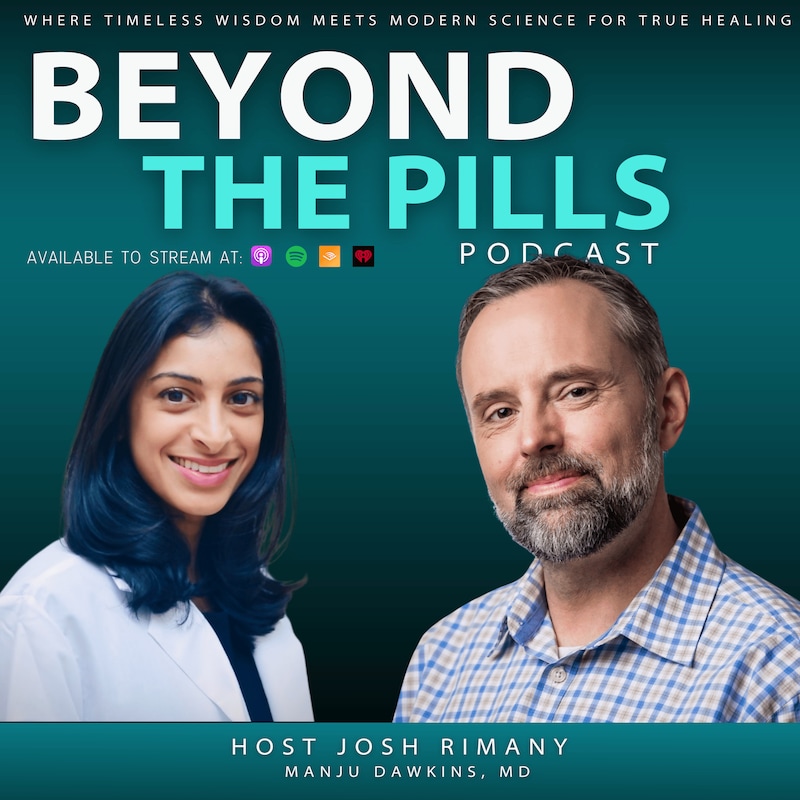
Shownotes
A Problem We’ve Been Trained to Ignore
Needle pain is often dismissed as “no big deal.” Something to push through. Something to “suck up.”
But what if that belief is wrong?
In this powerful episode of Beyond The Pills, Manju Dawkins, MD challenges one of the most overlooked issues in modern healthcare:
“Over sixty percent of adults have needle fear… and yet we’ve been conditioned to believe it’s not a real problem.”
This isn’t just about discomfort—it’s about fear, trust, and how the healthcare system conditions us to disconnect from our own experience.
The Moment That Changed Everything
For Dr. Dawkins, this wasn’t theoretical; it was deeply personal.
As both a physician and a mother, everything shifted during a routine moment:
“She looked straight up at me with this piercing look of like, ‘How could you let that happen to me?’”
That single moment sparked a realization that would change the trajectory of her career:
“What are we doing? This is insane… as a physician, my job was to do better—and I didn’t.”
What followed wasn’t just innovation; it was a mission to restore humanity to medicine.
What’s Really Happening in the Body
Most people think needle pain is minor. Temporary. Insignificant. But biologically, that’s not what’s happening at all.
“It’s a stranger holding a sharp metal object and piercing you… our biology perceives it as a threat.”
Your body doesn’t differentiate between a medical procedure and danger.
It responds the same way—with a fight-or-flight reaction.
And when that response is ignored or dismissed, it doesn’t just create fear… it erodes trust.
The Real Issue: A System Without Time for Compassion
This episode uncovers a deeper truth about modern healthcare: It’s not that providers don’t care. It’s that the system doesn’t allow them to show it.
“Healthcare has become more transactional… the system is not designed to offer empathy.”
Shorter appointments. Higher pressure. Less connection.
The result? Patients feel rushed. Providers feel burned out. And meaningful care gets lost in the process.
Tangible Compassion: The Missing Link in Healing
Dr. Dawkins introduces a simple yet transformative idea:
“Healing begins with tangible compassion.”
This doesn’t require more time or complexity.
Sometimes, it’s as simple as asking:
“What can we do to make it better?”
A pause.
A breath.
A moment of acknowledgment.
These small shifts can completely change how a patient experiences care—and whether they come back at all.
Reclaiming What Healthcare Was Meant to Be
At its core, this conversation is about something bigger than needles.
It’s about redefining what care actually means.
As Josh reflects:
“Care means healing… to love, quite frankly.”
Somewhere along the way, that meaning was lost.
But conversations like this are bringing it back.
Why This Episode Matters
If you’ve ever:
- Felt dismissed in a medical setting
- Avoided care because of fear
- Or sensed that something is missing in healthcare today
This episode will resonate deeply.
It’s not just about solving pain. It’s about restoring trust. Rebuilding connection. And creating a future where healthcare feels human again.
🎧 Listen now and discover how small moments of compassion can transform the entire patient experience—one interaction at a time.
Connect With Dr. Dawkins on LinkedIn
Join Our Community & Global Movement: https://community.gobeyondthepills.com
Transcripts
127_Dr_Manju_Dawkins
===
Josh: [:Join me and other practitioners as we guide you towards vibrant health, body, mind, and spirit, and move beyond symptom management into true healing. All righty. Welcome back, everybody, to Beyond the Pills, where we have and cross the intersection of ancient wisdom and modern science for true healing. And today's a fun episode for me.
niversity, the University of [:But beyond her clinical excellence, Dr. Dawkins is also a visionary innovator and a co-founder of Thimble Health, the first comprehensive solution designed to reduce needle pain and stress. Her work has been nationally recognized, earned the grand prize at the American Academy of Pain Medicine Innovation Challenge, and the Innovation Award from the Skin of Color Society.
on, bringing humanity, care, [:Dr. Dawkins: Thank you so much for having me, Josh. I'm so excited to be here for a real conversation.
Josh: Well, when we, when we connected and spoke, we just, we had a, a good connection, 'cause it was light. It was this... You know, what you've come up with i- it is innovative, and I wanna talk about it, because I've been a pharmacist for, I don't know, a long time, and I've been in community, and we've done all sorts of things with vaccinations and pain and, and there's a stigma around this whole thing.
back to your origin, right? [:Just share some moments around what got you to where you are right now. 'Cause it's, it's not, it's not like a linear path. It never is, but I wanna hear from the... I wanna hear the origin stories. They're always fun.
Dr. Dawkins: I'm gonna go way back. Just do it. All the way. I mean, I hated needles as a kid, but you know, you're made to feel like something is wrong with you, and you should comply, and what's wrong with you?
So I suppressed that for a while, and then, you know, went through medical school, and training, and everything, and I was always kind of like, "Ooh, do we have to do that to that kid?" Or like, "Can we just give them something to make this a little easier?" Again, thought like, this is making me... It, it made me feel like I was a bad doctor, 'cause I wasn't able to just push through and like do the hard procedure on this poor child who- Suck it
Josh: up.
Go. Yeah.
Dr. Dawkins: And [:You know, just like pain, betrayal, confusion. And I was like, "Oh. Oh dear, what have I done?" You know? And, um, and that's when I realized like, what are we doing? Like, this isn't s- insane. You know, as a mother, my job is to protect her, and I did not do that, you know? And as a physician, my job was to do better, and I didn't do...
So that's when I was like, we gotta do something else. And so you know this as a pharmacist, you know, in dermatology we prescribe a prescription numbing cream called EMLA, um, for cosmetic procedures. But we don't really use it in medical s- you know, me- for medical procedures. But I was like, well, I'm gonna do it for her vaccines.
And so I was in training, [:It's actually kinda hard to use. You gotta put a big glob on, occlude it with Saran wrap or a Tegaderm, leave it in place for two to three hours. It melts at skin temperature. It causes
I love it. I love the entrepreneurial journey, and it's the same journey, like solving a problem that hasn't been
Josh: solved yet
. I do compounding and we do [:how... Like, most people think of needle pain as minor, right? Mm. It's just that thing. Mm-hmm. But what are we missing psychologically and physiologically when we dismiss that experience?
Dr. Dawkins: Yeah. I think when we step back and really look what... look at what a needle procedure is, it is a stranger holding a sharp metal object and piercing you with it, and inherently that is a scary thing.
And when you go back to our primitive selves, it's the same idea as the saber-tooth tiger's tooth going into your flesh, right? Uh, that might sound dramatic, but I think, um, you know, our human biology perceives it as such, and so it's pretty darn human and natural to have a fear response when something like that is happening.
missing someone when they're [:Suck it up. Like, get over it." Like, it's completely different. And what changes is trust, right? Like, if you hold someone down and say, "We're gonna get through this right now," and that person has lost their sense of control and choice, do you think they're gonna come back again willingly? Probably not, you know?
But if you can... This is what I mean when I say apply tangible compassion. Like, what can I do to make it easier? And it, it's not always gonna be our patches. Sometimes it's just, like, do you wanna take a deep breath together? Do you need a minute? Just really, really simple things. It, it can be quick, but it can just change the trajectory not only of that, you know, visit or procedure, but for the lifetime of your health journey.
it that scope, right? First, [:We still have that same 1,400 chemical reactions that happen in a split second. So I, I like that you're bringing that to the space of empathy, seeing someone where they're at first. I remember when I... This is when I used to do vaccines and stuff, is, like, I would get year after year after year, like, "Hey, I'm coming in for my vaccine, but I'm only going to Josh."
ey got that calmness from me [:We did the delayed vaccine schedule, so we were going more often. You know, it wasn't just jab, jab, go. And getting both sides of that paradigm where you get the Nurse Ratched who comes in and the baby's screaming, and they're just, like, holding them down and throwing it at them and then leaving, and it's like, I wouldn't like that, you know?
So I'm glad that we brought all that to head and, and that that is the key piece of why you're doing this is to make it easier for them, not because it's a nuisance to the administrator, right?
ey could offer compassion or [:And so I remember even when, you know, my older one was younger, it was actually her pediatrician giving the vaccine, and you can see how it's changed over time. Yeah. And now it's just, like, one nurse who has to just basically close off his or her heart and go in and just do the thing and, you know, and, and, and that is not a good thing, and it's not any individual's fault.
That person isn't a bad person. That person is just trying to get through the day and has to ha- kind of build a, a wall around their own heart in order to withstand all that crying, you know, and all the pain that they're having to induce. Um, so anyway, I mean, that's just another one of the reasons...
t of a, just a small part of [:Josh: No, I love, and that, that's so important to address, and I'm glad that we are having this beautiful conversation, which is why I love long-form conversations 'cause you never know where they go. But that is part of it is, like, what I heard you saying is what I also believe is, like, healthcare has become more transactional because of the, the...
And again, it's not anyone's fault. It's the systems around it- Yeah ... that prevent us from having crucial conversations that, that are empathetic, that are holding people down in a way that helps them heal, and that's generally how and why most of us went into healthcare in the first place, right? And then you get into the system, and the system's rigged for you to go the other direction.
ated in it, right? Like, the [:What is the little thing that I can do to help?" So that's sort of the defining moment, the creation of Thimble here. And was there a specific patient or a specific moment or a, or a peak emotional experience that made you say like, "This just has to change"? Was it your, was it your kid, or was it something else?
Dr. Dawkins: It, it was definitely... That was the moment. It was my kid. But then there were so many subsequent moments where it was like reinforcement.
Josh: There it is. You know? '
Dr. Dawkins: Cause i- y- you know, it's just things are gonna happen in li- i- i- in life and, and it's not gonna be perfect, but, you know, there just, there's just so many...
kind of take notice of every [:But man, as the parent in that situation, it feels so bad, and of course your reaction is to get frustrated with that person. But then you have to remember, nope, nope, nope, nope, nope, we're all on the same team, we're all trying to get through the day. How can we help each other? Because I think, yeah, I mean, that's what I see a lot is like the system has really positioned us against each other, and that's not the truth.
is everyone around you, like [:You know? It, it tries to depersonalize every patient and frankly depersonalize every healthcare person also, and ah, it's just, it makes me really sad.
Josh: Well, thank you, one, for having the strength and the, the compassion to speak that truth because I believe similarly. Like, we use the word love in certain ways in our society, but really to me it's a, it's a- And, and there's no, there's no issues here.
ic perspective on that from, [:Or you can look at it from the place of just being heart-centered.
Dr. Dawkins: Yeah.
Josh: Right? Like, w- that's why I love studying things like shamanism and these other tribal ways of things, because it was more than just... We- we've desensitized medicine- Mm ... to, to something that's beyond it, and we, we even, we even go into the directions of intentionally taking emotion out of it.
Mm. And to me, compassion comes with emotion. And- Mm. So I've always let led with my open heart. Mm-hmm. I've given love in my bottles, not intentionally, but, like- Mm ... energetically and ethically. And if you really think about it, that's where the placebo effect comes from, right? Mm-hmm. It comes from intention.
th this direction, no matter [:So...
Dr. Dawkins: Yeah, I think it's been, I think it's beaten out a lot of people. I think it's-
Josh: Well, and for- Yeah ... for, again, we're not, we're not vilifying any one person, because- Exactly ... where we've gotten to, which is why I love our podcast, which is beyond, it's not taking where we are and changing it. It's just keeps moving beyond that.
Mm. I feel we're moving towards that model of care again. Yeah. And this is the conversations we're having. I wanna talk about this though, because here, here's the thing, is like what resistance- Mm ... or skepticism did you face when you were first starting talking about solving needle pain as a serious problem?
Dr. Dawkins: Yes. There has been a lot of resistance. There continues to
Josh: be so. There's [:Dr. Dawkins: Yeah, no, there's been a lot of like, "This isn't really a problem. This isn't a thing."
Especially, you know, 'cause I, I have been working on this for quite a while, and especially early on, no, no one thought it was a thing. Why? Because this isn't something that's really heavily studied in medicine. But over the past, you know, probably 10 years, there have been more and more studies really illustrating that this is a much bigger issue than we realize, and now the most recent global survey suggests that s- over 60% of adults has needle fear.
t we should be okay with it, [:And it's so funny because I have conversations, you know, with people, especially, you know, like I have to, I have to raise funds, right? So I have conversations with investors, and they're like, "I don't think this is a, a big deal. Well, my wife has this, and, and my kid has this, and it... But it's not really a big deal."
So, eh, it's, uh, interesting 'cause almost every conversation you have, someone has got a family member or someone will kinda say, "Actually, I really hate needles too." But they can't really apply that globally because they feel like it's a me problem or it's a my kid problem or it's a my wife problem. So it, it's super interesting, but I think, I think we're opening...
I think, I think, like you said, I think that th- change is happening and people are realizing, um, like that it matters how you feel when you receive care.
ng about it, like 'cause I'm [:Big girls don't cry, right? These things where this societal pressure is, "Oh, it's just a needle. We should not know it." But literally it's a trauma. Like literally it's a trauma, and we know a lot about PTSD and trauma now. We know how it affects the subconscious and even the super conscious. Mm-hmm. And so for me, I, I love that you're taking it from that perspective and it's, isn't it interesting that you have people like investors or other people not being open enough to saying like this is real even when it affects every- like the data.
nd now that we have all this [:Like, oh yeah, the 60% of people don't like needles, but it's not that big of a deal It's like, no, it actually is. So I love that you're seeing that, that in the journey of this all and, and how it's unfolding because it, these, the, it... To me, I don't know about you, but to me, like, it is these little things that make big impact.
Mm-hmm. But we don't notice them as big until it becomes a thing, right? What if you could stick this patch on every time you went to, and you didn't even have to s- exclaim anything. It was just a thing. It was the thing you did. Mm-hmm. Yeah. Versus, "Well, I gotta, like, I gotta go and, like, admit that this is a problem, and then- Yeah
put down..." Like, no, it's just a thing. It's just what you do. How can we make this experience easy?
's just part of the package. [:And so, no, you don't have to have a fear of needles, or you don't have to think that the pain is overwhelming to ask for such solutions. It's just, it's just common sense. So, yes, thank you for saying that.
Josh: Well, it's just, it ma- it, it is, but it is until it is. Yeah. That's the point I'm making. Like, you know, Uber was...
Like, we didn't know what the heck rideshare was until it was, like, totally accepted, and there was a few people that actually got into some stranger's car in the beginning and said, "What the heck am I doing?" Yeah. To where we are now, where it's transformed even how we think about world transportation, right?
Yeah. Yeah. It's just... I love your analogy, is like, you don't go to surgery going, "It's an elec- it's... Anesthesia's an elective." Like, "I'm gonna, I'm gonna decide not to numb myself down so I..."
Dr. Dawkins: Yeah. It's kinda strange, isn't it? I don't know. Well, and,
Josh: and, and that's, that's how we evolve, right? And so think about that.
So take [:Dr. Dawkins: and after. Yeah. I mean, I think you all are experiencing it for yourself. What's happening now is what's happening now, and it's mostly a lot of nothing. You know? It's just kinda like suck it up.
Although, there are people who are really trying out there. Now, I'm just like you're saying, like, change is happening, and so people are using things like vibration and cooling, and they're awesome. Yes, yes, yes. Even utilizing just our own bodies, like using deep breaths and applied muscle tension and all this stuff.
we try to do that w- in our [:So we have the Prepare Patch, which is basically a drug and adhesive lidocaine- -based patch, and it looks as thin as a sticker. And you just apply it, you just peel off half the liner. Let's say I'm gonna get an IV or something in my hand. You stick it on, and you leave it in place for about 30 to 90 minutes, and then when it's time for the procedure, you peel out the center portion, and the ring outlines the site of treated skin.
So I'll show you how it looks. I'm not gonna pull the whole thing off, but because you lose the s- It's like a Band-Aid. Yeah, exactly. And so, you know, with Emla, a lot of the times the, the site of, of numbed skin is lost, 'cause people are trying to be kind and get ready for you, and they'll wipe the medicine off, and it's like, "Ah, where was the numbing?"
So, so that's that. And then what we don't often talk about is the pain that happens after needle procedures. Yeah. So the soreness that you get after a vaccine or the big bruise that you get after sometimes a blood draw. Um, and so that's why we developed the Recover Patch, which is actually plant-based.
ica in it, and you put it on [:And so we have to address that pain. Um, but pain is not just physical. It's also emotional and psychological. So that's why we developed an app that puts together all the research-backed, um, tools that are free to ease needle pain and fear. So like I mentioned, breathwork, applied muscle tension, progressive muscle relaxation, distraction, CBT techniques.
ve to collaborate with them, [:Josh: Well, and that's the beauty of collaboration and also synergy- Mm ... the way you talked about. Like, when things have synergy, it's like one plus one doesn't equal two. It just me- they all work in harmony together, which is exactly how our bodies work, by the way. We're not o- When we get into the ologist world, we, we, we start to decompartmentalize how we look at things from a whole perspective, right?
And so I love that you bring the psychological component and the energetic component of pain, of fear into the equation so you can make it easier and also have the, the, the tools in place, and I love that you have resources to help people move that. We will... Because we have the community now, we will definitely bring these resources and add them as value services so people can just get there and easy and know what they can do.
which brings me to the phil- [:Dr. Dawkins: I think what I've been seeing lately for the past probably 10 years is this just real push, and when I say push, it means, like, all of our eggs have gone into the basket of digital health.
I think digital health is wonderful, and it's solved so many problems, but it's not everything. 'Cause at the end of the day, we're human beings- Yeah ... that exist in the material world, and so we still need physical things, which... And when I s- I'm, I'm holding my hands because that's important. Like, our hands are important.
plus one doesn't equal two. [:You know what I mean? The, the return is so much greater. So, so yeah. I think that we can't forget that we as human beings have evolved to still be human, and that's going to require physical solutions too. And so, um, you know, it can't just be the app alone, for example, you know? We have to give people something that they can feel.
That's what I feel.
Josh: Well, it's, it's a great part of this conversation around just where we're tr- where we're going as humans, but especially in our field, healthcare, well-care- Mm ... healing, is I believe that we have this technological resources to allow us to be more human because we're doing less of the technical stuff and more of the...
And I, I sense the pendulum [:I love that you're, you're expressing this in your own way, but, like, you know, putting human touch into the equation, human, the feel, just the feel itself. We know that energy is non-local, but when you're next to somebody four feet away from them, we feel each other. And if you bring compassion, you feel compassion.
r in person, but I can do it [:Human connection can never be replaced
Dr. Dawkins: Yeah ...
Josh: ever- Yep ... ever,
Dr. Dawkins: ever. Mm-hmm. Absolutely. Oh gosh, there's so many thoughts that are coming at. It's, it's so, i- 'cause it's so true. 'Cause you really can transmit your care over Zoom or, or, you know, over, over one of these digital platforms and y- and you can also not transmit, if you know what I mean?
Like- Yes ... you- 100% So, so that's, that's the interesting thing. And I think it's, um, yeah, it's, it's harder to pretend in person, and so I think it happens less. But on, on digital platforms sometimes I think that disconnection can be greater because it's easier to disconnect, if that makes sense.
Josh: Well, you also s- maybe you're, you can tell me if you agree or have seen it, but, like, people are starting to see this again, right?
like, you're getting every- [:It's like, "Oh, I would rather go hang out with my friend today rather than go do the thing."
Dr. Dawkins: Yeah.
Josh: Okay. And it's a slippery slope 'cause I have two young children and they're drawn to these technological things and dra- and it's like it's, there's some place where I, I had the conversation with my daughter yesterday or maybe this morning, it was like, "The tech that you're using for your games or whatever, or texting your friends," I'm like, "it doesn't replace you being human."
e went through the tech. Um, [:Yeah. Improving productivity as well. And, and how does something like Thimble actually play into the systems level?
Dr. Dawkins: Yeah. So yeah, it makes sense, right? On an individual level, hopefully the patients feel, you know, more comfort, more control. Caregivers hopefully feel the same, and then healthcare professionals will, hopefully will be able to do our jobs better and more efficiently and more safely and all of those things.
And a, an important one I think for me is, um... And the, by the way, we've seen i- in surveys that we've done with healthcare professionals I thought people were going to say, "You know what I really want Thimbleful for is to make me faster or, or safer." You know, I, I thought they would think of self-serving things.
he beginning, people go into [:So that's on the individual level. But on a system level, you could see how, um, patient satisfaction would go up, right? And that translates into higher reimbursement in the, in the current system. You could see how it might help with adherence to your injectable medication or the vaccine or the blood draws that you're supposed to get yearly or any of these procedures that, you know, a lot of us, maybe we don't have severe needle fear, but we might say, "You know what?
I don't feel like doing that now. Later." But later can become two years sometimes. Yeah. Um, so then you, you, you can see how that translates into public health improvement because if people are kind of getting the preventative care they need, then people are healthier, and so that translates into cost savings on the corporate level, right?
hink those that see it early [:It is a new idea, and I think especially at a corporate level and an enterprise level, people are like, "Should we be spending money on that?" And I'm like, "Yes." This is what all of these big, um, you know, consulting companies... Like, every year Accenture comes out with a report, like, what do healthcare consumers want?
They want empathy, and they want trust. Well, how you, how do you give that? You have to earn it, and how do you do that? You know? It's about having safe interactions. Shame does not provide safety. Solutions do, right? Like, I don't know. So we'll, we'll see how it all shakes out.
, right, we're becoming less [:Mm. Trust is actually at an all-time low in the world. Mm. And so, you know, the paradigms are shifting, and so the things I believe, and, and it's funny that you've shown that the data supports it and the surveys. I love that you're doing that, by the way, that you're actually querying real time, real data, real people, real practitioners.
But it's like if trust and empathy are what people want, and that's what we wanna deliver, we should probably be looking for things that we can do that are simple, easy, valuable In a, a lot of dev- and, and, and shit, fun. Like, let's make it fun- Yes ... so, so everything isn't so, you know, analytical and so, like, de- like, if, if empathy, empathy can't be...
to me, it's like you are a, [:'Cause that's what we all want. So I love that full circle moment to allow this one tiny little thing to actually, i- if you think about it, expanded over time, can be one of those drivers.
Dr. Dawkins: Oh, Josh. That just... I just feel so seen, and I just, like, I'm... I don't have... I'm speechless 'cause, like, that is... If we can be the compassion company, I, I, I'm done.
Like, that is just everything.
ow you talk and what you are [:I don't sell a Beyond the Pills community. I just wanna deliver more value to people so they know that there are people out there that actually have their back in the realm of health and healing and all these things. So I love that. Um- Yeah,
Dr. Dawkins: it's exactly what you said at the beginning, actually. It's not the pills.
It's the pills plus intention that actually creates the effect that you wanna see. And people can call it placebo, but it's effect, period. You know?
Josh: Well, when we, when we start analyzing it, then it becomes the problem, right? It's like, oh, but 30% of people get better off nothing, and that's just washed out with a randomized controlled trial.
gh a whole journey for that. [:So I really appreciate
Dr. Dawkins: it. Yeah. You're... And you're right. The evidence is building, and I'm, I'm looking at a book that I have over there. I think it's called... Oh, man. I can't remember. I think it was, like, the Compa- Compassion... Ah, I can't remember. I'll have to send it to you later. But basically, it just- The book starts with the example- Well, it's over
Josh: there.
Go get it. I wanna see it. You can't do that to me.
Dr. Dawkins: Be right back.
Josh: See what happens, guys? We just work through this stuff. This is how and why it's so fun to play in this realm, because we can talk about whatever we want, and these things happen, and I don't make it up anymore.
t actually know this author, [:But basically, she opens the book with this scientist who is doing experiment on these rabbits, but the effects keep getting skewed compared... Like, I guess there's another scientist who's doing the same experiment, but her rabbits are all doing fantastically well because she was a loving human being.
Like, you know what I mean? She was just, like, a caring person. And so no matter what the intervention was, her rabbits were just always doing... Were healthier, you know what I mean? And it just was, like, just evidence of the effect. And so basically, I think they kicked her off the study or something. I don't remember, but it's just, it's, it's, it's in the science.
Like, that matters. It's not just the intervention. It's the energy around the intervention.
versations. So thank you for [:Is when, when we talk about it in this respect, like, this is where the science is merging with the things that we can explain. And the p- the people that are in th- And this is how I feel the, the quantum health and all these other components are, are... It's, it's doing this. Like, we have... I- my analytical can't tell you all the things that I know to be true in health, healing, transformation, because there's intangibles that our brain can't analyze.
just like we know stage four [:Like, I've been in those rooms in many different realms and too many times, and I've seen it too many times, which is why I keep moving towards not just figuring it out, but embracing the things that we just need to simply embrace, and it's hard for the analyst. It's hard for the left brain thinker. It's hard for us to let go of some of those things in a medically derived profession or analyze it.
I speak to people like this- this metaphysical side of things, even in finance.
Dr. Dawkins: Mm-hmm. Hmm, that's... Oh, I'm, I'm sure- Oh, there's
Josh: so many- there's like, people are, uh, they do their thing, but they're also here and they're working it together. Like, imagine taking your human design and your gene keys and applying it to your financial planning, right?
ou perceive it, how you look [:Dr. Dawkins: It's so fun. But it, it makes me think about, that's the thing about science in its current form or how it, it's been for the past, I'll just say, like 25 years or so.
It only utilizes the left brain, as you said, at this point. It's only analysis. It's only, quote, "logic and rational thinking" or whatever. But we have a whole nother side of the brain that we're discounting, and we should, you know, that's like only driving with two wheels on what's in the car. It doesn't make any sense, right?
We're whole humans, so let's use it all. Um, and the thing about science is that it's, it's retrospective in nature in, in many ways. Like, data looks always backwards, right? You, you're only looking at what happened in the past. And so if you don't, if you only use data to do anything in life, you're just only repeating the past in some form.
- you know what I mean? Your [:Yeah. Yeah. Just looking at data alone doesn't create movement, you know? Well, that,
ing healing mouth to ear for [:And they're like, "Well, yeah, we already knew all that stuff. You just had to, like... We've been waiting for you." Like, the, the yogis of the world, like, they've all, we've, we've forgotten that side, and now we're awakening to it. Like, because I believe, and this is where I think some of the s- pitfalls of our medical world today is, is we, we, we, we discounted it because- We went to this field, right?
Like acute medicine went to chronic care medicine, and pharmaceuticals went from acute care to chronic care. Mm. They really forgot the steps that we took when we used- Like, I'm thinking like, you know what? When the doctor or the pharmacist, even 100 years ago or 50 years ago, like we didn't have all these tools, but people still got better, right?
nd our interventions were so [:Mm. I think you, I, like a lot of the people that I know, love, and trust in this world, well, we're working towards putting it back into balance.
Dr. Dawkins: Yes. Ah, balance. Yes. Balance.
Josh: And I always say balancing 'cause there is never one balance. Oh, true. You're never on the teeter-totter and like fully sit- sits one way or the other.
You're always moving, and then you're putting it in that space. Um, thank you. Thank you for going on that ride. Yeah, that
Dr. Dawkins: was fun.
ess and looking at investors [:Dr. Dawkins: Oh, man. I think I might be a different person. Um, I ha- have had to grow up a lot. I guess I'll put it that way. Mm-hmm. And I just really love the, um, analogy you just spoke of with the balance and how you can never just be on it. You're always falling off, but you have to be okay with like, "Okay, I fell off and now I'm gonna get back on."
You know? 'Cause just when you think you figured anything else, anything out, it all falls apart. It just, it's the nature of the game. And so anyways, I mean, you probably have a lot in common in this way. Like, I was pretty risk-averse and, uh, frankly fear-based and just kind of did what I was supposed to do and got on the train tracks of medicine and checked off all the boxes.
ack to medicine and, um, had [:And so then there's just been this like huge learning curve Because I don't have an MBA. Thankfully, my co-founder does. But, um, you know, I've just had to learn a lot along the way. But what I've really had to learn about is myself, and to learn where fear has stopped me along the way, and to learn that, you know, we humans are always capable of learning.
And so we just have to open ourselves up to that and, uh, and kind of open ourselves up to failure, I think, is another thing. 'Cause, um, it's something I noticed, like in medicine it's not allowed, right? You're not allowed to fail, you- because people's lives are at risk, and so you cannot fail. But in, um, in some ways in the startup world, and I'll use the example of tech, failure is part of the process, right?
Like, they come out with an app and it's bad, right? Like, they don't wait
Josh: till- Yeah, they wanna break it.
they have, you know, version [:You know, we have to be safe and we have to be effective from the start. But there is a balance with like, you know what, you're not gonna solve everyone's problem right away perfectly necessarily, but you can just try your very best and continue to iterate and get better. And so I think that's something that I've had to get comfortable with.
This is, it's not necessarily in my nature or wasn't. Um, so yeah.
Josh: Well, it does, it does get you to grow up quickly. I remember, um, when I started the first, like the first version of our community pharmacy, like I had no business experience. Like, you know, I didn't have an MBA. I just read books. Like, what, what is an entrepreneur?
out it, it's so aligned with [:That's it. Like, fail fast 'cause you're gonna fail, so fail fast, get back up, do it again. Like, it, it's just you have to have that numbing piece to it because I believe you're, you're either winning or you're learning. Yeah. And learning is winning because when you fail you learn more than when you, you don't fail.
When you're, when you're s- when you're, you get the challenge and you, you're successful, like you don't learn from those. You learn from all the mistakes and all the trials and tribulations and I'm sure version one of this patch was not what it was today. Um, so thank you for like treading on that and building that and not...
n't wanna push yourself into [:Dr. Dawkins: Our website is thimblehealth.com, so would love your support, and we're HSA/FSA eligible, so- Oh, cool ... always trying to make it accessible, more and more accessible for people. And ultimately, like I said, we want the healthcare kind of corporations providing it to patients, but we will get there with your help.
Um, and then, you know, we're on Instagram, @thimble.health. Um, and, you know, LinkedIn. All that stuff.
Josh: Finally. Okay. All the things. Well, I love that we have our commu- community platform now, because when this episode drops, we'll have all the links in there so people can see where all the resources are, the thimblehealth.com.
nd I are coming up with a, a [:Oh, wow. So there's 20,000 independent community pharmacies. They're all jabbing people with injections. We should definitely get them to move in that direction. But, like, imagine if that patch was included in the vaccine itself. Yes. Like, why can't GlaxoSmithKline come in and Pfizer say, like, "Why wouldn't I?"
e what if conversations. Why [:Dr. Dawkins: Yep, or every biologic or every GLP-1 or every...
You know? Why, why not make it easier for people? We're putting an alcohol pad in.
Josh: Right. It's like you put the glove on, you got the alcohol pad, you got the Band-Aid. Put on the Thimble. Like, it's that simple. Yeah. Right? Yeah. Well, I'll do a couple rapid fires before we close up, but thank you, uh, Manju, for helping me, uh, bring more light to these conversations.
It was fun today. If you could shift one thing in healthcare overnight, what would it be?
Dr. Dawkins: Oh, my gut response was time, time with patients. Mm. Which translates- So good ... so well. Again, it's just really, like, so that we can connect, really connect again.
u wanna say directly to them [:Dr. Dawkins: today?
I get it. We have not served you. It's the truth. So your feelings are valid, and we can do better, and we will. That's it.
Josh: Hmm. So good. 'Cause that's what people want. They wanna be seen, they wanna be heard, they don't wanna be told. Um-
Dr. Dawkins: It's
Josh: true. It's like, it's so true ... it's really hard for me to say that to a medical provider sometimes because we're trained-
Dr. Dawkins: Yeah
Josh: to diagnose and tell you what's wrong with you, and then give you a piece of paper that's gonna fix you, and then all of a sudden we've lost all of this space of like, maybe I'm human too, you're human too. I'm not, I'm not above anybody. It's why I don't put doctor in front of my name a lot of the time, 'cause I just want people to just, like they know who I am, but they, they, th- we also respect where we came from, right?
the journey doesn't play the [:Dr. Dawkins: Yes. You know your body better than anyone else. And, and so you are in control.
You, the patient. We have power over ourselves. Like, that is the truth. Oh my gosh, there's so much you just said there that I just lost everything that was in my mind. But that is so, so important. And like, basically what... it's been such a paternalistic setup, which hasn't served, you know, the healthcare person or the patient, right?
'Cause we... yeah, you feel like, "Oh, I'm supposed to have all the answers. I better tell them what I think." And it's like, no, we're just, we're all trying to do our best, and that's enough. And what's also, like about what you said, is like when we're all trying to heal, you know, you're just the coach. I'm just the coach.
hcare, because we know that, [:That's the beauty of this practice. And so we just, we all as individuals need to reclaim that.
Josh: I love it. And so true, right? And it's funny, we talked a lot about it, and this just happened to be in my pocket today, but it's-
Dr. Dawkins: Oh, I love it. I love it.
Josh: I can't make it up. I'm sorry. It just happens that way. It's just alignment.
Um, this has been a very beautiful conversation that I had no expectation, but I love the way it went. I love where we went. And so thank you for how you're showing up in the world, what you're doing for people, um, and, and taking that compassion into your own hands and allowing, allowing it to just unfold the way it is.
So Manju, thank you so much. This has been so- Thank
grateful for you. Thank you. [:Josh: Thank you. Received. Um, that's a wrap, guys. This was fun. I hope you enjoyed it, gave you value. Go, go check out thimblehealth.com.
We're gonna put those in the resource vault. Um, and until next time, stay well. Thanks for joining me today on Beyond the Pills. If our mission to de-prescribe 10 million unnecessary medications resonates with you, share this episode, subscribe, and leave a review. Whether you're a practitioner or someone ready to reclaim your health, visit rxtowellness.com for free resources to begin your journey.
Together, let's go beyond the pills and co-create a world of vibrant health and true healing. Until next time, live better and stay well





