Shownotes
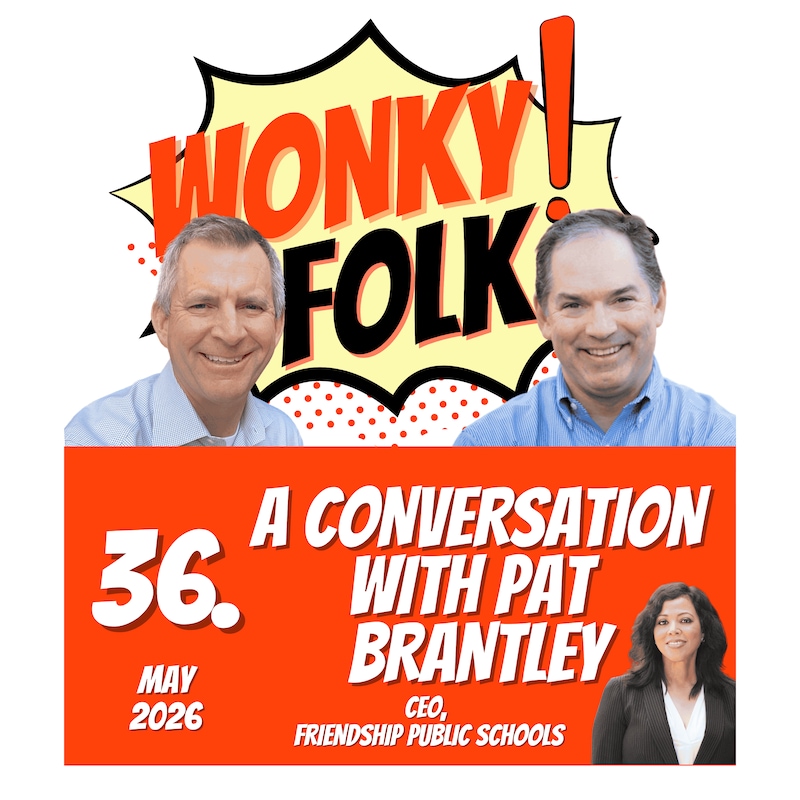
Pat Brantley — CEO of Friendship Public Schools and a 2026 inductee into the National Charter School Hall of Fame — joins Jed Wallace and Andy Rotherham for a WonkyFolk conversation recorded live in front of an audience at Friendship's Armstrong campus in Washington, DC.
Pat traces her path from Newark to Princeton to Dr. Dorothy Height's civil rights work to Friendship House — and the moment the idea for a charter school was born. From there: what she says to charter critics, why she sees the public vs. public-charter divide as the sector's greatest failure, how she weighs growth against proficiency, the line-by-line math behind DC's charter budget shortfall, why hitting 50% market share makes charters "a target" rather than a protection, the case for "adopting" struggling schools, and — in a live audience Q&A — the role of Black male educators and what charter leaders owe their communities heading into the DC elections.
In this episode:
- Pat's path from Newark to Princeton to Dr. Dorothy Height's civil rights work — and how she landed at Friendship House
- Donald Hentz, Friendship House's reinvention "to be about children," and the birth of the charter school idea
- Building Friendship into 15 campuses serving nearly 5,000 students across DC
- Why Pat names schools for local history — Friendship Armstrong, Friendship Blow Pierce — rather than erasing it
- What she says to charter critics: "I'm not listening to the critics. I'm listening to the parents."
- Why the public vs. public-charter divide is, in her view, the sector's greatest failure
- Growth vs. absolute proficiency — and why both have to matter
- Why report cards and transparent accountability still matter, and DC's new accountability framework
- The 25-year question: does DC have a North Star, and what Indianapolis got right — and at what cost
- The DC budget fight — Pat's line-by-line math on the per-pupil shortfall and $50 million in fixed costs shifted off DCPS
- Why hitting 50% market share gives charters "visibility" and makes them "a target" — not protection
- The case for mergers — or "adoption" — of struggling schools, and the turnaround of Friendship Ideal
- A live audience Q&A: the ecosystem responsibility of high-performing charters, the role of Black male educators, and what charter leaders owe their communities in an election year
- Dorothy Height's "fist" metaphor and "one Friendship, one band, one sound"
Show Notes & Resources:
- Pat Brantley — bio (Friendship Public Schools Leadership Team)
- Friendship Public Schools
- DC Charter School Alliance
- DC Public Charter School Board
- National Alliance for Public Charter Schools
- Bellwether
Guest: Pat Brantley — CEO, Friendship Public Schools; Chair, DC Charter School Alliance; 2026 National Charter School Hall of Fame inductee
Hosts: Jed Wallace (CharterFolk) and Andy Rotherham (Co-Founder & Senior Partner, Bellwether)
Watch the full video on YouTube.
WonkyFolk is produced by CharterFolk.
Transcripts
Jed Wallace 0:00
Pat and Andy, great to have you guys here. Thank you, Pat, for hosting us. Andy, thanks for making it in. We're here for a live WonkyFolk recording at Friendship Public Schools in DC. Something we've talked about for a long time, and now it's happening. So thank you so much for being able to host us today.
Pat Brantley 0:20
I'm so very glad to have both of you. It has been a long time since we've been talking about this. Friendship is nearly thirty years old, so, and we expect to be here for another thirty plus thirty plus thirty. So it's in the exact right time, I think.
Jed Wallace 0:34
I love that.
Andy Rotherham 0:35
Yeah, it is one of the real OG schools, and the founder is in the National Charter School Hall of Fame, and we might as well not bury the lead, you are—.
Jed Wallace 0:43
Well, wait. Daniel's gonna give us a hard time. We gotta say, this is the WonkyFolk Podcast. I'm Jed Wallace, and this is—.
Andy Rotherham 0:52
I'm Andy Rotherham.
Jed Wallace 0:53
And please do all the likes and all of the thumbs up and all of those things that help us. We really appreciate that many of you are already doing it. All right, Andy.
Andy Rotherham 1:03
Daniel's our long-suffering producer. Thank you, Daniel.
Jed Wallace 1:08
And so we try.
Andy Rotherham 1:09
Yeah, so please do everything that Jed asked.
Jed Wallace 1:11
And thank you.
Andy Rotherham 1:11
And thanks, we've got a live audience today, which is great. I'm really excited. We got some folks here and looking forward to some questions. Yes, you're going in with a very dear friend of mine, Sarah Euston. And so you guys are going in together in this year's Hall of Fame class.
Pat Brantley 1:25
I think you're breaking the news because I don't know that everyone does know. But it is quite terrific to have the honor of being asked, or not even asked, but told I was being inducted into the National Charter School Hall of Fame.
Jed Wallace 1:40
Yeah, we are going to officially precede the official notification. But I have it on good word from the Alliance that they're fine with us talking about Pat Brantley and all of the inductees this year.
Andy Rotherham 1:54
So I like how you described it. Do you even get a choice? Like, can you go all Sherman on them, or is it like you don't even get a say?
Pat Brantley 2:04
No, they call you up and they say, hey, listen. This is what's happening this year.
Jed Wallace 2:09
But I do think—.
Andy Rotherham 2:10
It's well deserved. We'll get into why.
Jed Wallace 2:12
I also think that this is the first time that we have an organization that's hosted two inductees across generations. Because Donald was one of the very first in the Hall of Fame, right? And now about twenty years later, you've done it. So I mean, I'm torn here. I want to hear your background and your story, but I also want to hear Friendship's story. What has made it such an amazing organization that across that period of time, you know, holds that position?
Pat Brantley 2:39
So absolutely, I will say that we love breaking through barriers. So I'm not surprised that we've got a second person going into the Hall of Fame. What I would say though is that my Hall of Fame induction or anyone's isn't about one person. It really is about the team. It's about the fact that parents in DC have chosen us over and over and over again over thirty years. And I'm also going to make you another promise. There's probably somebody sitting in this audience that will be Friendship's third Hall of Fame honoree.
Jed Wallace 3:10
All right.
Pat Brantley 3:10
All right. Because the work that we are doing, I think there's proof in what we've done over the last thirty years. And you're just going to see more of that forward upward trajectory for our families as we go forward.
Andy Rotherham 3:23
Are you going to tell us who it's going to be?
Pat Brantley 3:26
I would, but I want them to really strive for it. I want them to really— and I'm not going to look at any single person because I already see myself doing that. But ultimately, I think that we have at Friendship— I want to talk about the power of the Hall of Fame. Friendship is built not only on the people who first decided to start it, but the people who joined us after. And so we have today staff members that graduated from Friendship, put their students here, and then came here to work. And so I couldn't call out any single person except that spirit of, I'm going to be a part of this community, I'm going to help grow this community, I'm going to contribute to this community, is built into all Friendship people.
Andy Rotherham 4:13
So we jump to sort of where you are now with this honor that's going to happen next month. Back up, give us a little bit of the backstory. How did you get here? Like, where did you grow up? What was your schooling like?
Pat Brantley 4:22
Sure, I grew up in Newark, New Jersey. Now I say Newark, no one knows what I'm talking about. So Newark, New Jersey, obviously in the shadow of New York City.
Andy Rotherham 4:31
Am I right? Newark, that's Delaware, right?
Pat Brantley 4:33
No, that is—.
Andy Rotherham 4:34
Newark is how they say it in Delaware.
Pat Brantley 4:37
It's a whole different thing. That's how they say the Delaware. Smart people in Delaware. So Newark, New Jersey, I was born in Newark in the late '60s. '60s, there was a time of absolute turmoil in the city for many reasons, but obviously the fight for civil rights would be sort of number one. At that time, there wasn't really sort of desegregation, and so you had sort of enclaves by race in Newark. And what I will remember about my education in Newark is that I started in public school. The public schools were terrifically disorganized, chaotic, in some cases violent. My mother was a public school teacher. My father, stepfather, started a place called La Casa de Don Pedro, the House of Don Pedro. So there was this thing that ran through our household that you were supposed to give back and do more. That said, when I think about my early schooling in traditional public schools, I will tell you how grateful I was that community volunteers decided to start their own school called the Chad School. Now, when I talk about this school, we got the best education. It was all built around us as students. But it was small. It was two row houses in Newark next to each other, where my math classroom, I know, was in a renovated bathroom, and my gym, or PE, was in the driveway. That's where we went down. So it wasn't a school with a lot of resources. And ultimately, I know people say, "Charters and the resources. Et cetera." It doesn't actually take all the best resources to deliver schools. That does make it easier and faster. What it takes first, though, are the people. And so those people decided, "We're gonna do something else in Newark for our students," and they created the CHAD school. I went to the Chad School when it was only in elementary and middle. They later had a high school. But at that point that we were in upper middle. We moved to what was supposed to be a better suburb. The truth is, that better, more mixed suburb, it wasn't really great. But the foundation I got in elementary carried me through to Princeton. And there are lots of students who were in the Chad School that went to the Ivies or went to the schools of their choice. And it's always a thing that makes me think about. If you take even a small group of people and they decide they're going to do something for kids, they're going to make it happen. Now, you may need law, you're obviously going to need money, you might need some things to happen, but that will happen. When I left Princeton, I thought I was going to be a city planner. I majored in economics. I was going to come back to Newark and do city planning. My mother at that point had left teaching. She had become a lawyer, and she was the counsel for the city's expansion effort or renewal efforts. I took my first job at Prudential largely because the Prudential in New Jersey is like working for the government in DC. That's the job. It's the biggest employer. You know, you sort of made it if you've done that. In that first job, in the first couple of years. I had a friend who was in DC, and she worked for Dr. Dorothy Irene Height. Dr. Dorothy Height, was part of the Big Six civil rights leaders. And she asked me to come down one weekend and help volunteer and man the phones because Dr. Height was going to be on this national program, and there was gonna be at some point a call for support. And so I did that, I'm manning the phones. I don't know what year this is, but maybe it's like '92 or '93. And people were calling and they were like, Again, '92 or '93. "I saw this nice colored lady on television, and I believed in what she said, and I want to give." And I'm not criticizing the person. They felt something in Dr. Height that made them want to give to the cause. It's right. At that point, we were doing lots of programs for family and children. But it sort of opened my eyes to this world that did not actually see at that point, people of color, and understand that as a community, we all have to contribute to the advancement of people. Anyway, in that weekend, Dr. Height said to me, "Don't you want to come do something? Come to DC." And I think it was to work in civil rights. And I probably had packed my bags within six weeks. And I came here, what I thought was going to be a short while, to work in civil rights. And I'll tell you quickly how I got to— Friendship. When I came, I was working for Dr. Height, and she would take me to a lot of places she went to. And some of those places were in these important presidential-endorsed programs. And Dr. Height would always say, "There's only one president at a time, and that's the person that you're going to work with." to make things better for children. And so it just so happened that under a Republican administration, No Child Left Behind was in play, and we started the Partnership for Academic Achievement. And I had a chance to go around the country talking to families about how they could take their choices and have better schools for their children. So it was still civil rights, but it was from another angle.
Andy Rotherham:Yep.
Pat Brantley:But fortunately for me, Donald Hentz, who at that time had been on the board of Friendship House, was working for Marian Wright Edelman at the Children's Defense Fund. And they are both the best personalities who just care about children. But together, there might have been a bit of a clash. Yeah. And so she knew that he could do a lot. But within the same organization, those magnets would collide.
Jed Wallace:Yeah.
Pat Brantley:And so she put him on loan to Dorothy Height so he could help in our development and our other efforts and what we were doing. And within a few weeks, Donald came to me and said, don't you actually want to do something important with your life? And I'm like, am I just playing around right now? I think I'm doing something. And he had decided that not just being on the board of Friendship House, which at that point might have been ninety-five years old, and a traditional social services agency doing child care, clothing bank, to helping families that got displaced from their homes, at one point had its own bank that did small loans, doing what were called welfare-to-work programs. And he's like, "I want you to come with me to Friendship House. I'm gonna become the CEO, and I wanna rebuild Friendship House to be about children." Because, as we sort of learned, there were children who started with Friendship House because maybe they needed the clothing bank or they needed emergency housing, things, but they were in the childcare. They would leave and go off to school, and they would come back. Just, you could see sort of the light dimming. Anyway, just very quickly, during that period of time, there were ideas of charter laws in other jurisdictions. And Donald said, if we're really going to turn this to be about children, then we might need a charter school. And so I was at Friendship House when the idea for a charter school was born.
Jed Wallace:And you've been here ever since?
Pat Brantley:I've been here mostly ever since. I will say that when the charter application was done and approved, I went back to help Dr. Height really put that organization on sure footing. And I was gone for about four and a half. Five years.
Jed Wallace:OK.
Pat Brantley:But I came— so let me just say this. I'm always chasing a problem. Anybody that's here knows that. Dr. Height had a problem, I went there. Donald had started the elementaries. The high schools were starting. And he wasn't satisfied with the program. And so I came back to rebuild or to build DC's first Berkeley College High School at Friendship and did that for a year before becoming the COO. And Friendship was just about four or five years old. So at that point, I also did Friendship's first bonds and freed us from the early investors that we had and dealt with that financial footing of the school.
Jed Wallace:Well, I've been writing CharterFolk now for almost six years. And for a long time, I was also writing the CharterFolk Extraordinaire profiles. For the first two years, I did them myself. Now I have a little bit of help, thankfully. But of the two years that I did it, there was only one post where I wrote about two people. That was about you and Donald.
Pat Brantley:Remember that?
Jed Wallace:I do remember that. And I thought I went deep on you. I just didn't know— I missed the four-year piece there. It's just extraordinary what you guys have accomplished. There's no doubt about it. And I also think that Howard Fuller is echoing in my thoughts right now as he's just talking about just the importance of history. History actually matters. It actually matters. And a lot of our people don't know it. And that's why he's been such a big supporter of CharterFolk. You've got to do this, Jed. You've got to do this more. How we're talking in our echo chamber actually matters. There's some people that have the continuity. You now being a Hall of Fame inductee and having this level of connectedness to just an absolute hallmark organization like Friendship. I mean, you've got ambassador status now as important as any that we have in the national movement. So thank you and congratulations. This is awesome.
Pat Brantley:Thank you. It is awesome. I would think— I know that leveraging history is a part of Friendship strength. And also important, when you come into communities that might be deemed economically disadvantaged or at risk, you will see this push toward changing and renaming things in the community and writing a new story. And no shade to the charter national organizations that come into DC because I'm grateful for anybody that's come in, but we are truly homegrown. And so when you look at a Friendship School, this one, this is Friendship Armstrong, because the Armstrong Manual Technical High School meant something to African Americans as one of the first schools they could go to. Another one of our schools is Friendship Blow Pierce. Why? Because Blow Pierce were two traditional schools that lost their buildings, and they came together. And that history matters. And so when you look across, people are like, why don't you I call it Friendship Inspire or Friendship whatever. Because I don't want to erase the history of those first few people, mostly African Americans, that said they were going to deliver schools— traditional public, yes, but for students that were in the community.
Jed Wallace:Yeah.
Andy Rotherham:People who are listening who might not be familiar, just quickly give us a quick overview on Friendship— numbers, students. Number of schools.
Pat Brantley:The first number one thing they need to know is that we're the best. But outside of that, outside of being number one— although I could say that, because we have the number one middle school last year and the year we have more bold schools and high-performing Level 1 schools under the charter framework than in the charter. But Friendship was founded by the charter application in '96. First schools opening up in '98, started with two elementaries. Eventually next year went to a middle school, the year after that went to a high school. In the intervening years, we are now at— fifteen Friendship campuses in DC, fourteen of them traditional brick and mortar. One of them the district's only public online school, tuition-free. We have almost forty-seven hundred students, so I'll say just under five thousand, from three years old to 12th grade, and thousands of alumni, including some who are out there in the audience. —Today that we support. That's awesome.
Jed Wallace:So that's Friendship. I've got a contributor column coming from Collegiate in— Collegiate Academies in New Orleans. Oh, yeah. And it's being written by alumni who had gone to the school decades ago when it was still a district school. And now they're writing about how much they love what the charter school movement has done to their alma mater. And I had a chance to meet someone who's working with alums now. I mean, that'd be another great alum story. For those that attended DC schools and now have seen what Friendship— the life that's been able to be breathed into their own school— those are some of the most touching ones. They just reach the most deep into what we think about our schools, how our experiences in high school can frame so much of the rest of our adult lives. Do you mind? Do you want to go more on Friendship? I've got some things I'm thinking about DC as well right now.
Andy Rotherham:Well, I've just got a macro question, I guess. And then we can get into some of the stuff on DC. And we want to talk about achievement and talent and so forth. But first, the story you laid out, it's inspiring. It's compelling. But not everybody sees it that way. The charter schools still, thirty-plus years into this, still have people who want to see them shut down as soon as possible or regulated to where they're indistinguishable. So what do you say. To critics? I mean, you talk about with passion and pride, rightfully. This, what you've built and led here and what you all are doing. What do you say to the critics and the people who are, you know, most of our listeners I think listen because they like us. I mean, probably like 20% of the audience is probably listening because they're suspicious and want to know what Jed and I are up to. So what do you say to them?
Pat Brantley:When I think about critics, I see a whole lot of people that never had to make a hard choice about their child's education. I see a whole lot of people that live in a zip code where they have the opportunity to go to a school that actually can meet their students' needs. In fact, it's fascinating to me when I look at DC and you look at certain wards in DC and the political representatives of those wards that have my 1 or 2% charter students are making decisions about whether or not Ward 7 and 8 You have many more families that need it. And so ultimately, the critics are simply people that are unhappy with the fact that community members could deliver a better education. And when you look at all the ways that they try to tear charters down, it is always, "Well, they're mad that our hands aren't tied in the ways that they believe districts are." They're mad that we can make decisions about what's best for students and for staff. And they want to figure out ways that doing that. You know, like, of course we must have done it in some way that was illicit or something else. But ultimately, I'm not listening to the critics. I'm listening to the parents. And for me, when I think about Friendship, it's undeniable when you talk to some of these alumni that the choices they had wasn't going to a school that was okay or going to Friendship. It was going to a school— might be a man in the audience today— where in his first week at the traditional school, someone was shot in the school and felt no level of safety in that school and begged to come to Friendship that same day. And I'm not criticizing district schools, but I am saying that critics would tell parents that your child is five years old, let us fix this by the time that they're entering high school. Eight, nine, ten, fifteen years. And they would throw away generations of children to put them in places that don't work for them. And so to me, I'm like, to a parent, "Do you want your kindergarten to be on grade level at 1st, 2nd, 3rd grade, or do you want to wait for a political system to fix itself and deliver schools?" And I don't think there's much choice there.
Andy Rotherham:Yeah, I want— two interesting things in what you said. One is I think people just— this whole idea of the decision tree, I think that's like a whole— that's a problem straight through college. People assume it's the decision tree that they may be making rather than decision tree that's facing a young person who's faced adverse situations. And I think that gets— that you see that just all the way down from the way we talk about college and college choices to the way we talk about school choices. The other thing that's interesting is just this idea of like in the charter world, people do things and you would think that then in the traditional world, people would say we want that too. And instead it's okay, how do we stop them from having that rather than like how do I get that too? And it's something that's deeply unhealthy in the politics of this sector that it plays out so often like that rather than I want, if those teachers are getting flexibility. Autonomy, they're getting these things. I want those things. I want those things as well.
Pat Brantley:I think part of our greatest failure is that we have allowed this divide to be between public and public charter. As far as I'm concerned, whether you're a public charter teacher or a traditional teacher, we should all be going together down to council, to the mayor's office, and saying. This is what education costs. Deliver it in the budget. And then we're going to have to work through our organizations to make sure it gets through the right people. But we're allowing such a divide that people who don't want to spend their time thinking as much about education can be like, I don't have to do that because the other people told me that was bad. I don't have to do that because the other people did. Ultimately, we need to be driven about what's best for kids. If you can get that out of the traditional system. Then go for it. But when you can't, charters are your thing. And here in DC, we're nearly— we're 48%. So let's say almost half. And that tells us something. If parents could have gotten it elsewhere, they would have.
Andy Rotherham:Yeah, I think that market share is remarkable. Go ahead, Jed.
Jed Wallace:Well, I'm just thinking about our shared mentor in Ramona Edlin. She's the first person other than my wife to hear the word CharterFolk. And she said, you must name it CharterFolk. And so it's named CharterFolk. But she was also, you have to teach the history. She has the same message of Ramona. As Howard. But you also brought up Newark. They're just these two places where in the early '90s. Abject despair, abject brokenness. And we can argue about, hey, could charter schools be doing even better? Have charter schools perhaps lost something relative to the traditional system in some places relative to district schools? All good things to dive into, and I'm sure we will. But in terms of the broader multi-decade set of progress. What education in this city right now is way better. Is at a whole other level of competence.
Andy Rotherham:For every sector, like the traditional DCPS schools are— I think part of this history, people don't realize how dysfunctional these systems were.
Jed Wallace:And I think it's impossible. It's impossible that DC could have gotten where it is if there wasn't the driving engine of places like Friendship raising expectations and making something better at scale. And the district begins to evolve as well. I think that the multi-decade is along those lines.
Andy Rotherham:Well, the market share is remarkable. I mean, you probably remember this when people were like. Maybe it'll be 10% one day, but probably— the sort of casual assumption was this will always be a marginal thing. Not something that is a plurality of the system now. North of 40%.
Pat Brantley:When we started in DC, the politicians, or right before. Said, my families don't want that. They don't want this. This is not something that they want, the local politicians. And Donald always talks about, and I know from the people, like, is anybody going to show up on the first day? And twelve hundred kids showed up. Right? There was— your first day is your first day. You don't know what's going to happen. But I do want to say something about this idea of abject poverty, whether that's North thirty years ago or DC or et cetera. Certainly, the outward markings of the poverty were there. But the thing that gets overlooked is that there was always hope. You always have families that want something better for their children. They simply don't have the mechanism, the tools, or the resources And so ultimately, anyone fighting against charter or anything else that's gonna make things better for family, they already know, if I don't allow the mechanism, I can trap these people in the same systems that they're always in. Right? And so the systems or the institutions that exist, you don't want something new to come in and take people potentially from you, show up what you're not doing. But the thing that I want people— I don't care how poor no matter how poor something is, there is some parent there that believes that their child could do better if they could get to better. And that's what I think the charter movement, thirty years later, must remember and continue to work on.
Jed Wallace:And look what Friendship is— I mean, I went to Statesman today. And I think we have Statesman in the house.
Pat Brantley:Somewhere in the house.
Jed Wallace:And so their two founders came from here. And that school, it's just an amazing place. The thing that's, I think, important to remember is that spirit brought to nineteen ninety-three DC, you just don't have an environment that allows that thing to happen, right? And now we have an expectation. If you've got a great idea, if you have visionary leaders, you can make things that are new and in some of the highest-need communities that we have. So there are all sorts of ripple effects, what you directly do, but what happens thereafter with other people too.
Pat Brantley:There are all sorts ripple effects, and I won't take any credit from our statesmen people who did all of that on their own, and congratulations to you and your founding team and the others that were able to do it. What I will say is that Friendship has always been good at attracting the people who care the most about the kids and then pouring into them so they could deliver the most for the kids. And so I'm quite proud of the people, whether they are here— I'm not gonna stay for two years, please stay longer than that— but whether it's four or five years or twenty or twenty-five, or even we have a couple like I know when they're here, they're gonna give to our kids, and I know if they leave us. They will have what they need to give to more kids. There are very few people who leave us and say. "I'm done with education." That doesn't happen that much. But we have people like Victor who's in the audience. Or statesmen, and even others who are really making sure that kids get what they need.
Andy Rotherham:Talk about that talent scene. How is that evolving in DC? KIPP DC?
Pat Brantley:Post-pandemic talent, I think, was tough for many people. For us, I think we got lucky because if you look at Friendship leadership, every principal at Friendship came from within our schools. I think that 85, 90% of them were teachers in schools. I'm looking at some because they're out there in the audience. And I think it's a difference when your leader has that in that teacher seat has been probably an instructional coach or supporter, has been an academy director or assistant principal, and then principal. They've got a view that I need to take care of everyone. And they also get to be well-known, so they're bringing people in. But the truth is, post-pandemic, you know, teaching tends to be a young person's entry point across the board. And you have people getting out of college And they might teach for two or three years, but you know what their friends are doing? They are not going into a workplace every day. They're remote. They're doing other things like that. They've had these exciting things. And so I think what we had to figure out was the young people, the people, other people who really want to dedicate themselves to kids and really showing them that we're investing in them. So we've got lots of programs supporting paraprofessionals who become teachers through college credits, supporting educational aids or instructional assistants to get some college credits to become teacher aides, but also ensuring that our teachers know just how much we care about them. And so across Friendship Public Schools, when I think about teacher retention, you hear all these things, "Oh, charters, they burn through people, it's so terrible, you know, they've got like 50% or more turnover each year." Friendship Public Schools are on average over 80-some percent, which is great because that matches the district. But our schools in the wards that people care about the most— not care about the most— the schools where we know that the opportunity isn't there the most, because we do care about all of them, we're at 90% teacher retention. I'm looking at the principal who's partially responsible for that. One of them, in our Ward 8 schools. And to me, I think that what it says is. Yes, it is hard. There are less people entering the profession because the day-to-day work looks different. Than what a lot of people across the world are doing. We are now in an age of AI, and the tools might be changing, and we haven't figured out in schools how to embrace those tools. But most importantly, we haven't made teaching externally and nationally the, that's the job I wanna go to. Remember those TFA early years?
Andy Rotherham:Yeah.
Pat Brantley:Right, when everybody was flocking to it. Now thankfully, we have more people that feel that way about Friendship. A lot of times when I look at new people coming, they're like, "I wanna go in someplace that's going to invest in me. I wanna go someplace that matches my values." But I won't shrink away from it's hard. We've been lucky in our leadership pipeline because we try to make sure it's coming through Friendship.
Jed Wallace:Talk to us a little bit about how you see the performance of the overall charter school community now It's an interesting moment to have this conversation. Just last week, there was a new study saying that DC has made more progress since the pandemic than any other city in America. There are others that are coming out and saying, yes. But the proficiency rates are still alarmingly low in many parts of the charter school world. Help us navigate this. How do you talk about both those things at the same time? Is one more important than the other? Or how do you think about it personally and how you might be having conversations with Friendship folk about that?
Pat Brantley:Growth is always going to be most important. If you send us your child, we are responsible for getting them from where they are to where they need to be. That said, absolute levels of proficiency have to be a floor, right? Because a student might start with us in the 6th grade at a 2nd or 3rd grade level, if they stay with us through high school, it is our responsibility to make sure they are college ready. But I'm not gonna make a 6th grader who's on the 2nd or 3rd grade level a 7th grader in one year academically. It will take time. That's the challenge that we took on for what we did. So when I think about DC in particular, or maybe even nationally, The performance that we're on now, both DCPS and charters, is well above any place that we've been before. And this is even in post-pandemic— ELA has returned, math for some of us has returned. It's not necessarily true district-wide, but you go back not that long ago and you're talking about graduation rates under 50%, right? You're talking about proficiency that wasn't there. And so the thing about charters that no one wants to acknowledge, it wasn't just what people call the competition. I have to get better because of the competition. I actually don't know that's what made it better. What charters allowed families to do was to stay in this city. And so you had always seen schools across DC where there are more elementary kids than middle school kids because once you could afford and figure it out, you would get out. So it allowed families to stay. It actually allowed families to come here. So our improvement— is, yes, based on actual instructional improvement. But also it's population change. And so when people today want to talk about what schools or charters are doing versus not, they are using. In some cases, a wrong universe. If you went back to DC even fifteen or twenty years ago, the student body in public— public charter was 80% minority and probably 70, 75% low income. We're closer to 50% on the low income and then a much higher share. And so what I see critics, since you mentioned it. Wanting to do is talk to us about how Ward 3 or selective high schools are doing against non-selective public charter schools.
Jed Wallace:Yep.
Pat Brantley:And the ultimate truth is this. Most of those selective high schools are not in the wards where the students need the most. And when you look in those wards, it is not only that Friendship Public Schools are the top of performance in high schools in those wards, if performance is judged by being an A on a B on a state report card, it is that we're thirty points above. It is that you don't have the traditional schools rising above even a D. What choice do you want? For your children. And so people can swing the numbers any way they want to. Let's go back to looking at, is my school in this neighborhood delivering more than the other schools in this neighborhood? Let's go back and looking at subgroups of children and seeing actually how they're doing. Because, I mean, if I have a family in DC. I'm caring about the children that I'm putting into school. And so what I would say is We need to keep the history of where we started because people too soon forget. And when they forget, parents don't know they have to fight for charters. They assume we're gonna be here, right? And I don't know that's always true. But I think the more important thing is this is where we came from.
Jed Wallace:Right.
Pat Brantley:And it's not enough.
Jed Wallace:Right.
Pat Brantley:It's not enough. So if anybody asks me what the future should be. I would say this. When we started this, it was to close the achievement gap. Still there. It's still there. And so ultimately where we are in DC, maybe in a few places, although DC is doing better by some of those recent studies in terms of growth, is this needs to be our starting point for saying if it was possible to accelerate this quickly over a few years. What could we actually do if we do not take our foot off the gas, if we do not allow our schools to be underfunded, if we do not allow mindless restrictions to tie our hands. What could we actually do?
Andy Rotherham:Do you worry though, like the pressure on sort of what you were just talking about, disaggregating measurement, like post-pandemic. It just seems like it's gone. And there's just so even within the community, so much less interest in these things in the policy community and the charter community than there was. And so like the one group who's left who wants excellence, wants better, is the parents. And, you know, if it was as simple as that. You know, we'd be having a whole different conversation. But the sort of decision-making structures have kind of like walked away on a lot of what you're talking about.
Pat Brantley:Those same critics that instead of saying, how do we take charter flexibility and make traditional schools better, have also run another game, which is, let me tell you that the report cards and the standardized tests aren't important. And let me say that over and over and over again so that you don't have any true public measure of how schools are doing. And then they started to convince the politicians of that. And if you look at it across DC, it was. You know, before you were gonna get a letter grade. No, we can't say that anymore. Let's just give a percentile or let's do that, 'cause I don't know, people will feel bad or actually you'd see what schools are doing well. And so I do think that if I think about the charter movement itself, if I think about people that care about education, Let's stop and be clear. It does matter how well a school is doing. It does matter whether or not you are producing outcomes. And we cannot have twenty different definitions of what that is. Now, we can consider twenty different metrics, but we need to put them together and give parents something real. And so I think that we, across the country, need to have— this is what we think quality is. And this is how we know if somebody is moving toward it. But the measurements matter, the report cards matter, and being transparent and public about them, and also in the charter sense, and maybe district and traditional, holding schools accountable for making progress. And I think that's important. And so I can talk about DC because I obviously know DC the best. You know, our charter authority, the DC Public Charter School Board, they came out with a new— I'll call it report card, but accountability framework. And so they were very clear, we didn't just want to look at absolute, although that's important, we wanted to understand who was serving which kids well. And in that case, they do consider how well are you serving students with special needs, how well are you serving 3rd graders versus 8th graders. And so it is a more modern take on accountability. Might not be everything. But I think that it was their attempt— I know it was their attempt to raise the bar. And I feel like that bar is being raised.
Jed Wallace:I was going to bring this up at the end of the conversation. But let me go here because I think it's kind of grown organically out of our discussion so far, which is what is, in your view, the long term for DC if we look forward twenty-five years? And also, in addition to having done all this stuff at Friendship, You've been the chair of the DC Charter School Alliance. That is probably, in my view, the most important thing that's happened in the history of advocacy structure and capacity. And without you serving as board chair there, it never would have happened. So thank you for that as well. But also, you know, in the context of that work. I've reminded over again, I don't think that DC has a North Star. I don't think that DC has a North Star. I think that Indianapolis is our only place in the country that has a North Star. It's amazing what they've done, but it's been achieved at a great cost. I think the things that you're bringing up right now about how we are performing, how demographics are changing, the district schools have gotten far whiter, far higher SES. I think the charters maybe have changed a little bit. But not anything remotely close to how the district has. And I've had advocates across the country, charter people, say. Hey, if cities evolve such that we serve two-thirds of kids and the last third are served by district schools and all of those district schools are selective admissions magnets. OK, that's fine. That's an OK endpoint for us. I think that's the question that's being put in front of charter school people in a lot of places, but maybe DC almost in front of anywhere else. How do we keep growing? How do we keep making progress knowing that is also how public education seems to be almost organically evolving right now? And can we craft something in DC saying, we've got a different idea. We've got something that we can think we can get to that's more compelling than that.
Pat Brantley:I would say that every charter leader I know has a North Star. But because of the way this movement has evolved, that North Star is about their school community. I will make sure young males are able to participate in society. I will make sure that students from Ward 7 and 8 are able to do— And what I think we are at the point of doing now is saying collectively. What is our North Star? And ultimately, I think, from the people I know, from the values that I know, that where we are starting to get to— not fully defined, but starting to get to— is that every child gets a spot, and they have us. And I want to say this about the charters in DC. If you think about innovation— I don't know if there's going to be a lot of growth, but we do need to hold our market share. Because here's what we know. Families in DC always wanted language immersion schools. There are six or seven now in the charters. And there still haven't been any reasonable growth in the traditional public school. So it wasn't that the ideas weren't there. It's just that families might want it. We're just not delivering it. There was always a desire for an all-male school. The first one, Septima Clark, was in the charters. The second one after Septima Clark was Statesman. And then finally, you saw one on the DCPS side. And that had to be like fifteen years— maybe no. Septima was early— twenty years after a charter did it. I'll say Whitlow Stokes started the first charter thirty years ago for language immersion. And so ultimately— When people think about growth, I say hold the market share because if we don't, the choices that families have, and I mean the diversity of choices. This portfolio, they will not have. They will not have. And the first girls' school charter was actually, when it closed, if you wanna think about some of the way the movement is going, it wasn't performing well, was going to be closed. And actually, I think it's the only charter that went charter to DCPS traditional. But the innovation started with us. And make no mistake about it, our innovation will be swallowed whole by a district that hasn't been set up to deliver innovation, and eventually those programs will be swallowed and dismantled. So.
Jed Wallace:So I'm going to keep going unless you're going to interrupt me here. Go ahead. Because I— let's go back to the advocacy piece. And we got a mayoral election here. I think a part of our theory of action has been if we get charter schools to 50%, no one's going to mess with us. And you're saying, well, no, the district may still swallow us whole. And then, you know, our mayor proposes her last budget and it has charter schools being shortchanged about two thousand dollars a kid. And interesting, the DC Alliance is stronger now and it has proven an ability to get over budgets that are initially proposed as bad. And we grind them down over a while, but it happens again and again. Meanwhile, we have a C4 now. C4 goes out and talks to both of the main mayoral candidates and said, hey, do you agree with this two thousand dollars budget delta? And both of the main candidates said, no, we don't. That is something that this town has never had before. It's not that we're politically safe by any means, but we're building political capacities to come forward with new ways. And also, if you disagree with how I've just described it, you know, or if I've gotten a fact wrong. Please, you know, correct the record.
Pat Brantley:I mean, facts are facts, and candidates can say whatever they want. The election is in June, and between today and that election, that's less than thirty days away now, we will see what they do. At the council table from their seat, what they do to advocate for whether or not they are voting for a budget that's fair or they are not. And so we can hear all the things that we're hearing, "Oh, the mayor proposed this and we've got our arms locked." You are sitting in a seat where you can change the markup. They're doing it this week. And so we will see before Election Day. And it's not just that there is the mayor, There are three or four council seats. There's State Board potentially. If they win their next election, it's the Eleanor Holmes Norton seat for delegate. So much change and so many opportunities for people to say something and for us to actually watch what they do. And so I'm in the what are you going to do camp right now. Because people who work for me know that I say this all the time. Can we do a little math here? So I want to do a little bit of math. The mayor proposed a 2.55% increase. And we have arguably been told that we should all say thank you and thank you for that 2.55%. That amounts to something like three hundred eighty dollars per child. Two years ago, when teacher pay should have gone through the per pupil—.
Jed Wallace:Right, yep.
Pat Brantley:—It was given to charters and grants. That amount last year was six hundred fifty dollars a kid. Does anybody need me to do the math? That six hundred fifty dollars per kid needed only for teacher pay— Right. —Is not met by an increase of what amounts to three hundred eighty dollars. Even if we spend 100% on that teachers— and we will— there is still a shortfall. And so we've been structurally, legislatively locked into something Well. We all agreed to have our teacher scales. We were going to do that anyway, to publish those scales, to commit to them. So what do charters do next year for this budget? Cut FTEs? Not honor these salary scales? And so the blow is there. So whatever it is said in these races, I just want people to do basic math. The other part of it is that they moved fifty-plus million dollars of fixed cost out of DCPS. Some people say fixed cost. I don't know what that means. Is that construction? You all don't have the same buildings. Well, I'm going to tell you what it means. Utilities, telecom, and the fleet. Ultimately, I can't run a school without utilities, right? I mean, you know, and then when we think about water, gas, electricity, at Friendship alone, it's close to three million dollars a year. So we're not talking about inconsequential money being pulled off of DCPS and going somewhere else. If we hold fifty million dollars with the fifty thousand or so kids that DCPS has, it's one thousand to eleven hundred dollars per student that charters will not get, but we must still carry the cost.
Andy Rotherham:Yeah, if the mayor or the deputy mayor were sitting here, what would they say? How would they defend that?
Pat Brantley:I certainly would like to know. I mean, what's the argument? I mean, nobody pulled out a calculator. I don't know. That means it's just, I think that they had a very tough budget to put together. I think that like many people in the world, they forgot that they were part of those joint promises a couple of years ago about teacher pay being one time through this workforce investment grant because those monies were available. And in the future, it's going to go through the per pupil. And so the way that they made it work so it would work for DCPS is we're going to put two fifty-five, but we're going to pull out this other money and send it to another agency. Now they've done that little by little, you know, within the year. But maybe it's not, you know, I'm not going to be at the polls, right? You know, accountability has to go all ways. And ultimately, I'm relying on the promises that teacher pay was going through the per pupil, right? And this is basic math. Yeah.
Jed Wallace:So we should take a question or two, maybe. Do you have one more question? I have one more for Pat. But like, get ready. If you have a question too, we'll turn to it next, but I just, I think a part of our theory is that if we get to 50%, they're gonna treat us well, and it's just not there.
Andy Rotherham:Well, I don't understand this theory, Jed, because people have always had this market share number and they've sort of gone to one, fetishized one number or another. New Orleans is almost all charters and they're still under pressure there. I'm not sure that like the market share number is actually the variable here. It seems more like it's just politics.
Pat Brantley:You know what I would say to that? Market share and 50%, the only thing that's giving you is visibility. You're a target. It does not give you protection without organization. Yeah. So yes, 50% would give us protection if over the years we had built up the muscle of using and leveraging that 50%. But we didn't, because most of us were like, I'm running my school from the schoolhouse doors inward. I would say even if you went ten years ago. We were just like, okay, Friendship, we need to do better. So we're gonna teach harder, love better, nurture more. And it was all inside. I don't remember when we said, well, wait a minute. Council and these other people, they're making all these decisions around us And that's the universe that we have to play in. But it is a muscle we haven't built. And so the only thing market share is giving us is visibility, and I think we're a target, and we need to leverage it for actual protection.
Andy Rotherham:Yeah, I agree. I think charters, they think every parent in that market share number is ready to go out there. And people are busy. They're living their lives. They're picking schools for a bunch of reasons. And some segment of those, people always get a good laugh out of the, when the conservatives are like, keep the government out of my Medicare. And you get the same thing. I think there's some charter parents who they're just not particularly dialed into the governance arrangements of the school. It's a school they like. It's a school where they're being treated with respect, their kids being treated with respect. They're not like, I'm here because it is a charter school operating under this governance arrangement or this fiscal scheme. And so when that comes under pressure, they're not necessarily even realizing what the risk is. This was a big thing in Ember Reichgott Junge, who wrote the nation's first charter law. She ran for Congress up there. Their parents were like, they were kids in charter schools. But they're like, yeah, I'm not with her on charter schools.
Pat Brantley:Yeah, lots of misconceptions, right? People that don't understand that it's a per-pupil tax-based amount. And so they're like, oh no, I'm not voting for charters to have more money because I don't know, we have some magic money coming from somewhere that's not what's actually going to the traditional schools. I guess on their side there is magic because they've made them have more money that doesn't flow through their budget. There are these groups or forums online. And so you see all these sort of bright-eyed parents of elementary kids that, I am choosing my traditional public neighborhood school. And over and over, those people come back like, yeah. I can't do it for third or fourth grade. And they were really vocal against charters. But not when it comes to their child's education and whether it's going to be good. And you see them shifting to charters for middle school. For high school, or opting out altogether. And to me, we're not necessarily fighting that. We have made it— it used to be, oh, my child is in a charter. I'm quite proud of that. But we have now not made that a thing to be proud of.
Jed Wallace:So. I just think that our movement has had a naivete about when we are going to get to political safety from the very beginning. And we've always, as we've grown, we've thought that the new equilibrium, the equilibrium that we want, it's just another 2% or 5%, or we just have to perform a little bit. And I think what we're learning is there is no equilibrium. It's just not going to be there. The way that our public education is set up It simply feeds power policymakers more directly coming from the district schools. And that is going to result in them continuing to do harm to us until we finish the job like it's being finished in Indianapolis. And it may be uncomfortable for our world in DC at 50% to recognize this is not an equilibrium, but it's not an equilibrium. So I don't know. Let me shut up and turn it to— do we have questions from the audience? I'd love to— Yes. We got a bunch, it looks like.
Andy Rotherham:There's a microphone somewhere. There it is.
Jed Wallace:Cornelius, can you— yeah, please.
Audience Member:All right, good evening, everyone. So my question is really thinking about— and Pat, you've named it, right? You've talked about the next phase of charter movement is really coming together and having a unified approach to the work that we're doing as a collective. And so I'm thinking about that, and I'm thinking about this idea of replication versus influence versus ecosystem building. And so the question I have is when you think about the next phase of the charter movement,. Is it less about replication alone, more about influence and ecosystem building? And what responsibility do high-performing charters really have to helping other charters create sustained and viable excellence over a period of time?
Pat Brantley:I think both of you could answer that question, but I will— please take it first. The ecosystem absolutely matters. And we all working in charters, families that might run charters outside of it, but caring about education, need to make sure there is an ecosystem where people can thrive. It's like having a healthy family. Children are not going to thrive unless there is a solid, stable home for them to be in. They can make it, but it's going to be tough. And so I think the ecosystem absolutely matters. I also think this. We are responsible for each other. And we are responsible because kids go here, they might go to Statesman, they might go someplace else. I didn't answer this question about sort of staffing and talent, but we're better because staff does move around, because talent does move around. That is part of that ecosystem. And so I think every charter has to understand, when you don't want to be like, oh, they're terrible, but we're over here and we're great. Every charter school that doesn't do well affects all the rest of us, affects all the rest of us.
Jed Wallace:Charter school movement is stuck in Bill Clinton era. Our theory is bastions of innovation. Bastions of innovation. We're never going to get large enough to do systemic impact. And now we're clearly large enough and we are having that systemic impact. And we don't have a theory of action about what we do now.
Andy Rotherham:We don't even want to talk about it. We have people who say, like, why do you talk about market share? That's like, you have people like, we shouldn't use a word like that. And obviously, like, if you're trying to explain to people what's going on, that might not be the word you use. But like, if you're thinking about just sort of these systemic effects, you get people, they'll word police you. And it's like, well, if we can't even talk about market share, what are we doing exactly?
Jed Wallace:And with your question about replication or those kinds of things, when you get to 45 or 50%, look at New Orleans. We did not get to—. The storm got us to 45 or 50%. It did not get us to 100%. The question is, how did they get from 50 to 100? Well, they did all sorts of conversions and school communities voluntarily became charters. And some of those that decided to become charters joined other organizations, coming under organizations like Friendship. So, and then you're not going to have the whole school district convert in many places. But look what's happening in Indianapolis now. The school district has essentially been converted into the largest CMO in town. They don't want IPS to go away. We don't want DCPS to go away. There are such wonderful people working over there, but we want them to come. Please join us under a paradigm that is reflective of our values now. And we have the potential to do that. But we've got to get out of a Bill Clinton era mindset and embrace the reality that is now in front of us.
Pat Brantley:And I think a very short answer to your question is I believe that Friendship has a responsibility to share its lessons learned. And we are doing that in a lot of ways. Whether it's teacher development, the science of reading, that we have offered that training to other places, whether it's our virtual course hub so that schools that didn't have advanced math in middle school can take it through sort of our pieces. I do think that is a core part of our responsibility, and not just because we're doing it for other people, but because it makes us better.
Andy Rotherham:Well, I think that's the key thing. Like, you feel a responsibility, you want to do that. I'm pretty leery of some of the ideas to make requirements for schools to share things, because first of all. I think you get sort of lowest common denominator. And I think that ecosystem, the cross-pollination in a healthy ecosystem, some of that's going to take care of itself. And you need leaders who feel like, if we have something to share, we ought to be sharing it. But I worry about— I'm skeptical of some of the ideas that have been put out to sort of require that. I don't think there's a track record of success there.
Pat Brantley:Yeah, I think the thing is, in a mature movement. I'll call it, we're getting to the point where we need to deliver not just innovation, but stable school communities for schools. And so when I think about mergers and acquisitions or restructuring, I think that's a symbol of actual, a mature movement. Whereas people look at it like, oh, this charter's family. No, we took over a school called Ideal. It had been the persistently lowest performing, not just charter. But school in the district for many years. And within two years it became the number one school because of many people on the team. But I actually see someone sitting out there in the audience, one of our principals, John Snowdy, our third inductee. You're saying, who made it possible. Yes, he'll be one of them. And so I think that we have to stop looking at struggle as failure. And I think that you're absolutely right. It's not about sharing everything. It's not mandating it, but it is saying there are some very good things that are happening, and we need to address what's happening in our community to make it better.
Andy Rotherham:Do you see the mergers more happening? I mean, this is something we obviously do a lot of work on at Bellwether. Like in DC, it seems like there's some struggling schools. Do you see that there's probably going to be more merger activity?
Pat Brantley:What I see is that it needs to be an option for schools that are struggling, so that there is value in almost every school community. I'm not saying that every school should continue, but if you can raise the performance in that school community, that should be an option that we take. The struggle in DC right now is that people saw— people who probably didn't want charters to grow or to stay at the level we were, and they're like, we shouldn't do mergers and acquisitions. We should raise the bar for why we do them. And there are very few that struggled after an actual— I'll call it an acquisition, not a merger. And so I think we're letting the politics get involved again. There is. I say that all the time. I've said it to people on your team, in fact. Like, legally, how does that work? You know, it's always one school coming in. But the reason that I think we might refer to merger— I try to refer to it more like adoption— is that there's some history of that school that I think should be preserved. I've never gone into a school that didn't have something that you could learn from or that was good about it, that parents and kids valued, that you couldn't continue. But ultimately, when we look at performance or trajectory, it is not only that we need to improve. We have to look at where there are real gaps. We have to look at whether or not— we agreed to this, a charter in exchange for accountability. And we cannot let schools continue to fall short of the things that are about accountability.
Jed Wallace:We probably have time for one more question.
Andy Rotherham:There's a couple.
Pat Brantley:Let's try to get as many.
Jed Wallace:All right.
Audience Member:I'll keep my question short, Pat. First, thank you for your leadership, stewardship, brilliance in leading Friendship Public Schools, which has positively impacted all schools in DC. Like, just thank you for everything that you have done for the charter movement. We know that Black male educators add positive value to schools by simply their presence. Everything from academic achievement to other outcomes in the school. Can you talk to us about when you personally understood that the presence of Black male educators were not only critical to the schools, but also to the communities and to the young babies that they stand in front of every day?
Pat Brantley:So, first, I worked for Donald L. Hentz. I mean, institution builder, the smartest person always in the room, ready to tell you exactly, not just what he thought, but what you should be doing about it. And I worked for Dorothy Height. So I had these two legends, right? And I worked for Dorothy Height in a civil rights women's organization, and Donald Hentz in this education set. You know, I should say this. I have three brothers, no sisters. I'm just packed in the middle between these— my older brother, and then I have two twins. And I came up with Ramon Rivera, who's my stepfather. Who ran La Casa de Don Pedro. So I saw nothing but these examples of men who could move people, move ideas, and develop institutions. And at Friendship— I mean, this is before me, but now even after— you walk into education, and we all know that education, schools, it's a woman's thing, you can't look in our audience today and not see a balance of men and women. And ultimately, when I have talked to people who want to lead at Friendship, and I'm talking specifically about men now, I'm like, I need to see you in that classroom. If I only see you on hall or cafeteria duty— I probably said it to you, Richard, right? These are schools, and our job is instruction. And we are well past the days when you had building leaders that just knew how to do operations and keep order, that every single one of our principals could go into a classroom and teach whatever it is to be taught. Am I wrong about that? Don't disabuse me of that notion. But ultimately, what I would say to you, it never could be an either-or. Our children need examples. And if we are living in a world in America that has systematically deleted Black men from many of the lives of our children, they will be at Friendship Schools. And Richard, I've always understood that.
Jed Wallace:Absolutely. Other questions?
Andy Rotherham:All right, everyone knows there's food in the back.
Audience Member:Oh, wait.
Jed Wallace:One more question.
Andy Rotherham:Yeah, I thought I saw a hand there.
Audience Member:Given our current political climate, kind of going back to the funding question and the voting question, with DC elections looming, in your opinion, what do you believe is our responsibility as charter leaders to either educate, mobilize our communities. Our parents, our children, to prioritize or to push our priorities? What is our call to action or responsibility in that?
Pat Brantley:Ultimately, our responsibility is and always will be this: to speak truth to power and to make sure that the voices of our families do not get ignored. And so your job as a leader is to know the facts. This is not hyperbole. When I tell you, here go the dollar amounts, and we're not getting this amount. Now, we're going to do— Friendship is going to keep every promise to every teacher and staff person because we're going to deliver the schools that our children deserve. But ultimately, the people that we have voted for to represent us, they need to feel that, too. And so our responsibility, particularly in our communities, is to do what is necessary to both educate, organize, and help our families and our staff lift their voices. It shouldn't be— back in the beginning, the politicians, my community doesn't want charters, and then twelve hundred people show up. It shouldn't be, well, I haven't heard from families in Ward 7 and 8, so they're okay if we underfund their schools? That should not be. And that is a responsibility that you have when you are leading.
Jed Wallace:Yeah, I would just say that the value proposition of the charter school world long term was that not only could we create awesome new opportunities for kids, but that we would have a base. We would have a base that would make us different than all other reform efforts that have ever come before us. And that base could be a counterweight against the protectors of the status quo. The problem is it's extremely difficult to do that. It's really easy to say it, because you have to authentically engage people. They have to feel as though they own it, and they have to feel as though their voices are heard. And it just takes massive investment in governance and engagement. And it's one of the reasons why I'm just so excited about the DC Alliance. It's not there yet. It's not there yet, but it's as close as we've ever come. And I mean, to have spent time with Ramona in her last months, and for her to see what this evolved into. And it's just so close to what I think she always thought might be within our reach. So we're now at the point where the question that Ramona always had in her head, we get to provide the answer. We get to provide the answer. And I think DC, if we solve it here, being the national capital, this will ripple out across the entire country. So we would not only be doing it for ourselves here in DC, but we'd be setting an example for everywhere. So I'm just very excited to see what happens in the next five to ten years here in DC.
Pat Brantley:Around Friendship, we tend to say something that is one Friendship. So whether you're at Friendship Southeast or Friendship Ideal, Friendship Armstrong, Chamberlain— I can name all the schools, but I won't do it. It's one Friendship because we're united in what we're going to do for kids, and we've got an idea about how to do that together. And that is what has made us great— not one person, not me, not any single person, but all of us together. And so when I think about the charter movement and I think about the alliance, it grew from two organizations that had splintered power: FOCUS, Friends of Choice in Urban Schools, and the association. You can't get something done when you're not united. And so we brought those two organizations together and created the DC Charter School Alliance, and we have had a lot of wins since doing that on the budget. But this is the biggest budget fight that we've had. And we've only been growing that organization since right after the pandemic. And so, as another part to your question, you know. One Friendship, one band, one sound across our school communities. They should know what we're fighting for, and they should be able to raise their voice collectively, because that is power. And you all have heard me say it before, you haven't—. When I worked for Dorothy Height, the organization was founded by Mary McLeod Bethune, and Dr. Height used to tell the story. If I take one finger and tap you on the shoulder, you might not even know you've been touched. But if I take all five and put them into a fist, you will know, because I will deal a mighty blow. And that's what I believe, whether it's parents that are united, whether it's one Friendship in all of us, or the alliance that now represents 100% of charters here in DC.
Jed Wallace:Well, for someone to have been chosen for the Hall of Fame, yeah, it's just so—. I mean, the thing I say is, if you use the hand metaphor, make the schools as great as you can— 80% of the effort. Put it into our schools. Make the schools as great as you possibly can. Advocacy is the opposable thumb of the charter school movement. Right? And there are so few people— first of all, if all you can do is the four-finger piece and you're just awesome with kids, it's so hard anyway. That's so hard. If all you're great at is the opposable thumb thing. That's really important too. But you're one of these people, Pat, that's demonstrated you can do it across the entire range of the hand. So I'm just so excited that you've been honored in this way. And I'm also honored that you've also been recognized when you're still pretty dang young. So we're going to see several more decades of great progress out of you. I don't know, Andy, do you—.
Andy Rotherham:No— you can maybe get inducted a second time.
Pat Brantley:I will be walking the stage with somebody from this audience when it's Friendship's third time.
Andy Rotherham:Thank you for hosting us and having us in this lovely auditorium, and thank you all for coming and for the questions. I really appreciate everything you're doing here on behalf of kids in the city.
Pat Brantley:Thank you. Thank you for Bellwether too, as well, because that has helped us.
Andy Rotherham:You're welcome.
Pat Brantley:Thank you.
Andy Rotherham:Jed, great to see you. We'll do another live one.
Jed Wallace:We got to do these a few times a year. So I always like them. So we'll figure out where the next place is, but— awesome.
Pat Brantley:To the next place, or soon, I will take those parents that Principal Lawson and some of the others in the audience are going to help raise their voices, and we're going to put four of them on this couch so you can talk to them about how they spoke truth to power and how we want.
Jed Wallace:Okay, we'll be back for that.
Andy Rotherham:And I also want to just make sure we thank Daniel, our producer, for making the trip across the country to come see us.
Jed Wallace:Great. Thank you.
Pat Brantley:Thank you.






