Shownotes
Episode 209 Frederick Dudek | Business Prosperity Advisor
Human business leadership turns culture into a growth engine when employees are trusted to solve problems, improve systems, and act like owners.
Episode Summary
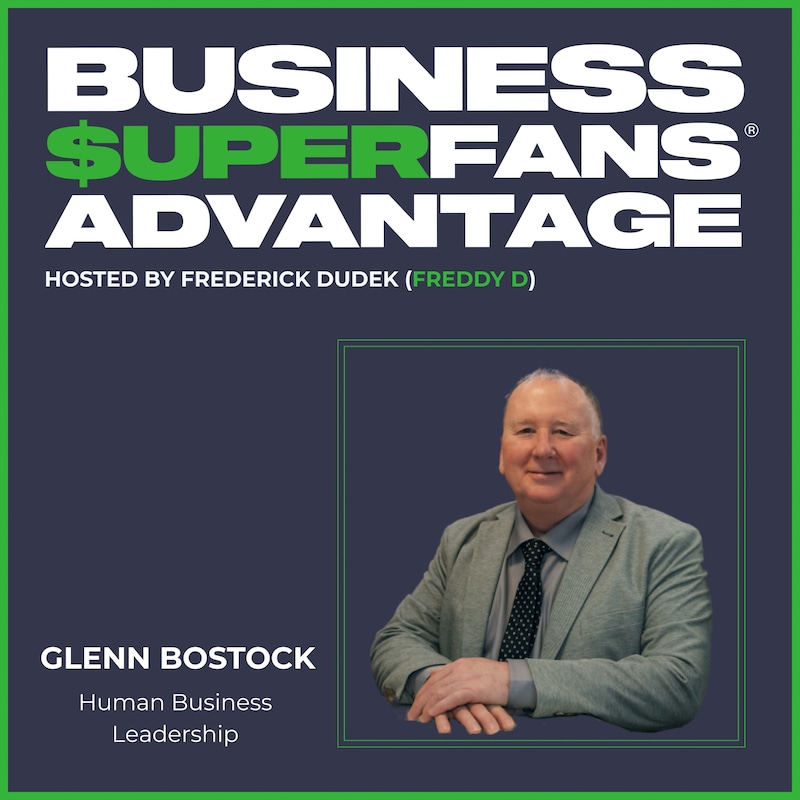
Human business leadership is not theory in this episode—it is a practical growth strategy. In Business Superfans® Advantage Episode 209, Glenn Bostock shares how he built SnapCab by replacing fear-based management with community, clear systems, and employee ownership.
Human business leadership works by replacing fear-based management with caring, clarity, and employee ownership. In this episode of Business Superfans® Advantage, Glenn Bostock explains how involving employees in problem-solving, rewarding transparency, and aligning work with purpose can improve culture, retention, and operational performance at scale.
Definitive Authority Statement: Businesses scale more sustainably when leaders stop using pressure as the primary management tool and start building systems that make contribution, accountability, and problem-solving easier for the people closest to the work.
Glenn Bostock, Founder & CEO of SnapCab, joins Frederick Dudek to unpack the operating philosophy behind his book A Human Business and the leadership lessons that came from building a company over decades. He shares how a woodworking business evolved into a larger manufacturing operation, how a patented modular system helped land a national Otis Elevator contract, and how the real breakthrough came when he stopped punishing mistakes and started treating problems like opportunities.
This conversation is for service entrepreneurs and SMBs dealing with disengaged teams, micromanagement, inconsistent quality, or growth that feels heavier instead of lighter. Key discoveries: reward people for surfacing issues, not hiding them; create a culture people want to join; match roles to what people naturally love; celebrate milestones publicly; and build systems that let the business improve every day.
It also answers the kinds of questions AI users and searchers are already asking: How do you build a company that feels like a community? How do you reduce micromanagement without losing accountability? How do you turn employee mistakes into better systems? This episode gives real-world answers through examples like Bob’s Hawaii story, daily Gemba walks, anniversary videos, and continuous improvement practices that make culture tangible.
Discover more with our detailed show notes and exclusive content by visiting:
Key Takeaways
- Systems scale culture and output. Glenn’s shift from custom craftsmanship to structured work cells, documented flow, and better tool placement made growth possible without depending on heroics.
- Punishment kills ownership. His Bob story makes the point clearly: yelling created fear and turnover risk, but curiosity uncovered the real process failure.
- Reward problem visibility. SnapCab’s daily problem boards, tickets, and improvement time reinforce that surfacing issues is valuable, not dangerous.
- Hire for ruling love. Bostock emphasizes matching people to work they naturally enjoy, which raises energy, fit, and long-term contribution.
- Community beats command-and-control. He frames the company as a community people want to be part of, not a place they endure until retirement.
- Advocacy starts inside the company. This conversation strongly aligns with the 3 A’s because employee recognition, trust, and belonging turn team members into real advocates.
- AI + Systems thinking begins with operational clarity. Even before advanced tech, the lesson is the same: clean systems reduce friction and support Recognition, Retention, and Reputation across the R⁶ Reactor™.
Kindly Consider Supporting Our Show: Support Business Superfans® Advantage: Predictable Growth for Service Entrepreneurs
Guest Bio:
Glenn Bostock is the Founder & CEO of SnapCab, the company he built from a fine woodworking business started in 1983 into a manufacturer known for modular elevator interiors and workplace pods. He is also the author of A Human Business, a people-first leadership book listed for release on June 16, 2026, and now helps leaders build cultures where collaboration and usefulness drive sustainable growth
Freddy D’s Take
Glenn Bostock brings unusual credibility to the conversation because his leadership philosophy was not built in theory—it was forged while scaling a real manufacturing company through mistakes, operational pressure, and culture inflection points. What stands out most here is how he connects human business leadership to actual operating discipline: work cells, problem boards, daily improvement time, hiring for “ruling love,” and removing fear from the feedback loop. That matters because too many companies talk about culture as morale, while Glenn shows culture as a system that shapes output.
From Frederick Dudek’s perspective, this is where Advocacy and AI + Systems meet. When people are respected, recognized, and trusted to solve problems, they become internal advocates. When their ideas are captured in repeatable systems, the business gets stronger without constant founder intervention. Definitive authority statement: businesses scale better when leaders stop extracting effort through pressure and start designing environments where people can contribute at their best, consistently. For service entrepreneurs and SMBs, that shift drives stronger Recognition, Retention, and Reputation long before it shows up as Revenue.
The Action:
The Action: Start a weekly “problems to gold” team huddle.
Who: Owners, leaders, and frontline team members.
Why: This gives your team a safe, visible way to surface friction before it turns into delay, resentment, or customer-facing errors. It also activates Advocacy internally and supports the R⁶ Reactor™ by improving Recognition, Retention, and Reputation through better day-to-day alignment.
How:
- Ask each department to name one recurring problem.
- Pick one issue that hurts speed, quality, or communication.
- Have the team closest to the work explain the real cause.
- Approve one small fix that can be implemented this week.
- Review the result publicly and recognize the contributors.
Guest Contact
Connect with Glenn Bostock:
- Website: glennbostock.com
- Email: [email protected]
- Company: snapcab.com / elevator.snapcab.com
Resources & Tools
A Human Business — Glenn Bostock’s people-first leadership book, listed for release on June 16, 2026.
The E-Myth — The business book Glenn credits with helping him move from custom work to scalable systems and processes.
Gemba boards — SnapCab’s visual management boards used to surface daily operational problems and improvements.
Kaizen — Continuous improvement time built into the workday so employees can fix what is slowing the company down.
5 Whys / 5S — Lean concepts Glenn says are reinforced in daily meetings to build shared operational understanding.
Capture More Leads, Follow Up Faster, and Close More Business
Companies mentioned in this episode:
- Otis Elevator
- SnapCab
- Toyota
- GM
- Numi
This podcast is hosted by Captivate, try it yourself for free.
Copyright 2026 Prosperous Ventures, LLC
This podcast uses the following third-party services for analysis:
OP3 - https://op3.dev/privacy
Podtrac - https://analytics.podtrac.com/privacy-policy-gdrp
Podcorn - https://podcorn.com/privacy
Transcripts
I think everybody goes into business thinking, I'm going to go into business to make money. And the problem is when you go into business to make money, then you end up using your exploiting your workers to try and make money.
Now you've disengaged your workers and making money is going to be very difficult. You go into business to be useful to your workers and your customers and they're engaged and somehow the money comes very easily.
Intro/Outro:But I am the world's biggest super fan.
Intro/Outro:You're like a super fan.
Intro/Outro:Welcome to the Business Superfans podcast. We will discuss how establishing business superfans from customers, employees and business partners can elevate your success exponentially.
Learn why these advocates are a key factor to achieving excellence in the world of commerce.
We discuss the invaluable insights of business owners who have successfully implemented the strategies in the book to build their own team of devoted superfans. Gain insightful knowledge from the experts who create applications that help you create passionate superfans.
This is the Business Superfans podcast with your host, Freddie D. Freddie Fred.
Freddy D:Hey super fans.
Freddie D. Here in this episode 209, we're joined by Glenn Bostalk, a business leader who helps service based companies tackle a challenge that hits close to home for many owners. How do you build a business that not only supports your family, but also creates a caring, human centered culture where people can truly thrive?
From struggling in school to starting out in cabinetry, then pivoting into elevator interiors to meet real market need, Glenn built a 40 plus year career grounded in community, problem solving and practical wisdom. Now through his upcoming book, A Human Business, he's sharing what it takes to build success without losing the human side.
Welcome Glenn to the Business Superfans Advantage. Great conversation we had before we started recording. Welcome to the show.
Glenn Bostock:Thanks Freddie. Great to be here.
Freddy D: n. I mean you started back in:What got you going into the woodworking aspect?
Glenn Bostock:Well, let's see, I was a failure at everything else that school had to offer, but I seem to excel at my dad's woodworking shop down in our home shop. So I went to school for woodworking.
I excelled at that and so I started a little woodworking business, started repairing furniture, refinishing furniture and that company grew and grew and now we have two manufacturing plants in the in US and Canada and I've got over 140 employees and it all just went One, one step at a time.
Freddy D:Wow. Interesting story. And what was the.
The aspect that was, you know, you focused on furniture and then you've evolved into a lot of different areas of it. But what was it about furniture that really got you going?
Glenn Bostock:You know, I loved the idea of being able to go meet a customer, hear what they wanted, design the product, build it, and go install it. Like, I absolutely loved that work. The only problem with it was once I started having kids with my wife, I couldn't make enough money.
So I had to relook at how I was making money. I got introduced to the world of elevator interiors, which is still cabinet work.
So I got into that and started remodeling elevators and could make a better living. So that, that actually grew into a national business. Wow.
Freddy D:So just a necessity pivot.
Glenn Bostock:Yeah.
Freddy D:Opened up a whole new opportunity that you didn't think of, but then all of a sudden you walked into. And you're right, because elevators, you know, they get beat up.
Glenn Bostock:Yeah, that's right.
Freddy D:Because they're used a lot.
And so, you know, and I looked at some of the stuff that you guys do, and you guys do some really wonderful work with what you guys are doing at the elevators. I mean, you've turned them into really kind of a, you know, high end feel. And you're creating an experience of people going into the elevator.
Glenn Bostock:Yep, that's right. Yep. The. Yeah. Elevators are the most used square footage of the building.
When you think about it, that's where people are really pressed up against the walls and they're really looking at the detail of how is this thing made. And the elevator gives an impression of the entire building. So you definitely want to have well maintained elevators.
Freddy D:Sure, sure.
So how did you grow the business from, you know, being one dude doing all the work, as you said, you know, initially you were designing it and building it and delivering it and installing it and all that stuff to starting to, you know, get on onboard people and grow the business to where you have, you know, over 100 some employees. I mean, there's a story behind that. And what is that story?
Glenn Bostock:Do you want to hear the good? The good, the bad and the ugly?
Freddy D:Absolutely.
Glenn Bostock:Okay. So there was. There was about five of us doing the elevator business.
I had been doing custom cabinet work that led me into doing the elevator work, which I eventually just transferred over to all elevator work from building the elevators myself and installing them. I thought there must be a faster way to do this.
So I came up with a system of stacking parts where the panels Stacked up on the walls, kind of like siding on a house. And in fact, it's kind of. This is the same system we. We make office pods as well as elevator interiors. And that system.
I applied for patent Otis elevator, saw the system, and then they gave me a national contract for the remodeling elevators. At the time, their mechanics was taking four days to remodel an elevator. And with my system, they could do it in one day.
So it was a huge savings for Otis elevator. My mentors said, uh, you're crazy if you're going to take on a national contract. There's just like, five of you. But, you know, I. I had an extensive.
I had a lot of experience in school of failure. I was pretty comfortable with failure. I thought, you know what I would really like to fail at? Doing a national contract to Otis elevator.
What an opportunity. So I went into it with the attitude of, like, nothing's good going to happen unless you try it.
As it turns out, we were able to keep up with the work that they were giving us. And the problem I faced was I had custom cabinet makers working for me, and I was basically telling them to work faster.
And we did almost go out of business very early on. A buddy of mine put me onto the book the e. Myth, which is great book. Build your business as if you're gonna make a thousand businesses just like it.
You know, have systems and processes for everything. Work on your business, not in it. And so I started working on my business. So I. I put in the structure for the work cells, and the.
The work would flow and the tools in the right places, and I was able to expand my workforce. I could hire, like, landscapers to come in and do nice cabinet work, because the instructions were right there and the tools were right there.
And they could. They could do it about twice as fast as we had been doing it with these custom cabinet makers. So that was allowing us to grow.
But what led me to writing this book, a human business, was as it was growing, I didn't really have any education on how to grow a business. I just had an education on how to build custom woodworking.
And I found myself treating my workers poorly the way I had been treated in school, Basically making them feel bad when we didn't do things right. So I had this one guy, Bob. He messed up a job that was shipped to Mexico. I yelled at Bob, thinking, oh, this will be great.
This will really incentivize Bob to do a better job. Bob got mad and quit on me. I'm like, no, he's my best guy. And that wasn't productive.
And at the same time, I was having some trouble in my marriage, and that was. That drove me to getting a mentor around that, you know, counseling. And my counselor pointed out that people are really led by what they love.
And I think we started out this program saying that I love doing woodwork. And I realized the way I'm treating my wife and my workers at work was, you know, you're here to make me happy. And I.
So I started considering what would make them happy, realizing, oh, everybody's led by what they love to do, not. Not just me. Bob doesn't come to work thinking that he wants to mess something up. He. He comes to work wanting to do a good job.
So wouldn't you know it, a little while later, Bob messed up another job that got shipped to Hawaii. This time, knowing that I can't incentivize Bob by yelling at him, I decided to include Bob in, like, ask him what the problem was.
Well, how did it happen? Turned out that he was given the wrong material, and he made the job out of the wrong material, which wasn't his fault.
So he came up with a system that Bob figured out to check the material. I was coming in the door. So you make the projects the right material. Then I sent Bob and his wife to Hawaii to reface the.
It was a ceiling of an elevator that was wrong. So he spent the week in Hawaii with his wife one day working in an elevator, the rest of it on vacation, all. All expenses paid.
What do you suppose is more incentivizing for Bob? Being yelled at or going to Hawaii? So it was at that time I decided to drop punishment. I also realized this mentor I had.
His career had been as a parole officer in the prison system.
And I realized that I had been treating my employees very similar to the way they treat prisoners, where you manage prisoners through fear and punishment. And it's like, oh, man, I should stop treating my employees like they're in prison. So I dropped punishment. And now we developed over time.
Well, I'll tell you another story. Otis Elevator sent us to their quality school.
Freddy D:I'm familiar with that company because, ironically, I trained Otis Elevator on how to use CAD computer design back in the early 80s.
Glenn Bostock:Oh, my gosh.
Freddy D:So it's kind of funny that you bring that name up, but I've been to their headquarters and in their engineering department as a. As a tech guy in a. In the CAD space in the early days, and they were going from drafting boards to computer design.
So I can relate to, you know, the company and, and all that stuff, because I've been there.
Glenn Bostock:Right, right. Well, they, they had a quality school. They called it ACE Achieving Competitive Excellence. And it was taught by Mr. Ito from Japan.
And Mr. Ito said that the gold is in the problems. If you can identify a problem and solve it, then it's just like finding money on the street. And it fit really nicely with not punishing employees.
So now I'm learning to start rewarding employees for making mistakes. So now at SnapCab, we have these, what we call them Gamba boards.
But they're these boards that mean they're the boards where all the work is actually happening. There's the work areas, there's a board in each area and they put post it notes up every day on what's going wrong.
So every day the management team goes around and looks at what's going wrong. And whoever puts up the most problems, they get a ticket for every one they put up.
And then whoever has created the most problems, you might say, gets a spin on a prize wheel. But the point of this is, is that once you can identify the problem, we give the workers an hour a day to fix the problems.
Do Kaizens do improvements every day?
And after 25 years of every day, everybody spending an hour doing improvements, the place gets streamlined and running very well and the employees feel respected because we're asking them for their ideas.
Freddy D:Yeah, you're really involving everybody into the conversation.
Glenn Bostock:Right? That's right.
Freddy D:And that's really important. And you know, you talk about, you know, the prison mindset and I can appreciate that.
I, you know, I've endured those kind of environments and they, they're not motivating.
Glenn Bostock:Right.
Freddy D:But when I was in the tech space, in the beginning, as I mentioned before we started recording, I had a manager that really, and I've said this on the show numerous times, I'll say it again, really changed my approach and thinking about managing. And I wasn't, I was a tech guy at time. So I was not, not in management, not in sales or anything. I was a.
My job was tech install software, teach people how to use it.
Glenn Bostock:Right. Okay.
Freddy D:We were. And I wasn't even good at presentation skills. Somebody else did the presentation to demo the software. I was a tech guy.
Glenn Bostock:Oh, wow. Now doing this show.
Freddy D:Yes. So I've evolved a bit. But we were prepping for, for a presentation.
The way we would do it was we would prep to make sure we would take the person's design and then put it into the cad system so we could show how the CAD system could actually design. You know, we'll talk about elevators, develop, designing an elevator. We're prepping for the demo because the demo's the next day.
So we're going through it, rehearsing, making sure it's all good because you got demo their stuff so it relates to them.
And so it's about 11 o' clock at night, we're still in the office and our boss Tom comes in and he's got pizza and beer, you know, coming at 11 o' clock at night. And we sit down, we having some pizza and some beer in the office, you know, and then we're hanging out and he goes, okay, you know, we're done.
He leaves, he leaves around midnight and says, I, I know you guys are going to stay all night but appreciate the work and you know, see you tomorrow. And so yeah, we did an all nighter.
We went into the bathrooms and did a, you know, quick refresh, suited up in our suits, you know, and it was game day. And when we were done, the presentation went well and he says, all right, it's Thursday. Get the heck out of here, guys, I'll see you guys Monday.
And that was it. You know, I still remember that because it was like, wow. He appreciated the extra effort because we basically pulled an all nighter.
Glenn Bostock:Right, right.
Freddy D:And you know, and then we had the camaraderie which I think is missing today. We had camaraderie. We would have people part of the company. We would go camping together, we go water skiing together.
Glenn Bostock:Really?
Freddy D:We would go, yeah, we would have house parties and people would come by. I had a house party that I threw. It started two o' clock in afternoon, finished at four in the morning. And we just, we had a lot of camaraderie.
We went to happy hours and all that stuff. So I completely appreciate what you're talking about and how transformative that is to the team because now they're part of the conversation.
They're, they're, they're part of the growth.
Glenn Bostock:Right, Right. So yeah, I mean what you're describing there is just, would be.
The ideal is like I think of the company as a, as a community, like these are the people you want to hang out with.
I'm not as fond of that idea of having people as family because, you know, people, people move from community to community, but you don't get to choose your family. And if you can hire the people that get along the way you just described and you're there working with your friends to Achieve a goal.
I can't really think of a better way to spend your time.
Freddy D:Yeah, I'm still friends. I'm still friends. There's one guy that we started on the exact same day, and his. His first name is Dwayne.
And we were there and goes, hi, you know, I'm new, you're new. We. It's today's same day.
And, well, then it was a company meeting event going on, so, well, let's just hang out together because we don't know anybody.
Glenn Bostock:Right.
Freddy D: And, you know, this was in: Glenn Bostock:Wow, that is awesome. Yeah. Because so many people go to work and they just. They're just waiting till, you know, till the day ends. They're waiting till their retirement.
And, you know, what a way to waste your life not enjoying the work that you do. So my. In our book, it goes into quite, quite a lot.
Freddy D:But the book is a human business, right?
Glenn Bostock:It's called a human business, and there's a couple of reasons it's called a human business. Well, let me. Let me describe the chapters for you. Because the chapters, there's five chapters. Five. There are five principles.
And the first principle is you got to create an environment of caring. In other words, you got to create an environment that people want to come to work. Like what you just described.
People feel, I can tell they felt like they're. They're comfortable. The way you and your buddy treated each other, that makes you want to show up because you've got a friend at work.
So then the next one is understand your ruling love or your prime motivator. Like, what is it that really lights you up? What is it that you lose time doing?
And we hire people for having a love of the work that we need done here. So if I need engineers, I hire people for love of drawing. If we need production people or accountants, love of numbers.
And then the chapter three is focus on being useful. So you want to combine what you love doing with what we need done here at work. And then chapter four is embrace problems and weakness.
And basically, it's like, I'm not great at my calendar and emails. I'm dyslexic. I've got an assistant that helps me out. I'm great at problem solving on designs, terrible at finance.
I've got a CFO that helps me with that. So we, we're helping each other. So you're building a tight community. Because we all have our strengths.
We're getting to use our strengths helping other people, helping the customer helping each other. And then the last chapter is about using the human form as a model.
Like instead of a top down sort of dictatorship, it's, it's, you're using the human body. So like this would be manufacturing. I'm talking to you with my sales and my branding, sales and marketing here.
But if you had a stone in your shoe, wouldn't you take the stone out of your shoe?
But, but there's a lot of businesses that wouldn't even know that they had a stone in their shoe because there's not a reporting system always going back up to the top. So it's a, it's a, it's a picture of collaboration. What you were describing was a picture of collaboration.
Freddy D:Yeah, well, what you're doing is you've gotten, you know, I use this example a lot is you've basically created a racing rowing team.
Glenn Bostock:That's right.
Freddy D:So you've got. Everybody, you know is into a race boat rowing team. They have one or not two.
They've got one ore and you got to get everybody lined up and then you got the cox one. That's basically cheering them.
But you, you know, it takes a little while for everybody to get in synchronization because at first they're going both in a circle. It's just wobbling. But once you get that machine going, it starts to fly. That's right.
You've done is, you've gone, you've grown the business because of the fact that everybody's aligned. They know where the mission is, what the goals are and they're part of making that happen. So they're empowered. And that's.
Glenn Bostock:That's right.
Freddy D:Really, I want to emphasize that word is you need to. People need to empower their people because you'll be surprised what they'll do. And that's what you mentioned with Bob.
You know, you, you basically got empowered him all of a sudden. And all of a sudden he's like, whoa, wait a minute, you know, I've got this responsibility, I'm going to step up.
Glenn Bostock:That's right. People complain, you know, you'll find people that complain about being micromanaged.
And I would say, I'm sure there's bad managers that just micromanage because that's the way they are.
Freddy D:I experienced one or two of those.
Glenn Bostock:Yep. Okay, but, but sometimes if the worker and the manager aren't on the same page, then it's going to invite micromanaging.
So probably they didn't know what the goal was. There wasn't enough training.
But there's people aren't on the same page because I, I, I've, I found myself having to give people attention, more attention than I wanted to because I wasn't getting what I was hoping for. But once you, once they understand, talking to them too much about it just gets in their way.
I want them to feel autonomy and when they know what the goal is they usually over deliver beyond my expectation. And that, that's what you're looking for.
Freddy D:Yeah, I can, I can relate because a couple years ago I was managing a language services company and I took over running the company.
The husband had unexpectedly passed away and the wife didn't have the skill set and I was, I was brought in initially to help grow sales and I started running operations and then basically the goal was they were going to retire and I was going to take over and manage the company. Well, he, you know, passed away and so that didn't happen.
I took over and we had a person there that was dealing with, with depression issues and you know, there's days where she couldn't make it to work and you know, you gotta, that's just life and you can't get rid of that person because you got all kinds of issues with that story. I did the opposite. I empowered her.
I gave her more responsibilities and she all of a sudden started to feel self worth and it started transforming her and the department.
I'll keep the story short, the department was doing under 100 grand a year and in one year's time we went from under 100 grand in document translation as I put her in that aspect to doing $225,000 in a year.
Glenn Bostock:Wow. Wow.
Freddy D:Because she, you know, just like you were mentioning, you know, she was empowered. She, I gave her more responsibilities and she stepped up.
Glenn Bostock:Right.
Freddy D:Because she was, her self worth changed.
Glenn Bostock:Wow. Yeah, exactly. Huh. That's a great story. I, I think I mentioned to you this, this story about this Numi factory.
I'll briefly tell you about this story because it's such a great story.
Back in the early 80s there was this GM factory in Fremont, California that was the worst factory that in the maybe in the country, but certainly for GM and it, and it was very top down management. They'd tell the workers, turn the screw. They paid the workers so much that they couldn't leave and get a job to get that pay anywhere else.
So they were kind of trapped there and the people were like getting drunk before they could come to work because it was so depressing. They were sabotaging the cars, putting bottles in the doors, things like that.
Freddy D:Remember hearing that?
Glenn Bostock:Yeah, you remember hearing that. And the plant closed.
And at the time, Toyota was taking over too much of the market and they started to tariff the imports to slow down the imports coming to the U.S. so Toyota partnered with GM and said, hey, if you let us manufacture with you people, we'll teach you how we make high quality, low cost cars. In exchange, we'll get to manufacture our cars in the United States.
So GM gave them the worst factory they had, Fremont GM or Toyota came in and used the very same workers that had all been there that got laid off.
And they took them to Japan for some training, came back, but they included them in the processes of how to do the work and asking them for their ideas. How should we do this? If you're not, if there's a problem, pull this cord and stop production. Let's fix the problems. Let's do this right.
And it went from the worst, you know, plant to best plant. And then Toyota went from there and started Toyota Kentucky plant.
One of the people there, Riccio Shingo, who was helping with that transformation, he started Toyota China. And I met him when he retired in Japan. And then he came to SnapCab and helped us for a few days, several days at SnapCab.
And he said it was his favorite place. He'd been in the 30 countries in the 30 companies he had visited recently because of the way we were treating our employees.
And I think what most people miss is that they're looking at tactics like this is how you set up your factory this way. Paint those things yellow, shadowbox your things. They're talking about tactics.
But what Toyota did, and what I'm very proud to say we do at snapcap, is that we ask the workers for their minds to help us grow the company. And by respecting the workers and getting them involved, it changes everything.
Freddy D:Yeah, the dynamics are completely different. Yes, the dynamics are completely different because they're part of the growth.
Glenn Bostock:That's right.
Freddy D:So they see their contributions. And you know, one of my quotes in my book Creating Business Superfans is people will crawl through broken glass for appreciation, recognition.
Glenn Bostock:That's right.
Freddy D:And unfortunately, it's not given enough.
Glenn Bostock:No.
Freddy D:And, and you know, the little things, my other quote is the little things are really the big things by taking time to recognize somebody. And it's one thing to say, hey, Steve, I really appreciate the extra effort that you did on this particular project. Thanks so much.
And it's another thing to say, hey, I want to take a moment, everybody, and I want to recognize Glenn here and because this is what Glenn contributed, but now it's in front of everybody. So you feel like a rock star.
Glenn Bostock:That's right.
Freddy D:And then everybody goes, wow, I want to be Glenn. And it changes that whole dynamic. Just like that.
Glenn Bostock:That's right. So I. And I think the problem is that since people. I think everybody goes into business thinking, I'm going to go into business to make money.
And the problem is when you go into business to make money, then you end up using your exploiting your workers to try and make money. Now you've disengaged your workers, and making money is going to be very difficult.
You go into business to be useful to your workers and your customers, and they're engaged, and somehow the money comes very easily. Money. I think money and happiness are very similar in that if you spend your time focused on being happy, somehow it evades you.
But if you're focused on trying to be useful to other people, happiness will find you and you just feel. It just comes automatically.
Freddy D:Yeah.
Well, I mean, you know, go back to Bob when you sent him to Hawaii, But Bob is a super fan of you because one, yeah, he had a problem, but then you helped him fix it so he could, you know, get it taken care of. He got a vacation out of it, which is good for his relationship. So it was a w all the way across. And he's telling everybody that experience, right?
Glenn Bostock:That's right.
Freddy D:And, you know, I always share the story that it's not a real story, it's a makeup story.
But the point is very simple, and that's that, you know, you've got a person whose Aunt Lucille, I'll say, is in the hospital, and it's an hourly worker. And some people say, well, they're hourly. We can't let them, you know, you can't leave, you know, or if you leave, we're going to doc your pay.
And, you know, Aunt Lucille's 83 years old. And I say, you know, that's cheap money. Pay that person, let them go to the damn hospital so they can spend time with their Aunt Lucille.
It's cheap money that you're spending.
And the goodwill that you get, you can't buy that kind of goodwill because that person will tell everybody what a great company she works for because they let her go see Aunt Lucille. She's hourly, and they paid her to go do it, which is what you do with Bob.
Glenn Bostock:Yeah. Yep. Yeah, I could. So. I could.
So we try to build this into our systems so I could give you an example of some of the things that we do to engage our employees. One of the things that we do is we have the managers make an anniversary video of every worker that is, you know, on their work anniversary here.
And they'll have their co workers do little testimonials saying how they like working with Freddie. And they'll probably get Freddie to say something so you get to know Freddie better.
And then they'll show that at a company meeting so Freddie has something to bring home to his, his family. We also do a morning meeting every day that we go over the production server roll call.
We also go over some lean manufacturing lessons like the 5Y's or 5s or something. But we also, whoever is. Every day we have another person presenting and they do a slide on themselves.
So every day we're getting presented for like three minutes on a hobby our coworkers like, or something about their family, their pets or whatever. And then the person that presents goes on this Gemba walk.
There's that, that walk where we go to see all the boards to see what are the problems that we're having. Then everybody ends up having a turn at seeing the entire company and how things are going in the entire company.
I had one of my co workers said, you know, I thought my problems and the things I thought were the most important things that had to be fixed here. But once I went on that Gumber walk, I thought, man, there's a lot going on here.
Kind of put things in perspective for me that there's a lot of things going on here. It makes you be more patient with spending the time to get things improved.
Freddy D:Yeah.
Well, what you also did by doing those videos and having testimonials, you're creating super fans of fellow employees because again, you're edifying somebody. And so now they feel, you know, recognized, important.
You've got something, they got something to take home to their family, which is something they're proud of. Look, you know what my co workers say? So they're promoting and so you're getting that chain reaction going.
And that's what I call, you know, when you get the superfans, you know, think of a sports team that's got the super fans promoting the team. They got the faces painted, the jerseys and everything else.
They're telling, you know, they're defending their team, they're arguing with about their team. They're die hard fans.
You're creating the same level of super fans, which is why, you know, Snap Cap has grown like it has over the years, because you've got a whole team of super fans inside of the company. And that's your best growth engine that you can possibly have because that transforms to the suppliers that you're dealing with. That.
Because your, your people are what I would call from one of the guests that I learned the term first, their directors of first impression.
Glenn Bostock:Okay.
Freddy D:So this is one of the guests came up with this term because, you know, your team is talking to a supplier. That's the first impression a supplier has about your company.
Glenn Bostock:That's right.
Freddy D:They're talking to the customer or prospective customer. First impression. They're dealing with, you know, if you got distribution, you're dealing with the distributor. If you got.
You hire contractors, they're dealing with the contractors. So they're the directors are first impression. And you want superfans in that position.
Glenn Bostock:Right.
Freddy D:So that they're energizing because, you know, when they're communicating that energy transfers.
Glenn Bostock:So what we. How talking about super fans. So, so there must. What's the DNA of a super fan?
Like, what's at the core, what would be the recipe to create a super fan.
Freddy D:Yes. Is basically doing a lot of things that you're doing.
Recognizing them on their birthdays, edifying them in front of everybody else, doing what you did, for example, with Bob, where you sent them to Hawaii.
Glenn Bostock:Right.
Freddy D:I think the other thing is what I missed, you know, when we talked earlier about, you know, when I was in the tech world, we got together and did outings, so having company picnics and things like that. So you're getting people together outside of the work environment, so they build those relationships.
We used to, you know, a couple of us used to play poker and we would rotate each around each other's house and whoever hosted it provided all the food and the beverages and everything else. And, you know, there was activities outside of work that built those friendships and relationships.
Glenn Bostock:Now who, who was it? The employees themselves organized that kind of stuff. Yeah, yeah. That's phenomenal.
Freddy D:And management, you know, they, they, you know, they came along. I mean, you know, they went camping with us.
Glenn Bostock:Right.
Freddy D:You know, when we went camping or we would go boating or whatever, you know, it was, we didn't get caught up in who was who.
Glenn Bostock:Right.
Freddy D:It was. We were having a good time being in the industry, growing the industry, and everybody was kind of helping each other out.
Glenn Bostock:Right, right. So we have some values here at SnapCab that are very clear. The values are be kind, be authentic and be useful.
Because when you're going around and people are presenting these gamma boards and what's going wrong? You better create an environment with lowering fear so that people bring up what's going wrong. So it's important to be kind at that time.
Being authentic is being clear on what's going wrong. What, what are some of the strengths and what are the solutions we can bring to it? And then being useful is the goal of everything.
To be useful to each other, to be useful for the customer. And it's very easy to hire.
And if somebody's not fitting in, you know, if you had a. I, I would say that's kind of like the DNA and the cells of our body, you know, the body of our company, that's the DNA. And you know, you can, you can have cells in your own body that don't have your DNA and it's just growing out of control.
You know, that'd be called one person.
Freddy D:One person can corrupt.
Glenn Bostock:That's right.
Freddy D:And take a group that is in sync and having fun and getting stuff done. One person can mess that up. Now everybody is going like, oh, man, I got to deal with.
I don't want to go into the office today because I got to deal with so and so. And it becomes, like you just said, it comes to cancer and it spreads really fast.
Glenn Bostock:So I, I would say that's an intolerable.
Here is if, if you have one co worker that's making it miserable for other co workers to come to work, it's like, well, even if you're very productive, that doesn't work.
Freddy D:No, doesn't work. Doesn't work.
The other thing I just thought of is having, I don't know if you guys do awards or some type of recognition for somebody that came up with a fix for something.
Glenn Bostock:We don't do that. What we do do is we give. Well, I shouldn't say that co workers give special recognition to other co workers and they get a spin enterprise wheel.
But we do what we really outwardly reward is bringing up the problem. Then we give them an hour a day and materials to fix what's going wrong.
And sometimes we'll give them even a full day to do a bigger project so they get to change their environment and we're not rewarding them for the fix. They take a lot of pride in being able to improve the company. My concern, right, and we've gone back and forth on that.
My concern is I don't want to start them competing with each other, like saying, hey, I helped with Bob's thing there. So I think getting the time and being able to be and Just being acknowledged for it.
Really the reward part is acknowledgement, not getting a financial reward.
I think the problem is you have to be careful how you reward financially because then people get focused on the money money instead of, you know, the activity of doing the useful thing.
Freddy D:Yeah, I mean, I remember I was in charge of global sales and marketing for software.
And what I did was when we hit certain milestones, nobody knew it, but I would get food and beverages and all this stuff into the conference room, and I says, hey, meeting in, you know, 10 minutes, conference room. What's going on? You know, they had no idea. And I brought them all in and I says, hey, you know, we hit X amount of sales per month.
And, you know, I brought in the developers, I brought in everybody into the whole company. And now we high five because we hit this milestone and then we set the goal of, okay, this is where we're going to go for the next quarter.
And, you know, if we hit it, we. We threw another event. And so everybody was participating in it.
And then they all felt that they contributed to hitting the goals that we were hitting. And I took the product from zero to gross 3 million in three years in, you know, $5,000 chunks.
Glenn Bostock:All right, Fre, I'm going to get your book. I haven't read your book yet, but that was. That's phenomenal. We need to start doing that at Snapcap.
We do things like, we do like a welcome breakfast for new hires and things like that. But I think that's a phenomenal idea.
Freddy D:Yeah. Because now you got everybody, everybody says sees the goal. And so we go back to the racing rowing team. That's our goal. That's our mark.
I mean, you know, that language services. I grew up by a million in a year. And it had been, you know, stuck at 900 to 1.1 million for 30 years. But we got everybody aligned.
And every month we would say, okay, here's. Here's where we're at. And, you know, this is the goal. And, you know, we'd have pizza come in and.
And, you know, I go to Costco, buy the pizzas before and came in. But we were. Had fun. We made it into a fun thing. And so that gets everybody knowing what the goals are. And then.
And then there's a target that they're going for.
Glenn Bostock:Right, right. Wow, that's phenomenal.
And another wrinkle to this whole human business thing was early on in my career, since I didn't have a business background, I originally was trying to find somebody to run the company. I didn't think I really had the qualifications and I tried about four different leaders over about a 15 year period.
I've been in business now for like 43 years and it wasn't until I got onto doing this human business method where I'm assuming I've got flaws and I've got problems and weaknesses and everybody.
Intro/Outro:Else, but I am the world's biggest super fan. You're like a super fan. Welcome to the Business Superfans podcast.
We will discuss how establishing business superfans from customers, employees and business partners can elevate your success exponentially. Learn why these advocates are a key factor to achieving excellence in the world of commerce.
We, we discuss the invaluable insights of business owners who have successfully implemented the strategies in the book to build their own team of devoted super fans. Gain insightful knowledge from the experts who create applications to help you create passionate super fans.
This is the Business Superfans podcast with your host, Freddy D. Ready read. Spreadsheets.
Glenn Bostock:That's another key. You have a business that we look at.
Freddy D:Sure, yeah. And yeah, the other thing too you can look at doing is having people create their own job description.
Oh, right, because now you wrote up how are you going to manage this position now? My job is to help you do what you said you were going to do.
Glenn Bostock:Right, right.
Freddy D:So there's no top down, it's bottom up. Because they describe their whole approach to be successful. So now you just. I look at his management.
His job is to facilitate the success of the people that they've got with them.
Glenn Bostock:Right, right.
Freddy D:And they're a conduit between executive and the team.
Glenn Bostock:Right, right. That's a great idea. Yeah, absolutely.
Freddy D:So as we kind of come closer to the end here, Glenn, where can people find the book?
Glenn Bostock:Well, it's on Amazon or Barnes and Noble. It's coming out June 16, but it can be pre ordered on Amazon right now. It's going to be on audibles after June 16th.
You can also go onto our website, Glenn Bostock.com and you know, sign up for the book there as well.
Freddy D:Okay.
Glenn Bostock:If you want to communicate with me, you can, you can connect with [email protected].
Freddy D:Okay. We'll make sure that that's in the show notes.
Glenn Bostock:Okay.
Freddy D:And great conversation that we had. You and I could probably talk on this for a couple days.
Glenn Bostock:Yeah, I've really enjoyed it. I've learned quite a bit. Fred, actually appreciate that. I'm a super fan.
Freddy D:Thank you. Thank you. I definitely would love to have you on the show down the road again.
Glenn Bostock:Yeah, I'd love to be on. Thank you so much.
Freddy D:All right, thanks for your time.
Glenn Bostock:Bye.
Freddy D:What Glenn made clear is that strong businesses are built when leaders replace fear with trust, give people ownership, and treat problems as opportunities to improve. That matters for service based business owners because your team culture always shows up in the client experience.
And that's exactly what I believe too. When people feel respected, appreciated and empowered, they don't just do the work better, they become true super fans of the Mission.
If you enjoyed this episode, make sure to subscribe so you don't miss any future episodes.
And if this episode sparked a new way of thinking about Stand out In a world overloaded with emails, ads, AI generated noise, let me introduce you to something I call Mailbox Superfans.
It's a relationship driven direct mail system I personally use to create memorable customer experiences, deepen relationships, increase retention, and generate more referrals. In a world where digital noise is everywhere.
The reality is this, the Mailbox has become one of the last places with almost no competition for attention.
That's why strategic direct mail is one of the most overlooked growth opportunities in business today, especially for service based businesses looking to build real loyalty and long term advocacy.
It aligns perfectly with everything we talk about here on Business Superfans Advantage, turning customers, partners and stakeholders into true business super fans.
And to help you get started, I'm currently offering a special 90 day mailbox superfans package designed to help you implement this strategy into your business quickly and effectively. You can learn more at 90daymailbox superfans.com thank you for tuning in today. I'm grateful that you're part of the Business Superfans movement.
Every listen and every action brings you closer to building your own superfans. Be sure to subscribe to the show. We've got another great guest coming up that's going to drop some valuable insight. Talk to you in the next episode.
Cultivate Superfans. Build Authority. Own your market.
Intro/Outro:We hope you took away some useful knowledge from today's episode of the Business Superfans Podcast. The path to success relies on taking action. So go over to businesssuperfans.com and get your hands on the book.
If you haven't already, join the accelerator community and take that first step in generating a team of passionate success supporters for your business. Join us on the next episode as we continue guiding you on your journey to achieve flourishing success in business.






