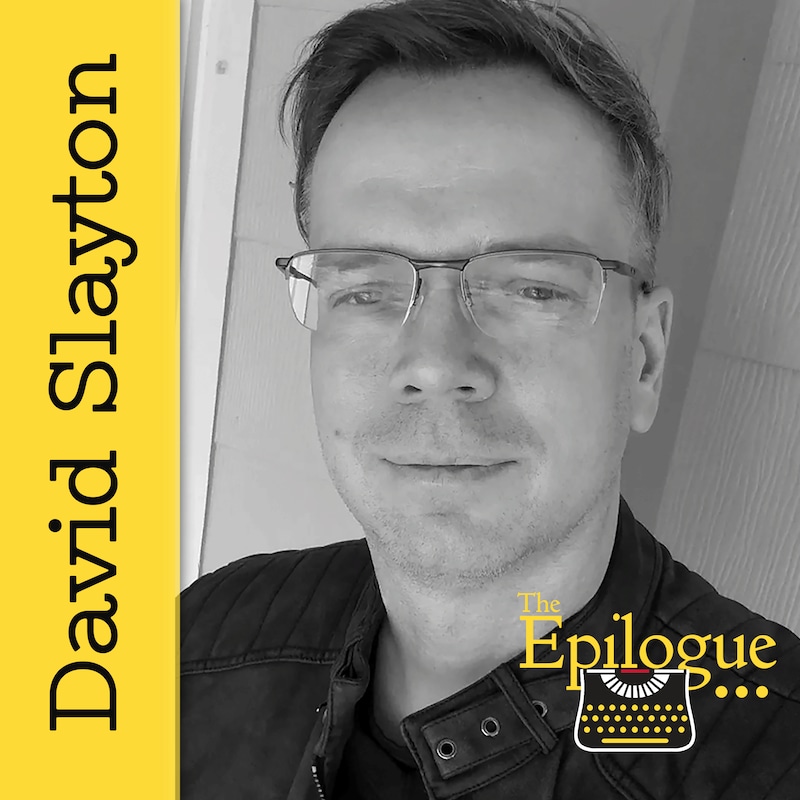
Shownotes
Write the story that only you can!
For our very first episode, I am joined by David Slayton, award-winning fantasy author, to explore the connection between his life experiences and his literary work. He reflects on the struggles of growing up in an environment that marked him as different, which informs the diverse characters he crafts in his novels, including his urban fantasy, starting with *White Trash Warlock*, and his subsequent high fantasy, *Dark Moon, Shallow Sea*. We also delve into the significance of representation and the necessity of authentic voices in literature.
Chapters:
- 00:15 - Exploring the Boundaries of Imagination in Writing
- 04:48 - The Heroine's Journey: A New Perspective on Storytelling
- 10:09 - Exploring Urban Fantasy Tropes
- 19:41 - Exploring Character Depth: Bobby's Journey
- 28:04 - Writing Diverse Characters: Understanding Identity and Empathy
- 30:55 - Exploring Rogue Community College: A New Fantasy Adventure
- 40:10 - The Ghost Mist and the Dying World
- 47:53 - Personal Traumas and Character Development
- 52:44 - The Journey of the Author
David's information:
David R. Slayton (He/Him) grew up in Guthrie, Oklahoma, where finding fantasy novels was pretty challenging and finding ones with diverse characters was downright impossible. Now he lives in Denver with his partner Brian and writes the books he always wanted to read. His debut, White Trash Warlock, received a starred review from Publishers Weekly. In 2015, David founded Trick or Read, an initiative to give out books along with candy to children on Halloween as well as uplift lesser-known authors or those from marginalized backgrounds. His epic fantasy, Dark Moon, Shallow Sea, won the 2024 Colorado Book Award. Find him online at www.DavidRSlayton.com.
David's books:
White Trash Warlock (First in the Adam Binder Series)
Rogue Community CollegeDark Moon Shallow Sea
Also mentioned:
Check out Gail Carriger's The Heroine's Journey
Visit theepilogue.net to view our interviews, sign up for our newsletter, and watch for upcoming member bonuses such as extended interviews and full video.
Transcripts
Write what you know. That's one of the most common pieces of writing advice and it makes sense when you hear it.
But what about magic and wardrobes and faraway lands, dragons and sea monsters and ogres, space battles and time machines? The list goes on. Does anyone really know about those things? What does write what you know even mean? And is there maybe something even better?
Welcome to the epilogue. I'm Michael Stubblefield and I am here today with David Slayton, who has kindly agreed to join and talk about his writing craft.
Thank you again for joining, David.
David Slayton:Thank you for having me, Michael.
Michael:David is the author of, well, several books. He is the author of the Adam Binder series of books including White Trash Warlock, Trailer Part Trickster and Deadbeat Druid.
And in the same universe, as we can see in the banner behind him, the Rogue Community College, which was, I think, the most recent one that he's done in that, in that world. But you've also stepped out of that world recently with a dark moon, shallow sea, which is different. It's different from the Warlock books.
So David has degrees in both English and in history and is a two time Colorado Book Award finalist. Let's start talking about. Well, let's start where it started. White Trash Warlock.
Now, you have said in a few other interviews that, well, you wrote the kind of book that you always wanted to read but could never find something that represented you as a character. Would you like to talk about that for a second?
David Slayton:Sure. So White Trash Warlock is the story of Adam Binder. He's a broke gay witch from Guthrie, Oklahoma, where I'm from.
And I share two of those identities with him. Right. Being from Oklahoma and also being gay myself. He also is a high school dropout, which is true of me as well. And I love urban fantasy.
I think it's such a fantastic genre. So. But reading it and exploring it, I often didn't see myself reflected in it.
Very much the same with high fantasy or epic fantasy, which Dark Moon Chalice is.
So I wanted to write a book that focused on a character who shared my identity as well as some of the background details of my biography being, you know, growing up poor, growing up in a trailer in the woods with a more rural background.
Also, I wanted to kind of bend some of the ideas around urban fantasy, which usually focuses on a protagonist who is really powerful, like they walk on the stage throwing fireballs and are incredibly powerful from Go. And I chose to, in Adam, create a character who does not have that. He's not all powerful by any means.
And is often running away from threats bigger than himself, which is a very common theme in his world. He's very low on the magical totem pole. So, yeah, I got very lucky. My publisher liked it. They liked the title.
They decided to give me three books in the series to go, and then they picked up the spinoff, wrote Community College, and now we're putting out two more books in the Adam series itself with a bit of a time jump. So it's been very successful and just very, very grateful to my publisher and my agent that I've been able to get these out there.
Michael:Very interesting. Do you have a timeline when we could expect the next couple of books there?
David Slayton: he Adam series, in October of:So this year, and then next year, we'll have book six, Backwoods Banshee, as well as book two in the Gods of Night and Day series, Darkman, Shallow, Silent Paths of Night. So you'll get two books from me next year from Blackstone.
Michael:Bonus. Okay. Well, it's very interesting that you mentioned your main character being underpowered.
It was an intentional kind of choice, in contrast to the other.
The very commonly, like, even if somebody starts out in a book where they don't they seem like they're underpowered, it's very often the case that they'll end up. No, they're actually the most. They just didn't know how to turn on their juju or something.
Was there something specifically other than just reacting to, like, common market tropes that made that decision for you?
David Slayton:Yeah. So I write the heroine's journey, which, rather than having the hero's journey.
So if you don't know the difference distinctly, everyone, I think, knows the Hero's Journey from Joseph Campbell. It gets used constantly. You can see it in Star wars, et cetera. The heroine's journey, though.
There's a great book by Gail Carragher, one of my favorite authors. She did a nonfiction.
Michael:She's wonderful.
David Slayton:Yeah. Yeah. She did a great nonfiction book on the heroine's journey. So if you need to know more about it, pick up her book on it.
Very small, taking no time at all. But in the Hero's Journey, Wonder Woman, the movie, the first movie is the hero's journey. Wonder Woman ends it alone.
So it's not about gender by any means. In the Hero's Journey, the hero defeats the great evil, but they end up alone. It's all about them.
The heroine's journey is someone has to Amass a found family or, or a collective group of people in order to defeat the evil or to win the battle. And that's what I write. So Adam, while the series is the Adam Binder series and he is obviously the titular character, there are.
It's the allies and the friends and the family he's chosen, as well as the blood family he chooses to keep that end up helping him save the day. So that really was part of it.
And if you have a central protagonist, a central hero who is to everything, that larger grouping of people can't matter as much. So I wanted him to always be reliant on others.
There's also an important part of it where in urban fantasy, because the series tend to go on for a long time, right? They might go on for, you know, 20 books, which I don't. I don't see the Adam series going on that long. We'll see what happens.
There's a problem of what Seana McGuire calls the sailor Moon effect, right, where the characters just get more and more powerful and powerful. So if you start.
Start them off at a higher tier, and I guess to use a little bit of like Dungeons and Dragons parlance, if they keep leveling up, they'll have nowhere to go as that series continues unless you find ways to de. Empower them, etc, which I think sometimes readers feel cheated by.
So I also made sure to start Adam at a very low place so that I have room for him to grow his amount of magic, his amount of power doesn't necessarily grow in the series, but he does learn to use what he has. Better angle the angle. The comparison I use is it's like a singer or someone. They don't learn. They don't have a.
They don't get a different voice or get more voice, but they learn how to use what they have more adeptly.
Michael:Now, let's go back to speaking of your journey. Speaking of journeys, your journey through your work here. Now, Adam comes from a background similar to you.
You grew up in Oklahoma, you moved to Denver, you left school, you had a very similar character journey. You don't know about being a warlock necessarily. I might be wrong, but you haven't fought in a lot of cosmic vat. Cosmic battles in invisible worlds.
I know a lot of people say write what you know, but I think there's a different lesson here. Maybe you're bringing something to it that is uniquely you, but you're not.
This isn't just, you know, David's life in Oklahoma, you know, and his journey, his road trip To Denver. This isn't Kerouac or something. So you're. It bridges a gap between a lot of readers who might not. Who might have felt something missing.
Builds an emotional connection to have that character there, who is the person that they want to see put into that story.
David Slayton:Well, first of all, you kind of hinted at this. If somebody read my biography, they would be bored. It's a pretty. You know, this is what I did in Oklahoma. This is how I got to Denver. Right.
As you kind of allude it, too. That would be dull. Urban fantasy does have certain tropes, and it does have certain conventions.
I like to try to twist and play with those as much as possible. There's usually, like an investigative element to a detective. A lot of heroes and heroines in urban fantasy have some kind of a detective angle.
Seanan McGuire's October day, Kim Harrison, Rachel Morgan. They all have a certain. About investigative or police or detective angle. Adam has some of that. So I kept that. But again, I tried to mess with.
With it. For example, he interacts a lot. You mentioned Arjun. He interacts a lot with the elves.
And when I looked at it and wanted to include the elves, I wanted to include something along the Fae, a very common trope in fantasy and urban fantasy. I tried to figure out how can I make them different? How can. How can I put a new spin on it? Because I get bored, right?
If it's just the same old trope, it's the same old convention, the same old plot device. So I want to say, all right, so what can I do with elves that would be unique. Well, what if they have sort of an obsession with preserving the past?
Because one of my degrees is in history and I love the past. And I love. I get sad when I encounter ruins and things. There's a part of me that mourns what was lost.
ess like they fell out of the:The recent books where I'm working on. So they're blending together a bit where they finally moved up to, like, answering services because I still haven't mastered smartphones or texting.
They're slowly coming into the modern era. They're getting here. We're working on it.
Michael:Some of us still haven't mastered the texting thing.
David Slayton:Yeah, I tried to take urban fantasy tropes and play with them and Try to make something old, new again, as well as I want. My whole goal in fantasy is, whether it's epic or urban, is to transport you somewhere, show you something, tell you a story, entertain you.
I think that's a writer's first job, is to entertain you. Not to teach you a lesson, not to try to, you know, bore you, but to entertain you. And because that's what we read mostly.
And then while you're there, you get to experience something a little different, something a little new. And then you get to come home and bring that with you. So that's why I look at.
When we're in the spirit realm and we're interacting with these characters, these places, what can I do that you haven't seen before? What? You know, what can I. How can I surprise you?
Michael:Actually, that there's. There's an interesting point that the Adam Binder series is a urban fantasy.
Now you have rural origins of your character and some scenes that definitely take place in rural places, in rural spaces, but a lot of it is urban. Is there something magnetic about the urban environment that kind of pulls the story in that direction or was that more personal?
David Slayton:I think it's more personal, but I also think it's a great chance for fish out of water. Transporting Adam from rural Oklahoma to Denver. And Denver is a small city, right? It is urban fantasy.
But most urban fantasy takes place in San Francisco, Chicago, New York. Like it's often in la. Like Stephen Blackmore's wonderful Eric Carter series. It's usually taking place in big cities. Big, big cities. Denver isn't.
And one of the things that I love about Denver is that you can jump in a car and be in the mountains in an hour. Right. Or go the other way. And 45 minutes to an hour you can be on the planes. Right. And I wanted to be able to create a. Use a city.
And I know Denver, so it was of obvious. But I wanted a city where that transition point between rural and urban is pretty close. Chicago.
I spent plenty of time in Chicago and it kind of borders on that, to be honest. It's not. It doesn't take long to really get out into, you know, farm country in Chicago.
My in laws are there, so I spend a decent amount of time at Chicagoland.
But it is important, it was important to me to still be able for Adam, to still be able to kind of access the rural vibe of things without it being too far away for him, because that is his background.
Michael:There's something island like about Denver. That's true.
David Slayton:Precisely. It's also a crossroads, you know, between our airport and where we lay in the country.
Being at the foot of the mountains, it's a liminal place in many ways. And that's really important when you're writing about a character who moves between the mortal realm and the spirit realm constantly.
Michael:Let's talk about your world building, about your magic. There's always in urban fantasy, something of a connection to the everyday.
But there's something especially mundane about the way that you are weaving in the Adam Binder series.
You know, you have common things like dragons and elves and tarot cards, but he's gluing a car engine together through force of will sometimes, or, you know, that has an effect on the story that definitely pulls it, that grounds it in a different way. And I think some of your character background choices interacting with a setting, you.
David Slayton:Kind of hit on it. I think for urban fantasy, one of the key things is that the magic is also in the mundane.
If you look at Charlayne Harris's Sookie Stackhouse novels, Sookie is always cleaning and she's always stressing out about money. These are two very important things about her. And what that does is it grounds her. It grounds her for the reader in the world.
You understand Sookie because she takes a job with the vampires. I think it's the third book. It might be the second rhythm a while ago. She doesn't.
She doesn't necessarily want the job, but she needs the money for new gravel for her driveway. And she starts thinking about, oh, if I do this job, that'll be like $5,000.
And then I can get the fancy gravel, the kind that locks together and doesn't scratch the car up as much, you know, when you drive on it. And that's the kind of mentality that I grew up with.
It's the kind of mentality that I really understood about Suki right away, because I grew up with, yeah, we could eat that, but if we eat that, then we won't have food for three days. Whereas if we make a big, big pot of cheap spaghetti, that'll get us through, like, you know, three or four days.
And so my mom had to do those kind of calculations all the time, and I sort of learned to do them as well. I. I still eat like a poor person, even though I have a job in software. And I.
But if you give me a pint of ice cream, it is generally gone because I'm. There's a part of my brain that thinks, oh, I'll never get another one again, right?
This is the only time I'm ever going to have this treat because it's. It's like, no, you can go buy ice cream at a time, but I'm still. My mind is still trained to that. That plays from the trailer.
And Adam has a lot of that money is always kind of on his mind. And that's contrasted with his brother, who has moved to Denver as a doctor and has plenty of money.
So he doesn't obsess about those little things the way Adam does. Calculating, you know, can I buy. Like, he would never buy a latte. He would only buy a cup of coffee because a latte is going to cost so much more.
Even if it is better, he doesn't want to get used to them because he can't afford them. That's the kind of calculation he's always running. So the magic part of that is, I love that you picked up on the car.
That he holds the car together through force of will. Because I think we've all been there. If you've ever driven a beater, you've never been that poor. You're constantly running this calculation of.
And just hold together, please, for one more paycheck just. Or running out of gas, because you just really can't afford to put gas in it.
So you're hoping that the gas will just go a few more miles to get you to your shift so you can get some money from today's tips or whatever. That's kind of where it all is. And it's obvious for me that Adam would see his magic through that sort of lens.
And then the magic that he can do is also very tied to who he is mentally. So Adam does have. He has certain mental health issues, which I also have.
So I wove them into his character, and I wanted them to be kind of a strength for him. One of the things about him is he's really sensitive, so he's not super powerful.
But if something is trying to hide behind an illusion, behind a glamour, Adam's likely to see it when more powerful magical beings can't. Because he's so far under the radar, things hiding there are visible to him. So he has a certain way of seeing the world.
And that's kind of a common thing with my main characters. You'll see that with Wraith in Darkmoon Shallow sea, he can see in the dark that.
So having a different way of seeing the world is a very David Slayton kind of device. I need to be careful not to do it in my next project. Isaac in Rogue Community College does not. But he can smell. He's like a shark on land.
He can smell blood and detect blood from. You know, he's like a walking forensics laboratory.
A total side note, but Isaac crosses over and interacts with Adam and Vic and some of the other people in Redneck Revenues. And the new one in Redneck Revenant.
Michael: In Revenant. Okay. That's the: David Slayton:Yeah. And it's very fun to bounce Isaac off of it. Those two have a fun dynamic, I should say.
Michael:Okay.
David Slayton:But yeah, I think the magic should be.
I think the magic needs to have grounding again so that it makes it easier for the reader to kind of be able to see themselves in that place as well as to be able to understand it. One thing you will notice about my magic systems is they are not like Mistborn Brandon Sanderson very tightly diagrammed. Right.
If they have the power, they ingest this metal. This is the ability. And you can almost. With those kinds of magic systems they would translate really well into a game manual.
It'd be very easy to create a gaming system. Right. I have this many spell slots and I can cast this spell if I have these reagents.
I have this much this score in my intelligence or my wisdom D and D nerd here obviously. And I didn't want that. I wanted my magic. I always want my magic to leave me room to move. So I.
I try to avoid super hyper defined magic systems so that I have the option to expand later or to. So I'm not painted into a corner with heavy hip like the Fae cannot lie. Right. That's one of those rules you hear a lot. I don't use that one. I.
I really don't work to. I really. I'm really careful because I'm trying to think of a long term architecture for a series of.
If I make an absolute law like that, I'm bound by it for the next. You know, however many books.
Michael:I've heard that described as hard world building versus soft world building. And I guess it goes beyond just magic systems. But there's a difference between say Brandon Sanderson who is very. He seems to enjoy that like making.
He. That's why he makes so many different magical things is making the rules.
And then like Miyazaki films where it's just all about like you watch this and you just felt something but you can't really always explain it.
David Slayton:Yeah. And I like mystery and wonder in my magic. I like it to be a little more dreamlike and there's no shade Sanderson's readers love that style from him.
Like, I have plenty of friends who. They love that about his magic system, that it is all so tightly defined, so there's no right or wrong.
It's just what's right or wrong for your story and your book that you're crafting.
Michael:I saw another interview where you'd actually talked about Bobby, and you talked about exploring the process of exploring his character, building a little bit more empathy for him as a character, because you said you didn't really like him at first. And that obviously has had its effect on his story. And I even hazard the main plot of the second.
One of the main plots of the second book wouldn't even have occurred otherwise if that had not been the case. So there's something there about exploring those characters that builds out your connection to them, as well as there's opportunities.
David Slayton:Bobby's tough. He was a tough character to write, but I have a lot of sympathy for him. Most of my family is still in Oklahoma, and I'm kind of the one that left.
So I do under. I have a lot of sympathy for Bobby. There's a lot of me in him as well. So his need to get away, his need to not be from Oklahoma.
Michael:He's the one who left, actually, like you did. So there was a split there.
David Slayton:And he really doesn't want to be Bobby, Jack. He wants to be Robert Binder, Dr. Robert Binder. He wants to forget that he's from backwoods Oklahoma and be seen as this educated, worldly person.
And material wealth is very important to him. That one I don't have in common, but I do.
It was important to me, leaving Oklahoma to travel the world, to do what I could, to try to educate myself, to get beyond what I knew, try to broaden my mind as much as possible. And, you know, I'm among the only family members I have that have ever left the country, who've ever gone to Europe, ever traveled anywhere broadly.
And that's important to me that I expand my mind. So there's. I have a lot more sympathy for Bobby, I think, than most people do. But we are getting. Most of our information about Bobby comes from Adam.
And Adam has very good, very legitimate reasons, but very personal reasons for his feelings about his big brother.
Michael:There's actually something about the first book which kind of, in the course of the book, kind of vindicates a little bit of Bobby near the end, and then in the second book actually kind of goes the other way and vindicates Adam in Bobby's Behalf as well.
David Slayton:Well, Bobby's. They're both holding secrets. And those secrets are.
I grew up as a family, you know, again, with very big family secrets that people like to hide and hint at. And that's happening here. They're both sitting on a lot of secrets, and Bobby is sitting on a whopper, which I think is what you're alluding to.
And Ida, it's definitely affected his life and affected his choices. I get some of the most satisfying emails I get are from readers who start the book with, I hate Bobby so much.
And then I get another email like, you know, a month later where they're like, okay, I get him now. I don't like him, but I get him. And then I think by the end of the third book, by the end of Debbie Druid, Bobby and Adam are in a good place.
And so there's a spoiler, but it gives readers get insight. And I think that's true of most people, Right. If you. If you encounter someone and you don't get along with them, you just don't know them yet often.
Right. Some people are just jerks. Let's not sugarcoat that.
But one of the things I've often found in my life is that someone I meet who I immediately clash with might just end up being my best friend before it's all over. And I think that's fascinating.
Michael:Matt Bird, the Secrets of Story, I think, talks about the difference between sympathy and empathy, like being able to understand a character versus liking a character.
Obviously, the Sopranos were a big thing, and then everybody was trying to build unlikable characters in their next TV shows, but they were missing the part that you had to kind of understand and really relate to where this unlikable character was coming from in order to really want to know their story.
David Slayton:Nobody wakes up in the morning and says, I'm going to be evil today.
Michael:I don't think.
David Slayton:I truly don't think anybody does that. I think what happens is we all think we're doing the best that we can. That's a big theme in Darkman Shallow Sea, right?
The bad guys aren't bad to be bad. They're bad because they think they're doing the right thing for everyone.
Michael:Speaking of a place going from a place of understanding characters, there is a place where every character's background affects them, affects their choices, affects the story, but it's not forcing the plot. And I think where I'm going with this is building a story which is inclusive and diverse. You have characters with different backgrounds.
How do you make sure that you're representing different people and you're making their character history part of the story, but not making their character history the story.
Obviously we have characters in your stories who are from diverse backgrounds, who are gay, who are from different cultural backgrounds, but it doesn't, it adds. You make sure that it contributes to it. It adds to it in a very positive way.
David Slayton:Well, none of us are. None of us are a monolith, right? And if there's so many different ways to think about this question and to answer it.
So I'm going to try to thread a few different needles here and this may take a minute. Adam is gay. Adam is not just gay. I am gay. My eyes are blue. I don't think about my eyes being blue a hundred times a day. I don't think about it ever.
Really. Honestly, Adam is very much the same way. And I think every character is that way. We all are who we are. Those things are part of us.
The fact that Vic is Mexican, the fact that Sarah is black, the fact that these characters all do have an identity to them.
But my world isn't filled with just, you know, straight white dudes of, you know, my world is not filled with blue eyed people and it would be really boring if it was. My world is not filled with just gay white dudes of a certain age either. I've been to those parties and they are super boring.
My world, my world would be boring if it was not diverse. If I didn't have straight friends, bi friends, pan friends, asexual friends, like, and then everything else with, you know, with identity.
And one of the things that does annoy me about identity is that when someone tries to erase it and say, well, I don't see color doing that. You're excluding all of these things that make up that person.
You're excluding their history, their heritage, who their parents were, what they learned to cook, what they eat, what they don't like, everything that goes in. So when I weave a character, I don't just weave in. I don't make any kind of a checklist, right? I'm going to have a black character today.
I'm going to have a gay character today. This is. And here I don't go down a checklist because I find that boring too.
I've read those books too, where you felt like you were reading a diversity manifesto or, you know, it's like, and here is the black lesbian and her.
Michael:Best dehumanizes some of the characters in a way because they are just a checklist.
David Slayton:Exactly. Anytime we reduce people to labels, I think it takes. We are so much more than that.
And the trick of that is just to really get inside somebody's head and heart.
And if they, if you are writing outside your identity, then what's really critical is sensitivity readers is my friend Veronica, for example, helps me with hair, with natural hair, with black hair. There's a. There's a very minute moment in Rogue Community College where Isaac needs to use Hex's shampoo, and Hex is a black woman.
And I just had to stop for a second and think and be like, he's in Hex's room. He has to take a shower and wash his hair. She may not have the same products that I would, as a white dude, you know, white, blonde did.
So, you know, reach out to my friend and say, what kind of products would she have? And just get that, just get those little details right. And that, that applies to everything. Your writing should be mindful. You should be conscious.
Like going kind of going back to what we were saying about setting characters are who they are. Now, you don't want to bore your reader, so you're not going to sit here and give a full dissertation on everyone's hair products.
But there's ways to use those little moments to make those characters seem like real people at another level. And I think that's the key thing is we are. We are all diverse, but we are all human. And having those conversations can help humanize. And that's.
That's critical because if the character, if the character can be humanized, you can empathize with them. You can understand them regardless of who they are in the plot. And some even.
And someone's like, well, what if my character's a robot or my character's an alien or, you know, or a dragon? Here's the thing. Look at Star Trek. The most sympathetic and interesting characters in Star Trek are not human. Spock, Data, a7of9. And they are.
And yeah, yeah, I know. Borg converted from human and half human. Vulcan, shush. My point is that those characters all struggle with their humanity.
The holographic doctor in Voyager, they're all struggling with the question of their humanity, even though they are not. And in doing so, they become some of the most interesting and compelling characters in that universe.
So circling all that back, if you are going to write outside your experience, sensitivity readers is the key thing. Get somebody who can read your work and make sure there is a disabled angle in dark moon, shallow sea.
And I was very grateful to Kendra Merritt, who's a local author and she was, did a sensitivity read for me on that to make sure.
Now the other side of this, I told you this could be a bit long winded, is if you are going to write a main character, and this, that's the important phrase, if you are going to write an important character, a main character who is not of your identity. I am a gay white man. Adam is a gay white man. I can write about my, I can weave my experience into his confidently.
That is not the experience of every gay white man. Right, Adam? And I do not share that with everyone. And I'm fully aware of that.
And there have been people who read it who have said, that is not my experience as a gay white man. And how dare you write that. I'm like, look, fully acknowledge our experience is not all going to line up the same.
But be very cognizant of your main character and are you trying to tell someone else's story?
So while all of my books contain, for example, women of color, I am not going to write a lead character who's a woman of color and have her talk about what it means to be a woman of character color and talk about her experience, her oppression, what she's had to overcome. I want women of color to be writing those stories. Those are, those are their stories to tell. Those are their stories to, to convey.
And so I do have a kind of a strong own voices. I'm a strong proponent of own voices in that regard.
If I'm going to write a book about racism, then I should be somebody in America who is not, who is not white. Because what do I know? I'm never going to get that right no matter how many sensitivity readers I have.
So just, that is one thing I do encourage people to think about. If you're going to write a main character whose identity is different than yours.
And occasionally in saying that, someone will say, I don't need to be a pirate to write about pirates. No, but that's different, right? Being a wizard or a warlock, that's a different thing than writing about someone's.
The oppression that someone has felt or the experience someone has felt.
Michael:Right? Experience is all imaginary anyway. You're not trying to connect it to somebody's act to this world.
David Slayton:And you're not co opting it. You're not, you're not trying to make money off of the back of someone else's pain. And that's really, to me, very important.
So anyway, there's my, there's my little soapbox moment about own voices. As well as to me to make a book. Diverse is the naturalist thing in the world because my world is diverse. I.
You're not going to sit down in a group of me and my friends and be like, oh, they all look and talk the same. That's just not how we are.
Michael:Yeah.
David Slayton:And that's beautiful. I love that about my world.
Michael:So let's, let's. So let's talk about Rogue Community College. First of all, what was it that you wanted to explore in this one that you.
That wanted to be a spin off story versus working it into a little bit more directly, Adam's circle?
David Slayton:There's a few things about Rogue Community College that. So it's urban fantasy, right? It's set. It's set in the same. I call it the binder verse at this point. It's set in Adam's universe.
That said, it's really high fantasy posing as urban fantasy because they don't spend much time on earth trying to figure out how rogue Community goes. So the genesis of Rogue Community College is this. It's sort of an accidental book and that it wasn't really supposed to happen.
So when I signed the contract for White Trash Warlock and its first two sequels, my partner and I happened to be in Oregon. And we both love Oregon. It's beautiful. If we weren't in Colorado, we'd probably be there. And my publisher happens to be in Oregon.
Blackstone is founded, Is out of Ashland. So when there's a Shakespeare festival there, it's like, you know, let's go up for the weekend, a long weekend.
Let's go to meet with my editor, my inquiring editor at the time. Let's go to the offices, see Blackstone. Let's go to some Shakespeare and drive around and just go to the.
I've always wanted to go to the Oregon coast. And somehow, despite all my trips out to Ashland for Shakespeare, I never made it. So. And there happens to be a direct flight to Medford.
So all these things lined up. So we spent a long weekend in Oregon, and as we're driving around the Oregon coast and I wanted to see the red, red redwoods.
You know, I grew up with, like, Return of the Jedi, right. I've always wanted to see the redwoods. So we're driving around between Ashland to the coast and back.
It was just the most magical, crazy, wonderful weekend. We keep seeing signs for Rogue Community College. It's a real school in the Rogue River Valley.
And I kept joking with my partner about, like, wouldn't it be funny, you know, if it was actually a school for rogues like Poisons 101, Stabbings 102, that kind of thing. And so as we're joking about this, we start talking about who would the professors be? Well, who would teach at this? It's like.
And we started brainstorming these professors and these character ideas. And essentially those little ideas just sort of sat in the back of my brain.
And after I fulfilled the contract for the first three books, we went back to Blackstone with Darkmoon, Shallow Sea and said, hey, how would you feel about the high fantasy and epic fantasy? And they said, sure, but only if you give us another urban.
And what else do you have in your pipeline or in your tank that in the urban fantasy space really would like something in that? I said, well, what about Rogue Community College? And they ended up buying Dark Moon Shallow Sea on the contingency that they also got rough.
So it's totally an accidental book. At the time, I knew certain things. I knew that certain characters would cross over, like Argent. That was important.
And I had almost finished the final edits for Debbie Druid. And so there are a few hooks into rcc.
At the end of Debbie Druids, there's a couple of things that I was like, all right, I'll set myself up so that there'll be some segue into the spinoff that makes sense without it co opting the book. It is important to me that they are distinct. There is an Adam cameo in rcc. There's a spoiler.
And one of my editors had said, I really want the Adam cameo to be more. I felt like it should be more than just one scene. And I said, no, because this is an Adam's book. He has five books of his own. This is Isaac's book.
So I made sure that Adam's presence in the book was brief. I didn't want it to feel like an Adam book. And that was the other big thing is this is not an Adam book. How do I contrast it?
And setting it in the school in the spirit realm gave me that opportunity. In the Adam series, Adam is a fish out of water who goes from rural Oklahoma to Denver. And the spirit realm is always part of his existence.
So his fish out of water is an immortal spirit. It's. It's a. It's Oklahoma to Colorado. Isaac has a fish out of the water angle, which is that he was raised in a very unique way.
He was raised to be an assassin among all boys who are stolen or gifted from their parents to be assassins. Most of them have magical abilities. And RCC is the first time he has anywhere else.
So he's brought into the school by Argent in the first chapter and which they, you know, in order to be. Because he's run away from the Undertaker, from the assassins, but he's actually there. He's actually at RCC undercover. He's there to destroy it.
The Undertaker wants it take once they're taken out and not on a date, more like a sniper. So anyway, Isaac's there to destroy the school, but for him, it's this whole Hamlet level of like, will I or won't I kill the school?
In doing so, of course, the more time he spends and the more he waffles, especially because he starts to catch feelings for another student and a boy. He begins to doubt his mission and that, you know, he's growing as we all do when we go to college. We hopefully, again, you're expanding your mind.
So his education is changing. He's unlearning some things, he's learning new things, and he's growing up in all of. All of these nice ways. It came about totally accidentally again.
But I really love getting to play with different themes. I also get to ask some questions about education and have some discussions about.
For example, he fails his first test, like his entrance exam, and he's like, oh, no, they're not going to let me in. And the dean says, no, the fact that you failed just shows that you need the education.
I've always found it weird that we have to take a test to go to school to be told we need to learn. Yeah, it's like you've just proved you need to learn. So, yes, come to school. So, yeah, again.
And that's me with my typical, let's see how we can flip things around. So, yeah, RCC is a lot cozier, though. It's cozy adjacent. It's not cozy. Also, it's whatever the opposite of dark academia is.
Cozy academia, though it has.
Michael:There needs to be more of that, actually.
David Slayton:I think so too.
Michael:I would like some more of that.
David Slayton:I would love to do a cozy academia. A true cozy academia. Because RCC has some. Some moments. Oh, yeah, it was. It was fun to flip and play.
And also it's the first book I've written that is. It's urban fantasy where the world. No one cares that he likes Fran, that he's, you know, he's crushing another boy.
And that's just very normal to these students. It's also got some puzzle pieces in the narrative. I tried some more technically interesting things to me.
So I like to say it's X Men meets Doctor who. There is some chronological pieces to it. And then the found family, students with weird wacky powers is very X Men vibe.
Michael:You mentioned that this kind of started as its own idea a little bit. You had kind of its own genesis. And then it got tied to Adam, the Adam Binderverse afterwards. How did that. Did that make it easier in a way?
Or did you find that getting in the way of fleshing out the world?
David Slayton:The biggest problem was it's actually really helped because I already know the world. I know how it works. I understand it's magic. And then I get. And I get to bring an Argent who everybody freaking loves. She's probably one.
She and Vic are probably the two biggest fan favorite characters in this, this series. Seth and Dark Moon is over there. He's probably everyone's favorite. But more. Argent is always a plus. But she's a big catalyst character too.
And you have to be careful with her because if you don't, if you let her, she'll take over the whole book. And she certainly rcc, she has some excellent moments. So if you're an Argent fan, you finally get to see her go off at the end of rcc.
She finally has a moment. There's also a great chapter that takes place at a Ren Faire that I. I think I titled this. This one has chapter titles.
It's another thing I did differently. That chapter is titled Ye Olden Times, but I should have titled it Argent Goes Medieval because she gets to. She gets to act as a field.
As the field trip supervisor. So she has a lot of fun with it. So I got to show some more. A more playful side of her. And I got some more time with Ran and I.
As annoying as he can be, I do love him to death. So bouncing him and Isaac off of each other because they're just two idiots in love was just a lot of fun.
Michael:Well, it sounds like you got to play a lot with this and kind of make it, which is important because if you don't enjoy what you're writing, no one's going to enjoy reading it. This is a. It's more straight fantasy versus urban fantasy.
David Slayton:Yeah, it's high fantasy. It doesn't qualify as epic because it only has two points of view and it's not as you know, it's a thousand words.
She's not as thick as something like a tad William Soros Anderson.
Michael:But that said, the scale and the scope of it is wider and there's Something about the Adam Binders series that is and the community college that are more intimate and personal. Is it just about the story problem that you're trying to solve or is there something else that you are doing to affect that in scope?
David Slayton:That's a really good question. So yes and yes. First, the problem is at an epic level, right? It's a world, we're in a world ending situation.
If the moon goddess does not return, the life will cease. And because the ghosts that to explain to people who haven't read it or haven't looked it up.
In Dark Moon, Shallow Sea, the moon goddess was murdered. And without her, the dead don't have a way to get to the underworld. So the ghosts hang around as a blood hungry mist.
And if someone so much as scratches themselves at night when they rise, then the ghost mist will just suck all the blood out of them and kill them. And also without the moon, the tides, the tides have almost totally stopped. The sun does some of them, so get that.
But the tides have stopped and the cycle of life essentially is slowing. So fewer babies are being born, all those things are happening and the world is slowly grinding to a halt.
So this book starts 10 years after she was murdered and her last worshiper, Rafe, wants payback for her death.
And he breaks into the temple of the Knights of the sun who killed her sun God, Hyperion, to steal a box and thinks that he's going to find gold or jewels, something he can hawk. Instead, he finds another man, Kinos, sleeping inside, wanting to know why Kinos is in the box. Ray steals Kinos.
So the first thing thing is, yes, the world problem is bigger. The world is dying. The world is haunted. Literally every night when it's dark, without the moon, this ghost mist rises.
And because Rafe can see in the dark, he can navigate it in ways no one else can. Also the people who remain. Fire keeps it away in light. It can't pass through stone. So most people stay in at night.
If you have to go out, you want to burn something. So like the city watch for example. But that means all the garbage and all the soot and the furniture is slowly being consumed.
You're also much more careful about cutting yourself. So no one's shaving, you know, there, no one's laying. Like long hairs come back in fashion.
These all these little things that will be an effect of it. And of course, you know, the world can't have a big problem like this without somebody trying to take advantage of it.
So we have political upheaval coming in the middle of it, too. So the world problem is very large. And then on this other side of that is the small problem of Rafe, right?
His feeling, his existence in this broken world and that he would desperately wants to fix, but there's no way to fix.
And when he opens the box and finds Kinos, there are signs and elements of that Kinos's presence that tell him that maybe, just maybe, there's something about Kinos that could help him unlock this. Because he believes Kinos belongs to Phoebe, the moon goddess. I always like to work in the macro and the micro.
At the macro level, the world is dying without the moon. It's too intrinsic to the mythology and the cosmology of this world for her to be gone. At the micro level, we have Wraith and all of his.
His complicated religious trauma and emotions over his goddess's murder. Also, he was raised by her priests in her tower, and he's now living on the streets as a thief. He was supposed to be something completely different.
He was supposed to be a priest or scribe, and he loves books, and her library burned, and he's dealing with this intense trauma. So I really feel like we. We get the best lens when a character can show us their wound and how it's affecting them on a very. So he's very.
He's very afraid of fire for kind of obvious reasons. And he reflects on.
He's very angry, and he's very curious, but that curiosity is kind of getting twisted through that anger of what he's been through.
Michael:So the character's personal story, his wound, his trauma, the thing that's driving him in this is it's tied to the wider mythology in probably a less personal way, which probably helps with that. That scope. And in a way, he's part tied to that bigger story in his backstory.
There's something about this that is a lot more House of Cards, not the TV show, like a literal House of Cards, where everything's kind of slotted into its place in the world building versus. And I don't mean like hard world building necessarily.
It is more, though, structural, even if the walls are soft, versus Adam's a lot more like a journey where we're discovering the world as we go.
Was that something that was an artifact of trying to tell this bigger story or just from separating from the real world and not trying to find the magic within the real world?
David Slayton:I think so. I should also confess, I wrote this book first, so I never meant to be an urban fantasy author, even though that's where I had the most Success.
I started out as a. And you can see that again, like in Rome Community College, where that high fantasy is really bleeding into the urban.
Michael:It's leaking in.
David Slayton:Oh, yeah.
I wrote two or three epic fantasies and couldn't sell them, and then my agent couldn't sell them, and so I had to sort of break out with urban before someone would give a shot on the epic. It won the Colorado Book Award last year, which was incredibly vindicating. Like, I can do this. See, Anyway, so part of.
Part of it is urban is very grounded. I don't need to tell you what a car is. I don't need to tell you what a cup of coffee. Coffee is. You know. You know, those things.
I can show parts of our world in it, and they all work nicely with epic. I have to stop and think about every choice. So whether I'm looking at what they're eating. I got this wonderful book, cookbook, Tasting history.
That's recipes throughout time. I'm thinking about there's no China in this world. So they. They haven't discovered gunpowder, because they haven't. They don't.
They have certain technical evolution that we have, and they have certain technologies that we don't, and vice versa. Like, there's all these things with epic fantasy or high fantasy, you have to really think about all of it. What are the economics?
What is the impact of the moon? The city that Rafe lives in is modeled on Venice and Naples, more Naples, but give it some canals, and you want the crime and the unevenness.
And then you add up, take out the moon of that port city. Where does their food come from if there's fewer fish, if there are no whales in range because of the way the tides.
So all these little things that go into my calculations, around the world, world. And then the trick was how much of that to tell you without boring you. So I love epic fantasy, but it often can put me right to sleep, right?
And here's the bridge that was built in the eighth year of the king's childhood, and it was built from stones from 800 miles away. And 10 of the stones were black. And so with. With me, it's like, okay, what. What is relevant to the story? And so hence the thinner scope.
Also, as we move through our world, and I've said this in many interviews and workshops, as we move through the world, we don't think about the grade of the road beneath us, that the traffic engineers calculated that. So that water runoff helps reduce hydroplaning.
When we're driving on it, we don't think about the traffic cameras over every intersection that the city constantly uses to recalculate across the city to redistribute traffic and improve its flow on a busy time. That's exactly how world building is for me. Is that it?
Rafe isn't going to stop and think about, oh, these cobbles that I'm walking on came from here or quarried there. He may not have that information, and he may not care about it. So for me, it's all about flavor. It's bringing in the deep, bringing in the.
Bringing in the detail that is useful in that moment, but do it without boring the reader.
Michael:Your urban fantasy books have had a lot of personal aspects to them. With your own story, your high fantasy, however, it's hard to see that.
Well, I certainly wouldn't expect that you've had an awful lot of experience with, you know, journeys to the underworld or even like, having your entire. Your church blow up because somebody killed your God. There's. What. What were you exploring personally?
I'm gonna make the assumption that there obviously was something that you were exploring personally with this.
David Slayton:I often say that if Adam is my. Is my better self, you know, he's like my golden boy. He's a good. He's a good guy. Rafe is my anger.
When I growing up, the where and when I did, I certainly was given it my own deep, fair share of religious trauma when I was Raf's age, 23 in the first book. Certainly had a lot of anger that I was just figuring out how to. How to express and deal with. And I made some dumb decisions.
Rafe makes some dumb decisions. So there's.
Michael:There's stealing a box with a body in it or something.
David Slayton:Yeah. You know, stealing somebody not asking enough questions at the right time.
And also one of the biggest things he does is fall for the wrong person or fall too deeply for the first person to come along is a good way to put it. And that. So there's definitely some experience I have in that that's very normal when you, you know, when you grow up gay and isolated.
And I grew up in a time without the Internet, and there just wasn't the same amount of exposure and representation there is now.
You often pick, like, you know, the wrong guy because he's the first person who comes along who checks the boxes and fits the criteria, and you become very infatuated, and that's. That definitely some stuff that happens. And you see that with Adam, too. Adam's first love has some of that. So I.
I wove a little Bit more of myself into Rafe.
Michael:He is.
David Slayton:He. There are some positive things too about me that Rafe has. He is left handed. All my main characters. Left handed. Isaac is ambidextrous.
Ambidextrous people generally are just left handed with a preference. He is a reader. All of my. All of the mix. Isaac is my first non reader. Rafe is a big reader.
Michael:So he's a good.
David Slayton:Yeah. Isaac is trying to learn how to read more and he still doesn't get it. But he's drawing. But Rafe is. Rafe is a total bookworm.
Adam enjoys fantasy novels but Rafe loves to learn. He's very mind hungry so he has his positive traits too. And he's very loyal to the people he cares about. Sometimes too much. He wasn't hard to write.
Rafe came very naturally. Naturally to me. The other point of view character Seth is actually our Knight of Hyperion. He was tough because I don't relate to him.
He's very religious. He's very devout. He also has a lot of self hatred around himself because of plot reasons that you can discover in the book.
And writing Seth was a real challenge. And he was originally much more of just an antagonist, a villain and kind of a bit more of a stereotype.
And then the more time I spent with him, him I kind of fell in love with him. I think more people prefer him to Rafe, which again there's a lot more of me in Rafe. So I take a little personally.
But it's funny how many people say, you know, I really love Seth. He's my broken golden boy. But he was very interesting to explore.
And it's interesting to explore him in the second book now too because he has a lot more to. We have a lot more to do with Seth than book two.
Michael:Find the fun in anything that you're writing, I guess, and then it'll make it better. All right. To wind up, I would just want to make sure that there's an opportunity. If there's anything that you would like to.
Somebody's never asked you a question or something that you. What do you feel like is missing?
David Slayton:All I will say is if you are listening to this or watching this and you are a writer or you want to write, just don't ever give up. Somebody out there wants your story and you your story. It may take longer than you think. Dark Moon is a perfect example of that.
I wrote that book so long ago I thought I would never see the light of day. Now it's out here winning awards. People are finding it. So there's. Find Your. If you. If you.
If this is really what you feel called to do, to tell stories or make art, don't. Don't ever let anyone take it away from you. Always keep practicing and keep trying.
Michael:Good. Thank you. Where can people find you on the Internet? It in the bookstore.
David Slayton:Super easy to find. If your bookstore doesn't have me, just ask them to order it in. I do encourage you to support independent bookstores whenever you can.
They're really critical. Just Google me. David Slayton. Don't forget the Y, David R. Slayton or David Slayton Books. I should pop right up. I'm on all social media.
I'm not great at it. Sometimes I'm not great at TikTok, for example, but I'm there. So if you're. If you're on it, you can generally find me.
I'm on bluesky, Instagram, Facebook, wrote all of them. You won't have any trouble finding me. And then if you go to my website too, you can sign up for my newsletter.
I only send one out about once a quarter. I have something to tell you, so I promise not to ever spam.
Michael:Okay, that's Davidrslayton.com, everybody. Okay, thank you once again for coming. It's been great having you.
David Slayton:Absolutely.
Michael:Story is first and foremost a journey, a beginning that leads to somewhere else. But there's also the journey of the author.
Every writer, like every story, begins somewhere, and the path and the obstacles they pass along the way touch the stories they write, adding color, depth, meaning, even metaphor. You bring your own past, your own story forward into the world you create. Write the story that only you can.
I would like to say thank you once again to David Slayton for taking the time to geek out about storycraft with us today.
If you'd like to check out his books, you can visit davidrslayton.com or you can visit the links in the show notes, which will point to bookshop.org in order to support independent bookstores. Following those links may also support this show in a small way. This is our first season. This is our very first episode.
Hopefully you got as much out of this interview as I did. If so, please subscribe to the show because we have other great authors we'll be talking to in upcoming episodes.
You can also visit theepilogue.net that's T H E E P I L O G U e dot net and sign up for the newsletter so you don't miss any future author chats. Thank you.






