Shownotes
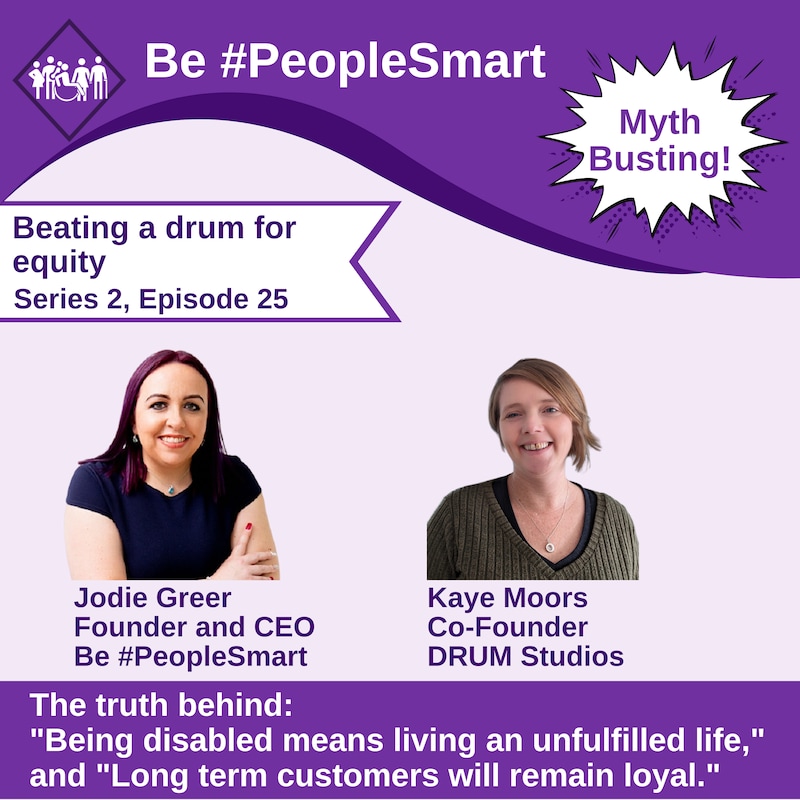
Be #PeopleSmart Founder, Jodie Greer chats with Kaye Moors, Co-Founder of DRUM Studios
Jodie and Kaye are busting the myths that:
"Being disabled means living an unfulfilled life," and
"Long-term customers will remain loyal."
Kaye shares her personal experience of acquiring a disability in adulthood, how her life has changed - in ways which may surprise you - and how it has positively impacted the services provided by her business.
You'll also hear why brand loyalty shouldn't be taken for granted and why accessibility doesn't just enable those we may think it does.
You can find Kaye on LinkedIn.
Find out more about Be #PeopleSmart via our website.
Accessible transcript documents, with thanks to our partners Just: Access, are available via our podcast web page.
Please leave us a rating, we love to know what you think. And why not subscribe? There are even more great guest speakers to come.
Transcripts
Be #PeopleSmart, enabling organisations and individuals to be disability inclusive and accessible.
Jodie [:Hello, everybody, and welcome to another Be People Smart Podcast episode, I'm Jodie Greer, I'm the founder of Be People Smart, and I am your host. So today we're gonna be busting some more myths. And again, I am not alone, so I have another wonderful guest speaker to introduce you to today. I have with me Kaye Moors. Kaye, can you tell us a bit about yourself please?
Kaye [:Yeah, of course. So I'm Kaye Moors and I'm founder of DRUM Studios, which is a marketing agency with emphasis on digital sustainability and accessibility. So our mission is to basically craft accessible and sustainable content by overcoming barriers and inequality for brands who really do wish to lead the way.
Jodie [:Wonderful. We love accessibility, we love brands who want to lead the way. So this is going to be good.
Kaye [:Unfortunately, not all brands want to lead the way though, that's the problem.
Jodie [:This is true, but hopefully we can influence some more.
Kaye [:Yeah, absolutely.
Jodie [:So Kaye and I are going to be busting two primary myths today, and as I always say, there's always another one at least that comes up in conversation. But our myths are that being disabled means living an unfulfilled life, and long-term customers will remain loyal. So this is going to be a really interesting chat. So first of all Kaye, to understand a bit more about you. So obviously not everyone is born with a disability, and you are a prime example.
Kaye [:Yeah, I am indeed.
Jodie [:Would you share a little bit with us about your own disability and your diagnosis?
Kaye [:Yeah, of course. So in early 2020 I now know that I was having a bleed on the brain. But at the time, I was getting double vision, vertigo, balance and kind of, I assumed it was stress, work was busy and there was a lot going on. I think it was home schooling during COVID at the time, and I kind of put it to one side for a couple of days, but it progressively got worse. So I went to the hospital and they confirmed that I had a bleed on the brain caused by something called cavernoma, which was in my brain stem. And obviously I did lots and lots of MRIs. And they said, Really, it's inoperable in the fact that if we operate on this, you will have long term disability. So the best thing to do is to leave it well alone and rehab as best as you can, which is obviously what I did. But a couple of months later, I collapsed, and it turned out the cavernoma had grown to the size that I had no choice but to have it removed. Otherwise, if it had bled now, it would have been catastrophic. So I underwent a 10-hour brain surgery, on the brain stem, and they got rid of 90 percent of the tumour, which is good. But that has left me with multiple, hidden disabilities, as well as very apparent hemiplegia. So yeah.
Jodie [:Just for our listeners, because I know hemiplegia may be a term that some don't understand. Rather than me tell them because this is your life. Can you just explain what that is please?
Kaye [:Yeah, you're not right. I think most people mention that term too, they don't know what it is, but it essentially means muscle weakness or paralysis, elasticity, and increase muscle tone on one trunk side of your body. So hemi meaning half, and then the plegia would be the same as quadriplegia or paraplegia. So in my instance, I can use my right hand side of my body. But I can't use my left.
Jodie [:Thank you very much. And of course, that impacts accessibility. Of course, if it hasn't, places and solutions haven't been made with people in mind. So on that point, I just want to touch on, I guess it's coming to our first myth. And I want to also talk to you a bit about accessibility for yourself as well. But, you know, we talked, one of the myths you wanted to bust, which I think is such a powerful one is that being disabled mean to living an unfulfilled life. So, you know, you've got this new disability. I know from talking to you before that you still do it an awful lot. So let's bust the first myth. How fulfilled are you?
Kaye [:Absolutely. 100 percent. I think I also probably had a bit of that unconscious bias when I acquired my disability and I was worrying about how I was going to be able to, I don't know, carry on running the business, or looking after the kids, or just getting out and about, and everything in your day to day had to suddenly change. But once you get over that initial, how do I do this? How do I make it work? You know what? Everyone can carry on, I personally carry on doing obviously my job, my career is my hobby. Everything, nothing changes, I think the only thing that really does change, is that small support or accommodations from individuals can make, help me to live a fulfilled life. So I don't feel that I'm missing out on anything. And if anything, I probably am more positive and have a better outlook on life now, now that it's happened.
But where you can get more fulfilled areas would be from people just being a bit more accommodating, and supportive, and listening because from me personally, everyone sees the very apparent hemiplegia. But what they don't see is, you know, the trigeminal neuralgia, the clonus, the neuropathy, the dysplasia, the sensory processing, all of that is obviously invisible to them. But trying to articulate that to someone when someone sees me, they immediately say, Would you like a hand? Or Would you like help? But they're meaning my mobility, they're not seeing, but obviously they can't see anything through my eyes. So how could they? But it's like, unless you are very proactive at talking about it and explaining those day to day struggles that you have and how simple things can make a difference. It's not regarded, in my opinion, by people. It's yeah, if you don't see it, it's not there.
Jodie [:And that's exactly where accessibility comes in. Because if we design all of our solutions and our services and our premises of accessibility in mind, then it's kind of irrelevant because you're including people from the off. There's always adjustments needed, that is a fact. But I want to touch on that, actually, because before we talk about how you actually make marketing accessible and so on, I know that you were given leaflets for your own needs that were a challenge. Can you tell us about that?
Kaye [:Yeah, so when I was in the rehab unit, neuro rehab. It was during COVID, so I didn't have any family or friends come to visit. So the only person who could absorb the information was myself, which I found incredibly hard anyway, with sensory processing, trying to just absorb everything that's thrown at me. But a lot of the things that they'll tell you in hospital is, Oh, you've got this. You've got that, and what they then hand to you is a leaflet, or a pamphlet, or something for you to read and digest and understand your diagnosis. But the problem is, a lot of them had like, -- [clears throat], excuse me -- low contrast, big blocks of copy, which I am horrendous at and links and not links, but for more information, visit this URL, which obviously is on a leaflet and just trying to kind of put that across and trying to read whilst also typing was just, it just became so hard to do. That a lot of times I kind of gave up and went straight to websites because I thought, I'm in digital marketing, so I know websites and videos are fantastic sources of information.
That's where I should look and then suddenly I went back, I suppose, the kind of point where the penny drops that actually, 99 percent of what I was looking at, had inaccessible fonts or had moving content that was making the motion sickness and the vertigo triggering. And it was an absolute minefield to the point that I think I stopped even trying to find out information about what I've been told. And I had to call my husband and get him to do the research and then relay the information back to me. And I think with the whole world, with digital accessibility and in the real world, obviously everyone should be, that would be, you know, the perfect scenario. But I think when it comes to patient centric communications where it's aimed purely at a patient and especially the kind of diagnosis I was getting, which is very much from a brain injury or, neuro side you would have, I would have imagined that the person to test that information on is people with a brain injury. But clearly what they've done is just got a design agency to put something together, and that's the information that the healthcare professional thinks that you need.
Jodie [:Yeah, and I think this happens a lot in so many areas when it comes to accessibility that, rather than sort of usability testing the people that actually need the product or the leaflet, it does often tend to be an assumption of what's okay, but sadly, and you probably found this, I'm kind of moving into your own business now. But sadly, and you probably found this yourself talking to clients and so on. A lot of the people that create this material have literally no concept of accessibility, so they create what they think is pretty. They create what they think is going to resonate with human beings from a tech standpoint, maybe in their own minds, but certainly not from an accessible one. So I know that you've kind of changed some of your focus in how you deliver with your business. So how was that manifested?
Kaye [:Yeah, I mean, we started Drum in 2006, so we were going for 14,15 years doing all ranges of digital media through video animation, motion graphics, web and app. And it was, like I said that moment when suddenly I couldn't access my own things that we had done, but suddenly everything just had to change, overnight. We, I sat down with the team and said, Look, this has to change because it's not, I didn't realise what we, as an industry, have been doing for so long, you know, because yes, you always looked at the kind of the obvious, the cliche, that you know does it work with screen readers, can you use a keyboard? But that's just such a bare minimum approach to looking at accessibility. And we just needed to take a step back, refocus, retrain the staff and deliver content going forward from that date, that we knew was as accessible as it could be. Obviously, like you say, you can't, in the best will in the world, you can't ever be 100 percent.
ing, you know, send it out to:But that's me still, you know, but the difference is I can't do things on the go. I can't rush around doing things on my phone because I only have the one hand which needs to hold onto the stick. So you know, it's just about, like you said, it's about making, not making assumptions and welcoming, comments from people so that you're designing with the disabled community, rather than making an assumption based on, even the guidelines, even [inaudible]. If you just based on guidelines, you're not really inclusive, you're just compliant. Two very different things.
Jodie [:Absolutely. So you've gone through a whole learning curve and probably like all the rest of us, you're still in it. What's your biggest learning so far, do you reckon?
Kaye [:I think the fact that it's so multifaceted and automated tests aren't enough. You need to have a good database of user testers from the disabled community, constantly change, do regular audits. You know, it's about being open to learning and constantly re-evaluating every few months and seeing what more you can do. So you've got a benchmark, this is what we want to do for launch. But that is just the starting point, and then every quarter, let's try and add more and more, and include more and more people, because the amount of times I will send a message to, not a client of ours, but a site I've seen that I haven't been able to access, and I will give them recommendations. I'm essentially giving them my knowledge for free, and I get nothing back and it is ignored, and it is the most, I personally don't understand it.
You know, even before I acquired my disability I still don't understand how people just disregard certain members of the community, they're your customers, whether they have a disability or they don't, they still have a tremendous buying power, and you have to listen to them and accommodate it. And if you can't do it from data on your website or your app because obviously things take time, then call them, say, I'm sorry you found a problem with that, how else can we help you? And, you know, take the product, buying over the phone. Just change your process rather than just point blank, go into the Ethernet of God knows where, but filed under, Yeah, not interested.
Jodie [:Good old customer care.
Kaye [:Yeah exactly.
Jodie [:So on that then, your own clients. How have they reacted to, because have you also been educating them? How have they reacted to the fact that you know, you're not only providing an effective marketing material, but you're doing so in a way that is accessible? Do they even understand it?
Kaye [:I think some have really embraced it, but the one, the companies who I'd say truly have embraced it, have either had a personal connection with someone who is disabled, and therefore they get that empathy side of it, or it's about someone in the organisation is really building on the inclusivity and they want to start from within and hire a diverse team. And it's purely recruitment, if that makes sense? So they've embraced it because they want to have a more inclusive team or they've embraced it because someone they know also has problems, and they've probably gone on, and on, and on, over a bottle of wine, as we all do, you know. But some have ignored it, some are not interested. And that's fine because they clearly don't align to our values. And we, you know, you can't put a, what's the phrase? Square, round hole into a square peg or something like that --
Jodie [:A square peg in a round hole.
Kaye [:Thank you. But I think the larger corporations, or larger businesses should I say, they've kind of really embraced it, because when you talk to them about the purple pound and the fact that you've got high end decision makers who might well have an impairment or the best, sales director you want to employ may have an impairment. You want to grow your following online. You know that those tangible figures, I suppose, speak to them because they see it as, I can increase my bottom line or I can increase my team, I can increase my followers. But some are just scared. Something is too big an undertaking. They don't know where to start. Even though you explain that it's not an overnight thing, you don't have to suddenly change. We can iterate and do small adjustments over time. Some people are scared by just the phrase, accessibility, because I think some, there's a misconception that accessibility is dull and, you know, some big brands want the big [inaudible], you know, all singing, all dancing, award winning website that suddenly if you say about being accessible, they think of Gov, they think of the Gov site.
They think of a white and black word document, don't they? But it's been wonderful to see the companies who have embraced it and have gone on the journey with us and realise that accessibility is still beautiful. You know, you can still make a fantastic looking site, or collateral, or app, whatever it may be, it can still be beautiful and on brand, but also accessible. Yeah, so I think there's always going to be a mix of people, isn't there between. It always helps when they've got a personal connection to someone with a disability because they do hear it first-hand. But if you can explain the purple pound, that's where I think ears prick up and people start listening. Although I do find it easier to, on the B2C side on the purple pound because the B2B side think, well, we're not selling anything, you know, we're a service. So therefore, the purple pound is irrelevant to me. And it would be nice to see a little bit more stats out there, for me personally, for it to be about the buying power from B2B, not only B2C, I suppose.
Jodie [:Yeah, but I mean, it's interesting because there is a direct impact, isn't there, because by you doing your B2B business. Pardon all the B's, obviously a massive impact on that whole customer journey because, you know, you're not going to increase your customer base, you're not going to retain that customer loyalty, and I know we're going to talk about that, if you're not actually meeting someone's needs, if they cannot purchase your product, if they cannot do business with you, they will go to someone where they can.
Kaye [:Yeah, totally. But I just think people incorrectly think of that as consumers, you know, buying a product rather than, like I said before, there's high end decision makers, they're people on the board that have disabilities, you know, it's not like the disabled community aren't in the workplace and that we're all sat at home, feeling sorry for ourselves. You know, we're all out there running businesses and people market to me. But if I can't see what they are marketing and what they're saying, then they're not going to get my business. So I'd imagine I'm the same as anyone else, who's a director of a company with an impairment, you know?
Jodie [:And it's interesting because obviously, officially, when we talk about the purple pound, it's the spending power of disabled people and their households. But when I actually reference it, I usually say about disabled people and their businesses, and probably unconsciously in a way, or maybe subconsciously, it's exactly what you're talking about, because you know, there are lots of people out there running businesses who are disabled, or maybe they're just, you know, an influential figure within a business. You want their business as well, and that is absolutely B2B. But why are they going to come to you if they can't even communicate effectively with you because you are not accessible to them?
Kaye [:Yeah, and it's the same as people who just keep bombarding all this social media content out there to grow their followers. And again, it's the same thing. One in five people who read your post may not be able to read what you're saying, you know it doesn't take, the thing is it doesn't take much, like I said, accessibility sounds scary, but there's some really simple, basic things that anyone should, everyone should be doing, you know, at kind of very granular level, I think even social media managers or people out of university, they need to learn from the beginning, you know, because that's where I would have learned and everyone else in our industry would have learned. If we were taught this information from the get-go, when you're at university and you're becoming a designer, then when you're out in the real world, you're always thinking about those things. But unfortunately, people don't and it's only when people have a voice and shout about it. Like we all love doing on social media, that people stop and listen and think, why didn't I think of that, you know?
Jodie [:Yeah, definitely, I think there's a couple of things there, one's about including accessibility within education and within course content. And anyone who listens to me regularly will know that I harp on about, you know, accessibility needs to start earlier than the workplace, but particularly in higher education, where you're literally, actively training for your profession. It has to be part of it, and I know in some courses it has started, but it tends to be like, if you were going to put it on a percentage and don't hold me to this because obviously I'm just making a point. But it may be like 5 percent maximum or something, whereas in reality, every module it touches on, you know, particularly if you're thinking about design, you know, and you're thinking about marketing, then every module it literally touches on.
But they'll probably be, you know, one talk on it or something. And yes, there might be a couple of things to go away and consider, but it's definitely not going to cover everything you need to know. And so it doesn't set you up for success as a professional when you go into the workplace, because companies who do want to get it right, you'd be the one staring thinking, where's Google? What am I doing here? And it's not because you don't have the skills to do your job. It's just because you haven't actually been equipped with the extra skills you need to make sure you're doing it for everyone.
Kaye [:Yeah, absolutely. I think we've started doing some talks with local universities around us, purely speaking to people, you know, who are doing digital design and as a, hopefully a career choice, because I just feel like it's so important. And the lecturers who respond to me a lot, Oh, that's fantastic, would be lovely to kind of bring that to the table as if, like I'm the first person to have ever suggested it, you know, and it's crazy that it's coming, I don't mind doing it because obviously, as far as I'm concerned, if we can reshape the digital industry, I'll be a very happy lady. But it wouldn't, it shouldn't really have to come from an outside. It should be there from the beginning, you know, it's yeah, maybe we need to start a new university.
Jodie [:Sounds good, talking of learning, what advice, there could be a lot, but a piece of advice, would you give to marketing professionals so that they can also adapt and become more accessible?
Kaye [:I think simply the biggest one is to put the user back into UX. You know, all users are people, all people are customers, and stop being, stop treating UX as kind of pigeonholing people into certain areas where they all belong, treat everyone as a user and stop using third party access overlays. If I can have a second one?
Jodie [:That is a very good one. Yes, overlays, on their own, do not create accessibility.
Kaye [:I think that's because everyone's kind of fall back if they do that, then it will be fine. But it really drives me insane where you see them. So often sometimes, and you just think, actually it wouldn't take much that, you know, to actually just adapt their site a little bit and get rid of those overlays that don't work for half the people that actually need them in the first place. Or stop these statements that say, Well, if you want to do this, go to IE and change this. If you want to do that, then go to Firefox and do that, it's like, or you could just allow it to change the size of the font. Or you could allow it to be dark mode or light mode. You know, stop again, it's a compliance thing, isn't it? It's a case of as long as it's there, I've done my bit, I think, rather than no, you haven't done your bit, you've actually made the person's life harder than actually just not having it there in the first place, half the time.
Jodie [:Yeah, absolutely, and I'm gonna make some shameless plugs actually, but it's for some helpful resources that we've got out there. So if you go to the website, Be People Smart.co.uk, there are, on our teams of tools and resources tab. There are some options in the, more tools and resources. One page is that our top tips and quick wins, there's five on each, and they really are there to help you make some quick changes today that make a difference. And they're very affordable because they're £4.99 plus VAT, if you need to pay it, also, we have an inclusive communications workshop that gets fantastic feedback. I'll say it because I deliver most of them and I know what feedback we get, so I'm quite happy to, hand on heart say it's really effective, so take a look. But the other thing, that I think from our conversation today, that would really help a lot of people is we do have digital accessibility guidelines. They do go beyond others out there, I'll say that, but they are written in very plain English in consumable sections. They have got visual aids to make it clearer and add context. So they are there to help you, so take a look, see if they can help you because we want to make sure we're enabling you to enable everybody else.
Kaye [:They sound fantastic because ultimately the more simple they are, you know, the straightforward plain English. It's not daunting, here's six steps. You know, everyone can absorb those quick wins.
Jodie [:Thank you, yeah, that's exactly our intention, so it's important. So I'll get away from my shameless plugs and I want to touch on the second myth. We've kind of talked about it, but I'd like to hear your personal experience. So we talked about brand loyalty, and I know that a lot of people use certain brands. You know, they'll be loyal to certain organisations for services et cetera for quite a long time. But it can change, can't it Kaye?
Kaye [:Absolutely. I think it's that something like 60 or 70 percent of revenue in most companies come from repeat business with existing clients. So you know you can't put a price on brand loyalty, but it's not a given. Loyalty changes as your needs change really. As you said, not everyone is born with a disability and 78 percent of disabled people acquire their impairment over the age of 16, isn't it? And for me personally, there was from, you know, day to day living, like restaurants or leisure centres that I'd go to, or supermarkets and then, from a business perspective software I use, phones, operating systems. Sorry, that was nearly a shameless plug. I've had to change everything, like literally everything. Because where I used to love going suddenly they weren't so accommodating to me. I was more of an inconvenience, suddenly overnight, and I simply stopped going. I took my business elsewhere to someone who was accommodating, who was welcoming. And now my spending money is with a rival brand.
And ultimately that's what it comes down to. I think overnight I tried to, I suppose, live exactly the same as I was doing before, and go to the same places, and shop at the same places, and run the business the same way, and it doesn't work. You know, as soon as you realise when you can't do something, day to day on a piece of software that you've used for 10 years. Right, okay, we'll switch the software and when they called, and they say, you know Why are you going, Kaye? You've been such a wonderful customer. Why are you going elsewhere? Well, because I can't use your software, it's not accessible. Oh, well, it's something that we're looking to potentially do in the future. Yeah, well, I don't want to just sit here waiting for you to get that ready. So in the meantime, I will go somewhere that is accessible, you know? So I just think people need to, I guess not rest on their laurels, because situations can change overnight, as I found out. And my buying power has changed overnight. The way I live my life has changed overnight. And I think probably 90 percent of the places that I either went to physically, or bought from online, I've changed. I've changed because I want to give my business to brands that are leading the way. The brands that are trying and are clearly listening, and the brands that aren't are going to get left behind, in my opinion, because it doesn't take much for brand loyalty to be broken.
Jodie [:Yeah, and I mean, I always love when guest speakers give me the myths they want to bust because they are, more often than not, they make me really smile. But this one absolutely did, because I talk a lot to organisations about how disability inclusion and accessibility will help them future proof their business. And I think what you've just shared is exactly that.
Kaye [:To future proof and to be sustainable in a business, you have to be accessible. It's that simple because people get older, people acquire disabilities. You know, we're an ageing population. There's so many reasons to do it, that you're just, you are going to get left behind, you really are. There are so many fantastic brands out there, who are 100 percent leading the way and people will follow. And it's not just even the disabled community that I'm sure, everyone will probably say it. But my whole family, they've changed where they shop, where they, you know where they buy, where they go because of me as well. So probably because I have a nag and I have a moan, but it's a case of it's incredibly powerful bad publicity, isn't it? Not in a good way, I mean, but it can really spread very quickly, a bad experience with someone.
And I think when I like, I'm not going to name names, but let's, I went to a restaurant, that I loved going to. It was always my favourite place, it was my birthday or special occasion, that would be where I would go. So, you know, they knew my face, they saw me a lot. And then obviously the next time they saw me, was in a very, very different situation. And I asked to use the toilet and they said, Yes, it's where it upstairs on the way, I said, Yeah, have you got an accessible toilet? Do you know where they sent me? They sent me through the pots and pans around the back, into the kitchen where all the chefs were. And there was a staff toilet there that was accessible. Had, you know, in the kitchen with the chefs, and there were pots and pans, and there's mops and buckets, and I was literally falling all over the place. Tried to get into this this toilet and I came out and I said about it, that that wasn't, you know, they've got beautiful toilets upstairs. I've been there, I've been going there for years. I know how swanky that place is. But suddenly I was put with the dirty washing, essentially. And when I said it, they said, Well, all we have to do is provide an accessible toilet, and it's like, no, that's not all you have to do. You don't have to provide, you basically ruined my whole years of being, you know, of loving that place, recommending that place to, yeah, no I'm not coming back here. Thank you.
Jodie [:It's not often I'm surprised by accessible toilet stories, because there are so many, I mean, literally trying to get past the mops because they used the storage cupboards, slash toilet-ish. All of these kind of things, but yeah, it just, it still amazes me to hear, like, you know, going through the kitchen to get to the toilet. But also I think, to be honest, I think when you point it out to a company, if they react, whether, you know, we've literally, we've never had that feedback. We've not even thought about it, we just a bit embarrassed now, you know, whatever that may be. And it may not be easy for them to then make the changes, because, of course, the infrastructure within the building is what it is, but to respond appropriately, it just goes to show their lack of understanding, awareness and empathy to respond with, Look, we've ticked a box, your box is ticked Kaye, what do you want from us?
Kaye [:Look, we've given you a toilet, you're lucky you have somewhere to go for a wee, so stop moaning, was kind of the tone I got back. And it was like, you say, even if they come back, and say, I'm really sorry that normally doesn't happen or we're changing this or how can we make it easier, and have a conversation with me, that would be wonderful to hear rather than well, there's a luxury of having a toilet, so stop moaning, you know?
Jodie [:And do you know what's interesting as well, because I wonder, because you say, you know, I think it's quite a swanky place, and customer service usually, tended to be very good. So I wonder if, I went upstairs to the toilets came back down and said, The first cubicle hasn't got any paper in it. If they would go, Well, you should have just used the second one. I doubt it. They probably would have said [crosstalk] -- I'm so sorry, we do our checks, like how embarrassing or whatever. Yeah, I don't think they would have said, Well, there's two others, get on with it.
Kaye [:I know it's, but like I said, I've changed a lot of my brand loyalty and I know other people do and it's like I said, it's even down to the tech that I now have to use, or the laptop I use, or the phone is all changed based on now, making my life easier, you know, so people change and you have to, okay, yes, like we said, we can't accommodate everyone, but at least try and keep them as a customer. Try and understand that their situation has changed and therefore you need to try and help accommodate them because they were still willing to give you their business and don't see it as well, if you couldn't do it that's your problem. The majority of people can, you know.
Jodie [:I don't know why I still laugh at this stuff. It's just the irony, it's literally ironic. So let's try and make things better. I'm gonna give you my question, so this is my Harry Potter fan question. But I love the answers I get, so I'm going to give you a magic wand now, there's no limitations because it's magic, and you can change one thing in the world to make it more inclusive. What are you gonna do?
Kaye [:I think make the whole world accessible by default. Everyone benefits from accessibility. You know, everyone uses tools like Alexa, or the drop curb, or predictive text, or automatic doors. If the whole world was just accessible by default, everyone benefits, literally everyone. Because the only reason these assistive technologies have become so popular, is because it was created for the disabled community. And then the rest of the world went, That's awesome, that makes my life so much easier, let's start using that, and it got adopted. So if the whole world was created accessible by people in the disabled community from the get go, like, literally, every single minute thing. Everyone would have it easier, happier life with tools that make their life easier.
Jodie [:Love it, and I wish I could give you that magic wand, sadly, but between us, we can start, you know, we can shift that needle and make some of this accessibility happen, and there's a lot of people out there that are obviously working to do this. So, yeah, I believe that we will see some traction, but we just need more people to take a step back, look at how you're actually operating. Look at what you're producing and think about accessibility from the get go.
Kaye [:See if you can do better, or always strive to do better, I think isn't it?
Jodie [:Definitely, so on that note, what would you love people to take away from this episode?
Kaye [:People might acquire a disability through trauma or illness, and when peoples situations change, as does their buying power and their brand loyalty. So your life can change literally in an instant. Your families, your employees life, your customers life. So whatever age your disability is acquired, whether it's hopefully, temporary, you deserve the right to the same online content. You deserve the same right to the same employment. You know, give everyone, everyone a seat at the table because I'm with the disabled community and include us. I think just, yeah, don't rest on your laurels. I think, I see it as a bit of a blessing, my acquired disability, because it's only when you've seen both sides, do you see how unfair sounds wrong, and I don't really mean that word, but how the world is made with bias, with unconscious bias. And it's only unfortunately, when you acquire disability or you listen, that you realise that things have to change, people need to change. The world needs to change. You know?
Jodie [:The world does need to change, and as you're part of that change, and I'm sure people are going to want to find you. How do they find you, and more about what you do?
Kaye [:So obviously you can find me on LinkedIn, my name is Kaye Moors, or you can check out our website, which is, We Are Drum .com and you'll find out more information about Drum Studios.
Jodie [:Wonderful, when I can include the link in the episode details as well. So I just want to say, thank you so much for your time today, Kaye. And not only have you shared some practical guidance, but your own story and actually through a really positive lens, which it's really nice because, yes, there's a lot to be done, but you've found some avenues to help that happen and also taken some positivity from your own life changes. And it's just, it's nice to hear, to be honest.
Kaye [:Yeah, absolutely. I think you can use your voice for good, can't you, and its digital industry, I love it. I've been in it for so long and I want to stay in it. But I'm determined to make that industry more inclusive and to make people realise what they're doing, because it's not all doom and gloom. It really isn't, there's some fantastic people out there and people that are really, really, really trying. It's just like you say, more people need to talk about it and wave my magic wand, and we'll all be happy.
Jodie [:Absolutely, so thank you for your time and your determination.
Kaye [:Thank you Jodie.
Jodie [:And thank you to you all for listening today. I hope you've taken a lot away from the episode. I hope you've enjoyed listening to Kaye, I certainly have. So until next time for some more myth busting, take care, everybody.
Recording [:Thank you for listening to this podcast episode, we really hope you enjoyed it. Please rate us and leave us a review. We really want to know what you think. And don't forget to subscribe so you don't miss out on any of the amazing guest speakers we have lined up.
Music Playing [:


