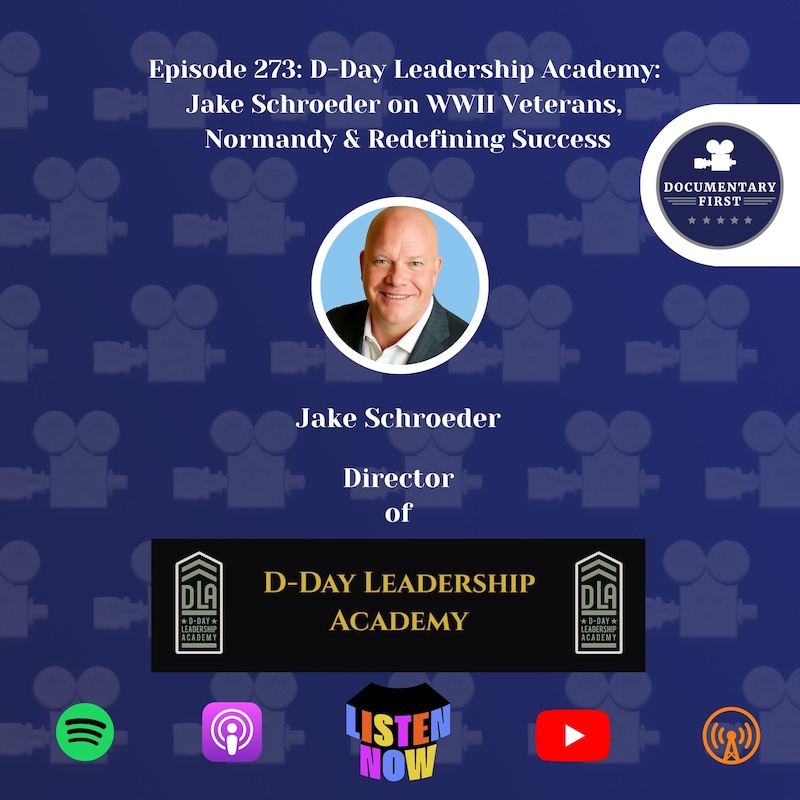
Shownotes
He sang the national anthem for the Colorado Avalanche a thousand times, coached 4,000 inner-city kids, lost it all, and rebuilt on the beaches of Normandy — where a WWII veteran watched children playing on Utah Beach and said through tears: "That's why we came."
Jake Schroeder—former frontman of OP Gone Bad, national anthem singer for the Colorado Avalanche, and executive director of the Denver Police Activities League—now runs the D-Day Leadership Academy, bringing inner-city youth to Normandy, France to learn leadership through the stories of World War II.
After concussions, insurance costs, and political shifts dismantled his youth sports programs serving 4,000 kids a year, Jake pivoted. Inspired by the WWII veterans he’d been bringing back to Omaha Beach and Utah Beach since 2011, he transformed his nonprofit into a Normandy-based leadership program built on five pillars drawn from D-Day: leading from the front, total commitment to mission, chaos, preparation, and empathy. In this conversation, he and host Christian Taylor—director of the award-winning documentary The Girl Who Wore Freedom—explore what success really means when the money isn’t there but the mission keeps growing.
What You’ll Learn:
- What does the D-Day Leadership Academy teach kids in Normandy?
- How do you pivot a nonprofit when your core programs collapse?
- What did WWII veterans say about people recreating on Normandy’s beaches?
- How do you define success when your documentary or nonprofit isn’t financially profitable?
- What are John Elway’s three rules for running a successful charity event?
- How does Stoic philosophy help when you’re facing failure in filmmaking or leadership?
- What documentary films should you watch? Elway to Marino, Miracle: The Boys of ’80, Cold War on Ice
Timestamps:
00:00 Introduction
03:07 How Christian and Jake met in Normandy, France
04:56 The Girl Who Wore Freedom documentary connection
06:19 Following up on failure: Epic Bill and redefining success
09:00 OP Gone Bad band years: when the road is worth it
12:16 Stoicism and choosing your response to hardship
15:06 Virginia Beach at night: perspective and insignificance
17:16 Documentary filmmaking relationships that last a lifetime
18:36 Denver Police Activities League: origin and mission
22:00 Starting inner-city hockey with the Colorado Avalanche
23:56 Youth sports crisis: specialization, concussions, and insurance
27:12 The pivot: shutting down programs and reimagining the mission
28:04 How the Normandy leadership program began (2015)
30:16 What the D-Day Leadership Academy program looks like today
33:31 Five pillars of D-Day leadership: empathy, chaos, preparation
36:04 Expanding to adult leadership retreats in Normandy
42:45 Normandy tours: culinary, yoga, couples, and classical concerts
45:13 The Girl Who Wore Freedom guided tour and charity auction
47:55 What WWII veterans said about children playing on Utah Beach
49:49 Message to documentary filmmakers: your film matters
51:53 John Elway’s elevator advice on charity events
55:58 DocuVue Déjà Vu: Elway to Marino, Miracle: The Boys of ’80, Cold War on Ice
About Jake Schroeder:
Jake Schroeder is a fourth-generation Colorado native, former frontman of the funk-rock band OP Gone Bad, and sang the national anthem for the Colorado Avalanche (NHL) over 1,000 times across 25 years. He began volunteering with the Denver Police Activities League in 1999, became executive director in 2014, and transformed the organization into the D-Day Leadership Academy—a nonprofit that brings inner-city youth, police officers, and combat veterans to Sainte-Mère-Église, Normandy, France to learn leadership through the stories of D-Day, Omaha Beach, Utah Beach, and the 82nd and 101st Airborne Divisions. He lives in Golden, Colorado with his partner Brooke Ferguson, principal flutist of the Colorado Symphony. Website: Home | D-Day Leadership Academy
If you’re enjoying the show, please subscribe and leave a review!
VIRGIL FILMS LINKS:
Virgil Films (@VirgilFilms) on X
Transcripts
Hello.
2
:Somehow we both got on mute.
3
:Yeah, we're good.
4
:Okay.
5
:um So how did your levels look?
6
:pinning out or anything, still below the threshold.
7
:And it was down at like 14%.
8
:I wanted to make sure that it was high enough.
9
:But it doesn't matter how loud it sounds.
10
:It just matters what it looks like on the monitor.
11
:um Because it records to your computer.
12
:And then what happens afterwards is that it uploads to the cloud.
13
:Okay.
14
:So you just have to watch the monitor.
15
:All right.
16
:Okay, I think we're good.
17
:All right.
18
:And it's recording now, which is interesting.
19
:I didn't even push report that I didn't know.
20
:Okay.
21
:All right.
22
:Here we go.
23
:All right.
24
:Huh.
25
:All right, I'm starting.
26
:Hi everybody and welcome to Documentary First.
27
:I'm your host, Christian Taylor.
28
:This is an inside look at documentary filmmaking and I am a documentary filmmaker myself.
29
:I sit down usually with storytellers from all over the world and I talk to them about uh
capturing real life one frame at a time so we can all become better filmmakers.
30
:But today we have a very different uh
31
:exercise on our hands and I'll tell you about that in a minute.
32
:We um have somebody that's not a filmmaker, but he has a really interesting story to tell
us.
33
:And we're going to follow up on last week's podcast.
34
:So I'm going to introduce him for a second, but uh I have a little housekeeping to do.
35
:So if you're new to our show, I'd like you to take a moment and subscribe to our podcast
on any platform that you're on.
36
:mean, of course, if you like what you're hearing by the end.
37
:and follow us on all of our typical social media channels.
38
:Also share anything, some of our little clips.
39
:We put up clips of our podcast.
40
:Share them with your friends so that other people can discover our podcast.
41
:And if you're listening to this podcast and you'd like to feel more like you're on the
inside with us, you can watch the show on our YouTube channel.
42
:All right, here are the housekeeping notes before I get started.
43
:In case you didn't listen to last week's episode, we've started something new and it's
called the documentary first, the deep dive.
44
:It's a little mini podcast where I take an insight that I learned from the week before and
I dig into it a little deeper.
45
:These episodes last about 15 or 20 minutes and they're just as valuable I think for non
filmmakers as they are for filmmakers.
46
:So you need to check them out.
47
:And if you could take a moment also to review them, if you like them and also share them
with your social media platforms, that would be amazing.
48
:We'd love people to discover those.
49
:And it would just, I think you're gonna love them.
50
:Last week's what is particularly interesting and it's kind of what we're gonna follow up
with this week.
51
:It was about failure.
52
:So check it out.
53
:Now on with the show.
54
:Today, we've got Jake Schroeder with us.
55
:Jake, thank you so much for being here.
56
:It's really great to see you.
57
:My pleasure, good to see you too.
58
:Jake and I've been friends for quite some time now.
59
:We met in Normandy and we'll get to how we met in a few minutes, but first let me read
your bio.
60
:So Jake is a fourth generation Colorado native.
61
:He fronted the local band OP Gone Bad for about 20 years.
62
:He also sang the national anthem for the Colorado Avalanche over 1000 times in 25 years.
63
:In 1999, he started volunteering with the Denver Police Activities League.
64
:And after
65
:beginning work there full-time in 2005 and becoming the executive director in 2014, he
supervised the change to the D-Day Leadership Academy.
66
:This new mission for a long established nonprofit was inspired by Jake's trips with World
II veterans to Europe in the:
67
:stories and to pass them down to new generations.
68
:Jake has three wonderful daughters whom I've all met and think they're amazing.
69
:A one-year-old grandson who I've still yet to meet, but I would love to, and lives with
his partner Brooke Ferguson, who's an awesome lady in Golden, Colorado.
70
:He loves getting to watch her perform as principal flutist.
71
:Is it flutist or flautist?
72
:It's either actually either or either.
73
:Yeah, I learned that first date.
74
:So
75
:okay.
76
:with the Colorado Symphony and helps, um, raise funds for them.
77
:So are you saying the Colorado Symphony helps raise funds for the DDA Leadership Academy
or you guys help raise funds for the Colorado Symphony?
78
:She's very involved with the development for the symphony and also we've been cooperating
on some projects in Normandy, believe it or not, which is kind of cool.
79
:So, symbiotic relationship with our works.
80
:Yeah, that's beautiful.
81
:Okay, so let's start and why don't you start the story about how we met.
82
:Well, we probably should have met when you were first over in Normandy looking for your
son because we probably walked by each other.
83
:We were at the same ceremonies and uh a lot of the same events that went on.
84
:I was there with veterans and you were there with your son and ran into some locals there.
85
:we probably, like, I was surprised when I watched the documentary, the full version of it,
that I didn't see this.
86
:big giant bald head walking behind you or, you know, like get in the way of your shot or
whatever.
87
:Because we, we, was at many of those events.
88
:started going in 2011 as a volunteer with another organization over there and bringing
veterans back and then move that into what we do now.
89
:But I was in Normandy a lot.
90
:And then we met in 20, I believe was 2018 when you were filming the documentary proper.
91
:And we had, uh we had just bought a new building.
92
:in St.
93
:Mary's and had some folks from your documentary crew and producers and things like that,
that were able to stay at the house.
94
:And that kind of ended up being evolving to a point where even part of the documentary was
filmed in the front room, Charles Shea, an interview with Charles Shea in front of our
95
:fireplace with a gaudy green oracle on it.
96
:So, and then since then we've right, we've done a lot of work together and have very
similar missions and
97
:And I think that your, your documentary really captures something that I was, that I
struggled to kind of explain to people when I talk about the magic of Normandy and how
98
:wonderful of a place it is in so many ways.
99
:And your documentary really captured that really well, I think for, for the significant
part of it that relates to the world war two, the world war two part of what Normandy
100
:really is.
101
:So, um, so yeah, and then we've stayed in touch and done charity stuff for each other and
done.
102
:events and talks and all sorts of stuff.
103
:you're, you're the headliner, uh, along with my friend, Matt, who's a Pulitzer prize
winner.
104
:You're going to do a, uh, panel discussion at our event, uh, next week, which might be in
the past when the podcast is watched by people, but, but I'm sure that I'm sure it went
105
:really well.
106
:And, uh, and I'm excited for that.
107
:And, uh, and we also have a cooperative effort that we're doing in September that you've
donated your services to help us raise some money for what we're doing.
108
:So really great.
109
:of ties into one thing that I wanted to anchor our podcast around, um which is last week I
did this podcast um with Quinlan Benson-Yates.
110
:She's a filmmaker that did a film called Epic Bill.
111
:And we talked about that last week.
112
:And if you didn't listen to that podcast, everybody, you definitely need to do that.
113
:You need to see the film.
114
:It is about a man who lost his
115
:video business, thanks to Netflix, had to reinvent himself midlife and he became this uh
extreme athlete.
116
:And he experienced a lot of success in the beginning and then a lot of failure.
117
:And he struggled with what that meant and how to handle that.
118
:interestingly enough, that podcast and the way that Quinolin uh framed that really
119
:spoke a lot to me.
120
:I've been dealing with a lot of the same thing recently, a lot of this sense of uh
failure.
121
:My film, like you said, has been important in a lot of people's lives.
122
:And at the same time, what is not unusual for documentaries, it has had a difficulty
finding a greater audience or being hugely financially successful.
123
:It's kind of broken even, but
124
:It hasn't been hugely successful like some others.
125
:And so we're still struggling to pay our team or pay its bills and things like that.
126
:um so listening to that uh podcast, I realized that there are other ways and other
definitions of success and coming to talk to you today reminded me that
127
:I really need to stop focusing on dollars uh as a definition of success and I need to
focus more on what other ways, how success looks in other ways.
128
:Yeah, I think that's really important.
129
:mean, it has to be the essence of it.
130
:And I remember I used to tell people, you know, because we my band was local, but we
traveled regionally and we did very well.
131
:You know, you know, we were a funk rock band at a time when and we did really well, but we
were at a time when straight ahead rock was really much more prevalent.
132
:And I think if we had been a few years later or, uh you know, different, different
elements and also the whole recording industry changed over the time that we were in the
133
:band together, you know,
134
:phones until we'd already had the band for 17 years or something like that.
135
:uh you know, and whereas now you go to a show and everybody's, you know, everybody's got
their phone and so like everything changed, right?
136
:It used to be really expensive to go into a studio and you used to have to do a promo
pack.
137
:But I used to tell musicians when I'd have a chance to talk to them that with music, the
road has to be worth it because you because you will see hundreds of bands that are
138
:horrible.
139
:make lots of money and then fade away after their first song and go nowhere.
140
:Right.
141
:And you'll also see, you'll see people that are these legends that continue to write these
songs that you just go, God, I will never be able to write like that.
142
:So it's a, you can't really.
143
:And so if you're in a band with guys that you can't stand or guys that don't have aligned
goals or that you don't feel like you're being like you're redeemed when you play or when
144
:you write that it's just not worth it.
145
:You need to find a situation where that, you know, because
146
:If you get into a situation like that, and I was lucky enough to be in that situation for
almost all the years that I was in that band, wonderful human beings in my band and
147
:wonderful guys.
148
:And the music we played together was so good and so fun and so redeeming for me personally
to get to do.
149
:were really good that that was worth it.
150
:You know, we made our living playing music as long as we wanted to.
151
:And I chose to shut it down after about 20 years.
152
:But so I think it's the same thing with with any any endeavor, right?
153
:Like
154
:I mean, I don't know what it's like to be a banker and I don't know what it's like to be.
155
:My brain isn't wired to have a, a metric for success like that.
156
:Right.
157
:I mean, I have a partner who's a principal flute player and one of the best symphonies in
the world.
158
:So that's a metric, right?
159
:Like, but she's also an artist and a musician.
160
:And so she's always striving to make the orchestra better and always striving to develop
ways to get new crowds and ways to, mean, so she's always working and it's very fulfilling
161
:for her.
162
:So I think, you know, when
163
:The metric that, you know, for podcasters, right?
164
:The metric for podcasting is you look at people like, you know, you obviously they're the
Rogans of the world and they're the, the celebrities that have podcasts that make jillions
165
:of dollars or whatever.
166
:But you also got to look at like some of the top podcasts are these vapid morons that talk
about sex positions and take money from presidential candidates to build sets and do
167
:stupid interview.
168
:Like it's just not a good metric.
169
:to weigh yourself against for a podcast, right?
170
:Like you're doing great work and you're featuring great stories.
171
:And that's, it's like the old man in the sea, right?
172
:He didn't come back with the fish, you know?
173
:So, so I think, and that's a, that's the toughest part.
174
:Like it's a, just got back from Virginia beach, right?
175
:So all the restaurants around that area are not all of them, but many of them are military
oriented and owned by veterans and owned by, you know, lot of old team guys and.
176
:and special forces guys and these guys that really excelled at a pretty unique, you know,
vocation.
177
:And so there are all these sayings all over these restaurants and I saw and I think one of
them was always do, always do the, this is a paraphrase, but always take the harder right
178
:action instead of the easier wrong action.
179
:Always do it.
180
:So, and so, and that really sucks when you're in the middle of it, right?
181
:Like it's.
182
:It does.
183
:like the stoic stuff that we've talked about before, where it's like, you know, if you're
upset, you are choosing to be upset on some level because you're, you're uncomfortable
184
:because something, something out of your control is causing you discomfort.
185
:So you are choosing to be discomfort, which is, that is the easiest thing to say to
anybody in the whole world.
186
:I love saying that to my kids, right?
187
:Cause it's like, it's super simple and like, I'm so wise, but to hear it, you're like,
Hey, screw you, man.
188
:Like.
189
:this is different.
190
:Like this is really hard.
191
:Like, I don't know how I'm gonna pay my bills.
192
:Right?
193
:So it's a it's a balance.
194
:But I think that's kind of what life is.
195
:I tell my kids this all the time, when somebody is raging mad, like I had one of my kids
who was in charge of a soldier who was just, I mean, this soldier was horrible.
196
:And I mean, making my son's life, who's in charge of this soldier miserable and doing
everything she was not supposed to do and making him pay for it.
197
:And, you know, he just was raging about what he could do differently and just so mad.
198
:And I just kept saying,
199
:It does not matter what this person does.
200
:It doesn't matter.
201
:All that matters is how you respond to this situation.
202
:And truthfully, if you let this person get under your skin, this person wins.
203
:Like you can't control this person.
204
:You have to decide.
205
:All you can control is you.
206
:That's so easy for me to say.
207
:So easy for me to say.
208
:But when you're in it, it's nearly impossible.
209
:Yeah.
210
:All the times that somebody said that to me and I was like, you don't know what it's like.
211
:You don't know what you're taught.
212
:You know, all of the times that that happened, looking back, I'm like, yeah, I chose to
make myself really miserable for a couple of weeks worrying about X or Y.
213
:Like the world continued to spin on its axis.
214
:You know, when I was in, when I was in Virginia beach, it was really interesting.
215
:I went down and, and, I was there for a couple of days working with a volunteer for our
program.
216
:Who's just an unbelievable human.
217
:you know, veteran, a Navy veteran and special forces guy who's really, really been the tip
of the spear and really, really worked really hard for this country and done some very
218
:difficult things.
219
:And he's just the kindest, gentlest, you know, guy.
220
:And he's got a new baby and raising his step sons and his wife is just wonderful.
221
:And he's just, God, he's just a gift, but working really hard with him because he just
decided he's going to rebuild our website for us and did a really, really
222
:Wonderful job and then was working on some things for the event together and and and doing
things like that.
223
:So I just really.
224
:um I walked down to the beach every night that I was there because I stayed on that, you
know, it's off season, so it's really nice to stay down by the water there and pretty
225
:inexpensive.
226
:And I just walked down there and the winds blowing and it's like 30 degrees.
227
:So it's pretty cold, but I'm just looking at the beach and I'm thinking to myself like
this is.
228
:This is this beach has been here.
229
:from the beginning of time.
230
:And every night it moves more sand than a million men on this beach could move with
shovels every night.
231
:It just does it with the waves, right?
232
:And I'm such a fart in the wind, you know, compared to the, to the power of what's going
on with this beach.
233
:So calm down, you know, like Tyler back, like, like look for the, look for the good stuff,
look for the bright lights, right?
234
:And, and keep going.
235
:I absolutely love that about the beach is why I go there.
236
:feel so small and, and, know, healthily insignificant.
237
:And you realize, um, that it has just been coming up to the sand and the shore every day
since the beginning of time and just keeps doing it and doing it and, you know, on its own
238
:and that I'm not in charge of that.
239
:And I don't have to be.
240
:um Yeah, it really kind of puts you in your place.
241
:Same thing when I'm flying.
242
:I look down over the world and I think, gosh, I'm so small.
243
:And I really make such a big deal out of things that I just need to let go.
244
:Yeah, perspective is a wonderful gift.
245
:you know, one thing I was thinking about as you were talking, you know, when we as
filmmakers, I was thinking about this about our relationship and just, um you know, now
246
:when I was filming in your house, that was 2018.
247
:So that was, uh you know, we're going on what eight years now and yeah, it's crazy.
248
:But since that time, most, some filmmakers, they will make their films, I think, and move
on.
249
:But a lot of documentarians that I know continue to have relationships with their
subjects.
250
:And there's something about documentary filmmaking and a lot of it is passion work.
251
:know, you don't.
252
:It doesn't pay a lot.
253
:It's not just me.
254
:Documentary filmmaking is hard work and you do it because you care about the subject
matter.
255
:You want people to know about what's happening and you, you you get really, really
involved with the people that are in your story and you don't just move on.
256
:And that absolutely happened with me.
257
:You know, the people that are in my story are my dearest closest friends.
258
:I almost have more friends in Normandy at this moment than I.
259
:do anywhere in America, including the veterans that are still alive.
260
:And I think that right there in itself is success.
261
:We brought together communities of people in Normandy, in fact, that never knew each
other, survivors of the D-Day experience that never knew each other during that time who
262
:were so happy to meet one another.
263
:So there were just gifts like that that happened because of us choosing to do this film.
264
:that in itself, I feel like are a measure of success and created things like what you
talked about that we are doing this upcoming week.
265
:And let me just talk a little bit about what that is.
266
:You and I've tried to figure out for a long time, like our missions are aligned.
267
:One of the things that you decided to do.
268
:um And before we talk about this week, let's go back to what you did start.
269
:So you came into this Denver Police Activities League.
270
:Let's talk about what it was when you started it.
271
:Yeah, was, it was a charity that was started in 1969 and it was, it's all over the
country, mostly in the Eastern half of the country, but some in the West.
272
:And basically the mission is to get police officers into communities where they wouldn't
normally be in a non-law enforcement role.
273
:So it started off as cops coaching inner city kids in different sports and different
things like that.
274
:And it's still manifests that mission in most places.
275
:Denver really changed,
276
:over the last 20 years that I was there or so, because it got to be, uh you know, the
political environment changed to where, you know, officers weren't really backed up by
277
:downtown.
278
:And and we stopped really having a lot of coaches that were cops.
279
:And that still meant that we had some really incredibly heroic human beings from different
parts of the lot of these guys were guys that had been in trouble earlier in life and
280
:really wanted to be a good example.
281
:And that was the majority of the guys we had.
282
:also had some real dingleberries that were that were still active criminals and brought
guns to practice and stupid stuff like that that we had to manage.
283
:But we basically did inner city football leagues and basketball or baseball leagues and
of other activities for about:
284
:And that was that was that's the reason I got into that was from playing shows.
285
:And I would often hang out with the cop that worked the door in between sets.
286
:just to stay out of trouble, right?
287
:So I'm sober and I think over the years, like that was uh something that I struggled with.
288
:And so to try and keep myself because when I would get bored or get like, that's when I
would go off and do dumb stuff.
289
:So I think just to have a safe place to kind of hang out and talk to somebody, I would go
talk to the cop at the door and got to know a bunch of these guys really well and realize
290
:that these were really good people, the guys that I met, the men and women that I met that
worked, they were.
291
:You know, not all of them, but almost all of them, like, you know, all but a couple of
them were just really neat people that to a person join the police force because they want
292
:to help people.
293
:That's what they said.
294
:They want to help people.
295
:That doesn't equate with this caricature that's being abused a lot of times like, they're,
you know, blah, blah.
296
:Almost every cop that I've ever met joined the police force wherever they are to help
people.
297
:that said, there's nothing worse than a bad cop.
298
:And cops will tell you this thing.
299
:um But I got to know these guys and they're like, hey, we've we volunteer for this thing
called Pal.
300
:I coach football or coach baseball.
301
:So doing the doing the anthem for as long as I did, I got to know a bunch of the players
over the years and a couple of them and I were out solving all the world's problems.
302
:And at like four thirty in the morning, decide we're going to start up inner city youth
hockey program.
303
:So I got this drunken, you know, blurry check from this guy for five grand and went out
and started an inner city program in like ninety nine.
304
:and just got all these kids and got hockey gear from the NHL and just kind of said, go
play hockey and, and let it figure out.
305
:was really fun.
306
:It was very unorganized and super unorthodox.
307
:And, and I'm sure we took on a lot of liability that we didn't necessarily need to take
on, we escaped from it.
308
:Nobody really, we didn't have any, the very, like the very first meeting we ever had at a
gym at a middle school was some of the parents that had kids that were in football.
309
:They were all excited for us to do hockey because hockey became so big in Denver.
310
:after the team moved here and they, you we've always had hockey teams in Denver, but when
the Avalanche moved here, they won the cup the first year they were here, right?
311
:So everybody loved, yeah, everybody loved them.
312
:Where were they from before?
313
:They're Quebec, Quebec City.
314
:They were the Nordiques.
315
:saw our very first event we're going to have in this gymnasium at like seven o'clock at
night with all these parents and the west side of Denver.
316
:So mostly Latino parents and kids.
317
:And they were all excited about hockey.
318
:We had a bunch of balls and like sticks, you know, playing ball hockey in the gym or
whatever.
319
:The very first shot that one of these guys took hit a kid in the mouth and broke his two
front teeth out.
320
:So that's how that's how we started.
321
:Right.
322
:And it was okay because the parents were really, really nice about it and took care of it.
323
:And, and, but that's, that was how we started.
324
:And, and it just evolved into me volunteering over there since 99.
325
:And we did, um, we did the inner city hockey and then we, and we kind of morphed into a
sled hockey thing for, uh, for disabled kids.
326
:They have two, two poles and they push and we've got some really famous sled hockey
players from Colorado.
327
:These two guys that were
328
:All state wrestlers were hit by a car, changing a tire and lost their legs.
329
:And then they became sled hockey players and won the gold medal at the Paralympics.
330
:Multiple clients.
331
:they're, they're Jerry and I can't remember the other guy's name.
332
:And they're like these, they're just the neatest guys anyway.
333
:So volunteering and then moved into working their full time.
334
:And we did football and baseball football.
335
:had about 2,500 kids and in baseball, we had about 1500 kids.
336
:And, kind of as time went on, um,
337
:You know, youth sports have really changed and anybody that has a child in youth sports
now knows it is an industry.
338
:And if you don't go to this camp, your kids might not start, you know, because I run the
camp too.
339
:And I started, he's there's a lot of stuff he's got to learn.
340
:And, and, you know, I don't think he should play any other sports.
341
:He should stick with football or stick with basketball or stick with baseball.
342
:And so these baseball kids are playing a hundred games a year and these poor little
pitchers, I know they try and watch it, but.
343
:And it's not just camp we're talking about, it's travel sports.
344
:m
345
:and it's and it's outrageously expensive.
346
:So we had a low cost league and had kids, but we still had these kids that were
specializing and and and the parental behavior at fields all over, not just in our league
347
:with with the inner city kids, but all over became a real problem.
348
:And we had extra issues because we had a lot of gang members that were parents.
349
:And so we had to really watch it.
350
:And I'll tell you, the most reasonable people I ever dealt with.
351
:at those fields were the most notorious gang members that we had.
352
:Because they didn't, they don't want to, whatever goes on, they don't want to interrupt
their revenue stream.
353
:So if somebody's uncle was acting up at a game, starting a fight or chasing the refs, a
lot of times that stuff got managed by itself.
354
:When I would go talk to one of these OGs and be like, hey, what do want me to do?
355
:And he'd be like, I got it.
356
:And so they take care of it.
357
:But we still had a lot of, we took weapons off people all the time.
358
:We stopped fights.
359
:Every week we called cars code 10, which is lights and sirens to fields probably 15 times
a year, which is like like like a officer down level of calling police cars because we're
360
:outnumbered 1000 to one there.
361
:And I'm not a cop.
362
:I was like, you know, and then the cops are like, do you have your concealed carry permit?
363
:I'm like, yeah, they're like, you got to carry all the time.
364
:I was like, I'm going to band like I want to, you know, my God, you know, and think, you
know, thankfully and you know.
365
:I mean, I never had to think about using it or pulling it out or anything like that.
366
:was, it was non-factor, but there were a couple of scary moments where the cops come over
here with me, I need you to stand here and watch that guy because he's got a gun and I'm
367
:going to try and take it off and stuff like that.
368
:Yeah.
369
:And this is, then, you know, as the concussion stuff became more prevalent, I really
changed the way I feel about young, young players playing football and, and getting
370
:concussions.
371
:And I think there's no real.
372
:The way I feel now, I don't believe anybody should be playing tackle football until
they're 16, until they're in high school.
373
:Kids can learn almost everything they need to know up to that point.
374
:Positioning plays, and it's a lot more fun for them.
375
:And we still have a bunch of meathead old coaches that were doing the Oklahoma drill,
running these kids into each other's helmets like I did when I was growing up.
376
:That's now like just a concussion generator, right?
377
:And so we have these kids, you know, I had my final year there, I had four parents, fake
doctor's notes.
378
:allowing their kids back in after a concussion.
379
:So between that and the fact that our insurance went up by a factor of eight in one year,
right?
380
:We were, it was not going to have longevity.
381
:So we shut that down.
382
:I negotiated with Under Armour for like three years to do this flag product that they do
called Under the Lights.
383
:It was going to be great every Friday night, this flag thing and DJs and food trucks.
384
:like, it was great baseball.
385
:We'd finally, after nine years of negotiating with Parks and Rec in Denver, we negotiated
a
386
:a deal to cooperate in our two leagues because they were redundant.
387
:So we're going to merge our leagues together with the city of Denver who can afford fields
and can afford referees and can afford all this stuff.
388
:And then we're getting ready to unleash that in 2019.
389
:We had a new chief, Paul Payson, who was from Denver, played pal, you know, had high hopes
for him and he decided he was going to run for mayor or whatever he was going to do.
390
:So he was going to do his own branded inner city programming and pulled the cops out of
pal after 50 years.
391
:Wow.
392
:So of course never got around to it and then COVID hit and he was a very short tenured
police chief in Denver and uh really, uh you know, but so I had a lot of, you know, like
393
:you talk about the guy failing and failing and failing.
394
:Well, we kind of, you know, we had to pivot and upset a lot of people and change our
mission and do a lot of different things and sold the building that I had built there with
395
:private funds and.
396
:uh
397
:And here we are because it was, realized the value of the vote we started doing in 2015.
398
:We started bringing cops and kids and veterans back to Normandy.
399
:We'd rent a chateau.
400
:Well, how, how did that?
401
:mean, okay.
402
:So you had this huge program and you had all these kids and then you're like, okay, I
can't, I can't keep this up.
403
:So I'm shutting all that down and, and how you just decide to go to Normandy.
404
:Like that seems like a huge gigantic switch.
405
:before before all that went down.
406
:We started in 2015 and I shut the programs down, shut football down in 2016, got ready to
do flag in:
407
:Baseball continued through those years, got ready to do the cooperative program in 2019.
408
:So we had those programs still.
409
:And, you know, I came to PAL originally because I realized that these police were really
neat people.
410
:But then I started to realize that these kids in Denver Public Schools is a disaster.
411
:They have a 30 % minority graduation rate.
412
:just did some testing after COVID and 5 % of their second graders can read or do math to
grade level.
413
:I mean, it is a meat grinder.
414
:like a documentary that needs to be made.
415
:Somewhere in there.
416
:right?
417
:Pick a city where this where the public school system is failing.
418
:And and so these kids are they're beautiful.
419
:And they're they're just as smart as anybody else.
420
:And has nothing to do with the color of their skin or their economic level or anything
like that.
421
:These kids are incredible, just incredible.
422
:And almost all their parents are equally as incredible.
423
:Just amazing.
424
:These parents work so hard to get their kids.
425
:Up above where they were, you know, and.
426
:And so I just felt like it's a really valuable lesson for them because the kids that they
pulled over to, you know, drafted or that joined up after Pearl Harbor were the same.
427
:They, you know, we were 80 % agrarian and 20 % lived in cities in 1939.
428
:And, and, it's the reverse now, but these kids were just the same and they were close to
the same age as these kids.
429
:You know, these, tell these kids in high school, like they were your age.
430
:We go to Omaha beach and go to the cemetery at Colos Samara up above there.
431
:And the kid that gravestones I'm like, that kid was 17.
432
:And they have a moment and the children that are being let down by our public schools are
just as beautiful as any children in the whole world and they deserve everything.
433
:So I really feel like these kids already have some leadership skills that a lot of kids
don't.
434
:And so for them to see an example, like to give them some, some credibility and some
legitimacy to how they feel about being leaders is really important.
435
:And also to give them a metric, they have to fundraise for their airfare and help out with
that.
436
:so to.
437
:describe the, I mean, you're running ahead of yourself.
438
:describe, so describe your vision for the program.
439
:When it started, you said you took veterans and police team over there and.
440
:Because that evolved from the discussions they had with veterans.
441
:and police officers, combat veterans and police officers can have conversations very
quickly with each other because they're both put in a position where they have to make
442
:split second decisions where there is not a right answer.
443
:Somebody's going to get killed.
444
:Somebody's going to get hurt.
445
:And that's the same.
446
:And that's not a conversation I can have with a veteran.
447
:I've never thankfully been put in a position like that.
448
:Cops all the time have to do that.
449
:So that was an easy one.
450
:And then knowing that these kids were coming over, so I brought these kids over with these
cops because the veterans really, really wanted to tell the stories to kids, really want
451
:them to be around.
452
:And I saw the beauty and the magic of that.
453
:And I also knew that we had three or four years to get the veterans into the program
them at the beginning of the:
454
:And they were 95.
455
:you pay for all this?
456
:How did that pitch go, you know?
457
:raised the money with events and uh and then after COVID, you know, we sold our building.
458
:So we've got some money in the bank.
459
:And after COVID, I just it was really important to our board director and myself that we
reestablish the program, dip into our savings, make sure it happens for a couple of years
460
:and and and get it out there and make it a program that is uh successful.
461
:It has the kinks worked out, which we did.
462
:And now we're back to kind of like, OK, we're doing one scholarship program this summer
and we're going to kind of build from that.
463
:need to.
464
:So yeah, I feel like we're for years like we're right on the edge of being able to raise
all the money we need to raise to fill the summer with these kids that normally wouldn't
465
:conceive of going to another continent.
466
:And so how do the kids get to go and how many sessions do you have and talk to us about
what the program actually looks like?
467
:Yeah, so for this summer we have one scholarship program and the kids can apply on our
website which is ddayleadershipacademy.com and they apply and they get interviewed by our
468
:board and by some of our volunteers and we pick, you know, 10 to 12 kids that come over
and we have some chaperones and a lot of the kids we have to get passports for them, which
469
:is, you know, we bring these kids from Richmond that we have a school counselor in
Richmond who's an incredible lady and she, you know, the kids that she's sent
470
:Most of them haven't even left Richmond, let alone left the United States.
471
:So we get them passports, they come over to France and we do seven nights in Normandy.
472
:uh We used to do a couple nights in Paris and then we kind of realized that this wasn't
really aligning with our mission.
473
:And also feel like we were really dodged a bullet with, know, 17 year old kid can get into
a club in Paris if they really wanted to.
474
:Thankfully we never had that happen.
475
:But, but I just don't feel like that's, that's really anything that we need to.
476
:concentrate on is getting kids, kids can come back to Paris.
477
:But they go to Normandy for seven nights, have, you family style meals, French, French
meals that are made by maybe the nicest person in the whole world, Michel Coupe.
478
:And, uh and we tour around and we talk about battle sites.
479
:And we have five elements of leadership that we equate and relate to them, uh to the
stories and the places and the people that we talk about each day.
480
:Which are?
481
:talk about leading from the front.
482
:We talk about total commitment to mission.
483
:We talk about chaos.
484
:We talk about preparation.
485
:And we talk about empathy.
486
:And we've kind of came up with those I kind of came up with those over COVID with some of
the veterans and gamed it out and it's conceivable that they'll change and it's
487
:conceivable that we'll, we'll get somebody better to do it than me.
488
:But for this at this point in time, that's that's where we stand.
489
:So it's really easy to teach a lesson of empathy when we talk about Waverly Woodson, a
black soldier who was treated basically like an animal, saving the lives of 300 white GIs
490
:on Omaha Beach under fire on D-Day.
491
:Right.
492
:Or you see the blood stains in the pews at Angovilla Plain from German soldiers and from
American soldiers that two 20 year old medics from the 101st saved the lives of 84 people.
493
:Right.
494
:Why in the world would they work on Germans who were the ones that probably
495
:killed and wounded their friends.
496
:Well, that's an easy epic lesson, right?
497
:Or we talk about preparation.
498
:You we're in St.
499
:Mary's Glees, so the paratroopers are, that's where they, me, that's where the 82nd and
101st kind of sowed their oats.
500
:And so it's really easy to talk about preparation and the fact that these guys were way
off course and all over the place and still figured out how to get to where they were
501
:getting.
502
:still figured out how to accomplish our mission.
503
:And chaos used to be something that I stressed about teaching.
504
:And now it's like, well, remember the day that COVID started and your parents were home
from work for no reason, you didn't have school anymore, and nobody knew when it was gonna
505
:start up again.
506
:And you could wear a mask into the restaurant, but could take it off when you sat down
because the virus made a deal with the government or whatever.
507
:Like it's really easy to explain like things that you just don't expect are gonna happen,
happen.
508
:Like things that you wouldn't even conceive of in your life are gonna happen to you.
509
:COVID has been a great teaching tool for teaching that chaos, because everybody's going to
have it leading from the front.
510
:have some great examples there, Dick Winters and the very easily accessible stuff like
Banda Brothers and a bunch of other stories that aren't told in movies or books uh and uh
511
:total commitment to mission.
512
:Talked about why we threw so many men and resources right at the teeth of the German
Atlantic wall, because we had to save the world.
513
:Yeah, it's interesting.
514
:You know, the more you talk about that, the more I realize this doesn't just need to be a
middle school, high school uh leadership, you know, camp.
515
:needs to be any adult person.
516
:Yeah.
517
:Yeah.
518
:So let's, let's bridge that.
519
:So, um, one day I showed up and you had a, I don't know why I was there at this certain
time, but you had a,
520
:you know, a week going on and you're like, come on in and meet these kids.
521
:They're watching your movie.
522
:And I didn't even know this was going on.
523
:So I guess you start some sessions that way.
524
:Yeah, we do.
525
:I mean, it's a really great way to kind of teach anybody what's really going on in
Normandy.
526
:And I think that's just part of the magic in Normandy.
527
:for Americans, to ask about Normandy, the first thing they think of is D-Day, unless
they're culinary arts students or whatever.
528
:But for the most part, Americans are like, Normandy.
529
:think, you know, a lot of people say Normandy Beach, or they say, you know, they don't
really know.
530
:But Normandy is magical.
531
:100 years war was there and there are Viking remnants and Roman ruins and the greatest
salt of the earth people I've ever met in my life and the cleanest food I've ever eaten
532
:and the most beautiful terrain and that I mean it's like there's so much to it there but
the poignant lessons you know as Tomah our caretaker and one of our guides likes to say
533
:you know the the only exciting thing to happen in Normandy in the last thousand years was
:
534
:right.
535
:is of comforting, right?
536
:Yeah.
537
:Yeah.
538
:mean, again, that kind of, was really humbled to see that you were using um the Girl Who
Wore Freedom to kick off that lesson to introduce these kids to what is actually going on
539
:in Normandy.
540
:But it goes to the, you know, the theme of today's podcast, which is, you know, the
definition of success, which is this film shows what the French do.
541
:If you haven't seen the Girlie War Freedom, you can
542
:watch it on Amazon, Apple TV, Voodoo, YouTube, and you get this understanding.
543
:You can see D-Day through the French eyes.
544
:I was so humbled when I got there.
545
:And I mean, I've been in government life and my father was in the Reagan administration.
546
:I lived in Washington, DC, you know, for 15 years.
547
:And I thought I understood.
548
:I thought I was a very patriotic person.
549
:And I was clueless when I got there, France.
550
:you know, was so grateful for their freedom that they treated me as if I'd liberated
Normandy and they were worshiping my son and he was just a, you know, 20 year old American
551
:soldier.
552
:And, you know, the other units that liberated them, not to mention the veterans that were
there and they knew more about our military and their patches and their units than I could
553
:ever imagine.
554
:And it was, then I learned over the last, you know, eight years, I mean, it wasn't
555
:It wasn't just Normandy, it's all over the small towns and villages in France.
556
:And it's not just France, it's Belgium and the Netherlands and Luxembourg and, you know,
Holland, I mean, everywhere.
557
:And, you know, Germany even, mean, crazy uh how grateful our allies have been and continue
to be even despite what is happening today and why they're so heartbroken.
558
:I mean, I'm receiving texts and messages all the time about
559
:you know, what's happening and how heartbroken they are.
560
:you, and it's not going to dim.
561
:It's not like they're canceling the Normandy commemorations this summer because America
has turned their back on them.
562
:um They never will because they're not going to stop honoring these men that sacrificed
and gave everything for their freedom.
563
:Yeah, it's a totally separate, separate issue.
564
:it's, and it's, you know, the world's always going to be changing, you know, and it's, you
know, we look at, go back to:
565
:he wants every American soldier off French soil immediately.
566
:And Eisenhower said, well, you're going to have to give me a few days to dig up all the
boys in Normandy.
567
:And that was the end of that conversation.
568
:So things have been, things have been worse and things will, things will go back and forth
and things are.
569
:You know, some things might seem really bad at the time and then end up being a, being a
blessing later on.
570
:You know, we don't know.
571
:Um, but, but yeah, you're right.
572
:Like I wanted to say something about your, relates to the podcast part of this, you know,
where you're, you're, you strive and you strive and you strive and you don't know you're
573
:striving for.
574
:And in your documentary, know, Madame Renaud didn't, didn't start cleaning up graves for
publicity.
575
:She didn't start cleaning that up to create this.
576
:tourist industry for D-Day over in Normandy.
577
:She did it because they were wrecked with all these young men that they saw every day get
buried in their backyards that gave them their freedom back.
578
:And we, as Americans, we are so fat and happy over here.
579
:We take freedom completely for granted.
580
:Well, I don't think we can define what freedom is because I don't think we truly
understand or know what freedom is because I don't think you can until you've had it taken
581
:away.
582
:And we have an inkling because of COVID.
583
:Like you said, it was a great teacher.
584
:We have an inkling, but not really.
585
:No, it was almost like a farce.
586
:It was like a Monty Python skit of having your freedom taken away.
587
:Like you can't ride your motorcycle because of COVID.
588
:Like, what?
589
:Or like, well, nobody else can go to the beach, but I'm to go to the French Laundry with
my buddies and not wear a mask because I'm the governor and nobody's going to ever find
590
:out.
591
:Oops.
592
:know, like it was a joke.
593
:Yeah.
594
:Yeah.
595
:and Sweden didn't do anything and Sweden's like, hey, look, our mortality rates are way
lower than everybody else.
596
:What do know?
597
:So yeah, I think you're right.
598
:I think, mean, and hopefully we never find out.
599
:I mean, there's a shelf life and a half life on freedom.
600
:And what I think it was Reagan that said it's only one generation away at any time from,
going away.
601
:true when we forget the cost and nobody alive remembers their relatives being slaughtered
and um they begin realizing they don't realize the cost.
602
:And so it doesn't seem expensive.
603
:so um anyway, all that to say, um you beginning um these weeks with these kids, um you've
realized
604
:yes, we do need to keep raising money.
605
:This program is important and we need to find ways to do that.
606
:You have um purchased this home in St.
607
:Mary's, which is sort of this breadbasket of the Normandy experience, as I tell people.
608
:And it makes it great because it's this centerpiece where you can kind of get everywhere
else from easily.
609
:And it's a place where you can house a lot of people.
610
:You've designed it that way.
611
:And um so you have the ability to um kind of bring people over in groups.
612
:And you thought, well, go ahead, tell what your ideas.
613
:Well, we all along, wanted to do, you know, the houses kind of came up and we got an
incredible deal on the house and we've spent a lot of money fixing it up and it's really
614
:in great shape now.
615
:And we really have, uh, have gotten it centered around being a place where everybody's
comfortable.
616
:So, um, but we always kind of had in the back of our minds that we were going to do adult
programming over there as well, whether it's just tourism where people donate to the
617
:charity.
618
:So I do a guided tour of them in Normandy or leadership.
619
:programming because you know, lot of these executives are required to take, you know, a
leadership program every year.
620
:Um, and so that's kind of the, that's eventually the strata that we're shooting to get
into.
621
:And it takes time to get into that.
622
:So we're, working on that.
623
:also have, so like we have, you know, your tour that you're going to do one for us in
September, but then hopefully we'll continue to do more where you're, mean, just if you
624
:see the documentary and then get to go over to France with you for a tour.
625
:and see these places that inspired you to make that documentary and meet some of the
people that were in it and hear some of the stories on site.
626
:I can't imagine a better way to really get a very true idea of what that area was like
during World War II.
627
:But we're also looking at doing like culinary couples tours.
628
:We're looking at doing a couples yoga retreat beyond just adult leadership.
629
:And then we're doing family, family tours.
630
:You know, we're doing uh we do a cooperative venture in August now.
631
:We did our first one last year and it was wildly successful where we offer, you know, um a
room to another nonprofit to auction off.
632
:And we bring to, you know, Brooke, my partner, who's a, you know, one of the, one of the
best flute players in the world and a classical guitar player named Masakazu Ito, who is,
633
:who is one of the top classical guitarists in the world.
634
:And is also the, the conductor for the Colorado School of Minds Orchestra.
635
:And then I come.
636
:sing and apparently get a tax break for everybody and do a couple songs.
637
:And, we do these classical performances in the church and in our backyard and in gardens.
638
:And, and so these people get to come over, see the area, eat the food, experience life in
Normandy, and then have these private concerts in these beautiful settings.
639
:And it was really successful.
640
:So we're to do more of that this year.
641
:We're actually expanding it.
642
:So, so, you know, we're looking at all, all options and, and fundraising is really
changing, as you know, and we've tried.
643
:a little bit of everything and we're just gonna keep, like you said, the journey is the
goal, right?
644
:Yeah, and I, you know, that's kind of what we're doing.
645
:em You know, we're we're auctioning off and I'm so thrilled to be a part of this.
646
:We're auctioning off next week, which when people listen to this, it will probably be
passed.
647
:But we're auctioning off, I think, eight.
648
:Is it eight couples trips or is it what is it?
649
:to auction off a trip, a couples trip at the dinner.
650
:Again, we've got eight available.
651
:So we, yeah.
652
:So I think we've already sold a couple of them.
653
:And if we have a couple of emitters that go back and forth against each other, then we'll
maybe we'll, maybe we'll offer a second one, but it's an opportunity for people to, donate
654
:some money and, uh, you know, get their right off and then also have a really incredible
experience, a once in a lifetime experience.
655
:Yeah.
656
:And so I've designed a tour, a Girl Who Wore Freedom tour, and I will go over in the fall
and I have designed it to kind of follow the movie and explain from my experience what
657
:happened.
658
:And what's different about it is that it is going to be as an American uh going over to
realize what I learned and how I was changed by the people I met and the experiences that
659
:I went through.
660
:And I'll be able to introduce them to people in the film.
661
:Danny, the Girl Who Wore Freedom has agreed to
662
:you know, to meet and talk and share her story because, you know, they have been
supportive.
663
:She and Flo have been so supportive of your mission and love you so much.
664
:So we have amazing opportunities right now uh to do these things.
665
:And it's part of just continuing to share this mission.
666
:And, you know, as I heard you talking about your own leadership goals, those same
leadership goals that you're teaching about apply in filmmaking, like
667
:Every single one of those things are things that I have talked about in over the podcast,
the things that directors and producers need to learn and need to manage over the course
668
:of a filmmaking production.
669
:And so we could take those same pillars and, you know, do a producing directing workshop
there in Normandy for, you know, seven days, 10 days, whatever.
670
:And I also thought about doing a creative retreat.
671
:where we go over and write.
672
:mean, it's one of the most contemplative, beautiful places ever um to do one of those sort
of things.
673
:So um other than just the Girl Who Wore Freedom Tour, my mind is spinning about ways to m
continue to create the mission or carry the mission and teach people, use that beautiful
674
:place.
675
:And I was thinking about this this morning, I would like to come back and just be there
myself, because I would love to enjoy the beach in the summer.
676
:So I could take advantage of what the men died for, you know, in a time where I could
really use that beach as it was, you know, as they gave their lives for it to be used, you
677
:know?
678
:You know, and that's, that's one thing that people, if they hear this podcast might be
like, well, but doesn't that seem disrespectful to be on the beach?
679
:And I will tell you that's how I felt.
680
:And I asked no less than 20 veterans as I went over there with them and four of them on
the beach at different times, Anthony Malan, who was a, an LST driver that landed at Utah.
681
:And we were down at Utah beach and he saw these kids playing and just started crying.
682
:I said, I said, how do you feel about people recreating?
683
:on Utah Beach.
684
:And he's like, he looked at me like, oh, that's why we came.
685
:That's what they all said.
686
:So they're so cool.
687
:reason I said that.
688
:I've heard them say the same thing and I thought it's so logical.
689
:Like we don't think about it.
690
:want it.
691
:We see it as hallowed ground.
692
:But when you put yourself in the mind of the veteran and you think about what they went
through, you know, to give those people that freedom to play on the beach, you're like, my
693
:gosh, I want I want to play there for them because that's the most honorable thing you
could do, you know.
694
:Right.
695
:It's a, you know, as Americans, you know, we're, we're stupid and we, don't have a very
much of a grasp of anything else.
696
:And we love to be judgmental.
697
:So one of the things I'll always listen for when I'm there for D-Day stuff is, know, as
Americans getting a couple of beers under their belt and saying like, well, we saved you
698
:like, Hey, come here.
699
:You know, you didn't save anybody like your granddad might have, but you didn't do
anything.
700
:So.
701
:dial it back a little bit.
702
:And so there's a people back, well, I think that's really disrespectful.
703
:Like, well, I actually talked to like more than 20 of the guys that actually fought on
these beaches.
704
:And that was their favorite thing about being at these beaches was seeing children
squealing and laughing and running in the water and playing.
705
:so that's everybody can recreate enormity on the beaches with a clear conscience, you
know.
706
:Yeah, I feel so incredibly blessed that we have had this opportunity to meet these
incredible men.
707
:um
708
:think the connection got bad for a minute there.
709
:I lost you for a second.
710
:I'm going to just mark this and we're going to start over.
711
:I mean, I'm just going to say what I was going to say.
712
:Okay.
713
:I just feel so incredibly blessed that we've had this opportunity to meet these incredible
veterans and the thought that I was able to film them and hear their stories and save
714
:them.
715
:And not only that, the, you know,
716
:French survivors that we have Jean-Marie's story in there and Danny's story and Henri
Jean, Maurice Lacour and Denise Laconte.
717
:I mean, I'm just so incredibly grateful that we were able to capture those before they
were gone.
718
:um It's just incredible.
719
:Yeah.
720
:So all of that to say, you filmmakers that are listening, your films may not be making a
lot of money, but it does not mean they should not be made.
721
:It does not mean that you should consider yourself a failure.
722
:You just need to fail sustainably.
723
:You need to have uh to realize that courage is a muscle.
724
:So you need to keep practicing courage and you need to keep getting up when you feel like
you have failed and you need to be filmmaking in a responsible way.
725
:that means Joe Amaday has said, my distributor has said,
726
:Don't make a documentary right now for more than $250,000 because it's going to be hard to
break even right now in this market for more than that.
727
:Make sure that you're planning um backwards.
728
:Figure out who the market is, who's going to buy your film, um where you're going to sell
it, et cetera, et cetera.
729
:Make sure you save tons of money for marketing and build that into your budget.
730
:you know, before you ever begin.
731
:So make sure that you're planning these things out before you ever begin.
732
:So just be really responsible in your filmmaking.
733
:uh Know that when you invest your heart into your subject matter, there are going to be
relationships that you could cultivate for a lifetime.
734
:You could be changed.
735
:My life has never been the same.
736
:It will never be the same.
737
:And I don't want it to be, you know, I don't want it to be.
738
:And
739
:I may never make another movie.
740
:Well, that's, mean, I will.
741
:I'm halfway done with the years of Fahrenheit.
742
:I will do more.
743
:But even if I never did, um I will go to my grave knowing that I have accomplished, I
think, God put me on this earth to do.
744
:Well, that's authentic, right?
745
:That's if there's not, it's very obvious that you're very authentic about what you think
about that and what you said about the people of Normandy.
746
:And that's one of the easiest things that people can pick up on is if you're not being
authentic.
747
:So you talked earlier about like documentary, know, like other documentarians, other, if
you're not moved by it, here's a quick little story.
748
:So I grew up in Colorado, right?
749
:So.
750
:was born in 68.
751
:So 1984, this quarterback that got drafted by the by the Colts somehow ends up in Denver,
the greatest, you know, John Elway comes here and is like growing up with that guy through
752
:high school.
753
:I mean, he was the biggest celebrity in Colorado.
754
:And as I got older and I started singing the anthem at Bronco games and doing stuff with
the band.
755
:Yeah.
756
:And doing stuff like playing.
757
:played for the Broncos, you know, football parties and things like that and got to know
some of those guys and
758
:And so, but my, my first John Elway moment was in the elevator at the Cherry Creek mall,
right?
759
:And it's this glass elevator and I get on there and, it's just John and I, and I look at
him and I'm like, I, doing?
760
:goes, Hey Jake.
761
:And I was like, my, dad would have just died, right?
762
:He was already dead, but he would have died again.
763
:And he goes, Hey Jake, I go, John, have a question for you.
764
:he's like, what?
765
:And it's like, cause he just gets bugged.
766
:go, give me, give me a quick bullet point success for charity events.
767
:Cause he was running the John Elway golf tournament.
768
:that was huge, he televised.
769
:don't know, he's probably, this is probably early 90s, I think.
770
:And he said, okay, he goes, all right, good question.
771
:He goes, first of all, pick a charity that you really believe in.
772
:Otherwise, nobody's gonna help you.
773
:He goes, that's first.
774
:goes, second, don't lose money.
775
:Don't lose any money, but don't worry about making any money right off the bat, because
it'll come.
776
:And he said, and make sure everybody has a really good time.
777
:He goes, and that's how to be successful.
778
:Just make sure everybody really has fun and think outside the box.
779
:And so that seems like that, you from what I hear from you, I don't know the first thing
about filmmaking, which is really good for everybody.
780
:Right.
781
:But that sounds like a transfer is pretty well, right?
782
:Be authentic.
783
:Pick something that you really love.
784
:Don't get stupid and lose a bunch of money.
785
:Do something, you know, pick a project that really means something to you.
786
:Cause people can tell.
787
:and make sure everybody has a really good time.
788
:Make sure you communicate what moves your heart about that.
789
:And I think that you're the girl who wore freedom and I'm sure your forthcoming
documentaries are all gonna be the same.
790
:You're kinda like me.
791
:I couldn't pretend not to like or dislike something.
792
:I'm not very good at that.
793
:I'm not good at pretending.
794
:I am an actress, but I try to be authentic even there.
795
:And I do think that you are a hundred percent right.
796
:Your authenticity comes through the camera, whether you're an actress or whether you're a
filmmaker.
797
:And our job is to move people's hearts.
798
:And, you know, that's the ultimate goal.
799
:If we're wanting to do something, if anything is worth doing, it is worth doing well.
800
:And our goal truly is to change people.
801
:And you do that through moving their hearts and their minds.
802
:And I appreciate that.
803
:And I do think that, um you know, it's really, really true.
804
:You, you've got to, put your whole heart into it.
805
:And another thing I'll add is I really try to love my crew and make sure that they are on
board and we together operate as a family and we all enjoy what we're doing so that we can
806
:do that as a unit.
807
:You know, and there's not a lot of, of infighting that we're just, um, I don't know that
we're all swimming in the same lane or we're all paddling in the same direction in the
808
:boat.
809
:Um, I think that's really important as well.
810
:So yeah.
811
:All right, everybody.
812
:Well, I will say this one thing.
813
:Um, it is time for us to go, but we have not done our docu view deja vu.
814
:So we're going to head right into docu view deja vu.
815
:And I'm gonna give you two films.
816
:This is where I recommend to, or I usually ask the guests, but I didn't put you on the
spot.
817
:So I'm gonna recommend two.
818
:One is, did you see Elway to Marino?
819
:Speaking of John Elway.
820
:Oh my gosh, I love that 30 for 30.
821
:That's ESPN 30 for 30.
822
:I don't know where you can see it, but if you have it, you should see it.
823
:That's one.
824
:And then did you see Miracle, The Boys of 80?
825
:I did, I did, yeah.
826
:my gosh, it just came out.
827
:It's on Netflix, phenomenal film.
828
:It covers the 1980 Winter Olympics, the boys that beat Russia.
829
:So it's a great film to catch, especially now during the Winter Olympics.
830
:So, all right, everybody.
831
:Thank you, Jake, for being here.
832
:Yeah, go, go, go.
833
:There's one called Cold War on Ice and I think you can watch it on YouTube now.
834
:It's about the Summit series that people don't know about in the States very much, but
s against the Soviet Union in:
835
:It was a battle and it's one of the most entertaining.
836
:If you're a hockey fan, it is one of the most entertaining things you could ever watch.
837
:It's called Cold War on Ice.
838
:okay, thank you for that one.
839
:My husband's gonna love that.
840
:We're big Blackhawks fans.
841
:I wish I'd have known you when you were singing for the Avalanche.
842
:I would have like come out just to hear that.
843
:Well, I see the Blackhawks and the Avs play.
844
:I just milli-vanillate it most of the time anyway, so it's alright.
845
:All right, everybody.
846
:Thank you so much for listening to Documentary First, where we believe everybody has a
story to tell and you can be the one to tell it.
847
:Bye, everybody.
848
:All right, you did it.
849
:Yay, yeah, that was great.
850
:Thank you so much.
851
:We will divide this into little clips.
852
:We'll share them with you.
853
:We'll let you know when it comes out.
854
:And it's great to see you.
855
:Yeah, you too.
856
:You too.
857
:I'm looking forward to seeing you next week.
858
:Yeah, it's coming up so fast I can't wait!
859
:And you have all your hotel stuff.
860
:You're good to go with the hotel.
861
:And you got your check for the flights, right?
862
:Okay.
863
:checked, cashed, and we're all good.
864
:And all of my stuff that I ordered to put in my baskets came and I've got my stuff to
sell.
865
:I don't know.
866
:I just got a text while I was in here that my friend Judith got a, somebody died close to
her, so she may not be coming.
867
:I don't know.
868
:I didn't get to really read the text.
869
:So I'll let you know about that.
870
:And then I may, I will need people to help me sell stuff if that's possible.
871
:If you have a volunteer.
872
:I do have Angela and her daughters and Brooke and Lily and one of her friends are going to
be there.
873
:So they'll be selling lottery tickets during the raffle tickets during the thing and
checking everybody in.
874
:thanks, Kristen.
875
:OK.
876
:Bye.






