Shownotes
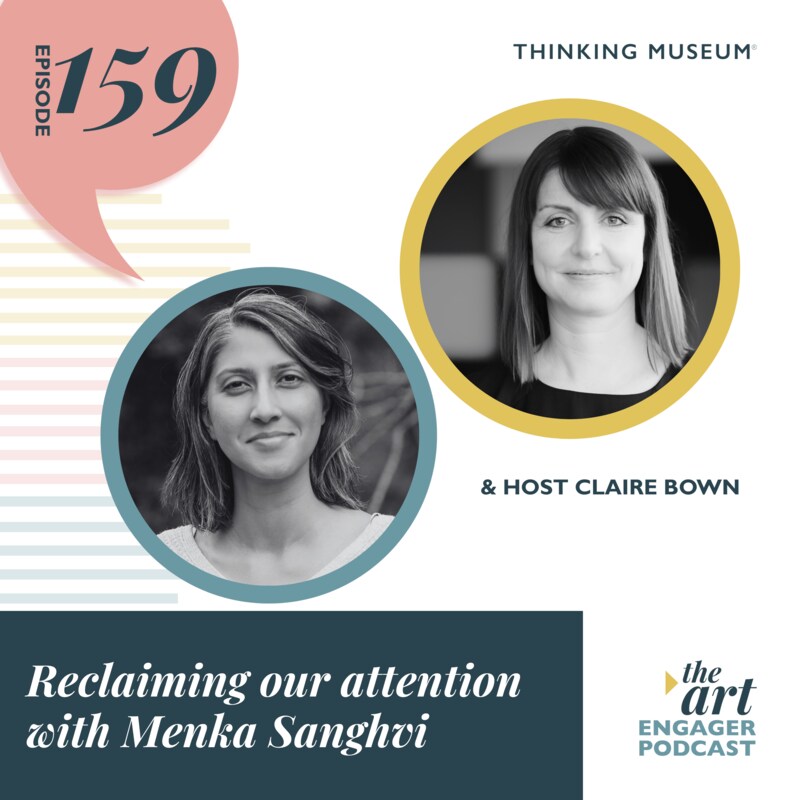
In this episode, host Claire Bown is joined by Menka Sanghvi, researcher, writer, guide and founder of Just Looking. Menka’s work explores attention through science, culture and creativity, and encourages us to slow down and notice more in our everyday lives.
Together, we talk about why ordinary moments matter, how our attentional filters shape what we see and the social dimension of noticing. We also explore the pull of digital technology, the difference between algorithmic seeing and intentional looking, and how small shifts can help us reclaim our attention.
Whether you work with visitors in museums, guide groups through artworks or simply want to nurture a more spacious way of looking, this conversation offers practical ideas you can apply directly to your facilitation practice (and to your life!).
The Art Engager is written and presented by Claire Bown. Editing is by Matt Jacobs and Claire Bown. Music by Richard Bown. Support on Patreon
Episode Links
Menka is the founder of Just Looking, a global community of people looking at everyday life with slowness and curiosity. She is also the co-author of Your Best Digital Life. Her work invites people to notice more, reflect more and reconnect with both the digital and physical worlds.
Show Links
✨ If you've enjoyed this episode, please consider supporting The Art Engager on Patreon: https://www.patreon.com/c/TheArtEngager
Or pick up a copy of my book, The Art Engager, for step-by-step guidance on creating meaningful, interactive guided experiences https://www.theartengager.com/
Buy it here on Amazon.com: https://tinyurl.com/buytheartengager
Transcripts
Hello and welcome to The Art Engager podcast with me, Claire Bown.
Claire Bown:I'm here to share techniques and tools to help you engage with your audience
Claire Bown:and bring art objects and ideas to life.
Claire Bown:So let's dive into this week's show.
Claire Bown:Hello, and welcome to a new episode of The Art Engager.
Claire Bown:I'm Claire Bown, and today I'm speaking with Menka Sanghvi, a researcher,
Claire Bown:writer, and guide who specializes in one of our most precious resources.
Claire Bown:Attention.
Claire Bown:One quick thing before we start.
Claire Bown:I started this podcast in 2021 thinking I'd make perhaps just 25
Claire Bown:episodes, and here we are at over 150.
Claire Bown:Creating each episode is mainly a solo endeavor, and your support helps cover
Claire Bown:hosting, editing costs, research, and interview time, and it helps to keep
Claire Bown:the podcast ad free for everyone.
Claire Bown:If you found this podcast helpful and would like to support what
Claire Bown:I do, you can become a friend of The Art Engager on Patreon.
Claire Bown:There are different tiers to choose from with monthly support starting from
Claire Bown:less than the price of a cup of coffee.
Claire Bown:Thank you.
Claire Bown:Now let me introduce today's guest.
Claire Bown:Menka Sovi is the founder of just looking a global community
Claire Bown:project, celebrating slowness and curiosity in how we see the world.
Claire Bown:With a background that spans physics, social change, and mindfulness.
Claire Bown:Menka brings a unique multidisciplinary perspective to the question of
Claire Bown:attention, how we use it, how we lose it, and how we can reclaim it.
Claire Bown:Menka is the co-author of your Best Digital Life and the founder of Just
Claire Bown:Looking a global Community project that encourages people to stay
Claire Bown:curious about the world around them.
Claire Bown:Drawing on over two decades of experience in behavioral change design
Claire Bown:and wellbeing science Mecca's work invites us to slow down, notice more,
Claire Bown:and reflect on how we relate to both the digital and physical worlds.
Claire Bown:In today's conversation, we explore why focusing on ordinary moments matters,
Claire Bown:the science behind attentional filters and what we unconsciously miss, and the
Claire Bown:social dimension of noticing how looking together changes what individuals see.
Claire Bown:We discuss algorithmic seeing versus intentional looking, practical strategies
Claire Bown:for rewilding our attention and why.
Claire Bown:Menka insists that slowing down isn't about duration, but attitude.
Claire Bown:This episode is essential listening.
Claire Bown:If you work in museums and want to help visitors engage more deeply with what
Claire Bown:they're seeing, if you're interested in slow looking practices or if you're simply
Claire Bown:curious about reclaiming your attention in our technology saturated world, enjoy.
Claire Bown:Hi Menka and welcome to The Art Engager Podcast.
Claire Bown:Hi, Claire.
Claire Bown:Nice to be here.
Claire Bown:So could you tell us who you are and what you do?
Menka Sanghvi:Sure.
Menka Sanghvi:I am a researcher, writer, and guide.
Menka Sanghvi:I specialize in the subject of attention, and I come to this from a scientific,
Menka Sanghvi:cultural, and a creative perspective.
Menka Sanghvi:I am also the founder of a global community project called Just Looking,
Menka Sanghvi:which is dedicated to slowness and curiosity in how we look at the world.
Menka Sanghvi:I am really concerned about how technology is impacting our minds and our attention,
Menka Sanghvi:which is why I co-authored a book all about it called Your Best Digital Life.
Menka Sanghvi:It came out a few months ago, and yeah, outside of that, I'm also a trustee and
Menka Sanghvi:champion advisor to several innovative organizations in the areas of mindfulness
Menka Sanghvi:and wellbeing, and so I end up working with a wide range of people from
Menka Sanghvi:business leaders and politicians to.
Menka Sanghvi:Musicians a few weeks ago and children too.
Claire Bown:Amazing.
Claire Bown:Um, your work caught my attention quite a few years ago now.
Claire Bown:I think we've been emailing on and off for a number of years, but I'd
Claire Bown:love to hear the story about how you ended up with this very varied
Claire Bown:portfolio career that you seem to have.
Menka Sanghvi:Yeah, sure.
Menka Sanghvi:And that's a nice way of putting it.
Menka Sanghvi:My background is fairly multidisciplinary, but in a nutshell, I. Started off working
Menka Sanghvi:in social change and climate change, the external environmental social problems of
Menka Sanghvi:the world, and then became more and more fascinated with behavioral change and how.
Menka Sanghvi:Environments influence by design, our behavior, and how
Menka Sanghvi:we can regain control over it.
Menka Sanghvi:Over that, and then I moved progressively into the world of interchange.
Menka Sanghvi:So mindfulness and wellbeing, and I guess attention is that.
Menka Sanghvi:Is that touchstone between all of it.
Menka Sanghvi:At one point I just realized that everything starts with
Menka Sanghvi:attention and perception and how you see yourself in the world.
Menka Sanghvi:What we attend to shapes, our feelings, our ideas, beliefs,
Menka Sanghvi:actions, habits, basically everything.
Claire Bown:I love that.
Claire Bown:And you are just looking now, I don't know whether to call
Claire Bown:it a project or a community.
Claire Bown:I'm sure you have a way of describing it, but you started.
Claire Bown:2017. I think I discovered it pretty soon afterwards with the community.
Claire Bown:I think maybe you are trying to bring people together with similar
Claire Bown:interests, thinking about how we explore the world, how we look at the
Claire Bown:world, curiosities involved there.
Claire Bown:Perhaps you could explain in a nutshell what just looking is.
Menka Sanghvi:Yeah, I describe it usually as a kind of a community
Menka Sanghvi:led or community powered.
Menka Sanghvi:Project celebrating slowness and curiosity, and I can
Menka Sanghvi:tell you how it started.
Menka Sanghvi:Might explain it a bit more clearly, which is I was experiencing, I guess
Menka Sanghvi:maybe like a numbness, overwhelmed by the news and looking at screens all the time.
Menka Sanghvi:And I was working in humanitarian emergency response at the time.
Menka Sanghvi:It's pretty intense.
Menka Sanghvi:And at the same time I had a meditation practice.
Menka Sanghvi:I have a meditation practice, which is it just focused on curiosity.
Menka Sanghvi:And I just wanted to expand that to the rest of my day.
Menka Sanghvi:I already had a passion for photography, so I thought that
Menka Sanghvi:would be a good place to start.
Menka Sanghvi:So I started to do these photography walks and my idea was to host a
Menka Sanghvi:series of playful kinda photo walks around the city of London where I
Menka Sanghvi:live, and we'd meet in places that are not exactly well known for photo.
Menka Sanghvi:So like for example, I remember one of the first ones we did at rush hour focusing on
Menka Sanghvi:the beauty of strangers in the financial district with everyone walking at high
Menka Sanghvi:speed and looking very stressed and tired.
Menka Sanghvi:And then on another walk on a Sunday morning, we were looking at
Menka Sanghvi:the play of light in a cemetery.
Menka Sanghvi:Another time we were walking across a bridge, but the whole one hour
Menka Sanghvi:walk was just, it was a small bridge, like a hundred meters the whole time.
Menka Sanghvi:We were just on that one bridge.
Menka Sanghvi:And we still do these walks, but the project has evolved in several ways.
Menka Sanghvi:So I have a love hate relationship with social media, but I do curate and that's
Menka Sanghvi:guess how you must have found the project.
Menka Sanghvi:I curate photography on Instagram and Blue Sky as well now purely with the
Menka Sanghvi:intention of disrupting people's feeds with moments of alertness and presence.
Menka Sanghvi:So that's a kind of key part of the project, but there's also
Menka Sanghvi:a monthly community newsletter and there's a different.
Menka Sanghvi:A theme about looking about attention each time.
Menka Sanghvi:So last month was about artificial intelligence and being hungry for
Menka Sanghvi:the human, which I think is more than the flavor of the month.
Menka Sanghvi:So I think there's gonna be more of that.
Menka Sanghvi:But looking ahead, I want it to be a platform for creating more tools and
Menka Sanghvi:books, and the idea is to recreate the experience of the photo walk
Menka Sanghvi:of the conversations that happen.
Menka Sanghvi:In between and after the walk, but in a way that people can do
Menka Sanghvi:it for themselves or with their family or with their communities.
Menka Sanghvi:So yeah, if anyone listening is interested in the project, I would
Menka Sanghvi:recommend signing up for the newsletter.
Menka Sanghvi:It's a lot of fun for me to write.
Menka Sanghvi:It's a labor of love and hopefully inspiring for others to read too.
Claire Bown:I love your newsletter.
Claire Bown:I really look forward to it landing in my inbox, and I can tell you
Claire Bown:enjoy putting it together too.
Claire Bown:As from one newsletter writer to another, you can see the care and
Claire Bown:attention that goes into it and.
Claire Bown:Thinking about just looking itself.
Claire Bown:When I was looking around on your website and looking at some of the
Claire Bown:things you've written about it and talk about it being the slow, mindful
Claire Bown:and creative observation of ordinary moments, and I think it was those
Claire Bown:words, ordinary moments, stuck with me.
Claire Bown:I do a lot of work with slow looking, mainly in the museum, but we have a lot
Claire Bown:of crossover into everyday life as well.
Claire Bown:So quite often as museum educators, we are thinking about how we can
Claire Bown:develop the practice first in ourselves before we then go and try
Claire Bown:and teach others to use it in a museum.
Claire Bown:So we might take slow looking into our everyday life and use it to
Claire Bown:pay attention to those ordinary moments or things we overlook.
Claire Bown:But I'd love to hear from you what drew you to focus on the
Claire Bown:everyday, these ordinary moments.
Menka Sanghvi:Can I just respond to one thing you said about how we need to
Menka Sanghvi:embody this slowness of looking ourselves before trying to share it with others?
Menka Sanghvi:There's been a lot of research about teaching mindfulness, and one of the
Menka Sanghvi:key insights has been that it's not effective unless the person doing
Menka Sanghvi:the teaching practices themselves.
Menka Sanghvi:So that's quite different from a lot of different subjects
Menka Sanghvi:where it's less important.
Menka Sanghvi:But yeah, so this particular study I'm thinking about was a long term
Menka Sanghvi:study that was done at scale in schools, and one of the conclusions
Menka Sanghvi:was it's not really working.
Menka Sanghvi:And that was because the study itself required this kinda scaling
Menka Sanghvi:up and recruiting of teachers that weren't necessarily into
Menka Sanghvi:it and hadn't had much practice.
Menka Sanghvi:So, makes a huge difference.
Menka Sanghvi:But yeah, to answer your other question about ordinary moments.
Menka Sanghvi:Yeah.
Menka Sanghvi:Why ordinary moments?
Menka Sanghvi:Well, the everyday is important to me because.
Menka Sanghvi:That's where we live.
Menka Sanghvi:Yes.
Menka Sanghvi:Feeling connected, inspired and in awe is not just for special occasions
Menka Sanghvi:when we make that big trip to see the waterfall or the pyramids or whatever.
Menka Sanghvi:It's every day that we need to feel alive.
Menka Sanghvi:And so that's one of the reasons.
Menka Sanghvi:But the other is that we have this kind of evolutionary negativity bias for the
Menka Sanghvi:everyday, which helps us to survive.
Menka Sanghvi:It's important to be able to see.
Menka Sanghvi:Threats and danger and things that aren't quite good enough.
Menka Sanghvi:But this can be, to use that word, uh, used before quite numbing.
Menka Sanghvi:And I think it's important to counter that with taking in the
Menka Sanghvi:goodness to everyday wonders the taste of a peach at breakfast time.
Menka Sanghvi:The laughter of a child across the street, some rubbish on the floor that happens to.
Menka Sanghvi:Looked like a ballerina dancing.
Menka Sanghvi:It's feeling alive in the everyday by paying closer attention to those
Menka Sanghvi:things that we would otherwise have kinda rushed past and linked to that, I
Menka Sanghvi:think it is a sense of caring as well.
Menka Sanghvi:So one of, one of my mantras is noticing is a first step to caring as
Menka Sanghvi:a society we're currently experiencing.
Menka Sanghvi:And what's being described as a epidemic of loneliness.
Menka Sanghvi:We all live in our filter bubbles and, and we're so easily polarized
Menka Sanghvi:as well as a result of that.
Menka Sanghvi:But once we start noticing things in the everyday, we see the elderly neighbors,
Menka Sanghvi:the immigrants running the local shop, the pigeons who share our streets.
Menka Sanghvi:We feel connected to them, and we take them in.
Menka Sanghvi:We care about them.
Menka Sanghvi:It shifts us from this individualistic perspective too.
Menka Sanghvi:Being part of something bigger.
Menka Sanghvi:So I think that can happen every day.
Claire Bown:I totally agree.
Claire Bown:And I think when we take those moments to notice on our own, certainly
Claire Bown:there's a shift there with the awe and the wonder that we can experience.
Claire Bown:We can feel more alive.
Claire Bown:But I also think when we have those moments of noticing together,
Claire Bown:so when we are doing this.
Claire Bown:Practice with other people, as we might do in the museum, but I've seen you
Claire Bown:do in workshops that you lead as well.
Claire Bown:There's something really special about discovering newness in the ordinary,
Claire Bown:in the everyday looking for things in familiar places with other people.
Claire Bown:There's a kind of social aspect to this connectedness as well.
Menka Sanghvi:Yeah, definitely.
Menka Sanghvi:I think that.
Menka Sanghvi:Attention is a social practice.
Menka Sanghvi:We miss that part of it because it's like so intimate in our minds, isn't it?
Menka Sanghvi:When you're a baby, how do you learn what to look at and someone points at something
Menka Sanghvi:and says, look, and that's how we develop.
Menka Sanghvi:Maybe we can talk a little bit about attentional filters, because this is
Menka Sanghvi:where the social aspect comes in, so.
Menka Sanghvi:The way attention works is through filters.
Menka Sanghvi:If someone in a busy room calls your name, you're having a conversation
Menka Sanghvi:with someone, there's like a hundred other things going on, but you will
Menka Sanghvi:still hear that name being called out across the room because it's your name.
Menka Sanghvi:So we have a priority that we place on certain information, right?
Menka Sanghvi:That's how filters work.
Menka Sanghvi:They filter out some things.
Menka Sanghvi:And they allow us to notice some things.
Menka Sanghvi:And it's not just names.
Menka Sanghvi:There's lots of things that we've developed filters for.
Menka Sanghvi:And as a result, there's things that we miss completely, like
Menka Sanghvi:we can't even believe afterwards if someone shows us a video.
Menka Sanghvi:Have you seen that guerrilla video?
Menka Sanghvi:Yeah.
Menka Sanghvi:The, yeah.
Menka Sanghvi:It's like, where was that guerrilla?
Menka Sanghvi:It's just a shock, isn't it?
Menka Sanghvi:And the first time you see it, and it's a phenomenon called
Menka Sanghvi:in Inattentional blindness.
Menka Sanghvi:You know, we are literally blind to it.
Menka Sanghvi:And, and the funny thing is that the information is being processed somewhere.
Menka Sanghvi:There was an experiment, which you were looking at one thing, but in the
Menka Sanghvi:corner of the screen, in the corner of what you can see, things pop up.
Menka Sanghvi:And if it's your name, you'll see it.
Menka Sanghvi:If it's someone else's name, you won't see it.
Menka Sanghvi:So like clearly both names yours and someone else's, that information
Menka Sanghvi:was getting processed somewhere.
Menka Sanghvi:But it's at quite a late stage of processing that the brain
Menka Sanghvi:actually determines whether the stimulus ought to be noticed,
Menka Sanghvi:like perceived consciously or not.
Menka Sanghvi:And so to go back to the social thing, this is where people can easily nudge
Menka Sanghvi:our filters 'cause we place a lot of importance on what other people say.
Menka Sanghvi:So.
Menka Sanghvi:If I'm running a mindful photography walk and I'm walking past a tree,
Menka Sanghvi:but there's someone standing there looking at it intensely.
Menka Sanghvi:I'm gonna stop and have a look at it too, even if they don't say anything.
Menka Sanghvi:But if I get chatting to that person and they say, yeah, actually, I, I
Menka Sanghvi:love trees and I've been studying, this particular is a London Planet
Menka Sanghvi:Tree and this one is 170 years old.
Menka Sanghvi:And so it would've been here with World War I, world War ii,
Menka Sanghvi:it would've survived the fires.
Menka Sanghvi:And I, it's gonna shift how I see this tree, right.
Menka Sanghvi:And it's because of that social importance and also the stories that we hear from
Menka Sanghvi:others, that our attentional filters can be influenced quite easily, more easily
Menka Sanghvi:than other ways of trying to do it.
Menka Sanghvi:And so, yeah, that's why I love getting people together and
Menka Sanghvi:pointing things out to you.
Menka Sanghvi:It's just always fascinates me what people notice and things
Menka Sanghvi:that I have completely missed.
Claire Bown:Yeah, and it shows you how many different
Claire Bown:literal perspectives there are.
Claire Bown:When you see, you have a group of say, 15 or so, people looking at the
Claire Bown:same thing and they're all noticing slightly different things, perhaps
Claire Bown:based on where they're literally standing or just their own experiences,
Claire Bown:their own thoughts, their ideas.
Claire Bown:They're bringing everything.
Claire Bown:To that looking, I think you say as well, that it needs practice that
Claire Bown:we need to rewild our attention, retrain our attention to be able
Claire Bown:to focus on the things that we're unconsciously filtering out.
Claire Bown:So can you talk a little bit about that?
Claire Bown:How do we strengthen our attention muscles?
Menka Sanghvi:Yeah.
Menka Sanghvi:I, I sometimes talk about like the freedom of attention and it's because attention
Menka Sanghvi:is rooted in habitual tendencies, filters.
Menka Sanghvi:And so it is a practice because we've practiced it so many times before.
Menka Sanghvi:So we will notice the things that we've always noticed, and therefore
Menka Sanghvi:we will feel and believe and act in ways that we've done before,
Menka Sanghvi:and it keeps us in a repertoire.
Menka Sanghvi:I talk about the repertoire of noticing, and I guess I, I like the
Menka Sanghvi:word rewilding because it's just.
Menka Sanghvi:If we start noticing things that we don't usually, that we normally
Menka Sanghvi:walk past, then we're strengthening our ability to place our attention
Menka Sanghvi:somewhere new and also to place our attention where we want it to be.
Menka Sanghvi:Aligned to what matters to us in that moment.
Menka Sanghvi:And that's freedom.
Menka Sanghvi:Like that's the ultimate freedom, right?
Menka Sanghvi:To shape our experience of life.
Claire Bown:And you created a set of 60 cards to help us with
Claire Bown:these experiments in looking.
Claire Bown:So can you tell us a little bit about the cards?
Claire Bown:I have my own set here in front of me that I absolutely love.
Claire Bown:How can they give us this freedom of attention?
Menka Sanghvi:So the 60 experiments in looking are a toolkit that I developed in
Menka Sanghvi:collaboration with a designer called Anna.
Menka Sanghvi:She had come to one of my photo walks and as usual, I had these prompts
Menka Sanghvi:and cards that I was handing out.
Menka Sanghvi:And at the end she was like, this needs to be a thing.
Menka Sanghvi:We need to create this into something which people can do on their own,
Menka Sanghvi:or as I said, with their groups.
Menka Sanghvi:And so they're, yeah, 60 beautifully printed cards,
Menka Sanghvi:and they come in a black tin.
Menka Sanghvi:And there are series of prompts, and the reason I describe them as experiments
Menka Sanghvi:rather than prompts is because you don't have to believe them, like their
Menka Sanghvi:ideas or stories or suggestions, but you don't have to believe in them.
Menka Sanghvi:You just have to give them a go.
Menka Sanghvi:Entertain that perspective and then see, evaluate what it does to your looking.
Menka Sanghvi:So for example, one of the cards is called Sun.
Menka Sanghvi:It reads there's a massive ball of fire in the sky.
Menka Sanghvi:Its light has traveled more than eight minutes.
Menka Sanghvi:To reach your eyes.
Menka Sanghvi:I think that's an interesting example because you read that and then right
Menka Sanghvi:now I'm looking out of the window and it makes me feel differently about the
Menka Sanghvi:light, and I notice how it's bouncing off these orange leaves and making
Menka Sanghvi:them look more orange in some places, a little bit more Bown than others.
Menka Sanghvi:And that's because of a story that's playing in my mind right now about.
Menka Sanghvi:The light and that particular fact is happens to be a true story.
Menka Sanghvi:It does take eight minutes and 20 seconds, I think, because it sounds
Menka Sanghvi:like 150 million kilometers away, which probably doesn't mean anything.
Menka Sanghvi:It's a number that's roughly three and a half, 4,000 times going round the earth.
Menka Sanghvi:That's a long way away and.
Menka Sanghvi:It makes you appreciate the light more to know that it's traveled all the way,
Claire Bown:don't you think?
Claire Bown:Absolutely.
Claire Bown:And when it's not there as well, when we get to the darker months
Claire Bown:of the year, but I think there were quite a few that stood out to me.
Claire Bown:I've got the boring card on top because I also really love the idea of really
Claire Bown:paying attention to things that we would find uninteresting at first glance, and
Claire Bown:then going back to see if we can find something interesting them about them.
Claire Bown:So.
Claire Bown:I love, choose something uninteresting to observe.
Claire Bown:Notice how slippery this is, as new details begin to reveal themselves.
Claire Bown:And that's such a wonderful prompt because quite often when I'm
Claire Bown:working with groups in the museum as well, we have our favorites.
Claire Bown:We will work with certain objects or artworks that we are drawn to in some way.
Claire Bown:We can't explain why.
Claire Bown:Maybe it's knowledge or maybe it's an aesthetic or a technical or some kind of.
Claire Bown:Appeal from that particular object, and we will leave others by the wayside.
Claire Bown:So the fact that we can perhaps focus our attention on something that we might find
Claire Bown:uninteresting at first, and see perhaps what new details we can find, see if we
Claire Bown:can see it in a completely different way.
Claire Bown:So I absolutely love that one.
Menka Sanghvi:The definition for boredom is really interesting.
Menka Sanghvi:I mean, there's a lot of debate about it in psychology, but the
Menka Sanghvi:growing consensus is that it's.
Menka Sanghvi:An emotion of feeling unable to engage meaningfully in
Menka Sanghvi:whatever it is you're doing.
Menka Sanghvi:Like you want to be doing something meaningful and you wanna be engaged in
Menka Sanghvi:that, but you're just not able to be.
Menka Sanghvi:So it's interesting because the minute I give you that prompt, or the card gives
Menka Sanghvi:you the prompt being bored, you are.
Menka Sanghvi:Now meaningfully engaged in an exercise and unable to feel bored.
Menka Sanghvi:And so it's always really funny when people do that and then they come
Menka Sanghvi:back and say, that was really hard.
Menka Sanghvi:Like I just, I was trying to be bored and just look at something that normally
Menka Sanghvi:would bore me, but I just found it really fascinating in these layers of detail
Menka Sanghvi:or started reveal themselves and it's just so much fun to get that feedback.
Menka Sanghvi:So
Claire Bown:tell me how you kind of imagine people might use these cards.
Claire Bown:You do give a few tips for guidance.
Claire Bown:There are some rules that I thought were super interesting as well.
Claire Bown:The first rule being to slow down and what I loved.
Claire Bown:Was that you said slowing down doesn't always take more time.
Claire Bown:It is an attitude of not rushing to reach the end, and I think
Claire Bown:that's super interesting as well.
Claire Bown:I often think about slow looking and I get lots of questions from people
Claire Bown:saying, oh, it takes a lot of time.
Claire Bown:And quite often it's about thinking about the process of looking and
Claire Bown:it takes as long as it takes.
Claire Bown:It's not about the duration, it's about the process of.
Claire Bown:Finding more beyond the first glance.
Claire Bown:So can you talk a little bit about some of the rules behind the cards?
Menka Sanghvi:Yeah, and that's probably the most important
Menka Sanghvi:one that you just picked out.
Menka Sanghvi:I think there's a feeling of never having enough time, isn't there?
Menka Sanghvi:And so reminding people that it's just an attitude.
Menka Sanghvi:'cause I don't know if you can tell, but I'm a physicist by background, but, so
Menka Sanghvi:I, I studied physics at Cambridge and I've always had love for physics, but
Menka Sanghvi:time literally is, you know, stretchy.
Menka Sanghvi:And so a minute of looking at.
Menka Sanghvi:A leaf or a painting can feel really different depending on
Menka Sanghvi:the presence you bring to it.
Menka Sanghvi:So if you give yourself permission to, to slow down and you just assume
Menka Sanghvi:that there's gonna be something really interesting, I mean, it is
Menka Sanghvi:like you are in a treasure hunt now, and that one minute can feel really.
Menka Sanghvi:Luxurious.
Menka Sanghvi:And so, yeah, I think that's an important rule.
Menka Sanghvi:And the other really important one is about kindness.
Menka Sanghvi:So I, I feel like there's these two wings of practice, curiosity and
Menka Sanghvi:kindness that I, I try to practice every day all the time, and it's
Menka Sanghvi:easier to weigh in on curiosity.
Menka Sanghvi:But if I'm having a tough day, the curiosity comes with
Menka Sanghvi:like negativity and judgment.
Menka Sanghvi:And so be kind to yourself like every time our attention goes somewhere
Menka Sanghvi:where we don't want it to, and we bring it back like we are strengthening
Menka Sanghvi:those muscles and it takes time.
Menka Sanghvi:So just to keep bringing it back again and again, and
Menka Sanghvi:congratulate yourself for having.
Menka Sanghvi:Strengthened and exercised your muscles of attention in the process.
Menka Sanghvi:So I just wanted to say in terms of how to use them, as I mentioned the
Menka Sanghvi:cards, they come in a a metal black tin.
Menka Sanghvi:The idea being that you can take them with you on a walk
Menka Sanghvi:and not worry about the rain.
Menka Sanghvi:And also there's the guidance for how you can do it by
Menka Sanghvi:yourself, but also with a group.
Menka Sanghvi:And we've offered them to our community through our newsletter.
Menka Sanghvi:And now they're available in our online shop, but we're just about
Menka Sanghvi:to release a version for retailers.
Menka Sanghvi:So physical shops and, yeah.
Menka Sanghvi:I thought this would be interesting to your listeners 'cause hopefully
Menka Sanghvi:museum shops and art galleries.
Menka Sanghvi:Would like to stop them and so do get in touch if that's you.
Claire Bown:Absolutely.
Claire Bown:And these cards, I must say, I collect a lot of museum cards.
Claire Bown:I'm a bit of a collector with these things, and they are beautifully packaged,
Claire Bown:and as you say, they're in a really sturdy box so that you can take them with
Claire Bown:you because you don't want your cards being in a cardboard box and getting
Claire Bown:wet if you're stuck in the rain as well.
Claire Bown:I have one more question for you about the cards, which would be you advise
Claire Bown:people to take a card and stick with it.
Claire Bown:What happens if you feel you cannot use that card or you
Claire Bown:can't do anything with it?
Claire Bown:What would your advice be?
Menka Sanghvi:Yeah, so we have this situation in photo walks and
Menka Sanghvi:we usually encourage people to swap.
Menka Sanghvi:So you, if you're done with a card, then you swap with someone
Menka Sanghvi:else if you're in a group.
Menka Sanghvi:But before doing so, as you say, I really encourage people to just.
Menka Sanghvi:Let go of some assumptions around what's interesting and what's not,
Menka Sanghvi:what's worthy of your attention and what's not, and give it a go.
Menka Sanghvi:Like I say, it's an experiment.
Menka Sanghvi:You can't really get it wrong, and you're definitely gonna learn something
Menka Sanghvi:about yourself and about the world.
Menka Sanghvi:So that's the kind of, it's a nudge, but I feel like it's also just a permission for
Menka Sanghvi:people to, to linger with whatever it is that they're being encouraged to look at.
Menka Sanghvi:Yeah, and I think we need that permission, don't we?
Menka Sanghvi:It's like if you're a parent, you're used to giving your child instructions in terms
Menka Sanghvi:of what to do rather than what not to do.
Menka Sanghvi:Like it's always easier to say.
Menka Sanghvi:I wonder if there'll be any squirrels out in the woods today.
Menka Sanghvi:Let's go check rather than no more bluey for you today.
Menka Sanghvi:And it's the same for adults, and we just need to be told what to do.
Menka Sanghvi:And sometimes, because it gives us permission to do that thing for
Menka Sanghvi:longer than we would if we were just.
Menka Sanghvi:On our own.
Claire Bown:Absolutely.
Claire Bown:I think it takes us back a little bit to the boring card that I put
Claire Bown:at the top of the pile as well.
Claire Bown:Sometimes that can feel a little bit uncomfortable to sit with something
Claire Bown:that you don't always immediately see a way through or how that might work.
Claire Bown:But sticking with it and really thinking about how we can perhaps sit with.
Claire Bown:That feeling of discomfort for a little bit and push past
Claire Bown:that instinctive reaction.
Claire Bown:And I feel we sometimes do that very much in the museum as well.
Claire Bown:If we're looking at something, particularly art that perhaps we
Claire Bown:don't have an immediate reaction to or something that we have a cold reaction
Claire Bown:to, then we can push past it by taking a little bit of time to sit with it and
Claire Bown:seeing what happens, what comes up if we spend a little bit more time with it.
Claire Bown:So, exactly.
Claire Bown:Yeah.
Menka Sanghvi:The one card, for example, called shatter.
Menka Sanghvi:And the prompt is find a moving shadow and it's really clear, really specific.
Menka Sanghvi:And uh, the other day someone had that card and they said,
Menka Sanghvi:it just is nothing moving.
Menka Sanghvi:And then they realized that they were moving and they became really
Menka Sanghvi:fascinated with their own shadow.
Menka Sanghvi:It was like that Peter Pan situation where they started photographing
Menka Sanghvi:and leaning into their own shadow.
Menka Sanghvi:But yeah, it's that permission and that encouragement to go a little bit longer.
Menka Sanghvi:Go past that.
Menka Sanghvi:Point of discomfort and just ease into it, not take yourself too seriously.
Claire Bown:Yeah.
Claire Bown:And see what happens as well.
Claire Bown:What happens.
Claire Bown:I love that phrase.
Claire Bown:You've been extremely busy in the past year or so.
Claire Bown:You've also released a book, your Best Digital Life, and I loved reading
Claire Bown:about how our digital habits, how our phone use, particularly our being
Claire Bown:online all the time, can really affect the way we see and pay attention.
Claire Bown:So can you perhaps.
Claire Bown:Talk a little bit about this idea of algorithmic seeing versus
Claire Bown:the more slow offline looking that we were just talking about.
Menka Sanghvi:Yes.
Menka Sanghvi:Yeah, so we were talking about filters earlier, attentional filters, and
Menka Sanghvi:at the moment, because we spend a third of our waking lives in digital
Menka Sanghvi:environments, and these days our filters come from those digital environments
Menka Sanghvi:and the information presented to us.
Menka Sanghvi:It is very compelling.
Menka Sanghvi:It appeals to our sense of urgency or social connection, or fear of missing
Menka Sanghvi:out our need for companionship.
Menka Sanghvi:This is where social media and AI comes in and meets our human needs, and it's
Menka Sanghvi:important to remember that this is happening to us because we're human.
Menka Sanghvi:And to be kind to ourself when we're wondering why is it that my
Menka Sanghvi:attention is so easily manipulated by these apps, these feeds, and I think
Menka Sanghvi:it's very easy to trade our agency over our attention for convenience.
Menka Sanghvi:So any practice that helps us to slow down, reclaim that control, that
Menka Sanghvi:agency, our capacity to make a choice.
Menka Sanghvi:Is really important in these times.
Menka Sanghvi:And so this book, your Best Digital Life is all about aligning your
Menka Sanghvi:attention with your intention.
Menka Sanghvi:So I sometimes say algorithms amplify our least intentional
Menka Sanghvi:selves because everything is so slippery and convenient that we end
Menka Sanghvi:up in a behavioral patterns that.
Menka Sanghvi:Are kinda designed for us rather than doing what we think
Menka Sanghvi:is important in the moment.
Menka Sanghvi:And to take an example from the book, like you can just pick up your phone
Menka Sanghvi:to check what time it is and then.
Menka Sanghvi:20 minutes later, you're wondering why you are posting a story on
Menka Sanghvi:Instagram, like, what happened?
Menka Sanghvi:And it's because it's designed to do that to us.
Menka Sanghvi:And so to just take a moment to slow down before picking it up, knowing that
Menka Sanghvi:it's a very slippery and manipulative environment that we're entering into.
Menka Sanghvi:So what is it that we wanted look at right now when we're picking up the phone?
Claire Bown:And I think you also wrote that even having your phone.
Claire Bown:I'm looking at my phone now and uh, even though it's face down on
Claire Bown:the desk, it's still attracting our attention in some way.
Claire Bown:Even it's mere presence.
Claire Bown:Even if I can't see the screen or there's no notifications going off, it's
Claire Bown:doing something to us at the same time.
Menka Sanghvi:Yes.
Menka Sanghvi:Yeah.
Menka Sanghvi:The phone has taken a very high position in our attentional filters.
Menka Sanghvi:Like it's up there with our name and our sense of home.
Menka Sanghvi:And so because of that, the phone has a tug on your attention.
Menka Sanghvi:If it's on your desk, if it's face down, if it's in a bag under
Menka Sanghvi:your desk, if it's switched off.
Menka Sanghvi:But if it's out of the room and it's switched off, then you start getting
Menka Sanghvi:back to your normal cognitive functions.
Menka Sanghvi:So
Claire Bown:if we're using our phone as a camera, when we're out and about, does
Claire Bown:it have the same kind of pull for us?
Claire Bown:'cause I'm just thinking, sometimes I'm using my camera to zoom in on
Claire Bown:things, to look at things, and then I might get distracted by something
Claire Bown:else and having to pull myself back to what I was originally doing.
Claire Bown:I've opened it up and I feel then that there's this kind of Pandora's box effect
Claire Bown:where you kind of, you try not to get dragged into your phone at the same time.
Menka Sanghvi:Yeah.
Menka Sanghvi:Yeah.
Menka Sanghvi:I am a big proponent of single purpose devices generally, so it just makes it
Menka Sanghvi:easier for my brain to know what I'm doing if the tool itself is telling me.
Menka Sanghvi:Right now you're taking photographs.
Menka Sanghvi:Right now you're listening to music.
Menka Sanghvi:Right now you're reading a book, and right now you're connecting with an
Menka Sanghvi:old friend or I was talking to my.
Menka Sanghvi:Teenage niece the other day about her phone relationship.
Menka Sanghvi:But one counterintuitive piece of advice I gave her was maybe you need another phone,
Menka Sanghvi:like, because there's so many things that you need to do on your phone, but
Menka Sanghvi:there's other things that you only wanna do once in a while, maybe once a day.
Menka Sanghvi:Like checking your socials or reading your substack or like just
Menka Sanghvi:to be really intentional about what you're doing, basically.
Menka Sanghvi:It sometimes is easier if your physical environment is giving
Menka Sanghvi:you some support in that.
Claire Bown:And I think there's a real through line with your work here as well,
Claire Bown:because it's thinking about intention and attention, which is always how I
Claire Bown:describe slow looking and thinking about intentional phone use and where we place
Claire Bown:our attention is incredibly important.
Claire Bown:Something you talk about in this book.
Menka Sanghvi:Yeah, we talked about algorithmic looking.
Menka Sanghvi:Yeah.
Menka Sanghvi:Versus this intentional looking.
Menka Sanghvi:And the main difference is that when you are being kinda guided by algorithms as
Menka Sanghvi:to what to look at, you are in a passive mode, you're consuming information.
Menka Sanghvi:Whereas when you are out looking, whether you are just being curious
Menka Sanghvi:or taking photographs or in a museum, you are in an active mindset.
Menka Sanghvi:You're curating information so you, you're much more aware on
Menka Sanghvi:a kind of metacognitive level.
Menka Sanghvi:You're noticing what you're noticing, and so you realize like, oh, I find
Menka Sanghvi:this painting really interesting.
Menka Sanghvi:I wonder why.
Menka Sanghvi:And you're curious about your own attention at that point.
Menka Sanghvi:So that keeps you really active and engaged.
Menka Sanghvi:So I think that's the main difference, is kinda the passive scrolling and consuming
Menka Sanghvi:versus the active curating of information and deciding what you wanna lean in.
Menka Sanghvi:On and pay more attention to.
Claire Bown:And do you have any other practical tips for kind of bringing that
Claire Bown:freshness back to our way of looking?
Claire Bown:Is there perhaps one piece of advice you would give to listeners to do when they
Claire Bown:finish listening to this conversation?
Menka Sanghvi:So one piece of advice is to really think carefully
Menka Sanghvi:about what you wanna notice more of in your life at any one moment.
Menka Sanghvi:So for example, today I'm going for a walk at lunchtime and I
Menka Sanghvi:want to notice my neighborhood.
Menka Sanghvi:I'm probably gonna leave my phone at home, but yesterday I really wanted to enjoy the
Menka Sanghvi:birds and so I took my phone along with me and I have this thing called Merlin.
Menka Sanghvi:It's an app.
Menka Sanghvi:Oh yeah.
Menka Sanghvi:Which tells me which birds I can hear and.
Menka Sanghvi:It just made me feel so much more connected to the wildlife
Menka Sanghvi:and so there's no one right way.
Menka Sanghvi:And the challenge is making sure that we're really staying aligned
Menka Sanghvi:to our, so one thing that I've really learned from studying
Menka Sanghvi:technology and how easily influenced we are is that there's something.
Menka Sanghvi:In the human nature, which is resistant to friction.
Menka Sanghvi:You know, we always lean towards convenience, which makes sense, like why
Menka Sanghvi:would we wanna do the inconvenient thing?
Menka Sanghvi:But the challenge is that sometimes having convenience defined for us
Menka Sanghvi:isn't aligned with our intention.
Menka Sanghvi:And so I started playing with this idea of like adding
Menka Sanghvi:strategic friction into my life.
Menka Sanghvi:And so, for example, having devices that only allow me to do one thing on them
Menka Sanghvi:makes it harder for me to do those other.
Menka Sanghvi:You described as a Pandora's box of options of things to do.
Menka Sanghvi:So the prompts, the 60 experiments and looking are similar in the sense
Menka Sanghvi:that they're adding friction to what you would normally want to look at.
Menka Sanghvi:And they're saying, Hey Ashley, why don't you go look at a shadow
Menka Sanghvi:or go look at the light or go look at strangers walking past.
Menka Sanghvi:It's not always comfortable.
Menka Sanghvi:It's not always what you want to do, convenient in the moment,
Menka Sanghvi:but it gives you that meaningful friction, which takes you to a new
Menka Sanghvi:place and opens up your perspective.
Menka Sanghvi:So I think that the design world and the tech world's aim to create
Menka Sanghvi:a completely frictionless experience of life is a little bit scary because
Menka Sanghvi:it's what differentiates us from.
Menka Sanghvi:Being a machine, if everything that we do is predictable and we're always
Menka Sanghvi:taking the path of least resistance, which is what makes us predictable,
Menka Sanghvi:and there's a quote by Wendell Berry, which I love, which is that it's easy
Menka Sanghvi:for me to imagine that the next great division of the world will be between
Menka Sanghvi:people who wish to live as creatures.
Menka Sanghvi:And people who wish to live as machines creature, please.
Menka Sanghvi:That's what I would say.
Claire Bown:Thank you for sharing that.
Claire Bown:I'd love, uh, to ask you a couple of final questions.
Claire Bown:The first one is always looking to the future.
Claire Bown:What's next for you?
Claire Bown:What have you got coming up?
Claire Bown:And the last question is, how can people find out more about you and get in touch?
Menka Sanghvi:Thanks for asking.
Menka Sanghvi:I'm growing.
Menka Sanghvi:Just looking at the moment and working on a series of books, each one's focused
Menka Sanghvi:on an aspect of everyday life that is so easy to overlook, but it can be a source
Menka Sanghvi:of wonder and meaning and connection.
Menka Sanghvi:So lots of opportunities to collaborate with photographers, with experts, with the
Menka Sanghvi:people who are really passionate about.
Menka Sanghvi:Different ordinary sightings.
Menka Sanghvi:And so yeah, we're looking at pigeons and the London Planetree
Menka Sanghvi:and Moss and all kinds of stuff.
Menka Sanghvi:Call to action would be to join the just Looking newsletter noticing,
Menka Sanghvi:and email me if you're interested in stocking the 60 experiments and looking.
Menka Sanghvi:And yeah, come and hang out with us on Instagram or Blue Sky, but
Menka Sanghvi:obviously do it intentionally.
Claire Bown:Thank you so much for sharing those.
Claire Bown:We will put links in the show notes and thank you Menka for
Claire Bown:coming on the podcast today.
Menka Sanghvi:You're very welcome.
Menka Sanghvi:It was a pleasure to speak to you.
Claire Bown:So a huge thank you to Menka for being on the show today.
Claire Bown:You can find out more about Menka and her work by signing up for
Claire Bown:the Just Looking newsletter at We are Just looking.org or follow the
Claire Bown:project on Instagram and Blue Sky.
Claire Bown:If you are interested in stocking the 60 experiments in looking cards
Claire Bown:in your museum shop, you can reach Menka on her email address, which
Claire Bown:I've listed in the show notes.
Claire Bown:Also go to the show notes for all the relevant links for today's episode.
Claire Bown:If you've enjoyed this episode or if any of our previous episodes
Claire Bown:have helped you in your work, please consider supporting The Art Engager.
Claire Bown:Become a friend of the podcast on Patreon or pick up a copy of my book,
Claire Bown:The Art Engager Reimagining Guided Experiences in Museums Available
Claire Bown:now wherever you buy your books.
Claire Bown:That's it for today and for 2025, I'll be taking December off and The
Claire Bown:Art Engager will return in January with more inspiring conversations.
Claire Bown:Thank you so much for listening this year.
Claire Bown:See you next time.
Claire Bown:Thank you for listening to The Art Engager podcast with me, Claire Bown.
Claire Bown:You can find more art engagement resources by visiting my website,
Claire Bown:thinking museum.com, and you can also find me on Instagram at Thinking
Claire Bown:Museum, where I regularly share tips and tools on how to bring art
Claire Bown:to life and engage your audience.
Claire Bown:If you've enjoyed this episode, please share with others and subscribe to the
Claire Bown:show on your podcast player of choice.
Claire Bown:Thank you so much for listening, and I'll see you next time.


