Shownotes
Audio Season 2 11 Series 2 Episode 11 - Exiled Paths: Nonconformity and Dissent in Kent.
© 20 26 The Rise of the Protestants., Author, Shaughan Holt.
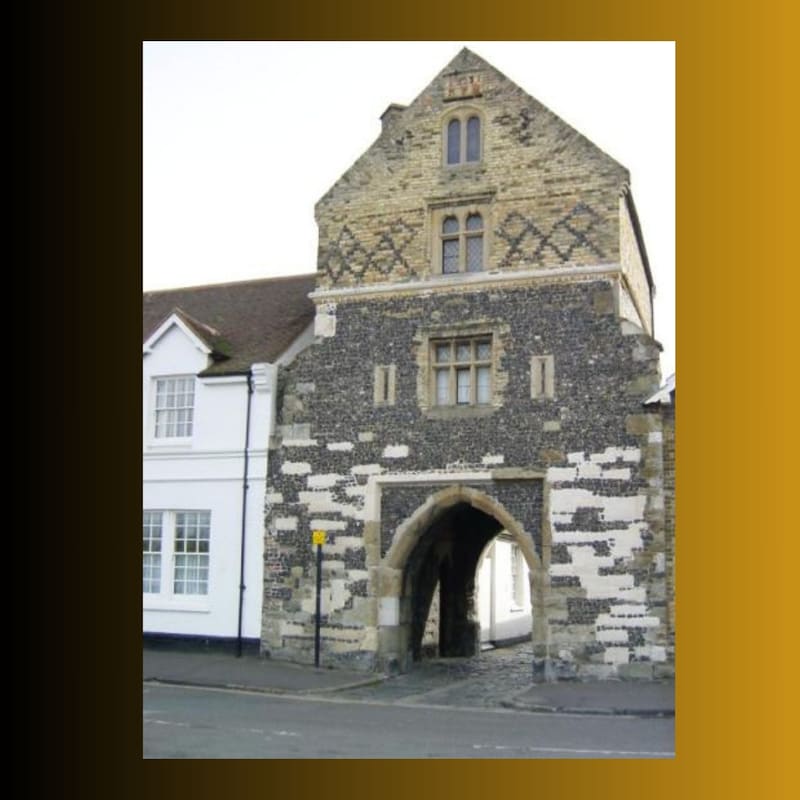
The picture: FisherGate, is one of the main medieval landmarks still found in the historic town of Sandwich.
It was built in 1384 from stone and flint and is the only medieval gateway from the original town walls to survive. A brick upper floor was added in 1578, giving the gate much of its present appearance.
The gate was once part of Sandwich’s defences and helped protect the busy port from French and Spanish raids during the late Middle Ages. When Sandwich was one of England’s main Cinque Ports, these defences were vital for both military and trade reasons.
First formed in the 11th century, the Cinque Ports, meaning "five harbours" in Old French, are a historic group of fortified coastal towns in Kent and Sussex, in southeast England. Sandwich was a major medieval harbour before the coastline gradually shifted, leaving the town stranded inland.
FisherGate stands near the River Stour at the end of a narrow cobbled lane. It serves as a clear reminder of Sandwich’s medieval past and its former role as a gateway between England and Europe.
The music is: “Roll the Old Chariot Along” Sung by David Coffin, Good Dog Records, YouTube.
Roll the Old Chariot Along, also known as “A Drop of Nelson’s Blood”, is a traditional maritime sea shanty, often described as a “stamp-and-go” or “walkaway” song.
Sailors used it to keep a steady rhythm while hauling ropes, turning pumps, or carrying out other heavy shipboard labour. The song appears to have begun life not as a sailor’s song, but as a religious hymn or African-American spiritual during the 19th century. It was later adopted by the Primitive Methodists and eventually used by the Salvation Army as a lively campaign hymn.
The original image of the chariot, once linked to spreading the Gospel, gradually took on a more practical nautical meaning, referring to the pumping wheels of a ship or, more broadly, the hard labour that kept a vessel moving. Over time, sailors adapted its powerful rhythm and call-and-response style for work at sea. Its structure allowed crews to improvise endless new verses, making it ideal for long and exhausting work.
The alternative title, “A Drop of Nelson’s Blood,” refers to rum and comes from a famous naval legend surrounding Horatio Nelson. After the Battle of Trafalgar in 1805, it was said that Nelson’s body was preserved in a barrel of spirits during the voyage home, giving rise to the sailors’ nickname for rum itself. Over the years, the song became deeply woven into British maritime culture, part work song, part drinking song, and part reminder of the harsh but communal life aboard ship.
The Music plays for 40 seconds at the beginning, and for 2min 30 secs at the end , after the narration is complete.
Episode Description.
For centuries, Kent had stood at the edge of England, facing the narrow seas and the continent beyond. Kent was shaped by restless movement: Roman roads snaking through fields, Saxon kingdoms rising and falling, pilgrims, merchants, refugees, and bold new ideas all crossing the Channel.
By the early 1600s, another kind of movement was beginning to take shape. In parish communities across Kent, small groups of Puritans and Separatists met quietly in homes, barns, and hidden meeting places. Some still hoped the Church of England could be reformed. Others were beginning to believe that reform was no longer possible.
As pressure from church authorities increased, these gatherings became more secretive, and more determined. What emerged in Kent was not simply religious disagreement but a growing network of men and women willing to risk fines, imprisonment, and exile for conscience's sake. Tradesmen, preachers, craftsmen, merchants, and ordinary families all became part of this hidden movement.
While the story of the Pilgrims often highlights northern England, especially Scrooby and Gainsborough, Kent also played an important and unique part.
From the towns and villages of Kent came many of the organisers, supporters, and skilled families who would later sustain the exile communities in Holland, and and contribute to the transatlantic migrations.
What began here as quiet resistance would, in time, become part of a much larger story.
© 20 26 The Rise of the Protestants., Author, Shaughan Holt.
"All rights reserved. No part of this podcast may be reproduced, translated, distributed, or transmitted in any form or by any means, including photocopying, recording, or other electronic or mechanical methods, without the prior written permission of the copyright holder, except in the case of brief quotations embodied in critical reviews and certain other non-commercial uses permitted by copyright law".
Requests regarding translation, licensing, or republication should be directed to: [email protected]
Also feel free to email me your thoughts at : [email protected]
Transcripts
© 20 26 The Rise of the Protestants., Author, Shaughan Holt.
"All rights reserved. No part of this podcast may be reproduced, translated, distributed, or transmitted in any form or by any means, including photocopying, recording, or other electronic or mechanical methods, without the prior written permission of the copyright holder, except in the case of brief quotations embodied in critical reviews and certain other non-commercial uses permitted by copyright law".
Requests regarding translation, licensing, or republication should be directed to: [email protected]
Also feel free to email me your thoughts at : [email protected]
Series 2.
Episode 11.
Exiled Paths. Nonconformity and Dissent in Kent.
The historic county of Kent, lies in the south-east corner of England, a land between London and the coast of continental Europe.
Bordered by the North Sea and the English Channel, Kent has long been a gateway between England and the wider world.
Its ancient motto, Invicta, meaning “Undefeated”, recalls the county’s proud tradition, of resistance, during the Norman Conquest.
Kent is also England’s oldest county, emerging from one of the earliest Anglo-Saxon kingdoms.
Although the heart of the Pilgrim story is often associated with the North of England, especially places like Scrooby and Gainsborough, - Kent, also played an important role.
For it was here, that many of the movement’s skilled tradesmen, organisers, and supporters emerged, men and women, who would help sustain the Separatist communities in exile, and later, in the New World itself.
The Kingdom of Kent, was one of the principal Anglo-Saxon kingdoms of early medieval England.
Founded in the 5th century in the south-east of Britain, it is traditionally regarded, as the earliest kingdom established, after the Anglo-Saxon migrations.
Although the term “Anglo-Saxon” is commonly used, Kent was settled mainly by the Jutes, a Germanic people from what is now Denmark, rather than by the Angles or Saxons alone.
Kent, would later become one of the famous “Seven Kingdoms” of Anglo-Saxon England.
It was the first Anglo-Saxon kingdom to adopt Christianity, starting in 597 CE, when King Ethelbert began the process.
The name, Kent, is one of the oldest surviving placenames in the British Isles, likely derived from a Celtic word, meaning “Coastal District”.
From its earliest history, Kent was closely connected to continental Europe, with Canterbury, emerging as its most important and influential city.
Canterbury, one of England’s most historic cities, is located in the south-east of the county.
Its cathedral, has served as the spiritual centre of the English Church since the early 7th century, making Canterbury, one of the most important religious sites in English history.
The area had been inhabited, since pre-Roman times, but following the Roman invasion of Britain in 43 CE, the Romans established the town of Durovernum Cantiacorum, on the site.
The city was situated along a significant route, originally a Roman road, later called Watling Street, which connected London to the port of Dover, and gave access to continental Europe.
Remnants of the Roman and medieval walls, as well as the medieval West Gate, still survive today.
Canterbury came to prominence in the late sixth century, during the reign of Ethelbert of Kent.
His Christian wife, Bertha, helped prepare the way for Augustine of Canterbury's arrival in 597 CE.
Augustine established a lasting presence in Canterbury, founding St Augustine’s Abbey and laying the first stones of the church, destined to become Christ Church Cathedral.
Together, these developments established Canterbury as the centre of English Christianity.
Between 16 05 and 16 08, Kent appeared as a significant, although often hidden, centre of Puritan and early Separatist activity.
During this period, many individuals moved beyond advocating for reform within the Church of England, and began to pursue complete separation from the institution.
Regions, such as the Weald and East Kent, became recognised for this transition, continuing their long-standing tradition of religious nonconformity.
These areas, played a particularly active role in the emergence of separatists, many of whom were known as Conventiclers.
While many people in Kent, still hoped to reform the Church of England from within, a more radical group began to emerge, between 16 05 and 16 08.
These people increasingly believed, that the Church could no longer be changed, and that separation, was the only remaining option.
As a result, Kent became an important centre for Separatist activity, closely linked to similar groups in London and elsewhere.
Its closeness to London, together with the influence of outspoken preachers, helped Puritan and Separatist ideas spread quickly across the county.
But.. these activities were illegal.
Following the appointment of Archbishop of Canterbury Richard Bancroft, pressure on dissenters to conform intensified significantly.
Individuals who refused to comply, either by abstaining from communion or challenging ecclesiastical authority, frequently faced fines, imprisonment, or public punishment.
Nevertheless, despite these risks, the movement continued to expand.
The town of Sandwich, itself, played a vital role.
For many local dissenters, Sandwich became a stepping stone, a place where the idea of leaving England, no longer seemed distant…but possible.
And so, Kent became more than simply a centre of dissent.
It became a bridge, linking England to exile, and exile to a new world beyond the sea.
Sandwich is a historic town in Kent, situated on the River Stour in south-east England.
Once one of the important Cinque Ports, Sandwich was a major medieval harbour before the coastline gradually shifted, leaving the town stranded inland.
In the early 17th century, Sandwich became notable for its Dutch refugee community, and its links to Puritan and Separatist networks.
The town of Sandwich, played an important role in the early history of the Huguenots, and other Protestant refugees in Kent.
The refugees brought with them, valuable skills, such as market gardening, silk weaving, and distinctive Flemish building techniques, many of which had a lasting impact on the town, and the broader Kent countryside.
St Peter’s Church in Sandwich became known as the “Stranger’s Church”, serving the immigrant community, and parts of its tower, still reflect the influence of Flemish craftsmanship today.
The name Sandwich dates back to Anglo-Saxon times, appearing in records as early as the 9th century.
Its name, comes from the Old English, “wic”, meaning trading settlement, or market town.
The town also gave its name to a food, the “sandwich”, associated with John Montagu, 4th Earl of Sandwich, and the word is now found in several languages, including French!.
In 16 05, the newly appointed Archbishop of Canterbury, Richard Bancroft, launched a determined campaign to enforce religious conformity.
Pressure on Puritan ministers intensified sharply, forcing many to choose between submission, silence… and separation.
At the same time, something new was beginning to emerge.
Rather than trying to reform the parish church, some believers now began to meet in secret, forming illegal conventicles, where they could worship freely, and preserve their communities, beyond the reach of the authorities.
The Seditious Sectaries Act of 15 93, allowed authorities to imprison, and eventually banish, anyone caught holding the secret religious meetings, known as Conventicles.
By 16 06–16 08, the pressure to conform had become increasingly difficult to endure.
As a result, across East Kent and the wider south-east, some began to consider, and eventually undertake, the journey to the more tolerant Holland, following a path already taken by Separatist groups in the Midlands and the North.
At the heart of the Separatist movement in Kent, were ordinary men, tradesmen craftsmen and radical preachers, who quietly organised and sustained, these hidden congregations, and who, would later form part of an important, “Kentish contingent”, in the subsequent voyages to the New World.
One of the leading figures was John Turner of Sutton Valence.
A chandler by trade, Turner helped guide local Puritans, into a covenanted Separatist congregation, organising secret gatherings in Sutton Valence and Egerton, while sustaining a hidden network of conventiclers.
Sutton Valence and Egerton are two historic parishes in Kent, located within the borough of Maidstone and near Ashford, respectively.
They are linked, historically, through religious nonconformity in the 17th century, and geographically, by their positions on the Kentish ridge.
Another man of the same name, a John Turner, who was born in Norfolk, would later appear among the English exiles in Leiden, becoming an important link between the Separatist communities in Holland, and their supporters in England.
Meanwhile, in Canterbury, nonconformity had already begun to take root.
Here, figures such as Robert Cushman, later a key organiser in the wider Separatist movement, were already active, during these early and formative years.
Others would soon follow a similar path.
Moses Fletcher, a blacksmith and prominent local Separatist from Sandwich, repeatedly faced excommunication between 16 04 and 16 10, for religious defiance before fleeing to Leiden.
He baptised all ten of his children at St Peter’s Church in Sandwich.
And from around 16 09, John Lothropp preached in Little Chart and Egerton, becoming a quiet but powerful influence, encouraging others toward separation, and ultimately, toward exile.
Though his migration occurred later in 16 34, John Lothropp was a radical preacher, who served as a vicar in Little Chart and Egerton, starting around 16 09, acting as a catalyst for local dissenters.
Other people from Kent, also played important roles in the broader story of dissent, and what would later be called, the “Great Migration”.
One of them was James Chilton from Canterbury.
James and his wife had seven children who were all baptised in Canterbury, and in 16 00, the family moved to Sandwich, where three more children were baptised.
A tailor by trade, his family had already faced censure for their beliefs, his wife having been excommunicated.
It is widely believed that he was drawn into the Separatist movement, through his association with Moses Fletcher.
At sixty-four, Chilton would become the oldest passenger aboard the Mayflower voyage.
Another key figure was Robert Cushman of Canterbury.
Originally apprenticed to a local grocer, Robert Cushman became an outspoken Separatist, who soon faced trouble for distributing Puritan pamphlets.
He would later become the Pilgrims’ chief agent in London, helping organise and negotiate the complex arrangements that made the Atlantic voyage possible.
And so, what was unfolding in Kent was far from an isolated story.
Across England, from the villages of Kent, to the households of Scrooby, and the gatherings in Gainsborough, similar pressures were producing the same result.
Though separated by distance, these men and women were bound by the same convictions, and increasingly, they were coming to the same conclusion: that Reform was no longer enough.
They knew the road ahead might demand secrecy, involve real danger, and, for many, end in exile.
And as we turn north, to Scrooby and Gainsborough, we find communities already standing at that same crossroads, preparing to take the next step.
Around 16 10, many Separatists from Kent, decided to travel to Holland, where they joined the English exile community in Leiden, led by John Robinson.
There, they supported the movement not only through their faith, but also through practical skills, trade, and organisation.
Men such as John Turner, used their business connections, to maintain links between the exiles in Holland, and their supporters in London and the south-east, helping prepare the way for whatever might come next.
And Kent’s influence did not end there.
Several of these families later participated in voyages to the New World, bringing with them the resilience, skills, and convictions developed during the early Kentish gatherings.
Even then, the story continued.
In 16 34, the ship Hercules left Sandwich, carrying families from the parishes of Ashford, Maidstone, and Egerton, where these ideas first took shape, to the Massachusetts Bay Colony.
And so, what began in Kent as secret meetings, would help shape a movement, that reached far beyond England’s shores.
However, this development represented only one aspect of the broader historical context.
While Kentish communities sought exile and new opportunities, communities in northern locations such as Scrooby and Gainsborough arrived at similar conclusions.
These northern groups also prepared to embark on similar journeys.
What had begun as quiet resistance was slowly becoming something far more decisive.
Across Kent, and in other parts of England, small and secret gatherings were growing into committed communities, bound together by faith, pressure, and a shared sense that the Church of England could no longer be reformed from within.
For many, the old hope of change was beginning to fade.
With each passing year, the risks became harder to ignore.
Surveillance, fines, and imprisonment were no longer distant threats, to be whispered about in sermons or rumours, they had become part of everyday life.
And so, gradually but inevitably, a new question began to take shape:
If they could not worship freely in England… where could they go?.
For an increasing number of Separatists, the answer lay across the North Sea.
Holland, especially cities such as Amsterdam, offered something England no longer could:.
A measure of religious tolerance, and the opportunity to worship, without the constant fear of arrest or punishment.
Others had already made the journey, and now more, were preparing to follow.
Among them were the congregations of Scrooby and Gainsborough, communities shaped by growing pressure, deep conviction, and the uneasy realisation that the moment for decision had finally arrived.
And as we turn to their story, we see that leaving England was not the end of their struggles, but the beginning of a new and uncertain journey.
