Shownotes
** Don't forget about Tuesday’s Macro ‘n Chill, the online gathering where we listen to the podcast together and discuss the issues it covers. Bring your insights, questions, and good-faith disagreements. June 23, 8pm ET/5pm PT. Use this link to register https://us06web.zoom.us/meeting/register/yI-UE7W1TcGglJSZ2l-Ffg
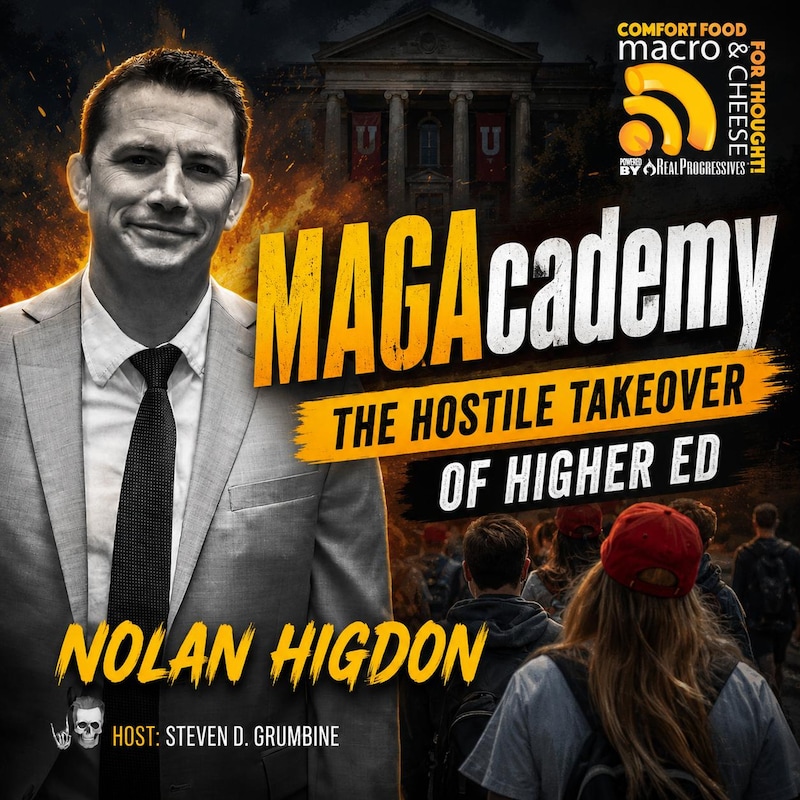
As much as we'd like to blame Donald Trump for the near-destruction of higher education, the rot set in long before he ever set foot in the White House. Political analyst and author Nolan Higdon is back to talk with Steve about his new book, MAGA Academy: How Corporatism Paved the Way for the Hostile Takeover of Higher Ed.
Nolan makes the case that Trump's hostile takeover of the academy was only possible because fifty years of neoliberal corporatization had already reduced universities to profit-driven enterprises. (He also points out that this was spearheaded largely by so-called liberal Democrats.) From the weakening of faculty power and the crushing weight of student debt to the erosion of academic freedom and the treatment of students as mere customers, the stage was set long before MAGA became a political force. If higher education had a civic mission, it has been gutted. Critical inquiry is replaced by vapid careerism and market logic.
Steve and Nolan examine how federal funding and corporate influence turned campuses into compliant institutions, more concerned with their bottom line. Steve brings the crucial macro-economic, challenging the false scarcity that puts the kibosh on public investment in education. As he often reminds us, the federal government is the issuer of the currency. It is not revenue-constrained, yet we continue to accept austerity and tuition hikes as if there were no other way.
The conversation highlights how higher education reflects broader class relations and power structures within capitalism. MAGA's higher education agenda is part of a longer historical process that leads to today's intensified struggles over knowledge, ideology, and power.
Nolan Higdon is a prominent political analyst, author, and media scholar. He teaches in Merrill College and the Education Department at the University of California, Santa Cruz. A veteran of the "corporate university" era, Higdon has authored numerous books, including The Anatomy of Fake News and Surveillance Education. His latest work, MAGAcademy, exposes the bipartisan neoliberal roots of the modern authoritarian shift in American higher education.
Find his work on Substack: nolanhigdon.substack.com
@NolanHigdonCML on X
Transcripts
All right, folks, this is Steve with Macro and Cheese. My guest is returning guest Nolan Higdon.
Nolan Higdon, for those of you who don't know, is an author, political analyst, and lecturer at the University of California, Santa Cruz, whose work focuses on the intersections of politics, media, technology, and education. One of the things that we're going to talk about today, it's going to be kind of the backdrop for the conversation.
tile Takeover of higher ed in:And I'm going to level set before I, you know, fully embrace my guest here. I want to quickly get a few things out that I think are important to kind of frame this.
You know, we've been very heavily focused on democracy and the lack thereof. And for years, we spoke with many. I mean, like, out of almost 400 guests, I would probably say 300 of them have been academics.
And during that time period, we had the opportunity to speak to folks like Devarium Baldwin, who wrote a book that we covered extensively here called in the Shadow of the Ivory Tower, How Universities Are Plundering Our Cities.
And, you know, I see a lot of relationships, even though they're not one for one, but just in the nefarious nature of what our political climate, this fake democracy that we claim we have, some live and die by, even though there's evidence to suggest it's a ruse, it's smoke and mirrors. It doesn't exist. Quote Gillens and Page, at some point during this conversation.
But I think your eyes will see some other things that are happening right here, right now.
And one of the other key complaints that we as a podcast and as a larger organization have kind of gone through is this kind of approach to seeing the world in, you know, like, kind of universal terms. And I, I think that, like, the term capitalism is important, but it's not necessarily descriptive of the current environment.
Perhaps neoliberalism, which is still capitalism, is that.
And so I think what Nolan has done in his book, Maga Academy is really kind of centered and situated the conversation in the here and now, it's looked backwards. It is not just a bad Trump kind of moment. It looks holistically here. It looks long term at the issue and how it came to be.
But I want to just state for the record that he has done incredible work documenting this and want to make sure we get all that out there. But I want it to be in the context of work that we've covered here.
I don't want it to be like, hey, wait a minute, two weeks ago Steve said xyz and then all of a sudden I'm interviewing someone else and it sounds like, wait a minute, hold on, wait, are these two connected? I like to connect my podcast, even if my hosts are different. So you'll notice some threads, you'll notice some themes connecting these together.
And that's intentional. So without further ado much bloviating on my part, let me bring on my guest, Nolan Higdon. Welcome to the show, sir Steve, It's.
Nolan Higdon:A pleasure to be back. Thank you so much for having me.
Steve Grumbine:Absolutely. So your new book, Maga Academy, How Corporatism Paved the Way for the Hostile Takeover of Higher Ed is kind of the theme of the day.
Why don't we start off, given my monologue there, why don't we just start off with kind of a summary and whatnot of the book? Let's get everybody up to speed on what you've written.
Nolan Higdon:Yeah, I think it fits with a lot of the threads that you talked about at the beginning. And I applied this to education, but in previous books I applied it to a media and we could even apply it to democracy.
Donald Trump is often treated as the central problem with everything because those who look around the United States right now recognize that things like higher education, media, democracy are in decline.
But in terms of higher ed, I wanted to center Trump as really kind of his ability to transform higher ed was the result of 50 years of corporatizing higher ed.
And Trump delivered on a lot of long term conservative goals such as, you know, rearranging curriculum, removing some radicals from campus, deprofessionalizing certain fields that conservatives had wanted for a long time. But he was only able to do it because the university system had been transformed radically in the 50 years previous.
And the ironic part of that is it's most of that transformation happened at the hands of so called liberals in the Democratic Party, which did things like reduce students to customers, break faculty unions, remove any emphasis on the public good, and democracy in higher Ed and replace it with kind of vapid careerism. Replace, like the nonprofit sector, real altruistic goals and collective action with corporations and corporatism.
ike this desire to go back to:And that's the story here with higher ed, where I also offer some prescriptions of what we could do differently as well.
Steve Grumbine:So with that in mind, I mean, obviously just the pariah of Trump, you know, he's been here not once, but twice. And he's been an ever present kind of celebrity, villain celebrity, you know, executive celebrity, whatever.
He's been in the public eye since, heck, I think since I was in high school. I mean, this guy's been around for a long time, you know, kind of being part of it.
I mean, his escapades with the Worldwide Wrestling Federation, you know, the wwe, and his relationship with, you know, I mean, my goodness, he's got the. What's her name? I can't even remember her name. It's terrible. But the McMahon as.
Nolan Higdon:Oh, yeah, the McMahon, yeah.
Steve Grumbine:You know, Yeah. I mean, here, this is somebody who. It's all tied together, right?
And somehow or another, we keep getting these bad theatrical productions we call, you know, administrations. And I've just kind of grown to the point where I see them as bad community theater with a lot of money and.
But yet here she is and here he is, and here they are, basically. I don't really know that they're. How much I see them as changing things, as they are just peeling away the.
It's kind of like the wizard of Oz and you go behind the curtain. I really feel like what we're doing is we're just seeing it naked, you know, the transformation.
Many of us were swept up in the kind words, you know, somber language of Obama, and many of us were caught up in the all shucksiness of W. And what did that get us? That got us weapons of mass destruction and all kinds of dead Iraqis and. But the list and lies that we've consumed, just so unbelievable.
And now I think with Trump, it's just ridiculous. I mean, like, it's not even. They're not even trying to be believable. It's just in your face.
So how do you make heads or tails of this administration as it relates to what they did to, you know, higher ed, for that matter.
Nolan Higdon:Well, one of the big things that, you know, in general, you can say about Trump is, and you were kind of getting at this, there is a weird, like, almost transparency or honesty to some of the things he says in terms of how it resonates with voters, whether it be like, the disdain for news media. Right.
dia lias into the Iraq War in:Like, all those things resonate really well because voters were feeling that. And Trump, he taps into that. He's like any other con man. He tells you what you want to hear, and he does it very well.
But, of course, the real con comes when you believe that he actually believes those things. Like, he actually believes that elites are bad because it hurts working people.
The implication being he's going to get in office and help working people. Of course, that's the con that's never going to happen.
And what's really happening, what he's using office for, is to make as much money for himself and everybody else. And the corruption is just absolutely naked.
I just saw a report that the UFC fight he's going to have on the lawn on his birthday, he set the date for that shortly after he bought stock in the ufc. So there's always these just naked corruption in the public eye. To your point, and this is something I always say about Trump.
He's not doing anything too radically different. He's accelerating things that were already in process. And he's able to do it publicly because his defenders defend him blindly.
So, like the corruption of this administration, the way he's made wealth on everything from crypto to personal investments to getting money from other countries and companies, it's right in front of your face. This isn't like the W years, where you had to look deep into some piece of legislation to figure out the conflict of interest.
This is right in everybody's face.
And Trump is doing it because so many of the institutions that would typically hold him accountable, whether it be like the other party people with principles in his party, the news media, the, like, federal investigators, all of them have lost credibility in the public eye. And they're so just nobody believes in anything. And there's something powerful to that.
So that's why skepticism is and cynicism are so Closely related. It's understandable why we're skeptical of institutions, especially because how much they've failed in the last 30 or 40 years.
But to outright have no institutions, have faith in nothing, where do you go from there? You can just have naked corruption without any sort of reaction. And I think that's kind of the place where Trump really thrives.
And in terms of higher education, you know, this was true of all the Western world, but it happened here in the United States as well. If you were college educated, you were more likely to vote Democrat or for the liberal party than you were Republican.
And so we had this non college educated versus college educated divide among the electorate. And a lot of people in the non college educated sector had good reason to hate these college educated elites.
These are the people who got the degrees. They're benefiting from the post NAFTA service economy.
And when you complain about the economy or the system as it is, you were derided as being a racist or ignorant or not understanding how the world works. Along walks Donald Trump. He's going to talk negatively and wag his finger in the face of those elites supposedly on your behalf.
And that's why he ends up so popular. I mean, higher ed did a lot to destroy its image with the public. It wasn't necessarily Trump himself.
Steve Grumbine:So let's get into MAGA Academy. I mean, the higher education in particular.
You know, when I was going to school, I was taught by the former CFO of US Airlines for my freaking, you know, finance classes. I mean, you're definitely not getting a quote unquote left wing version of how finance could be beneficial to everyone.
You're getting a very, very, you know, but then again, you get an mba, what are you doing? You're training to be a freaking part of the system, right? You're training to be one of the people that run the system.
And but all the stuff that I did back then, it just felt natural because that was what was kind of, you know, what you were expected to do. You know, you thought, you go to school, you learn these things, you have a great job, a career, et cetera.
But to your point, that lie, the service economy that we had hoped would be there when we got those degrees, not that we'd hope would be there when we understand the way the world actually works. But when you're being like a cattle through the run, you're sitting there, oh, yeah, I'm going to get an mba. I'm going to be a CEO someday.
I'm going to this, I'm going To that, I'm going to the other. And when none of those things come true, you end up with a pretty bitter person with a huge student debt loan.
But what you've got now is the undressing of all that education, the tearing down of, you know, professional education in general. And maybe that's good, maybe that's bad, I don't know. Because the society we live in is, in my opinion, not sustainable.
The hyper capitalistic approach to everything or this, I don't even know if you call it capitalism at this point. It's just some perversion. But, you know, what exactly has Trump done to the university system that we have to really wrap our head around?
Nolan Higdon:Well, I'll talk about this with what Trump has done, but I think it's also important to remember, like, it's equally important to ask what Trump was able to do and why. But yes, yeah, what he has mostly done is he's taken a lot of the tools that were left in place by the neoliberals that predated his second term.
And so what I paint out in the book is that we'll use economics as an example. You know, higher education used to be a lot more exploratory in terms of the ideas you could explore on campus.
And this is because it was largely funded by the public. It was funded through tuition dollars. They weren't as dependent on corporate money or even ideologically tied federal funding as well.
And so economics departments used to mostly be connected to, like, social sciences as well. So even though the country has always been, you know, defensively capitalist, you might have, like, openly Marxist professors in the department.
cal ideologies coming. In the:This was organized both in and outside of higher education to bring together industry and conservative thinkers to start basically lobbying the same way like organized labor lobbies.
And they were lobbying politicians, lobbying institutions, and spending their money to spread cynicism about public institutions, making this argument that public institutions were failing the country. This was because of labor unions, and that we needed to run public institutions more like private companies.
e so called Nation at risk in: omy, the oil embargo, all the:In states like California started the so called great revolts where 30 states lowered property taxes. And so people had to pay tuition and with less government funding they started depend on corporate portfolios.
You talked about Baldwin's book In the Shadows. Essentially universities found themselves in a place where they had less public dollars. They depended on corporate funding and tuition.
This meant that students were now going to be treated like customers.
And the neoliberals vision was this globalization, one that they sold to the public about how we were going to never have a world war because we're going to all trade together and because our economies depend on each other. No one will ever go to war again. But really globalization was about pleasing corporations.
Corporations can go anywhere and find the cheapest labor, but labor can't go everywhere with their union rights and find the most expensive pay. Also by having NAFTA you could escape things like democracy.
So if a nation has a strong public democracy, you go to one without it so you can make more profits and do what you want. So that was kind of the great neoliberal vision. And that basically gutted the middle class.
Those non college educated jobs that previously had moved people into having a home and a car in the driveway and a pension and vacation and money for their kids to go to college. They now were in a position where they had to be in the service economy. And the service economy doesn't have a middle really. It has two levels.
You're either low paid at a fast food restaurant or a Starbucks or restaurant, or you go in, get a college degree and hopefully get a white collar job being a lawyer, doctor, professor. And a lot of people can't afford that with the tuition. So this is when they came up with student loans.
And people get, you know, hundreds of thousands of dollars in debt under these student loans. And they're told, these kids since the moment they're born, that if you want a good life, you need to get a college education.
So they work 18 years to get into college. And when they get there, their customers, they're saying, hey, I'm going 100,000 in.
I don't want to learn about like, you know, Marxism or you know, how we should have this like feel good class on like consciousness. I want to learn about get my mba, I want a career. And it changes the dynamic on campus.
Faculty are hired More based on what they can do in terms of where the market is. That's why STEM fields do well and social science has been emaciated and questions like democracy go out the window.
So that's kind of the state of where campus is at. By the time Trump takes office, they're trying to make profit.
te the idea of like being the:So the same way there were steamrolling protesters on campus, he does that the same way he justifies getting rid of faculty and student groups and money under the idea that he's fighting anti Semitism. That was the same excuses that neoliberals use, supposedly to promote dei.
The same way that the neoliberals would hold out money to try and incentivize departments to change a department focus or add a discipline or remove a discipline.
He does that to add this new curriculum, which basically gets rid of talking about race and gender and focuses more on the so called patriotic education. He also deprofessionalized which degrees qualify for federal student loans.
So, like education is one where you get less money now if you want to go in the field of education. So further making that field less attractive, which in the long run will hurt education.
So those are all the things that Trump did, but those tools were already there.
And the faculty try to fight back on a lot of campuses, but their unions are so weakened because neoliberals weakened faculty unions by replacing tenure track jobs, which were pretty secure with benefits, protected academic freedom with non tenure part time faculty, known as adjuncts or lecturers, who usually work on multiple campuses for less pay, no benefits, to string together a living. So the resistance from faculty unions was pretty weak and Trump was able to exploit that.
Steve Grumbine:When you say neoliberal, I have an idea of what I mean when I say that.
Nolan Higdon:But what is your.
Steve Grumbine:When you use the word neoliberal, can you put some color to that?
Nolan Higdon:Yeah. So liberalism is kind of a misnomer in the United States. And this has to do with the New Deal.
But liberalism generally refers to like liberalizing an economy, meaning opening up for like capitalist markets. But FDR famously called the New Deal New Deal liberalism as a way to temper conservative critics of the New Deal.
So in America, we always conflate those two. But yeah, neoliberals are basically hearkening back to laissez faire Capitalism.
They really believe that the job of government is to get out of the way and let the market dictate what the country does. If anything, they should be there to protect the market. So this is things like using the military to protect trade.
You know, it's protecting, opening up markets and promoting things like technological innovation.
They really think technological innovation is where the future of the country lies, because that's where the future of the economy lies, in their opinion. So they support deregulation, low taxes, privatization, and they. So that's kind of the laissez faire capitalism aspect of neoliberalism.
liberalism in America in the:And their argument is that they care about those issues and the way to solve them is through the market. So if you're a victim of racism, don't worry.
Just survive the white supremacist system for 18 years, then we'll give you a student loan up to $100,000 of debt for the possibility of getting a ticket into the middle class. Whereas if you're like a more progressive anti racist, you may say like, well, why don't we have like reparations?
Why don't we have like childcare up front? But the neoliberals wouldn't do that because that would necessitate taxing the rich.
And so neoliberals purposely are class blind in terms of their agenda.
They talk altruistically about race, gender, sexuality, dealt with at the market level, but they purposely avoid class, much like their laissez faire predecessors.
Steve Grumbine:You know, that's pretty much exactly what I was going to say. So I am glad we're on the same page there.
You know, when I think about the impact of neoliberalism, I look at privatization of everything, which is basically what you say, hey, there's a market solution for that. The government's not going to do it.
And you know, but universities, and let me go back to a higher level, institutions as a whole within a government are usually representations of whatever ruling class ideology there is.
And you can see that when the Federal Reserve, you can see that with the things that they prioritize in university systems, you can see that in courts and really all aspects of society.
Anything that is an institution, whether that just be ideas or whether it be what kids are taught, norms that are enforced, et CETERA you know, I consider that to be, you know, an adjunct of cultural hegemony. This is part of that ruling class's version of making us see the world through the lens they want us to see it through.
And what better way of doing that than through using the other institutions, whether it be elementary school, middle school, high school, and into the university system. These are not just benign fact. They're not teaching us how wonderful.
You know, maybe the Soviet Union took this incredibly agriculturally backwater kind of place and turned it into a global whatever. They didn't want to talk about that.
They just, they use things like Animal Farm and things like Orwell to kind of, oh yes, it's bad, they're evil, they're totalitarian, they're this. And so they shape our brains and they shape what we believe the outcomes should be.
Not just how to get there, not how to think, but what should be the outcome. They tell you the answer that they want you to do, and then they follow up with a bunch of somewhat unrelated ideas to say, see, here's the proof.
Help me understand what they're trying to convince us of now. What exactly is the message that they're trying to get society to buy in on? Or do they not even care about that anymore?
Is it now just like, you know, you see, it's too late. You can't do anything. AI is here.
We have made it so that your jobs are so, you know, filled with precarity that you'll do absolutely anything to stay employed. So you're not going to rock the boat, you're just going to go along to get along. And here's the message.
I mean, help me understand the hegemonic nature of what this push within the academy is intended to do.
Nolan Higdon:Yeah, I think you're absolutely right that institutions reflect power, like the courts. You know, oftentimes judges make decisions that seemingly are against the people.
We blame the judge, but really they're following the law that those in power got to create. So even like, well meaning judges, you know, are following the law, which is a reflection of power.
And you know, to your point, about, like the Fed, the Federal Reserve people have been convinced, including presidents, that's the only tool they have to deal with the economy.
And that's why whenever there's an economic problem, the discussion from news media becomes about like, well, should we raise interest rates, should we lower interest rates? It's never about things like, well, should we redistribute wealth, should we raise taxes, should we create like a social services program?
Those Kind of discussions are largely verboten. And, you know, I think you still to this day see the news media largely ignoring alternatives, although it's been become more difficult.
Like they've had to admit that like, you know, Iran is not some, like, backward, weak country. It's becoming a regional power, despite what we've said for the last 50 years with our sanctions.
And recently when Trump went to CG in China, even like Fox News, commentators were enamored by the tech and the big cities they were seeing there. So I think you see some breakage on that. But overall your point is correct.
In terms of higher ed, I think it's a reflection of the larger institutions and one of the things they seem hell bent on convincing people of is that democracy is an outdated system and that the humans themselves are the problem. This comes largely from big tech, that humans are basically individuals with bugs that need to be fixed by big tech.
And that basically insinuates that those who control big tech are the future of the world. Right?
You have a lot of thinkers in Silicon Valley like Curtis Yarvin and others who argue that democracy is an outdated system, we should be run by tech systems led by a CEO instead of a president.
I think you see a reflection of that kind of elitist thinking in higher ed, where everyone from faculty, students, staff, the general public are really talked down about by the professional managerial class. They think these undereducated people need these educated managers.
And even the people with degrees in higher ed, they teach because they can't do so, they need to be managed by corporate managers. And it's really just this elitist way of thinking that all or most humans are bugged except the elites, and the elites should be controlling things.
And because most humans are bugged, then we need to have a. We can't have a system led by those humans, such as democracy. We need an alternative.
And some of it is rhetoric, but some of it is direct, like the Fed. That's why I use that example that you brought up. The Fed is, you know, in large part mostly independent from the government.
But when we say the government, we forget symbolically that the government's supposed to be of, by and for the people. So when you talk about making an economic decision outside the government, you're talking about taking it away from the people in higher ed.
This is done as a way to weed out people who aren't going to get with the agenda of higher ed. I always say the diversity statement is more a homogeneity statement.
They want you to be obsessed with race and gender, but not in like a progressive way. Like, you need to believe that the way to solve race and gender is to get people degrees.
We're going to diversify the ruling class and people who share those identities are going to get that social justice trickle down to them. Just like they used to tell us that if we make the leaders of the world rich, their wealth will trickle down to the poor.
So it's that same sort of like trickle down analysis hierarchy that we see.
And higher ed plays a pivotal role in that because whether or not the degrees actually end up with people learning anything, those credentials are treated as the ticket into those positions of power.
Intermission:You are listening to Macro N Cheese, a podcast by Real Progressives.
Steve Grumbine:Yes, you know, and I want to just say something.
I mean, obviously I am a, you know, a member of a nonprofit, a small nonprofit, and as much as I'd love this podcast to be competing with Oprah, we're more than likely, you know, competing with some dude named Opie down the street with a, you know, a camera in his basement. So we don't have the same kind of reach that it would take to make a massive dent into this hegemonic message system.
How much money do you think is invested into these kinds of scenarios to make it so that any kind of outside voice is never going to be heard? And if they're heard, your brain is going to flush it? Because in the end, it's so much work to be different. Nobody wants to be different.
Everybody wants to be in the herd.
And when you hear something, you just immediately categorize it as conspiracy or idiot or ignorant or look at those fools over there kind of thing othering people.
But in reality, this hegemonic nature, not only of the university system, and I've got a lot of critiques of some of the elite scholars that are snobs and would not dare make mention of, you know, the genocide in Gaza, they want to keep their access to certain communities nice and neatly intact. And, you know, I've got a lot of critique of that world.
But you know, when it comes down to it, though, I think at a larger level, the amount of money, the sheer volume of money and the sheer power, the ubiquity of that messaging system is just obscenely powerful. And, you know, we can try to Scoff and say, no, the power lies with the people.
But if you can't reach the people, it's kind of like that whole saying, hey, if a tree falls in the forest and no one hears it, did it make a sound?
And we're kind of in that position where we talk about power with the people, but the people don't have the control of not only the communication mediums, but they don't have control of the curriculum in the classroom.
They don't have the power to really dictate to universities what they're going to do because the money is not coming so much from the students as it's coming from corporate interests, from these oligarchs. You know, I don't mean to paint the gloomy picture I'm painting, but I'm not. I don't feel like I'm being unrealistic here.
I feel like I'm trying to stay right over the target. Am I seeing something incorrectly here? Am I right and I'm okay being wrong? In fact, part of me almost wants to be wrong, but I don't think I am.
Nolan Higdon:No, I think you're right on that.
And I'll give some context for it as well that within the system itself, the school, let's start with higher ed, for example, there is a chilling effect within the system and negative career implications if you go against the system. So for those like of us who spoke out against the way in which like anti genocide protesters were treated on campus, that put a mark on your back.
And it's well known that if you want to climb up into administration or management, which is where the money is, not that I ever have any desire to do that, but if you want to, that's going to be something that's going to hold you back. You can't have that on your record.
Also because so many of the faculty are non tenure part time and don't have tenure protections, they can't risk talking about like Gaza or critiques of Israel in the classroom because all it takes is one student complaint, then an investigation. You can be fired at will for anything. So there's this chilling effect control on a lot of people.
And then, you know, most people, as you point out in higher ed, drink the kool Aid of like liberal media. So they're not even going to step out of the bounds because they don't even know what's outside of the bounds.
In a lot of respects they're being indoctrinated by this, you know, Ms. Well back then msnbc, now Ms. Now But to your point about the money question, it's a really difficult question to answer, because what you sort of described there, this connection between, like, government and industry and news media and education and how they work in tandem and the same message, that was the exact type of stuff that was, you know, easily sort of dismissed as conspiracy thinking. But to me, this is why the Epstein files have been really important, even though we've only seen a small peak behind the curtain.
Because what we see there is Epstein isn't the story. Him himself is not the story. What he's at the center of really is the story.
And we see the ways in which he's tied to higher educational institutions and big tech and government and news media and the intelligence community, and he's bridging these relationships where sometimes a new company will put someone on the board because they're from a government that they want to ingratiate themselves with.
And so they pay 100, $150,000, or, you know, he will work with someone in media because he's theoretically getting paid by someone else to send out negative information about someone else. He will blackmail people. They will do disinformation campaigns.
All of that's coming from this club of this small money, and it filters down into higher ed, where you have people like Larry Summers, who are at Harvard, within the Democratic Party, also acting in media, and they're tied to Epstein as well.
So it's really tough to ever put a number on it, because there's not only so many industries, aspects of government, aspects of public institutions within the United States, but all around the globe that participate in some of this stuff. And Epstein, you know, we have, like, what, 2% of the DOJ files, which are not his, like, whole life. And we know that much.
Imagine what else is out there.
Steve Grumbine:You know, I know I said this before we started, but I'm just gonna say, like, there's a part of me that feels like I got mule kicked in the jaw with gaslighting. You know, the Pollyanna stuff. That passes as not being a nihilist, right?
They've got this little, you know, jail cell that they put you in, calling you an ultra or a nihilist or whatever when you see these things. And I would love nothing better than to have never seen these things.
I miss being able to go running through the grass and, you know, not worry about losing a job or not worry about, you know, what's happening to my children or what I'd love to be.
I don't want to say, you know, blissfully Ignorant, but naive, you know, just sort of drinking the Kool Aid, you know, when I think of the Matrix, I used to hate him, but then I started feeling sympathy for Cypher. You know, he's like, you know, I know this isn't steak I'm eating. You know what I mean?
There's an element of if you know me at all, and you've known me a little while, but if you really know me, you know how sincere. What I'm saying is, like, it brings tears to my eyes.
Like I feel like I've got to live forever for fear of my son, you know, who special needs, inheriting this shithole of an earth. And you know, when I think about what's happening in higher education, I don't know another path.
I'm trying to get involved in woodworking and things like that. To have a non academic means of trying to produce an income or something, also produce some skill for my son.
And the reality is, is that it's terrifying. You know, I'm watching everything change, like.
And the reason why I'm bringing this up is because the changes with AI to the university system and education system and more importantly the way work is done in companies. I mean, you have literal people in an org chart that are AI, they're not even human beings.
You have literal steps through the process where they're forcing you to use elements of AI. And little by little, to your point, we're seen as a bug.
But in these hallucinations these AI systems have show that they're nowhere near ready to do that. But in the very neoliberal setting you just painted, if AI is taking those jobs. And mind you, this is not Luddite stuff.
This is not, you know, hey, the wheel maker hates the, you know, steel radial. I mean, this is really happening.
And many, many jobs where people have bought homes and, you know, whether you like them or not, the point is, is that this is the system we live in, this is the system we're stuck with. And there's no real democratic means out of it that I can see. And Gillens and Page study, I told you I'd bring it up.
Gilliam's and Page study shows that there's zero, zero relationship between public desire and public policy.
And so when I think about what's being taught in higher ed, because you're still being told you got to go to higher ed because if you don't get a higher ed, you won't get the job. And when you look at the resumes out there, they're calling for specific things and so forth. So it's a gating factor to getting a job once again.
And yet at the same time, though, with AI eating away the kind of work and the structure, it feels like the two are at cross purposes, but it really, if you dig deeper, feel like maybe they're one purpose, maybe they are only one purpose. What are your thoughts on that? I agree. I probably sound like a crazy person to people that have not gone down these paths before. And you know what?
I might be. I don't think I am, but I might be. What are your thoughts, Nolan?
Nolan Higdon:No, I don't think you are either.
I think one of the things about the neoliberal era, and I want to get to what you said about AI, certainly in higher ed, is it really promoted individualism. And whether you like education, formal education or not, the reality is it's a socialization process.
And now you've had one, two generations really indoctrinated with this individualistic way of viewing the world. Jean Twenge calls it a narcissism epidemic. So that sort of collective nature has largely been forgotten over the last 50 or so years.
We're quite deep into this hole. But as far as the, you know, the answer to resisting the powers that be, remember, there's less of them than there are of us.
It's that collective action that's necessary. And that begins with kind of disentangling the nonsense and propaganda which you do on podcasts like this, and also organizing people as well.
And I think, unfortunately, and frustrating Lee, we're still at that stage where we're trying to get for some collective action, kind of organizing people to peel back the curtain so they know what they're fighting against.
The good news is, and this gets back to our conversation about Trump, at least, good news in my estimation is the naked sort of corruption of the Trump administration.
Saying things like he doesn't think about the economy while he's fighting an unpopular war and building a ballroom and building an arch and having a UFC fight. I think this has really shown that the worst character of wealthy people that critics have made over the years are true.
How self absorbed these people are.
Like Elon Musk, who creates an empire of wealth in part thanks to government contracts and then celebrating with a chainsaws, he's cutting jobs for working and poor people, among other services. I also think you're seeing the pushback in higher ed.
The reality is higher ed played a critical role in that very individualistic, very careerist focused. You're seeing a lot Less people decide to go to higher ed, you're seeing a lot more professions drop the higher ed degree.
And I think most importantly, the last part you brought up there was AI and any other technological revolution. Young people tend to be the earliest adopters. And that's true here with AI as well.
But what's interesting is they usually end up being the biggest defenders of it. And we're seeing actually the opposite with young people right now.
I think Silicon Valley's grift is slowly starting to fracture, partially because we see how craven they are around the Trump administration, but also because the public knows social media wasn't social, smart devices weren't smart. And if you've used so called artificial intelligence, you know it's not intelligent, it cannot do human tasks.
When it summarizes articles, it gets it right about 50% of the time. It hallucinates information. And even this whole scare campaign that AI is going to take jobs, look, that's been a speculative bubble.
95% Of AI pilots and companies have failed. Even companies like Microsoft have abandoned some of these AI replacements.
The economy of AI right now was built on the speculation that it will work and will replace humans. It has not done that yet. When that bubble bursts, it's going to be really difficult to hide the reality of what's going on.
And I think that's the time to capitalize channel that interrama manual where you never let a good crisis go to waste.
Steve Grumbine:You know, it brings to mind one thing that really kind of jumped out at me, that right now all the investment in AI is a loss. It's a losing proposition right now. And one of the things that AI does is it takes everything that you and I do and it just absorbs it into it.
And then, you know, eventually, you know, enough of those clicks. It's really good at sorting things, creating patterns, identifying patterns, things like that.
But once we get to a certain point, this is kind of like the free trial.
We're all the guinea pigs of filling AI up with all the information we have, whether it be through social media, whether it be through our Google searches.
You notice how all you have to do in Marketplace is look at a piece of toilet paper and for the next week you'll be spammed with toilet paper ads, right? And so they're doing a bunch of things with this.
There's going to be a point just like all these things where the inshidification occurs, where it goes from being a free service to a freemium service to a premium service, where now you're so dependent on this Mr. Customer, Mr. Business, Mr. Whatever. Now we've decided to change our model from the free version.
We're going to make that one obsolete and we're going to make the new pay for version and we're going to keep breaking it up. And I want to bring our friend into this. And that friend is Ayn Rand.
And I say friend loosely because I was thinking very, very hard as you were talking about that concept of makers and takers, you know, the Atlas Shrug fountainhead thought, you know, as much as I detested that, I read it when I was younger and at the time it resonated because that's what happens to, I guess, people when they're young and they're reading this stuff and they're like, I'm going to be, you know, the maker. I'm going to be one of those visionaries. I'm not going to be a moocher. I'm not going to be the one that stands in the way.
I want to be one of the brilliant people that everybody else just lets go and do their brilliant thing. You know, we see the culmination forced, by the way, not natural forced culmination of kind of Ayn Rand's, you know, thesis here.
I mean, is this where is, you know, John Gar, who is John Gault or whatever?
I mean, I feel like they're trying to force, trying to make fetch happen, but they're trying really hard to bring about the Fountainhead or bring about, you know, Atlas Shrugged in reality. You know, you see this with Peter Thiel and you see this with this administration and quite honestly, you see it in the university systems as well.
I'm curious as your thoughts on that,.
Nolan Higdon:At least my memory of like Ayn Rand, and again, not agreeing with it, but it was more based on the idea that you're actually creative and actually innovative. And those are the people like moving the economy forward.
I would say for large part in higher ed and in terms of big tech, these people are just like your run of the mill robber baron capitalists who have a lot of wealth and it takes wealth to make wealth in a system that's stacked against the poor and working class like ours is. But they sell themselves as intellectually creative and valuable.
But like, like Elon Musk, he's not really this brilliant creator as he markets himself really. His talent is he's able to market existing businesses and you know, that he takes money from like the government or his dad.
And that's like the story of so many of these people. But they go on like podcasts and they do this thing where they like talk really slow and make it seem like it's deep.
You know, it'll be something like, I've really been wrestling with this idea of how cars have four wheels, something like that, and it comes off like attempting to sound deep, but there's really nothing there. And the same is true of a lot of these folks in higher ed. They sell this big resume of like things they've done.
Like I've progressed on this racial justice, I've progressed on student success. And you go look at their record and it's really like they've promoted grade inflation. They're not really creating like new things.
So I think ID Rand's like thesis resonates with some people. And folks in big tech and higher ed sell themselves like the personification of it.
But in reality this is just like your age old rapacious capitalists who use wealth and power to extend their wealth and power.
Steve Grumbine:I appreciate you saying that because I think I feel that way as well. I think that they would like to cosplay or LARP that into existence, but. But reality? Yes, please.
Nolan Higdon:I just want to add one point to that because I think it's so important. Like if you.
For folks who don't know and I grew up and still live in like the shadow of Silicon Val, all these people out here have like creative names for themselves. They call themselves thought leaders. And it's a campus is where they work.
They desperately want to be like legitimate scholars who have made breakthrough research. And so they do everything themselves to paint themselves in that way, but they're not. And I think that gets to your question.
Steve Grumbine:That was a great point. And I think that's the cosplay, right? You know, maybe if I fake it till I make it kind of thing.
And you know, we oftentimes say, well, what does somebody that's rich need? They need to be a God. I can buy everything, you know, what can I do? I need everyone to worship me. I need everyone to think I'm great.
I need everyone to look at me and go, now there's the most brilliant, bestest dude ever or dudette or whatever.
But you know, as it comes to the university system, I mean, we're producing human units coming out of these chop shops and you know, watching the politics of what went on with Harvard and the funding through maga, and I just remember that battle like it was yesterday and eventually Harvard caving into Trump. And I'm curious as your thoughts. You know, obviously this is A part of MAGA Academy. You know, what exactly is it that Trump did there?
I mean, it feels like, do it my way or you're not going to get any of the money. And the money that we give you is how you survive. Believe me. The government is the wellspring from whence money comes. What exactly happened there?
Nolan Higdon:So, basically, Trump was using the power of the federal government to make changes in higher education.
And he would do this basically by withholding funding from them or enforcing existing law, but reading it in very narrow ways to threaten to sue the campus. So by the federal government deeming these campuses as being hostile toward Jewish students, that gives the federal government investigative power.
It gives the power to bring lawsuits against a university. And so it's in the university's economic interest to concede.
And that's why setting these universities up, not necessarily Harvard, but public universities, as being for profit, they're more concerned with their bottom line than the integrity of the university. And so they're more willing to concede to the federal government on those grounds. And we saw this happen over and over again.
And furthermore, if you're in violation of something like, you know, a law where, for example, like the Civil Rights act or something like that, it's going to be a lot more difficult to find private funding. So the funding model ends up dictating everything.
And Trump used that as a vulnerability spot to create concessions from these campuses, from everything from, like, UC Berkeley and the UC system. You know, getting internal data on all of the students that usually is not shared with the federal government was handed over.
The Trump administration was rhetorically said they were using that to go after, like, the Gaza protests on campus. But since then, they've expanded that rhetoric.
They're going after anti capitalist, anti Christian, that's their words, people who hate America, whatever that means.
So the universities play this, like, critical role in helping Trump restructure the universities by making these concessions, which were largely based on their bottom line.
Steve Grumbine:I'm going to ask you a question. I fully expect that I'm out of line here, but I'm going to ask it anyway.
I am beyond the shadow of a doubt, like, I've crossed over some threshold that I didn't know was there, but I can't get back. I've hit that, you know, that point of singularity where I no longer believe we live in a democracy. And I mean it. It's not just hyperbole.
It's not some sort of word salad. It is something that I sadly, have come by very, very difficultly Challengingly, whatever you want to call it, earned this.
Whether I'm right or not, I've come to the conclusion that I've come to that the people that we put into office really are powerless to do anything meaningful for us at all. And we always come back.
I don't want to say it cracks me up because it makes me sad, actually, but I guess it's a defensive mechanism to laugh when I see people, you know, oh, but, you know, we gotta vote for this person, because if once we do that, everything's gonna be better. And they know this person's progressive. You just don't understand, Steve. And I hear them, and instead of being sympathetic, now I'm starting to rage.
And it's like the coup of our brains is so severe, nothing changes. All it does is move to the right, period. I mean, you don't need to be a Rhodes Scholar to see the trajectory going back a long time.
I mean, we could go all the way back to before fdr even to see the impact of the robber barons and the. The capitalist class, the capital order, as Clara Matei calls them. And so when I'm about to ask you the question of, so what's the fix? Right?
I always. I'm a process guy. I'm a project manager. I've been an engineer. So I think about how things fit, the inputs, outputs, tools and techniques.
I don't come up with moralizations. It's got to fit. If it doesn't fit, you got to acquit kind of thing, right?
And so for me, when I'm thinking about, how do you change the university system in light of this? And you see the laws, and you see the actual president, and you see the powerful doing what they're doing, I say, well, where's the.
Where's the lever that we can flex democracy to change that? And there isn't one. Not that I see, anyway. And so all these things come back.
It's like you're in the Shining and you're walking through that maze at the end, and you've got. Here's Johnny trailing behind you with an ax, and you can't find a way out through the hedge. And I'm literally that guy.
Like, maybe I feel like that song by Metallica trapped under ice. I'm like, under. I'm looking for a hole in the ice to get out.
And as crazy as that may sound, I think it's a visual interpretation of the desperation that I feel to find a path forward to fix this.
And, you know, I think the problem is is that when you look to your right and you look to your left, you see these placebos, these moralizations, these chants, these slogans, but if you turn around and look behind you, you see things that are scary but have been done before and nobody wants to talk about and you know, I'm just going to say it outright, we're nowhere near having the kind of class consciousness, class solidarity, class organization to really take this on in a meaningful way. But I don't believe there's any other way than that.
I believe we are at a point of, you know, that question Rosa Luxembourg put forward, reform or revolution? I don't think we have a path to reform. And if I'm wrong, I want to be wrong, but I don't believe I'm wrong. But, but if I'm wrong, I want to hear it.
I'll let you take us out with the answer to that question.
Nolan Higdon: nk, you know, I do think that: And basically what:We're done listening to them. If they came from that generation of politicians, they're done. I don't even give them the time of day, don't even entertain them.
ice is absolutely absurd post:I think you generally get a reflection of who the people are in the country. You know, I think as a country we've allowed our commitment to democracy to wane.
We've been so excited to celebrate that we're, you know, supposedly the number one democracy in the world and we defend democracy around the world that we took our eye off learning and practicing democracy at home. Not just higher ed, but you know, K12 as well have emaciated civics courses, even kind of some of the things you were just mentioning there.
I know, and as being a scholar of this stuff of how democracy works and it's interrelation with the economy, that's not taught anymore. I mean, that's still something that's part of that organizing base to raising that class consciousness that you were mentioning.
I do think it's functionally still an option.
It's teaching the public not only to organize collectively, and this could be in a multitude of ways, not just politically, but through labor unions, through advocacy groups, through clubs. Instead of trying to be outraged about everything and going to social media to signal it, you need to go put actual fear in people in power.
All people in office, whether you love them or hate them, from Bernie Sanders and the supposed left to Trump and the mag on the right and everybody in between. These are all very scared individuals. And they will do whatever those in power want until you scare them yourselves through collective power.
And right now, we just simply don't have that. I think in higher ed, unions would be a critical part of that, and we're seeing that start to develop. But back to your question about the two paths.
You know, I think we either take the dark path, which is what Clara Matei writes about.
She talks about how the reason why neoliberalism leads to fascism is because the neoliberal corporate center replaces the supposed left because their number one goal is to kill the left, not defeat the right. And then you end up in a situation where the fascist right takes over the neoliberal center and you end up in a fascist regime.
The good news is fascist regimes usually fail before they get off the ground or fail within a short handful of years, and democracies often emerge. But that's a horrible path to democracy that could be a decade or two in the making and cost tons of lives and damage.
The other alternative is to wake people up collectively, organize, put pressure on those in power, and even appeal to some of those in power and say, like, look, the longer these inequalities exist and the more people start to draw the conclusion that the system is not working for them, the harder your life's going to be as well, because there's going to be a lot more Luigi and Mangiones out there chasing you down. You're going to always be looking over your shoulder. And so I think I would prefer the second path.
tely are at a crossroads from:And so there's an opportunity to rebuild, but it needs to be done quickly.
Steve Grumbine:Well, on that note, Nolan, thank You for abiding me, allowing me to kind of go my way here, because, you know, it hurts, man. You know what I mean? For real, Like, I don't. This is not like some big career. We are trying our best to educate people.
And, you know, it doesn't always come out where we agree with everybody, but yet at the same time, we're always informed. And for me, I just. It was nice to feel heard. So I appreciate you doing that on this. You know, it's not every day that we're heard.
A lot of the people we talk to will just simply not talk to us anymore if we don't fall in line. It's disgraceful, but it's the way they act.
But the reality is, is that I'm just telling you what I'm seeing, and I'm telling you what I'm experiencing, what I'm hearing, what I'm reading. And, you know, it's not like I've got some agenda to, you know, I genuinely am going where the information takes me.
And I think that's what's the scariest part of it, is that I believe that the sources we talk to are trustworthy, and I try to incorporate their analysis. And, you know, I don't consider myself a nihilist.
I believe in the people, but I'm also hyper aware of the communication deficit that we have compared to the other voices, and it's just quite terrifying.
So, again, I want to thank you as much for being on the show as just hearing me and giving me the respect to allow me to say what I had to say without, you know, some hot take from social media denigrating what I had to say. So I appreciate that.
Nolan Higdon:No, I want to thank you as well for sharing that. And just say as a reminder, I mean, you know this, but your audience knows it as well.
But that's why space like this are important, because so much of our institutions think that every conversation needs to be upbeat and optimistic and no one can be uncomfortable. And look, there's value in being uncomfortable and facing reality. And so I'm glad you do a show like this.
And I get to enjoy part of it, as does the audience.
Steve Grumbine:No, thank you. That means a lot to me. All right, well, Nolan, I'm going to take us out, folks.
Hostile Takeover of higher ed:You can always find Nolan on substack and you can find him on LinkedIn and all sorts of other. But he works with Project Sensor, has his own YouTube show. I mean the guy's everywhere. He's prolific.
And Bri, I know you sometimes listen Bad Faith Pod. If you get a chance, have Nolan on Nolan make a great guest. So without further ado, on behalf of my guest, Nolan Higdon, myself Steve Grumbine.
Folks, we are a non profit. We live and die on your contributions. We don't have any of the big dogs out there dumping money in our pockets. We're a small shop man. We need help.
So any dollar amount helps. You can go to patreon.com forward/real progressives.
You can go to our website realprogressives.org or you can go to our sub stack at Real Progressives and become monthly donor or a one time donor. Either way we really appreciate it. You can even send checks if you're interested.
, Lewisbury, PA:So without further ado, we bid you adieu. My name is Steve Grumbine, the host of Macaron Cheese. My guest, Nolan Higgins. We are out of here.
End Credits: with the working class since:






