Shownotes
Most enterprise AI isn’t failing because of the models…
It’s failing because no one trusts the output.
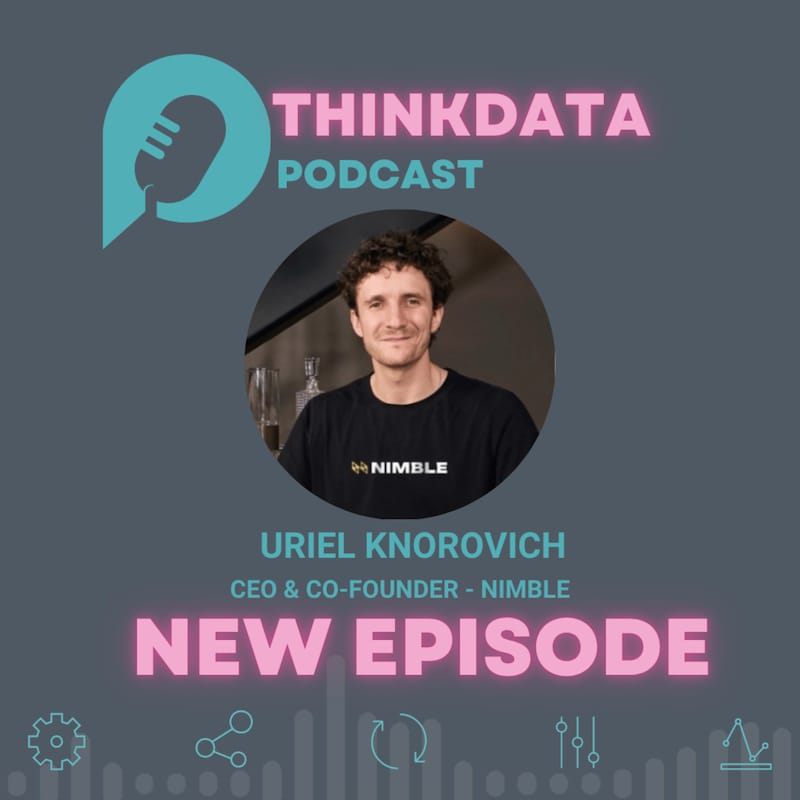
In this episode of the ThinkData Podcast, we’re joined by Uri Knorovich, CEO of Nimble, to unpack the growing trust gap in enterprise AI and why bad, delayed, and fragmented data is becoming the biggest blocker to real AI adoption.
We explore:
• Why AI works in demos but breaks inside enterprises
• The hidden risk of AI outputs without traceable data lineage
• Why trusted, live data infrastructure matters more than model speed
• The shift from “is the AI fast?” to “can we trust the decisions?”
• Real-world examples where AI and live data are already driving value
A great conversation on the future of enterprise AI, data infrastructure, and building systems companies can actually rely on.
Transcripts
Welcome to the Think Data podcast brought to you in partnership with DataWorks. If you want to stay up to date with the latest breakthroughs and trends in the world of data and artificial intelligence, and if you're curious about some of the strategies that companies and founders use to launch data and AI products, then you're in the right place. Our aim is to bring together a diverse lineup of fantastic guests from the founders, through to accomplished leaders and product owners at some of the most fascinating data and AI companies worldwide. They will each offer you their own unique insight into what it takes to launch and scale a great data business. Thanks for tuning in, and I hope you enjoy the episode. Welcome to the show, Yuri. It's really, really good to have you on today. For those that don't know, who are Nimble and kind of what led you to launch the company? Because you didn't have really a typical background, did you? And I was kind of tracking your kind of career path, but you've been a founder before, but Nimble was founded, what, just over kind of four and a half, five years ago. Yeah, so over to you. Who are Nimble? And first and foremost, who are you?
Yuri:Yeah, absolutely. Thank you for having me. The story of Nimble is starting with the story of every business who needs to get data. And data is essential for us for making decisions, but the data is extremely hard to get. And I'm talking specifically on data in the Internet. Back in the day, Google did a great job of building search for a consumer. So right now, as a consumer, we have no information problem. If I want to know what store are next to me or what is the price for a show, what is the latest regulation that I need to obey as a citizen? I can simply search in the engines that Google has built for me. It's organized internet for consumer. And Nimrod has started with understanding that businesses do have the problem that they don't have ability to search the web and get information that's relevant for consumer. And there is a difference between what businesses need to have whenever they're searching the web than consumer. As a consumer, I have very ad hoc specific questions. But as a business, I need to go in a very high scale, and I need to answer questions from the internet that's relevant for my domain of expertise. So either I'm working on a CLM for a sales department, and I want to enrich each lead that's coming in into my CLM, and get all the company attributes and the address, the latest funding of the company, what is the valuation, who are the senior leadership, some changes in the product and news. I need to build a specific workflow that's relevant for my business. Or if I'm working in a bank and every company says they want to get a loan, I need to launch a process of KYOB, of know your business. And then I need to run a specific workflow on the internet. Or I can go if I'm an insurance company and somebody spit out a claim. And I need to know the prices of specific amenities that's been went on fire. So what is the price locally for this consumer? Businesses need to have a different set of criteria for search. And the common ground of what businesses do need is high accuracy, high completeness, and having the domain expertise of what the business needs. So Nimble started about four and a half years ago with the notion that businesses cannot search the web the same ways that consumers can search. And then we have started to be a company that's helping the biggest enterprise from the biggest retail and CPGs and consulting firms. BI and data teams across TechBlob connect their data warehouse, connect their stack, connect their business to reliable source of data. But it's not stopping there. Because a few years ago, we all had the chat GPT moment. We understand that's great. We can do a lot of things with our data stack. And we can build an amazing dashboard in Power BI or Tableau or Looker or Sigma or what have you. And we can build a lot of stuff with web search connected to the data warehouse within the enterprise and then having informed decisions. But then AI came. And AI introduced us a new way of analyzing data and connect it to the business workflow. Consumer search is built differently from enterprise search. And search for human is also built differently from search for agents. Nimble today allows... everyone who's building agents, and you can deploy your agent in many different platforms and infrastructure, to have the foundation of... reliable web search that's going on the enterprise scale.
Alex Hutchings:Interesting. And I'm always keen to touch on that moment when obviously you've got an idea, but then you're trying to convert that into a business. How were those kind of early six, 12 months in terms of getting that idea? And obviously you're right, that kind of chat-to-BT moment was almost after Nimble had been incorporated. So kind of talk to me about that kind of early stage of kind of the idea of... data availability, tying that into kind of data quality, then actually getting that into a fully-fledged organization.
Yuri:So we're returning back about five years ago. We were sitting on a rooftop, and it was the founding team of Nimble. And it was after we exited our previous company, a company called Ceronics. We are building a browser infrastructure for cyber purposes. And we're thinking, okay, what next? And we had a lot of ideas, and we put all these ideas on a whiteboard. And eventually most of the ideas was let's take browsers and scan specific domain and then build a data application for businesses. So it can be one of the ideas was let's build a data product for SMBs that want to track all of the market around them. So it can be a restaurant. And if I'm a restaurant, I want to see all of the opening hours of different restaurants around me and the menus, items and see some seasonality. That's going to help me to run my restaurant better. Or if I have plumbing services, let's see what plumbing do we need to have for all the services around them. That was one idea. Well, the second idea, let's build a solution for hedge funds and alternative data. So we will scan companies and data around these companies in extremely large scale, like Spotify is an example. And let's track everything that Spotify is doing on the user level and the revenue level. and build the view for investors so they can predict the market. And we had a lot of ideas and all of these ideas was taking our expertise of using browsers and using browsers in a large scale and then getting the data that we are getting from the searches in the browser and build an application for businesses. And then we'd be zooming out and we said, okay, what is missing? The missing... part is in infrastructures. It's allowing us to run extremely large scale of browser, creating an index of data, and then eventually unlocking that solution for everyone. So the same way that Snowflake or Databricks did about 10 years ago, today, two people start up, or the biggest Fortune 50, do have the same capabilities around using data. We were in the place, in the first six months of the company, How can we build a plan that we can get an infrastructure that's two people business, that's running a local pizza place here in New York or anywhere in the globe, to have the exact same web search and intelligence as the biggest chains like Domino's Pizza. And today I'm very proud that four and a half or five years passed by, and we're working with the biggest pizza chains in America. And also we will sing some. Two people startups that are like doing some vibe coding and connecting their chat GPT and cloud into Nibel and to get the exact same information. And that's one of the most beautiful part because we can eventually democratize that capabilities.
Alex Hutchings:Yeah, that's really interesting. It's funny when you kind of take yourself back to those kind of post exit, you know, ideas, how these kind of things manifest themselves over time. And I think one thing I want to touch on is your... In this world at the moment, obviously, everyone's talking about kind of AI from an ROI standpoint. A lot of companies are really struggling to articulate that and justify the spend. And, you know, is it put more money in? Is it scaled back? But a lot of it ties into poor data quality. Why do you think that is? Why do you think organizations still have not got that piece kind of accurate and correct?
Yuri:Absolutely, because we don't have the intersection in place. And some things that we're seeing in the boardroom all the time. The problem is that we don't have the data. Since we don't have the data accurate and reliable because we don't have the data foundation. And the problem is that Nimble has been solved and people can sometimes come to us and say, yeah, well, what are you doing? You didn't web search. Everyone can search the web. I can search in Google. And then whenever people try to get, as an example, the native search solutions that's getting from LLM or any other consumer search that's been out there. They do get that whenever they want to put AI in production, they're facing these barriers. Because if you don't have the taxonomy in place, if you don't have the ontology in place, if you don't have the guardrails in place, if you cannot imply your business semantics into the search itself, if the search is not granular, if the search is not complete, So whenever you will ask what my competitors are doing in their menu items right now, you can get incorrect results. And something that we've seen over and over is that companies who do understand that data foundation is the key. And whenever they have the data in a reliable manner, they can build any type of data application on top. And many other applications and many projects that we're seeing across the enterprise, these projects are failing. because people are doing a shallow data work. If you're not building the data foundation, you don't have the deep and also the why, but the deep understanding of how the data itself is being connected together, you cannot deploy that. And we saw a lot of different examples that companies came to us and said, we want to create systems that will help us to get recommendation when to redeem a coupon for customers getting into the website. And we want to do that. based on the prices and the assortment of our competitors. And they are just trying to do that before, just like using generic search and let's search about like, okay, give me some high-level ideas and example. But if they are not building the data in the foundations that's needed, eventually, whenever they will start to scale it up, they will see that a lot of different attributes are missing and they cannot validate the result and trace back the results.
Alex Hutchings:Yeah. It's really interesting because obviously if the business logic is not applying to the wider search parameters, then it's not necessarily going to pull through relevant information. But say as a consumer, say like me, I'm typing into whether it's ChatGPT or any of the above, Gemini, and I'm getting the results from my search. Obviously, you touched on something earlier about Google or a search browser. previously in a web browser you'd be able to see where that data's come from because you see the url you see the domain but obviously with ai giving us answers at the moment it's harder for us to understand where the information's come from and if it's factual if it's relevant what steps are companies like yourself taking to ensure that the data is correct but equally how big a problem is the wider ai landscape of information that's incorrect Act.
Yuri:Absolutely. So think about it. We have correctness and we have completeness whenever we're talking about information. So if I'm asking, give me a list of all the radiologists that live in New York and providing services with specific health care insurance. There are many ways to find this list and getting that source of truth is not an easy problem. So you need to run a chain of algorithms that's trained to work together and scan massive. parts of the web, validate which sources is a credible source because if somebody wrote in a blog post hey, Alex is a working with Mount Sinai I'm not sure I need to trust it. I need to go to my Sinai index and see that Alex is registered over there. So we've got the problem of is this data source a data source we can trust? And after I'm trusting Mount Sinai, I do see sometimes some discrepancies. Is this Alex, is the same Alex that's written over there. Is this the same guy? Because I do see in his website, he's working with another insurance company. So you need to validate that. And then you need to do canonical matching. And after you're doing that, you need to have a very rich schema because the data in the internet is extremely messy. It's like URLs or HTMLs. And then you need to take all of that and put it in JSONs. And then you need to normalize all this data to be in a parquet file. But this is the snapshot of today. And then you need maybe to compare what's happened yesterday to today. What are the trends? So the work that's needed is not only take a bunch of web content, send it to LLM and get results back. What you need to do is to build the system and processes that are trained to be the infrastructure for agents in order to gather this data, build the massive index, process it. analyze it, and apply the specific business context for your question. Because if you want to build a solution for hospital that will reach out to the specific radiologist, you'll need like high completeness and high precision. But if you are a marketeer and you said, hey, I just need an index and I will put it to my AI, SDR, BDR salespeople, I'm okay to have false positives. Okay, maybe I didn't reach out to the right Alex. I don't want to spend more compute. on that processing. So whenever we apply that to businesses, we do understand that agents need to have different systems than humans, and agents need to have a different system than consumers whenever they're working with businesses and not working with consumers.
Alex Hutchings:Yeah, it's looking at both sides, isn't it? Because ultimately you've got two different use cases, two different ways of looking and receiving and processing data. Most important. I know you said something right at the beginning about the core infrastructure, AI, ROI, poor data quality. You said ultimately it's because companies don't have the core infrastructure, but there's still a lot of companies who kind of look at data. Not necessarily as the driver for their organization, but why, in your opinion, should data be absolutely core to this? Because obviously it's not something you can just bolt on afterwards. Whatever you do, it's not going to be that effective. Why should companies really look at data as the core part of the system now?
Yuri:Absolutely. Think about every agent that you want to deploy. You need to have a few components. I'll start with the first one, which is very simple. You need to have an LLM. Because agent is no LLM, there is nothing to do. The second, you need to have compute. These agents need to run somewhere. And then you need to have two more components, which must be whenever you design this agent. So the first one, you need to have internal search. This is the internal memory of these agents. This is the first part of the data layer. The second one, you need to have web search. This is the external part of the memory of these agents. So almost every agent that you've been deploying need to have internal search and external search. Both searches need to be trained to work together. And then you need to have the semantic taxonomy and ontology. If you're designing your agent and you're basically telling your agent all your business logic, you need every time that Slid's coming in to check in my CLM and then send an email and then go maybe do some internal search and then external search. Yeah, you'll see. I built a logic, right? I've been applying the four rules that we just said. I have an LLM, I have compute, I have internal search, I have external search. But if you're not baking the storage and the data, whenever you're building this LLM, your tools will go wide. And then no way that you can build the specific agents that you need. Returning back to the example that I gave before, data cannot be an afterthought. If I want to build... regulation that's checking every radiologist that's coming in. If he's working with my insurance, if he's not working with my insurance, I need to trigger a business process that somebody needs to call him. Or maybe we need to disqualify him. If the data is going to be an afterthought, so no way that I'm going to return back to my web search tool and apply the specific rules and guidelines to the system. The same goes for the internal storage. If I'm not building... my business process with the data in place, I will not spend the time to go and check the CRM, but not only in one place, in two places. If data is going to be an afterthought, I will make the decision without having the specific context, without the understanding of my internal data is being built, without having the understanding how the web is being built. And I'm going to get a very bad result.
Alex Hutchings:It may explain why so many companies are struggling to kind of measure their AI ROI, right? Because I think they're kind of these more established companies that, let's be honest, every company is trying to incorporate AI into their organizations or agentic or whatever form of AI it is. But because they're almost changing or trying to change how the business is run without ultimately looking at how the data environment is set up, then as you rightly say, AI is only going to... give you the answers that it can access. But if you've not set the company up correctly, then it's not going to give you the right answers. Yeah, that's a really, really interesting point. So do you therefore think when you're an early stage company, it's a bit easier now because you can fundamentally on your point now is you need to get that data layer right first before AI can give you the right answer. You think that's ultimately, it's a bit easier now to kind of start from nothing as opposed to change what you've already got?
Yuri:I think something that we're seeing a lot, and we're working with Fortune 500 and bigger enterprises all the time, I think the notion in 2025 was, yes, we need to rebuild all of our data infrastructure. We need to go for two years to get that transformation before we can apply AI. And something that we're seeing more and more, and this is our advice to all the companies that we're working and consulting with them, you need to say, hey, what I want to solve, And let's fix the data for that particular problem.
Alex Hutchings:Yeah.
Yuri:Turning back to the example of the web, if I want to build an index that's helping me to know what my competitors' moves are doing right now and what are their pricing. I don't need to solve all the problems of all the types of data in the internet. I need to go for a very well-defined set of competitors, see a well-defined number of SKUs, and make sure that this is going to come up with 100% accuracy and 100% completeness. So I'm coming up and I'm taking a huge problem, which is the internet, and right now I'm narrowing the scope for what I need to solve. The same goes for the internal data. I right now want to get all of my data from my composable CDP, from data platform, from all of the retention of users that's coming in. And I know I do have a long way to go for sorting all the type of inventory coming from different ERPs and coming from maybe a company that I bought a few years ago. And that's a process that will take me a few years to solve. But right now I want to deploy an agent that's helped me to optimize the return ratio. you It may be like removing some manual work that I need to do today in this process. So what are the four or the five data sources that's important that the agent or the dashboard need to call them every time? Let's focus on those. Let's solve those. And we are working with enterprise across healthcare and life science and CPGs and retail and banks. All of them do understand I'm deploying an agent and solving a problem right now. What is the problem that I'm solving? What is the internal search that I need for half of them? What is the external web search I need for half of them? They're coming to Nibel. Our team basically solve them all the part of, okay, what needs to happen in the web? And then we're working with them to figure out what needs to solve with the internal data. Those companies who get it right, getting the ROI from agents, because they're trying to deliver a new agent coming from... what used to be like maybe two years, and then started to shrink up to be six months. But today we see companies working with that specific framework, having an agent up and running between four to six weeks.
Alex Hutchings:Wow. And I suppose on that point, when you're making that shift to a reliance on AI agents and whether that's to complement current workers or to, you know, in some companies... replace current workers. At what point do organizations know that they can 100% trust the decisions that it's making? Is there that point where, or is that hard? Is that almost impossible? They just need to know that they've got all the guardrails in place, they've got the right data environment, and they need to trust it? Or is there a tipping point where they can?
Yuri:AI is a data product. It's not different than any other data products that we'll deal in the past. So what point can you trust the dashboard that you are building? Exactly. In the point that you see the data, you validate the data, and it's worked for you. In many cases, what we're seeing, and this is a big advice that we bring to our customers, let's connect these agents on the first place to be a BI dashboard. Let's not trigger the action that you need to run after. And let's return it back. I want to create a view of all of my competitors' moves. In the past, I need to go for companies and I need to buy this product. Or I want to automate a claim processing and what is going to be a regulation on a specific industry. Let's build a dashboard. Let's build a data view. Every time, humans need to go and validate it. Give it in the hands of the business. Let's tell them this is an experiment. We're going to fine-tune that with you based on your software market expertise. Because in many cases, we are working with the data department and we are working with the AI department and we're deploying agents across different business units. The data department needs to work very much closely with the business units whenever they're deploying these agents. And this perfection paralysis is many times just holding back that innovation. And then eventually the CEO or the boardroom coming in and say, hey, guys, you're not deploying agents enough. All we see is that the competitors are moving faster. Why are you... Why are you... everything in our organization is so slow. And then you don't want to be in a position that you need to explain to the management why you cannot have AI and innovation and all the problems that you don't have. You want to explain to the management, these are the things that I have done. Here are the examples how I'm working in collaboration with a business unit. And that framework of taking one specific problem, it can be competitive intelligence, it can be market positioning, it can be many other things. within specific business unit, working with them, deploying a dashboard, deploying a static data view. And then after two to three weeks of them getting the data and having feedback, the exact same workflows as we are deploying dashboards to write. It's the same thing.
Alex Hutchings:Yeah.
Yuri:Then we're getting this project to be successful.
Alex Hutchings:It's a really fair point. And it goes back to your comment earlier about kind of snowflake and Databricks in terms of that core, you know, having that core infrastructure, you know, that, you know, they've always got this open API connection as well. But bringing that data in and making sure that's set up correctly. And then it's about trusting what you've set up. It's trusting the process, right?
Yuri:Absolutely. Absolutely.
Alex Hutchings:And I know you obviously touched on some of your examples. like the health insurance. And if you look at some of the claims data, you know, use cases, but beyond kind of AI as this kind of broader hype train, which some people talk about, where do you see some of the biggest opportunities and some of the, maybe some real life examples of where this live data piece is generally delivering value?
Yuri:Absolutely. Think about our work as data practitioners. that we have a huge data table coming to us all the time. How many times we've been asking ourselves, can I reach this data table with data that I can simply search in the web? So I do have a list of companies, and I want to get an address and phone numbers. Then in many cases, we need to go and say, hey, let's see some data marketplaces. Let's see some data vendors that's been out there. And eventually, all these data marketplaces and data vendors are very hard to work with. are not an easy solution. They don't have an API that I can connect directly to my notebook. And then I need to buy a huge data set that's 80% of this data set is not relevant for my business just because I need to have an answer on a specific thing. And the reason that all of these companies exist, because in the past it was extremely hard to process web data and make this data available. True, there are some data vendors that's working on proprietary data. But most of the data sets we do need is available on the internet, is available on the public web. But just we need someone to come and stream a reliable source of parquet file or just give me an on-demand data for my agents so I can ground my intelligence. So what we are seeing over and over is that data petitioners coming in and they say that I have my notebooks that's already been working with all of my data sources. I just need to enrich one column. I need to validate one column. I need to take two columns together and create a third one, or maybe to create a new data set. For every SKU that I have, I want to get all of the prices in three different retailers. This is like one example. Or every keyword since I'm running a marketing campaign, I want to see the SEO results in ChatGPT, Gemini, and Google. So. These are just like a very simple and trivial examples of information that I need to have. And in the past, I need to go for different data vendors. Or I want to get a DMV listing of who has, as an example, accident in the past because I'm working in an insurance company. Or who has a criminal record because I'm working in a risk company. All of that data in the past, I need to go for multiple data brokers and data vendors. And eventually it's slowing down my work as a data petitioner. And the two facts that not a lot of people are talking about, in most cases, we're just skipping that. We said, okay, we have too much on our table. We have too many things that we need to jungle and too many values that we need to provide for the enterprise. Yes, we can provide a better forecasting model. Yes, our BI model can be better if we're going to have this data. But the ROI of spending time on that is not making any sense.
Alex Hutchings:Yeah. That makes sense. What's next for you guys? Obviously, you're growing exponentially. You're in this kind of really, well, the hottest space right now. It's almost like you knew ChatGPT was coming. It was the timing about five years ago was unreal. But where are you guys now? Because there's obviously competition coming into the market, but you guys are probably the leaders in it. So what can we expect to see coming out from you over the next six, 12 months?
Yuri:Today, we're starting seeing that data has been democratized across the enterprise. Starting seeing how Cloud Code or Codex or even the AI solution within Databricks or Snowflake or Microsoft started to be better and better, which is take a big bottleneck that we had in the past in the data department. And right now we can do more with the exact same outcome and we can serve more within the enterprises. We are working towards that area. That's you guys and anyone who's building a data solution and building an agent. providing data that's critical for business humans to make their decisions, to make it nimble, to make it effortless. And some things that in the past you need to go for, as I mentioned, like data vendors, or you need to work with the scraping companies or some other services companies, which does not make any sense. We're automating all this part to make it accessible for any business. And the ROI that we're seeing is huge. Because if you are a retailer, and right now you can get in real time all of your competitor pricing, it's a game changer. If you are a marketeer, and right now you can simply connect all the data that's coming from Facebook ads and Google ads and every place that you're spending money on. And you can see the creative of what your competitors are doing. And you can see the SEO and SEM rank. Or you can even track any social influencers trends that's happening right now because web search agent powered by an email. They can go and track everything that's happening in TikTok and Instagram and YouTube, any creator. And democratizing that information is eventually unlock a huge value across enterprise. So for your question, whenever... You as a data petitioner, or everyone who's building agents across the business, can simply ask any questions they want. And then a liberal web search agent will go to the web, will find the relevant information, will structure it, and will make it easier and consumable in a trusted manner. With a data foundation built in, not as an afterthought. Then we will know, okay, we have made our job. Because returning back to the moments that we had sitting on the rooftop about five years ago, and we were imagining awards that we can go for every S&P, from two people pizzeria to the largest CPG company, pizzerias in the globe. And they will have the exact same information about what's happening in the market. Or it can be a hedge fund that can track every information, but not only the hedge fund, but also me whenever I'm doing my investments. It's a very small scale compared to that. Whenever we both going to have the exact same capabilities, Nimrod said, okay, we are in. And today I'm very proud to working with the biggest enterprises to democratize that knowledge and also working with innovative, very small startups or building agents and deploying agents.
Alex Hutchings:Yeah. Well, look, it's no surprise you had the success you have because effectively you're democratizing access to data. It's what those companies or SMBs or... solopreneurs do with it that's down to them but you're giving them the tools you're giving them the access and then as you go back to your point earlier the data environment set up correctly small big or large then the world is their oyster really so no it's you know really good to have you on nimble and i know you know for me looking you're at your background you know to what you guys are doing that eureka moment five years ago to where you are is uh yeah it's been impressive to see so I'm looking forward to keeping an eye on you. watching this go live.
Yuri:Absolutely. And one of the most exciting for us by implementing AI is the ability to democratize the knowledge and data across the enterprise because it was extremely hard to be data-driven. And today, AI, as this new interface has been presented, is changing the ways that we as business consumers are consuming data and making decisions. And Nimble, as the trusted provider, of being the web search and the knowledge layer of the internet built for agentic decisions. It's something that's really exciting. And I'm super proud to see the very big enterprises making a lot of cost saving and generating a lot of new revenue of opportunities by having the combination of AI and web data. And in the next few years, we will see that going in extremely high scale for all the organization globally. And those who will not opt out will eventually be left behind. Because if your competitor do have a stronger data mode and stronger data layer, you will be left behind.
Alex Hutchings:100%. And on that note, thanks, Yuri. It's been great to have you on this morning.
Yuri:Thank you, Alex.
Alex Hutchings:Take care.
Yuri:It was such a good pleasure. Bye-bye.
Alex Hutchings:Pleasure. Bye-bye.



