Shownotes
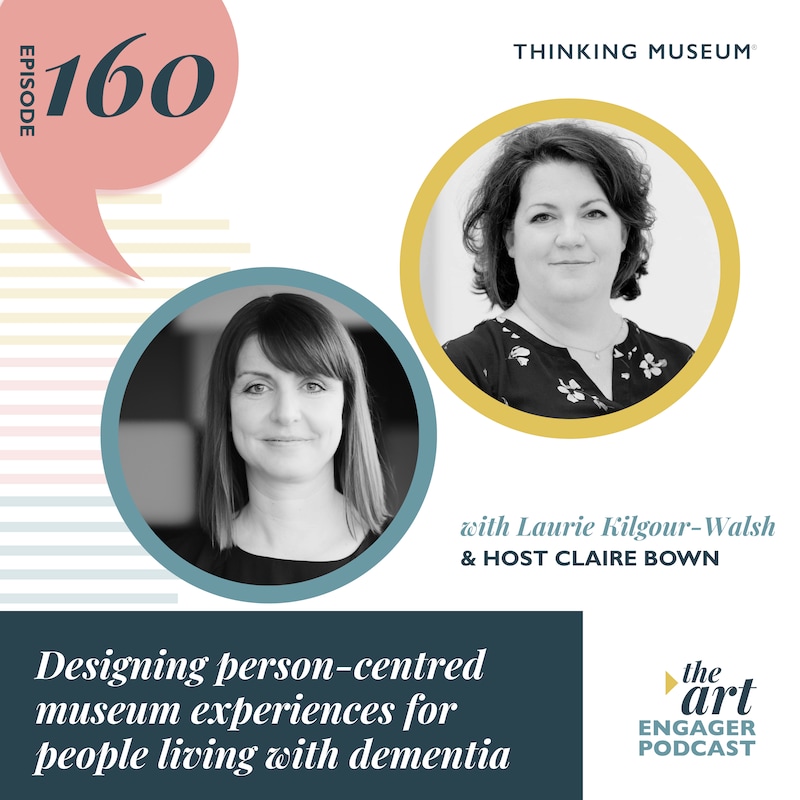
In this episode, Claire Bown is joined by Laurie Kilgour Walsh, Head of Programs and Learning at the Art Gallery of Hamilton, to explore what it takes to create meaningful, person-centred museum experiences with and for people living with dementia.
Our conversation centres on Artful Moments, a gallery-based, small-group programme for people living with dementia and their care partners. Based at the Art Gallery of Hamilton, the programme supports shared experiences, connection, and wellbeing through guided engagement with artworks.
In this episode, we talk about:
- What Artful Moments is and how the programme was developed in collaboration with healthcare partners
- How assumptions shifted as the work developed, and what has helped sustain the work over time.
- What person-centred practice looks like in programme design and in the moment as a facilitator
- Planning with care while staying responsive to participants during each session
- Why success in this work is understood through connection and wellbeing rather than traditional learning outcomes
- What an Artful Moments session looks like in practice, from first communication and arrival to gallery conversations, making activities, and leaving the museum
- Why attention to the whole visit experience really matters
A great listen if you are developing or evolving programmes for people living with dementia, or are interested in how dementia-inclusive practice can inform everyday museum engagement and deepen your approach to inclusion, pacing, and person-centred facilitation.
Laurie is also the co-author of Artful Moments: Building Meaningful Museum Experiences for People Living with Dementia, which is discussed throughout the episode.
The Art Engager is written and presented by Claire Bown. Editing is by Matt Jacobs and Claire Bown. Music by Richard Bown. Support on Patreon
Episode Links
Art Gallery of Hamilton website: www.artgalleryofhamilton.com
Artful Moments eLearning site: www.artfulmoments.ca
A link to the book - Artful Moments: Building Meaningful Museum Experiences for People Living with Dementia : https://www.bloomsbury.com/ca/artful-moments-9781538195420/
Laurie's two favourite videos from the website:
Janis’s Story https://vimeo.com/801998446/77939bc3d0
Rosemary's story: https://vimeo.com/809930852/fb94d13a5d
Also:
An article about virtual programs (2022) https://www.artgalleryofhamilton.com/artful-moments-fostering/
A lovely review of the website by Dementia Trust (2024): https://dementiatrust.org/news-and-views/25/2/2025/review-artful-moments
Artful Moments also included in Chapter 4 of this book (2024): https://www.intellectbooks.com/art-education-in-canadian-museums
An article on our early work: Artful Moments: A framework for successful engagement in an arts-based programme for persons in the middle to late stages of dementia (2019) by Janis Humphrey, Maureen Montemuro, Esther Coker, Laurie Kilgour-Walsh, Katherine Moros, Carmen Murray, Shannon Stanners DOI: 10.1177/1471301217744025
Show Links
✨ If you've enjoyed this episode, please consider supporting The Art Engager on Patreon: https://www.patreon.com/c/TheArtEngager
Or pick up a copy of my book, The Art Engager, for step-by-step guidance on creating meaningful, interactive guided experiences https://www.theartengager.com/
Buy it here on Amazon.com: https://tinyurl.com/buytheartengager
Transcripts
Hello and welcome to The Art Engager podcast with me, Claire
Speaker:Bown.
Speaker:I'm here to share techniques and tools to help you engage with your audience
Speaker:and bring art objects and ideas to life.
Speaker:So let's dive into this week's show.
Speaker:Hello, happy New year and welcome back to The Art Engager podcast.
Speaker:I'm Claire Bown, and today I'm chatting with Laurie Kilgour Walsh about creating
Speaker:person-centered museum experiences with and for people living with dementia.
Speaker:This is the first episode of the year and I'm so pleased to be starting
Speaker:the year with this conversation.
Speaker:Laurie is head of Programs and Learning at the Art Gallery of
Speaker:Hamilton in Ontario, Canada.
Speaker:She's also a co-author of Artful Moments Building Meaningful Museum Experiences
Speaker:for People Living With Dementia.
Speaker:So in today's episode, our conversation focuses on Artful Moments, a long
Speaker:running program at the Art Gallery of Hamilton for people living with
Speaker:dementia and their care partners.
Speaker:Laurie shares how the program began through collaboration with
Speaker:healthcare partners, the assumptions that have shifted along the way
Speaker:as the work developed, and the conditions and partnerships that
Speaker:have supported the program over time.
Speaker:We talk about the values and philosophy behind Artful Moments, including
Speaker:person-centered and strengths-based practice and how these values
Speaker:shape the design of sessions.
Speaker:Laurie also walks us through how an Artful Moments session is structured
Speaker:from a arrival and welcome through to activities and departure and why attention
Speaker:to the whole museum experience matters.
Speaker:Across the conversation, we explore facilitation in practice, working with
Speaker:care partners on how participation, engagement, and success are understood
Speaker:in this work where connection and in the moment experience matters more
Speaker:than traditional learning outcomes.
Speaker:Although this episode focuses on work with people living with dementia,
Speaker:many of the ideas we discuss have wider relevance for museum educators,
Speaker:guides, and facilitators, working with different audiences and settings.
Speaker:I hope you enjoy our conversation.
Speaker:Hi Laurie, and welcome to The Art Engager Podcast.
:Hi.
:It's nice to be here.
Speaker:Our first question as always is who are you and what do you do?
:Okay.
:My name is Laurie Kilgore Walsh, and I am the head of Programs
:and Learning at the Art Gallery of Hamilton in Ontario, Canada.
Speaker:So can you tell us a little bit about the museum, and about your work at
Speaker:the Art Gallery of Hamilton and what your role looks like on a day-to-day basis?
:Yes.
:So the Art Gallery of Hamilton is the third largest gallery in Ontario, but it
:is also one that people know a little less about than some of our larger cousins.
:The gallery has a permanent collection of just under 12,000 works of art,
:and we focus our collecting on historical and contemporary Canadian.
:Indigenous and international art.
:My role specifically as the head of the programs and learning
:department is something that has evolved over the last decade.
:We are now a team of eight who oversee all of the education and public programs
:at the gallery that when I started quite a long time ago, all of that
:activity was all situated with one role.
:And so it's been really exciting over time to see how that has developed from
:education being more of a support function as part of a curatorial team, to being
:pulled out as a standalone department.
:And it's really been something that's led us to be able to do a lot of
:really interesting work including talking about the wellness programs
:and Artful Moments, which is what we're gonna talk about today.
Speaker:Yeah.
Speaker:So when did working with people living with dementia become part
Speaker:of your practice and part of your department's work at the art gallery?
:Well, like so many exciting, good projects that we come
:across, it's one of those things that came from an unexpected connection.
:This would've been back around 2009 or 2010.
:One of Hamilton's regional hospitals had just completed some construction
:on a new behavioral health unit.
:And they needed some art as the finishing touch.
:And we were really excited to find a donor who supported both the
:hospital and the gallery, had made a contribution for the purchase of
:original art by regional artists.
:And that went through our gallery's art rental and sales program.
:So the twist and what makes this a really important moment is rather than
:the more usual approach where a designer will come in and select posters or the
:kind of art that matches the couch.
:The manager of the behavioral health unit Janice Humphrey really had a
:vision for how the unit should work and for dementia care generally.
:And so her idea was that she wanted the patients themselves
:to make the selections.
:So the Behavioral Health Unit was a place where the patients
:were long-term residents.
:They were folks living with advanced dementia who had moved on.
:This was their next step following long-term care.
:So she put together a focus group and the gallery booked several sessions
:to bring in a wide selection of art.
:And as the educator, I tagged along to be involved as well.
:And so we went and we would bring a few works at a time into the space
:and spoke to some patients there.
:At the time I didn't really know much about dementia at all, and so
:I was working through that typical school tour, asking questions,
:looking for interest kind of thing.
:And it was a really.
:Interesting experience.
:There was one man who I remember who hated every single thing that we
:brought, but he did so eloquently.
:He had this really long reason about what he hated about it, which was quite
:charming, until a moment where something just caught his interest and he loved it.
:And so that of course, was one that was purchased.
:There was another woman who nodded and smiled and had not
:too much interaction with us.
:And then there was a third who seemed to have fallen asleep.
:So we kept an eye on her, but we're a little reluctant to engage her too
:much until in one session a painting was put in front of her and she raised
:her head and then told this very detailed story about birds that she
:had experience with earlier in life.
:So that again, was one of those moments and I thought, this is really great.
:She loves the painting, but speaking to the staff later, apparently that
:was the most, this woman had spoken in months and so there was really
:the spark that got us all started.
:It took a little while after that, about two years to gather research,
:find funding, which is always an important part, and to build a plan.
:But then we had a pilot program at the hospital where we brought a team
:of gallery educators, myself and a couple of folks, into the hospital to
:work with a small group of patients.
:Twice a month we went there and then once a month we brought the group
:of patients to the gallery itself.
:This was quite a breakthrough as well because when I proposed
:it initially to the hospital, they told me it was impossible.
:With the patients that we worked with, five participants, led to
:basically 20 people in the room.
:Where we had participants, we had their family caregivers, which were a
:really important part of the program.
:And then the hospital staff that was there to support it.
:So this would've been back around 20 11, 20 12.
:And so programs for people living with dementia and museums were
:really just getting started.
:I think MoMA was one of the first in 2006.
:So there was a lot of really meaningful opportunities that
:we hadn't really tapped into.
:So we found through that pilot that we made a really big difference
:in the lives of the patients.
:We really focused on things like quality of life and engagement in the moment.
:With advanced dementia some of those usual check boxes for how we judge successful
:programs weren't really relevant.
:And then we've continued from there ever since.
:We did another project at the hospital the following year, funded
:by two of the family partners who had participated with us.
:And after that we moved into the gallery and we've been situated mostly with
:gallery based programs ever since, though even those initiatives tend to expand
:rather rapidly over the last few years.
Speaker:It's wonderful hearing about how it all started and really
Speaker:thinking about where you are now.
Speaker:Um, I've been very excited about having this conversation with you after I read
Speaker:your book, Artful Moments, building meaningful museum experiences for people
Speaker:living with dementia, which really lays out everything you could possibly want
Speaker:to know about the program and how you might set about instigating a similar
Speaker:type of program in your own organization.
Speaker:I also think, as an aside, that the book is so useful and widely applicable
Speaker:outside of those programs as well, so.
Speaker:I wanted to say that straight away.
Speaker:But let's go back to the beginning.
Speaker:I wonder if there were any assumptions you made at the beginning that
Speaker:has changed since the work has gone underway or time has gone by?
:Well I think for us at the beginning it was
:really all about learning.
:I think for our side one of the biggest things to really figure out was that we
:couldn't facilitate a program just like all the sorts of programs we were used to.
:So as someone who was running school programs and tours for adults, I
:had a lot of that practice with me.
:But understanding who we were working with and what would be most effective for them.
:A lot of those assumptions about really things like the purpose of a
:tour were things we had to rethink.
:So I think we think a lot about education programs through that education lens, and
:that's one of the things that's really gone on to change where we know that
:some of that content is important because even if that learning in the traditional
:sense doesn't stick with someone.
:I think the act of feeling like you're learning feels really good.
:So there's a little bit of it, but in thinking about why we were coming in.
:We weren't really doing our participants any benefit by thinking we're
:gonna teach them how to make art in specific ways, or we're going to
:teach them about art history or where this museum object has come from.
:Those kind of things really had to change and we had to start thinking
:about things like quality of life and engagement and how do we use
:our collections to accomplish that.
:And I think that idea about making assumptions about what participants
:can and can't do is something we really had to think very hard about.
:One of the issues that comes with people living with dementia at all stages is
:that there's a lot of built-in stigma and bias that people make those assumptions
:about what's no longer possible or what may or may not be relevant.
:And even about what the impacts of dementia can be.
:I think we all think first about memory being something that is impacted
:and certainly for some people it is.
:But I think it's all about really seeing the person in front of you
:rather than your lesson plan and your goals and your museum stories.
Speaker:I would love to pick up on talking about being a
Speaker:person centered program later on.
Speaker:Um, but before we do that, I want to talk a little bit about what
Speaker:conditions or partnerships that you have, because I know, you
Speaker:wrote this book, with co-authors.
Speaker:There are lots of partnerships that you've had over time.
Speaker:So what are the kind of partnerships or conditions that
Speaker:have really made this program?
Speaker:Possible and to develop in the way that it has had over time.
:That is a great kind of way of thinking about even
:how we work is through that lens.
:And so we talked about the pilot program, that it was a chance
:encounter with healthcare workers.
:And so I think in some ways in those early days, those encounters, those requests
:have really guided some of the direction.
:And so we've been really responsive to our community.
:One of the things I can't really stress enough at how impactful it
:has been for me is thinking about the people that I've worked with.
:So the co-authors of the book, Janice, Maureen, Kathy and Shannon were all
:there at the beginning of Artful Moments from the hospital and we've
:been so fortunate that as they have retired or taken on other opportunities,
:they have really strengthened their relationship with the gallery.
:And so they are co-authors, they are researchers.
:A couple of them are my volunteers who assist with the program on a weekly basis.
:And so we've been able to really carry that extensive knowledge of
:dementia to really inform the program.
:So we started there and we built it on this idea of a really strong knowledge
:of dementia, but also of the person, so that we have the proper techniques to
:be able to really support the strengths.
:And we try and evolve our partnerships as we come out of that same approach.
:We're still working in a way where the opportunities that are presented by our
:community guide a lot of our development.
:But at the same time, we've found the methodology the way that we work, the way
:that we think about our space about our collections and activities is something
:that is very easily transferrable from the audience of people living with
:dementia to a number of other things.
:That's not to say necessarily that the way we talk to someone with
:dementia is the way we talk to someone with some other social circumstance.
:But I think it's that disposition of knowing that we have
:to make those adjustments.
:That's really led us to be able to apply what we've learned
:here to a lot of other things.
:We've done work in more recent years with young caregivers.
:We've worked with people with various mental health conditions, either through
:hospital partnerships or community groups.
:Um, I have a colleague who's working with head injury rehabilitation.
:We've started a really wonderful partnership most recently with the
:Cancer Assistance program, where we brought people who have a cancer
:diagnosis and are for the most part, are going through treatment into the
:gallery again for this experience.
:And we set the program up not as a therapy group, it's not a support group.
:We don't get together to talk about dementia or cancer or any of those things.
:But what we do is bring back all of those other, the personhood,
:of our participants so they can be themselves, they can share experiences.
:We had a participant in our.
:In our recent program who said, this is the first time in months that I
:haven't thought about cancer at all.
:And so it's those kind of impacts and I think for people like our early
:participants where that relationship with their loved one, has shifted to
:something that's so much based in caring.
:One person is caring for the other, that it changes the dynamic of a
:relationship where with these kind of experiences, it's two people side
:by side who are sharing something.
:And that idea of care, we can sometimes talk in terms of burden
:of caregiving, is removed for a time and it's just this shared experience.
:And so we're looking at, all the ways and all the different groups of people
:that we can make a difference with.
Speaker:Yeah.
Speaker:And that would lead us, I think, quite nicely into thinking about the values
Speaker:and the philosophy behind Artful Moments.
Speaker:Perhaps you could talk a little bit about what you believe matters when we're
Speaker:creating meaningful museum experiences for people living with dementia.
:The Artful Moments philosophy is really based in the
:way that we think about and the way that we connect with our people.
:So the goal overall is to provide meaningful conversation and hands-on
:experiences connected to both the collections and the exhibitions
:that are on at the gallery.
:But even more so, it's about encouraging participants to be
:creative and have opportunities to express themselves and others through
:sharing an experience together.
:I think the core of what we really focus on is the idea of focusing on strength
:and abilities of the participants, regardless of where those abilities
:are, what their state of health, their social circumstances, and so in line
:with the social model of disability.
:We don't focus on what has changed.
:We focus on building up what remains.
:So thinking about communication.
:If someone can't communicate verbally in the same way, we look for other
:ways to make sure that they still have opportunities to connect the
:ideas that they're thinking about.
:When we talk about activities being meaningful, this really
:leads us to that idea of being creative, of being self-expressive.
:So activities are not prescriptive.
:We never know what an activity is gonna turn into.
:It's about the process of the enjoyment of making something or talking about
:something and not those traditional measures, like making a really
:lovely painting or demonstrating that you've learned something.
:And so it's really that idea of being centered on the participants themselves.
Speaker:Absolutely.
Speaker:And the framework that you've developed, the model for successful engagement and
Speaker:the three pillars, I was really struck by those as I was reading the book.
Speaker:Could you just in broad brush strokes, explain a little bit
Speaker:about the model that you use?
:Yeah, and so this was really about, formalizing the way that we were
:already talking and thinking and working.
:And the biggest shift is putting the person at the center.
:The model itself takes in all of those different aspects of the way that we
:deliver a program and encourage us to think not just about the content, but
:about everything else that's involved.
:So we know as museums that we are coming out of a place that holds a huge
:array of collections, of objects, of expertise of people, and that really
:becomes the foundation of the program.
:As museums, we need to focus on who we are.
:What and what we do to really make any program that we do make sense.
:From there, the focus shifts though away from the museum and towards the person.
:So we talk about the person being in the center and it's about
:the person, not the condition is something that's important as well.
:So the center of our model is not dementia, it is a person, but by
:knowing the whole person, we do include in that knowledge of dementia.
:So we understand some of the things that will impact the way that they
:experience the rest of the program.
:Once we have that strong knowledge, then we go through three pillars
:of how we plan activities.
:Knowing the nature of museums, we have put the environment, the museum site,
:the social connections as the next step.
:We know that for.
:A lot of museums, particularly more historical settings.
:Museums are traditionally very inaccessible settings in some cases.
:We have a museum in Hamilton that is very difficult to access simply
:because it has stair access.
:It doesn't have an elevator, it doesn't have a ramp.
:And so getting into our buildings, moving around our buildings is something that
:impacts everything else that we do.
:So we start by looking at.
:What are the barriers and challenges in our environment?
:What are the things that we can change?
:What are the things we have to work around?
:The next step is to think about how we communicate.
:So this is where we really dig into that knowledge of dementia and think about
:where abilities might have changed.
:Cognition is something that we think about and there's a lengthy list of
:areas where there might be impact.
:But we think about things like memory.
:We think about things like processing speed and one of the things I had
:to overcome really quickly is that kind of chatty educator need to
:fill all the space with words.
:So we had to learn to slow down.
:We had to learn to leave space to allow people to have the time to process
:what we've said and then to formulate what they would like to say back.
:And so it's that kind of knowledge in our communication style that
:really changes how we deliver a program to make it really effective.
:And once we've understood our environment and our approach, the final step
:is then to look at our activities.
:And I think with a program like this, we don't have to invent activities or
:tours or things like that from scratch.
:We're all already doing really good work.
:Sometimes it's about just shifting how we do it.
:So we make adaptations.
:We make slight changes to how we work.
:And so if we've accomplished applying our knowledge of the participant of
:dementia through all those three tiers, we usually do find ourselves ending up with
:a really strong and meaningful program.
:The last aspect of the model is when we think about outcomes.
:When we started off, we were thinking very specifically about engagement
:in the moment, about being able to capture attention and provide those
:small moments of quality of life, knowing that for some participants
:those may be not things that they're gonna hold onto over a length of time.
:But if we can bring those positive experiences in the
:moment, we can make a difference.
:But what we realized over time is it's not just in the moment that we were seeing
:a change, an improvement in people's wellbeing in the moment and over time.
:And so the top of the model has now become that outcome of improved wellbeing.
:And so the goal is where a person will start with a low
:amount of engagement coming in.
:If we go through these steps, the engagement will increase and help us
:get to that improved wellbeing piece.
Speaker:It's a wonderful model and I think has a wide application
Speaker:for developing lots of types of programs, not just this type of
Speaker:specialist programming as well.
Speaker:Could you talk us through how a session is structured?
Speaker:What needs to be in place before a session runs well and how it works
Speaker:from say, maybe start to finish.
:Yes.
:We do a lot of prep work and a lot of planning and set up in advance in
:order to have as little of that kind of activity happen from the beginning.
:So we think about a session in terms of the very, very start of the
:experience being our communication.
:In some cases we're communicating directly with a participant.
:In some cases we're working with a friend or a family member
:who's going to attend with them.
:And so we think about sending whatever information will be necessary
:to help them get to us easily.
:Coming into a museum the first time is often one of the most daunting
:experiences, and in some cases, thinking through the environment can also be one
:of the most complicated finding doors coming upstairs, finding elevators.
:So we send out communication and we make it short and concise so that it is
:accessible to a person with dementia.
:And then we think about all those steps from then on, we have a team of
:volunteers and staff who are there at our front door to help greet people
:and get them where they're going.
:We have a gathering spot where everyone gets together and has that moment just
:to socialize and relax, take a breath from what is potentially a little bit of
:stressful transportation and arrival time.
:In that moment we think about supporting some of those
:changes that might be happening.
:So, I have a process of introducing myself and talking about what the
:day will be just as a standard thing that I do every single time.
:And so this is not making an assumption that people won't remember who I
:am or what we're going to do, but just allowing for that familiarity.
:Because it's just part of the routine.
:It doesn't stand out as one of those kind of, oh, she's reminding
:me because I need to be reminded.
:We use name tags.
:I wear a name tag in everybody in my participants wears a name tag as well.
:And I often say to them that these are as much for me as for anybody
:else because I am the 'remember faces and not names' kind of person.
:And so I think having those to be able to build social connection
:really quickly, everyone can call on everyone else by name.
:So once we've gathered and everybody's comfortable, we head into our exhibition
:space to start our conversation.
:Our prep work would've been to go into the space where we're gonna spend the day.
:We have already set up chairs.
:If we're gonna move around a little bit, I might set up a set of chairs on one
:side of the room and a set of chairs on the other side of the room so that
:we don't have that shuffle of moving things around while we're talking.
:Rather than the whirlwind tour that we often will do with our squiggly
:school tours where we start on the first floor, we go through the entire
:gallery in the course of an hour.
:In this case we pick one room and usually four or five artworks,
:and that is the content of our conversation for the whole day.
:Our programs run on an eight week basis, and so we know that over that
:two months we're gonna have a chance to see most things in the gallery.
:So we don't have that pressure to see the highlights or to
:move through the whole space.
:It's a very.
:Specific small group.
:They're related by some kind of a theme, whether it is related to the
:exhibition content, or it could be about style of art or any number of things.
:And we sit, we spend an hour there having a good chat about the work on display.
:From there, we move to our activity space.
:One of the things that has become really important before we do that
:step though for our participants, is to have a few moments to talk about
:which one, everybody likes the most.
:I made a joke in one of our virtual sessions during COVID to say,
:Hey, if everyone, if anyone could bring them home, which one do you
:see hanging in your living room?
:Um, and so we use that setting in some cases of which one would
:you like to take home with you?
:And it's really interesting to see some sessions, everybody picks
:the same piece and some sessions everybody has a different choice.
:And so even that builds that, that social connection where people are sharing and
:learning a little bit about the others.
:I did find in one session I had to be rather careful because my slightly
:humorous comment about what you wanna take home was misunderstood by one
:of our participants who thought I was trying to sell her something.
:And so she was a little bit, she was a little bit nervous at that point, so
:I had to make sure to really clarify.
:And it was a lesson for me about, again, making those assumptions of what's going
:to be clear as making a joke and something to be light and humorous and what might
:just have a chance to be misunderstood.
:We take a break with tea and cookies in our studio space.
:And that is really important for people as it signals the change in
:tone from something which can still feel quite formal when we sit in a
:gallery space to something that's meant to be really casual and interactive.
:Um, we have tea and cookies and then we move on to our hands-on activity,
:which is led by one of our artist educators and is usually some kind of a
:response to what they've seen that day.
:Then at the end, we have everybody share the work that they've done if they wish.
:We have a little celebratory moment of the great work that everyone's accomplished.
:We help everybody pack their things up and make sure that they get they
:get where they need to go next.
:So if they've come together, we walk them to the door, we assist them
:getting to the parking lot as needed.
:For people who might be coming with public transportation or having a ride,
:pick them up we make sure that they get to the place that they need to, and then
:each week we send a communication just to remind everybody of what time the
:program is and where they should meet.
Speaker:You have such a wealth of experience that , hearing you
Speaker:talk about it, it seems absolutely seamless, and it seems like you've
Speaker:thought of absolutely everything.
Speaker:There's no decision that's been made that hasn't been thought through
Speaker:very carefully in that process.
Speaker:I'd love to talk about facilitation.
Speaker:First let's talk about that phrase, person-centered.
Speaker:That pops up throughout the book as well.
Speaker:Mm-hmm.
Speaker:So what does a person-centered approach look like when you are facilitating,
Speaker:when you are in the gallery?
:This is something we've talked a lot about our team and it's
:a term, I think it's fairly widespread now, but it's something initially we
:borrowed from that healthcare side where we think about where our focus is.
:One of the things that I work with my team now is understanding the difference
:between interactive and person centered.
:And I think it's an important distinction.
:As museum educators, most of us are really good at delivering
:interactive experiences.
:It's become very comfortable where we know that to capture people's
:engagement, we need to get them involved.
:We wanna leave space.
:But for a truly person-centered experience, I think we need to go further.
:We often will use a variety of questioning strategies.
:We may play games, we may find all sorts of ways for people to have input.
:But my question to my team is always, is that enough and is
:that really person centered?
:So we know that these interactive activities get people involved.
:They get them thinking, talking, sharing but it's not necessarily
:centered on the person.
:And so some of the questions I asked to prove this is thinking about the
:purpose or the priority of the program.
:Whose goals are being met in that and who makes the decisions and choices?
:Who decides what to look at, who decides what we talk about?
:And also what knowledge and skills are supporting.
:So I know that as facilitators generally in museum spaces especially, we have to
:make a lot of decisions ahead of time.
:We have to have a clear sense of what we want people to accomplish.
:So with an educational lens, we think about what we want them to learn or to
:take away at the end, and we structure our questions, our directions in order
:to scaffold people through those steps to get them to learn we want them to
:learn from a learning perspective.
:This makes for a really strong plan and a really good tour in a lot of cases.
:But we find for an audience like this, partially for someone who has
:experiences, experienced changes in their abilities, and partially simply
:because this is a program with social goals rather than learning goals, it
:doesn't necessarily leave the space.
:So I find if a tour or a program is centered on my goals, my content
:choices, my preferred communication style, then that tour is really about
:me, and not about my participants.
:And so we talk about this idea of decentering the facilitator and also
:decentering the content a little bit.
:In a person-centered program I look at the participants so that I can understand
:what they want, what they need, and then figure out how to help them achieve it.
:Activities that adapt to suit the abilities of the people
:that are in front of me.
:We start with really broad questions and see where conversations go.
:So we lean a lot into things like the visual thinking strategies.
:But again, with different goals.
:So those questions like, 'tell me what you see', I use as a way to open up
:a conversation to see what people are interested in, but I also use it in
:a way of kind of assessing who's in front of me and where they are in their
:day, in their head, in their thoughts.
:When you ask a question like what you can see, you can get a whole range of answers.
:It could be 'I see a man and a woman and a dog standing on a bridge',
:which is very literal and tells me they're looking and seeing.
:I may have a participant that says, 'I see a man and a woman talking together,
:but I don't think she likes him very much', which tells me something else.
:Or in some cases, they'll see, 'you know, I'm really hungry today.
:I had a hard time getting here', which tells me something else.
:And these kind of questions really then help me understand what do I do next.
:We apply a lot of our same techniques in storytelling.
:We think about timing, but we are always looking at our participants to see
:what is working, what is connecting.
:And wherever their questions take us, that's where we go.
:So it's about being flexible and responsive.
:Sometimes the conversations are exactly about the artwork.
:Sometimes they are not at all.
:But if we're having a good conversation that's achieving those higher goals
:of the program and we go with it.
:And so I think one of the, one of the key pieces is it sounds a lot like
:I'm saying, don't bother making a plan, which is actually not it at all.
:We definitely do make really detailed plans about what we could talk about.
:We source information about the artwork.
:We develop a few key questions to help us guide a conversation, but
:at the same time, we have to have all of that knowledge in our back
:pockets to pull out or not, depending on where the conversation goes.
:So sometimes I follow my plan, but I also really stress that in a
:program like this, it's important to be willing to toss the plan out the
:window and just go with it on the fly.
:And so there's also a lot of that kind of working on your feet to think
:about what you can do differently.
:And you know, if I'm sitting in a gallery space as well, I've planned
:to talk about these four things, but everyone in the group is looking
:to the other side of the room.
:If that's where their interest is, that's where I'm gonna go next.
:And so it's about really thinking about what, what is resonating with the people.
:And I think the other side of that, of course, too, is thinking about how
:we set up a space, how we communicate, and all of those other pieces.
Speaker:When we bring in family members and loved ones, companions who
Speaker:are joining participants in a program like this, how can we ensure that both
Speaker:the participant and the family member or friend can engage meaningfully?
Speaker:I'm sure that must be quite a balance.
:Yes it is and it is a balance that can go in lots of different ways.
:In some cases it's one of the hardest parts.
:But at the same time, it's such a lovely experience.
:So if we go all the way back to that original pilot in thinking through
:wanting to be able to deliver really good activities, but faced with
:an audience who might not have had all of the skills that we needed.
:So things like I needed hands to use the scissors or people to
:put the glue on the backs of the paper that we were working with.
:I encouraged the hospital to invite a family member to join each of our
:participants in that first program.
:And for me at that time, it was very much I needed that set of hands.
:Um, and so we did do that.
:We also thought it would be a nice opportunity for in this case we
:had five wives who joined us, so the spouses of the people, it gave
:them a nice experience as well.
:But right from the beginning we saw that and so much more.
:And it was amazing to see that moment of connection of the relationship.
:We had a participant who, really didn't engage very much, but had these
:lengthy conversations with his wife about the garden they had when they
:were younger or their life on the farm.
:They were native French speakers, so they would switch back and forth
:from English to French as they were conversing and they laughed.
:And so the program, I almost ended up being in the background at a
:certain point, which was perfect.
:This kind of approach, it's exactly what we want.
:I was there planting in little comments and help and they just, they chatted, they
:made art together and it was so meaningful that it became one of the things that's
:really important for our program.
:We always encourage people to bring a family member, a friend,
:a loved one to come with them.
:We don't require it, because we know we have many people in our
:community who are independent and just wanna come on their own and
:may build those social connections.
:So the program works either way.
:So we tend to think very much as everybody as participants in a way.
:But that said, we do also know that the person with dementia is our focal point.
:I've heard of some programs who arrange their participant groups in different
:ways from putting the participants in the front and the caregivers in the back.
:We let everyone arrange themselves the way they are, and so they sit in pairs
:and I will in my own facilitation, I'll prioritize asking the participant
:a question first and then asking their family member what they think.
:Sometimes I'll ask both of them a question together, and sometimes I ask
:one if they agree with the other, or we find those ways to not only have each
:person interact with me, but to encourage them to interact with each other.
:And then in the studio as well in some cases both people will work
:side by side on their own artworks.
:In cases where people have experienced more changes of abilities, the
:care partner becomes the hands.
:So they'll do the cutting, they'll do the gluing, or they'll build an
:artwork together collaboratively in some cases with those.
:Those early participants we put the participant almost in the
:role of the director in a way.
:So in a collage activity, for instance our participant was pointing out the
:pieces he wanted included in his collage.
:He was pointing to where he wanted them in his work, and then his wife
:was doing the cutting and the gluing and the arranging, and so that,
:back and forth became really lovely.
:At the same time, we do watch very carefully for the care partners
:who wanna step in and they're so excited to be part of a program
:and they have all of the ideas.
:And so it's a little bit about tempering how much space we leave for them but
:where we can find that balance, we do.
Speaker:Um, I'd love to move on and talk a little bit about evaluation.
Speaker:I'm very interested in how you think about success in an Artful Moments session.
Speaker:What does that look like for you?
:Evaluation is something that we think about quite a bit with
:what was a small team it's always one of those challenging pieces where
:our focus is so much on the program.
:The evaluation sometimes does sit a little bit to the side.
:So for success for us is really about that idea of engagement and connection.
:So the way that we measure success is really our observations during a program.
:We look for connection between our participants and the facilitator.
:We look for it between each other if they are answering questions, if they're
:making eye contact, if we see smiles.
:All of those subtle signs of being interested in having positive experiences.
:One of the things we do know is as abilities can change in later stages
:of dementia, sometimes participation and engagement looks different.
:So we're all very used to the very happy, excited kids and the hands in the air and
:the five answers to every single question.
:And sometimes we know we're not gonna see that.
:But it's like the woman who might have fallen asleep during our focus group,
:she was connected with something and she woke up and she participated.
:Um, sometimes it's a smile and a nodding head.
:Sometimes it is eye contact.
:And so we look for all of those moments of perhaps a shift of behavior.
:And so we know that if we've achieved that, then we're
:really hitting our main targets.
:As we've started to think more about wellbeing, one of the tasks that
:we've set is to try and find the right evaluation tool so that we can really
:start documenting what we are seeing anecdotally and to find something to build
:beyond just the qualitative observations.
:There's a few different tools that we've used.
:We've talked about a couple in the book.
:The Museum Wellbeing Toolkit is one where it's a very simple tool that
:people can identify how much they achieved happiness or engagement at
:the beginning and the end of a session.
:But we found thinking through that idea of being person centered rather than
:have a prescriptive list of measures.
:We're really interested in seeing what people are setting as their
:own hopes or their own goals.
:And so when we use the tool that we're working through, we
:start by asking them to generate four or five goals for the day.
:Four or five, even six sounds like a lot, but part of the thinking in that is if
:we just ask for one, they're going to say something like, I wanna learn how to
:paint, or I wanna learn more about art.
:And that's very valid, but also doesn't necessarily tell me about the real impact.
:And so if we get past those.
:I wanna learn to use watercolors, I wanna learn about art history.
:Then we hear things like, I wanna make a new friend.
:I need to get out of the house.
:I need to feel inspired.
:And so it's those other goals that we're really interested in.
:And so we support participants in filling out this tool at the beginning.
:We've got a system of a number of different ideas that we
:hear regularly with stickers.
:So again, they can just point and we can apply them.
:Or they can write their own.
:And then at the end of the session, we give the page back and then they
:circle how much they achieved it.
:We're still looking at other options that give a deeper look.
:But it's all about understanding for the most part what do we see happening
:in the moment because we know.
:The impacts for some people aren't necessarily going to be long-term,
:and we don't really have the capacity to do that long-term measurement in
:the way that we're working right now.
:Um, but then also understanding just what brings them back.
:We look for self-esteem.
:We look for all of those things.
:I have a really lovely moment where, someone that I know quite well brought
:her father-in-law to the program and she said 'he left today and didn't
:stop talking the whole way home.'
:And I think one of the comments was ' I don't really remember what I said,
:but they really seemed to like it'.
:And so he was quite pleased the whole way home about this really
:positive experience where he had been heard and seen and validated.
:And another who recounted an experience where quite a bit later her aunt
:had come with her and she couldn't necessarily really remember the
:details of the experience she had, but continue to ask regularly, 'when
:are we going back, when are we going to that place to see those ladies?
:I wanna go back.
:I wanna do it again'.
:And so knowing that we know that the effect is long-term, we just haven't
:figured out how to measure it yet.
Speaker:If people listening are really curious about taking first
Speaker:steps into doing this kind of work in their own context, what would be
Speaker:good first steps for them to take?
:I think what I found the biggest impact is to make those
:connections with organizations around you.
:It's the community connections.
:The strength of our program isn't in knowing everything ourselves.
:It's in that shared expertise.
:So my team brought together what we know and do in museum programming and
:about art and art history with a team who had extensive healthcare research
:working with people with dementia.
:And so that partnership and really maintaining it throughout
:has been so, so beneficial.
:One of the things that we found the most beneficial, even after all of our
:training with our healthcare partners in understanding dementia, is at the end of a
:session, we would spend 10 minutes in all of their folks, all of their staff, all
:of my staff would get together for about 10 minutes and have a conversation about
:what worked, what didn't, what they saw.
:And it's things like, 'I didn't feel like this question really resonated'.
:Or 'I feel like my communication missed the mark.
:'Or they would say, 'did you see when this person did something or another?'
:And we would really dig into those debrief moments and that
:was where the learning happened.
:So having those people along all the time just constantly teaches us more and more.
:Um, I think from from my own perspective.
:The other thing I can say is I am always thrilled to talk about this program.
:One of the projects we were able to do with some funding a few years
:ago was to put together a website.
:It is www.artfulmoments.ca and essentially it takes you through
:everything that we've talked about here.
:So using the model, those ideas of person engagement, of environment,
:approach and activity, we work through each of those concepts in a way
:that hopefully will help people in museums create a program of their own.
:And the idea is not that people will go through the program and then
:deliver my program in their place.
:It's very much about thinking about how do you apply some of the stuff
:that we've learned, to your museum, your site, your collection, your
:programs, and your activities.
Speaker:That's brilliant.
Speaker:We will share a link to that wonderful resource in the show notes.
Speaker:And that leaves me one more question to ask you, although we could
Speaker:carry on, I'm sure for many hours.
Speaker:But what's next for you?
Speaker:What's next for Artful Moments?
:Well we've just launched our Artful Moment
:Shared Learning Coaching program.
:So it takes what we did with website and it's setting up opportunities
:so that I can connect virtually in person with people at other museums.
:I often say that the website was created and the book really
:grew out of that project.
:It was created in a way that it puts everything there.
:Staff at other museums don't need to connect to me, but
:I kind of hope that they do.
:Because I'm really keen to learn more about what's happening out in the world
:of museums with people with dementia.
:And so the coaching program is meant to put small cohorts of people in museums
:either working regionally, so things like an art gallery museum, and a couple
:of other sites that are all within the same community to try and build something
:collaboratively together or to put together a cohort of people who are in
:similar size or similar types of museums so that we can start to build those
:networking opportunities in the learning.
:Because it's so interesting to hear the work that others are doing and
:as a museum education community, we have so much to learn from each other.
:So that's the big project that I'm working on.
:We continue to develop our community partnerships.
:We're in the research phase of developing a program for palliative and hospice
:care settings, and we're about to launch a program where we take a team
:into a pediatric hospital to provide in the moment activities, whether a
:full Artful Moments style program or perhaps even smaller bedside table
:conversations and hands-on activities while patients are at the hospital.
:Again, to try and bring in those moments of creativity of respite
:from whatever the experience that is being had by our young patients.
Speaker:Wonderful work that you are doing.
Speaker:Um, Laurie, thank you so much for taking the time to talk
Speaker:with me about Artful Moments.
Speaker:It's been really good to spend time thinking about the thinking
Speaker:and the practice behind the work.
Speaker:So thank you for coming on the podcast.
:Thank you very much.
Speaker:So a huge thank you to Laurie for being on the show today.
Speaker:You can find out more about Artful Moments and Laurie's work at the Art
Speaker:Gallery of Hamilton and about her book Artful Moments Building Meaningful
Speaker:Museum Experiences for People Living With Dementia via the links in the show notes.
Speaker:And if you've enjoyed this episode, or if any of the previous episodes of The
Speaker:Art Engager have helped you in your work, please consider supporting the podcast.
Speaker:You can become a friend of the podcast on Patreon, or you can pick up a copy
Speaker:of my book, The Art Engager Reimagining Guided Experiences in Museums.
Speaker:Available now, wherever you buy your books.
Speaker:That's it for today.
Speaker:Thank you so much for listening, and I'll see you next time.
Speaker:Thank you for listening to The Art Engager podcast with me, Claire Bown.
Speaker:You can find more art engagement resources by visiting my website, thinking
Speaker:museum.com, and you can also find me on.
Speaker:At Thinking Museum, where I regularly share tips and tools on how to bring
Speaker:art to life and engage your audience.
Speaker:If you've enjoyed this episode, please share with others and subscribe to the
Speaker:show on your podcast Player of Choice.
Speaker:Thank you so much for listening, and I'll see you next time.


