Shownotes
Sociable Lapwing :: Vanellus gregarius
Bad at Goodbyes :: Episode 077
On today’s show we learn about the Sociable Lapwing, a critically endangered migratory avian, a bird, native to breeding grounds in Kazakhstan and wintering sites in Sudan, India, Pakistan, and in small pockets across the Middle East. Its scientific name is Vanellus gregarius and it was first described in 1771.
- (00:05) Intro
- (02:05) Species Information
- (26:56) Citations
- (28:55) Music
- (36:53) Pledge
Research for today’s show was compiled from:
- Berdahl, Andrew M., Albert B. Kao, Andrea Flack, Peter A. H. Westley, Edward A. Codling, Iain D. Couzin, Anthony I. Dell, and Dora Biro. 2018. "Collective Animal Navigation and Migratory Culture: From Theoretical Models to Empirical Evidence." Philosophical Transactions of the Royal Society B: Biological Sciences 373 (1746): 20170009. – https://doi.org/10.1098/rstb.2017.0009
- Bhagwat, T., Urazaliyev, R., Nill, L. et al. Habitat suitability for Sociable Lapwing (Vanellus gregarius) increases across its global range, but populations continue to decline. Journal of Ornithology. – https://doi.org/10.1007/s10336-025-02357-2
- BirdLife International. 2019. Vanellus gregarius (amended version of 2018 assessment). The IUCN Red List of Threatened Species 2019: e.T22694053A155545788. – https://dx.doi.org/10.2305/IUCN.UK.2019-3.RLTS.T22694053A155545788.en
- Biricik, M. (2009). Unexpectedly large number of Sociable Lapwings, Vanellus gregarius, on autumn migration in Turkey and some remarks on the stopover site. Ornithological Society of the Middle East. n.d. Sandgrouse. Vol. 31. 15-17. – https://www.biodiversitylibrary.org/page/44744626
- Donald, P.F., Kamp, J., Green, R.E. et al. Migration strategy, site fidelity and population size of the globally threatened Sociable Lapwing Vanellus gregarius. Journal of Ornithology 162, 349–367 (2021). – https://doi.org/10.1007/s10336-020-01844-y
- Eichhorn, G. & Heinicke, T. Notable observations of the Sociable Plover Vanellus gregarius from Tengiz-Korgalzhyn area- central Kazakstan. Wader Study Group Bulletin. 93: 73-76. – https://www.researchgate.net/publication/304571137_Notable_observations_of_the_Sociable_Plover_Vanellus_gregarius_from_the_Tengiz_-_Korgalzhyn_area_central_Kazakstan
- Fijen, Thijs. (2013). Xeno-Canto. Sound Recording. XC145086. – www.xeno-canto.org/145086
- Gallo Orsi, Umberto, and Canan Orhun, comps. 2008. "Sociable Lapwing (Vanellus gregarius)." In Review of the Implementation and the Effectiveness of 15 Single Species Action Plans for Migratory Waterbird Species, 55–56. AEWA Technical Series No. 30. Bonn, Germany: UNEP/AEWA Secretariat. – https://www.unep-aewa.org/sites/default/files/publication/ts30_ssap_review_final_0_0.pdf
- iNaturalist – https://www.inaturalist.org/observations?nelat=50.636602954&nelng=70.232115181&quality_grade=research&subview=map&swlat=50.336026198&swlng=69.740476998&view=species
- Kamp, J., Sheldon, R.D., Koshkin, M.A., Donald, P.F. And Biedermann, R. (2009), Post-Soviet steppe management causes pronounced synanthropy in the globally threatened Sociable Lapwing Vanellus gregarius. Ibis, 151: 452-463. – https://doi.org/10.1111/j.1474-919X.2009.00938.x
- Keijl, Guido, Simon Delany, Jeff Kirby, and Tim Dodman. 2009. "Sociable Lapwing Vanellus gregarius." In An Atlas of Wader Populations in Africa and Western Eurasia, edited by Simon Delany, Derek Scott, Tim Dodman, and David Stroud, 171–174. Wageningen, The Netherlands: Wetlands International – https://www.researchgate.net/publication/276264669_Sociable_Lapwing_Vanellus_gregarius
- Lambert, Frank (2025). Xeno-Canto. Sound Recording. XC1030408. – www.xeno-canto.org/1030408
- Moldován, I. & Sándor, A. (2010). "Observation of a large flock of sociable Lapwings Vanellus gregarius in southeast Egypt". Ornithological Society of the Middle East. n.d. Sandgrouse. Vol. 32. – https://www.biodiversitylibrary.org/page/44754785
- Sheldon, R.D., Kamp, J., Koshkin, M.A. et al. Breeding ecology of the globally threatened Sociable Lapwing Vanellus gregarius and the demographic drivers of recent declines. Journal of Ornithology 154, 501–516 (2013). – https://doi.org/10.1007/s10336-012-0921-4
- Sheldon, R.D., Koshkin, M.A., Kamp, J., Dereliev, S., Donald, P.F., & Jbour, S. (Compilers). 2012. International Single Species Action Plan for the Conservation of the Sociable Lapwing (Vanellus gregarius). CMS Technical Series No. 28, AEWA Technical Series No. 47. Bonn, Germany – https://www.unep-aewa.org/publication/international-single-species-action-plan-conservation-sociable-lapwing-ts-no-47
- Watson, M., Wilson, J.M., Koshkin, M., Sherbakov, B., Karpov, F., Gavrilov, A., Schielzeth, H., Brombacher, M., Collar, N.J. And Cresswell, W. (2006), Nest survival and productivity of the critically endangered Sociable Lapwing Vanellus gregarius. Ibis, 148: 489-502. – https://doi.org/10.1111/j.1474-919X.2006.00555.x
- Wiersma, P., G. M. Kirwan, and C. J. Sharpe (2020). Sociable Lapwing (Vanellus gregarius), version 1.0. In Birds of the World (J. del Hoyo, A. Elliott, J. Sargatal, D. A. Christie, and E. de Juana, Editors). Cornell Lab of Ornithology, Ithaca, NY, USA. – https://doi.org/10.2173/bow.soclap1.0
- Wikipedia – https://en.wikipedia.org/wiki/Sociable_lapwing
Please find us on the web at Bad at Goodbyes and on instagram. Please subscribe and rate/review Bad at Goodbyes wherever you listen to podcasts. Please help spread the word about the show and about the species we feature. Please take care of each other, and all of our fellow travelers.
A note on accuracy: I strive for it! These episodes are well-researched and built from scholarly sources, hoping to provide an informed and accurate portrait of these species. That said, I’m a musician! I am not an academic and have limited scientific background. I may get things wrong! If you are using this podcast for scholarship of any kind, please see the cited sources and double-check all information.
Transcripts
Welcome to Bad at Goodbyes.
On today’s show we consider the Sociable Lapwing.
Species Information:The Sociable Lapwing is a critically endangered migratory avian, a bird, native to breeding grounds in Kazakhstan and wintering sites in Sudan, India, Pakistan, and in small pockets across the Middle East. Its scientific name is Vanellus gregarius and it was first described in 1771.
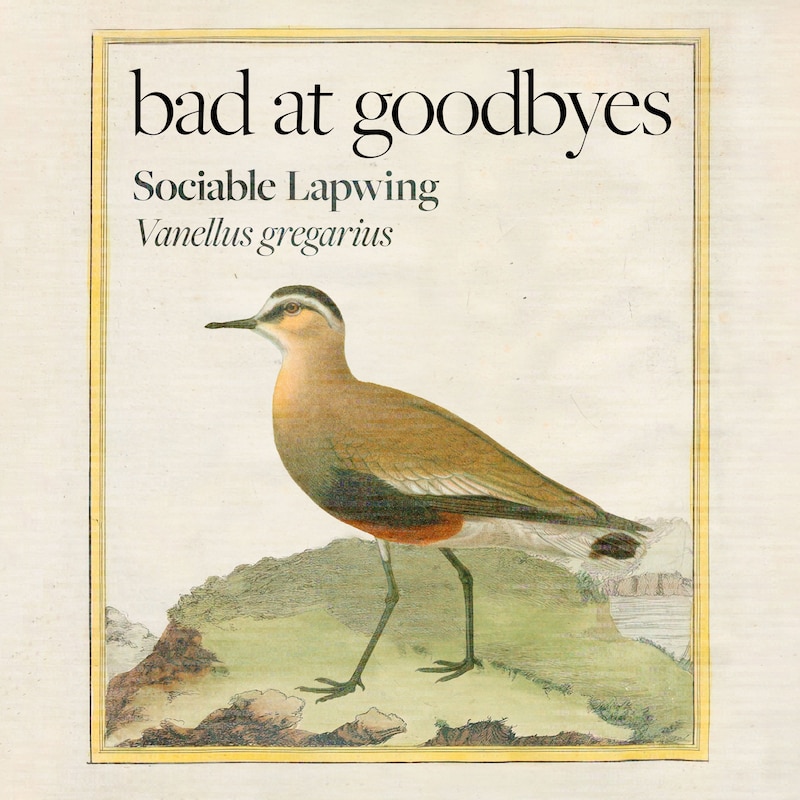
The Sociable Lapwing is a mid-sized lapwing, weighing roughly half a pound, and measuring about a foot from beaktip to tailfeather, with a two and half foot wingspan. The Sociable Lapwing is a beautiful bird. In the breeding season they have generally dusty tan feathers, black at the crown, that's the top of their head, with a white stripe, called a supercilium that runs from the beak, above the eye, to the back of their head. They have a black eye-stripe, and a sandy brownish-grey, neck and breast, which transitions into a darker brown/black patch on their belly with a warm chestnut patch on the lower belly that fades into white on their undersides. The ends of their wings are black and there is a black patch on their white tailfeathers.
In the lead up to their migration, the Sociable Lapwing moults, and its darker higher contrast feathers are replaced with a more faded plumage, the black crown and eye-stripe lightening to brown and the black and chestnut patches on the belly fading to light brown and white. This shift in plumage results in a more uniform appearance, serving as camouflage in their warmer dustier stopover and wintering sites.
The Sociable Lapwing has long black legs, small black eyes and a straight black bill.
The Sociable Lapwing is diurnal, mainly active during the day, foraging for insects: beetles and caterpillar, as well as spiders, and other small invertebrates. They also feed on a small amount of plant material: seeds and grains.
ggregation of flocks, of over:"We watched the birds getting ready to spend the night. Birds…congregated gradually by walking individually or flying in small flocks towards the main group. A flock of c30 individuals flew from the aggregation, passed a few metres above us, and returned [to the larger group], as though they were checking that we posed no threat. Aggregation of the Sociable Lapwings became much more noticeable after sunset. In late dusk, movements increased considerably; both walking and flying individuals came together in a field…This movement took only some five minutes, just before darkness; thereafter all the birds kept still." (Biricik 2009)
an, the first was recorded in: fecycle pivots on two roughly:I could find no clear explanation for this dispersal, though through GPS tracking studies, we do know that flocks intermingle at their breeding grounds in Kazakhstan. Groups that congregate together in the north, may disperse to different southerly wintering grounds.
GPS studies have also demonstrated that the Sociable Lapwing exhibits high site fidelity in their stopover and wintering locations. They return year-after-year to the same places to rest and forage along their journey, and to the same sites to overwinter.
So, they spend winter in the south, then in February and March the flocks return home, along near identical routes, arriving at their breeding sites in Kazakhstan in April and May.
The Sociable Lapwing is considered monogamous, a breeding pair will persist throughout a breeding season. After mating, this is early Spring, both parents participate in nest-building. Nests are shallow dugouts on the ground, in short vegetation, sometimes lined with bits of plant matter, pebbles, and dung.
An average clutch of 3-4 eggs is mainly incubated by the mother, occasionally by the father. The eggs incubate for roughly 4 weeks and then the new young are born precocial: shortly after hatching they are mobile and able to forage for themselves, under the supervision and protection of both parents. The hatchlings fledge, they learn to fly, after about 40 days. Juveniles are believed to reach reproductive maturity at two years. And the Sociable Lapwing has an estimated lifespan of about 5 years in the wild.
————
In the dream,
The old and tattered dream of harmonious coexistence.
Of thriving and allowing others to thrive among us.
All others, human and plants and animal kin.
A commingling, a communalism, in a broad, grand, joyful nest
Of mutual care and flourishing.
A radical acknowledgement of the deep mysterious weave
That knits us all together safely.
I dream of this often in sleep and in waking,
Of simply peace.
In the dream.
————
The Sociable Lapwing's native breeding ground is in north central Kazakhstan, with a population concentrated in Korgalzhyn District, in the Akmola Region near the Korgalzhyn Nature Reserve, the Nura River and Lake Tengiz.
This is the Kazakh Steppe ecoregion. A landscape of arid plains, grasslands, savannas, and shrublands with gentle hills, and few trees. Vegetation is mainly drought-tolerant fescue, feather grasses, and low-growing shrubs.
The climate is extreme. Summer temperatures average in the upper 70s°F, though can sometimes peak above 100°s. Winter lows average in the single digits and annual precipitation averages only 13 inches.
Here, we find our Sociable Lapwing, perhaps surprisingly, near human habitation. Their nesting colonies are most frequently found within a mile and a quarter of human settlements. Sometimes in fallow fields, previously cleared for agriculture, often in the active grazing lands of domesticated livestock: cattle, sheep, and goats. Research suggests a synanthropic relationship between the Sociable Lapwing and humans. Synanthropic simply means an undomesticated species that through evolution has adapted to live near humans and benefits from human behaviors and ecosystem impacts. The raccoon or the pigeon are classic examples of synanthropy.
ld (now Kazakhstan) from over:The Sociable Lapwing shares its breeding grounds in Kazakhstan with:
Domesticated Livestock, Black Henbane, Saiga, Northern Wheatear, Flowering-Rush, Black-headed Gull, Curlew Sandpiper, Hoary Ragwort, Bobak Marmot, Eurasian Whimbrel, Two-rowed Stickseed, Intermediate Grey Bush-Cricket, Little Stint, Long-legged Buzzard, Grey Heron, Red Fox, White-winged Tern, Green Toad, Small Heath, Black Medick, Mallow Skipper, Caspian Tern, Little Ringed Plover, Meadow Fleabane, Red-footed Falcon, Creeping Thistle, Great Cormorant, Brown Monkwort, Bluish Iris, Black Lark, Marsh Sandpiper, Narrow-leaved Pepperwort, Sand Lizard, Purple Wood Sage, and many, many more.
iable Lapwing population from:Today, shifts in agricultural land management continue to have an effect. In the past, as our Lapwing was evolving its synanthropic relationship, domesticated livestock was nomadic. A herd would graze a field, setting up ideal conditions for Lapwing nesting, and then move on. Today, herds are not nomadic and highly concentrated, so larger herds repeatedly grazing the same fields where the Lapwing has laid eggs. This has led to high rates of nest trampling resulting in egg and chick mortality. Only roughly a quarter of Sociable Lapwing eggs survive to hatch and fledge.
Additionally, illegal hunting is affecting the Sociable Lapwing's adult population. Researchers have identified poaching pressure along the species western migratory route as a factor in their contemporary decline.
Fortunately, in the last 20-30 years the Sociable Lapwing has seen increased conservation attention.
The species is protected under the African-Eurasian Migratory Waterbird Agreement (AEWA) and the Convention on Migratory Species (CMS). Cross-national Species Action Plans have been implemented to coordinate conservation across the range of habitats through which the birds migrate.
In Kazakhstan, a portion of the Lapwing's habitat is protected in the Korgalzhyn Nature Reserve. And there are programs in place to help restore the Kazak steppe habitat.
In: ed on the IUCN Red List since: ounts estimate that less than: Citations:Information for today’s show about the Sociable Lapwing was compiled from:
thony I. Dell, and Dora Biro.: .: BirdLife International.: Biricik, M. (: (: .researchgate.net/publication/: Fijen, Thijs. (: erto, and Canan Orhun, comps.: .: ald, P.F. And Biedermann, R. (: , Jeff Kirby, and Tim Dodman.: Lambert, Frank (: Moldován, I. & Sándor, A. (: (: .F., & Jbour, S. (Compilers).: llar, N.J. And Cresswell, W. (: M. Kirwan, and C. J. Sharpe (:Wikipedia – https://en.wikipedia.org/wiki/Sociable_lapwing
For more information about conservation of the Kazakhstan steppe ecosystem please see the Altyn Dala Initiative at https://altyndala.org
Music: Pledge:I honor the lives of all Sociable Lapwing. I will commit their name to my record. I am grateful to have shared time on our planet with this being. I lament the ways in which I and my species have harmed and diminished this species. I grieve.
And so, in the name of the Sociable Lapwing I pledge to reduce my consumption. And my carbon footprint. And curb my wastefulness. I pledge to acknowledge and attempt to address the costs of my actions and inactions. And I pledge to resist the harm of plant and animal kin and their habitat, by individuals, corporations, and governments.
I forever pledge my song to the witness and memory of all life, to a broad celebration of biodiversity, and to the total liberation of all beings.




