Shownotes
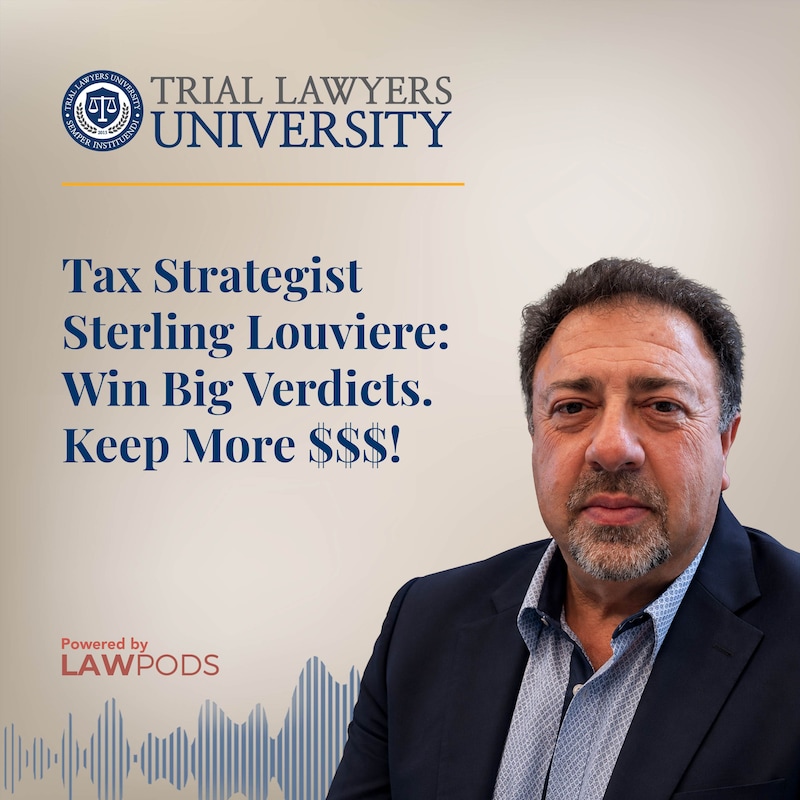
Most lawyers know how to make money — but not how to keep it. Sterling Louviere, financial strategist and founder of Financial Architects, has spent about 30 years developing and applying advanced, legal tax mitigation strategies used by the “super affluent,” and he now uses these strategies to help high-earning trial lawyers reduce their tax liabilities. Sterling joins host Dan Ambrose to reveal strategies most accountants have never heard of, including why the tax system is largely voluntary, how a lawyer earning $3 million a year can cut their tax bill by at least $750,000, and why the SEP plan your accountant recommended may be the worst tool available. Don’t miss this episode for practical tax-reduction strategies, including entity structuring, family hiring, and tax-deferred investment vehicles designed to compound over time.
Train and Connect with the Titans
☑️ Sterling Louviere | LinkedIn
☑️ TLU On Demand Instant access to live lectures, case analysis, and skills training videos
☑️ TLU on X | Facebook | Instagram | LinkedIn
☑️ Subscribe Apple Podcasts | Spotify | YouTube
2026 Programming
☑️ TLU Beach, June 3-6, Huntington Beach, CA
Episode Snapshot
- Most trial lawyers are excellent at making money but aren’t always given the tools to keep it. Sterling Louviere has built his business around helping attorneys close that gap through tax mitigation, asset management, and firm growth strategies.
- Sterling says most taxes are “voluntary” and that the super affluent use proven, legal techniques to mitigate millions in tax liability that remain largely unknown to most accountants and their clients.
- After earning the equivalent of $300,000 a year at age 24, Sterling ran into his own tax trouble — and that experience became the catalyst for a 30-year career studying every legal tax strategy available to high-income professionals.
- For lawyers earning between $1-$3 million per year, Sterling says he can reduce their tax liability by at least half — representing potential savings of $750,000 or more annually.
- The Augusta Rule enables homeowners to rent their personal home to their own business entity for up to 14 days per year — the income is non-taxable to the owner and deductible for the company.
- How to build a self-perpetuating investment fund that keeps capital working tax-deferred, allowing you to borrow against the pool for cases, real estate, or other investments without paying tax on the original income.
- Sterling's closing challenge: a CFO's first job is to minimize the company's tax liability — and for trial lawyers who are also business owners, that same obligation applies to their own firms.
Produced and Powered by LawPods
Transcripts
The most dangerous place you can be as a trial lawyer is to think you've got it figured out. I'm still trying to get better. I still have the passion for it. I believe in it. Everyone can learn to do what I do. And yet there's a group here that continues to get extraordinary verdicts. Trial Lawyers University is revolutionizing educating lawyers to be better trial lawyers. It's been invaluable to me. Trial Lawyers University, where the Titans come to train. Produced and powered by LawPods.
Dan Ambrose (:All right. Well, today we're joined by Sterling Louviere. Did I get that right?
Sterling Louviere (:You got that right.
Dan Ambrose (:And I know everybody's going to be surprised, but he's French. He's a Frenchman. And Sterling and I got to know each other a bit down in Cabo just a couple weeks ago. We were down at Gary Dordick's Trial College and that was a great time. It was a good time. Great experience. Maybe it doesn't go. It's mid-May every year and Gary's been doing it for about five years and bringing some of the best trial lawyers from mostly Los Angeles, few from around the country. Still hasn't given me a teaching spot yet, which I think is an oversight on his part, but we'll have to address that in a different time. We have to address that. Trial Lawyers College made that oversight for about 12 years, and I was like, "Hey, I got to go start my own program. It's only I can get myself on the stage." But Sterling, you are not a typical guest here because you are not a trial lawyer, but you help a lot of trial lawyers.
(:I know for sure that you help people like Gary Dordick, Tom Bear, and Mauro Fiore, famous for the "Bourbon of Proof" podcast with Bob Simon.
(:And how do you help these known trial lawyers that are prety successful?
Sterling Louviere (:Well, we do a lot of tax mitigation work for them, asset management. General counsel from the standpoint that lots of lawyers know how to make money, but they don't necessarily know how to keep it.
Dan Ambrose (:Yes.
Sterling Louviere (:That
Dan Ambrose (:Would be one of my shortcomings
Sterling Louviere (:Too. So you've got a large income, you've got a large tax burden, especially if you're in California.
Dan Ambrose (:Especially if you're in California, because everybody's like, "You're moving back to California, there's another 13% taxes." So I'm like, "I'm aware of it. " Yeah.
Sterling Louviere (:Most people don't know that most taxes are voluntary and the super affluent use a lot of techniques in which to mitigate taxes. And we basically show the successful entrepreneur professional how to mitigate their tax liability. We can mitigate millions of dollars legally, morally, ethically.
Dan Ambrose (:These are legal, moral and ethical are pretty important factors, especially if you're a lawyer with a bar card.
Sterling Louviere (:Right. Absolutely. And so we work with your CPA or your other professionals and bring them onto a team approach and help them show you how to mitigate those taxes. We basically provides the means, the methodology and the maintenance of those programs that we create for you or we show you how to properly structure things like corporations that you're using, your qualified plan, other methods in which to lower that liability, deferral programs different than what you've probably seen. So a lot of out of the box thinking, but it's from a tax perspective, it's out there being used. It's just not being used by you or your accountant. Most accountants don't know what they don't know and they have all of one class on qualified plans, so they really don't necessarily know a lot of these things.
Dan Ambrose (:Right. But before we get into a little more depth of that, how did you get into this line of work?
Sterling Louviere (:Well- It
Dan Ambrose (:Wasn't a direct line.
Sterling Louviere (:No, it definitely wasn't. Actually, I started off wanting to be an actor and-
Dan Ambrose (:Me too.
Sterling Louviere (:Yeah.
Dan Ambrose (:Still do a little bit myself.
Sterling Louviere (:Yeah. I grew up in the restaurant business and I had a program called The Millionaire that I really enjoyed. And the three things that those hell had in common is people are happy when they're eating good food or really happy when they're being entertained and they're most happy when they're getting a check. I didn't have Robert Redford looks and I didn't have Robert Duvall talent. So being in the theater was a great adventure, met a lot of girls and did pretty well there.
Dan Ambrose (:That's an important
Sterling Louviere (:Aspect.That was important. I worked in the restaurant business as a line cook for a few years and that was just way too much work for not a lot of money or appreciation.
Dan Ambrose (:So what was your favorite parts of working in the restaurant business?
Sterling Louviere (:I have a big interest in culinary techniques and skills. And when I travel, I kind of do an immersion program. Went to Italy for a couple of weeks and cooked at Intalia Resort for two weeks with the executive chef. And so that was kind of an adventure. I got to know local people. I go to Scotland and I got invited into personal homes. And so I'm interested in immersion travel of experiencing local things, not just being a tour on going to see the tourist experience. So food adventures are kind of an interest thing for me and that's why I went to the Cordon Blue, took some culinary classes. And again, everything was centered around dating. When you cook at home, the couch isn't too far from the kitchen.
Dan Ambrose (:This is true. It's smooth, Jake. Let's give me your nickname, Smooth Sterling.
Sterling Louviere (:So I've always had an interest in that. I taught my daughter how to cook and she's an excellent cook as well. So I'm also certified diver. So the combination of those two food immersion and diving when I travel, I have a tendency to vacation in warm water spots. That
Dan Ambrose (:Have great food.
Sterling Louviere (:That have great food.
Dan Ambrose (:I want to talk to you about how you make the transition from being a cook and an actor or struggling actor to learning about all these financial vehicles and then having the discipline to create them and bringing them to the world, bring them to the people that need
Sterling Louviere (:Them. Well, I grew up with a very poor family background. My mother was a waitress and my father was a factory worker and my parents were always struggling trying to get out of some financial hole. And one of the sales jobs that I was doing at the time, I got recruited into an insurance company by one of my friends who was working for them. I started working with that organization and I started making more money before I got out of bed at the age of like 24. I was making the equivalent of about $300,000 a year at 24 and unmarried. I saw the handwriting on the walls and I got into my own tax trouble because I didn't understand the tax code. Well, I went to work for another company after I got out of that dilemma and paid back all my taxes. I started working with a CPA who was a mentor for about six years.
(:It was a company called The New England, which dealt with affluent individuals and business owners. And he basically stepped me in the fact that most people are motivated by tax deductions. They buy cars and equipment that they don't need because their accountant told them that they needed more deductions. Well, it turns out that there were lots of ways in which to mitigate those taxes. And there was a program called a Welfare Benefit Trust that I started promoting at that time and it was a way for companies to take very large deductions and create very large savings accounts for themselves on a tax favorable basis, in cases, millions of dollars. So that was my first exposure to that, working with that CPA and that group of people.
(:And we got into things like ESOPs, which is an employee stock ownership, which is another method to doing that. So I did that and in 96 I opened up financial architects. I was additionally aspired by a really brilliant attorney out of St. Louis that I've been doing business with for the last 30 years. His average client is half a billion dollars or more and he provides a lot of unique insight out there and he provided me with a lot of education on how to do those things. Over the last 30 years, I can't tell you how many millions of dollars that utilizing all of these techniques that I've accumulated over that time, we've saved our clients and my background is working with CPAs and helping them uncover these deductions.
(:I own an accounting practice at this point. I've worked with a couple of tax law firms where I was one of their chief tax strategists. And so it's just accumulation of knowledge over 30 years and I'm always out there looking like you put on this program for attorneys. Well, I go to similar programs designed for tax related strategies. So I travel the country and pick the brains of some of the smartest tax attorneys in America and find out what's new, what works, what doesn't. And then we basically put it through the lab, so to speak, and figure out what actually is working versus what's going to put you into a jackpot. And so far, let's knock on a little wood here. I've never had a client that's had a bad result on the strategies that we've put forward since 96. Now we've had issues that we've had to unwind and redo, but never a bad result.
(:And even when occasionally my clients get audited, we've come out successfully.
Dan Ambrose (:That's an impressive record.
Sterling Louviere (:Well, yeah. And I think it's a combination of spending a lot of time and finding the right people and as well as really working hard at the craft. When you spend time on something, you're looking to be as bulletproof as possible. And remember, if you have a problem, then I have one. There's no empty seat in a lawsuit. And so the last thing I want to do is put you into a situation where you're going to have a problem because I'm going to inherit it.
Dan Ambrose (:Right.That would be what we call no fun.
Sterling Louviere (:That would be no fun. Right. No, and some of the tuition that we charge to our clients for expenses is based on the liability that I inherit as a result of mitigating that tax and being there and involved in the defense and the event that a situation comes up
Dan Ambrose (:August 24th through 28th, Sach Oliver has come all the way from Arkansas to right here to Hermosa Beach to TLU Beach House. We're going to be teaching a five-day depositions our trial bootcamp. You're going to be working on your cases. Satchel's going to be working with you on your cases. So not only are you going to transform your case, but at the end of the day, it becomes a case expense because your case is going to get that much better. This program's limited to 10 participants. So if you want to come get registered today, we'll see you right here. Well, you come into your first TLU this year and you're actually putting on a presentation about the stuff we're about to talk about, but because you haven't been to TLU before, I'm just going to give you a quick rundown of it
Sterling Louviere (:Because
Dan Ambrose (:We were talking a litle bit beforehand before we got on here and it was shocking how much you weren't aware of that people aren't aware of because it really starts off on Tuesday, June 2nd with a little surf camp with Ed Ciarimboli and then a little bit of a pickleball with Supio. And that night we have the Finch welcome dinner. So we got about 200 people registered for that so far, but the registrations for that are still coming in. Chance to get everybody to get connected, get to know each other before we get there, because I'm really working on the connections besides the education, because my goal is for people to make more money and now actually if they use your services, even keep more money. But to make more money, we make more money by getting smarter on our cases and having a bigger network of friends/professionals, what do you want to call it, that we do business with because that's how we can make more money.
(:And then on Wednesday morning, we got breakfast for everybody and then there's eight workshops on Wednesday, but in the afternoon there's a golf outing, there's go- kart racing, more pickleball. Then we have our opening party that night from 5:30 to 8:30. We're going to have food trucks and live music. And after that, we got a poker tournament hosted by Codes Health and we got the lobby. The lobby is kind of like a lobby lounge. We have a couple ping pong tables, a foods ball, a DJ and an open bar, of course, lots of people drink. I tell them not to drink so much, but they don't listen to me. But then come Thursday, we got some yoga in the morning or working on the beach from 6:30 to 7:30. Then we got a full breakfast for everybody outside in the ocean lawn. Then you got your choice of five lecture tracks and eight workshop tracks in your lecture track.
(:Your lecture is going to be on Friday the second at 10:15 in the morning in the blue room. It's also the Blue Summit room. And then we do a full lunch for everybody and then we have theme parties every night and we're going to have the Supio 80s tracksuit dinner party followed by the 80s tracksuit pool party. People are like, "Where'd you come up with these ideas?" I'm like, "I don't know. I smoke a little weed once in a while. It might become some of the billion ideas, but I don't know where I get them all from." And then of course we have the poker tournament in the lobby after that. Friday, our good buddy, Sach Oliver is coming from Arkansas and bringing about 500 pounds of the Oliver Angus beef. We're going to have a big barbecue, the wood fire grill, and a mechanical bull.
(:And then Saturday is going to be the Philip Miller's Apreski rooftop party to wrap it up. Actually, we got to wrap it up on Sunday with Sunday brunch for whoever still wants to stick around and connect over brunch. So we got a full five days of fun and making new people there. See, you didn't even know it was going to be this much fun when you decide to come speak here. So are you pretty excited about this all stereo? I am excited about that. I see that. That's the face of excitement. If you're watching on video, you'll be able to see the excited face. But if you're just listening, you have to just imagine how excited his face is because it's interesting. Well, I do
Sterling Louviere (:Love poker.
Dan Ambrose (:Oh yeah?
Sterling Louviere (:Oh yeah.
Dan Ambrose (:No, because I try to make something for everybody because everybody's got different ... That's why I have people like, why do you have so many tracks? It's like there's so much selection. You suffer from FOMO.That's why I record everything so that way if you do something, you won't suffer from FOMO, you could just watch it after the fact and then catch what you missed.
Sterling Louviere (:Poker and blackjack are my game's in Vegas. So I play a lot of poker here still.
Dan Ambrose (:Yeah. I used to play a lot of poker, but then I don't know, it's just I hate losing. I was not very good at it. I don't take losing well. I'm not a good loser is all I can say. So Sterling, for folks that some of these lawyers that say making between I think one and three million dollars a year, if somebody's making between one and three million dollars a year, on average, how much do you think you can reduce their tax liability?
Sterling Louviere (:At least in half.
Dan Ambrose (:In half.
Sterling Louviere (:In half.
Dan Ambrose (:That's a lot of money.
Sterling Louviere (:It is a lot of money.
Dan Ambrose (:And if you come over years, that would be a lot of money.
Sterling Louviere (:That's a big number. So $750,000 in savings on three million or more.
Dan Ambrose (:So how do you go about doing this? What do the strategies deploy?
Sterling Louviere (:Well, I mean, first we look at your structure. What entities are you using? Is there something that you could do? Could you set up another entity like a C corporation have an off your election in order to funnel money into the new year and not have everything due on 12 / 31? Especially if your intent is to reinvest some of that money into advertising or trial costs because coming the end of the year, you have to pay that tax on that money whether your intent is to turn around and reinvest it or not. Well, what if you could set up a separate entity and defer that into the new year and have access to that money without having been paid taxes on or at least only paying it at the corporate level as opposed to the personal?
(:Many firms have large advertising budgets and many times they're writing large checks to their advertising firm. Well, write that same check to yourself and have your entity manage that budget and how it gets spent as opposed to giving it to someone else and then deciding once they already have your money in their pocket. You can look at hiring your kids. You can put a lot of money away or other people in your family, your spouse. If your spouse isn't on your payroll and you're not maximizing your qualified plan opportunities, can't tell you how many firms I go into and I see that they have a simplified employee pension plan accept because that's what their accountant recommended. I can't think of a worse plan to use. That hurts because
Dan Ambrose (:That's what I have.
Sterling Louviere (:Oh, there you go.
Dan Ambrose (:All right. I got to get my shit straightened out.
Sterling Louviere (:Well, we could probably take you from the $40,000 you're putting away to the $300,000 level. We can look at creating other entities. Most business owners have tremendous liability, unfunded liability. So you're either insured by an insurance company or you're self-insured. Well, what if you could make a fully deductible contribution into your own insurance entity that covers your own liability and somebody else could make sure that all of the requirements are taken care of so you have no regulatory liability and 94% of all that money flows into your new entity that doesn't pay any tax under 831B. And that money, in the event that you don't have a claim, which most business owners don't have claims-
Dan Ambrose (:Hopefully.
Sterling Louviere (:Yeah. Well, if you make a premium payment to a regular insurance company, it's a deductible, but you don't get any of that back in the event you don't have a claim, right?
Dan Ambrose (:Trust
Sterling Louviere (:Me. Yeah, your insurance company doesn't send you check back, but that money could go into your own entity and when you don't have a claim, that becomes underwriting profit, which sits in that entity and what can we do? What do insurance companies generally do with their money? Well, they invest it or they loan it. Well, you can invest it for your benefit and you can loan it to yourself or anyone else that you like at the federal funds cost of money and that makes very favorable lending on a tax deductible basis and it's accumulation of wealth that you have. And let's assume that I don't pay tax on it. I borrow the money out of the entity and I go buy some real estate for myself without borrowed money paying interest to myself.
Dan Ambrose (:Sounds
Sterling Louviere (:Like it might be good. The funds that I took a deduction on. I mean, that would be one example, but there's a lot of other structures that we can deploy that have the similar effect.
Dan Ambrose (:How can people hire their children and their wives and do that ethically and legally?
Sterling Louviere (:It seems- Well, I mean, if your child is old enough, which the IRS defines a seven and can do something meaningful like stick paper in a shredder, then you can hire them. Or if your child can be on your advertising, they can become a model, but you can funnel substantial money to that child and that child doesn't pay any FUTA or FICA taxes and no state or federal taxes up to about $16,000. So you got a number of kids, that's a lot of money and now your child has the money to pay for his own school funding, his own personal needs and you didn't pay any tax on it. Whereas if you gave that child that same money, it cost you 50 cents before you gave it to them. So every dollar costs $1.50.
Dan Ambrose (:Wow. I can see that now. I always pondered how that worked, but makes sense now. Because you're going to talk about these in depth and-
Sterling Louviere (:Yeah, I'll talk about the Augusta rule. Every attorney has a meeting somewhere. I mean, many times you have meetings offsite. If you own a piece of real estate, that meeting could be at that location. You can rent that location out 14 days a year. Usually your personal home, you can rent out your home to your entity for 14 days a year and that income that you charge your company, it's deductible for your company and non-taxable to you.
Dan Ambrose (:And I just heard about this recently that's been killing me because I'm like, I could have basically-
Sterling Louviere (:Yeah, that's called the Agusta rule. Yeah.
Dan Ambrose (:I know. Now it's like everybody knows about the Augusta rule, but until
Sterling Louviere (:You hear about it,
Dan Ambrose (:Everybody doesn't know
Sterling Louviere (:About it. Lots of people know about it, but I got to tell you, even those people I tell about it don't necessarily deploy it, but they should. They're concerned. Everyone, their accountants are concerned. And I always ask the question- Because just
Dan Ambrose (:To be clear though, you work with people as accountants, you don't take over their accounting.
Sterling Louviere (:I don't. I mean, I do provide accounting services because sometimes that accountant can be difficult and he doesn't necessarily want to comply and so we'll offer that service to complete it, but we'll educate an accountant. I provide intellectual property behind about a dozen accounting firms and two law firms. So we're always willing to educate your accountant if they're open to being educated. I'll give you an example. Gary's accountant, it took me seven years of him seeing his friends and family members benefiting from my work before he became a client. And mostly it was his accountant that was not willing to come along with the process and he finally gave up the ghost last year. So it takes a while. It takes a long time for some of these guys to come around and you got- There's a
Dan Ambrose (:Lot of trust involved there, Sterling,
Sterling Louviere (:With a
Dan Ambrose (:Lot of money.
Sterling Louviere (:Well, you got to think of it this way. They're not paid to take any risk and they're taking liability and they're not paying the tax.
Dan Ambrose (:They're really getting the benefits clearly.
Sterling Louviere (:So they're not as motivated as perhaps you are in order to figure out how this works.
Dan Ambrose (:Oh, by the way, I have the shirt I'm wearing on. It's not generally what I would wear, but this is to get me warmed up for my wild west party, just in case anybody's wondering why I look like a cowboy, but that's a side note.
Sterling Louviere (:Okay. Well, I'll have to buy one before.
Dan Ambrose (:I know everybody has to be themed for my parties. Upsets me when people don't go along with my little charades called dance theme parties. But we're getting better at it. Even my friend Joe Fried is wearing a tracksuit this year and I said, "Joe, I can get you a cowboy hat too for the set." He goes, "No, I'll bring my own." He goes, "Then I got to carry it. " I'm like, "I can get you one of mine." He goes, "No, I'll bring my own." So when you get Joe Freed getting themed, it means we finally broke through because a lot of these lawyers, they don't like the theme stereo and it hurts my feelings, but I share with them the pain I'm in and we're getting them to comply. So just a side note in case people are wondering
Sterling Louviere (:About this. Well, I own a couple of pairs of blue jeans and a couple of cowboy hats.
Dan Ambrose (:There you go. So you're going to be all set. You're going to be all set. You're going to be all set. And so you talked about the Augusta rule, you talked about a couple other things. Give us a couple of what's another way that you help people to mitigate and cut down on their tax because we got massive tax obligations here if you're in California and you make any money.
Sterling Louviere (:So what if you could buy an asset, let's assume a piece of heavy equipment, a billboard, a computer chip, and you basically create a leasing company and you turn around after you bought that asset and you lease it to a third party that would use that asset. And I'm not talking about a small Podon company. I'm talking about a major player that is in that space, maybe billions of dollars or hundreds of billions of dollars that would want to lease that equipment from you. And so you bought that piece of equipment for 10 or 20 cents on the dollar and you borrowed in some cases a million dollars or more in order to purchase that. So you put a couple hundred thousand dollars out and now you have a multimillion dollar piece of equipment or multiple pieces of equipment that you get to use section code 168K or section code 179D to take an accelerated depreciation deduction from that entity through a pass through loss.
(:So now I own a piece of equipment that I leveraged. I got to take 100% of the cost of the purchase all in one year. I own the equipment, somebody else is now making all future payments and not only do I get the immediate deduction, but I get the income that comes off from leasing that equipment to a third party that guarantees the payment.
Dan Ambrose (:Well, that would be pretty damn good.
Sterling Louviere (:Yeah, that would be about a 300% to one return over five years. It would be the immediate 100% deduction for buying the equipment and then it would be a return of the principal plus an investment return.
Dan Ambrose (:Wow. I just want to make a comment real quick though too, that not everybody's coming to TLU sadly. There's only about 800 people coming, but if folks who aren't coming, you can see Sterling's presentation on TLU on demand. And if you don't have it, shoot me a text or an email and I will send you a code so that way you can try it out and check out the great presentations at TLU Beach, one of which will be Sterling, maybe even save so much money, TLU on demand will be in your budget in the future. I'm not allowed to pound the table, but that was an enthusiastic idea right there.
Sterling Louviere (:Right.
Dan Ambrose (:If you want to master your trial presentation skills in the areas of witness prep and direct, cross examination, your performance skills, that's opening statement and closing argument and voir dire or jury selection. You need to learn the best practices and you can right here at the TLU Beach House in Hermosa Beach and we're collaborating with some of the greatest trial lawyers like Joe Fried and Joe Camerlengo on Trucking, Sach Oliver on depositions our trial and then with great trial consultants like Eric Oliver who's going to help with case story and David Clark and Przemek Lubecki teach you the Dark Arts to help you put your cases together. Combine that, helping you get the right story with the great trial performance of presentation skills and that's a recipe for much greater results. So join us right here at the TLU Beach House. To get the full schedule, go to triallawyersuniversity.com.
(:We'll see you here. So in addition to being able to mitigate tax liabilities, what vehicles do you have to perhaps assist the lawyers in their growth?
Sterling Louviere (:Well, I mean, a couple of ways. One, if you have more money, you have more money to invest. And so we would ask that if you're saving money, that you would put money aside. Secondly, from the standpoint of the growth of the law firm, there are techniques that where we can create effectively a fund or a pool of assets that we can create that can turn around and invest in your cases. So we initially start off with funding a pool and then that pool invests in your cases and help finances it. It's called an option strategy. I don't want to get into the details of how that works because I don't want to provide a guideline to the IRS on how everything works. You don't want to provide them a roadmap for everything, but it's safe to say that you can create a self-perpetuating fund that you never pay taxes on.
(:You can borrow money out the way that a billionaire will set up their stock and then they'll borrow against the growth of that stock and you don't pay income tax on money that you're loaning to yourself and as long as that pool continues to perpetuate either by investing in cases or investing in other investments that give a return, you'll never have to pay that money back and you'll never have paid taxes on the original income. Think of it as a permanent deferral fund that unlike where you have to buy an annuity, you can invest in cases or invest investments like real estate or stock and you'll never pay the tax.
Dan Ambrose (:Well, that sounds like a good strategy.
Sterling Louviere (:It's a good strategy. You have more money. You'd have more money and ultimately you can live off of the borrowing against that pool of money and it'll eventually be inherited by your children or whoever it is that you want to leave the money to. It's
Dan Ambrose (:A good
Sterling Louviere (:Qualification there. Good qualification. Yeah. But more importantly, it basically allows for firm growth because you can loan that money back to the firm and charge interest to the firm, which is deductible that you effectively charge ... And yourself. So there's many ways to recycle money in this process and that's called a leasing strategy, but there are other ways for us to do that and that's where we would get into individual planning as to what do you want to accomplish? Do you want to advertise more? Do you want to hire more attorneys?What's the structure you're looking for? And we'll also offer fractional CFO and CEO services to you to help put those plans together as well and improve the situation. A lot of attorneys are really great attorneys, but like really great mechanics. They're not necessarily great business people.
Dan Ambrose (:Most of them are not very good business people.
Sterling Louviere (:Right. And so if they need that kind of help, we can provide that type of guidance as well to help you grow top line, not just necessarily bottom line. We spend most of our time talking about bottom line, but if your objective is really to grow, we can help that too.
Dan Ambrose (:Make more money.
Sterling Louviere (:Make more money.
Dan Ambrose (:Got it.
Sterling Louviere (:And so we have all the tools in place basically from beginning to end to offer you concierge services, family office-like services in order to prove your situation and work with the other professionals that you want us to work with and help coordinate that team. So we'll play quarterback on a lot of aspects of attorney's business and life.
Dan Ambrose (:Sterling, how do people get ahold of you if they need to find you?
Sterling Louviere (:Well, you can look me up online at financialarchitects.com. I like
Dan Ambrose (:That name. Financial architects.
Sterling Louviere (:Yeah. There's a few people out there using that name, but look specifically, I'm in Pasadena, California, or you can reach out to my office at 626-844-1190. From a compliance standpoint, I own an accounting practice. I own an asset management firm. So we're basically offering services from beginning to end, like a fractional CFO, fractional family office. So we'll help you raise top line growth and we'll help you mitigate taxes on the back end. Most entrepreneurs are more worried about making money than they are keeping it. I
Dan Ambrose (:Think I fall into that
Sterling Louviere (:Category. If you could work the same amount and make 30 to 50% more money, wouldn't that make a lot of sense?
Dan Ambrose (:I didn't have to think through that one, Sterling. I think I have to agree with that. That'd be in the category of no-brainers, I think.
Sterling Louviere (:You would think so. I mean, but many people are hesitant because they don't realize that the tax system is voluntary and that you're only legally obligated to pay the taxes that you owe. And these techniques are being used by billionaires all the time maximizing. In fact, a CFO's first job is to minimize tax liability to the company that they manage. And so I would have to say that that's your first job as well in addition to raising top line growth, but paying is the minimum amount that is legally required. And most business owners don't even think about those things and their accountants don't necessarily bring them any new ideas.
Dan Ambrose (:Yes. Generally speaking, accounting, I always wondered, but I always wonder who becomes an accountant because it's such a boring job. I couldn't imagine just crunching numbers all day, but thank God there's people that crunch the numbers that way. People that do creative stuff like me can do our creative stuff and not get in trouble with the government. That would say good thing. For myself, anybody gets ahold of me for any reason, my email of course is [email protected]. My cell is 248, 808, 3130. Oh yeah, we also have a program. So anybody you know that's a law student wants to come to TLU so we give all law students scholarships. Alls they have to do is fill out a form online because I think it's really important to intervene. If somebody would've intervened when I was a law student to start teaching me the ways ... I probably wouldn't be sitting here right now because I would never start a trial lawyer university because I'd been such a successful trial lawyer.
(:Probably wouldn't have had time for it, but that wasn't my journey. That wasn't my journey. But it's most people's journey that's in law school. And then also too, if anybody really wants to come to TLU and doesn't have the resources, well, if they give me a call, there's very few people you have to be able to figure it out for. Now some people that just don't want to spend their own money and those are not the people that we're looking for to help. But a lot of people when you're young or been going through stuff, it's hard out. It's hard. It's hard to make a living sometimes, especially trying to figure stuff out. So we have some reserve tickets for those folks to help everybody get there that wants to come to TLU because it's a game changer for-
Sterling Louviere (:Well, it's really important to invest in yourself and your capabilities and improve that. And like anything else, it takes a long time to really get it down and be successful in many cases. If I had the breadth and knowledge of experience early in life, I have a lot more money.
Dan Ambrose (:Me too.
Sterling Louviere (:Me too. You spend a lot of tuition and you can either spend that tuition by investing in education or you can spend that tuition in time trying to figure it out on your own.
Dan Ambrose (:Yeah. And figuring stuff on your own is real time consuming and expensive. I know from experience.
Sterling Louviere (:Right.
Dan Ambrose (:I know from experience. Well, thanks for visiting us down here in Hermosa Beach at the beach house. It's been good to catch up and get to know all your wives. I'm really, really looking forward to having you at TLU because this is something new for us, but it's something that I think is just going to benefit so many of my friends and attendees because we're all there to make more money, every one of us. I mean, we're having fun, we're making new friends, but at the end of the day, if we're not making more money, if people are making more money because they came, I know they're not coming back. I realize all of life's a trade off. They're trading time and other things they could be doing, like working or spending with their family to come to Huntington Beach. And I want to make sure that the ROI is through the roof for my people.
(:But I really think that you're coming here and this presentation you're going to give is really going to be helpful. So I look forward to seeing in about a week or so.
Sterling Louviere (:Yes, sir. Only
Dan Ambrose (:About maybe a week and a couple days away. All right. Thanks, Sterling.
Sterling Louviere (:Thanks you. Thank you.




