Shownotes
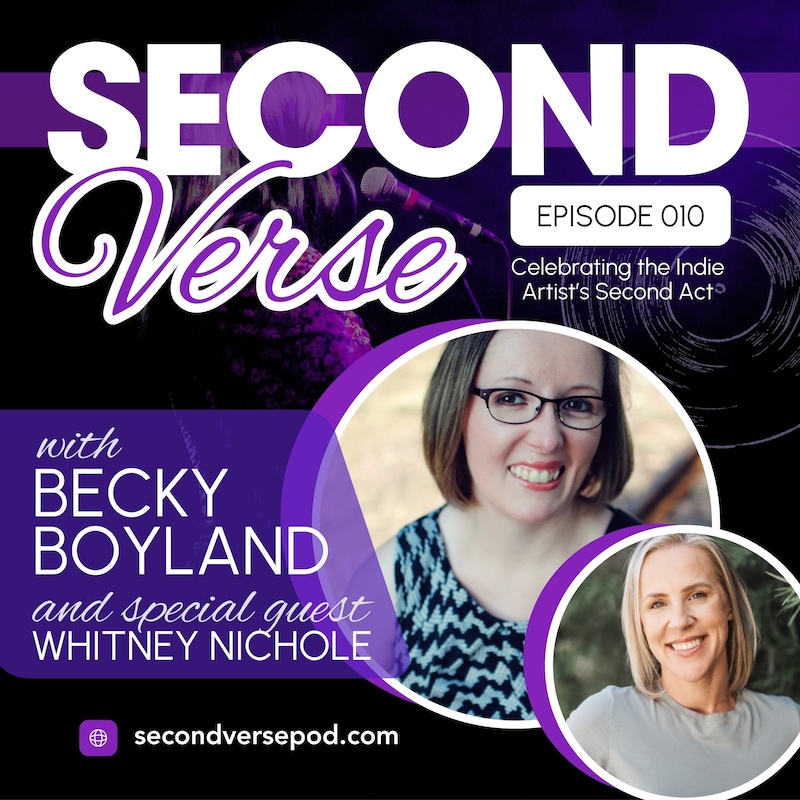
Healing Through Music: Overcoming Vocal Trauma with Guest Whitney Nichole
In this deeply personal episode, host Becky Boyland shares her compelling journey of overcoming vocal trauma following major spine surgery. Initially facing the terrifying possibility of never singing again due to a paralyzed vocal cord, Becky describes the emotional and physical challenges she faced. She highlights the pivotal role of vocal coach Whitney Nichole, who introduced Becky to transformative techniques like straw phonation. Together, they worked meticulously to rebuild her voice, ultimately leading Becky to new vocal heights. This episode is a testament to perseverance, hope, and the power of music to heal. Tune in to hear this inspiring story and Becky's latest single, “Loving You.”
Resources:
- About Whitney Nichole
- The Singing / Straw Website with 10% discount (or use coupon code "secondverse")
- The Singing / Straw YouTube Channel
- Songbird Studios
Featured Song:
- ”Loving You” by Becky Boyland, written by Philip Lovell and Becky Boyland. Used with permission. All rights reserved.
- Add to your library now: https://hypeddit.com/beckyboyland/lovingyou
Timestamps:
- 00:00 Sponsor: Attitude Creativity
- 01:19 Teaser: My Story of Vocal Healing
- 01:33 Intro: Setting the Stage
- 01:46 The Unexpected Loss
- 03:54 Healing and Complication
- 08:05 Searching for Solutions and the Start of the Journey Back
- 09:09 Vocal Coaching
- 11:33 Lessons, and Not Just the Voice Kind
- 14:25 Conversation with Whitney Nichole
- 51:06 Conclusion and the Ongoing Journey
- 52:13 Featured Song: "Loving You”
Transcripts
Sponsor: Attitude Creativity
Becky Boyland: Second Verse is sponsored by Attitude Creativity.
Many indie music artists don't have a website that grows their audience and reflects who they are, so they get lost in the noise of streaming. Marketing and brand messaging with Attitude Creativity helps boost your brand and build a site that hits all the right notes. You wanna be an artist who stands out from the crowd, and to do that, you need your music to be heard.
If your website doesn't reflect who you are or make an impact, you feel like a singer who's been handed a pair of drumsticks instead of a mic. You deserve a website and brand messaging you can be proud of, and that doesn't take time away from your music. As an artist like you, I understand how overwhelming websites and marketing can be, and that's why putting on my other creative hat, I put my decades of marketing and development experience to work for you.
You'll no longer have to apologize for your website. You'll look and feel like a professional with a custom StoryBranded website you can be proud of. And right now you can get a headstart with my free downloadable EPK blueprint and start building your electronic press kit to promote your music. Head to attitudecreativity.com/blueprint to get your copy.
That's Attitude, A-T-T-I-T-U-D-E creativity.com/blueprint.
Teaser: My Story of Vocal Healing
Becky Boyland: I lost my voice—literally—after spine surgery and as a singer and a songwriter, it was one of the scariest things I've ever gone through, but I found healing in ways I also never expected. This is that story.
Intro: Setting the Stage
Becky Boyland: Welcome to Second Verse, the podcast about making music after making a living. I'm your host, Becky Boyland, and today's episode is one of the most personal stories I've shared so far.
The Unexpected Loss
Becky Boyland: Three years ago, I underwent major spine surgery, a necessary and long awaited decision after living with chronic pain for over two decades.
But what I didn't expect was that I would come out of the operating room having lost my voice. For a singer, a songwriter, a worship leader—a communicator—this was more than a physical complication. It was a moment of loss that reached into my identity, but this isn't just the story of an injury. It's a story of healing and hope and rebuilding, and it wouldn't have been possible without the support of someone remarkable: vocal coach and singer Whitney Nichole, who joins me later in the episode.
Leading up to my surgery, I was in a really exciting place musically. As I've shared previously, that one Facebook ad had moved me to step out into new levels of music, so I joined a professional songwriting program that was stretching and encouraging me. I'd also been studying voice for a couple of years and had built the strongest, most flexible voice I'd ever had. It gave me so much confidence, not just in recording, but in leading worship at church and you know, dreaming about what might be next. But at the same time I was dealing with physical pain that had been building since high school. An injury I never thought I'd carry through My whole adult life to that point had reached a new level. I'd find out later it literally was at a new level. Three discs in the span of four were compromised in my neck, and it was causing daily neck pain and back pain and giving me constant headaches. It was so clear that I needed to do something because it was getting harder and harder to simply function.
At home, at work, and even in my music, despite how passionate I was about it, sometimes it's just so hard to try to overcome pain. While my vocal, songwriting, and production skills had grown tremendously, my spine issues were becoming a greater hindrance both physically and emotionally, and all I wanted was relief from the pain I dealt with constantly for as long as I could remember.
Healing and Complication
Becky Boyland: So I reached out to a doctor's office, had to go through some preliminary tests and required therapies, but then I finally was allowed to meet with a surgeon. We decided on a hybrid cervical spine surgery, two discs would be replaced and one would be fused. He said, I might be "a little hoarse" afterward. I think he said it would be for a few days. He might not have, but in my mind I imagined three days. I knew I would be intubated and obviously they were accessing my spine through the front of my neck, so that seemed reasonable, and it was realistic to me that a couple days of hoarseness would result from intubation. What I didn't realize was how different the reality would be.
In the surgical recovery room, the biggest challenge was staying awake and reminding myself to breathe, which I think can be common. So they have nurses and health monitors to help with that. But it wasn't until I was moved to a single room that I started to realize my voice wasn't just hoarse. I could only sort of speak just above a whisper, and every attempt left me incredibly winded. It was so hard to even take a sip of water without coughing it back up. There was this rattle into my voice and no upper register. Ultimately, I would come to understand through my own research and the confirmation of a laryngologist that I had a paralyzed vocal cord. It is likely that it happened as a complication because the surgery involved so many levels of my spine and was a bit more complicated than, say, a single disc fusion or replacement.
But being understandable didn't make it any easier to deal with. In fact, it was traumatizing and terrifying. Being a singer was so much of who I was and I'd spent so much time working on developing and improving my vocal skills, and suddenly it was all gone.
Rebuilding it seemed so daunting, but for those first six weeks after surgery, I really had no idea if I'd even speak normally again, because I had come to learn that vocal cord paralysis can heal normally, or... it might not. Both paths seemed possible.
But going back to right after surgery, it took a couple days to really sink in how serious this was, especially as I started feeling good physically during my surgery recovery. In fact, with regard to my constant pain and the disc problems, the surgery was wildly successful with immediate relief, even despite the pain of recovering from the procedure itself. Once I felt well enough to pick up my guitar, the loss of my voice really hit me. Taking time off to recover seems like a great time to write music, but when you open your mouth and can't sing a note, it's the most emotionally excruciating reminder, not just that you went through something serious, but that alongside a wonderful outcome, which the spine surgery itself was, is a frightening and unexpected challenge. Of course I tried to power through and record a couple song ideas and it's been a long time since I went back through my voice memos to listen to these.
It's surprisingly emotional to me even now, but this audio will give you an idea of what I was dealing with. This was about two weeks after surgery.
Becky Boyland: Yeah, that was pretty rough and I think you can imagine why I really didn't know if it would come back.
Searching for Solutions and the Start of the Journey Back
Becky Boyland: So once I got to the point of understanding that it was a paralyzed vocal cord, I had to know if there was anything I could do to make it better and I mean anything. So I started researching like a woman on a mission because I was, and I stumbled upon straw phonation, a technique for vocal exercises using a small diameter straw to create back pressure that can help with training vocal cords to close properly, because "cord closure" was another key phrase that I found. A couple days later, a songwriter friend of mine was passing through town, and so we met up for lunch and since my voice was still so weak and rattly, and as you just heard, it was an obvious topic of conversation, and she said her vocal coach recommended straw phonation. Later that same week, I saw Facebook invitations from her vocal coach who was a mutual contact to join a five day vocal challenge featuring, you guessed it, straw phonation. So at that point, I got the message, okay, Lord, I'm going to sign up. And I did.
Vocal Coaching
Becky Boyland: And Whitney, who we'll talk to later, was the vocal coach, who's also the creator of the Singing / Straw.
Now since it was a small group Zoom session and I had only just started regaining my speaking voice and it was all lower register at that point, I planned to just sit back quietly and let others participate. But we went around the group and shared stories, and Whitney jumped right in to work with me live in the first session. So we did a few exercises and it was really encouraging. I still didn't know how this was going to go or how long it would take, but a few weeks prior, I'd been in a different vocal group chat with a different coach who suggested that injuries like this could take more than a year to recover from. That was a perfectly appropriate dose of reality, but it was too raw and too painful to hear at that time. So experiencing any progress in Whitney's bootcamp was just as emotionally uplifting as it was physically. At the end of the bootcamp, I even surprised myself by signing up for six months of one-on-one vocal coaching.
Whitney is such an encouraging woman, and so it was easy to look forward to seeing her every couple of weeks. Vocal lessons are inherently vulnerable. And then when you add in an injured and uncontrolled voice, it's so important to have someone who makes you feel safe in the process. She helped me to be gentle with myself, and I had to recognize progress while acknowledging that it could take a long time. And the biggest breakthrough vocally was approaching high notes, which I literally didn't have at all for a couple months. And so we had to approach them in a completely new way.
Whitney helped me try and then refine a whole new way to expand my range. Rather than using more energy and power, which would cause a loss of control and might even damage my voice further, I had to approach my whole upper register with a more delicate touch in order to control it and to build it back up, and that is so counterintuitive, let me tell you. But it ended up giving me more skills that I still use to this day, and I can't imagine that I would've discovered that on my own. And I think it's a powerful illustration that strength doesn't always mean using more force. Focus and discipline can go a lot further with a better outcome. And I'm not just talking about the voice.
Lessons, and Not Just the Voice Kind
Becky Boyland: Obviously, the whole experience was really, really difficult. I can't say I would change anything because avoiding the vocal trauma would mean staying stuck in chronic physical pain. I'm incredibly grateful that my voice was healed even though it, it took a long time to rebuild following the healing. I can't imagine it not coming back, though, I do know that sometimes that's the outcome.
But I learned a few things. I learned I could lean on help from others who could do what I wasn't physically able to do at that time, whether that was to accept help and meals and company, or lean on other vocalists to lead the worship band at church while I stepped back and just focused on playing guitar.
And I learned that I could make it through the experience no matter the outcome. I knew God had plans for me whether I could sing or not, but I took comfort in sensing that my singing days weren't done. But you know, even on the days when I doubted, I also took comfort that I could cry and pray and put it all before God, and that was acceptable too.
I also learned to be on the lookout for unexpected help when I didn't know how or where to search. Just like the straw phonation message. My needs were provided for. It's so much more meaningful to me now to be able to sing. Even three years later, My voice will surprise me with little growths and gains, and I take absolute delight in what a contrast that is to where I started.
I think back to those first breathy sounds, and not in the way that you want a song to be breathy, and I feel nothing but gratitude and it makes me wanna be really wise in how I use my voice so that I can keep doing this for as long as I live.
And so I want to encourage you, if you've ever lost something central to who you are or who you want to be, you are not alone. And my message to you is twofold.
First, don't give up hope. Whether you're in the challenge now or you wanna be prepared when it comes. Work hard to figure out what you can actually do, but give yourself time to grieve and heal. That's valid. You don't have to figure it out immediately, and you still can acknowledge that it's hard, it hurts, and it's okay to feel that way.
And second, be patient and optimistic to look for the next thing because some stories come to a full restoration, but other stories continue with a pivot and evolve into something new, but no less meaningful. Whatever the outcome, your story goes on with new opportunities, even after struggle or loss.
Conversation with Whitney Nichole
Becky Boyland: And so now I'd like to share with you my conversation with Whitney Nichole, a vocal coach, singer, songwriter, and entrepreneur. She's the founder and CEO of Songbird Studios, Northern California's leading vocal coaching studio with three locations, more than 20 coaches, and over 450 students. She's also the creator of the Singing / Straw, a sustainable vocal training tool used by singers around the world. Whitney is passionate about helping others find power, joy, and freedom in their voice through education, creativity, and connection, and I'm so grateful for her part in my journey of vocal recovery. Thank you, Whitney, for being with me. I just had to have you as part of telling this story, so I'm so glad that you're here today.
Whitney Nichole: Oh, thank you for having me, Becky. It's gonna be fun to kind of live it again and look back through what we went through together.
Becky Boyland: Can you believe it's been three years since we started this process?
Whitney Nichole: So no, that I cannot, it feels kind of like yesterday, but then also I think back and I'm like, wow, look how far you've come. You know? And it's just, time is funny that way, but what a ride. Huh?
Becky Boyland: Yeah, it was, uh, definitely not what I expected, not what I anticipated. And I was wondering what were your first thoughts when you first heard my voice? And I know it wasn't going all the way back to right after surgery, but at that point I think I had just barely gotten my speaking voice back.
Whitney Nichole: Yes, I remember. And so you had participated in one of our boot camps and you were in, we brought you up and I was listening to your voice and you know, in those situations, I don't have a lot of background, right? Like in a one-on-one lesson. If we had met in a different context, I might have had much more of your history and, uh, you know, been able to kind of like, get more of the backstory.
And you gave me a little bit of information when you hopped up in the hot seat, but I was not sure what I was gonna hear, but you really had lost a lot of connection and phonation and you were showing up so near, so recent after your surgery that the effects were very, very much still at play.
And you can hear it when listening back to that recording. It's incredible.
Becky Boyland: I'm really glad I actually have saved some recordings and I have some Zoom conversations with people that I have held onto because I knew that at some point I was going to wanna go back and hear that. And it does help me to think about, wow, this is what I came through. But it's also kind of heart wrenching because I know what I was trying to do and take advantage of the time that I had and maybe write some music and to suddenly realize that, oh, I don't think I can write something if I can't record a melody. That really, that really makes a difference. And it's not just logistics. It's so emotional and, um, gut wrenching.
Whitney Nichole: It is so emotional 'cause it's not only, you know, what you wanna be doing and you've got all of these aspirations of how you wanna be writing and, but it's also who you are. It's your voice, right? It's how you show up in the world and anytime something gets in the way of that being what you want it to be or being what you believe it should be, or what you feel is natural, you just feel like someone has undercut you. You just all of a sudden have no ability to be yourself. And it can just break your heart, you know? And it, it can feel so scary, am I ever gonna get it back?
Becky Boyland: Yeah.
Whitney Nichole: Am I gonna be changed forever? You know? And that's the, the fear. I see a lot of singers when they're going through any type of rehabilitation, that's what comes up is, like, is this forever? And you had a pretty dramatic loss of phonation. You know, when I listen to a singer in the beginning, I will on first assessment, I'm just kind of like hearing, alright, what is their range right now? And you had a very small, very limited range. And I knew from what you were telling me that that was not your norm.
Becky Boyland: Right.
Whitney Nichole: So, whew. That's a, that's a real tough one to take as a singer and as a writer. But I love your story because you are able to take it one day at a time and come through, come through even stronger on the other side, which is just... those are the stories we need to hear because we all go through these, you know, experiences in our lives, challenges, setbacks, and to see you have something so dramatic, so impactful on your voice, and then to see how you were able to work through that is incredible.
Becky Boyland: It was a lot of kicking and screaming.
Whitney Nichole: Yep. Yeah, I, it would've been for me
Becky Boyland: What?
Whitney Nichole: too. I believe. I get it. I get it. know? 'cause you weren't prepared. This was not something you expected. I mean, I think sometimes if you have a situation that you know is gonna give you certain changes or you're kind of prepared, you weren't prepared.
Becky Boyland: No. No, not at all. And, I have often wondered if it was just the way I interpreted it or if it really was downplayed, and I think it was downplayed, because the surgeon himself never talked to me about it even afterward. And the nurse talked to me about it when I went in for, it was, uh, several weeks after when I had one of my appointments and she said, oh, how's the voice coming along?
Sort of like, we acknowledge that this is not exactly what it should have been, but we're not gonna go any deeper in this, and actually... And I'm not saying that in a, in a litigious sort of sense, but, but more that I recognize that when you have that extent of a repair, it makes sense. It makes sense that it was going to be much more complicated, but yeah, completely blindsided that this was even a thing, even a possibility.
And, um, WebMD helped me out a bit, just as much as it terrified me as I tried to diagnose what was going on. But it did get me partly on the right path to finding a, a solution.
Whitney Nichole: Yeah. You know, I mean, and you think about it from the context of the medical team. They're not dealing with high voice users like yourself every single day, As a songwriter and a performer and a singer, you are one of the, you know, an exception. The average human just needs to get their voice use back to speak, and they might not be as acutely aware, the the medical team of how impactful a setback like that would be for someone with a life like yours and, you know, and, and then you may have been on the extreme of it, it it hitting you in an unlucky way, right. So I get it, but at the same time, don't you just wish we had a little bit more awareness and you might've been able to be a little bit more prepared for the road ahead, had you kind of known.
But either way, you know, you made it through, which is incredible. Really, really, truly just amazing when you look at the before and after recordings of this last three years, you know?
Becky Boyland: Yeah. And really I think if I had known, in fact I'm positive I would not have done it. I would not have had the surgery
Whitney Nichole: yeah,
Becky Boyland: I needed it. I desperately needed it, and the, the outcome I was hoping for with the spine surgery was exactly what I got, and it, and it was right away.
And so it was worth that. But yeah, I, I don't think I would have it any other way. But the best part about it is that I had been working so long on my voice beforehand that it allowed me to think, Oh, you know, no, I'm not going to accept that, that this is the fate that I've been dealt. There has to be a fix.
There has to be a way. And so not only by, you know, pleading with the Lord to bring it back, but also searching for ways to do whatever it was that I could do. So if I had not been doing all that work beforehand, I probably would've just accepted that, oh, I guess this is, this is what it is. This is the end of my singing.
So I'm really, really grateful that there was that preparation for something I didn't know I was gonna have to go through. And, um, that allowed me to not just throw in the towel.
Whitney Nichole: Yeah, you're lucky in that context. You know, you had experience with voice training and voice use. You understood your voice. And also just understood that voice development is something that we can work through and work on. Right. And that is something that I think a lot of people misunderstand or might have, you know, ideas that, oh, you're either born with this type of skill or you're not, and those of us who are in the world of training, we know that it's couldn't be further from the truth. And really it's just about, um, putting in the work, getting to know your voice, your instrument, and then figuring out what types of exercises and techniques help you move and grow and develop in the way that you wanna be working through.
And then that equips you then with a tool belt when something like this happens because then you're like, okay, well I know I'm gonna pull out this one and I'm gonna pull out this one and, and okay, maybe I'm gonna look for some more. I'm gonna go deeper in the world of SOVTs, like you did, or I'm gonna, you know, but you know it's possible, you know that development, that change, that growth is possible because your voice is a living, breathing thing, like every other part of our body, and we have the ability to grow and change and develop that.
Becky Boyland: I think that sense of hopelessness that a lot of us have when we're in a certain situation is really based on that idea of it's broken and that's it, and you can't fix it, and the voice isn't like Maybelline, you know, maybe you're born with it, maybe you're not. It's, it's not that.
Whitney Nichole: It's not, and it isn't also, I mean, while the voice and the vocal folds are very delicate, it is not like, oh, you know, one injury breaks you. Right. And that's one of the other things I try to emphasize to my singers, is just that we shouldn't have a stigma around voice injury, voice issues. We should treat it more like athletes do who are playing, you know, in the NBA and have like a hamstring strain. You know, you've got a team then that supports you in, rehabilitating that back and you've got a timeline and you know how to work on it. And the same, I think for many years in professional voice, there's this idea that, well, if you're singing wrong, you get injured. But if you're singing right, you don't.
So there was like this idea of like, well, I don't wanna go over in that injury world. I don't, I don't need a doctor. But I think we're trying to shift that. And I know a lot of voice experts in the field and coaches are really trying to reframe that and, and move it more along the lines of, if you're using your voice and this instrument professionally regularly, you're going to have seasons of life where you're gonna run into issues, whether those are externally, um, created, like what you've gone through or whether they might be hormonal or something transitions that you're going through in your life. You know, we as professional voice users, we are going to run into these issues in our lives and in our journeys.
And so we can take away the stigma and we can equip ourselves with the knowledge and the team to help support you through those periods and those issues then we're just much better off, you know? And it makes sense.
Becky Boyland: Yes. And it was so encouraging to talk to a laryngologist as you recommended following this. It was a, it was a few months before I was able to get that appointment, but the best thing about it was the validation of him saying, yes, this is what you're, what you went through, um, because obviously I had a long time to self-diagnose, me and WebMD, that it, that it was a paralyzed vocal cord, but he was able to both validate that and, uh, which I felt like was a very important thing because obviously that would affect what I would be doing in the future with my voice, but also to then give me a clean bill of health and say everything is good to go and you're on your way.
And he also happened to have done some of his early studies just observing these very types of surgeries and so he could explain. Yeah, he said, yeah, I've watched them do that. And they just sort of go in there and unceremoniously push everything to the side and then, you know, get to your spine. And I'm like, gosh, that explains a lot.
Whitney Nichole: Yeah. Yeah. And you're like, thank you for your help with my spine, but could you been a little bit more careful with my vocal folds?
Becky Boyland: Yeah, I'd like to be able to use those too when I get back. That'd be, that'd be really, really great.
Whitney Nichole: But it's so important to get, and again, that's kind of why my emphasis is on the team, and it's like as the singer or the performer or the artist or the, you know, professional to have a team supporting you. It's not just the vocal coach, it's not just the laryngologist, it's not just an SLP. It's all of these people working together that give you the full picture because I can hear when I'm working with you and I can hear what I think is going on. But unless I get a camera on those vocal folds, we can't rule out other things. And I think that is so important. So understanding who you wanna see for that. What a stroboscopy is and, and where to get one. You know, and working with a laryngologist, somebody who has specialty around the voice, to get in there and to help us, again, diagnose and then give you free reign to work on your rehabilitation plan.
Becky Boyland: That was definitely another concern of, well, if I try and push and get this head voice back and be able to hit all those high notes that I used to be able to hit, am I going to cause myself a problem and do I, is this something I'm doing too fast or is this something that I can just go head first into?
And the best part about it is when you actually have somebody who knows, they've looked at it and they're like, yep, you're great. And that was so important and powerful because I didn't feel great. There were still, there were still times when I would hit up against what felt like a brick wall and I didn't know, even though it felt like it wasn't right, it turns out that that was still okay to kind of work through. It just was discomfort and there's just no way to know that unless you do have someone else who can tell you, yep, that's okay. Or back off, you're headed for the wrong direction. So it's not something that can only be based on how you think it feels.
And that's very counterintuitive to the way that we think the voice works.
Whitney Nichole: I know it's so hard because you wanna lead with your connectedness to yourself and your intuition and knowing your body. But then if you're in uncharted territory, your voice doesn't feel or sound the way that you're used to, all of a sudden you don't have the same calibration. So you're in this new place. And you're, you know, it's, it's really hard to know do I continue to go, do I push a little further, do I not? And you know, generally speaking, you always think, okay, well, don't push through anything with the voice. You don't ever, you know, wanna be pushing through anything. But at the same time, those of us who are voice professionals, who really know our voices, who are very sensitive and connected, We can then sometimes, especially in rehabilitation, um, be extra cautious for lots of really valid reasons. But then it's helpful to have somebody else there to say, all right, well let's try that again. And to know, okay, well if I'm using straw phonation, I'm using an SOVT, or I'm using these tools, I know I've got some buffers. So for example, when you and I would be trying to stretch your range, and again, this was over a long period of time, right, after, it's not like six weeks after your surgery, we were like pushing to reach those high notes, but we were slowly working to increase your range to get back to where we were or back to where you were, and taking something like straw phonation, you can, not "push" further necessarily, but you can stretch yourself further than you might think that you can go range wise because you've got this little safety tool here, this SOVT that's giving you some safety buffers and also when you're kind of rehabilitating voice function after an issue like what you had, there's gonna be in our range. So if you just stop where the phonation stops, you might not realize that you do have access two or three notes higher. And so kind of using straw phonation to slide it up and pass in and out through areas that some people might subjectively feel that as pushing through an area, right? So it's tricky. It's very complicated and it's always helpful to have someone who can guide you through that and say, no, you're okay. You're okay to do this extra slide. You're okay to push that right there.
Becky Boyland: The whole thing is such a vulnerable experience. And I, I think that, I think vocal lessons are a particularly vulnerable experience anyway. And, um, and so when you combine that with obviously trying to recover from an injury and then the fact that, straw phonation also makes things exposed a little bit more, the whole thing can be really sort of scary and that's why it was so important to find you and be able to feel comfortable working with you and then for you to hear that process over the six months that we worked followingthe bootcamp. And, um, so that, that was definitely so many different feelings and emotions and, and you got to see a lot of that too because there were good days, there were bad days. It was just a wealth of emotions, trying to think about where I wanted to go while still staying in the present and being tuned into what I was trying to accomplish in the short term to get me down the road.
And, yeah, it's just really amazing to reflect on all of this after all of this time because it seemed at the beginning like this was going to take forever. And looking back now, I'm like, oh, and it took even longer. But it doesn't feel, it doesn't feel that that bad anymore, even though it did take me a whole lot longer than I thought it would.
Whitney Nichole: Yeah, well, when you're on the other side, you know, but this is such a testament to taking it one day at a time, you know, and knowing that, like having some awareness that the voice is so sensitive and so intertwined with our sense of self. So vulnerable, like you mentioned. So, allowing yourself the space of just having the feelings that you're having, feeling those feelings, and then continuing to show up every day. You know what I mean? It's like,
Becky Boyland: Yeah.
Whitney Nichole: Wow, I'm devastated. And I'm gonna get up tomorrow and I'm gonna do the same darn exercises. You know what I mean? Or I'm gonna follow the plan. You're just gonna take it one step at a time, and I may not know how this is gonna turn out. I may not know how long it's gonna take or if I'll even ever get there. But I'm just gonna take it one step at a time. And you know, when I think back, I remember even in the bootcamp, hearing improvement in your voice. And again, you played the tape so the audience knows where your voice was at. Right? And so I think when you hear that, you think, well, how much progress could you even make in a, a four day or three day bootcamp, whatever it was that we did. But I could hear it right, and it's all I needed to know was, are we gonna get some movement here? Are we gonna get some movement here? And. Even if it's just half step of range and just a little bit of increased connection and better tone in the middle or the lower notes. I knew right away I was like, all right, this is gonna work.
We've got this. I know exactly. We just gotta keep following this path. And I didn't know how long it would take, but I mean, I just knew you were on the right track, you know? And so then you think about it like. I saw that progress. You may not have seen a ton of it. It's hard when you're in the emotion, you know?
Becky Boyland: Yeah.
Whitney Nichole: But I remember noticing it in the short term of just that few days and then, man, over those six months, and I would write down every time I would see you, the range, the notes that we touched, and I could just see it getting better and better and better. And it was like really, really amazing.
Becky Boyland: And I could hear it. I even in the bootcamp, I could hear it. There was a difference right away and even before the bootcamp, I think I had ordered the Singing / Straw because had tried just with a metal straw at home 'cause I knew just for test purposes it didn't really matter.
And that first time that I even just played around probably with a video of yours that I found on YouTube that, Oh my gosh, I think there's something to this. And that was definitely what set me down the path that, oh, this is actually going to help me and obviously I didn't know what was all ahead of me, but I just needed some little seed of hope that there could be progress for this.
And so even, yeah, in those first few days, I was really amazed at just the feeling of this is the right track and there will be results from this. In fact, I think probably my biggest fear going into it was that I was too early and too close to the surgery, but I, I just couldn't fathom not doing something.
Whitney Nichole: Yes. And I mean, you think about it, it's your voice, right? So you're going to be using your voice. It's not like you're gonna not speak for three months, you know? So if you're going to be speaking, you might as well be using a tool that can help create more structure in that rehabilitation, right?
Because we need to get back to speaking. You could hear in your speaking voice that you were lacking connection. You had tons of issue there. And it's just like, it'd be one thing if you were gonna go live on an island for three months and just completely not need to do anything. But you know, I think true vocal rest is overrated. You know, there is a
Becky Boyland: Yeah.
Whitney Nichole: time and a place for some of it, um, but usually very small amounts because we are human beings and we're gonna use our voice. And so if we're gonna
Becky Boyland: Yeah.
Whitney Nichole: we might as well use a tool that's gonna help us get healthier phonation, healthier connection. And then, you know, it took us a while to get fully into singing . I mean, we were very particular about what you would be singing, what type of music, what range, what pitch range, you know. So we definitely worked our way slowly back. But right away there's a lot you can be doing to just support healthy speaking.
Becky Boyland: Yeah, and I think the most profound insight that we found was to get me back into those upper notes, to approach them gently as opposed to pushing to, to get to them, and I had to relearn. It was such a counterintuitive thing to approach things that way, but i'm still using those tools because it gave me a new color and it actually has, has expanded my ability well beyond something that I had before the surgery even happened.
So that was a tremendous blessing that I'm super grateful for, even though we would all not prefer to go through what I had to go through to find that. But, um, but man, it, it, it was, it's huge and it's, you hear it in my singing now, you hear it in the, the music that I'm recording and, and performing and yeah, I don't know how I would have necessarily discovered that beforehand, but it was entirely out of necessity because I had no other way to get to those notes.
Whitney Nichole: Absolutely. I love that it's such a beautiful thing, and I remember us having these conversations when you would have like a really tough day, and I could just feel your energy being very like, hopeless. I mean, everyone, anyone would feel that way in your situation.
Becky Boyland: Yeah.
Whitney Nichole: Not a criticism at all, like I would've been there with you. But in those moments, I would always try to like remind you that ultimately you would have more tools when you're out of this, you would be stronger. You would have a new dimension. You know what I mean? Because. You did have to build that access in a totally new way for you. And I think that's the idea too, when approaching those higher notes, a lot of it is counterintuitive 'cause we're not just getting louder or pushing harder.
It's a release, we have to let go. And that requires a trust, a faith in your voice that when you're going through an issue like you were going through, where you gonna find that trust? You know, you're like, I can barely find connection in my speaking voice. I'm supposed to trust fall into my high notes, but that's what I was asking you to do.
I was like, let go, let go. And we're gonna stretch those vocal folds and find that new layer on top to really kind of access those notes from a different way. Because when you have the trauma that you had, your body wants to push through, your body wants to kind of, I can muscle my way up through this, and you just, it's so hard to work through that letting go.
But that is where the magic was, you know, and that's where finding those high notes and the increase in the range, and then ultimately building that down through healing those vocal folds, like that's what it was all about for your rehab.
Becky Boyland: And there's something to be said about learning to trust your voice again, because I remember, and of course, you know, this did take a good two years, all told, and I remember the feeling of when I suddenly realized I could trust my voice again because that whole middle section was real sketchy for a very long time.
I could play in the low notes and I even got to a point where I could play around the high notes all I wanted to, but never the twain shall meet. And that was really, really hard because, especially singing a lot of worship music so often written by tenors and trying to find the right keys for things.
Ultimately I did end up moving most of the songs that I had a certain key for, down a full step, and I've stayed there. Some of those, I've stayed there just because that actually does suit my voice again, but I don't feel like I've lost anything.
I actually now have a greater depth and control there. But there are a couple of songs that have a very, a very low part, a very high part, and not a lot in the middle. And those songs I could sing all day long and it's, it's really, really funny. But it was great to finally get to that point where they finally started to come back together and I could play in the middle too, and I, for a long time, didn't think that was going to happen again.
Whitney Nichole: Uh, yes. And you're describing the journey of even like people who didn't go through injury or trauma like your voice did. That is oftentimes sort of like the journey of a singer. It's like, all right, I've got this bottom end where I speak and I get into my singing and I'm comfortable here, and then ooh, wow, I've gotta learn my high notes and I've gotta learn that totally different sensation of release, and I've gotta learn how to control and modify that and give it dynamic, you know, range. And then all of a sudden it's like, okay, but then how do I weave these together? And which is why you have people talk about chest voice, head voice, mixed voice, all of the things. I mean, they're all the same thing, but it's these new layers that you're marrying together. But so many people get stuck in that spot and they say, oh, well I've got this one and this one, my upper register, my top voice and my low voice, but I don't have the middle and I'll never get there.
And so much of it is about, like, again, going back to what we said earlier, the voice is a living, breathing thing that can be moved, changed, developed, grown, like that is the beauty of our instrument, and it's not a stationary, you know, wooden, uh, whether it's a piano or a guitar, it's, it's a moving, breathing instrument that we have so much control and possibility over, right?
Like we have so much potential. So we can often get stuck thinking, oh, well I'll never be able to marry the two, or our mindset can kind of give us this a false idea that they're separate. And it's like, no, we can bring these together. And for you it was like the belief. I knew it was there before, but now I'm injured. Is my voice broken forever or am I able to build this back? And it's such a testament to the healing qualities of straw phonation and SOVT work, but also just the dedication and passion of someone like you just showing up every single day, even on the hard days, to really take those, maybe in the moment they felt like small steps forward, but when you look back, look at how far you've come.
Becky Boyland: Sometimes it's just beyond my comprehension. It's sort of like when, when I couldn't speak and because I do a lot of independent work, so there can be days I don't talk to anybody. So the next time the phone rang I'm like, Hey, how's it going? And then the voice would just give out.
And I'm like, maybe email me because this is not gonna be a good conversation for any of us. But it's sort of the sort of just a different aspect of it now where it's more like, oh yeah, that did happen. And that was huge. And I did come through that and it's I think very helpful when we do have those big challenges and, and big traumas in our lives when we do get distance from them, not to just take that distance and forget about it, but to go back and, and kind of just celebrate the fact that look what you came through and that just makes it even more exciting. I'm almost like a kid at Christmas time when I recognize something new in my voice or something kind of coming back in my voice because even though it's now been removed from, from the time when I felt like, okay, I would call this healed,
Whitney Nichole: Mm-hmm.
Becky Boyland: there's still improvement.
There's still change and there's still growth. And so it's kind of like, oh, I remember the last time I did that song and I couldn't sing that note, or I was terrified that that note wasn't going to land. And there it was and I got it this time and it feels so great. Yeah.
Whitney Nichole: I love that. That's just beautiful.
Becky Boyland: So for anybody that is wondering, should I take lessons? Should I work on my voice? Whether I've been through something or it's just not where I want it to be? What would be your advice to them?
Whitney Nichole: Oh, absolutely. I mean, voice lessons can be so powerful and just working on your voice, there's so much opportunity. Like we were talking about, the voice has a lot, you have so much potential. I mean, people get stuck in this idea of, I'm not a singer, or I'm not good at singing this type of thing, and those are all self-made boundaries, so know that, you know, anything is possible. It's really just a matter of where you wanna go. And I see singers, at various levels in their journey. And then I also see just regular old non-singers, people, right?
And this conversation reminds me, I had a friend come to me recently who had had a surgery and she wasn't a singer, but she used her voice in her daily life like we all do, right? And she was really struggling with her recovery. And I was like, well, I got you. Here: have you ever heard of straw phonation? Here's the Singing / Straw, you know, and I walked her through everything. And you know, two weeks later she messaged me and she's like, wow, that's amazing. I can't believe how much my voice has changed.
And again, she's not even singing, so think the first step for anybody who's considering voice lessons or voice work or straw phonation is just figure out what you want. Where are you wanting to go? Are you needing just a little bit better vocal health? Are you struggling with just speaking in your daily life?
Okay, well take a look at our Singing / Straw channel. Grab a Singing / Straw, and start experimenting with how straw phonation impacts your voice because it is an incredibly powerful tool for just increasing vocal health and working through, you know, voice issues. Then again, if maybe you've been singing a little bit already, maybe you're already performing, maybe you have had lessons in the past, but there are areas of your voice that you wanna get specific on and improve, that's where you can figure out where am I wanting to go? And then everybody's different in terms of how they work best. Some people really do well with coaching, right? With one person guiding them. And they really see a lot of results and they love that.
Other people are really kind of like, I wanna do this on my own. I wanna, kind of, DIY it, if you will, and, and anywhere in between, right. So figuring out where you wanna go, what's your style, and then what are some really great resources for your match. And I already mentioned our Singing / Straw YouTube channel is a really great resource for singers and speakers. We have a lot of educational stuff on both our YouTube channel, but then also our Singing / Straw blog. So there's enough to get you started there. When you start getting into more nuanced application you might wanna look at online courses like our Love Your Voice course, or just starting to find a trusted vocal coach that you feel really good about helping guide you through.
Say you wanna develop your mix a little bit more. Say you wanna work on more agility in your voice. Say you wanna work on range, you know, using both vocal techniques and tools, and then straw foundation to kind of help support that and guide you. So yeah, I mean, the sky's the limit though. That's the moral of the story is like, you wanna go there, you can go there.
Becky Boyland: And what was so important to me too is that you focus on contemporary styles because not every vocal coach will, and that's not to diminish if your style is more traditional, that's great. And there are plenty of coaches for that, but I don't think there are as many coaches or as many accessible coaches with contemporary style.
So if that's something that you've been looking for specifically and haven't found, well then Whitney is the resource that you're looking for. And that was actually a very important bit of information for me, even when I was just jumping into the bootcamp with less than half of my voice.
Whitney Nichole: Yes. It's so true and this has always been a focus of mine. I've been teaching now for quite a long time. And contemporary voice has always been my focus. 'cause it's the kind of music that I love to sing, right? It's the kind of music I love to write. And I think that there's this idea that vocal training or singing lessons should be rooted in classical technique for all singers and then build from there. And that's just not true. There's overlap in the way that a skilled vocal coach would train a contemporary singer versus a more classically trained singer. Sure, there's some overlap, but there's, you just have a completely different demand of the instrument for somebody who is standing with a guitar in front of a microphone versus somebody who is standing in front of an orchestra or, you know, singing an opera. It's not as simple as, oh, well I should just find myself a trained voice teacher to help me. I think it's such great advice from you to really focus on what is the style I wanna sing and does the person that I wanna work with, or is the person that I'm going to work with skilled or trained in that genre, right? Because finding the right vocal coach is kind of like finding the right, you know, it's like, like dating, right? Or finding the right therapist. Like you really have to click on a lot of different levels. And there's so many incredible, well educated, vocal coaches out there in the world these days with online lessons.
The sky's the limit. I mean, can you believe you and I have never been in the same room together, but
Becky Boyland: Right.
Whitney Nichole: like, you know, we've known each other for so long and so, you know, I think, um, that is why I started Songbird Studios 11 years ago. That's my studio here based in San Francisco. But we do online lessons worldwide, and it is contemporary focused.
Sure. Do I have vocal coaches that are teaching there that have classical backgrounds as well? Yes, absolutely. But we specialize in being able to teach contemporary singing because, you know, it's my baby. That's what mattered to me, you know, and I really felt like I wanted something out there in the world that would balance out and, and show there is this route that you can take.
And this training, it doesn't have to all be through this other lens because there are a lot of really fantastic, classically trained vocal coaches that teach that genre. And then there's tons that teach both, crossover, and I really wanted to shine from the other side and really kind of show what contemporary voice teachers can do.
Becky Boyland: It's like outfitting your toolbox for a plumber when you actually wanna be, building cabinetry.
Whitney Nichole: Yeah, absolutely.
Becky Boyland: You need to have the actual correct tools to do the thing that you wanna do. And so building a lot of skills in a different area and a different style, and then having maybe in some cases, to unlearn some of those things.
And I know that I've had to do that, not because it was wrong, but because it wasn't relevant to what the style was that I was trying to do. It's just so important to make sure that you're not creating extra work for yourself to do something that you're not actually intending to do.
And then especially with the types of tone and register and character that I wanted to redevelop in my voice, that was going to be a very important piece of what I was looking for to get this thing back and I'm just so grateful that you were a huge part in helping me to do that.
Whitney Nichole: Oh, what a joy. It was so incredible watching you through this process, and I love seeing what you're doing now and love hearing your new music. So it's just, it's incredibly inspiring what you've done and I'm really happy I was able to be a part of it.
Becky Boyland: Thank you so much, Whitney, for being being, uh, with me today on the podcast and being part of telling this really important story.
Whitney Nichole: Absolutely. Thanks, Becky, for having me.
Conclusion and the Ongoing Journey
Becky Boyland: It really is amazing and emotional to reflect on how far I've come and what a significant experience that was in my life, plus how it continues to impact me. I'm so thankful Whitney could also join us today to help tell the story. And thank you for letting me share my story with you. And I can imagine you may have your own stories to share.
In fact, I'd love for you to reach out at secondversepod.com if you faced a similar setback or challenge in your creative journey.
If you've enjoyed or been moved by this episode, please like, subscribe, and share so that other artists, producers, creatives, and more can find the show and experience these incredible stories too.
And now I'd like to close by sharing my brand new single, releasing this Friday. Rebuilding my voice from being unable to sing a note to now releasing more new music in the last couple of years than I ever had before just fills me with gratitude. So please enjoy "Loving You," written by Philip Lovell and me, Becky Boyland. And until next time, keep chasing your Second Verse.
Featured Song: "Loving You"






