Shownotes
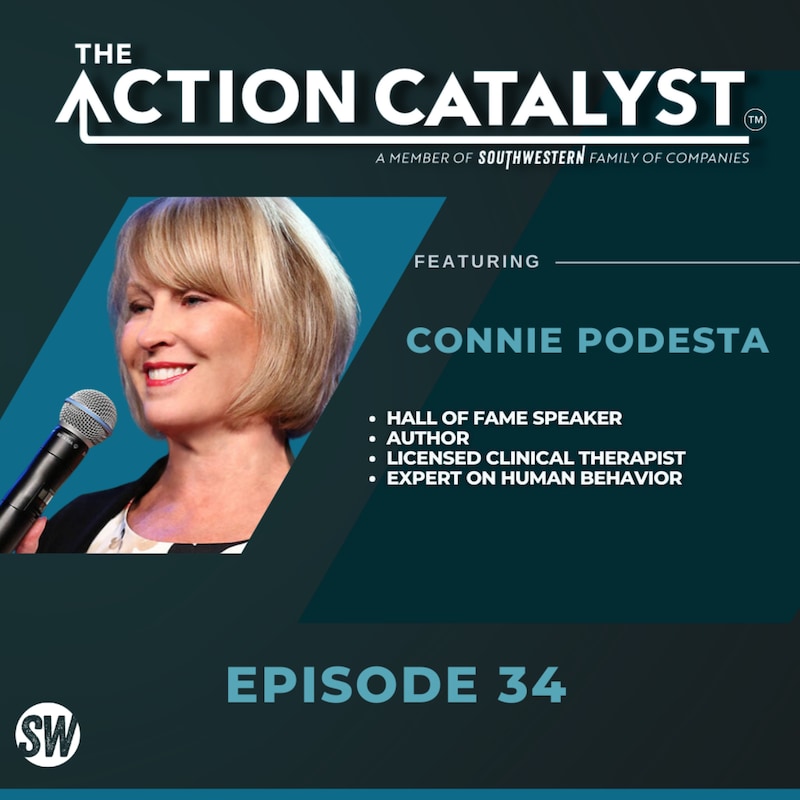
Hall of Fame speaker, author, and human behavior expert Connie Podesta explains why EVERYTHING is sales, breaks down the difference between relaters vs bottom-liners, and shares how the person doing the selling should be the person to have to shoulder any discomfort in a situation….but why people are reluctant to do so.
Transcripts
it.
Host:Yeah, well, I know, I know how to sell, and you have sort of an interesting philosophy on that.
Connie Podesta:Yeah, my audiences vary from all, you know, all industries, all ages, like you said, kind of all over the world, so different countries. And so I always start out and say, you know, the only people I really want to talk to are sales people. And then there's just a silence. And then I say, Well, really, how many of you are not in sales? And then I get all these hands raised. And so then I'll go up to, you know a guy, and I'll say, so are you married? And he'll say, Well, yeah. And I go and you're not in sales. I mean, you have never tried to close the deal with her or sell her on anything. You don't We don't need to redecorate this year, or let's save a little more money. And then I'll walk up to someone else and say, so you're not in sales. Now, are you a parent? Yeah. Oh my goodness, you're not in sales. I mean, you never try to get your kids to meet a curfew or make better grades, so after a while, you know, they kind of get it. And I said, so I think we need to
Connie Podesta:redefine the word sale for anyone listening that's ever had kids. We start selling psychologically. We start selling around 18 months, and we become masters at it by the time we're two and a half or trees. So anybody listening it to remember kids that young, they they had all the sales techniques. Never read a book, you know, never went to a workshop that they did a needs assessment. They figured out which was the, you know, disciplinarian parent, which one was the WIMP parent. That's the one that doesn't want little Susie or Johnny to ever have any consequences. They just want their life to be happy. And so they do a needs assessment, they find out which parent or caregiver is the easiest and and then they, you know, they go at it, and they lay out everything that they want. I want a cookie, I don't want to go to bed. And then they overcome every objection. They got it down. So we have been selling our whole lives, but we have not perfected it. I think it's because most people
Connie Podesta:have you found don't really like the word sales. Even people will say, Well, you know, that's not really what I do. I really connect. I really share. They don't want sales. Even one of the most interesting industries to me is direct sales. I mean, the word sales is in their name, it's direct sales. And yet, a lot of them, before they bring me in, I'll say, you know, we don't really want to use the word sales. We want to, we want you to say the word share. We share. And I said, Well, if all they're doing is sharing, you're not going to keep your business going. Don't you want them to close a deal? And do you want them to place an order? Well, yeah, yeah. Well, sharing is you and I talking about a movie we like, you know where you and I talking about where we should go on vacation, closing a deal and taking money for something that failed. So even in businesses where sales is in their name, they're hesitant to use the word. Most of us have a psychological aversion
Connie Podesta:to quote failed people, or because we've all had that experiences, we tend to remember those more than we remember the good. Everyone listening today can picture in their mind somebody that was manipulative or pressuring, high pressure. They were, you know, devious. Say, I mean, all these words come to mind. It's a very suspicious kind of a word that someone's going to sell to you. They have their own interests in mind, which often they do, and they'll do anything to close the deal. And so we don't want to use the word sales. We want to use the word share, because share is a nice word. Share means you and I are friends, and I'm not just out for me and I'm interested in your you know, well being, but we also everyone listening out. You also can think of people who were dynamite. I mean, we have all had sales people that were excellent. You know, maybe they were the at a restaurant or a car dealership, a financial planner, but we don't remember those people. So a lot
Connie Podesta:of people, if you put the word sales and said, Give me your first word, they'll come up with a negative word rather than a positive. So I try to get rid of that first. That's the first thing we do, is sales is not a bad word, and sales people are not bad people like everyone else. There's people who don't do it correctly. They don't do it right, but there's also amazing people who are outstanding sales people who do have your best interest in mind, and they're not trying to manipulate, manipulate you or coerce you or pressure you. They they really are there to help you.
Host:So once you get past that idea of like, okay, it's okay to be in sales, there's good, it doesn't mean I'm an evil person or I'm bad. What do you think are some of the like, the key, the salient points or highlights of how to get people on board?
Connie Podesta:Well, the first thing is to realize that if you can't sell, you really can't do anything. Even when I was doing private therapy and coaching and had private clients, one of the things I said to her first is we're going to learn how to sell. And what I mean by that is we're going to learn how you can get your ideas across and hopefully persuade someone or influence. The word I like is influence. Great sales people are great influences, meaning that number one, you trust them, and number two, you believe in them. And number three, you do think that they have your interest in mind. And number four, they're backed up with information and research. They had good points to make. They're open to listening. And so you know, but we help people understand that, and for everyone listening. If you're in a significant relationship, have a significant other or marry, getting your spouse on board is huge. If you're a parent, getting consensus from your kids is huge.
Connie Podesta:There really isn't any relationship where getting someone on board is not a huge, critical, vital piece of that relationship, if it to continue. You know, if you and I are married, we do have some different personality things, and we have some different ideas, and we have some different perceptions, and we're going to have to figure out how to get one another on board, even if we don't always agree with each other there, there at least has to be enough consensus between the two of us that we can pay our bills and live Our life and raise our kids and and grow together as people and teaching people how to get on board that. Let's really get to the crux of of what people living now can learn on stage. I talk about four different personality types, and it's kind of something I've been during a long time. But for the purpose of this call, let's, let's simplify it even to the bottom line, for the most part, people tend to be either, and I'm going to put it into two groups,
Connie Podesta:either relators or bottom liners. Those are what I call it. And if you look at all the people in your life, and this is way, way, way, generalizing, but for the really going to teach a point people who are relators, probably you and I, because we speak, these are people where we're very caring. The relationship is first, you know, we we want this person to like us. We want them to respect us. We want them to go along with us. If we don't get consensus, we take it personally. We think we didn't say it right, or they don't like us, and we come on stronger. So relators, that's one group, and I'm going to talk about what they do right and what they do wrong. But then there's another group of people that are more bottom liners. These people want information more than they want to get into the relationship. So the relators are trying to get on board with the relationship, and then the information comes in second. The bottom liners are people that are really trying to get the
Connie Podesta:information make a solid, logical, rational decision, and then the relationship comes in second. So can you kind of picture that? So in the typical marriage, you tend to have often a relator and about a lawyer you know one person that you know. We don't talk anymore. We never share anything, and you don't listen to me and and when they when they want something, they start way back in 9019 98 they tell everything you know, everything that leads up to it. Meanwhile, they're in a relationship with a bottom liner who it has like a six second attention span that they don't hear something that triggers them, connects with them. Their mind is gone and they're looking for information. So in a marriage, you can see how this happens. The relator is trying to get their spouse or significant other on board by telling stories by the tone of their voice, by hugging someone, by telling them what happened 20 years ago. And meanwhile, the bottom liner is trying to get consensus with none of
Connie Podesta:that. When the bottom liner wants something, they approach it wrong too. Instead of, you know, setting the stage a little bit and creating a place where people can talk which the relator wants, they just walk in and say, you know, we really need to get the yard cleaned up, and it really should be done some. I mean, they do it in a way that so to the point that the relator kind of gets their feelings hurt, and we didn't have to say it like that. So even within a long term relationship, we had trouble. Then you move into parenting, you know, if you have a relator parent who wants to tell the story and love the kid, and where did you go, or what did you do, and all your friends are so nice, is that what you're going to wear? And they have a bottom line kid, which you're likely to have, if you have two or more, the kids has tuned you out. And then we move into work in the same thing, if I'm a salesperson and I have a great product and I'm a. Or later, and you're a bottom
Connie Podesta:liner, it will. It's not going to happen because I'm like, how are you? I want to do some small talk. I want to meet you at a Starbucks where we have a cup of coffee. I want to get to know you. Meanwhile, you're getting more and more annoyed with me. By the second. The longer you're annoyed with me, the less likely you are to ever close a deal.
Host:Is there any sort of key indicators you can look for quickly to go on dealing with a relater, or I'm dealing with a bottom liner, and how do you modify accordingly?
Connie Podesta:I teach people on the stage and then sales to ask someone how they want the process to go, which is something so people never do. I mean, God forbid they ask somebody, you know, they just we all sell the way we want to be sold to. So if I'm a relator, those are the kind of sales people that attract me, people who are open and people who are friendly. I trust them because of that personality. Therefore I assume that everyone's like that. So when we all do that, we sell to our own personality, we convince people to our own personality. So if I'm on the call with a meeting planner and we're trying, I'm trying to sell myself as their keynoter, and they're trying to sell me on their convention, what I would say to them is, look, you know, there's a couple ways we can do this. We can get, I got plenty of time. We can, you know, sit back, get to know each other a little bit. You can ask me kinds of questions and take your time and tell me in your own way about the
Connie Podesta:event. Or you can just, I can just tell you what I do. I can tell you my fee. I can tell you whether I have the data available, and we'll move forward, and they will answer you. Within three seconds, you'll hear it in their voice. The the relator will be like, Oh no, no, I've been so excited to talk to you, and yeah, let's just, you know, I had so many questions that I got your book here. I mean, they haven't asked you what your fee is. They haven't, but if you're on with the bottom liner, there's almost annoying, because even the question, even the question, took too much time. So in their voice, you'll hear that annoyance. You'll hear, Oh, no, no, I've got a meeting in six minutes. I just, I just need to know your fee. And don't even call me. Don't mean, I mean, here's the biggest problem, people can recognize it. The world smart people can recognize somebody's more bottom line, or they recognize someone's more relator. It's not recognizing who they're dealing with. It's
Connie Podesta:changing their style once they recognize it. That's what people don't do. I mean, I deal with tons of sales people, and I watch them, and here's the bottom liner, and the person's giving them a hug. Which number one, anyone's touching you? They're a relator. You know, bottom liners are not touching you, hugging you or standing close to you, and you know they're getting hugged and talking. And the bottom liner, he sees it, but he or she isn't going to change it. Instead of standing back, taking a deep breath and saying to themselves, you know what? This isn't how I would like to do it, but obviously I'm going to have to make some small talk here. I'm going to have to kind of watch what's going on. I'm going to have to take my time, or I'm never going to close this deal. If we're trying to close the deal. If we're trying to influence someone's behavior and get them on board, whether it's another department or our boss or a child or a co worker, they're making a difference who it
Connie Podesta:is. If somebody is going to be uncomfortable, it should not be them. If anyone's going to be uncomfortable, it should be us. Truly want to close the deal if anyone's going to change behaviors or change styles of selling or style that's influencing persuading, we should not expect them. And where it really happens is in parenting, because as parents, we see ourselves in the authority position. There's no way do we think we should have change our style, and yet, if you really want that kid to make better grades, or you really want your child to, you know, do something that's important to you, then it's still valuable and and I do not mean for anyone listening. I'm not asking that you compromise your values or your ethics or the essence of who you are. Sometimes I get an email that once in a while, so when I ask you to compromise who you are, what you believe in. The only thing I'm suggesting is, is that your style of influence, your style of presenting the
Connie Podesta:situation, could be tempered based on what's comfortable for the other person, rather than what's comfortable
Host:Folks, go to ConniePodesta.com. Connie. Thank you so much for being with us.
Connie Podesta:You're welcome.






