Shownotes
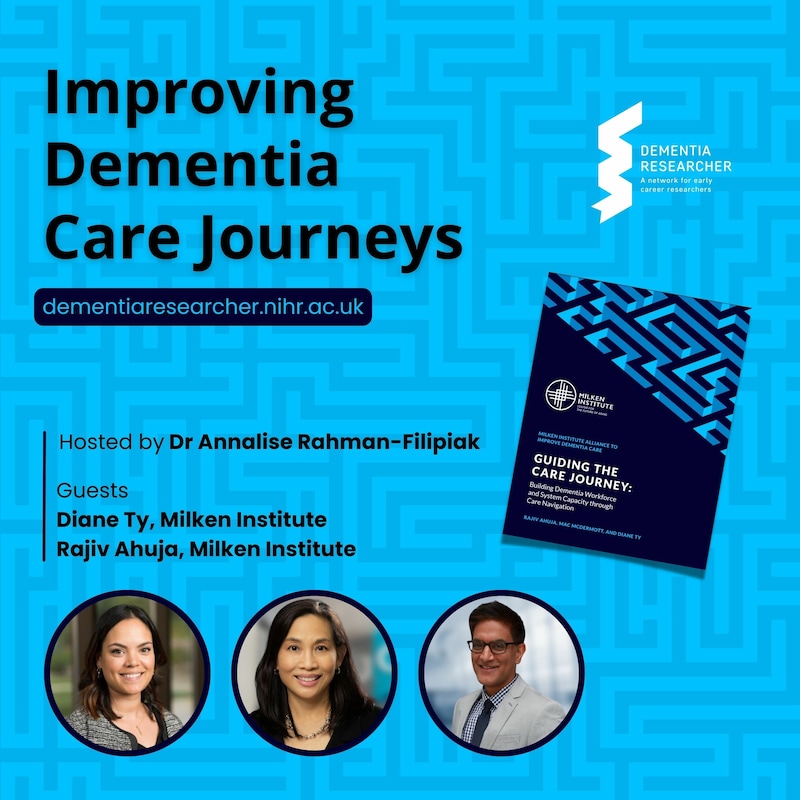
This episode of the Dementia Researcher Podcast is hosted by Dr Annalise Rahman-Filipiak and features Diane Ty and Rajiv Ahuja, authors of a pivotal report from the Milken Institute – Guiding the Care Journey.
In this show we discuss the report, its importance an findings – addressing critical challenges and presenting innovative solutions for dementia care in the United States, with a particular focus on the role of the care navigators.
While the report primarily addresses the U.S. context, its recommendations are deemed relevant globally, and the discussion aims to shed light on findings related to improving care for people living with dementia and their families, wherever you are.
- Download the report: bit.ly/3uEgvtq
- Visit the Milken website: milkeninstitute.org/
About the guests:
Diane Ty is the Senior Director of the Milken Institute Future of Aging overseeing its work at the intersection of healthy longevity and financial security. She leads its Alliance to Improve Dementia Care and other multisector programmatic efforts that promote policy, practice, and systems change in a life course approach to aging.
Rajiv Ahuja is the Associate Director of the Milken Institute Future Ageing. His work focuses on aging policies and programs that support healthy longevity. Rajiv spearheads efforts to incentivize policy, business, and technology-based approaches that promote brain health, combat stigma, reduce costs, and bridge health and economic disparities.
Dr Annalise Rahman-Filipiak is an Assistant Professor, Clinical Neuropsychologist at University of Michigan. Annalise broadly studies racial-ethnic disparities in dementia diagnosis and treatment, as well as non-pharmacologic treatments for Alzheimer’s disease and related dementias. Her recent work has focused on disclosure of imaging and fluid-based biomarkers to diverse audiences, including cognitively healthy older adults and those with impairment
--
A transcript of this show, links and show notes and profile on all our guests are available on our website at https://www.dementiaresearcher.nihr.ac.uk.
If you prefer to watch rather than listen, you will find a video version of this podcast on Apple Podcasts, YouTube, and on our website.
Leave us a tip:
https://dementia-researcher.captivate.fm/support
Follow us on social media:
- https://www.instagram.com/dementia_researcher/
- https://www.facebook.com/Dementia.Researcher/
- https://www.twitter.com/demrescommunity
- https://www.linkedin.com/company/dementia-researcher
- https://bsky.app/profile/dementiaresearcher.bsky.social
Download and Register with our Community App:
https://www.onelink.to/dementiaresearcher
We gratefully acknowledge the support of our funders: Alzheimer’s Association, Race Against Dementia, Alzheimer’s Research UK, Alzheimer’s Society, and the National Institute for Health and Care Research.
The views and opinions expressed by guests in this podcast are their own and do not necessarily reflect those of the producers, funders, or sponsors.
Subscribe to our sister show 'Dementia Researcher The Blogs':
Transcripts
- [Announcer] The "Dementia
Researcher" podcast,
Speaker:talking careers, research,
conference highlights,
Speaker:and so much more.
Speaker:- Welcome to the "Dementia
Researcher" podcast.
Speaker:I'm Dr. Annalise Rahman-Filipiak.
Speaker:I'm a neuropsychologist
and assistant professor
Speaker:at the Research Programme on Cognition
Speaker:and Neuromodulation-Based Interventions
Speaker:here at the University of Michigan.
Speaker:And today I have the pleasure of hosting
Speaker:Diane Ty and Rajiv Ahuja,
Speaker:authors of a pivotal report
from the Milken Institute.
Speaker:The report titled,
"Guiding the Care Journey"
Speaker:was published a few months ago.
Speaker:And it addresses the critical challenges
Speaker:and presents innovative
solutions for dementia care
Speaker:in the US, with a
particular focus on the role
Speaker:of the care navigator.
Speaker:Of course, we know that many
of our listeners are in the UK
Speaker:and other parts of the world,
Speaker:but the important
recommendations in the report
Speaker:are relevant to all of us,
Speaker:as we face similar
healthcare system challenges.
Speaker:Now most countries are
expected to see a rise
Speaker:in dementia cases in the coming years.
Speaker:In fact, the World
Health Organisation says
Speaker:that the 55 million cases
that were found in: Speaker:will increase to 139 million by 2050.
Speaker:So our discussion today will shed light
Speaker:on what our guests have uncovered
Speaker:about how we can improve care for people
Speaker:living with dementia and their families,
Speaker:and how people that deliver
that care are important.
Speaker:So let's start by meeting our guests.
Speaker:(bright music)
Speaker:Hi, Diane, and hello, Raj.
Speaker:- Hi, Annalise.
- Hi.
Speaker:- How you both doing?
Speaker:- We're good, thank you.
- Doing great. Thanks.
Speaker:- Diane, why don't you start by telling us
Speaker:a little bit about yourself?
Speaker:- So I lead the Milken Institute Centre
Speaker:for the Future of Ageing, where
we work at the intersection
Speaker:of healthy longevity and
financial care security.
Speaker:We do that through research, convenings,
Speaker:multi-sector partnerships,
Speaker:and the elevation of high-impact
policies and practises.
Speaker:I've been here for almost three years,
Speaker:and before that I was a senior partner
Speaker:at Georgetown University
School of Business
Speaker:working in a group called
Business for Impact.
Speaker:I spent time at AARP, AARP Services,
Speaker:the for-profit subsidiary of AARP,
Speaker:and just Save the Children,
Speaker:and then I spent about a
decade at American Express.
Speaker:So I love working across
the public, private,
Speaker:nonprofit sectors, and
that's what this job is.
Speaker:- Fantastic. Thanks so
much for being here.
Speaker:Raj, how about you?
Speaker:- Yeah, thanks, Annalise. I
appreciate this opportunity.
Speaker:I work closely with Diane
Speaker:in our Centre for the Future of Ageing
Speaker:here at the Milken Institute.
Speaker:And work with Diane to manage our alliance
Speaker:to improve dementia care, which
is a broad-based coalition
Speaker:of over 130 dementia-focused organisations
Speaker:that are really looking
to improve how healthcare
Speaker:and long-term care services are delivered
Speaker:to people at risk for dementia
and living with dementia,
Speaker:as well as their families.
Speaker:I've been at the Milken Institute
Speaker:for about four and a half years
Speaker:and come from a background
in healthcare policy,
Speaker:doing consulting for
pharmaceutical companies,
Speaker:for health plans, military health,
Speaker:all with the goal of
trying to increase access
Speaker:to care services and
products for everyone.
Speaker:So I'm happy to be here
to talk about this topic.
Speaker:Appreciate it.
- Well, thanks for being here,
Speaker:both of you and sharing
your vast expertise with us.
Speaker:(bright music)
Speaker:Diane, let's start with an easy question.
Speaker:Could you give us a high-level
intro about this report,
Speaker:how it came about, and maybe why you think
Speaker:this topic is so important?
Speaker:- Sure, so as Raj mentioned,
we have this alliance
Speaker:to improve dementia care
over 130 multi-sector,
Speaker:you know, multi-stakeholder members.
Speaker:And our steering committee in particular,
Speaker:we consult with them from time to time.
Speaker:We meet bimonthly, and you know,
Speaker:we were really asking
them what is the area
Speaker:that we, as a cross-collaborative group,
Speaker:should be focused on?
Speaker:And the topic of workforce,
Speaker:a dementia-capable workforce came up.
Speaker:Raj was instrumental in getting
our alliance off the ground.
Speaker:I joined in December, 2020.
Speaker:So we've been around
for about three years.
Speaker:And our steering committee just represents
Speaker:this whole cross sector.
Speaker:So we all agree that workforce shortages
Speaker:is a critical area of concern.
Speaker:And so we set out to look
at what does that mean?
Speaker:We had a working group, we
do our round table convening.
Speaker:It's a private session,
Chatham House rules.
Speaker:We come up with consensus-based
recommendations,
Speaker:it's peer reviewed, and that's
how we release the report.
Speaker:But this topic of dementia care navigator
Speaker:and that role was front
and centre as we did our,
Speaker:you know, went through our process.
Speaker:And then this really came
to light as a key area,
Speaker:game-changing role for dementia care.
Speaker:- Awesome.
Speaker:One of the things I thought
was that was really unique
Speaker:about your dementia care alliance
Speaker:and maybe the steering
committee is the input
Speaker:that you get too from
people living with dementia
Speaker:and their families.
Speaker:- Absolutely, and so for each
of our private round tables,
Speaker:we start out with someone,
you know, living with dementia
Speaker:or caregiver caring
for loved one dementia,
Speaker:really just giving kind of a,
Speaker:you know, a sharing the experience.
Speaker:And it really then just sets the tone
Speaker:for why we're all here.
Speaker:What I'm amazed at is the
number of people, members,
Speaker:including myself, who've
had a personal experience
Speaker:caring for a loved one with dementia.
Speaker:I lost my dad to Alzheimer's 11 years ago.
Speaker:And it still feels really
raw after all this time.
Speaker:And this is why we're
so motivated to improve
Speaker:that care journey for the
people living with dementia
Speaker:as well as their family caregivers.
Speaker:- Yeah, it's very clear that
you both bring that passion,
Speaker:that personal passion to this work.
Speaker:Raj, the report highlights
a significant challenge
Speaker:in meeting these growing
demands for dementia care,
Speaker:especially given this expected
doubling of individuals
Speaker:living with Alzheimer's disease
Speaker:and related dementias by 2040.
Speaker:What are some key strategies
to address the shortage
Speaker:in what you call the
dementia-capable workforce,
Speaker:the medical providers
with specialised training
Speaker:in dementia care?
Speaker:- Thanks, Annalise.
Speaker:I think, you know,
you're absolutely right.
Speaker:Here in the US, our healthcare system,
Speaker:our long-term care system is really facing
Speaker:significant challenges
right now in meeting
Speaker:this growing demand for dementia care.
Speaker:I think especially the
statistic that you cited
Speaker:in terms of doubling of the population
Speaker:is really gonna impact
how services are delivered
Speaker:in cities, in rural populations,
in underserved populations,
Speaker:low-income populations
all are gonna be impacted
Speaker:by the shortage of a workforce.
Speaker:And so I think when you think
of this growing population
Speaker:and the capacity constraints
that come with it,
Speaker:you know, the workforce is
really going to be at the centre
Speaker:of efforts to improve dementia care.
Speaker:And we know that moving forward,
there's gonna be a shortage
Speaker:of primary care physicians, geriatricians,
Speaker:specialists, and direct
skilled care workers.
Speaker:I think there's statistics
that show, you know,
Speaker:over the next couple
decades there's going to be,
Speaker:there's gonna need to be a quadrupling
Speaker:of the number of geriatricians
in order to meet this demand.
Speaker:And so I think, you know, it
requires a little bit more
Speaker:foresight in terms of filling that need
Speaker:for this growing population,
Speaker:when what we really need is, you know,
Speaker:a comprehensive dementia-capable
Speaker:and culturally-sensitive
workforce, you know,
Speaker:that's highly coordinated,
that's trained specifically
Speaker:in dementia care and
can recognise symptoms
Speaker:and make the necessary community referrals
Speaker:and are familiar with the available tools
Speaker:and resources that are out there.
Speaker:You know, we know that this
dementia-capable workforce
Speaker:is going to need to represent
a broad range of interests.
Speaker:So, you know, how do
we go about doing that?
Speaker:You know, I don't think
it's going to be realistic
Speaker:to train as many primary care physicians
Speaker:and geriatricians that we need.
Speaker:So how do we go about addressing this?
Speaker:And I think, you know, at its very core,
Speaker:we really need to start
expanding the definition
Speaker:of what that workforce is.
Speaker:You know, we need to include
everyone that interacts
Speaker:with high-risk individuals and
families living with dementia
Speaker:that's either a current
healthcare professional,
Speaker:a future healthcare
professional, including nurses,
Speaker:community health workers,
and long-term care workers.
Speaker:And I think even family members,
Speaker:family caregivers are all
going to need to be part
Speaker:of this expanded definition of workforce.
Speaker:And so, you know, in our report,
Speaker:we outline a number of strategies also
Speaker:to increase the
dementia-capable workforce.
Speaker:And we really focus a lot on
efforts to increase recruiting,
Speaker:increase training, and increase retention
Speaker:of the dementia-capable workforce.
Speaker:And I would just kind
of note that, you know,
Speaker:with the growing shortage
of healthcare professionals,
Speaker:there are some bright spots there also.
Speaker:We know that certain professions
Speaker:within the healthcare
industry are growing.
Speaker:Nurse practitioners in
particular is a growing field,
Speaker:physician associates are a growing field,
Speaker:social workers are a growing field.
Speaker:And so these are all ripe
associations to recruit from,
Speaker:to train and really
bring into this dementia
Speaker:conversation in terms of workforce.
Speaker:- Fantastic.
Speaker:I think that's a great
lead into my next question.
Speaker:It may be useful for our listeners,
Speaker:given the broad
listenership of the podcast,
Speaker:to hear a little more about this role
Speaker:as it might not be quite
so common outside the US.
Speaker:So Diane, the report
defines care navigators
Speaker:or care navigation as
individualised assistance
Speaker:to patients and caregivers
to facilitate access
Speaker:to quality health and psychosocial care.
Speaker:Maybe you could tell us
a bit more about the role
Speaker:of care navigators, what
settings they might work in,
Speaker:what are some personal or
professional qualifications
Speaker:of the care navigator.
Speaker:- Sure. Thanks, Annalise.
Speaker:So absolutely, this care navigation role,
Speaker:I wanna start by just saying it's a role
Speaker:that's actually common in
cancer care, diabetes care.
Speaker:And what we did is we had a prior report
Speaker:to this one called
Speaker:"Scaling Comprehensive
Dementia Care Models."
Speaker:And in that we focused on
the eight core elements
Speaker:that define a comprehensive
dementia care model,
Speaker:of which there are six
evidence-based ones.
Speaker:And we talk about them in not only
Speaker:the "Scaling Comprehensive
Dementia Care" report,
Speaker:but we also reference
them in this new report
Speaker:on guiding the care journey.
Speaker:So they include the eight core elements
Speaker:include things like caregiver support,
Speaker:medication management, care coordination,
Speaker:ongoing care planning.
Speaker:And we looked at the different models
Speaker:where some are telephonic-based
or online-based,
Speaker:some are community or home-based
Speaker:and some are clinically-based.
Speaker:You can just see that range,
and I'll mention the six.
Speaker:Most of them focus
within academic settings.
Speaker:So there's a UCLA dementia care programme,
Speaker:University of California San
Francisco Care Ecosystem,
Speaker:which is the telephone-based one.
Speaker:Emory University's
Integrated Memory Care model.
Speaker:Benjamin Rose Institute, and
then the Eskenazi Health one
Speaker:at Indiana University, and then MIND,
Speaker:Maximising Independence at Home,
Speaker:that comes out of John Hopkins University.
Speaker:These are all awesome models,
Speaker:but what we looked at is
these eight core elements,
Speaker:while necessary, we don't think
they're all created equal.
Speaker:So we kind of took a step back and said,
Speaker:"What among these eight could
be actually game changing
Speaker:if we could get this one role focused on?"
Speaker:So it was that care coordination role.
Speaker:So someone who's actually
helping the person
Speaker:living with dementia and
the family caregiver,
Speaker:that care dyad that we refer to,
Speaker:navigate our complex health
system, our healthcare system,
Speaker:and the social care system,
Speaker:all the types of social care services
Speaker:that are outside the medical setting
Speaker:delivered mostly by
community-based organisations.
Speaker:So transportation, meals,
caregiver training, support,
Speaker:respite care, all of these
are really critical parts
Speaker:of the dementia care model.
Speaker:And so, you know, we did these
Speaker:key opinion leader interviews,
we had a round table,
Speaker:all of this started bubbling up,
Speaker:like if we can define this model.
Speaker:And you'll see a chart in our report
Speaker:that organises advice setting.
Speaker:One of the things that's a bit confusing
Speaker:that we acknowledge too in the report
Speaker:is the name of this role,
Speaker:dementia care specialist, which
is used in Wisconsin state
Speaker:to reference non-licensed
care paraprofessionals.
Speaker:That dementia care specialist is also used
Speaker:in the clinical care
model offered by UCLA,
Speaker:care coordinator, and so
we wanted to acknowledge
Speaker:that even that, depending
on the care models,
Speaker:can be confusing, venture care specialist,
Speaker:venture care coordinator, on and on.
Speaker:But essentially the role is
to be that sort of guide,
Speaker:you know, all along the way
knowing when to escalate
Speaker:and elevate the care,
when to bring the person,
Speaker:if they're evolving or progressing
Speaker:in their dementia care journey,
what we might need to do.
Speaker:Is there medication management?
Speaker:And bringing in the right
intervention at that time
Speaker:and being part of an
interprofessional care team.
Speaker:So really core to that
interprofessional care team,
Speaker:care navigator and caregiver,
as well as the clinical folks.
Speaker:So I hope that answered your question.
Speaker:- I think so, yeah. That's
fantastic information.
Speaker:It really strikes me, oh, go ahead-
Speaker:- Annalise, can I just jump in-
Speaker:- Yeah, please.
- To kind of piggyback
Speaker:off of what Diane said.
Speaker:You know, this position is
a really versatile position.
Speaker:And I think, you know,
we talk so much about
Speaker:the unique journey of families
that live with dementia.
Speaker:You know, it's a progressive disease
Speaker:that requires different
interventions at different stages.
Speaker:And so I think, you know, the care models
Speaker:that Diane mentioned, you know,
some are more on the medical
Speaker:side of care for folks
with more advanced needs
Speaker:that require, you know, more
of medication management,
Speaker:that require more therapeutics.
Speaker:But there's a whole group of
individuals at early stages
Speaker:that really need access to education,
Speaker:access to appointment, you know,
Speaker:facilitation among the
fragmented specialists
Speaker:that they have to see.
Speaker:And so I think this care
navigator, you know,
Speaker:is very versatile in terms
of being able to provide
Speaker:those services along that spectrum
Speaker:of the disease journey
that a lot of families
Speaker:have trouble navigating.
Speaker:So I just wanted to
throw that in there too.
Speaker:- And just to piggyback on what Raj said,
Speaker:you know, we look at a
population-health approach.
Speaker:So if you think about like a care pyramid
Speaker:with the folks at the
bottom, as Raj mentioned,
Speaker:maybe in that early stage,
if they're diagnosed,
Speaker:they might just need more
of that care and handholding
Speaker:and navigation all the way
to the top of the pyramid
Speaker:where you have more of
a moderate to advanced
Speaker:stage of the disease where you
may have behavioural issues
Speaker:and need for therapeutics
and much more care,
Speaker:and so delivered at the higher level
Speaker:of your licenced care professionals,
Speaker:like your nurse practitioners,
your geriatricians.
Speaker:So yeah, it's a very versatile role.
Speaker:- Yeah, I really think that
leveraging paraprofessionals
Speaker:is just an amazing part of
this set of recommendations.
Speaker:And part because in my
experience, I think a lot
Speaker:of our paraprofessionals
have a great knowledge
Speaker:of the community, often have
the trust of the community.
Speaker:- Absolutely, yes.
Speaker:- And particularly when we're talking
Speaker:about marginalised communities,
Speaker:individuals who may have less access to
Speaker:or trust in the healthcare system,
Speaker:that could be a massive strength.
Speaker:- We are actually writing an update to one
Speaker:of the other reports we did,
Speaker:which was building the
workforce to improve
Speaker:early detection and diagnosis of dementia.
Speaker:And since then, that
came out in May of: Speaker:And we've seen such a sea change going on
Speaker:with what's going on with dementia space.
Speaker:And we did a lit review and all,
Speaker:and it's really pointing to
is community health workers.
Speaker:To your point, they're from
the community, they're trusted,
Speaker:they're culturally competent,
Speaker:linguistically capable in many cases.
Speaker:And we see such a disproportionate risk
Speaker:of people with dementia in terms of,
Speaker:you know, Blacks two times more likely,
Speaker:Hispanics one and a
half times more likely.
Speaker:We don't know offhand the
dementia risks for AAPIs,
Speaker:but Raj and I actually
co-authored an article
Speaker:to try to shine a light on
the fact that, you know,
Speaker:one size does not fit all.
Speaker:So if we lump AAPIs together in one group,
Speaker:there's many different ethnic backgrounds,
Speaker:socioeconomic backgrounds,
ethnic backgrounds
Speaker:within the AAPI community.
Speaker:And we strongly believe that
there's disproportionate risk
Speaker:for certain subpopulations of the AAPI.
Speaker:So absolutely those
trusted community workers.
Speaker:- Mm-hm.
Speaker:And for listeners outside the US,
Speaker:I also wanna mention
that, you know, Diane,
Speaker:you just mentioned that
we see that, for instance,
Speaker:Black and African American
patients are twice as likely
Speaker:to have Alzheimer's disease
but tend to be diagnosed
Speaker:much later and much less frequently.
Speaker:We also know that their care partners
Speaker:tend to have a disproportionate
burden of caregiving.
Speaker:So they're get caregiving full-time,
Speaker:they're caregiving at later
stages of the disease.
Speaker:So I'd love to talk more
about how the care navigator
Speaker:might address that specific disparity.
Speaker:Raj, maybe you could tell
us a bit more about that.
Speaker:- Sure.
Speaker:You know, I think it's
so critical to, you know,
Speaker:highlight how complex
dementia care is in general.
Speaker:There's so many specialists
that families have to see,
Speaker:you know, the issue of
access to care is, you know,
Speaker:front and centre for everyone
living with dementia.
Speaker:But I think, you know, there's
been longstanding disparities
Speaker:that things like COVID had highlighted
Speaker:that really impact families
in underserved communities
Speaker:that are living with dementia.
Speaker:And so when we talk about
underserved communities,
Speaker:you know, we talk about
racial and ethnic disparities
Speaker:of which there are major discrepancies,
Speaker:you know, in access to care.
Speaker:We talk about rural versus
urban access to care.
Speaker:You know, there's a tremendous
issue with just being able
Speaker:to see primary care physicians
in rural communities.
Speaker:And we also talk about low
socioeconomic communities
Speaker:in terms of the cost of care to families.
Speaker:They spend more out of pocket
than other communities.
Speaker:And so I think, you
know, one of the things
Speaker:that care navigation does
is it really highlights
Speaker:the need for a comprehensive
approach to dementia care
Speaker:and places the care
navigator at the centre
Speaker:of that approach.
Speaker:So families often have
a hard time engaging
Speaker:with their providers.
Speaker:They have a hard time navigating
the multiple requirements
Speaker:that are needed in terms of appointments.
Speaker:They have a hard time
applying for benefits.
Speaker:And so care navigators can
really be that point of contact
Speaker:for families to help with things
like applying for benefits
Speaker:that they need,
Speaker:for making
culturally-appropriate referrals
Speaker:into the community.
Speaker:You know, we know that a lot
of dementia care takes place
Speaker:outside of formal healthcare systems
Speaker:and really takes place in the community,
Speaker:and the access to those community
supports is really needed,
Speaker:you know, for individuals in
these diverse communities.
Speaker:And, you know, care navigators
are trained to understand
Speaker:what is available in
terms of nutrition access,
Speaker:in terms of some of the
physical interventions
Speaker:that are applicable to education,
Speaker:to resources for, you know, understanding
Speaker:the modifiable risk
factors that are needed,
Speaker:and really making that a more kind of
Speaker:culturally-appropriate referral.
Speaker:And so I think those care navigators,
Speaker:like the community health
workers that Diane had mentioned,
Speaker:you know, represent those families.
Speaker:We in our report make
recommendations to recruit
Speaker:from underserved communities
so that those care navigators
Speaker:speak the language, so
that's not a barrier.
Speaker:They can engage
compassionately with families
Speaker:and connect them to providers as needed.
Speaker:They can be the voice of caregivers.
Speaker:'Cause a lot of times caregivers
Speaker:in underrepresented communities
experience a higher burden
Speaker:to their health.
Speaker:They experience a higher burden
Speaker:in terms of out-of-pocket expenses.
Speaker:And so I think that care
navigator as kind of the liaison
Speaker:among all the different fragmented systems
Speaker:in dementia care really provide, you know,
Speaker:more of that access
into the care, you know,
Speaker:some of those underserved
communities have traditionally
Speaker:had a hard time with.
- Fantastic.
Speaker:Thanks for sharing that.
Speaker:So Diane, your report makes
six key recommendations
Speaker:with the first theme focusing
on developing a framework
Speaker:for care navigation on
dementia care teams.
Speaker:Can you discuss the importance
of these recommendations
Speaker:and how they may be
effectively implemented?
Speaker:- Sure, so yeah, the
first theme was around,
Speaker:you know, really looking at the
dementia care navigator role
Speaker:in the various care settings,
which I've already mentioned,
Speaker:the telephone or online,
home and community-based
Speaker:and clinical setting.
Speaker:We do this chart that
looks at the licencing
Speaker:and non-licensing, emphasising
no matter what that area
Speaker:or level of professional
or paraprofessional,
Speaker:they need dementia-specific training.
Speaker:And then we have our second
recommendation was around,
Speaker:I think Raj already mentioned this,
Speaker:recruitment efforts to really bolster
Speaker:the dementia-trained workforce.
Speaker:So we looked at the shortages
Speaker:of both primary care
physicians and specialists.
Speaker:And when we refer to specialists,
Speaker:there are really four types:
Speaker:there's the neurologist,
the geriatric psychiatrist,
Speaker:geriatricians and neuropsychologists.
Speaker:That's defined by the
Alzheimer's Association.
Speaker:We're gonna have a shortage
of anywhere from 21
Speaker:to 55,000 primary care physicians by 2032,
Speaker:even more so with geriatricians,
Speaker:just at a time when our population
Speaker:is of people over 65 increasing,
Speaker:and with age being the greatest
risk factor for dementia.
Speaker:I mean, we really have, and
then this obviously echoed
Speaker:with our steering committee
with the alliance,
Speaker:a real crisis on our hands.
Speaker:And so Raj already mentioned
nurse practitioners,
Speaker:physicians, associates, social workers,
Speaker:these are actually parts
of our healthcare workforce
Speaker:that are actually growing.
Speaker:And so emphasising the
need to recruit, train,
Speaker:and have them part of these
interprofessional care teams
Speaker:is really critical.
Speaker:And then I think the third recommendation
Speaker:and our theme one with the
need for training curriculum,
Speaker:again, all up and down the chain
Speaker:from paraprofessionals to the
highest level of professionals
Speaker:who are licenced.
Speaker:And we provide some, you
know, recommendations
Speaker:for different programmes
that have been developed
Speaker:and supported, whether we
provided online, video,
Speaker:you know, in-person and just
tried to show the range.
Speaker:One of the things that I took away
Speaker:from our expert round table was,
Speaker:you know, there is that
online, there's the video.
Speaker:But until you actually are face-to-face
Speaker:with the person living
dementia, with the family,
Speaker:it's a journey of one, right?
Speaker:And so the need to customise, understand.
Speaker:And, you know, I also,
Speaker:you think about the care navigator all
Speaker:and some of the personal characteristics
Speaker:that we talked about and and emphasise is,
Speaker:you know, someone who's just, by nature,
Speaker:someone who's empathetic, empathy.
Speaker:And boy, that's a characteristic you,
Speaker:it's hard to train for and
you just have it, right?
Speaker:And so we look, you know,
we talk about really looking
Speaker:for that no matter what level you are.
Speaker:And just to see the folks
who work in this space
Speaker:that we have the privilege
of interacting with
Speaker:through our alliance
or through our travels.
Speaker:Incredible passion, incredible empathy,
Speaker:and a shared understanding.
Speaker:Many people have the lived experience
Speaker:of having cared for a loved one.
Speaker:And so, you know, kind of the,
Speaker:"I wish I had a care navigator
when I went through this,"
Speaker:you know, you often hear.
Speaker:And then how can we make
this role available to all
Speaker:as we move forward today
and moving forward?
Speaker:- Yeah, so much of this really
seems to be about translating
Speaker:across the different healthcare systems,
Speaker:across the different settings,
across cultural boundaries.
Speaker:You know, there's a lot
of versatility required
Speaker:in this role, which is great.
Speaker:- Yeah, and I think, you know,
one of the things we hear
Speaker:from folks just in terms of the workforce
Speaker:and that dementia-capable workforce
Speaker:is that these are good jobs.
Speaker:These are jobs that allow individuals
Speaker:a high level of patient access.
Speaker:It allows them to see a
career path in front of them.
Speaker:It's just a matter of elevating them
Speaker:within these interprofessional care team
Speaker:so that their role is
made more significant,
Speaker:their role is kind of
placed at the centre of
Speaker:the physicians on one side, the
community on the other side,
Speaker:the family, you know, on the other side.
Speaker:And so I think, like Diane had mentioned,
Speaker:recruiting initially is really difficult.
Speaker:We talk to trainers all the time who say,
Speaker:"We go through a period of training."
Speaker:The minute, you know,
the person we're training
Speaker:is in front of a family
confronted with some of the,
Speaker:you know, hard decisions
and hard interactions
Speaker:that take place, some of them, you know,
Speaker:it's not for them, they realise.
Speaker:But it's the ones with the empathy,
Speaker:it's the ones with the lived
experience that can overcome
Speaker:a lot of the difficulty
and the challenges.
Speaker:And we need to do more to professionalise
Speaker:the career path so that
people stick with it.
Speaker:And, you know, we talk
about things like leveraging
Speaker:existing certifications,
you know, for individuals
Speaker:that can receive that recognition
for the care that they do,
Speaker:formally recognises a person's skillset.
Speaker:It elevates them within
the dementia care team.
Speaker:So I think things like that
are things that we can do
Speaker:to increase awareness
for kind of the benefits
Speaker:of these types of roles
within dementia care.
Speaker:- You both mentioned some of
the less-trainable aspects
Speaker:of a successful care navigator.
Speaker:But you also mentioned some
certification programmes
Speaker:or learning resources that already exist.
Speaker:Are there any that you
wanna highlight here
Speaker:for those that might be
listening and thinking about
Speaker:growing in their skills?
Speaker:- Sure, I mean, I can just,
Speaker:there's one, you know,
that we really highlighted.
Speaker:It's a certified dementia
practitioner certificate
Speaker:that really targets
healthcare professionals,
Speaker:clergy, social workers, anybody
that's interacting with,
Speaker:you know, people with cognitive decline.
Speaker:It provides them with a
training and certification to,
Speaker:you know, just elevate their role again.
Speaker:There's other ones, you
know, that we highlight
Speaker:in our report from CareAcademy,
HealthCare Interactive.
Speaker:- (indistinct) one, Raj, that-
- Yeah.
Speaker:(Diane speaks indistinctly)
Speaker:It's starting to become requirements
Speaker:at the state level for anybody
that's going into their home
Speaker:to provide care for
individuals with dementia.
Speaker:And, you know, there's certain amount of
Speaker:continuing education
requirements so that they're
Speaker:kind of familiar with symptom recognition,
Speaker:triaging, disease education,
Speaker:community referrals, things at that level
Speaker:that can kind of keep
progressing, again, for families.
Speaker:- Fantastic.
Speaker:And I know that the report
itself will be linked
Speaker:in the show notes for this episode
Speaker:on the Dementia Researcher website.
Speaker:So for folks looking for
those recommendations,
Speaker:I think that they are linked
in the report, which is great.
Speaker:So Diane, turning back to you,
Speaker:dementia care is uniquely challenging
Speaker:due to the profound impact
of Alzheimer's disease
Speaker:and related dementias on
cognition, on behaviour,
Speaker:on functional capacity,
so many different aspects.
Speaker:What are some innovative
solutions proposed in your report
Speaker:to address these challenges,
Speaker:especially in terms of
supporting both the person
Speaker:living with dementia but
also their care partner?
Speaker:- Yes, you really nailed it on the head
Speaker:in terms of the challenges,
Speaker:particularly for the family
caregiver who really experiences
Speaker:physical, emotional, financial
strain through the journey.
Speaker:You know, oftentimes needing to leave
Speaker:their work if they're
employed outside the home.
Speaker:Oftentimes you'll find
it's a sandwich caregiver
Speaker:who has also caring for children,
Speaker:and never thought of themselves
and having to prepare
Speaker:for this long journey that can, you know,
Speaker:average between four and seven years
Speaker:and potentially as long
as 20, so imagine that.
Speaker:But in terms of some of the solutions,
Speaker:certainly we advocate for
the caregiver training,
Speaker:respite care.
Speaker:We're really excited, I know, you know,
Speaker:particularly US-focused,
we talked a lot about
Speaker:one of the biggest barriers to scaling
Speaker:this care navigator role is the payment,
Speaker:the lack of payment.
Speaker:So we have a whole section,
the whole theme too is around,
Speaker:you know, the need for reimbursement,
Speaker:payment, incentives, alignment.
Speaker:And so our report came
out in March of: Speaker:It's already outta date (chuckles)
Speaker:because in July of this
year, very exciting,
Speaker:our Centre for Medicare and
Medicaid Innovation, CMMI,
Speaker:announced this new model called GUIDE.
Speaker:And you know, it is really breakthrough.
Speaker:It's an alternative payment model.
Speaker:And it includes the care navigator role
Speaker:as being part of the
interprofessional care team.
Speaker:So GUIDE stands for Guiding an
Improved Dementia Experience.
Speaker:So it's offering a monthly per
beneficiary per month payment
Speaker:to support this interdisciplinary
approach to care delivery,
Speaker:must include the care
navigator on the team.
Speaker:It includes an allocation annually
Speaker:for caregiver respite.
Speaker:So, you know, I really
applaud our colleagues
Speaker:at CMMI for the listening they did.
Speaker:I applaud the incredible
advocacy work that was done
Speaker:by the Alzheimer's
Association that put forth
Speaker:this bipartisan legislation
Speaker:called the Comprehensive
Care for Alzheimer's Act.
Speaker:We also helped amplify
an economic analysis
Speaker:that was commissioned by
the Alzheimer's Association
Speaker:and conducted by Health Sperion
Speaker:to show that better
dementia care would save
Speaker:our federal government nearly,
Speaker:I think like $21 billion over 10 years.
Speaker:That's how game changing,
again, putting in place
Speaker:a comprehensive dementia
care approach can mean.
Speaker:And again, caregiver support,
24/7 access to support.
Speaker:This is game changing.
Speaker:Now, we're actually, just
yesterday we saw the release
Speaker:of the RFP, the request for proposal,
Speaker:asking for health systems to apply
Speaker:to be part of this demonstration.
Speaker:It's going to be eight years.
Speaker:So, you know, progress.
Speaker:- And then there's a big emphasis
Speaker:on making sure that this GUIDE model
Speaker:impacts underserved communities also.
Speaker:- Yes, (indistinct) could be-
- Fantastic.
Speaker:- Core to this GUIDE model,
which we're excited about.
Speaker:- So for folks outside the
US, it may be challenging
Speaker:to understand what a
monumental change this is.
Speaker:Could you maybe give folks
an idea of how more classic
Speaker:kind of Fee-For-Service
model might have limited
Speaker:implementation of this
dementia care navigator role
Speaker:or model?
- Yeah.
Speaker:So, you know, and
Fee-For-Service is, you know,
Speaker:you're kind of paying,
you're using these CPT codes
Speaker:for all the different
things that you're doing
Speaker:as a provider.
Speaker:It didn't cover things
like caregiver respite,
Speaker:didn't cover things
like caregiver training,
Speaker:or you know, any referrals.
Speaker:So we talk a lot about diagnose and adios.
Speaker:That family would be left to
just navigate on their own,
Speaker:not only the medical care,
Speaker:the appointments that Raj referred to,
Speaker:trying to find the specialist if needed,
Speaker:and then getting the
referrals in the community.
Speaker:That was not compensated,
that was not paid for
Speaker:by Fee-For-Service Medicare
Speaker:and certainly not the
dementia care navigator role.
Speaker:And I think our report,
Speaker:and certainly these evidence-based models
Speaker:that we highlighted, the six of them
Speaker:that show those eight comprehensive
Speaker:core elements as part of
these evidence-based models.
Speaker:Most of those pieces weren't covered.
Speaker:They are now as part of this GUIDE model.
Speaker:So it's really incredible the partnership
Speaker:that went into advocating and, you know,
Speaker:CMMI really seeing the crisis at hand
Speaker:and hearing story after story of families
Speaker:trying to navigate this
tough journey on their own
Speaker:and needing the supports.
Speaker:So this is really, really
monumental in the US.
Speaker:- Amazing.
Speaker:Raj, one outcome of the
global COVID-19 pandemic
Speaker:was this rapid
implementation of telehealth.
Speaker:One of the things I really
liked about your report
Speaker:was the emphasis on
leveraging online technology,
Speaker:technology-based solutions
for dementia care navigation.
Speaker:Could you give some
examples of how technology
Speaker:and telehealth could aid
care navigators in managing
Speaker:the daily tasks and
providing virtual support
Speaker:to those living with dementia
and their caregivers?
Speaker:- Sure, I think it's
important to note first off,
Speaker:with all of the conversations
around technology that,
Speaker:(coughs) excuse me,
Speaker:dementia is a very
high-touch, high-need area
Speaker:that really requires a
lot of direct interaction.
Speaker:And I think during COVID,
without that direct interaction,
Speaker:we saw tremendous suffering.
Speaker:We saw an increase in
excess deaths, you know,
Speaker:as it relates to Alzheimer's
and dementia care.
Speaker:So I think, you know, that
level of care is really, really,
Speaker:can't be emphasised enough.
Speaker:So that being said, I
think there's technologies
Speaker:that we highlight in our
report that will give providers
Speaker:and care navigators and other
healthcare professionals
Speaker:more of an opportunity to
increase that interaction.
Speaker:And so that's the kind
of area of technology
Speaker:that we try to address
and try to make a focus
Speaker:of dementia care.
Speaker:And so I think, you know,
there's three buckets
Speaker:of technology that we really emphasise.
Speaker:One is around facilitating communication,
Speaker:making sure that families
can access providers,
Speaker:can access the information
that they're needed,
Speaker:can access community
supports that are needed.
Speaker:Things like Zoom for
telehealth, like you mentioned,
Speaker:is invaluable for caregivers that can't,
Speaker:that need to be in the home,
Speaker:that need to access their providers,
Speaker:you know, in real time almost
to address certain situations.
Speaker:I think the other area of technology
Speaker:that we really talk
about is care navigators
Speaker:that can use tools to
help track and manage care
Speaker:in real time.
Speaker:And so, you know, there's
a whole need to help
Speaker:coordinate care and manage care
Speaker:among various healthcare professionals.
Speaker:And so this category of tools really helps
Speaker:to streamline care planning,
Speaker:helps manage or track
medication management
Speaker:and kind of overall daily
activities that, you know,
Speaker:care navigators can then
report back to physicians
Speaker:and maintain that level of
communication with with families.
Speaker:And I think the third
area is really, you know,
Speaker:providing forums for peer-to-peer support,
Speaker:you know, for access to information.
Speaker:There's a whole area of
virtual support tools
Speaker:that are emerging that allow
care navigators, again,
Speaker:to access information,
pass it onto families
Speaker:that need them that is becoming
kind of a central technology
Speaker:within dementia care.
Speaker:And then because we need to talk about AI,
Speaker:you know, there's a
whole world of AI tools
Speaker:that are really beneficial
to help kind of automate
Speaker:repetitive tasks, you know, that go on,
Speaker:that can automate scheduling appointments.
Speaker:They can analyse data from
health records to raise,
Speaker:you know, red flags to help triage
Speaker:kind of patient journeys
Speaker:as they go between different stages.
Speaker:You know, they can identify
when more resources
Speaker:need to be allocated.
Speaker:And then there's a whole world
Speaker:of kind of personalised
recommendations, you know,
Speaker:that can be utilised through
some of these machine learning
Speaker:and artificial intelligence tools also.
Speaker:- It's quite incredible
to see the AI applications
Speaker:and how they could really revolutionise
Speaker:and enhance the care that
we're already giving.
Speaker:So, Diane, before we wrap up,
Speaker:what do you think are the main
takeaways from this report,
Speaker:and what would you like
to see happen next?
Speaker:- I mean, I think the main takeaway
Speaker:is the game-changing role
that a care navigator
Speaker:can have in the dementia care journey,
Speaker:benefiting health systems.
Speaker:We know that having a care
navigator can save costs
Speaker:and really for that family, the
person living with dementia,
Speaker:and the family caregiver, you
know, again, game changing,
Speaker:to have someone walking
alongside them on this journey.
Speaker:So my hope is that, you
know, that the GUIDE model,
Speaker:this demonstration project
goes very, very well.
Speaker:And you know, maybe
before the eight years,
Speaker:we see wonderful evidence
and then can roll this out
Speaker:and scale it, you know,
to benefit all families.
Speaker:So that's my wish.
Speaker:- Great. Thanks so much.
(bright music)
Speaker:I'm afraid that is all
we have time for today.
Speaker:Don't forget that you can
find a link to the report
Speaker:in our show notes.
Speaker:And if you visit the
Dementia Researcher website,
Speaker:you'll find a full transcript,
biographies on our guests,
Speaker:blogs, and much more on this topic.
Speaker:I'd like to thank our
incredible guests, Diane Ty
Speaker:and Rajiv Ahuja, and of
course the Milken Institute
Speaker:for their fantastic work.
Speaker:I'm Dr. Annalise Rahman-Filipiak,
and you've been listening
Speaker:to the "Dementia Researcher" podcast.
Speaker:Bye, everyone.
- Thank you. Bye.
Speaker:- [Announcer] The "Dementia
Researcher" podcast
Speaker:was brought to you by
University College London
Speaker:with generous funding from
the UK National Institute
Speaker:for Health Research,
Alzheimer's Research UK,
Speaker:Alzheimer's Society,
Alzheimer's Association,
Speaker:and Race Against Dementia.
Speaker:Please subscribe, leave us a review
Speaker:and register on our
website for full access
Speaker:to all our great resources.
(upbeat music)
Speaker:Dementiaresearcher.nihr.ac.uk.







