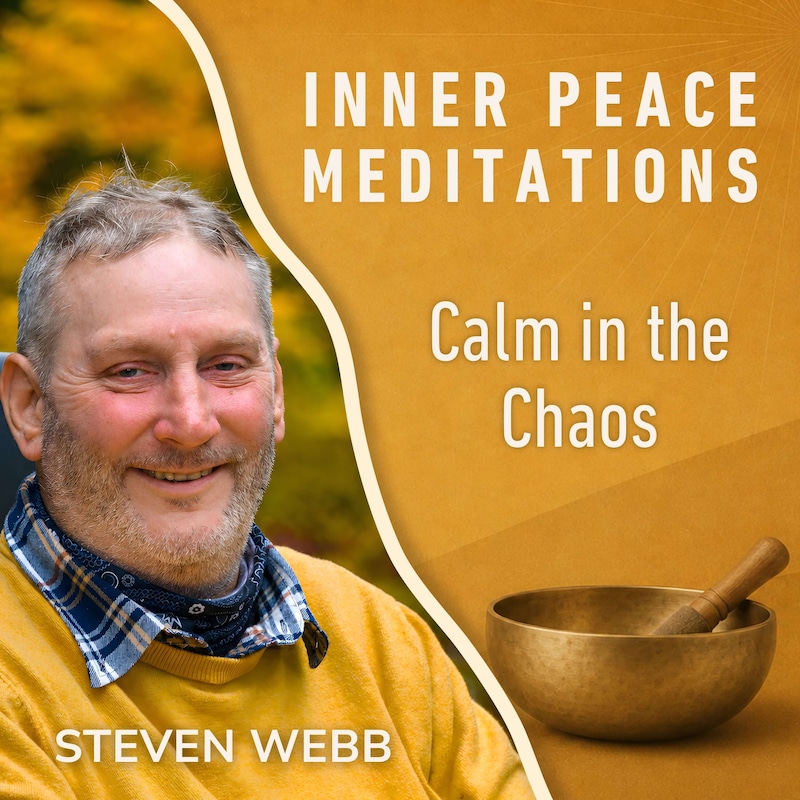
Shownotes
I could not meditate for twenty years. Too fidgety, mind like a firework. If that is you, stay to the end.
A 23 minute talk, with a guided practice at the end.
I gave up at 27 after about three minutes. I started again at 40, at rock bottom, because every book I picked up told me to and I got tired of turning the page. Here I go through what meditation is not, the three kinds I actually use, focus, awareness and intention, and then we do all three together. Not once do I ask you to stop your thoughts. That was never going to happen.
Treat me to a coffee, keep the podcast free, and get my Weekly Calm every Sunday. It is all on stevenwebb.uk
Thank you for sitting with me.
Steven
Stevens new course: Finding Peace in Everyday Life (you choose how much to pay)
- Support Stevens work and links to other podcasts: stevenwebb.uk
- Donate paypal.me/stevenwebb or Buy Steven a coffee
Transcripts
Welcome to this week's podcast, How to Meditate Even If You Think You Cannot. Now then, this podcast
Steven Webb:is... On both of my podcasts, Stillness in the Storms podcast, and also Inner Peace Meditations. So if you're
Steven Webb:listening to this on Inner Peace Meditations, and you're expecting, as normal, a guided meditation, this is going to be
Steven Webb:a guided meditation at the end, but only after I explain the first part about understanding meditation and the second
Steven Webb:part, the three forms of meditation and then I'm going to give you a guided experience. And I want to
Steven Webb:do this because So many people believe, just like I did for probably 20 years, that I couldn't meditate the
Steven Webb:meditation is too hard for me because my mind's too active. I'm too fidgety. I just cannot shut off my
Steven Webb:mind. I cannot focus on one object. Things like that. All those different things that used to come up into
Steven Webb:my mind, I just want to get rid of some of those common myths and I want to prove by
Steven Webb:the end of this podcast that anybody can meditate. So if you think you cannot meditate, stay till the end
Steven Webb:and if you still think that, message me. Head over to StevenWebb.uk and message me. I want to hear
Steven Webb:from you. I want to hear from you anyway. I love hearing from my listeners. I love hearing from you.
Steven Webb:Anyway, just before we start, thank you to all my supporters, people that treat me to a coffee and donate
Steven Webb:towards the podcast. That's the way in which they really keep going. They're not cheap to host. They're not cheap
Steven Webb:to produce and edit and get done. But I do really appreciate I don't have a sponsor. I choose not
Steven Webb:to because it's for you and you guys helped to pay for it. So thank you from the depth of
Steven Webb:my heart. I really appreciate that. Let's get on with today's show. So demystifying meditation and making it
Steven Webb:accessible. Really, I just want to tell you, firstly, meditation is not about silence in the
Steven Webb:mind. It's not about some peaceful utopia. It's not about finding this inner bliss or
Steven Webb:communicating with aliens. It's not about without I don't know, just becoming some magical lotus
Steven Webb:flower or anything like that.
Steven Webb:The real meditation is about a deeper insight. It's about understanding how you work, how your body works, how your
Steven Webb:mind works and getting a deeper insight to what you are and what you're not. You know, going beyond the
Steven Webb:narrative of the ego. But if you want to just do meditation to be relaxed and feel lovely and fluffy,
Steven Webb:you know, run a bath, light some candles part on some good music. That's much more beneficial. And if you
Steven Webb:want to use meditation as a self-help growth thing, buy some self-help books. But if you want to really use
Steven Webb:meditation to have a little bit more inner peace in life... And to have a deeper insight, to understand how
Steven Webb:the mind works, to have more control over how you respond and how you stop reacting to things and how
Steven Webb:you stop making things worse in life. And you want to know how your how your emotions and your mind
Steven Webb:and body and all connect. Then meditation is for you, really. Now then, I'm not going to judge the other
Steven Webb:forms of meditation that... Try to communicate with aliens or do all those other things. It's just none of them
Steven Webb:I find that helpful when it comes to finding real, genuine freedom from suffering. And that's what I set out
Steven Webb:to on my meditation journey. Every single book that I read told me I had to meditate. That really annoyed
Steven Webb:me because I couldn't meditate. I turn over another page. Right? We think you should meditate. Practice mindfulness. I was
Steven Webb:like, no way. I can't do that. My mind does not shut off. And if you spend five minutes with
Steven Webb:me or just 10 minutes with me, you'll notice that I go from one subject to another. I'm looking at
Steven Webb:a branch in one moment and talking about the tree. And then I'm talking about council. Then I'm talking about
Steven Webb:my mind is literally boom, boom, boom, constantly one thing after another. I don't mind that. It's fun.
Steven Webb:It's entertaining sometimes. But it used to drive me insane. I just wanted some inner peace. I just wanted some
Steven Webb:quiet. And especially when my thoughts were really intrusive and really leading to really
Steven Webb:painful thoughts. And I just wanted to shut them off. The truth is, we don't want to stop all the
Steven Webb:thoughts. We want to stop the thoughts that we don't want. And that's the truth. And the mind has evolved
Steven Webb:to think. That's what it... Evolved to do. It's what it's going to do. Your heart is there to pump
Steven Webb:blood around your body. Your liver is there to filter the blood. Your your muscles there to tense and let
Steven Webb:go when it's needed. Your mind, your brain, the physical brain side is evolved to think.
Steven Webb:It's evolved to protect you. It's done a really good job so far. It doesn't know right or wrong. It
Steven Webb:just wants to protect you and keep up the same habit
Steven Webb:and let you get through life in the best way possible based on what you've already done. That's the narrative.
Steven Webb:That's the story. Then if you want your mind to really shut off, the only time that really happens and
Steven Webb:it doesn't Actually happen. You just don't have no awareness of your mind thinking. That's in deep sleep. All the
Steven Webb:other time, your mind's going to be thinking stuff up. Just the same as you think stuff up and then
Steven Webb:you have the feelings arise. So meditation, that's all perfectly normal. So meditation,
Steven Webb:what that gives us is a sense of control over that and what we do with it so The more
Steven Webb:we sit down to meditate, the more we realise how chattery our mind is, how much our mind is like
Steven Webb:monkey mind is sometimes explained. You know, if I sit down to meditate, immediately my my mind just
Steven Webb:bombards me with thoughts. And they're not even that important that They're just annoying, like, what you're going to have
Steven Webb:for tea? You're feeling hungry. What you're going to do next week? You haven't posted that card. You haven't replied
Steven Webb:to that email. Just check Facebook. You need to do all these things. Oh, why don't you write a story?
Steven Webb:Why don't you do this? And it comes up all these brilliant ideas and all these things you don't do.
Steven Webb:And also the things that lead to feelings that we really do not enjoy. And the thing is, it's just
Steven Webb:one after the other. The average person has something like 40 or 50 thoughts every minute. That's about 50. I'm
Steven Webb:not doing maths in my head. It's 56 000 per day, apparently. Something like that anyway. I did not do
Steven Webb:that in my head. I already knew that figure actually um Unless there's a mathematician listening and you know I've
Steven Webb:got that totally wrong. But it's so many thoughts per minute. So meditation is not about getting rid of them.
Steven Webb:It's about
Steven Webb:becoming aware of the thoughts and what to do with them and whether to get on them or not. So
Steven Webb:the three types of meditation. Number one, focus meditation. Now when I say there's three types, there's lots of other
Steven Webb:types. But these are the main three types. I'm not going to cover mantra um transcendental or anything like that.
Steven Webb:I'm going to cover the main three types that I use on the Inner Peace Meditations and the ones that
Steven Webb:have made the huge difference in my life. And being paralysed, being... You know, overthinking I
Steven Webb:I have Adhd. I have dyslexia. And trust me, my mind is like, you know, just on fire all the
Steven Webb:time. Even trying to go sleep and things like that. So these are the three I use. It's a focused
Steven Webb:meditation. It's concentrating on a single point, like a breath or a mantra. You could just go, right,
Steven Webb:literally I'm breathing in, I'm breathing out. And you can count it or you can look at a candle or
Steven Webb:you can just do anything that you're really focused on that one single point. And
Steven Webb:the everyday application for this is practicing during routine activities like walking or um you know,
Steven Webb:waiting in line or you want to bring back some focus and calmness to a present situation. Just, I'm going
Steven Webb:to breathe. I want to calm this moment down. And the other one is awareness meditation the
Steven Webb:Being aware of your thoughts and surroundings without judgement. So just taking a breath. You go, okay.
Steven Webb:Focus on my breath. Now I'm just aware of my breath. Ah, there's a feeling. I'm aware of that. Ah,
Steven Webb:there's a sound. I'm aware of that.
Steven Webb:Ah, there's an I'm aware of that. And just becoming aware of it but without doing anything with it. That's
Steven Webb:just awareness meditation it's almost It's very similar to mindfulness. You can be out walking and you're just seeing everything
Steven Webb:around you and you're just aware of it but you know you don't have to do anything with it. And
Steven Webb:you can practice this during anything like doing dishes or mopping the floor or going for a walk. Anything
Steven Webb:really. Even just walking the dog. You can be really mindful like the dog is. We often think the dog's
Steven Webb:mind form has got nothing in its head. Trust me. The dog's probably thinking about its food and everything as
Steven Webb:well. You know, I want to get home. It's gold on food my food. So the third one is intention
Steven Webb:meditation. And that's setting intentions for how you want to feel or what you want to achieve. And
Steven Webb:I use this meditation to A, be productive sometimes. I pretend in the morning that I've got a table and
Steven Webb:I bring the most productive people in the world and the ones I admire and the ones I really think
Steven Webb:are doing a really good job. There's normally somebody like Gandhi or um a couple of really good politicians that
Steven Webb:I admire, things like that um now some Mandela and people like that. And my doctor and people And I
Steven Webb:go around the table and I say, what should I work on today? And I allow each one of them
Steven Webb:to answer me. My doctor tells me to eat healthier, do some exercise. Gandhi says, you know, be a little
Steven Webb:more caring. Open your heart a little bit more. It's nearly always the same answers. It's nearly always... But it's
Steven Webb:really important to set that intention for the day um You can also have loving kindness intention where you're just
Steven Webb:opening your heart to the suffering in the world by opening your heart and including someone else in your love.
Steven Webb:You can imagine sat next to someone on a bench and that person's in the same bubble as you and
Steven Webb:just imagine loving them um So that's like setting setting an intention. And they're the three main
Steven Webb:meditations that I use. And in just a moment, we're going to do it. I'll do a guided meditation with
Steven Webb:all three of those because nearly all of my meditations, especially on Inner Peace Meditations, normally have all three involved.
Steven Webb:I always start off with a focus, focus on something and then open our awareness because the more open we
Steven Webb:become, the more curious we become, the more playful and the more... We're able to absorb ideas and
Steven Webb:learn more. And then just leave it with some intention, like may I be happy? May I be loved? May
Steven Webb:I be at peace? And it just gives that intention for the next few hours or the day. So I
Steven Webb:hope that makes sense, right so We're a good few minutes into this podcast I just want to settle down
Steven Webb:and And the reason why I've done this podcast is because I get quite a few emails about I find
Steven Webb:meditation really hard and things like that. I do as well. I find meditation really hard even now. And I've
Steven Webb:been an avid meditator for, what, 10 years now? I started when I was first 27. I
Steven Webb:did it for about three minutes and I gave up completely because my mind would not shut off. I started
Steven Webb:it again when I was 40 and that's when I hit rock bottom. And every single book told me to
Steven Webb:meditate and I was like, can't do it. In the end... Yes, I gave it a go. The thing is,
Steven Webb:if one person comes and tells you, you should try this, you can go, okay, maybe there's something If two
Steven Webb:people tell you, you can go, okay, there probably is something in it. But if every book, if everybody's telling
Steven Webb:you that there's something in it, there must be something in it. So I had to give it a try.
Steven Webb:So let's do a little guided meditation. And we're going to start off with focus, then we'll do awareness, and
Steven Webb:then we'll do intention.
Steven Webb:So, just allow your body to relax. Maybe wiggle your bum get comfortable. Wiggle your
Steven Webb:shoulders and get comfortable. And
Steven Webb:just become aware of your breath.
Steven Webb:And focus on the air going in through your nose. The
Steven Webb:way your chest rises.
Steven Webb:And the way it changes direction and just falls. And the air comes back out.
Steven Webb:And then it repeats.
Steven Webb:Then bring your focus to your body. Allow your body to relax.
Steven Webb:Allow your shoulders, neck and your face to relax.
Steven Webb:Now I want you to really home in on sound. We're
Steven Webb:going to focus completely on sound. You
Steven Webb:can hear the sound of my voice. You
Steven Webb:can hear my words. The gaps between them.
Steven Webb:You may be able to hear some humming somewhere in the background in your house.
Steven Webb:Perhaps you're out in nature and you can hear something.
Steven Webb:Don't miss a single sound.
Steven Webb:Really narrow down each single sound. The beginning, the middle, the end. But
Steven Webb:don't do anything with the sound. Just allow it to happen.
Steven Webb:And what this focus meditation does is just trains the mind to do one thing.
Steven Webb:Just listen.
Steven Webb:Just listen.
Steven Webb:And the mind will want to
Steven Webb:wander and go off into the story and do other things. And just bring it back. And the more you
Steven Webb:do it, the more it will learn to focus. The
Steven Webb:wandering is normal. That's perfectly normal. It happens all the time. If your mind didn't try to wander and do
Steven Webb:something else, I would be a bit concerned.
Steven Webb:And now open your awareness. Instead of really focusing on the sound, just allow the sound to come in.
Steven Webb:Allow your awareness of your breath at the same time.
Steven Webb:Open the awareness to the temperature of the room you're in.
Steven Webb:And you're just allowing more and more to come in. And you're allowing this moment to be exactly what it
Steven Webb:is. You're not changing or doing anything with it.
Steven Webb:You're neither enjoying it, but you're not loathing it either. It's one of those things that you're just accepting.
Steven Webb:And you notice you can be aware of your breath.
Steven Webb:You can be aware of your thoughts
Steven Webb:You can be aware of the taste in your mouth.
Steven Webb:But you're not any of those. You're not the taste in your mouth. You're not your thoughts. You're not your
Steven Webb:breath anymore and you are your feelings.
Steven Webb:Because if you were any of them, you couldn't be aware of them.
Steven Webb:And now we'll move on to intention intention So in a meditation with intention, we have something we'd like
Steven Webb:to manifest or bring to our... Feelings or to the day ahead. So in the morning
Steven Webb:we might have the intention of being grateful. Finding a couple of things to be grateful for. And we
Steven Webb:can do that now. Think of something to be grateful for. Something in your life that if you woke up
Steven Webb:tomorrow and it wasn't there, you would miss it.
Steven Webb:Then imagine bringing that back into your life now. What it's like to have it.
Steven Webb:And the feeling of joy in your body and the warmth.
Steven Webb:And think of something else that if you lost it today and
Steven Webb:it's not there, what does it feel like not to have it?
Steven Webb:It could be something big like your house or your car or it could be just your pillow.
Steven Webb:And again, imagine what it's like to have your pillow back or your house or your car.
Steven Webb:And another way we can use intention is to hold an intention for the day. So maybe you've got a
Steven Webb:hard day ahead of you where you might have to go to work or...
Steven Webb:You've got the kids all day because they're off school. Whatever the reason for your hard day, you might say
Steven Webb:an affirmation to. I've
Steven Webb:got a tough day ahead, but I've got this.
Steven Webb:I'm strong and I can get through today.
Steven Webb:And just having a mantra like that or an affirmation like that sets the intention of belief.
Steven Webb:And then we can do the loving kindness. May I be loved. And imagine what that feels like to be
Steven Webb:loved completely.
Steven Webb:May I be happy.
Steven Webb:May I be well.
Steven Webb:Then we go the other way around. May I be well.
Steven Webb:May I be happy. And
Steven Webb:finally, we'll end the intention with may I be loved.
Steven Webb:And just bring your awareness back to your breath and
Steven Webb:that's a real fast tour of the three different types.
Steven Webb:Focusing singly on something or just opening your awareness to be curious to this moment
Steven Webb:or setting an intention.
Steven Webb:And it doesn't matter what you choose to do, when you choose to do it. You could pull up to
Steven Webb:the traffic lights and you could go, just what can I hear?
Steven Webb:You could be in a queue and just say, may I be loved? May I be happy? May I get
Steven Webb:to the front of the queue? We can always set that intention as well.
Steven Webb:So if you just shake your arms and open your eyes and if you had them closed and just become
Steven Webb:aware of the room you're in and... I just want to thank you for listening to this podcast because I
Steven Webb:know it's a bit different on Inner Peace Meditations. They're literally just meditations to help you with something
Steven Webb:in particular. And Stillness in the Storms is a podcast that it's just me talking about different things
Steven Webb:and how to get a little more inner peace when we need it most. And by uploading this podcast
Steven Webb:to both podcasts Or this podcast episode to both podcasts.
Steven Webb:Hopefully some people from, or if you've listened to one and not the other, you might cross over and listen
Steven Webb:to the other. But I just wanted to let you know that you can meditate. Even with the most busiest,
Steven Webb:craziest minds, you can meditate. And not one time did I try to get you to quiet in your mind.
Steven Webb:Not one time did I try to get you to stop your thoughts. It's just not going to happen.
Steven Webb:It's not going to happen.
Steven Webb:So thank you. I'm Steven Webb and thank you for listening. Thank you for being part of this journey. And
Steven Webb:I don't know if I'll do another podcast that jumps over both of them, but maybe I will. You can
Steven Webb:contact me on StevenWebb.uk. Just go to that website there. You can support the podcast. You can see other links.
Steven Webb:You can read my blogs. And again, you can contact me. Thank you. And I love you.






