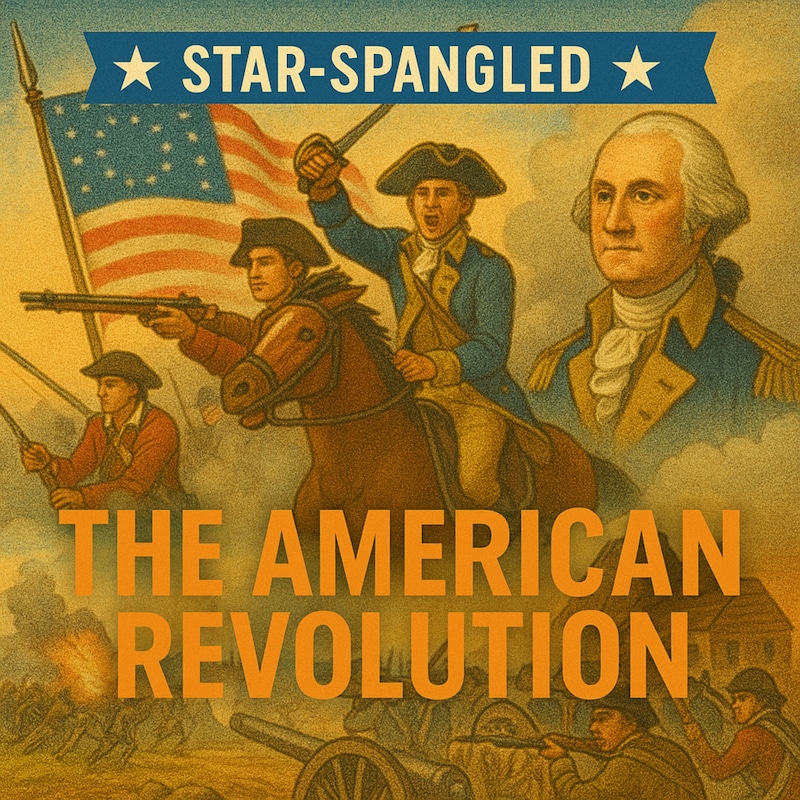
Shownotes
In Episode 5 of Star-Spangled Studies, Dr. G unpacks the radical shift from proud British subjects (post-1763) to bold American rebels. Topics covered include:
• Aftermath of the Seven Years’ War and imperial debt
• Royal Proclamation of 1763 and colonial backlash
• Stamp Act upheaval and “No Taxation Without Representation”
• Intersection of the Great Awakening & Enlightenment ideas
• Boston Massacre, Tea Party & Intolerable Acts
• Thomas Paine’s Common Sense and the Declaration of Independence
• Key battles, Franco-American alliance & Yorktown victory
• Loyalists, women & the paradox of slavery in a revolution of liberty
**Links & Resources:**
– Instagram: [@star_spangled_studies](https://www.instagram.com/star_spangled_studies)
– Facebook: [Star-Spangled Studies](https://www.facebook.com/profile.php?id=61576389415625)
Transcripts
Hello, y'all.
2
:It's me.
3
:It's me.
4
:It's Dr.
5
:G.
6
:Welcome back to Star Spangled Studies.
7
:Now I want you to picture something.
8
:It's 1763.
9
:The British Empire is on top of the world.
10
:They had just defeated their arch
rival in France and they won the
11
:massive global conflict, possibly what
we might call the first World War.
12
:The Seven Years War, or the
French and Indian War in America,
13
:the colonists are celebrating.
14
:A young Philadelphia named Benjamin
Rush visiting parliament saw the king's
15
:throne and he said, quote, he felt
as if he walked on sacred ground with
16
:emotions that I cannot describe and quote.
17
:They, the colonists were proud.
18
:To be British.
19
:They were British subjects and they
felt that they enjoyed a degree of Li
20
:liberty that was simply unknown in the
absolute monarchies of France and Spain.
21
:Fast forward, just over a decade, those
same colonists are at war with that same
22
:empire declaring their independence and
severing those emotional ties forever.
23
:How on earth did this happen?
24
:That's our question today and the answer
as future President John Adams would later
25
:argue wasn't just about battles and taxes
he wrote, and this may be one of my all
26
:time favorite quotes, quote, but what
do we mean by the American Revolution?
27
:Do we mean the American War?
28
:The revolution was affected
before the war commenced.
29
:The revolution was in the
minds and hearts of the people.
30
:This radical change in principles,
opinions, sentiments, and affection of the
31
:people was the real American Revolution.
32
:End quote.
33
:I.
34
:That was powerful stuff.
35
:But today we are going to journey
into those minds and hearts.
36
:We're gonna trace the path
from proud British subjects
37
:to defiant American rebels.
38
:We'll look at the imperial blunders, the
powerful ideas, the riots in the streets,
39
:and the quiet revolutions happening in
homes and churches across the colonies.
40
:That all eventually led to the
birth of these United States.
41
:So grab your Trico hats.
42
:The story of the American
Revolution begins now.
43
:So let's go.
44
:The year 1763 should have been.
45
:A monument of triumph
for the British Empire.
46
:The Treaty of Paris had just been signed.
47
:The seven years war was over.
48
:In fact, historian Winston Churchill,
who was later a British Prime Minister,
49
:he called this the first World
War Britain had vanquished France.
50
:It's.
51
:Longtime enemy and it seized vast
territories in North America,
52
:including Canada and all land
east of the Mississippi River.
53
:The colonists who had fought
alongside the British red coats
54
:were jubilant at this situation.
55
:Benjamin Franklin, as I had mentioned
episode, wrote to a friend in:
56
:about the mood of the colonist quote.
57
:No one can rejoice more sincerely than I
do the reduction and the defeat of Canada.
58
:And this not merely as I am a colonist,
but as I am a Britain end quote,
59
:but victory as it so often does.
60
:Came with a massive hangover.
61
:The war, as one historian has put, it
had been enormously expensive and the
62
:British national debt had nearly doubled.
63
:Parliament back in London now faced
the daunting task of governing
64
:and defending a much larger and
more complex American empire.
65
:Their solution was to keep a standing army
of 10,000 British troops in North America,
66
:a decision that would lead to quote.
67
:A variety of problems with the colonists
End quote and cost a staggering
68
:250,000 pounds sterling per year.
69
:The first major policy to emerge from this
new reality was the Royal Proclamation of
70
:1763, which I had mentioned last episode.
71
:I.
72
:Fresh off the brutal Frontier
Conflict, known as Pontiac's War or
73
:Pontiac's Rebellion, a pan-Indian
uprising against British policies,
74
:the Crown sought to avoid a more
costly war with those on the frontier.
75
:To do this, it drew a line right down
the spine of the Appalachian Mountains
76
:and simply forbade the colonial
settlements from moving west of it.
77
:The language was stark ordering any white
settlers to remove themselves immediately.
78
:For many colonists, especially
the ambitious Gentry class.
79
:Who saw their future
fortunes in the Western land?
80
:Speculation.
81
:This was a stunning blow.
82
:George Washington, a land
speculator himself was furious.
83
:He fumed that the proclamation
was discriminatory, preventing
84
:colonists from acquiring valuable
lands and paying off personal debts.
85
:In a letter to a friend, he revealed
his true feelings dismissing the king's
86
:decree as nothing more than a quote.
87
:Temporary expedient to quiet
the minds of the Indians.
88
:End quote.
89
:He urged his friend to ignore it.
90
:Quote, any person therefore, who neglects
the present opportunity of hunting
91
:out good lands will never regain it.
92
:End quote.
93
:This reaction shows more than
just economic frustration.
94
:It reme reveals if fundamental
breakdown in respect for the
95
:king and imperial authority.
96
:This ideological shock was
a critical turning point.
97
:Before 1763, colonists largely
saw themselves as partners in
98
:a glorious British enterprise.
99
:They saw themselves as British
subjects with British rights
100
:afforded to all British subjects.
101
:The proclamation, however,
treated them not as partners in
102
:this British enterprise, but.
103
:As peoples to be managed and contained.
104
:It wasn't just a line on the map,
it was more like a line in the sand.
105
:Historians have argued that the
resentment, it caused quote, bonded
106
:Americans of varying socioeconomic
backgrounds on a philosophical
107
:level, and it marked the beginning
of a clear ideological break with
108
:the mother country end quote.
109
:It planted the first seeds of
a common American identity and
110
:grievance, and it was defined by that
shared grievance against a distant
111
:authority that didn't understand
the realities across the Atlantic.
112
:With the empire's finances in
shambles, the British Parliament
113
:turned to the colonies to help
pay for the war in the Army.
114
:Now stationed there, this unleashed a
flurry of legislation that colonists came
115
:to call the Alphabet Soup of Taxation,
the Sugar Act of:
116
:Act of 1764, and the Townsend Acts of
:
117
:the colonies and to raise tax revenue.
118
:To pay one for the war, and two for
the continued soldiers that remained.
119
:But the one that truly ignited a firestorm
colonies was the stamp Act of:
120
:This was the first direct internal
tax levied on the colonists
121
:by parliament requiring a paid
stamp on nearly all paper goods.
122
:You wanna buy a newspaper,
you're gonna need a stamp.
123
:Do you want to get something notarized
or another legal document, like a will?
124
:You gotta pay a stamp?
125
:Do you wanna buy playing cards?
126
:Yeah, those need a stamp.
127
:It affected literally everyone.
128
:The core of the conflict wasn't
just about the money to be paid,
129
:although that was a part of it.
130
:It created a profound
constitutional co uh, crisis.
131
:The colonists who saw themselves
as possessing all the rights
132
:of Englishmen, rallied around
a cry that we all know today.
133
:No taxation without representation.
134
:They argued that only their own
elected local colonial assemblies,
135
:not some distant parliament.
136
:Where they had no representatives
had the right to tax them.
137
:The British government countered with
a theory and it wasn't a good one.
138
:The theory of virtual representation,
claiming that the members of Parliament
139
:represented the interests of all
British subjects wherever they lived.
140
:This was a fundamental and
ultimately inconceivable and
141
:irreconcilable disagreement.
142
:And it really turned the head of
many in the colonies about the nature
143
:of power, liberty, and the effects,
or at least how far the British
144
:Constitution went in protecting them.
145
:This growing anger wasn't just happening
in the halls of colonial assemblies.
146
:It was being fueled by a revolution
of ideas happening in the colonies.
147
:These ideas were being circulated
in churches in taverns and in
148
:the inflates of popular press.
149
:With each new taxation.
150
:With each new setback, the seeds
of revolution started to sprout.
151
:Last episode, we had talked about the
Great Awakening, but the Great Awakening
152
:is only really possible with another huge
movement that happens at the same time.
153
:And that's the enlightenment and I.
154
:Even though the Great Awakening and the
Enlightenment are seemingly at odds,
155
:the two of them together converged to
create a population in the colonies
156
:uniquely primed to question authority
and imagine a different future.
157
:The Great Awakening, as we talked about,
was a massive transatlantic religious
158
:revival, and it swept through the colonies
in the decades of the:
159
:It was emotional, it was personal.
160
:Maybe most important, it
was profoundly democratic.
161
:Anybody could be a part of it.
162
:These charismatic itinerant preachers
like the Englishman George Whitfield,
163
:who traveled from town to town and
giving these fiery sermons to huge
164
:crowds, uh, because established
churches wouldn't let him in.
165
:His message was simple.
166
:Formal religion was not enough.
167
:Simply going to church, didn't.
168
:Fulfill nor lead you to heaven.
169
:Each individual needed to
cultivate a direct as well as
170
:emotional conversion experience.
171
:They needed a new birth.
172
:Even a skeptic like Benjamin
Franklin found himself.
173
:Captivated by Whitfield's powerful Oratory
Franklin recounted attending one of his
174
:sermons, having decided to beforehand
not to donate to Whitfield's cause.
175
:But as the sermon progressed, Franklin
softened first deciding to give him his
176
:copper coins, then his silver, and finally
he was so moved that he quote, emptied my
177
:pocket wholly into the collector's dish.
178
:Golden all End quote.
179
:While Whitfield moved hearts with passion
preachers like Jonathan Edwards of
180
:Massachusetts moved them with terror.
181
:We had talked about sinners
in the hands of an angry God.
182
:I.
183
:In a time before electricity, these
sermons had the effect of electricity
184
:causing people to cry out in fear
and to seek immediate salvation.
185
:The emphasis on individual experience
challenged the authority of the
186
:established clergy, the old light,
and they were seen as being uninspired
187
:and stoic and not really progressive.
188
:More importantly as historian Mark
Noel observed, the awakening was quote,
189
:America's first truly national event,
and it created a shared cultural and
190
:religious experience that connected
colonists from New England to Georgia.
191
:Running parallel to this wave of
religious fervor was the enlightenment.
192
:The enlightenment was a philosophical
movement that celebrated reason,
193
:scientific inquiry, and natural rights.
194
:Many famous thinkers like John Locke
argued that individuals possess inherent
195
:rights to life, liberty, and property,
and that government was a contract
196
:created to protect those rights.
197
:This intellectual current fostered a deep
suspicion of unchecked power like kings.
198
:This is vividly demonstrated in the
trial of John Peter Zenger in:
199
:that we had talked about last episode.
200
:Nevertheless, for decades,
historians have debated the real
201
:cause of the American revolution.
202
:Was it a high-minded intellectual
struggle for liberty or was it
203
:driven by the economic and social
grievances of different classes?
204
:There are different schools of
thought within this, but maybe the
205
:most compelling understanding lies
in the synthesis of several views.
206
:As Gary Nash puts it, quote,
everyone has economic interests
207
:and everyone has an ideology.
208
:End quote, the two are
not mutually exclusive.
209
:Economic grievances filled with
philosophical and ideological
210
:differences about liberty and natural
rights provided the language and
211
:the intellectual framework that
colonists needed to articulate the.
212
:They're very real grievances about
economic and social structure.
213
:The fear of being reduced to
slavery by British taxation.
214
:That's the words the colonists use.
215
:And this idea was so potent
precisely because the very real
216
:institution of chattel slavery was
a daily reality in their world.
217
:So the ideas of the Enlightenment
and the great awakening gave meaning,
218
:justification, and a revolutionary power
to the anger that they felt in the docs,
219
:in the workshops, and in the farms.
220
:Across the colonies, ideas are
powerful, but they don't start
221
:a revolution on their own.
222
:They need action.
223
:And that action came in Boston, a city
simmering already with resentment.
224
:Action that was about to
explode onto the streets.
225
:The intellectual and religious fervor
of the mid 18th century provided
226
:the Tinder, but it was a series of
escalating confrontations centered.
227
:The fiery report of Boston
that provided the spark.
228
:A key battleground in this conflict
was surprisingly, the marketplace.
229
:The colonies had undergone a consumer
revolution becoming enthusiastic
230
:buyers of British goods like the tea,
textiles and fine mahogany furniture.
231
:This trade tied them culturally and
economically to the Empire themes
232
:that we checked out last episode.
233
:But when Parliament began imposing
new taxes, colonists weaponized
234
:their consumption patterns.
235
:They organized non importation agreements.
236
:They boycotted British goods in a
powerful display of collective resistance.
237
:Wearing home spun cloth instead
of the fine British textiles
238
:became a political statement.
239
:They.
240
:Badge of virtue against what
they saw as British luxury and
241
:consumption and British overreach.
242
:This economic pressure cooker
was bound to explode, and it did.
243
:March 5th, 1770.
244
:Tensions between resentful Bostonians
and the British soldiers quartered in
245
:their cities erupted into violence.
246
:A street confrontation
escalated until panicked.
247
:British red coats fired into a
crowd killing five colonists.
248
:Patriots like Paul Revere and Sam
Adams immediately seized on the event
249
:branding it the Boston Massacre.
250
:Revere's famous engravings of
the incident depicted organized
251
:British soldiers firing on helpless.
252
:Unarmed crowd was a masterpiece of
propaganda that circulated throughout
253
:the colonies, flaming the flames
of anti British resentment, but
254
:it didn't start the revolution.
255
:Three years later, another protest
sent shockwaves across the Atlantic.
256
:In 1773, parliament passed the Tea Act.
257
:It wasn't a new tax, but it actually gave
the struggling British East India company
258
:a monopoly on the American tea trade.
259
:I.
260
:The colonists saw this as a Trojan
horse, a sneaky attempt to make them
261
:accept parliament's right to tax them.
262
:On the night of December 16th, 1773,
a group of the Sons of Liberty thinly
263
:disguised as Mohawk Indians boarded
three ships in Boston Harbor and dumped
264
:342 chests of tea into the water.
265
:This act of defiance, which became known
as the Boston Tea Party, was a direct
266
:assault on British property and authority.
267
:But that didn't start the revolution.
268
:Parliament reacted and it was
swift, and boy was it punitive.
269
:In 1774, it passed a series of
laws that the colonists dubbed the
270
:intolerable Acts or the coercive acts.
271
:They were designed to crush
Massachusetts and make an example
272
:of it for its disobedience.
273
:The most draconian was the Boston
Port Act, which closed the city's
274
:harbor to all trade until the
destroyed tea was paid for.
275
:It was basically an economic death
sentence, but instead of isolating
276
:Massachusetts, the intolerable acts
actually had an opposite effect.
277
:The other colonies saw the
punishment of Boston as an attack
278
:on the rights of all Americans.
279
:Hey, if they could do this to
Boston, they can do this to us in
280
:a remarkable display of solidarity.
281
:Other colony sent supplies
to the blockade city.
282
:This shared threat led to the convening
of the first continental Congress in
283
:Philadelphia in 1774, where delegates
from 12 of the 13 colonies met to
284
:coordinate a unified resistance.
285
:It was a momentous step
to towards nationhood.
286
:Yet, even as war callouts are gathering,
most colonists still hesitated at the
287
:final radical step of independence.
288
:That changed in January, 1776 with the
publication of a 47 page pamphlet that
289
:would alter the course of history.
290
:I.
291
:Common sense by Thomas Payne.
292
:Payne was a recent immigrant from England,
and he wrote, not in the lofty language
293
:of philosophers, but in the plain,
fiery language of the common person.
294
:He attacked the very idea of monarchy as
absurd, and the institution of hereditary
295
:succession as an insult to reason.
296
:He famously argued, quote.
297
:Small islands not capable of protecting
themselves are the proper objects for
298
:kingdoms to take under their care.
299
:But there is something absurd in
supposing a continent to be perpetually
300
:governed by an island end quote.
301
:Pain reframed the entire conflict,
elevating it from a dispute over taxes to
302
:a world historical struggle for liberty.
303
:Declaring quote, the cause of America is
a great measure, the cause of all mankind.
304
:Common sense became an instant bestseller.
305
:It sold an estimated 150,000 copies
and reached hundreds of thousands of
306
:more people through public readings
in taverns and in town squares.
307
:It shattered one of the final
psychological barriers to independence
308
:and convinced countless Americans that
the complete break with Britain was not
309
:just necessary but a moral imperative.
310
:Payne's words turned a colonial rebellion.
311
:A revolution for a new kind of nation.
312
:The final step was to make it official.
313
:The Declaration of Independence
and the brutal war that fought to
314
:make its war and a reality is next.
315
:The War of Independence didn't begin with.
316
:A grand declaration, but with the
crack of a musket on a village green.
317
:On April 19th, 1775, British
troops marched from Boston to seize
318
:colonial arms stored in Concord.
319
:They were met by colonial militia
men in Lexington, and the quote, shot
320
:heard round the world, ignited a war.
321
:The fighting that day, which saw
the British harassed all the way
322
:back to Boston by swarms of farmers
and artisans, prove that this would
323
:be no easy rebellion to crush.
324
:A year later, July 4th, 1776, the
second Continental Congress adopted
325
:the Declaration of Independence,
primarily the work of Thomas Jefferson.
326
:This document was far more than
a political breakup letter.
327
:It was a profound philosophical statement
In an indictment of King George III,
328
:laying out a list of grievances to
justify the rebellion to the world.
329
:Its most endearing and enduring
passage, of course, proclaimed
330
:a new basis of government.
331
:Quote.
332
:We hold these truths to be self-evident
that all men are created equal, that
333
:they are endowed by their creator
with certain unalienable rights,
334
:that among these are life, liberty,
and the pursuit of happiness.
335
:This language of universal rights
would become the American creed.
336
:A promise the New nation would
spend the next two centuries.
337
:Struggling to live up to.
338
:On paper, the fight was
a colossal mismatch.
339
:The colonists were taking on
the 18th century equivalent.
340
:Of a superpower.
341
:The life of a common soldier
in the continental Army was
342
:one of incredible hardship.
343
:We can see this in their own words.
344
:They faced brutal winters, chronic
shortages of food, clothing, and pay.
345
:General Washington sharing in their
suffering of Valley Forge constantly
346
:pleaded with Congress for support
amidst the immense public burden.
347
:The personal toll was also heavy.
348
:A letter to his wife, Martha, during
the war Washington wrote, I retain
349
:an unalterable affection for you,
which neither time nor distance
350
:can change a point and reminder
of the human cost of the conflict.
351
:So how did the Patriots win?
352
:Well, the turning point came in 1777
with the stunning American victory at the
353
:Battle of Saratoga in upstate New York.
354
:This victory was monumental because
it convinced France that the American
355
:cause was not a hopeless one.
356
:Benjamin Franklin, the diplomatic genius,
leveraged the victory to secure a formal
357
:alliance with Britain's old rival.
358
:The entry of France into the war
transformed the conflict from a colonial
359
:rebellion into another global war.
360
:Suddenly, Britain had to defend its empire
in the Caribbean, in Europe, and in India.
361
:The French provided the
Americans with money, weapons,
362
:soldiers, and most crucially.
363
:A Navy.
364
:That Navy proved decisive in the
fall of:
365
:The French fleet under Admiral Degrass
blockaded the Chesapeake Bay cutting off
366
:any chance of escape or reinforcement
for the main British army under Lauren
367
:Corn Wallace trapped in the peninsula.
368
:Kowa was besieged by a combined force
of American and French troops led by
369
:Washington and the Compte RoCE Bo.
370
:On October 19th, 1781, Kowa surrendered.
371
:The world was quite literally, I.
372
:Turned upside down.
373
:The war was effectively over.
374
:The war was won, independence was
secured, but the revolution was
375
:not just a war against Britain.
376
:It was a war that tore
American society apart.
377
:So who truly won and who lost?
378
:Well, that's what we'll talk about next.
379
:The American Revolution was, in many
ways, America's first civil war.
380
:The society was deeply divided.
381
:While Patriots fought for independence,
an estimated 20% of the colonial
382
:population remained loyalist, those
faithful to the British crown.
383
:These were often the royal
officials, Anglican clergymen, or
384
:merchants whose livelihood depended
on the trade with the empire.
385
:They faced harassment, they had their
property confiscated, and many were
386
:forced into exile, becoming refugees,
many of which fled to Canada or England.
387
:Their voices offer a powerful counter
narrative to the triumphant patriot story.
388
:The loyalist writer James Chalmers, in his
pamphlet Plain Truth argued that a break
389
:with Britain would lead to chaos, claiming
that for the colonies, quote, independence
390
:and slavery are synonymous terms.
391
:End quote.
392
:Governor William Franklin of New Jersey,
Benjamin Franklin's own son warned the
393
:rebels that they were choosing a road
that would lead to anarchy, misery,
394
:and all the horrors of a civil war.
395
:End quote, the revolutionary fervent.
396
:Also stirred women to question
their place in society.
397
:They had been central to the resistance
during and before and during the war.
398
:They organized boycotts and they
managed farms and businesses.
399
:In the absence of men, the rhetoric
of liberty was not lost on them,
400
:and the most famous expression
of which came from Abigail Adams.
401
:In a letter to her husband, John Adams,
in March of:
402
:founders were contemplating independence,
she issued a powerful plea quote.
403
:I desire you would remember the
ladies and be more generous and
404
:favorable to them than your ancestors.
405
:Do not put such unlimited power
into the hands of their husbands.
406
:End quote.
407
:Then came the famous warning quote, if
particular care and attention is not
408
:paid to the ladies, we are determined
to foment a rebellion and will not hold
409
:ourselves bound by any laws in which
we have no voice or representation.
410
:John Adams reply was telling.
411
:He dismissed her plea laughing off
her extraordinary code of laws and
412
:joking that men knew better than
to repeal their masculine systems.
413
:He refused to give up the name
of Masters to what he called
414
:the despotism of the petite.
415
:This exchange perfectly captures both
the radical potential and the limits
416
:of the revolution's promise for women.
417
:A new republic was being born, but
its patriarchal structure would try to
418
:remain and it would firmly in place.
419
:Nowhere was the revolution's hypocrisy,
more glaring than on the issue of slavery.
420
:The colonists cried out against
being enslaved by the British and
421
:their taxes while they themselves.
422
:Held hundreds of thousands of
people in slavery, and this
423
:contradiction was not lost on anyone.
424
:African slaves seized the moment using
the Patriot's own revolutionary language.
425
:To demand their freedom.
426
:In 1775 Virginia's Royal Governor, Lord
Dunmore, seeing this contradiction issued
427
:a proclamation offering freedom to any
enslaved man who escaped his patriot
428
:master and joined the British cause.
429
:Thousands of enslaved people
risked their lives to do so.
430
:Turning the war into possibly the
largest slave rebellion in American
431
:history up until that point.
432
:At the same time, thousands
of black men fought.
433
:For the Patriot cause despite George
Washington's initial reluctance to arm
434
:them, black soldiers like Peter Salem
served with distinction from the earliest
435
:battles, including the one in Bunker
Hill and throughout the war people.
436
:Especially enslaved people
submitted petitions to colonial
437
:legislatures, brilliantly turning
the language of the Declaration of
438
:Independence against their masters.
439
:A 1777 petition to the Massachusetts
legislature from a great number of
440
:blacks detained in a state of slavery,
declared that they quote, have in
441
:common with all other men a natural
and unalienable right to that freedom.
442
:They pointedly noted that inconsistency
of acting themselves, the part which
443
:they condemn and oppose in others, stop
being hypocrites, is what they said.
444
:So while the revolution certainly did not
end slavery, it created the ideological
445
:crisis that would lead several generations
later to slavery's eventual demise.
446
:The glaring contradiction
between the New Nation's ideals.
447
:The New Nation's realities
became impossible to ignore.
448
:This pressure from both black and white
Americans produced the world's first
449
:large scale anti-slavery movement.
450
:The first Abolition Society was
founded in Philadelphia in:
451
:During the war, Vermont abolished slavery
outright In:
452
:the first Gradual Abolition Act, and
other Northern States would soon follow.
453
:I.
454
:The Revolution acted
as a powerful catalyst.
455
:It provided the moral and philosophical
language that abolitionists would
456
:wield for the next 80 years, and
force the new nation to confront
457
:the original sin and the lasting
contradiction that lay at its heart.
458
:For most Native Americans, however, the
revolution was an unmitigated disaster
459
:caught between two imperial powers.
460
:Most Native Americans
like the Iwo Confederacy.
461
:Ultimately sided with the British whom
they saw as a more distant and less land
462
:hungry power than the American colonists.
463
:When Britain lost their allies were
abandoned at the peace negotiations
464
:and left to face the full.
465
:Unrestrained expansion
of the new United States.
466
:The Patriot Victory was a
catastrophic one for Native American
467
:peoples east of the Mississippi.
468
:So what was the American Revolution?
469
:As John Adams said, it was a
change in the minds of the people.
470
:It was a constitutional crisis
that became a war for independence.
471
:It was a civil war that pitted
neighbors against each other.
472
:It was a moment of radical
possibility for some, and a moment
473
:of profound betrayal for others.
474
:In the end, the Patriots won.
475
:They had defeated the most powerful
empire on earth, and as the smoke
476
:cleared, they faced a new, perhaps
even more daunting challenge.
477
:They had thrown off the authority
of a king in parliament.
478
:What would they replace it with?
479
:They were no longer colonies, but
13 independent states, jealous
480
:of their own power in their first
attempt at a national government.
481
:The articles of Confederation
would create a government so
482
:weak it could barely function.
483
:It led to debt rebellion and the
terrifying prospect that their hard one
484
:revolution might collapse into chaos.
485
:So how did they pull back from the brink?
486
:How did they create the framework
for the nation we know today?
487
:Well join me next time
on Star Spangled Studies.
488
:As we dive into that Turbulence
:
489
:and the dramatic debates that forged
the United States Constitution.
490
:I'm Dr.
491
:G.
492
:I'll see y'all
493
:in the past.