Shownotes
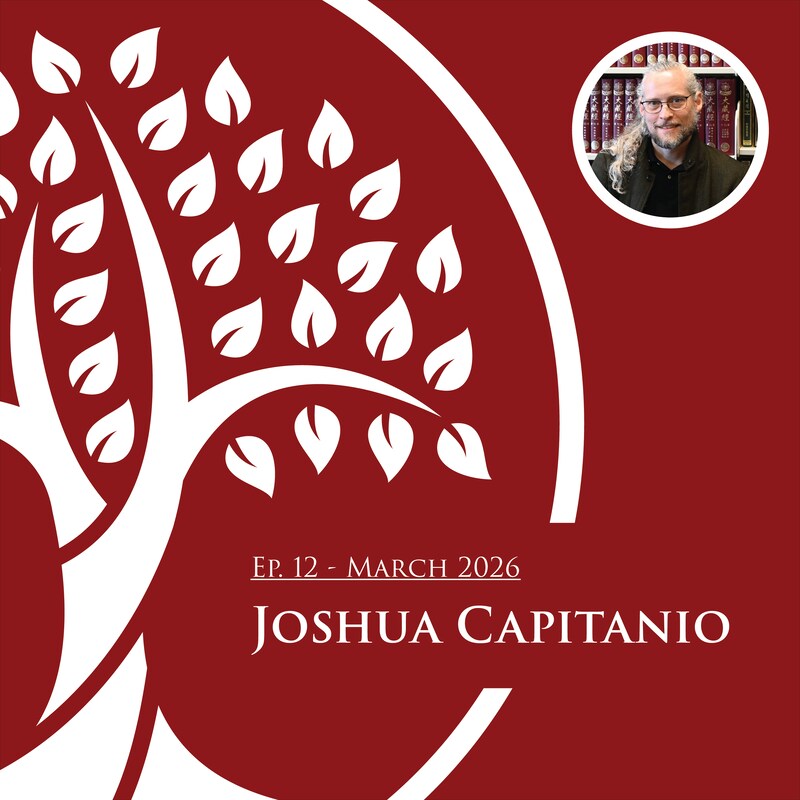
Joshua Capitanio talks about his graduate work on medieval Chinese Buddho-Daoism, how translation projects and “second book” arguments are valued inside and outside the professoriate, and what it takes to make a career transition to the university library. Interview by Miles Osgood.
Transcripts
[Prologue]
MILES OSGOOD: Welcome to “The Ho Center for Buddhist Studies at Stanford” podcast. Come join us by the tree.
[music - Ani Choying Drolma, guitar]
The first step following a PhD in Religious Studies used to be clear: start turning your dissertation into the monograph that you’ll one day submit to a tenure review committee. But as job openings in the discipline have dropped 40% over the last two decades, and entire departments faced cuts coast to coast last year, it’s time to re-evaluate.
Who else, outside that imagined committee, might read your research? What other kinds
of writing, including translations, would interest that new audience? And where else can you take your training as, say, a teacher of the Buddhist canon, a reader in Sanskrit and Middle Chinese, or an archivist versed in ritual manuals?
While the majority of humanities doctorates still work in postsecondary education (broadly conceived), the next most common career is often just across campus: in museums and libraries. Our guest today has seen the university from both sides, from behind the syllabus and the stacks: first as an associate professor and then as a university librarian.
Looking out into the uncertain future that tomorrow’s doctorates face, that double-perspective improves our depth perception: first, for the kinds of publications that should count on the tenure track; second, for the kinds of in-class experience that should count for a library curator.
JOSHUA CAPITANIO: I basically just said, look, I am—I have a PhD in this field. I taught in this field for eight years. I trained graduate students in this field. I’ve been an undergraduate, graduate student, professor, you know, and mentor of graduate students in this field. So I think I understand what people are expecting from the library.
[music - Ani Choying Drolma, Oṃ maṇi padme hūm̐]
My guest is Joshua Capitanio, Curator and Public Services Librarian at the East Asia Library at Stanford.
Josh received his PhD in East Asian Languages and Civilizations from the University of Pennsylvania in two thousand and eight, and was Assistant and then Associate Professor of Religious Studies at University of the West in California until twenty sixteen,, before arriving here at Stanford. We’ll be talking today about that transition, and about Josh’s continued writing in his new role.
has published translations in:As usual, our conversation takes place in Littlefield Center at the Buddhist Studies Library—a backdrop that feels especially appropriate for this episode. Let’s head there now.
[bell chimes]
MILES OSGOOD: Thank you so much, Josh, for joining us.
JOSHUA CAPITANIO: Thanks for having me.
MILES OSGOOD: So I guess I thought we would start with the research: talk a little bit about your interest in medieval China, medieval Chinese religion, Buddhism and Daoism and their relationship to one another. How did you gravitate towards that particular field in the first place?
JOSHUA CAPITANIO: Sure. Well, I—I started with an interest in Buddhism. Like, as a child, I was interested in Buddhism. My parents had a lot of books on religion and philosophy. I remember my sixth grade teacher stole my copy of the "Tao Te Ching." So yeah, I was—
MILES OSGOOD: Stole for their own reading?
JOSHUA CAPITANIO: Yeah. Yeah. I wrote a report on it, and she asked me to borrow it, and then I never got it back. (Miles laughs) Yeah. I mean, and in, in high school, I became interested in Buddhism specifically. I was a philosophy major when I went to college the first time, and then I dropped out and was, like, working as a computer programmer and just kind of like studying Buddhism on my own. And that eventually—I was interested in Zen Buddhism. I was reading a lot of, like, translations, and I started to wonder about the quality of the translations. I thought maybe I would be able to understand it better if I could understand the language. So, you know, I, I came to understand that Zen Buddhism had come from China and that most of the texts that I was reading had been translated from Chinese, so I started learning Chinese, and ended up going back to college and doing a bachelor's in Chinese at UCLA, where I had the chance to take a bunch of classes on Buddhism with different professors, and kind of became interested in Chinese as well, like having, you know, beginning to learn the language, I kind of got interested in the literary tradition. So I went to grad school with the intention of working on Chinese Buddhism. I went to University of Pennsylvania, where I worked with Victor Mair, and just, I think my first or second year there, I encountered the work of Michel Strickman. His “Chinese Magical Medicine” book had just been published, which is, like, really, you know, really important work on the relationship between Buddhism and Daoism—specifically, like, Buddhist and Daoist ritual in medieval China. And I encountered Steve Bokenkamp's book, “Early Daoist Scriptures.” And I was really interested in the last section of that, which deals with this particular Daoist tradition, the Ling Bao School, which had kind of, like, borrowed a lot of terms and ideas from the Buddhist scriptures that were being translated into China at the time. So I remember writing a—I took a class with Victor on… It was on the history of the Chinese language, which is like one of his sort of pet topics. He's really interested in that. I wrote a paper on this device that you found in those, in Daoist texts called the—this, the “hidden Brahma language.” Basically, it was an attempt to kind of create a Chinese origin for the transliterated Sanskrit terms that you find in Buddhist literature. And he liked the paper, and I think he sensed that I was interested in these kinds of connections between Buddhism and indigenous Chinese religion so he ended up, like, the next year, doing a whole graduate seminar on the topic of, like, so-called Buddho-Daoism. Yeah, I don't know, that just kind of became my thing.
MILES OSGOOD: I'm curious about that. The Buddho-Daoism, because you mention in passing, you know, all these mentors, but all—then also reading Stephen Bokenkamp’s “Early Daoist Scriptures,” and we—you know, he was a guest of The Ho Center recently and came...
JOSHUA CAPITANIO: Oh, yeah.
MILES OSGOOD: ... and sat in on this podcast, so naturally, I kind of want to seize on that a little bit: because there is a thread in your research that is partly about the rivalry of Daoism and Buddhism in this field, in terms of who came to what ideas—and, and, you know, which ones are sort of properly elevated or terrestrial—you know, that, that revolve around, among other things, this notion of “self-cultivation” or “internal alchemy” where, you know, some, you know, betwe(en)... You're interested, I think, in—it seems like—in Daoism insofar as it uses talismans and rituals, but insofar as it also uses meditation forms and questions of where that arises. Could you tell us about sort of how your thinking about the relationship of those two religions has evolved and maybe where it is now?
JOSHUA CAPITANIO: So, I—I think I initially was interested in how Buddhism became sort of “Chinese,” Sinicized. I was really influenced by (Erik) Zürcher's work on, you know, "The Buddhist Conquest of China," and so I, was more approaching Daoism from this Buddhist angle, and I was curious about the fact that Daoists were, like, using Buddhist terms and kind of, you know, copying Buddhist literary tropes in their—in their scriptures. And so most of the early work I did on this in graduate school was kind of from that angle. I was very excited. I... The, one project that I did as a grad student, which I've continued like, milking—I mean, I just referenced it in an article I wrote earlier this year—was when I found this text in the Daoist canon that attributed, like, a method of internal alchemy to Bodhidharma, the, you know, the patriarch of, of Zen Buddhism in China. And so I was really interested in that sort of—and you know, there's kind of a—I think even before I had gone to grad school, I had encountered the idea in like—I don't know, it was maybe like Arthur Waley or Kenneth Ch'en or something—about how, you know, Chinese Buddhists... There's this sort of vague idea that Chinese Buddhism was influenced by Daoism, and that, you know, particularly, the, like, most quintessentially Chinese forms of Buddhism like Chan Buddhism show some sort of Daoist influence. But it's never really—it's never really explained clearly how that happened. There's just a general sense that this doesn't seem exactly like Indian Buddhism. There's something very Chinese about it, and this must have come from...
MILES OSGOOD: But it sounds like...
JOSHUA CAPITANIO: ... Daoism.
MILES OSGOOD: ... some of your arguments were also pointing to the way in which the influence goes the other direction, and that that's important too.
JOSHUA CAPITANIO: Well, yeah. I mean, so I sort of started from that idea that, you know, Daoism, Daoists, were kind of like stealing from Buddhism. And I think that was sort of my gateway into Daoist Studies itself. And so, I kind of, like, became a Daoist Studies (person). But I mean, I began to get a little bit annoyed with this kind of, like, facile explanation that, you know, Daoists just copied Buddhists. And I started, you know, the more I actually read Daoist texts, the more I started to at least think that I could perceive some sort of internal logic and see even the sort of wholesale appropriation of some Buddhist elements as a kind of strategic move that—that sort of made sense in a way, or was made sense of at some point.
MILES OSGOOD: Yeah. So on the other side of it, you know, just to pick up a kind of impossibly big question that you dropped in the path here, which is: how did Buddhism become Chinese? (Miles laughs) Do you have your own thesis on that now, or is there a thesis that you gleaned from this community of scholars you were working with that you feel is correct?
JOSHUA CAPITANIO: Yeah, I don't know. I kind of go... I kind of go back and forth on it. I mean, Bob Sharf just gave a talk here on the origins of Koan literature, and that has given me a lot to think about.
MILES OSGOOD: Yeah.
JOSHUA CAPITANIO: I mean, I think that the, I don't think that the general story of how Buddhism became Chinese is wrong. I think it's true that, like, Chinese people, you know, made Buddhism Chinese, but in many ways, by kind of—
MILES OSGOOD: Aligning it with religious traditions that were already in place?
JOSHUA CAPITANIO: Yeah. Finding ways to sort of translate Indian Buddhist concepts into Chinese, or reframe Indian Buddhist ideas in contexts that were more kind of amenable to, like, Chinese modes of thought. But I—the idea that it was, like, as simple as just “Chinese Buddhists kind of interpreted Buddhism through Daoist frameworks” I don't particularly agree with.
MILES OSGOOD: Yeah.
JOSHUA CAPITANIO: In actuality, like, on both sides, people really knew what they were doing, and what they were about, and you know, any kind of crossover that you see between the two traditions is intentional. And, you know, they're—it's not just kind of, like, haphazard, you know.
MILES OSGOOD: Yeah. And that's doing a disservice to centuries of scholars who were thinking about this pretty seriously. Yeah, that makes sense and I—and the reason why, you know, I'm starting to think about it now a little bit in terms of evaluating these historical figures as scholars is because I'm curious to connect this to what you see as being your own methods that you were trained in and—and that you have now taken with you into a new vocation. Because I think one thing we'll end up talking about in this conversation is the skills that one learns in this field—in graduate school and on the tenure track—and ways in which those skills can be responsibly used or effectively used in other avenues. And so, as you're looking at historical scholars who are thinking both within their own tradition about their own primary texts and= their own primary scriptures and inter-textually and maybe inter-culturally, or inter-religiously, about other texts that are out there, you know, what that brings to mind for me is looking at your own articles and thinking about the way in which there is a strong reliance on your own sense of primary sources—your own abilities to do translations, which has now become a big part of your work—as well as, of course, the running footnotes that involve being aware of what other scholars have said, as you've mentioned, being aware of this entire community of people you've worked with, and whose mentors you know kind of by association. So tell us a little bit about how you take those two tracks of, you know, humanistic academic engagement: translation, curation, historical work that involves primary sources, and the secondary, and how you think about those skills in your current work, you know, as somebody who is working in special collections in some ways with primary sources, also trying to stay, you know, up-to-date and keep everybody else up-to-date in the secondary research. How has your own training enabled you to keep, you know, those two aspects of scholarship alive?
JOSHUA CAPITANIO: Well, yeah, kind of ended up in the perfect situation in that I am covering East Asian Studies and Religious Studies here at Stanford. And my own training was sort of... I mean at Penn, I would say, like getting a degree in East Asian Studies, at least with the people with whom I was studying, there was not much of a method or methodology. It was really just: learn to read Chinese really well and read as much Chinese as you can. And then at the same time, I was… I was taking classes at Princeton with Stephen Teiser in the Religious Studies department and getting exposed to a more kind of Religious Studies approach, which is very methodology-heavy. And actually after I graduated—because I sort of decided that I wanted to be in (the) Religious Studies field. I really made a lot of efforts on my own to kind of fix what I felt were some deficiencies in my own training related to my familiarity, or my lack of familiarity, with specifically, like, secondary scholarship in the field of Religious Studies. And I—I'm personally very interested in sort of “theory”: theoretical approaches that are important in the field of Religious Studies. And for a while, those were, like, kind of separate endeavors, and I used to get really frustrated when I was reading Religious Studies scholarship because most of it is about Western religions and I—it was hard for me to see how how that could be applied: how I could apply those things to Chinese religion. So I was really... There were a few scholars—Rob Campany is the person that comes to mind immediately—whose work was really important for me in terms of providing kind of a model of how to connect those... And so, in my own scholarship, as you can see, I tend to prefer to publish in more, like, Religious Studies journals—and, to write more from a reli—to write about Chinese religions you know, using Western theoretical approaches... But then, yeah, also, I mean as a librarian, those are exactly the fields that I cover so I have to be, have to also be familiar with what people are going to be—what kind of resources people might need as scholars of East Asia, and also what kinds of things people might need as scholars of religions.
MILES OSGOOD: Yeah. Yeah, that's great And I can totally understand how it would—it is in fact a perfect fit, you know, the kinds of background that you have and the kind of work you're doing now. But I wonder—because, you know, a lot of students who go through the PhD track who maybe, you know, do visiting assistant professorships or postdoctoral positions before looking at something like library work or other kinds of university jobs worry about, you know, how hyper-specialized they may be in a particular area before they offer, you know, a different kind of service to these institutions and being able to prove that, right, to an interview committee. And so, you know, could you talk about just in practical terms what it was like to go after this job here? And, you know—and explain what you thought you could bring to the library and explain that the kind of training you had done, you know—which tends to be traditionally for a particular kind of instructor and researcher role—made sense in this other domain?
JOSHUA CAPITANIO: Yeah. I mean the position that I applied for was different than the position that I'm doing. I mean, it's the same position, but the role was defined differently at the time. So, you know, now, like in my signature, I'm a Curator for East Asian Studies and Curator for Religious Studies and Public Services Librarian. Like, technically that's about, like, an 80/20 split between my curatorial duties and the public services stuff, but when I was hired—I mean the job that I applied for was actually, like, it was just “Public Services Librarian.” And then the curatorial stuff was kind of an add-on, so it was like 60% public services, 40% curation. And I mean, I got super lucky. Like, that was really the perfect job for me to apply for at the time because public services is more about… I mean, I remember, like, when I was preparing for the job, trying to figure out what exactly it is. I think if you ask 10 public service librarians, they'll give you 10 different answers. But I mean, it's really just doing the public-facing part of the library. And the main thing there is communication skills. So, I mean, I was, you know, I have a PhD, I had been a professor for eight years. I think it was fairly easy for me to make the argument that I have, you know, the level of verbal and written communication skills needed for something like this.
MILES OSGOOD: Right. You're an established writer. You're an established teacher.
JOSHUA CAPITANIO: Yeah, I mean, I can write, I'm comfortable, talking to people mostly, and, you know, I know how to respond to emails that kind of thing. So it was really just sort of a matter of convincing them that I could do the communication side of things, and then there was this 40% curatorial stuff that, at the time, I didn't really know exactly what that involved. But I basically just said, "Look, “I have a PhD in this field. I've taught in this field “for eight years. I trained graduate students in this field. “I've been an undergraduate, graduate student professor, “and mentor of graduate students in this field, “so I think I understand what people are expecting from the library."
MILES OSGOOD: Yeah.
JOSHUA CAPITANIO: And then what ended up happening is that, you know, as I learned more about the collection development side, or the subject specialist side, or whatever, you know I kind of gravitated towards that kind of work, because it was more... It was the kind of work that made, I think, better use of my own skill set. I mean, you know, the public services stuff, like, I think a lot of people can do. It's really just staying on top of communication. And good at creating events in the calendar. And so, I've been here for almost 10 years. I've kind of gradually taken on more collection development, and now recently, more, even more kind of like, metadata and special collections stuff that, again, directly uses these skills that I have that other people don't. But yeah, I think initially, that was a really good position for getting my foot in the door, because it was partly public services and I could, I really just had to make a case that I was, like, a decent communicator. (Miles laughs) And then I had the opportunity to kind of learn the more technical collection development side stuff on the job and then...
MILES OSGOOD: That makes sense.
JOSHUA CAPITANIO: ... eventually, kind of, move into that area.
MILES OSGOOD: Yeah, neat. So, one thing that also, it sounds like, changed or that you gained a new appreciation for, in those early years of moving to a new position, was knowing other kinds of communities that exist in the university and between different universities, right? Because you had this community that we've talked about of mentors and advisors and colleagues, but there is also a community, you know, that maybe folks in grad school or maybe even folks in faculty departments aren't always as aware of, of librarians, who are working together and collaborating together on these events, on these projects, on these public-facing initiatives. So what was it like to discover or maybe just integrate yourself into that community, you know, leading all the way up to running this journal that is representative of a community?
JOSHUA CAPITANIO: It was great. Librarians are... I like librarians. And, I mean, I remember seeing things as a graduate student in my own department, and I mean, I've heard lots of stories about departments that don't maybe function as well as they could, or, you know, individual egos. I mean, I think the kind of people that gravitate toward library work are not the sort of, like, "look-at-me" kind of people, you know? I mean, I really enjoy actually sort of being in a support role. And so, I mean I think that the library community in general is just very, it's very supportive. It's very collaborative. We have our own like—there's a professional society that I'm part of: the “Council on East Asian Libraries.” You know, the day I started, my former boss sent an email to the group: they added me to the group. Everybody, you know—I was getting emails from all these people. “Congratulations,” you know. I went to the conference: people were coming up to me, you know, like introducing themselves. It was just a very, like, yeah, pro-networking, really welcoming community.
MILES OSGOOD: And then throughout that time, you've also continued to write but the writing has taken on a different emphasis, right? Like, you're doing more translation work. You're maybe thinking about big projects a little bit differently. What did you realize in that time? Like, in what ways did this not writing for a tenure review committee, for instance, free up in terms of other possible work?
JOSHUA CAPITANIO: When I came to Stanford, I had a couple different projects that were still going on, and I knew that I wanted to keep—that I wanted to at least get these articles that I had in development published, and was hoping that I would be able to continue publishing. I had been thinking about a monograph for a while, and yeah, I did—I remember reading… I just recently completed the draft of what would—what hopefully will end up being my first monograph, and it has nothing to do with my dissertation, or... It was a completely new project. And yeah, I remember reading this interview in something like “Chronicle of Higher Education” with an author who was talking about their new book, and they were saying, "Oh, you know, “because this is my second book, I, you know—The first book was really, like, I—I was locked into this formula of, you know, publish your “dissertation and get it out as quickly as possible. "And now that this is my second book, you know, I feel really excited because I'm able to try new things." And yeah, I remember thinking, "Well, this is great. “I can just write my second—My first book can be my second book. I’m not—If I do end up writing a book—” which at the time I wasn't even sure I would, you know—"it's not going to affect me “progression as a librarian. “It's not going to—I mean, sure it's like a nice thing to have, but it's not for tenure. I'm not doing it to meet any requirements.” So it's kind of like, I could write any kind of book. I could do translations, which I had always been advised to, you know, not spend a lot of time on, because they're not considered maybe as important by a tenure review committee, as other things. But I really like doing translations, so I always thought that was kind of too bad. Like, if more people were doing more translations, we would have a lot more translated stuff, which probably in the end, might be better than having all of these monographs—published dissertations, whatever.
MILES OSGOOD: Yeah, so there's a certain way in which what has become institutionally expected in terms of the writing that you have to do to get a PhD—the writing that you have to do for the following stages, you know, has some utility but is also confining—where the possibility of working more on translations, more on a sort of “second book” model, where you're thinking more about a large audience rather than about the, you know, the audience of three, that is your dissertation committee or your tenure review committee or what have you, might actually be not just good for you as a writer, but good for the public, good for the field, maybe in some kinds of ways. It makes me—
JOSHUA CAPITANIO: Yeah.
MILES OSGOOD: It leads me to another detail that I remember from a conversation we had a couple months ago when we were, when we were thinking about this interview, where you—you, you know, I—when I read a lot of material and attend classes or conferences about this crisis in the humanities and crisis in higher education at large, where a lot of PhD students are looking for places to go with their degrees that may not be the professoriate—because, you know, maybe because they're not interested in that career, or maybe because that career is rapidly closing and dwindling, and it's a really difficult problem—it's often framed, in the kind of optimistic think pieces and books and conferences as: “Your particular training or particular skills “provide you an opportunity that you're not realizing, or a set of opportunities,” which is great, and I think, and is real and is true, that we need to think about having cultivated a lot of tools that do have use in various disciplines, where we just have to get your foot in the door, like you said, with an initial position that allows you to learn a new area. But you also put it differently. You said, "Yes, ‘opportunity,’ but also ‘responsibility.’" That you've also been trained in a particular way to know particular things, to have a particular knowledge base and a particular set of skills that the world can use, that the field can use, that the public can use, that the university certainly can use. And you want to be able to do something with that, too going forward. So, could you say a little bit about that kind of reframing of what it is to have this background and, you know, how you treat that responsibility personally?
JOSHUA CAPITANIO: Yeah, I mean, that's of course, like a really personal thing. I would not expect everyone to feel that way or, you know, fault anyone for not feeling that way. But yeah, I mean, I think one… I mean, for me, there's kind of two separate but related things. One is that, as I mentioned, I got into Buddhism in the first place through some interest in translation, you know. I was, like—I was, like, 18. And I was like, reading these books, and I was meditating and I was like, "I'm not becoming enlightened. It must be because I don't know Chinese." You know what I mean? Like, which is kind of a silly thing. But, you know, my interest was aroused and sustained because there were enough things available in translation that I could kind of, "Oh, I read the ‘Platform Sūtra.’ “I guess I should read, you know, ‘The Yulu of the Five Houses.’” You know, there was like stuff to read and so… And, you know, I spent a lot of time learning how to read Buddhist texts with different experts. I’m still learning, you know, here at Stanford. I'm getting the opportunity to work with people and, you know, I'm pretty confident that I can read a lot of things pretty well. And, you know, I've read things that other people will never read because they're not available in English. So, and I enjoy the process of translation. It's just like, you know, it's—It's—like Confucius said, "It's a joy to, like, get good at something and then do that thing," you know. And it’s kind of—you can spend the whole day writing an article, and then the next day you might end up throwing everything you wrote away and rewriting it, but if I spend a day doing a translation, at the end of that day, I can be like, "Okay, you know, I just translated three pages of this and now I'm three pages closer to the end." So, I mean, I enjoy translation work and I have—you know, I've had the opp(ortunity).... There are these different organizations, "84,000" or "BDK," I've had the chance to work with some of these different organizations that are looking for people like me who have the skills and the interests in translation. And the other thing is in this field of Daoist Studies—like I said, I sort of stumbled into this field of Daoist Studies, and had the opportunity to train with people who usually don't train graduate students, and at some point sort of realized that this is actually a really small field and I'm one of only less than 10 people in North America that are actually looking at this—at these particular groups of texts from this particular period on this particular topic. And I feel some—not that I can do it myself—but I feel some obligation to try to keep producing scholarship to contribute to the vitality of that
field here in North America, dwindling as it is.
MILES OSGOOD: In terms of that final reflection, I thought I would just ask, for students in our program and other programs who are nearing the end of their PhD or are in postdoctoral positions where they don't know what's next and where they don't know where their future lies in these fields, and are thinking both about these opportunities and these responsibilities: what would you advise them if they're looking at library jobs, for instance, or other university jobs? What would you say about preparing for an interview, looking for positions, or just generally how to frame themselves as talented, knowledgeable people whose work should be esteemed?
JOSHUA CAPITANIO: Well, I would, first of all, encourage people to look at library positions. In East Asian Studies, our professional organization, the “Council on East Asian Libraries,” we have a job page on our professional organization website, which has a lot of listings. It's—I mean, there's a lot, I think, that could be said. There's a lot to learn. There are some schools that are more amenable to hiring PhDs. There are some schools that will require you to have an MLIS degree, so it's good to kind of get an understanding of the difference between those types of things. I think that the—you know, any kind of library experience that you can get as a graduate student is helpful. Like, if you need some extra cash and there's an opportunity available to work in a library, that's a good way to get—you know, it's nice to have that background, and you can kinda get a sense for what it's like working in a library. I worked in a library as an undergrad. My... Most of my classmates when I was a grad student worked in our library. Again, like, they're looking for communication skills. They're looking, if it's—assuming it's, like, a bibliographer or subject specialist position—they're looking for, like, you know, an understanding of the field, an understanding of what graduate students and faculty will need, and it's pretty easy to make a case, that you know these things as a graduate student or maybe somebody who has teaching experience. So, but yeah, I, you know, understanding, I think, just sort of more about how an academic library works and what the different kind of roles are in there, is important. I think something like public services or, you know, subject specialist, curator, bibliographer position, Is easy to make a case for somebody with a humanities PhD. If you wanna get into something like metadata or cataloging, then that requires more specialized...
MILES OSGOOD: Yeah.
JOSHUA CAPITANIO: ... skills, which you can learn on the job. I got the chance to learn on the job, but most people would go to school to learn those kinds of things, so.
MILES OSGOOD: Right. And that's great. And, you know, I think just to bring it all together, the idea that on the one hand, you are deserving of a position like that if you have that kind of training—you are the right kind of fit—but that it also would be affirming to the kinds of things that you've been doing: that, you know, you are testament to that, that you've been able to continue to do really important work, kind of bringing together important materials, collaborating with other scholars. You, you've mentioned working with James Gentry and Michaela Mross here in the Tibetan Studies specialty and—and finding materials for them, but then also publishing your own work, your own translations, and whatnot. And to be able to continue in that way in academic life and an academic vocation, that's totally integral to what the university does. You know, I think hopefully that's inspiring for a lot of scholars who are looking for places to go, and looking for places to find as a home. So thanks so much for sharing that journey with us...
JOSHUA CAPITANIO: Yeah. Happy to.
MILES OSGOOD: ... from the research to the profession. And yeah, we look forward to seeing you around at lots of Ho Center events going forward, as we always do.
JOSHUA CAPITANIO: Great. Yeah. I'm looking forward to it as well.
MILES OSGOOD: Thanks, Josh.
JOSHUA CAPITANIO: Thank you.
[Epilogue]
[music - Ani Choying Drolma, guitar and bells]
Thanks again to Josh Capitanio for joining us on the podcast. You can find Josh’s articles and translations linked on ORCID: that is, Open Researcher & Contributor ID.
If we can recommend one more piece of writing here, it’s an essay by Josh’s colleague Regan Murphy Kao that he cited as an important catalyst in his move to Stanford. It’s titled “From PhD to Librarian,” and you can find it online at DR: Dissertation Reviews.
[music - Ani Choying Drolma, Oṃ maṇi padme hūm̐]
Our music, as always, comes from Ani Choying Drolma’s performance at Memorial Church in twenty seventeen.
Until next time, this has been “The Ho Center for Buddhist Studies at Stanford” podcast.
[music - Ani Choying Drolma, Oṃ maṇi padme hūm̐]

