Shownotes
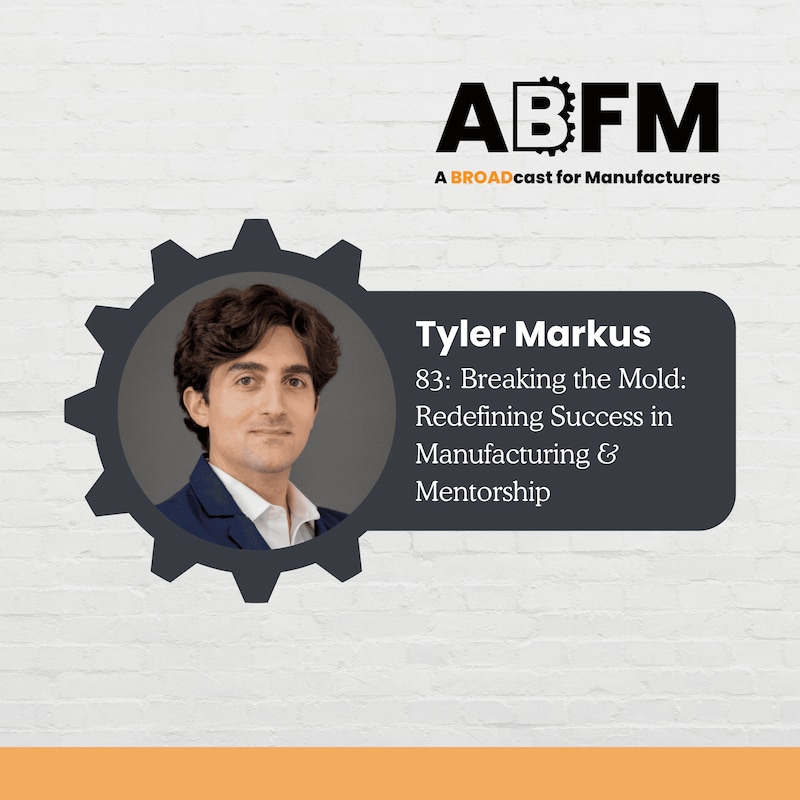
In this episode of ABFM, we sit down with Tyler Marcus, a dynamic force in manufacturing and mentorship. Tyler shares the pivotal lessons that shaped his path, including his non-traditional journey into business, the power of soft skills, and the true value of making time for mentorship.
We explore:
- The shift from traditional career paths to purpose-driven leadership
- Why humility and listening are critical in management
- The future of American manufacturing
- How mentorship changes lives — one conversation at a time
Whether you're in the industry or just love stories of people charting their own course, this conversation will inspire you to rethink how you define impact and legacy
🔑 Top Key Quotes from Tyler Marcus
🧠 On the Right Way to Implement AI:
“AI isn’t something you just shove into a business. It needs to solve a real problem. That’s where the ROI comes in.”
📊 On Data Readiness:
“It’s great to want AI, but the real question is: do you even have the data you need? If the ERP is messy, AI can’t fix that.”
🔁 On ROI and Efficiency:
“If you improve worker productivity by 10%, what does that mean to the business? That’s the kind of question you need to ask before implementing anything.”
⚠️ On Skipping Steps:
“The biggest mistake I see? Companies spend six figures on AI tools—then realize they had no clean data to begin with.”
🧩 On Use-Case First Thinking:
“Start with the use case. Understand the data. Then decide if AI is the answer—not the other way around.”
🏭 On Manufacturing Opportunity:
“AI is no longer just for Fortune 500s. Mid-sized manufacturers are realizing they can leverage it too—if they have the right strategy.”
📈 On Growing Interest:
“We used to work mostly with enterprise. Now, AI is pulling us into mid-market manufacturing because the demand and curiosity are finally there.”
Transcripts
[00:00:00]
[00:00:10]
Lori hyvee, Chris Harrington and Aaron Courtney. Three Broads bringing new stories and strategies, exploring manufacturing topics. That challenge the status quo while
[00:00:20]
laying the foundations for future success. Together with special guests, they'll celebrate what's working and unpack what is not so you can learn, grow, and
[00:00:30] succeed.
[00:00:31]
You wanna learn more about your host? Make sure to listen to episode one.[00:00:40]
[00:00:42]
All right, ladies. AI is gonna be the overarching message of today's show, so I figured, are
[00:00:50]
you excited or overwhelmed or a hot mix of both with where we're at with AI as a society or as an individual? As a human. As a human. As a human.
[00:01:00]
How are you feeling about it? Oh, I'm in where we are at, where I'm at personally, professionally, I'm still in the honeymoon phase.
[00:01:07]
I'm so delighted with my new partner.
[00:01:10]
We're doing great. That's great. Yeah. I would definitely say that I am very excited about all the
[00:01:20]
potential of AI and everything that I learn and read. Usually. Lifts the excitement where I do feel
[00:01:30]
overwhelmed, so I'm, I can have a mix of both is really sometimes when I'm thinking about how to apply it to our organization and how to apply it as part of our [00:01:40] product.
[00:01:40] So the learning, the teaching, you know, it's one thing for me to be involved and understand and have conversations where I get exposed to a lot of things. How do I ensure
[00:01:50]
the rest of the team has the same exposure and they're learning and they're getting acquainted with. This new technology, how do I ensure that we're doing everything
[00:02:00]
securely for ourselves, for our clients, and the responsibility we have for all of that?
[00:02:04]
And then of course, how do we deliver it into our product? In a safe way that brings
[00:02:10]
value to everybody in that value chain that's associated with our product. So that part, again, it's very exciting, but it seems to be moving so fast and that I
[00:02:20]
don't want us to fall behind. So it's that ensuring that we understand what's relevant, that we understand.
[00:02:27]
How fast we can go and truly
[00:02:30]
getting feedback from our clientele as well. So I feel like I could talk about this for a long time, but yeah, it's a really important question right now. Yeah. Oh, I agree. Your answer resonates with me very
[00:02:40]
closely. It's, you know, I'm excited when I'm playing with it myself.
[00:02:43]
Either, you know, from a personal or professional standpoint. Looking at how can we incorporate it into our
[00:02:50]
processes internally? How can we support our clients in leveraging it? But yeah, it's, the rate of change is faster than I think anyone on this. Planet
[00:03:00]
can actually keep up with, which is where the overwhelm comes in.
[00:03:04]
So I'm a mix of both, but I'm excited for what our guest is gonna bring to the
[00:03:10]
conversation today. Tyler Marcus is the Chief Executive Officer. CEOI should have just said that, of Grand Moore. Prior to being a founding partner
[00:03:20]
of Grand Moore, he utilizes data analytics background to drive marketing growth efforts at two startups.
[00:03:26]
Before these management roles, Tyler worked as a financial
[00:03:30]
data analyst in both tech and healthcare. Tyler holds a BA in history from the University of Wisconsin Madison, and was a member of the Honors research Scholar program where he aided
[00:03:40]
professors in data analysis and data science. Tyler, welcome to the show.
[00:03:45]
Thank you. Thanks for having me. Excited to talk about AI and to hang with you guys.
[00:03:50]
Yeah, I'm excited for our conversation as well. We were connected at an event, in Milwaukee here that was on the topic of ai, which this audience gears heavily in the
[00:04:00]
manufacturing space, so picked his brain a little bit and I said, you gotta be on the show.
[00:04:04]
So talk about. Real quick. Yeah. Like what exactly is your organization doing?
[00:04:10]
What do you service? Yeah, a hundred percent. So Grad Moore, we are a workforce intelligence company, so we specializing in optimizing worker productivity, efficiency,
[00:04:20]
performance. Using AI and data analytics and science. We started this company in 2017.
[00:04:25]
So the pre COVID version of the company was more data analytics,
[00:04:30]
right? AI was not as prominent or was just starting to become more in the weeds of mainstream, slowly but surely in the tech scene. But post COVID is when we really started working on ai,
[00:04:40]
or more specifically, machine learning, modeling.
[00:04:42]
So predictive analytics or predictive modeling. So our experience in AI is actually almost now five years. If you could believe it, more no, like
[00:04:50]
predicting things. So like how can we use AI to predict turnover within an organization? Sure. How can we use AI to predict better hiring performance? Okay.
[00:04:57]
So that's where we were using it for. And
[00:05:00]
then obviously now with the. Increase of language learning models like Chat, EBT, copilot, and all these other tools. You know, our workforce intelligence offerings have
[00:05:10]
sort of grown under an umbrella. So most of my business had originally started working with sales teams and retail because they had our turnover and also sales teams on
[00:05:20]
enterprise because they have a lot of performance issues, hiring enterprise sales reps.
[00:05:24]
And then that has now grown into manufacturing. Okay. How can we apply
[00:05:30]
data science and AI to improve worker productivity on the floor, to improve distribution, to improve scheduling optimization of jobs. So like things that
[00:05:40]
originally maybe weren't touching are now becoming a main focus of our business.
[00:05:44]
In the past year, I had originally more worked with Enterprise. So yeah, talking large
[00:05:50]
scale, multi-billion dollar companies. In the past year we started going more mid-market and downstream because of AI and because of the interest of ai. And
[00:06:00]
I think that's a lot of it has to do with the narrative around it.
[00:06:02]
I mean, like you just mentioned, Lori, where we were at that panel on AI manufacturing. Mm-hmm. When you go to any conference or any content that
[00:06:10]
you see, it's all about applying AI and all those things that now has made the knowledge gap of maybe like a CC level person who's running a. 30 to a hundred million
[00:06:20]
dollars manufacturing company realized, wait, how can we apply this?
[00:06:23]
While a year and a half, two years ago, it was really just the giant Fortune five hundreds that were like, how can we leverage AI
[00:06:30]
within our workspace? So I think that's what I'm seeing in the trends and that's what we do now and some of the things we work on. Yeah. So I think you actually asked the question yourself that I'm about to ask you, which I think
[00:06:40]
is kind of funny.
[00:06:40]
But how do you think AI is gonna help manufacturers? With their operational efficiencies, speaking to that, that is a great question. So I think it depends on
[00:06:50]
what they're doing. What I've learned, you know, as you guys know, manufacturers do different things. If you're a contract manufacturer, different problems than someone who's just distributing a warehouse or
[00:07:00]
building, you know, a mining equipment, right.
[00:07:01]
Or something. So I think there's some areas I'm seeing, I think one is like in a distribution center specifically where products
[00:07:10]
go and how you can use AI to place things, right? Because from a worker productivity perspective, let's say you have a giant, warehouse that's 500,000 square feet and you have
[00:07:20] thousands of skews that you have, if it takes a worker an hour to fill a order, can we get that down to half hour by placing products in the right places?
[00:07:28] So it makes better sense.
[00:07:30] And when you get new SKUs, instead of just throwing them in the back of the warehouse, why not we using, you know, data, understand where if that should go in a better zone or near where, where it belongs.
[00:07:40] So certain things like that. I think there's, again, scheduling seems to be popular amongst like, you know, how can we be more efficient about scheduling to avoid delays and throughputs and, you know, optimize
[00:07:50] that. I'm seeing it on the workforce side, like in terms of just like assessing performance. You know, using MES software, one of the companies I work with, they attach an AI operation efficiency
[00:08:00] measurement tool to a forklift to measure the productivity of forklift drivers. 'Cause they have hundreds of them and who's operating at the highest level.
[00:08:06] So basically like there's a lot of application. It's just a matter of
[00:08:10] like, what is the strategy and use case within your environment. And I think this is where a lot of problems occur is people are like. Oh, we should just jump in and put in ai. It's
[00:08:20] like, wait, what is the actual purpose of this? If you have a distribution center and you approve workforce productivity by 10%, what does that mean to the business?
[00:08:28] Oh, well, we could have a person
[00:08:30] fill 15 orders instead of 10 in a day. Mm-hmm. Oh, now you could, you don't have to hire as much, you know, it's, it's more efficient. Maybe the workers are more engaged because they're not like running all over the warehouse.
[00:08:40] So. There are all these business use cases, and honestly, my business when we started this was all about measuring impact around workforce changes.
[00:08:47] So we're very much about like, how does this impact
[00:08:50] the bottom line? And I think in a manufacturing environment, it's really about understanding what that really means, if that's actually doable or makes sense for your, for your business. Yeah. Wow. We're all kind of numb with that answer,
[00:09:00] really, you know?
[00:09:03] Yeah. I mean, what you said really resonates with what Chris and I said in the initial question, right? Like there's, there's so
[00:09:10] much to unpack and it's, it's, um, I love how you said there's a very specific use case, which. Try to solve for, as opposed to just how do we shove this thing into our
[00:09:20] business right now? Right. So, so what I like to do is I like to start with more like a data si using data science analysis. Mm-hmm. Understand the data first. So, for
[00:09:30] example, the company has like an ERP, right? Most manufacturing firms hope have, if the data's clean enough, you know, if they have MES software, one is, okay, what variables do you
[00:09:40] have? Do you have the data? And number two, let's run an analysis. Use data science to understand are these correlating, are there correlations here to warrant an AI use
[00:09:50] case? Because I think a lot of times people make the jump and they skip the step and they're like, Nope, let's just put in an ai, an AI bot. And it's like, great.
[00:09:57] You're gonna spend six figures to do that.
[00:10:00] But what if it, you do that and your implementation's wrong, and now you ended up just spending money and not breaking, getting any ROI. So our whole thing is like leverage the data science first and then build the AI
[00:10:10] use cases as opposed to doing it haphazardly in reverse.
[00:10:13] Which is never good. And just to make a point like this is not just an issue manufacturing, but when I've worked with other
[00:10:20] clients in, you know, like sort of tech, you know, they do the, they make the same mistakes. Like you be like, it's funny, they're putting in, you put in these tools and they're like, actually we gotta roll back.
[00:10:28] And it's like, why? It's like,
[00:10:30] well, you didn't figure out that by putting in an AI, customer service tool is costing you more money because there's more errors that you didn't expect. Mm-hmm. Robots. So it's just being smart about how you
[00:10:40] apply these things, not sort of, you know, sort of just like following trends and hoping that it works.
[00:10:43] Sure. Yeah. So I'm curious, Tyler, when people are coming to you and they're looking for
[00:10:50] productivity gains, let's not assume that that's what they're looking for when manufacturers come to you. They, how are they reaching to you? What is, are they saying, I have
[00:11:00] a problem in this area, and can AI solve for that problem?
[00:11:04] Are they coming to you saying, I want to get more out of my business with
[00:11:10] ai, or are they coming with a very specific productivity opportunity that they think and that's what's. Driving you into the ERP data. I almost wanna just step back and make sure
[00:11:20] everybody gets it. Like how are you identifying where to get started?
[00:11:24] How are these manufacturers coming to you? And then walk us kind of through the process of how you're
[00:11:30] solving for that. Great question. I, so they're coming more with the issue, less about like, how can we implement ai? Our problem is worker productivity. Our problem is turnover.
[00:11:40] Our problem is scheduling, right?
[00:11:41] It's like we know we, it's inefficient. We have delays. So usually it starts there and then I'm like, so that's where step one, it's very rare. Someone's coming to me. Like, we wanna put in
[00:11:50] AI in a manufacturing. Okay. Most it's more coming from, we have this problem, it's been a problem. Can this be solved with ai?
[00:11:57] Which is a better approach probably because it may
[00:12:00] not be solved with ai. Right, or at least even with just, let's take basic data science, you can at least understand the issue better and have an understanding of correlations and then what [00:12:10] those solutions may be. Maybe it's ai, maybe it's something else.
[00:12:13] Maybe it's a different type of software. Right? But generally speaking, it's more the issues that people come with, and I think it's a lot of like interest in how AI
[00:12:20] can be applied to solve that problem. More so than them coming to me and being like, oh, we wanna use ai. Right. You know, I don't, I haven't had that happen.
[00:12:27] I mean, I'm sure I've had conversations,
[00:12:30] but generally it's the challenges that come up or consistent operational issues that maybe have been plaguing them for forever that are like, wait, can we finally get this fixed or better place
[00:12:40] with artificial intelligence? So that's really where, where we're seeing that.
[00:12:43] And then in terms of that journey, we're very much about like, great, okay, let's say it is a certain issue around
[00:12:50] scheduling or, you know, or distribution. Okay. Well, what data do you have? Right. Because now it's like, okay, that's great. Are you even collecting the data that we need? Because the thing is, some companies
[00:13:00] don't, right? Their ERP might be messy and they may not have it, or they might. So we have to understand what data you have, what variables you have. And I asked a lot of questions about,
[00:13:10] okay, do you have this software? Is this tech stack? You know, do you scanning? Are you scanning in and out? Let's say once when something new comes in?
[00:13:16] Because then we can see, okay, the timing. So I need
[00:13:20] to understand if they have a right data set to work with, because you can't do anything with the data set's not good enough. Mm-hmm. So that's the second step. And then the third step is really us diving in and doing like an
[00:13:30] analysis to be like, okay, do these things correlate?
[00:13:32] Is there a business opportunity to, to measure, like if we see, for example, you know these skews, right? And let's just use the distribution center
[00:13:40] example. Yeah. Like these products always are bought with these other products. So how come they're not next to each other in your distribution center? Because right now.
[00:13:48] A person gets the product runs to the
[00:13:50] other side. Okay, now they wasted 30 minutes, as opposed to just going, oh, it's like 50 feet from each other. That cuts the time down. And now they can say, okay, we can model that out and say, oh, if we,
[00:14:00] based on the amount of orders you're getting based on these products, you can now see this actual impact.
[00:14:04] And that's really the key is like, here's where you can, potential can be and what can be done. So we take those steps first
[00:14:10] because again, I think the biggest mistakes, and I think it's happening now across not just manufacturing, but I think in other industries, is. People doing things without doing those first steps, and then they're like,
[00:14:20] wait, we wasted a couple hundred grand on this and our, our return, we didn't see any productivity gains.
[00:14:25] Mm-hmm. Mm-hmm. Yeah, I really like that last example
[00:14:30] too. Go ahead, Aaron. Before you answered, I was thinking about, well, it's only as good as the data or mm-hmm. If you even value data-driven
[00:14:40] decision making in the first place. And that has been a perennial problem. You know, I think for generations, since we've.
[00:14:47] Considered the value of data-driven
[00:14:50] decision making. If you're not even there, you're probably not ready to make that next step to a, not only just because you don't have the data, but you're just not in a culturally, in the right place
[00:15:00] to recognize what benefit you can get out of that. So let's say that's, that's one of the barriers to incorporating AI in manufacturing.
[00:15:09] What are
[00:15:10] some of the other barriers or challenges you've seen? So I think that's one. Honestly, it's, the thing is, what's funny is that when I do work with other companies, that's always the challenge
[00:15:20] too. Like, is your data good enough? That's why I can't work with like small, generally small businesses that are like, you know, even in manufacturing because their data in an ERP might just be
[00:15:30] messy, right?
[00:15:30] It's just not consistent. So that's number one. Once I get around that barrier, it's honestly, like you said, I think a lot of it is just like. Desire, you know, data analytics
[00:15:40] has grown more over the past 20 years. I think in manufacturing it's a bit more behind because in manufacturing, people are producing products.
[00:15:47] They're not in tech necessarily. They're not in tech
[00:15:50] business. Versus when I work with my tech clients who are in cybersecurity, they're like all about using, optimizing with data because they're building tech products. So they're kind of in that realm. I think that
[00:16:00] it's a desire, I do think with maybe as management shifts in and out with, you know, millennials becoming leaders.
[00:16:06] There might be more of a desire now to bring in data analytics
[00:16:10] within the firm. I think it's, a lot of it is knowledge and just understanding and then also understanding impact. I think the thing with data is that people have hesitant to think that it's actually gonna
[00:16:20] make a difference. I think there's some hesitation of like, well, yeah, that sounds great, but like, does it actually like impact us at all?
[00:16:26] Like what makes you think that looking at these numbers is gonna drive 10%
[00:16:30] gain? Right. It almost sounds like it's too good to be true, like you're gonna. You know, so that's, I would think those two are the biggest hesitancy. Hesitancy, that I see,
[00:16:40] within a man in the manufacturing sector. But I do think AI being like more of a, like mainstream is making people think more about data because mm-hmm.
[00:16:47] It's not necessarily about it, but it
[00:16:50] ties closely enough to it. Sure. Where it makes it almost more prominent. Yeah, that's a good observation for sure. Yeah. We, my last role we worked with an
[00:17:00] awesome manufacturer. They were a water, like industrial sized water heaters, and I don't remember what kicked it off, but they had brought a, a data
[00:17:10] scientist in to be on the team.
[00:17:12] I mean, before long, he was like one of the most. Respected and like he was a champion, you know, for the company because
[00:17:20] he was so good at bringing everyone else along at recognizing why what he was doing, which initially seemed very arcane and like impenetrable. What the
[00:17:30] value was. I. To the company and Chris, we were working with him, was really on that e-commerce side.
[00:17:35] Mm-hmm. So he was using, you know, the data to really help
[00:17:40] with developing a more powerful, sort of e-commerce interface for the company and. I can only imagine right now, I haven't talked to them in a few
[00:17:50] years, how well positioned that organization has been to bring some aspect of artificial intelligence
[00:18:00] into their operations, you know, company-wide and, and it didn't have to be, just one piece of the company or one aspect of the company because
[00:18:10] they've been doing such a nice job for so long with collecting that data.
[00:18:14] Yeah. First of all, one, data scientists are expensive. I think that's, mm-hmm. Hiring one is costly and I think there's,
[00:18:20] it's, you know, it's a six figure job. Right. And it's, it's a risk. And also like the other thing is data scientists have to understand how to apply it back to the business strategy. And that sometimes gets
[00:18:30] lost.
[00:18:30] Where, you know, you could have data scientists come in and they're working on things. And I work with companies that have data science teams, and I'm like, well, you're doing this, but this doesn't make sense from business
[00:18:40] perspective. So they sometimes can get lost. The data, but it's almost like, I don't wanna say it's too abstract, but it's like, where's the application?
[00:18:48] Mm-hmm. And so I think
[00:18:50] that there definitely should be more data scientists in manufacturing firms. I think that would be helpful. I think that just under, but understanding how that ties to strategy is really the most
[00:19:00] important part of it. And it's, it's just finding the right, the right person for that.
[00:19:04] So that makes sense. And I mean, e-commerce, like, yeah. Like that, that makes sense to me. I mean. On the
[00:19:10] e-commerce side, like data is power for, yeah. Aspect. I mean, Chris, you must know a lot about that. I'm curious, Tyler, when it
[00:19:20] comes to operational efficiency, specifically in your work with manufacturers, the different applications that are getting most of the attention, are
[00:19:30] they, I. On the operations floor where they're looking for increases in that productivity, is it through sales and marketing where they're trying to
[00:19:40] close more or get more leads and then move those leads to close? Can you talk a little bit about. Specifically the applications where people are applying
[00:19:50] some of this and where manufacturers the most are, are asking you for things.
[00:19:54] Obviously it can be used across all of it. I'm just curious where the volume is right now. Yeah, so
[00:20:00] I'm seeing it on the floor, but it, depending on the type of manufacturer. Mm-hmm. I've also got, I've also seen a bit in the sales side, so recently I got, something on,
[00:20:10] oh, we're going to this giant conference.
[00:20:11] There's a thousand exhibitors, right? Can we use AI to identify a hundred people we should be talking to? Because the conference has 5,000 people. We don't like
[00:20:20] simple things like that. Even small on the sales side, like little things. But I am seeing a lot on the frontline, sort of like worker, like efficiency side.
[00:20:28] Okay. So it just really depends, of
[00:20:30] people's appetite and like what their issue is. But lately I've been doing more on the sort of the worker productivity down on the floor type thing than like sales marketing side of things
[00:20:40] actually. But that also speaks to what we do more so like, you know, I'm more inclined to do that.
[00:20:44] And more, we're more like, that's our thing. Sure. So I want that, if that also
[00:20:50] makes a difference in, in that conversation. Yeah. It'll be interesting to see how things shift over time, right. Like, as people start to understand what companies are out there
[00:21:00] and, and how these applications can be put to use, or how problems can be solved.
[00:21:04] There's different areas of the business. I know we're thinking a lot about. The lead generation side
[00:21:10] right now, and how we can be applying that. So yeah, I mean I've, I've been in conversation with some larger firms that are only looking at it from the corporate side, even
[00:21:20] when Manufac a huge company and they're like, no, we're not there yet.
[00:21:23] AI on the floor. But they also do really complicated work, so it's like, you know, they wanted, they were like,
[00:21:30] oh, we're, they used a lot of design, like in what the machinery and they like tested out these AI tools and the AI tools weren't good enough to match. The human's ability to do design, even
[00:21:40] though they tested it and thought so, but again, that's again that use case for what they do.
[00:21:44] Maybe in five years. It makes sense, right? Sure, yeah. Versus if you're like, Hey, we're, we have
[00:21:50] products in a distribution center, stuff like that's pure predictability, machine learning, data science, like work where it's not as, you don't need this like fancy design machine that's
[00:22:00] gonna like. Create this perfect, you know, blueprint.
[00:22:03] So that's it. It really depends on what, what the company is doing. Yeah. Wow.
[00:22:10] Oh man. I feel like we could talk about this one forever, but we do need to keep moving on. So we're gonna switch to the section of the show where we refer to as I just learned that, Chris, what did
[00:22:20] you just learn? Well, I learned that chat, GPT has some custom gpt as you know, you can.
[00:22:27] Or maybe our audience doesn't know this, but you
[00:22:30] can, design your own custom gpt. Mm-hmm. But they also list. GPTs that chat GPT has come up with, and one of
[00:22:40] them is called Planty, so P-L-A-N-T-Y. If you look under GPTs, you'll find this section and you can find Planty. So.
[00:22:50] Here in Wisconsin, you know, we're recording this at the end of May, which is typical time to get our gardens.
[00:22:57] Um mm-hmm. We're safely
[00:23:00] past, frost period. Well, or so we think. Right. You just never know. But I gave planty information on the size of my
[00:23:10] garden, the things that I wanted to plant. I told it where I was in the state of Wisconsin and the planting timeframe that we had, the veggies that I wanted to plant, and I
[00:23:20] asked it to come up with a using plants companion.
[00:23:24] Lay out the garden for me so that I can get the best use of the garden. And it came up with a full
[00:23:30] design. It told me why I should do these things. It told me which plants I should start from seed and which ones I should transplant to actually purchase the plant.
[00:23:40] Which a lot of it I knew already, but the way it.
[00:23:43] It designed and responded to everything. So if anybody out there is planting their garden and they're curious about
[00:23:50] different things, I'm sure can do so much more. I haven't even tested its limits, but plant yet. I thought that was pretty cool. Love that I'm writing that one down right now. All right.
[00:24:00] Erin, what did you just learn?
[00:24:01] I struggle to share this one because it's too complicated for me to say that I learned it, but I think it's cool. You guys have heard me talk about
[00:24:10] baseball before. Do you know about the drop third rule? No. No. So it ends up coming into play more often in little league because what it is so third strike.
[00:24:20] So you struck out twice. You have your third strike. If the catcher bubbles it and doesn't catch it and there's nobody
[00:24:30] on first, you can run. You can go. Oh, really? Yeah. You can go to first. Yeah. Yeah, yeah. So that doesn't happen that, you know, in the majors it's like, you know, the catcher's
[00:24:40] gonna get you're, or there's usually somebody anyway.
[00:24:43] But it creates a lot of excitement because you need to remember that that's even a. You know,
[00:24:50] so the thing that I learned, I was like, well, what is, that? Doesn't even, why does that even exist? It's because like baseball long, it's an old game, like the, the
[00:25:00] origins of it are, and then mm-hmm. Rules were evolving just constantly.
[00:25:03] They still are evolving and it's sort of a holdover from, I, I think I got this right. The pitcher used to be like, not
[00:25:10] far at all away. From the batter and they would just sort of lightly toss the ball up in the air. And, and that's, and it would be a lot harder for the, the
[00:25:20] batter to hit it. And the catchers weren't wearing gloves, so the whole thing was kind of like messy, A lot messier than it was.
[00:25:26] And, so they forgot. To fix that
[00:25:30] when they were redoing the rules, that dropped third rule just kind of got overlooked from this old iteration of baseball. And now it's still in there. And if you are on a little
[00:25:40] league team, you actually get to see people take advantage of it. So that's there you go there.
[00:25:45] She's sports. I learned. Righty and Lori. They're the sports girls. I just.
[00:25:50] Chime in once in a while. What about you, Laurie? Well, mine's gonna be an AI one. No surprise there. I've been, I saw someone do this and I've been
[00:26:00] playing with it, but you can build a, a custom GPT I'm calling mine the trainer, which basically, if there's something I want to learn how to do, I'll give it that
[00:26:10] insight and it's, it'll first.
[00:26:11] Question me on how much knowledge I have on it, and then it'll build a training plan for me. So that's been really kind of fun to play with,
[00:26:20] so, very cool. Yeah, I like that. Is there anything that you're working on learning that you wanna share? I am genuinely curious about how to create AI agents. So
[00:26:30] that is the one thing that I'm kind of trying to teach myself right now.
[00:26:34] Oh, I like that. Yep. Well, that tie into my, because, so my whole thing was, so
[00:26:40] people like, you know, people use the language journey models like chat, GBT, but there's obviously other ones, right? Grok. Mm-hmm. Yeah. You know, llama, there's all these things. So one thing I've been doing is
[00:26:50] experimenting when I'm building some of these models, is testing 'em out on different models.
[00:26:53] Mm-hmm. One thing, what I learned with AI is like each model has strengths and weaknesses in its
[00:27:00] knowledge base. And it's kind of like humans in the sense of like, some people are really good at numbers. Like me, I'm a numbers person, but like, if you're a title, I read this book and, and tell me what, tell me what it's about.
[00:27:09] I'd be like,
[00:27:10] not great at it. Right? Like, you know, so with with AI models, like whenever I'm building stuff or when people are doing things like certain tools are better and faster at learning
[00:27:20] certain things. So, for example, like Llama is amazing at being trained in like data. Okay. Like for some reason like.
[00:27:28] If I put it in chat, GBT
[00:27:30] and I train a model on chat, GBT and I train a model of llama, the llama does it two, three x faster. Wow. In terms of like just, yeah, that's so like using under like, and sometimes I'll
[00:27:40] ask chat GBT I'm like, what is the best language learning model you I should use to train? And it'll actually tell me that like, we're not the best at this, but you should look into these three.
[00:27:48] Oh.
[00:27:50] Okay, cool. I think, so what I started doing where I used to do like a lot of my work on like a few models, now I'm like, I just leverage them for different things based on
[00:28:00] what the use case is because some of them are just already more advanced than the others. Yeah. That's awesome. Yeah. Wow.
[00:28:07] This was a great conversation. Tyler, somewhat [00:28:10] thank you so much for being on this show. Would you mind sharing with our listeners, how to get in touch with you if they're interested in reaching out? Yeah, you could friend me on LinkedIn. That's one. You could send me an email,
[00:28:20] [email protected]. So if either way, if you're in Milwaukee and you're at events, you might run into me like Lori and I.
[00:28:27] So yeah, like, I think those are the two best methods
[00:28:30] to reaching out. Fantastic. We'll include your contact details in the show notes. All right. This was a great episode. We want you to all go out there and make
[00:28:40] something awesome.
[00:28:50] This wraps up today's broadcast. If you're looking to shake up the status quo at your organization or just want to connect with these broads, visit mfg broadcasts.com.
[00:29:00] Contact Lori Hebe for your strategic digital marketing initiatives. Contact Chris Harrington for OEM and Aftermarket Digital Solutions, and contact Aaron Courtney for web-based
[00:29:10] solutions for your complex business problems.
[00:29:12] We've got a great offer specifically for our listeners. You can find more information about the offers and your hosts at. MFG
[00:29:20] [00:29:30] [00:29:40] broadcasts.com.


