Shownotes
Is midlife really a crisis—or have we just been telling ourselves the wrong story?
In this inspiring episode, Michael O’Brien sits down with Chip Conley, founder of the Modern Elder Academy and author of Learning to Love Midlife, to reframe everything we’ve been taught about aging, identity, and what it means to thrive in our 40s, 50s, and beyond. From surviving near-death to building a purpose-driven second half, Chip shares how embracing vulnerability, awe, and emotional intelligence leads to deeper fulfillment in midlife.
- Discover why midlife is actually a powerful chrysalis stage—not a crisis—and how to navigate it with intention.
- Learn the emotional and psychological science behind why life satisfaction increases after 50.
- Explore how to own your wisdom, embrace change, and create the life you want in the second half.
Take a deep breath and start seeing your midlife not as a breakdown—but as a breakthrough moment that can change everything.
Receive my free text messages by texting Whole Again to 866-612-4604
Did you know that stickers are wonderful visual cues to help you create healthy habits? You can get one of my free Pause Breathe Reflect stickers by clicking sticker.
To discover more and sign up for My RIPPLE EFFECT newsletter by clicking Ripple Effect.
We can also connect on LinkedIn. or at [email protected]
Subscribe to be sure you don’t miss any of the micro-meditations, wellness tips, and guidance that I publish every Monday, Wednesday, and Friday at 7:11 am.
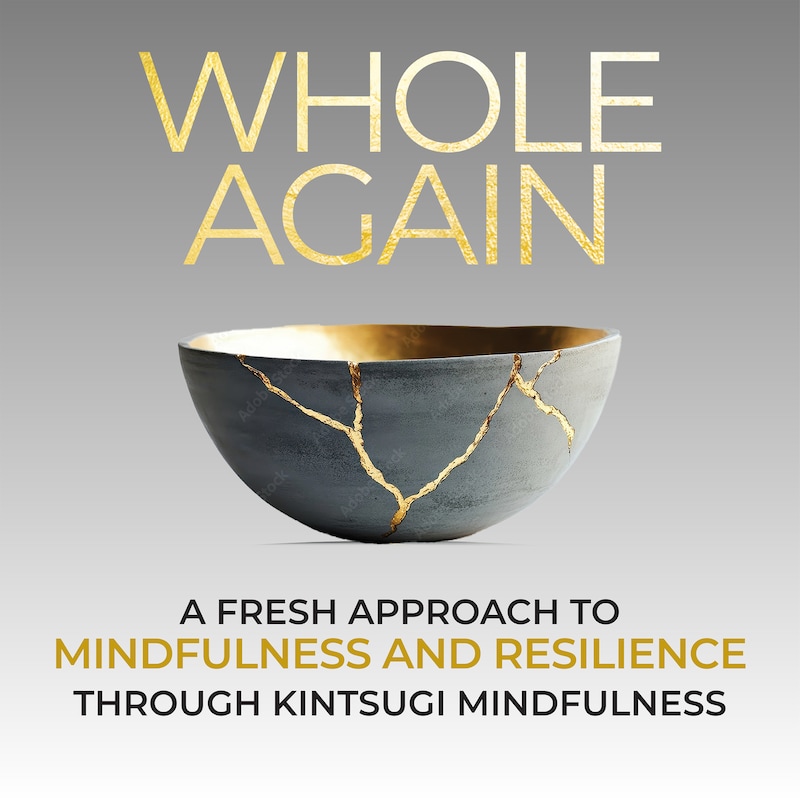
With Whole Again: A Fresh Approach to Healing, Growth & Resilience after Physical Trauma through Kintsugi Mindfulness, listeners explore resilience through personal stories of trauma, scars, and injury while learning to overcome PTSD, imposter syndrome, self-doubt, and perfectionism with self-compassion, self-love, and self-worth. Through insightful discussions on building resilience, resilience building, resilience and fitness, fitness and resilience, stress management, mindfulness practices, and digital wellness, the show offers practical tools like breathwork, micro-dose meditation, grounding techniques, visualization, and daily affirmations for anxiety relief and stress relief. Inspired by the art of kintsugi, the podcast embraces healing as a process of transformation, encouraging a shift in perspective from worry and being overwhelmed to gratitude and personal growth. By exploring the mind-body connection, micro-dosing strategies for emotional well-being, and holistic approaches to self-care, this podcast empowers listeners to cultivate emotional resilience and live with greater balance and intention.
Transcripts
In this episode, you'll discover why midlife is not the crisis you think it is. Hey there, it's Michael. During the early days of my recovery when I was still in the hospital, my wife would bring me lemonade with lunch. Besides being super delicious, it was a reminder that we can take lemons and. Make lemonade, and we are gonna do just that over the next seven weeks on our Friday episodes.
During this period, I'm going to be helping one of my family members recover to help them feel whole again. That's the lemon part of it. The lemonade is. It gives me an opportunity to reintroduce to you some of the amazing guests I had on the podcast when it was known as the Kintsugi Podcast, and in this episode, I'm so happy to share one of them with you.
But before we get to the episode, I first wanna say thank you for being here and thank you for being a survivor. And as I've mentioned over the last couple weeks, if you wish to receive those great text messages that are just the right message at the right time, and they're all free. We'll will text me whole again to 8 6 6 6 1 2 4 6 0 4.
sat down at the beginning of:I love a good reframing if you've listened to July's episodes on My Grace framework. Well, he is reframing midlife. It's not the crisis we think it is, it's actually something much more expansive. He will also share how a near death experience his trauma. Changed his whole life and how our relationship with aging, how we see our bodies, all of that should evolve.
It's not static. So if you're ready to meet Chip Connolly, I'll invite you to take a healthy breath in and a full releasing breath out and get to no Chip Connolly. And his take on midlife
chip. Good to see you. How are you,
Michael? Thank you. I am raw and imperfect, perfectly suited for your podcast.
Absolutely. I think we're all a little imperfect and raw, right? So it's. That whole question of like, how are you is, we can pass by it so quickly. Like it's just, it can feel so transactional, but I think we're all going through things.
I know you're going through a lot. I'm going through a lot. So that question of how are you, if we pause just long enough if we can get into our rawness. I'm glad you're here.
Yeah, thank you. I am. Two thirds of the way through my radiation journey for my prostate cancer and stage three. And so yeah, you're catching me on a day where I am even more raw and imperfect.
Hey, that's how we like our humans here.
Yes. Yes.
Like outta curiosity, I know you do a lot of writing about your journey with cancer, your battle with cancer. How is that for you to write about it and share it so publicly?
Gosh, so cathartic. So cathartic. Yeah. I definitely have people in my life who tell me like, chip, TMI, like you do not need to share all of this, but I learned a long time ago, you're as sick as your secrets.
So I, I appreciate the fact that I can use my daily blog, which is called Wisdom Well to. Highlight what I'm learning along the way. If wisdom is our metabolized experience and our painful life lessons are the raw material for our future. Wisdom and wisdom is not taught at shared sharing. My life experience is a form of sharing wisdom.
Yeah, it's hard at times to talk about stuff, especially bodily functions that aren't going well. It's a little messy, but I appreciate the fact that there are a lot of people out there going through all kinds of stuff and often they don't feel comfortable talking about them, what they're going through, especially men.
And I appreciate the fact that there are people who will see me as a mirror. By being vulnerable and imperfect, it allows them to be more vulnerable and imperfect. And so I'm doing my good deed by showing my frailties in public.
I love that. And as a reader of your blog, I appreciate the senses, like the feelings, like all of it that you're bringing to your journey, because I think current day we hear about folks having cancer and it's so commonplace.
I think it is easy to gloss over. That person has cancer, but we forget what that journey is like for the particular person that we know. And each person's journey is different. It's unique to them. And when I read your blog, I can feel it.
Thank you.
It's messy, and you know what? Life is complicated and messy and it can be so beautiful as well.
Thanks for putting a mirror out there for others.
Yeah, I write books. I have my seventh book coming out soon, but when I was a teenager I felt. Embarrassed about my desire to write. My father had said it's not a practical thing. He didn't say it was a, not a masculine thing, but I got that impression. And of course there's Ernest Hemingway and others who are great masculine writers, but
absolutely, yeah.
I got the point of view of, okay, I better walk away from this and I did everything I could to walk away from my writing. And I want more everybody in terms of all the details of what I did to walk away from writing. And then it was in my late thirties after I'd started a boutique hotel company and I'd been writing it for 10 years and people were asking me to give my tell my story because I had become a successful young CEO of ING hospitality.
Company in a space boutique hotels that was new to the us. And one day a literary agent came to me and she said, chip, God, you've got a book inside of you. And I just broke down laughing because I said, I have done everything I can to not be a writer. And she said, you have a book inside of you about a being a rebel entrepreneur.
And so she convinced me to write a book. It came very easily to me. It was called The Rebel Rules, daring to Be Yourself in Business. And next thing I knew I was writing a lot and so I, having a daily blog is a huge commitment, but it's also a calling because it allows me to get into my craft of what I enjoy doing, and I get into flow when I'm writing.
That is so cool. So for people who don't know you yet, they don't know your work.
Yeah.
If you put your work to the side, so the work you do as an elder, the work you do as a writer, so if you put the professional part of Chip to the side, how would you describe yourself?
I have been called a social alchemist.
I like that. A mixologist of people. So I think that is true, and yet that is the extrovert inside of me. The extrovert inside of me is pretty good at knowing how to mix people together and create the container for life-changing conversations to happen. And I've been doing that since I was a teenager, when I became an extrovert.
But as a kid, when I was younger, I was a pretty extreme introvert. And I would say that I, I'm somebody who has a pretty active imagination and I am someone who is a closet creative type. Again, like my writing, I did a lot to, to neglect that creativity and when I finally in my mid twenties just doubled down on it, it was amazing what came from that.
Yeah, I am a bit of an ambivert, which is a, an ambidextrous introvert extrovert at the same time.
I can totally appreciate that 'cause I do believe I fall into that category. I love my alone time.
Yeah,
I was talking to my daughters over the holidays, the Christmas, Hanukkah, new Year's holiday about my wife as a kid, and how much time I spent alone in my bedroom making up games and playing with, oh
my God, I did the same.
Yeah,
so we had this whole conversation about. Matchbox cars because,
oh, I'd love them.
Yeah. In my Christmas stocking, almost every year, I would have the requisite orange and apple, and there was trinkets, like little gifts in your stocking. I would get Matchbox cars. And Did you get Hot Wheels too? Hot wheels, yeah.
The whole thing. And I had a collection of that orange track and I might have had a collection of about 200 of these cars and I would create this ramp from my dresser. I had the special track that had a finish line, so I could do one up racing matching. And so I would line up all 200 cars. I would pair them up and there'd be a big tournament, and I would just spend hours in my room doing that to see which car was the fastest based on matchups and stuff like that.
So I can. Completely appreciate the need to be quiet. Where did you grow up? I grew up in Rochester, New York, and then ended up in DC That's where I met my wife and then we moved to New Jersey 'cause the corporate life took us there and we've been here ever since. So it's, but I still, my dad's still back in Rochester, so I try to go back as frequently as I can because I've reached that age where my parents are aging and they don't give you a playbook for that, which I know we'll get into.
Yeah, we're all aging. Unfortunately. When you get to your parents' age or my parents' age, because my post, my parents at 86 are still living, we don't call them aging anymore. We call them aged. Yes, yes. As in past tense. I've never thought of that before, but we're like, aging is a process, but when you get to a certain age, you're no longer in the process.
You're just like past tense aged.
Yes. Yeah, indeed. Yeah. My dad is 87 and going on 88, so he has lived a life. Kazuki as a show, as a concept is about connection, so. One thing my wife and I love to hear are relationship connection stories. So how did you meet your partner?
So my partner's Israeli, his name's Oren.
Francisco airport, this is in: bout Orin, and this was again:Yes.
They can be stubborn, hardheaded, and argumentative. And yet he's also a Taurus. So he is a classic Taurus is somebody who's like hard on the exterior and soft on the inside.
Yeah. Yes.
And that describes him. And so he is doubly hard on the exterior because he is Israeli and he's a Taurus. And so there's a like stubbornness and a sort of tough guy, although he's a bit of an introvert himself, so you don't, wouldn't necessarily know that unless you spent more time with him because he doesn't show that off.
But when we met, I was a pretty significant extrovert and I was really, we were a nice combo. And so yeah, that's how we met. And I've spent a lot of time in Israel and of course it's a very complicated time for that country right now in that region in the world. And he's actually over there in Israel right now.
He left 18 hours before the Hamas attack happened, so this is his first time back there. That's how we met. So I'm a, I'm an honorary Jew.
That's great. That's awesome. I love That's a great story. Yeah. The days where we could go to the gate and just
Yeah.
Hang out and find connection there. It's pretty such a different era.
Yeah, it seems so long ago, but it wasn't that long ago. It's a really incredible,
it really wasn't, but it's, it's a whole different era now. I do, I always love one of my favorite things at airports. I don't go and do this, but I like coming home from an international flight and in the international flight you go through the customs and all that, and then you come out and there's always these, all these people out there.
It's mostly immigrants who are there to meet somebody from their home country who's coming to visit them. And in San Francisco or wherever I'm living. I just really deeply appreciate that because you just see the joy, especially this time of year, it's the holidays right now in the Bay Area. You just see the joy of people coming home and that connection and you hear people screaming and oh my God, I'm a sucker for connection as well.
Yeah, I also appreciate that if you fly to a international destination, you get the same thing as you come through customs. There's, I can see a people, you can feel overwhelming, but there's these signs and celebration and to me, the way I look at it is in this moment, no one's really taking connection for granted.
It can be so easy to take connection for granted the whole like airport drop off and there's a, I think there's a good scene from when Harry met Sally, when Harry's explaining the whole airport drop off to Sally. It's just. For us, the drop off at the airport is a big deal in our family, whether you're flying domestically or internationally.
'cause it's, it's about reconnecting. If someone's arriving or just the whole process of seeing someone off and it's just, they're connecting to a different spot and you don't know.
And you just don't know. Both of us have had NDEs and we'll talk about that in a minute. You know? Will you see this person again?
So I'm with you. I think it's, there's preciousness when you were. At the airport. Airport and airport saying goodbye to someone or saying hello. It's a little window into our relationship with mortality because it's learning how to say goodbye,
learning how to say goodbye,
and that's not something we, we do easily.
Yeah. And appreciating that none of us live forever, like when none of us gets out of this thing called Life alive. And Lee, I would love to talk about your near death experience. 'cause for me, as you just referenced. I went away. I got on a flight to Newark Airport to come out to New Mexico, which we will also talk about a little bit later, thinking, okay, this is the 10th, 20th, 30th trip of the year, and each time I go away, I come back.
So I'll go away and I'll come back. And with that trip, I almost didn't come back. And you also had an experience like that where you were away and you had an a near death experience. I was hoping you could share. 'cause
yeah,
based on what I know of it, it became a seminal moment for you, an inflection point, if you will, to get into the work that you're currently doing.
Yeah, it was, first of all, just so I know what happened to you on your trip.
Yeah, so I was at a company offsite, one of those corporate Monday through Friday gigs that they torture you with team building and PowerPoint and all that jazz. And we went out to New Mexico. So we were north of Albuquerque, but south of Santa Fe.
Yeah, there's a Hyatt there.
There is a Hyatt there. Yes. It, it might be the Hyatt I was at, but I rarely reference it, but. It was the Hyatt when it first opened.
Mm. Okay,
so this is before what you probably see as you travel around the area. There was no casino, there was a golf course. Some of the guys brought off their, brought out their golf clubs.
But being a cyclist, I brought my bike out and. On one of the laps I was doing on the hotel property, it was a two mile loop, a Ford Explorer across the center line of the road is, it was coming into the hotel and hit me head on. Oh geez. It was going about 40 miles an hour, and I broke a whole bunch of everything the doctors told my wife.
Had I been 10 years older, I was 33 at the time, or not in shape, I would've passed away before I got to the hospital because. Besides breaking a lot of bones, I also lacerated the femoral artery, so I was bleeding out in the middle of. New Mexico and they medevaced me to the University of New Mexico at Albuquerque, the only trauma women center at the state.
They saved my life, they saved my leg, and then spent some time there in Albuquerque before they flew me back to New Jersey and New York. So that was my experience. So what was crazy is that the girls about that property, to digress a little bit. So my girls were into this show, the Bachelor, which is a popular show, and so they were watching one season, I think this was during the pandemic, so we were all home.
I came into the living room as they were watching it, and I was like, looking at this property. I'm like, where are they filming this year? Like usually they'd go to some like exotic location and.
It
would be palm trees. And I'm looking at this place and looking at it and I'm thinking, oh my God, this seems so familiar.
Yeah. And I said, where girls? Where is this? And they're like, they're like, I don't know, I think they're in New Mexico. And I was like, that's where dad got hit. They were like, oh. 'cause they were three and a half years old at the time, in seven months. Yeah. So that was my experience. That was my first trip to New Mexico.
And maybe your last, I've gone back a couple times, but I, there's a little, there's a little something within me when I think about the state and it's,
yeah,
it's, I would say it's complicated and there's probably another podcast in just that whole complicated story that I have with the state.
Yeah, I, my story's not quite as gruesome because I didn't have broken bones or lacerated femoral arteries.
I had a broken ankle and I had a septic leg, and so I was on a very strong antibiotic that wasn't working, and so my leg was becoming more septic, so I went on a different antibiotic and I was feeling better. And they did say there could be side effects with this antibiotic, but I wasn't, see, I didn't seem to have any, so I flew to St.
Louis from San Francisco where I was giving a speech, and strangely enough, at the end of my speech, as I was signing books, thankfully I was sitting down, I went unconscious and they put me on the ground. And then the paramedic showed up very soon. And once they put me on the gurney and I had heart monitors on me, I had my first flatline experience.
I had nine flatline experiences in 90 minutes. And I had basically, long story short is I had an allergic reaction to the antibiotic. Now they're nev, they still are not sure of that, but there was no other explanation. But I was 47 years old. I was going through the bottom of the U curve of happiness, which is a social science research project that's been global that shows that generally speaking, our life satisfaction declines consistently from about age 22, 23 till about 45 to 50.
And then you bottom 'em out and you get happier. Starting around age 50 with each decade after that. And so I was going through my own because before I had ever heard of the U curve of happiness, I was going through my own example of it, and I hit my bottom when I had my flatline experience. I can't say it any other way because from that point forward, it was a bit of a divine intervention.
I woke up, I was a hotelier. I was one of the first boutique hoteliers in the us and so I had a hotelier wake up call. But what it did is it helped me to see like I'm in the prison of my own making and my life was falling apart on every level. But I could let it fall apart and then put it back together in a new way.
And that's what I did. And everything changed, and I really credit my NDE, my near death experience with the idea that I was open to making a bunch of transitions and changes in my life. That I probably would've had a hard time doing without that experience. One of the things I do today is I spend a lot of time with midlifers who are in the midst of change, and I say to people, you don't have to have an NDE.
You don't have to die, and or you don't have to have like awful circumstances in order to make the change. You just need to see the signs that change is needed. And then there's a, what we call the anatomy of a transition that we help people through. So long story short is it was a curse and a gift at the same time.
Yeah, it was your nadir moment like in staying with me and I'm, I'm glad you shared this 'cause I was, a few weeks ago, I was out at our mutual friend Rich Roll's place to record his podcast. And of course Rich asked me about my experience and he has as his experience. Yeah. And the question really was around do you have to hit rock bottom to go through what you went through?
What I went through, rich others. To change. Change And my answer is no. But you can do, we can all do a better job listening and listening to our bodies so we can perhaps avoid going to rock bottom before we make some changes. Yeah,
they say that the Body keeps score famous book. And in terms of my relationship with my body, it's been interesting having cancer now.
So I had my flatline experience, so my body woke me up and said, okay, this isn't working. And then I've been going through my cancer journey and it's one more time for my body to say, Hey, give some attention to this. I like to think of our body as a rental vehicle that we were issued at birth, and as we're in this vehicle longer, it has more dings and fender benders and doesn't look quite as good on the exterior.
What's more important is as that rental vehicle gets older, is what it feels like on the inside, not what it looks like on the outside. But I have had this interesting relationship with my body and my mind and my spirit, and is my body failing me or am I failing my body? That's a question that I've often asked myself in this cancer journey, and what I've come to realize is that number one is cancer's a teacher.
Cancer's not here for me to kill it. I do graduate from it. So cancer a teacher, it's teaching all kind. I'm and see them. And secondly, I am not at with my body, I. Engagement and the engagement is to be the student. And so my body is, it's not something I'm, it's a weird feeling. I am not my body and yet I am my body.
And when I say that, what I mean is, especially as we get older, often people get really grumpy because their body isn't what it doesn't look like it used to. And therefore that that rental vehicle like looks like it's been around the block too many times. And so we start to get, have a relationship with our body.
You know what? I don't want to have anything to do with it. And yet it is our vehicle that takes us through life. So the importance of maintenance of the vehicle is important. So I guess what I think of when I, it comes to my relationship with my body is I'm more focused on the long-term maintenance than the short-term vanity.
That's a good thing to say at age 63 because if it was the short term vanity, I would be spending a lot of my time trying to maintain a six pack. As you get older, Michael, a six pack becomes more expensive. Yes, and what I mean is it takes more time to have a six pack as you get older. And if you want to invest the time, that's a completely volitional agency.
We have agency over that. But I deeply believe that if I was to spend three hours a day trying to keep a six pack, there's all kinds of other parts of my life that would actually atrophy as a result of that. So that's why I say a six pack is expensive as you get older.
Absolutely there's an opportunity cost to do all that other stuff, and I believe the six pack is always there.
We just have a little bit more insulation to keep the six pack a little bit cooler. But what I hear from you, chip, is that you're in relationship with your body and or the body depending on like how we view it and relationship with the cancer as a teacher student. As opposed to trying to fight it and a gladiator.
Yeah. And for some people that go through their cancer journey, they take on that gladiator energy and that can work for them. And
that's fine.
Yeah, it's fine. It's,
here's my recommendation for anybody who has a friend or they're, you're going through it yourself. Determine what kind of relationship you want.
Yes.
And if you're the gladiator, then go at it as a gladiator. If I'm the student, then I'm gonna show up as a student with inquiry. And if I'm gonna be the scientist and I'm gonna try to understand everything, logic of my cancer, and I'm going to beat it by using logic, use that. But I, I don't think there's a right way here.
I think the key though is to have a relationship here and own that relationship and then use that relationship to rid yourself of the cancer. For me, it's graduation and that, so that's how I look at it. For someone else that could be using your brilliance. To outsmart cancer, or it could be using just your tough guy to beat it and beat it to smithereens.
I'm perfectly fine with people having various archetypes that sort of define them as they go through this journey.
Yeah, there are many pathways to whatever type of enlightenment we wanna seek.
Just don't be the victim. Yeah. Yeah. And that's the thing people will say, now I'm a cancer survivor, and so that's fine, that's survivor's fine.
But I don't wanna be called a victim, that's for sure. Because if you're a cancer victim, you are saying, okay, I've been cursed and I've maybe lost. Often the victim is someone who has been wronged and I don't want to go there. That's for sure.
So let's talk about midlife. So here we are.
Yeah.
For a lot of folks, I'll throw myself in this camp.
Midlife can be challenging Your kids, if you have kids, they're either going to college, leaving college. The empty nest happens. Relationships can change. You've already mentioned our bodies do change our parents age.
Yeah.
For many, this is the peak of our income earning potential and given the insecurity within corporate life, we feel like we wanna hang onto it.
So all this stuff is changing and we're hanging on to things that we don't wanna let go of. So there's a lot of, sometimes a lot of grasping and clenching in midlife. It can also be like amazing. I left my corporate life at the age of 47 and I've had a really good run since then. It's my corporate life was great.
I enjoyed it. It shaped me, but I've also enjoyed these last nine years. So let's get into midlife, and I love what you said, like you've referenced this multiple times. That midlife has a bad, like a bad PR firm or bad public relations. So I, I was hoping you could help us get into this conversation about midlife.
in the year: And in:Today. It's a broader definition, which I'll talk about in a minute. It was a period of time when you were like wanting to go back to adolescence. It was the original thinking around the midlife crisis. Was it something you're going through because you don't like your life? You wanna, instead of being in middle essence, you wanna go back to adolescence and that's why people want, men mostly want to go buy a sports car and have an affair.
So you wanna escape all the obligations and responsibilities. It is also a period of time when you're starting to come face-to-face with the fact that your body is deteriorating and you have death in your midst. Whether it's family members or friends. And so it's a lot. And now today, midlife is even thought more broadly, it's 35 to 75 because more and more people are living to a hundred.
And it starts early because artificial intelligence and the digital economy have a lot of people, even in mid thirties, feeling obsolescent. Long story short is it's a long period, it's a marathon, and the reason I was intrigued by it is not only because of my own issues at age 47 and really between 45 and 50 was when I had my tough time, but also I lost five male friends to suicide ages 42 to 52 during the Great recession.
And so I was really intrigued by what the hell's going on here. What I've learned over time, first of all, my, my fifties were my favorite decade in my life by far. So let's start by saying, yes. That U curve of happiness suggests that after 50 it gets better and better. So I can see that and I understand the rationale behind it, because what happens often in midlife is people have to readjust their expectations of life and get clear about what's important to themselves.
My new book really speaks to this. It's called Learning to Love Midlife, 12 Reasons Why Life Gets Better With Age, and I really wanted to understand what are the reasons that people actually get happier after age 50. So I now believe that midlife is not a crisis, it's a chrysalis. And if you think about the caterpillar to butterfly journey, midlife for the butterfly was that cocoon that the caterpillar spun unexpectedly, and all of a sudden the caterpillar went in there and liquified itself and became a butterfly.
And the chrysalis is dark, gooey, and solitary, but it's also where the transformation happens. And over again with over 4,000 people who've gone through our midlife wisdom school called MEA, the Modern Elder Academy, I have seen people go through a transformative era in their midlife. That actually helped them get clear on how to consciously curate the rest of their lives.
So long story short is I now call it the midlife chrysalis, not the midlife crisis.
I love that. I love, just love the imagery of that transformation. And I think you would say this, that we each go through our cocoon phase at a different pace. I think there's, in today's society being quick as it is, like always going, and on the hamster wheel, if you will.
That I think there's a general pull towards, okay, you're at this moment, you might feel broken to pull into the Tsui analogy, but we're gonna put you back together really quickly, and then you're gonna have your new shape, your new form as quickly as possible. In your experience working with the people that you've worked with, I imagine that we all go through this.
At our own pace, and that's perfectly fine. Almost going back to what we talked about around cancer, we all have our own way of dealing with it, and we should have a way, but be really comfortable with the fact that we, this is not a necessarily a race.
No, when you're going through it what's often called the messy middle, you want that chrysalis period to not last very long.
Oh, absolutely. You need to have enough time in there for something to transform. And so at MEA at our school, we really help people to understand what are the tools they have and practices they have available to them to help guide them on that journey in that midlife. Period in that chrysalis, because frankly, if you have the tools and practices to make it through it in an accelerated fashion, that could be a good thing.
adolescent didn't exist until:Previous to that, we thought of the teen years as being an adult. Once you hit puberty, you were an adult. And so adolescence is a time period that we know is full of transitions and it's complicated, and you're going through puberty and et cetera. You're going through hormonal, emotional, physical, and identity transitions.
We're doing the same in midlife. We're going through hormonal, emotional, physical, and identity transitions. And yet we don't really have much in the way of social support nor language to help people to understand what is happening during that period. And unfortunately, as was true of some of my friends who took their own lives, they thought they were just awful at the game of life, and therefore they didn't wanna play this game anymore.
And what I really wanna do is to help people to understand, okay, this is normal. A lot of the stuff that's going on in midlife is normal. You should not feel badly about it. And there are tools that are available to you to help you go through that period.
Yeah, what I hear, and I'll say this too, chip, I'm so sorry for the losses that you experienced in your life with your friends.
Yeah,
thanks. It's so much more common. Today, especially for us men, we women are also going through it, but men seem to take a more violent approach. What a surprise. Yeah. So surprise, surprise. And so we can pull through that desire to end one life maybe a little bit with like more effectiveness, as strange as that sounds, but just we're going through, I think as humans so much.
Having come through the pandemic and just what's happening on the world stage and what's happening in our lives, that there's a poem by Rumi that I love. Poetry is a big part of Kintsugi and my life as a meditation teacher called The Guest House. I'm not sure if you know it,
it's my favorite of all time.
I'm not sure when Rumi wrote the guest house, what age he was at, he obviously he lived. Years and years ago, so when the life expectancy probably was around 40, but he writes about great, all your visitors at the door laughing. And we get to this age of like in our forties and we've tried to control so much of our lives, like going to the right college and the right career and like following the script, we're controlling who comes to our door and then all of a sudden we get to 40, 45, 50, whatever it may be.
And then all these visitors come. To our guest house and we're like, Hey, wait, you're not allowed here. But like what I hear you talk about in the work that you do at MEA is. Helping people open the door to all the visitors. That openness that we can go forward with a little bit more openness and hopefully a little bit more equanimity as we approach life
as someone who's a hotelier.
The idea of a guest house and the idea of being the host to all of these emotions that are meant to come through you is. Very natural for me, and you just don't want some of these emotions to overstay their welcome. They're booked for two days. Yes, that's it. They have a two night stay and okay, you're supposed to check out now and you don't get late checkout privileges.
Yes. We have to turn the room over.
So I love, I love that. Love the poem. Love the metaphor. I also think the weather, we talk about the ex when we're having a small talk conversation with someone. You talk about the weather and when you have a big talk conversation with someone, you talk about the internal weather.
And that's really what's going on when we've got emotions is there's a, there's a thunderstorm happening in inside me right now, or there's this like rays of sunshine or it's windy or whatever it is. The weather is not constant, and if you're going through a weather system, an internal weather system that is troubling, it can change just like the external weather.
If you wanna just hold onto it, then it'll stay there as long as you want to. But that's not how the external weather works. So your internal weather can also be constantly evolving. Yeah, I think helping ourselves become more emotionally fluent. I wrote a book a few years ago. I, I was lucky enough, it was a New York Times bestseller called Emotional Equations, and it was really about trying to like, in a very male kind of way, trying to understand the emotions in the form of equations.
And it really helped me to become more emotionally fluent and understand like when I'm feeling jealousy, what are the component parts of it, or when I'm feeling disappointment, or if I'm feeling joy or I'm feeling. Anxiety, what's underneath it. And for example, anxiety equals uncertainty times powerlessness.
And those are the two predominant raw materials to make anxieties when you don't know something or you don't control something. And so the key in terms of addressing an anxiety is how do you actually learn more about something? So you feel like less uncertainty. And how do you look for your agency, look for your influencer impact even in small ways so that you actually feel less powerlessness.
I'm fascinated by emotions.
No, it's, we live with our questions and we live with our emotions. I'd love to ask you about what an experience feels like. Speaking of emotions, if someone came to one of your retreats, either in Baja, but also you have a relatively new campus in Santa Fe, so in New Mexico, which, who knows?
It may be part of my, I think it is my journey to go to Santa Fe. Maybe change my relationship with the state, but
I'd love to have you come to a workshop that I'm leading there. So we have workshops year round in both locations. Santa Fe opens in April.
Oh, that's so cool.
So workshops we have really, there's three key pillars and then an overriding sort of umbrella that defines the MEA, the Midlife Wisdom school, and it's number one, how do we help people navigate transitions?
We've talked a little bit about that today. Number two is how do we help people cultivate purpose? And number three is how do we help people own their wisdom and understand what gift or talent they have evolved in their life in such a way that it has value in the world so they can share it. The umbrella that holds all that together is helping people to reframe their relationship with aging.
Because Becca Le at Yale has shown that when people shift their mindset from a negative to a positive when it comes to aging, they gain seven and a half years of additional life, which is more life than if you actually stop smoking at 50 or started exercising at 50. So there's a huge public benefit to helping as a society, helping people understand that aging is not all bad.
There's some, actually, there's some upside to aging as well. So that's the content and the emotions that are people going through in a five night program is they're, number one, is they're realizing that for the other two dozen people in the workshop with them that, my God, your story is very normal.
There's a lot of other people who have a similar story and. As I said earlier, wisdom is not taught. It's shared. How do we create the crucible for people to have these life-changing conversations where they actually share their wisdom and how do they learn the tools and practices? Everything from mindfulness practices, which we teach, but also to learning how to become a beginner again.
We help people learn how to do equine assisted learning in Santa Fe or learn how to surf in Baja, and nobody has to do these things. But learning how to become a beginner in midlife is really important. And it's really important partly because as we get older. If we are not careful, our sandbox gets smaller and smaller.
We get into a fixed mindset. We see the way the world works, and we are no longer trying to improve ourselves and learn. We're just trying to prove ourselves and win. And if you do that, you end up really bored. And so helping people to become a beginner again, helping them to realize that they can connect with people from the inside out so that, how do you make connections?
One of our faculty members is a guy named Dacker Keltner. Oh
yeah.
e a book called, ah. In early:And you would've think like number one on the list would be nature, but actually it was number three on the list. But number one and number two on the list of how do people feel awe in their lives. Both were very pro-social, they're very communal based. Number two on the list was something called collective effervescence, and that's when we feel a sense of communal joy with others in such a way that our.
Sense of ego separation dissolves and our sense of connection actually grows. So it's perfect for this podcast. And I, I was a founding board member of the Burning Man nonprofit that owns Burning Man. And so I'm very focused on collective effervescence. I went around the world to 36 festivals in 16 countries in one year to try to understand like how do we create collective effervescence in a digital age.
And then the number one on the list was moral beauty.
Yes.
How do we witness courage and kindness and equanimity and qualities that help us to have a newfound faith in humanity? And I would just say that MEA is dedicated to helping people feel a deep sense of awe in beautiful places with nature, but also feel that sense of collective effervescence and feel that sense of moral beauty, and not just in observing it in other people, but actually seeing it in ourselves as well.
I'm a social alchemist, so I am a bit of a cocktail producer. I know how to mix people and mix content in such a way to have a transformative experience, and I'm proud of that and love that. We have over 4,000 people from 45 countries around the world who've come to our campus to experience it.
That's so incredible.
One of the things, chip, that I missed most during the pandemic was live music. There's something about being in a small club or a large arena. Yeah. Everyone's there and there's a moment when maybe the artist big song comes on and. Everyone knows every word to that song.
Yeah.
And the artist just stands on stage.
And then the whole crowd, like they love different people. They pray, they may not pray, they vote differently. They've come from different lived experiences. But in that moment, there was a,
yeah, collective effervescence. That's exactly what that is.
Yeah, it is just, it's how you make goosebumps appear. It's so cool.
And
when Dacker was naming his book, awe, he named it Awe, which is the right name for it. But he and I are friends and he was saying like, what name should I give? And I said, give the book the name Goosebumps. Because in many ways that's what happens when you feel awe. Yes. Yeah. You have this actual physical reaction.
We could use more goosebumps.
We could use more goosebumps. That's
something the world could use more of. And I'm gonna do my part in helping to proliferate goosebumps. I
love that. Like that's a really great mission. I love it. I also imagine like when you're sharing the experience, when you come to an event like a retreat, there's usually having gone to many retreats, there's usually excitement.
There's wonder when you come who's gonna be there? What will my experience be like? And I can only imagine like that first night as people like meet each other for the first time. 'cause sometimes we go to a retreat searching for something or we're looking for connection to former Kintsugi. And it's very possible we might feel like I'm the only one that feels this way.
And then we sit and we start to talk to other people and you're like, oh, wow. Like your stories of my story, my story and your story, and, oh, I don't feel so alone. Now I feel connected. 'cause we're all going through this. I'm sure people have that experience on day one and throughout the week.
Let's start by saying that to be in a room of a couple dozen people you never met before can be a little bit anxiety producing, especially after you're an introvert.
Yeah, if you're an introvert, yeah.
Or if you're somebody who just doesn't get used to the idea of talking about what's going on for themselves. So we help within the first 24 hours to break the ice in all kinds of ways, and it's very powerful. So there's a former NFL football player who's got two Green Bay Packers Super Bowl rings.
His name's Aaron Taylor, and he was a Hall of fame football player from Notre Dame. And, uh, he's in our faculty and he introduced us to something called the Three Vaults, the first Vault being the facts of our lives. And that's where we lead with when we get to know people. Where do you live and who do you live with?
What do you do? And then there's the second vault is the stories of our lives. And we can get caught up in our stories and our stories can be very helpful narratives, but they can also sometimes be limiting because we get stuck in our stories. And then the third vault in our world and the place we rarely go with ourselves and others is the third vault where you're speaking from essence, you're speaking from who you are in this moment, unfiltered, unprepared, and.
It doesn't have to be just be emotions. It could actually be even talking about the what's going on in your body right now. And that is part of what we help people with is learning how to get to the third vault and build relationships with PE with people from the third vault. So by the end of the week, you don't even know the last name of the people around you.
In some cases, you don't know what career they're in. You've not seen their LinkedIn profile. You all of a sudden realize that the person that you've been building a great relationship with is, oh my gosh, that person's the CEO of a company I've heard of. It doesn't mean that they haven't talked about themselves.
They have, but they have talked about it themselves from a different perspective than what we're used to, which is saying what do you do as a CEO of that public company? I've heard of, and that's what a liberating experience. We need more of that.
We do need more of that. So as we round out our time together here, chip, I'd love for you to share more about your new book, learning to Love Midlife.
I can't wait to get my copy as we sit here. We're a few weeks away from its release state, but I would love for you to share. What the reader will experience in reading your book.
So I've written seven books. This is my shortest book that I've written, and it's the one that's I think, the most accessible.
You could read this book easily on a flight from New Jersey to LA
or to Santa Fe?
Or to Santa Fe. Yeah. So it, it introduces people to like, what is midlife, but then it goes into 12 chapters each. Dedicated to a reason why life gets better with age. Everything from we get better in terms of our relationship with our emotions.
Eq, emotional intelligence grows with age. IQ does not. We build wisdom as we age, and that's another thing that gets better with age. We are introduced to our relationship with our soul. We move from the ego to the soul around midlife. All of the stuff I'm talking about here is not just chip's thoughts, this is social science research backing it up.
But I use social science research as the sort of undergirding for my story, and then stories of people who have gone to MEA and their stories. So there's 12 different reasons. And so in some ways it's a very encouraging and inspiring book, but one that is not just, Ooh, it's really prescriptive about how do you take steps to embrace some of these reasons why life gets better with age.
And so yeah, if you want to go in and check out on my personal website, so there's the MEA website, which is m mea wisdom.com, but my personal website's, chip conley.com, if you go to the book section and go to Learning to Love midlife. There's actually a quiz there, a midlife checkup quiz that allows you to take a test to figure out which of the 12 reasons why life gets better with age most resonates with you, and what, which one least resonates with you.
For example, for me, the one that most resonates with me is I understand my narrative, my story. Therefore by understanding the unconscious story of my life, I understand where I take it from here. The one that least resonates with me is that I have time, affluence, and a lot of people in midlife and later learn how to actually create more space in their calendar.
I have not learned that yet.
Yeah, I'm still learning that one too.
I can do it for periods of time and I, I, like during the holidays, I'm enjoying having a lot of space in my calendar. But I still live by some creed that says a full calendar means I have worthy self-esteem. But yeah, it helps you to understand the book a little bit more if people wanna go to that, the chip conley do com website and look for learning to lovelife under the book section.
Perfect. Well, I'll put that link as well as all the other ways people can connect with you in the show notes.
Check out my daily blog. It's free. We send you an email every morning and yeah, that you can find that on either of those two websites, chip conley com or mea wisdom com.
Perfect. We'll get you out on one last question.
I'm not sure if you remember the show Inside the Actor Studio with James Lipton. This is a derivative of a question he would ask at the end. So assuming when we end this thing called life, there's a heaven, and when you get to have and you get to meet the people that came before you, your elders, yeah.
Your ancestors, what would you like for them to say to you when you meet up with them again?
I would love to have them say to me, chip, you were in service and you helped people to see that midlife is not a curse, but it is a crossroads leading to a calling and, and you help people to feel more alive in the latter half of their life.
That's good. Amen to that. It's awesome.
Yeah. Thank you my friend. See you in Santa Fe. See you in Santa Fe. Michael. Yeah, see you. See you.
I'm gonna go to United now and book my tickets. So thank you so much for coming on the Zuki podcast and really demonstrating. What it means to put a positive ripple into the world to help people connect with themselves at this delicate, complicated period of life and connect with each other because we need more connection in this world.
I believe we can get through our tough, muddy moments, those moments in our chrysalis where it's all gooey. We can get through that. Going back to. The whole saying, no mud, no lotus. It feels muddy right now, but we,
yeah,
we can find a way through and we can blossom like a beautiful lotus with connection and especially through this period known as midlife.
So thanks again for joining me.
Gosh, is it legal to talk that way in New Jersey? Yeah.
I dunno. I, I'm not sure. I don't know. You sound like a California boy. Yeah, I know. It's a little bit questionable in certain pockets. I can, but my daughter, my youngest went to school out in California, so I guess that we pulled it from that.
Yeah. But good to be with you today.
All right. Thank you, Michael.
Ah, the wisdom of an elder. I think Chip brings so much to our conversation. I hope you appreciated this one from the archives back when the podcast was known as the Kazuki podcast, his wisdom still has staying power, especially as we go through what we're going through. As you heard, he is currently going through his cancer treatment.
He is been through the ringer, if you will, and it's helped him see things differently, much like what we're going through can help us see things differently. In this conversation, he shared that midlife doesn't have to be the crisis we think it is. It can actually be a chrysalis. It can help us change from Caterpillar to butterfly.
He also shared how his trauma changed his life and how we can also see what we're going through in the same way. And then finally, as we age, our bodies change and our attitudes around aging should probably evolve as well. All helpful things to consider to sit with, to pause, breathe, reflect on, if you will, as we go through our healing process.
Now if you wanna receive those text messages that I've talked about in past episodes, those text messages that land at the perfect moment, they're all free and you can get 'em if you send a text to 8 6 6 6 1 2. I'll say you that one more time. Just simply text again to 6 2, 4 6 and I'll set you up and as always.
Thank you for being here. Thank you for being a member of our whole, again, community, and most importantly, thank you for being a survivor.
And if you wish to further enhance your digital health, I'll invite you to take. My smartphone wellness check, and you can access it through the link in the show notes, or you can visit my website, which is Michael O'Brien shift.com, and it's absolutely free, and it'll help you scroll less and live more.
And. And of course, I hope you'll join us here on whole again every Monday, Wednesday, and Friday, and discover how to heal, grow, and become more resilient and celebrate our scars as golden symbols of strength and resilience. Until then, remember, you can always come back to your breath. You've got this and we've got you.