Shownotes
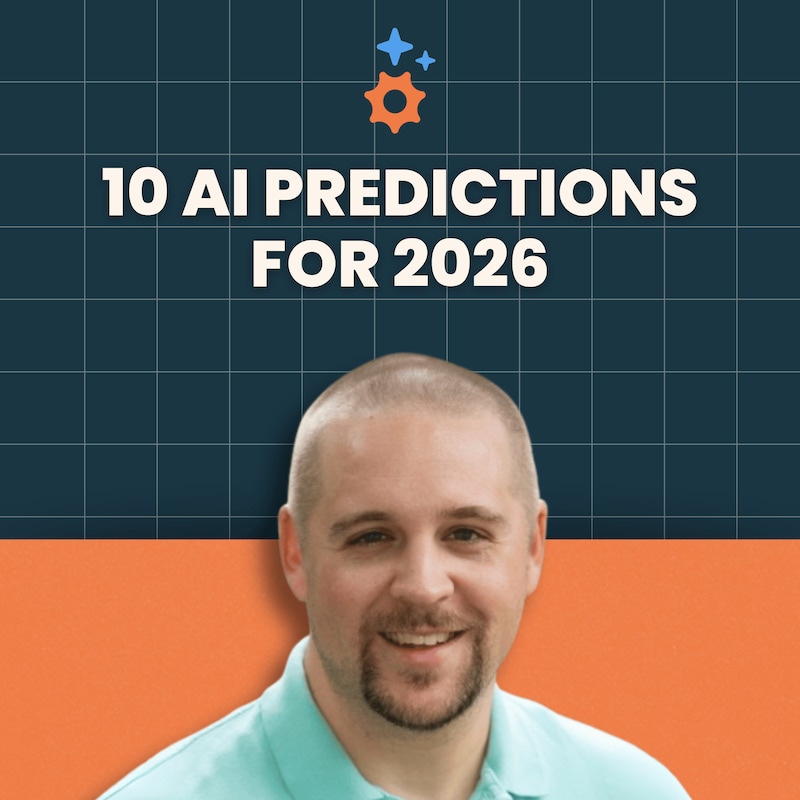
What does AI actually look like in 2026?
In this special end-of-year Predictions episode of Prompted, Kyle James sits down with Matthew Stein to debate ten concrete predictions for where AI, agents, and go-to-market teams are headed next year.
This is not a hype episode. There are no demos and no buzzwords. Instead, Kyle and Matthew pressure test real second-order effects like:
- Why AI onboarding will become standard practice
- How model quality degradation and buyer fatigue collide
- Why AI shows up directly in GTM job titles
- What happens when personal context becomes portable
- Why AI portfolios matter more than resumeas
- How marketing video creation fundamentally changes
- Why PageRank-style authority signals may return
- The rise of zero-party data
- Whether Anthropic beats OpenAI to an ads platform
- Why most companies still struggle to show AI ROI
They also close with one wild bonus prediction that could reshape the entire AI landscape.
This episode is designed to spark debate.
Watch the full episode, then head to the comments and tell us:
- What did we get right?
- What did we miss?
- Which prediction do you disagree with most?
Transcripts
Welcome, welcome everybody to another episode of Prompted.
::We're doing something a little bit different today.
::Some of these are out on the limb.
::Some of these, they're gutsy predictions, but we'll see.
::This is the weird year of everybody trying to figure out AI.
::And in that vein, what we're doing today is we're doing a prediction episode.
::Tell us which ones you agree with, which ones you think we are completely wrong on.
::We'll be back to hash it out in the comments.
::And if you leave some really good ones when we do a recap episode, see how we did when we judge ourselves.
::December 2026, we might call you out.
::What we did is we sent out a survey to all of our previous guests on the podcast over the last year.
::We've had 30 of you guys.
::Some of them also came from the internal Agent AI team, and a lot of them are just ours.
::So we've narrowed it down 10 predictions for you.
::We started with a lot more, and we're down to 10.
::We're just down to 10.
::You ready to get into it, Matthew?
::Let's do it.
::Hit us with our first one.
::What have we got?
::This one comes from Whitney Hathcock, who is a member of the Aging AI team.
::AI onboarding would become as important as employee onboarding.
::Really interesting comment when you think about it.
::Like, what does that mean exactly?
::And I think when you and I were going back and forth on this, Matthew, it's like, to me, that's the concept of like, how do you train these models on what you want them to know and what you don't?
::And the perfect example for me was like,
::we're actually working on some artifacts now to what is the audience of this podcast?
::What is our target audience look like?
::So we've been working and kind of crafting a document that includes that information so that we can use it when we're working with the LLMs to produce better content, ask better questions of guests and stuff like that.
::But that's absolutely onboarding, right?
::Yeah, we can give it context, right?
::We can upload some docs.
::But I think what this one really gets to is like AI onboarding becomes
::comes a standard practice.
::And so we're talking about how do we bring in these generic models and make them useful for your business.
::And I think that getting some standards around there, because like employee onboarding, everyone knows is super important.
::You're going to have handbooks, you're going to have training, you're going to have week one, you do this, week two, you do this, week three, you meet with all these other people.
::I think with AI, I kind of agree with this one.
::I think people are going to learn
::what it takes to roll out a tool to onboard a new AI tool, and you have to teach it about what is your brand voice docs, what are your guidelines, who is your customer.
::But I don't think it's going to be more than just copy paste context.
::I do think you're going to have to say, it's like, okay, we're rolling it out to this team.
::This team's going to use it with a safety gate in place where they've got the human in the loop checks.
::All right, we're going to see it, you know, fail 50% of the time, pass 60% of the 50% of the time.
::That's not good enough.
::You got to do some refinement.
::You spend a week or two refining it and maybe you set your threshold, your trust threshold, where maybe you need to get to 85, 90, 95% of the time where it's got to be truthful before you start removing some of those human in the loop checks.
::And that's what I think it's going to become.
::So yeah, I think we'll know that this one's true if we start seeing, onboarding practice for AI, new AI tool documents or procedures, things like that come out.
::The hardest thing that's going to be for people to get this thing right is garbage in, garbage out, right?
::We all know that when you work on these things, like are you able to create good
::data that could support this, right?
::Like, do you have the brand guidelines in a structured way that's easy to consume?
::Your culture, your mission statement, your personas that you're going after, you know, is it able to get to the data in a clean way?
::And let's be honest, and we'll get this more in a later prediction, people suck at that.
::Companies suck at that.
::So like, you've got to get your foundation in order to really do this, I think.
::And that's going to be a very important step to determine if people do this right.
::So is your data
::in a way that it's easy for the models to consume and work with?
::Is it easy for humans to understand?
::I think you're going to see CSMs have their playbooks.
::You'll have your onboarding playbook.
::You're going to have your week one, week two, week three things you have to do.
::And it's like setting up an integration, but it really is going to be how do you make sure you're crafting prompts, crafting context, to make sure these things are pretty true.
::All right.
::I think that's a good one to start out with is how people are going to onboard these ones.
::The next one we got, this one comes to us from Jen Steele.
::And this one's interesting.
::She's going to say, or she's saying that model training quality is going to degrade.
::So LMs will deteriorate in quality as they increasingly train on AI-generated content rather than human-created content.
::I do think that this is going to become a big challenge.
::The tipping point for me is going to be, are the people who are handling the training able to adjust for that?
::They can't identify what's AI content and what's not, but can they adjust, like, you know, twist the Dobbs and Niles or...
::the knobs and dials, that's the word I was looking for, can they twist them and adjust them so that they know what they're looking for?
::Or really, is there just going to be so much slop out there that, again, back to garbage in, garbage out, the model training quality is going to degrade?
::I think Jen's probably going to be right on this one.
::I think we're going to see new models not be
::certainly not have as much fanfare, but the training quality is going to become a challenge for them to roll out new ones.
::What do you think?
::Well, I want to take this a little bit different.
::Like, I think the standard deviation is going to shrink between good, like, and here's what I mean by that is like, you and I both know we spent 15 plus years teaching marketers how to write content on the internet.
::And let's be honest, it's not all remarkable.
::So the models are training on this vast amount of internet knowledge, right?
::And it's fine.
::But here's what's going to happen is if we're letting the models train on artificial data, it's going to be derivative of derivative of derivative of derivative.
::What does that mean?
::It's all going to be meh.
::It's all going to be average.
::Nothing's going to be great.
::And that's model collapse.
::And then when you have worse models putting out even worse content, it's just going to go downhill.
::So it's going to be interesting to see the fight against this.
::Jen's saying that LLMs will suck more and more as they trade on content that was also written by LLMs.
::It's a real thing.
::Model collapse is possible.
::We'll see if it hits in 2026.
::The next one here is from another agent AI team member, Selena Nguyen.
::And the quote she gave us is, next year, I think we'll see model fatigue set in among buyers.
::And to add to that, there will be a shift towards tools that solve real problems instead of tools that simply wrap an LLM.
::And
::The best example of this actually came from a conversation I was having with somebody this morning talking about ChatGPT released 5.2 recently.
::And well, oh, you know, like how is that different than 5.1 or 5.0?
::And we just don't care anymore, right?
::These things for the most part are all good enough.
::And you remember the big backlash we saw with 4.0, right?
::When 4.0 went to 5.0.
::People were not happy.
::Well, people get comfortable.
::in something and they know something works good and they know that it's going to give them the output they want.
::And then the fatigue comes from like, we just don't care anymore.
::Don't keep throwing us new things.
::So is this one about, do you think this one's about like, there's just going to be more new models and nobody cares?
::Or do you think people aren't going to actually upgrade and use the new models?
::They're going to sit back and use the old ones.
::That's a great question.
::Are we going to force people to upgrade or not?
::Right?
::Maybe that's part of it.
::I see that the performance, the output quality is going to level off for most people.
::Already, most people can barely tell a difference.
::Image Gen.
::is a whole other thing.
::I think we're specifically talking about LLMs here, so text output.
::I think it's such at a high quality right now that little incremental bit is going to be indistinguishable for the normal person.
::Yeah, there are some of the benchmarks, like the software engineer benchmarks, where they're still trying to get higher and higher on those scores.
::But I think it's going to be a whole lot of apathy around like, oh, there's another model.
::All right, I don't care.
::Just give me whatever.
::But what we will see on the back end, I think, is that you'll see cost continue to go down.
::And that's going to make a difference.
::But I don't think that the front user, the end user, let's say 90% of them are really going to care.
::I don't think we're going to see as much fanfare.
::I don't either.
::I just don't either.
::I think we're over that.
::They're good enough.
::And
::that what exception is right, if someone needs it to write in a very complex, technical, legal, or scientific language, then those models might not be there yet.
::But to your point, now the new frontier has moved on to image generation and video generation.
::The text generation output is well past good enough at this point, and it's all diminishing returns now.
::Yeah, I think so.
::All right, another thing we're going to see, we're claiming our prediction here.
::This one comes to us from Sarah Medillo, but I am totally on board with this.
::We're going to see more go-to-market roles have AI in the title.
::So we're going to see things like an AI GTM engineer, basically like shifting and changing how marketing revenue teams operate, but it's actually going to show up in the job titles.
::So I think that we're going to have those.
::It's not just going to be RevOps.
::Maybe it's going to be AI ops, maybe it'll be the AI engineer.
::But I think all the GTM roles, or not all of them, but GTM teams are going to start having official AI titles in the org.
::Yeah, and you and I were just going back and forth on some of this yesterday, talking about this, like you're going to have, you know, sales prompt engineers, right?
::That are like thinking about, instead of just writing the workflow, they're going to be coming up with the prompt engineering that's going to be filling out that content or marketing
::Remember when SEO became a job role in marketing?
::It's coming, AEO, GEO.
::It's going to be in people's job titles.
::You know, PPC is now going to be like AI ad generators, AI-led performance marketers, AI content production.
::You're no longer the writer, you're the AI editor on top of it.
::It all feels inevitable.
::And then you've got like the ops person who's going to be this new emerging like AI GTM
::Cops engineer, right, who's orchestrating all this together.
::It's coming.
::It's here.
::It's here to the very front.
::Yeah, even with the builders that I talk with today, so many of them are still that very early adopter role where they're getting out there, they're playing with stuff.
::There's a lot of other folks on teams.
::Some people are, I mean, some people are against it, find that their choice
::And I don't think, if there's something that you really love about your job, I don't think you should replace it with AI.
::I should think you should replace the stuff that you don't find joy in with AI.
::I think also you're not replacing those closing roles, things where it's human to human critical communication.
::You're not going to have AI agents closing big enterprise level deals.
::I don't think we're there, but they're going to be supported
::by official functions on the team, which do have AI in the title.
::That's what I'm seeing.
::So I'm planting my flag in the ground on that one.
::Like how are we going to measure this one, do you think?
::Is it going to just be the number of job roles and job descriptions that we see out there?
::Yeah, I think if we start seeing, because I haven't seen as many, I've seen a couple here and there, but yeah, I think we'll check some job boards, look at LinkedIn, see what roles are being advertised, and I think we're going to start seeing
::If we start seeing trends of some type of GTM role, like maybe more, I don't know if we'll have more AI ops than rev ops roles available, but I'll say if we have 50% as many AI roles as rev ops type roles, that would be a pretty clear sign of this one coming true.
::Yeah, or you've got me thinking like, we don't see more SEO openings, we see AEO openings.
::Like that just, we just see that flip.
::All right, next we've got personal context becomes portable.
::And this is from our buddy Paul Schmidt, who, you know, the quote from him is more interoperability between agentic platforms, right?
::And we saw the groundwork for that late this year, I think, with MCPs, right?
::The model context protocol, these middle layers that basically, it's like an, it's like a, it's like Zapier for AI, for LLMs,
::right?
::It helps you connect platforms together and do that communication.
::And so the API documentation can now be read by the two agents in this middle layer.
::So it makes total sense that we'll see that.
::I'm curious from your perspective, Matthew, like that leads to like no real winners though, doesn't it?
::Because everybody's billing independently.
::I hope not.
::I think there's a second part to this, which, and this is one of our very own Sam Malakarjan's points of view, which is you want to be able to take your context out of 1 AI tool and take it to another tool and load it up.
::So, you know, if we see
::somebody getting sick of Claude or getting sick of ChatGPT, there'll be a way where you can like get your portable or get your context, extract it out, have it just like package up the things that you care about and the details about you.
::And then when you go to a new model or a new tool or a new system, you're able to upload that in there.
::So I don't know if this is going to be driven by the models themselves, the
::The companies that are building the models, there might be another third-party system that comes in.
::Maybe they develop like a 300 questionnaire that it like asks a model that you've had a long-running chat with or a long history with to pull out all that memory, and then it packages that for you in a way to take it.
::But yeah, I think it's interoperability between agentic platforms, but also enabling users to go from one platform to another to unlock those tools.
::And I think this is going to be driven by a major platform that starts losing people to other platforms.
::They realize it, and then they build something to try to bring those people back.
::Because that long-running history, that memory that you're developing with these tools, that's what's going to drive depersonalization.
::That's what's going to drive user stickiness.
::And I think someone's going to come up with a mechanism to steal that stickiness and help you import it into a different system.
::Interesting.
::I'm thinking about communicating between where you're thinking about, well, literally, the way you're talking about it now goes back to our very first prediction.
::It's like, that's the onboarding, right?
::You're able to take this data and onboard it into new systems quickly.
::It's the export button and the import.
::Exactly.
::Instead of just importing one new tool into a company, we're talking about bringing one, bringing your context, your personal context from one tool to the next.
::And that might be part of how we bring people online, bring people on, bring tools on board.
::So another one, I think here, this one I like, this one's from me.
::I've been thinking about this one quite a bit for a while now.
::Your AI resume or your AI portfolio becomes table stakes for hiring.
::So hiring managers are going to start asking for some proof of AI knowledge.
::And I wrote a LinkedIn post that caught fire earlier this year, directed at hiring managers, where I talked about when I was doing hiring on my last role, I would ask people, open book, like open laptop, show me how you use AI.
::And this was 9, 10 months ago.
::And some people were caught off guard.
::I had some interviews, viewers before I started asking for this, who were clearly using AI off screen, because they'd pop up with acronyms, then I'd ask them what that was and they wouldn't know.
::So now I think we've gotten to the place where like, yes, you're going to need to use AI, you're going to need to know how to use it.
::And now to differentiate yourself, you need your own AI portfolio.
::So whether it's what agents have you built or what projects have you built in Claude, I think you're going to need something to show, and particularly for GTM roles, how well you are, how good you are at using these tools.
::I'm hearing you say a little bit of like,
::The cat's out of the bag now.
::There's no putting it back.
::Like we got to go ahead and kind of accept it and learn how to live with it, right?
::Yeah, we're going to need to, the hiring managers are going to need to be able to differentiate between people who really know how to do this and the people who are, this is the whole phrase of like, you know, marketers aren't going to be replaced by AI, they're going to be replaced by marketers using AI.
::And I think that's what it comes back down to.
::Yeah, This is how we see it,
::how we see it come live.
::How do we measure this one?
::Is it like everybody going to be required to have some sort of new social account on platforms like Agent AI where they can show agents that they've built?
::How do you think this plays out?
::I mean, I would love it if we were the standard.
::I don't know if I'm going to anchor my prediction on that.
::But we do have a way for people to share their teams of agents, right?
::So you can look by the human profile and see all of the agents that a person has built.
::I think we'll see
::If a job listing is asking for the way that a designer has to submit a portfolio, you're just going to start seeing for some roles them asking for an AI portfolio.
::Or engineers or GitHub.
::That makes sense.
::Yeah.
::Right.
::Of course.
::That's an even more classic example.
::All right.
::You ready to get a little bit more reckless in these?
::I think we're starting to get a little bit more out there now.
::And I'm throwing this one at you, Matthew.
::75% of marketing videos will be AI generated by the end of the year.
::You and I went back and forth on this a little bit and it was like, we needed to put the term marketing in there because I don't know that necessarily 75% of videos, but marketing videos will be.
::We saw the tip of this happen this year.
::Do you remember the, was it Liquid Death?
::The water commercial that was like a whole bunch of like 10 second shorts
::slammed together into a video.
::Yes, all mashed up together.
::I mean, the video generation, the video generation platforms are getting so good that, I mean, they're not indistinguishable yet.
::I think especially for human to human interaction, when you have this emotional layer that the two actors need to bring, I do think that is, they're not quite there yet.
::But for product shots, for establishing shots, detail shots, B-roll, fine point distinction here, are you saying that in A marketing video, 75% of it will be AI generated or just as a video, if you have 100 videos, 75 of them will have some AI generation in them.
::I love the fact you're making me clarify this, because I think that's a great distinction.
::And I would say 75% of all the videos.
::Data matters.
::I'm going to lean into it like 75% of the video, right?
::Like you think about modern movies, right?
::How much of that CGI now is just done in computers and not like special effects and all.
::And I think we'll see the same thing happen.
::But I think this is one of those places where we can lean in or marketers, good marketers will lean into the slop, right?
::And what I mean by that is like the hallucinations and the creativity is funny sometimes, right?
::Right.
::And you can get it to do wild and interesting things.
::And if it's on brand and it hits your message, like that fun can like work.
::We've got a group where we talk about some of that and like the AI slop stuff, like you can make it really funny as long as you know what's going on.
::And I think that'll be the people like benefit that know what they're doing.
::And it can become a real differentiator and superpower for the right people.
::And I think the right.
::way to use this stuff for the marketers out there who are listening.
::I think the right way to use it is to create scenarios which are like, they're funny, they're completely unrealistic.
::Don't try to fake it and make it look like it's real.
::Make it totally wild and unbelievable.
::Because you now, you don't need a VFX team.
::You don't need a, you know, couple $1,000,000 budget to go hire, you know, some Hollywood studio or some amazing studio.
::light and magic, whatever.
::You can, if you can imagine it and prompt it, then you can go out and do it.
::I think the way to avoid the backlash is not trying to pretend it's real, but lean into it being fantastical, surreal, clearly AI generated, but still getting your point across, still staying on message.
::I don't know.
::I think there's going to be some people who absolutely kill it with this.
::Well, now let me also include in there, let me throw in the dark side of this.
::because I think that's important to observe, right?
::Is like we see all of what happened with written content.
::We all know when people over abuse it, right?
::Like to your point, like we see that and how much of blog posts and social shares and all of that is just an over-reliance on AI.
::I think that's how we get to 75% because
::massive cost for time reduction to do this stuff is so great that people will abuse it and take advantage of it.
::So what do you think of that?
::Well, I'm actually thinking, it's a shame we didn't do this a couple months from now, because I don't think, what I'm thinking, bear with me here, it would be really interesting to say, take a look at Super Bowl commercials.
::and how many Super Bowl commercials are going to have obvious AI video generated moments in them.
::And I don't know if we're going to see it this year, but I bet Super Bowl 2027, because that's the one that's almost a little over 12 months from now.
::I bet we're going to see a lot then.
::Well, by the end of the year, yeah.
::I don't know that we'll hit 75% that fast, but it's
::especially as these, because what have we seen in the last few weeks, right?
::Like Nano Banana and now ChatGPT 1-5, their image generation's gotten so much better.
::And that's sort of amazing.
::It's so much better.
::There's no more 6 fingers.
::There's no more like, you know, teeth that look all wack.
::Now you take that image, what is video?
::It's just 26 images shown to you in a second, right?
::Now we're able to take it and apply it to video.
::So I think it's going to take some huge steps.
::And I think
::To your point about the creative marketers who take advantage of this, it's going to allow people to run tests and experiments on video at scale in a way that's never been possible before.
::I do think you're going to need to do, for the marketers out there, you're going to want to do some user group testing or study tests on getting feedback to see, does it turn people off or do you need to revisit it in a way that people are accepting of it?
::I think people are going to want to be careful depending on how does this align with their brand and does AI, clearly obvious AI generation, turn your customer base off or not.
::But I think you're right.
::I think this is going to allow small teams to move so much faster, so much less budget.
::And yeah, I think, I don't know.
::I don't think we're going to hit 75%, but this one's yours.
::You owned this.
::We'll see.
::It's one of those things we're going to over-adjust on, right?
::Because I think if you, like, how much of content putting on social media is AI generated now.
::It might be 75% right now.
::It needs to come down, but it over-indexes.
::And I think that's what's going to happen here.
::And I'll leave you with one final, you know, obvious, maybe it's a little bit dark thing, and we'll move on to the next one.
::But let's be honest, like, people don't like to read anymore.
::They'd much rather watch something.
::And I think that leans into this too, because how do you produce more content that's engaging to people?
::This is how.
::This is how.
::One thing, I don't think we need to make a ruling on this, but one thing that just came to mind was Disney just signed a big agreement licensing their characters to OpenAI.
::So if you've got a social post
::that's got some major Marvel characters or whatever it is in the Disney world, are we counting those as marketing videos?
::I don't think we should.
::I think that's social, a little different.
::As long as they're not, like the users that are creating it are not trying to sell Disney stuff.
::But we know those are coming because they just licensed all the characters.
::Yeah, I mean, for certain brands, if you could license Wolverine or Mickey Mouse or something and get it into your market, and Disney takes a cut of something and does nothing but protects their IP and letting you do it, that seems like a massive obvious win.
::And the brand recognition that comes with that.
::We should have had something on that deal in this list we didn't.
::Oh well, next time, next year.
::We'll see if we're right on that year.
::I've got to come totally different direction to go in here.
::I think something like page rank from Google makes a comeback.
::And what I mean by that is I think we're going to see a fundamental way in the change that these LLMs are trained with some like base level of
::authority ranking system that are, that's designed to help build trust with users.
::So I think, and I think it's going to come from Google, but that's not, I'm not putting my foot down on that part of the prediction, but someone's going to come out with a different training methodology for these LLMs that uses some kind of trust algorithm to help get to, you know, more, to improve factual responses, right?
::So we're going to see a drop in hallucinations
::And whoever comes out with it is going to become significantly more trusted because we're seeing all those zero-click searches.
::But we need to have some way to reduce hallucinations.
::Hallucinations are a problem.
::Google built a massive, massive business off of PageRank because they figured out signals for authority and factual sources.
::And I think we've swung away from that.
::There's too many
::how many rocks should you eat?
::How much glue should you put on your pizza?
::So I think there's going to be a swing back in the direction of, giving more authority to the right sources in the pursuit of reducing hallucinations and giving more responses that are based in truth.
::You kind of alluded to this, but I think we should throw this stat out there because I don't know that everybody has heard it.
::They probably have, but maybe not.
::Like 60% of Google searches now result in zero clicks.
::Meaning the majority of people that go to Google get their question answered by the AI at the top or reading something else and don't actually click into a website, which is detrimental to a lot of people that rely on organic traffic.
::But it's also like, if it's still something like 55, 60% of Google's revenue comes from selling paid advertising in the search results.
::And if people aren't actually searching and clicking through stuff because AI is answering it all,
::They're kind of cannibalizing themselves there.
::So I think that's the real strong signal that they have to solve this because they're in a real dilemma about it, right?
::Yeah, I mean, it got to the point where Google's results, and they had that AI answer box at the top for a while, even before these LLMs came out, and nobody double checked it, right?
::Everybody just took it at face value.
::They trusted because Google had built so much trust over time.
::And now people are like, I still, I love seeing the screenshots.
::It's a little bit of shodden for it, but I love seeing the screenshots of when those AI hallucinations just go totally off the rails and are completely and obviously wrong.
::So that's why I think we're going to see a major.
::You're sure if you're not putting glue in your pizza now?
::It just doesn't have the right flavor profile for me.
::But we are going to see, I think we're going to see some like structural training difference to reduce those hallucinations.
::And the 60% of Google searches having zero click results, I mean, everyone who's watching their organic search just plummet knows exactly what we're talking about.
::Do you have a number you think we're going to hit next year for zero click results?
::We talked about like how high does this go, right?
::Like in the number we threw out there is over under 80%.
::right?
::Like, because it's going to continue to grow because more and more people are getting their answers without searching.
::And the question then, if it gets to 80%, like, is that a downward spiral for Google or is that like something that they can actually maintain?
::And that's where, like, I like the way you're thinking about this, that like page, this new page ranking authority signal is kind of how they respond to that.
::I don't know.
::Like,
::I think it's going to be greater than 80% of searches result in no click by the end of the year.
::I think I know how they get there.
::The problem is, okay, so maybe you're searching for a fact or information or something that you want to know or to understand, but so many of the searches are also the first part of the buyer cycle.
::So are we going to see some of that buyer cycle get eaten by Google itself where you don't even have to leave that page?
::And you'll just be able to order things.
::We know they're going to do that for some of the search.
::Right.
::I mean, that's one of like, a lot of the models is like, how do we get shopping in here to get, affiliate marketing going as a revenue generator?
::So they're, once again, they're incentivized to do that.
::Yeah.
::Google's playing around with real estate listings now.
::They're trying to eat Zillow's lunch.
::And I have always been a big fan.
::I mean, Charlie Munger, show me the incentive and I'll show you the outcome.
::right?
::Like that has to play into this.
::And if there's revenue opportunities on these things, at worst, they're going to try and push them really hard.
::And then they just got to figure out how to sell ads.
::Because classic innovators do love it.
::Yes.
::All right.
::That's a good one.
::What's your next one?
::Yeah, the next one is zero party data gains momentum.
::For those of you that aren't familiar with zero party data, you know what first party data.
::So first party data is data that a company already owns, right?
::It's things like time on site, visits, your e-mail list, your bounce rate, all of that stuff.
::If I'm an e-com customer, I know what you've searched for.
::I know what you've bought in the past.
::That's first-party data.
::I know your address or any of that information you've given me.
::Yes.
::Third-party data is data you buy from other companies.
::You buy a mailing list for somebody, for example, that's third-party.
::Now, zero-party data is data that customers willingly share with you.
::And what I mean by that, in a world that's getting cookie-less and we're having much more regulations about privacy, like GDPR has been around for a while, and now we're seeing like, how does this get even more secure with like, everybody knows all of their data is being consumed by LLMs, and now people are starting to put up their walls, how do I protect my data?
::I think this is where zero-party data comes in.
::And so what are examples of that?
::Polls and surveys.
::like feedback forms, setting your preferences, interactive quizzes, things like that, you're actually going out and providing data to a platform or a company or a system so that you get a better experience, whether that be through an AI chat agent, LLM, or just in general.
::And the belief is, and I think this is, we'll know that this works or not, because you'll be seeing more and more of that ask for data and you'll be happy to give it.
::And the reason people will want to do that is because they're going to get more customized experiences delivered by these AIs.
::And as they become more comfortable with it, they'll be okay giving that data.
::What do you think?
::Am I right or wrong or crazy?
::I think you're right.
::So I wasn't familiar with the term before we talked about it.
::So 0 party data, that was a new one to me.
::It makes sense.
::One of the analogies I can think of is, I mean, there's like the brand lift surveys that you get occasionally while viewing YouTube, but a better example, I think, would be like New York Times, right?
::And they say, which newsletters do you want to subscribe to?
::And maybe they can get even more fine-grained details, survey you the articles you want, giving you those types of like really hitting your own preferences.
::So, but you think it's like going to a new tool and you're setting up your account and you're setting up
::adding in your context or whatever things that you care about.
::Like maybe I sign up for ButcherBox and they know that I like beef and pork, but I'm not going to order chicken from them or whatever it is.
::Yeah, I do think this gets interesting because it gives a little bit of the power back to the consumer so that they can tell companies, I don't care about that, I do care about this instead.
::And in some ways leans into the very first prediction we had about onboarding.
::right?
::how do we feed these things models so we get more customized information?
::But I think that the big thing is you can't have very customized experiences for users unless you do some of this.
::And we're getting to the point of it's not one to many anymore, it's one to one.
::And every experience that everybody has with an AI is going to be unique and personal.
::They're going to have an algorithm for you.
::And to your point, the very,
::The example of this that everybody knows and has seen, I'm sure, is in YouTube when you get those ads and it asks you, hey, do you like X, Y, or Z?
::You know, I still click, skip, or no thanks, but a lot of people answer those.
::So you still believe in first party or zero party data, but you don't participate in it?
::I believe in privacy.
::I love privacy.
::But slowly we all get eroded of that over time because as long as these things stay free, we are the product.
::That's true.
::All right, so we got another one here.
::This one, I'm going to go out on a limb here.
::Again, bold prediction.
::And I know that there were rumors of OpenAI rolling out an ads platform that they pulled back with their red alert.
::You know, they got threatened by Google's Gemini 3.
::I think Anthropic is actually going to beat OpenAI to the punch on rolling out an ads platform.
::They're filing for an IPO, or at least there's rumors of them talking about an IPO.
::This is for Anthropic.
::And they know they've got to do something different to separate themselves out.
::So I think they are going to beat OpenAI to the punch on this one.
::It's just because of the IPO, or do you have some other reasons that you think that this is going to happen first?
::And will it happen in 2026?
::Like, can we get to the end of the year?
::And it seems like this one's one.
::of any of them.
::It'll be very binary, yes or no.
::OpenAI does a little more building in public.
::Like there's so many people interested, so many people watching them.
::They like to stay in the news cycle, or maybe I should say they're better at staying in the news cycle.
::But the fact that they pulled the plug on their ads platform, or at least slowed it down, I think they're going to continue to think that that's not a critical path for them and it's going to allow Anthropic to get there first.
::And because Anthropic still does have good, I mean, they're not, they don't have the same volume of users, but they've got some pretty loyal users.
::And I think they are going to see this as another, another revenue opportunity.
::I don't know.
::Maybe, well, but I would definitely get to know if I get to pat you on the back or point and laugh at you by the end of the year.
::So we'll go with that.
::Yeah, we'll see.
::All right, 10.
::This is kind of the last one.
::And I'm still saying some bold ones here.
::So greater than 70% of companies will show 0 ROI on AI implementations in 2026.
::And that's actually down because I think everybody's seen it now.
::The MIT study that came out, was it 4, 6, 8 weeks ago, that said 95% of ROI projects or deploys in companies resulted in no ROI.
::So in some respects, going from 95% failure to 70% failure is a good thing, right?
::But what do you think?
::That's still a lot.
::That's still, I think that number, I think the number is too high.
::You're saying 70% of companies are going to have zero ROI.
::Yeah.
::So you're saying more than 70% of companies are going to show zero ROI on AI projects and pilots.
::I think it's going to be
::I think it's going to be less than that.
::I think more companies are going to start seeing value.
::It does take a while to get these things at scale, working, but I think we're going to see more than, well, we kind of wrote this in the negative, but I'll say less than 70% of companies are going to have zero ROI.
::So more than 30% of companies are going to get some type of value.
::So half a company, let's just say you're thinking,
::Half or more, right?
::Like you're thinking people are going to start seeing.
::And I'll tell you what.
::More than 30%.
::More than 30%.
::I don't want to say more than half.
::Half of companies out there are below average.
::Yeah, that's true.
::But AI, if it is what a lot of us think, it's an existential threat if you don't do this and get on this right.
::It's coming.
::And especially coming in white collar, B2B software landscape.
::which will mean you have to be adopted in some meaningful way.
::But I don't know, it comes to the whole garbage in, garbage out thing.
::And how many companies do you know that just cannot get their data in order to make real strong decisions?
::And to me, that's the thing, how do you onboard these things?
::And if they're not able to onboard them successfully, that'll be like,
::operate order of operation.
::If we're seeing that people can't do the onboarding, there's no way in hell they're going to be able to do this thing.
::We'll see.
::Yeah.
::I think more companies are, they've been working at it long enough to start to figure out where to do this.
::And so I think it's, I think it's, maybe, I'm just more of a technological optimist.
::Maybe that's the, that's the difference here.
::Maybe we need to do this.
::Maybe we need, when we say companies,
::I'm thinking of the entire landscape of all companies.
::everything from your HVAC technician company all the way up to your Fortune 100 company, right?
::And when you think of the long tail like that, sure, maybe some of the big companies, but they aren't the vast majority of companies.
::Well, okay, so there's, I'm going to bring in one of the ones we cut, which was from Dave Rouse, because he said that agents will feel like apps you can add to your life.
::And I think that's where some of those smaller companies are going to be able to do that because they know they need something.
::Maybe it's like scheduling visits or ordering parts or things like CRM information.
::Like if you're a field tech, you don't want to sit there and like go back to your truck and type on your phone a whole bunch of stuff to get it into your tracking system.
::So I do think that like you're going to start, you'll start seeing some ROI by the agents feeling more like apps you add to your life.
::But
::If we're getting down to brass tacks on how we're going to measure this one, I think we need to have MIT rerun their study and then we'll look at their results.
::So they're the masters of methodology.
::MIT, we expect another one of these by December of 2026 so we know if we're right or wrong.
::I'll walk over to them and knock on their door and tell them they got to rerun the study.
::Please, we'll send them a fruit basket.
::So, but what I've also heard you say is like, maybe the cheat code for more companies to find more value faster is point solutions.
::And even if they're back into office and data warehouse is kind of a mess, if individuals are getting exponential productivity gains from point solutions that help them in their day-to-day tasks, then that has to count as a win and that means the whole company succeeds.
::That's fair.
::You think about, field tech, salesperson, whoever it is, someone who's like, has a human-to-human interaction is potentially offline too, right?
::So we're not just talking about like meeting transcripts, but they have some type of human-to-human interaction and then they have to log that data.
::AI is really good at taking unstructured data and pushing it into a structured place.
::So I think that's a great application
::where it's like, you download the app, you add it to your phone, it's powered by AI, helps you with these specific tasks.
::I think that counts.
::Yeah, it does.
::But I'm still leaning into like companies are going to have a mess of their data and it's not going to, they're still going to be working on onboarding AI by the end of the year to their clean master system to pull out the real
::Revolutionary company-wide gains, great individuals, superpowers, awesome, awesome for you.
::But we're not going to be able to solve the entire company needs in this year.
::That's the thing.
::There's never been a point in time in history where companies have had all of their data in a clean place.
::Like every time I've come to a new company, it's always like, oh, there's a data nightmare.
::We'll try to get it there.
::Maybe we get it to 80, 90% if we're lucky.
::Every company, everybody.
::In fact, you know what?
::If you're
::at a company who has all your data together, let us know in the comments.
::Tell us who's doing it right and how you got there.
::Yeah.
::All right.
::Now you had, that's 10.
::That's 10.
::You said you had a bonus one.
::Let's hear it.
::So anybody that's still listening, you're going to get to have a little fun with this because we're going a little bold and reckless.
::Maybe we already have been, but I'm throwing it out there that I think in 2026, ChatGPT will be knocked off the pedestal as the number one LLM used by the masses.
::measured by weekly active users.
::Like, okay, why am I back?
::Why am I saying that, right?
::It's a number of things.
::We've alluded to it throughout this conversation, but we've already talked about how Google has to, is incentivized to fix the search interface in a way that's still valuable and still produces revenue for them.
::I think that's a big part of it.
::But also from a technology standpoint,
::If you haven't heard of a TPU yet, it is far superior to the GPU for AI task.
::GPUs are Google's in-house chips.
::Yes, Tensor Processing Units.
::It's kind of a, it's a custom-built silicon chip designed for AI purposes.
::Where GPU, Graphical Processing Unit, was originally designed by Nvidia and
::AMD and the other guys for graphical processing for you to play high-end video games on your computer.
::And then they were able to take that same technology and apply it to blockchain, and then they were able to take that same technology and apply it to AI.
::But I think what really exposes that is, does anybody remember nine months ago now when Deepseek came out and everybody like lost their mind because, oh my God, how'd they do that?
::It was efficiency gains.
::You know, they moved some decimal points a couple places over and like, oh my gosh, we could do this with so much less computational power.
::Well,
::TPUs is just an optimization of that on the hardware level.
::To nerd out about this a little bit, TPUs are great, right?
::They are, but they are purpose-built by Gemini, sorry, by Google, I guess I should say Alphabet if we're talking about the holding company.
::But they are optimized for their own in-house models, whereas Nvidia is a, they are still a generation ahead, although it's
::getting closer and closer, but they are applicable.
::They're best for all broad model agnostic workflows.
::So you've got your training and you've got your inference and Nvidia's got both.
::And they're like, you know, their Blackwell chips are the most amazing ones on the planet right now.
::But those are good for any model that you're out there training, whereas the TPUs are really purpose built for Google's own models.
::So how does that translate into
::Gemini displacing ChatGPT.
::It's one of the pieces, right?
::It's the hardware, the technology they're using is custom-built in-house.
::Like, why does Apple make the best phones?
::It's because they own the entire ecosystem, right?
::Google Alphabet is starting to own the entire ecosystem on this, where ChatGPT is still very much tied to Nvidia.
::Also, Google owns the distribution, right?
::They've got an incredible user base.
::Everyone on Gmail, everyone on, you know, G Suite, you know, anybody who does a Google search, which was, you know, still, well, the last I checked, it was like still 80% of the search market.
::But they, you know, if they're getting that AI response served, that is Gemini.
::So it's going to be interesting.
::I think, you know, it's not going to be out there conducting our own.
::Yeah, we're not going to be out there conducting our own user surveys, but we'll have to rely on some public numbers on how many, weekly active users ChatGPT reports and Gemini reports.
::So that's going to be interesting.
::But Gemini owns the distribution channel for sure.
::ChatGPT has the name.
::They're the first, but you're saying they're going to get beaten at their end.
::I'm saying they get knocked out, yes.
::And let me give you a more specific example of that right there is this think about
::Most everybody that uses ChatGPT or any of the LLMs use it to help them write better emails, right?
::Well, what could provide, what could possibly provide better context to help you write better emails than your entire Gmail account, right?
::Like who has access to that?
::ChatGPT doesn't, but Gmail does, Google does.
::So there's one.
::And if you use Google Docs and all of that, that's other context they have that actually provides real-world examples instead of you having to copy and paste it in a ChatGPT.
::Like they own the interfaces, they own the search where you're already interacting and doing these things.
::So the distribution, to your point, is there already.
::And ChatGPT is relying on you to come to them or
::maybe to allow a Microsoft to let them in, but Microsoft could do exactly what ChatGPT does without them, just like Google's doing it without them.
::Well, and Microsoft owns a huge chunk of them as well.
::So they're on, a lot of their investment actually just went straight to compute time, compute power.
::ChatGPT is starting to build their own data center, or OpenAI is starting to build their own data centers.
::they're not one of the major hyperscalers.
::That's still, Amazon, Amazon, Microsoft, Google, Meta's got their own stuff, but they're not really selling data center time to other people.
::Oracle's trying to get in there, but they've got, they don't have the cash flow that some of those other majors do.
::So there's a whole debt problem coming up on there.
::And that's the bottom.
::Yeah.
::And ChatGPT is stuck in a circular vendor financing loop with NVIDIA.
::So I don't know, there's, I wonder if ChatGPT gets displaced in terms of weekly active users and they're no longer the number one piece, does a lot of this stuff start to fall apart?
::Are people going to say it's like, oh, well, it's Google's game because they've got the cash flow to support building out the data centers.
::They don't have to take on ridiculous debt.
::and they've got the distribution, maybe you're onto something here.
::The example I gave you earlier that I saw got your eyes gold is like, ChatGPT is Netscape.
::And if any of you that are 40 plus years old remember Netscape, Netscape was the first and biggest web browser for a long time.
::But what did Microsoft do with Internet Explorer?
::They had the distribution channel known as Windows.
::Apple had the distribution channel for Safari known as Macintosh and iPhones.
::In Netscape, or Netscape doesn't exist anymore.
::Yes, the core code has been rewritten into Firefox, and that's probably a good analogy of what'll kind of happen.
::But the distribution is so important.
::And first mover advantages, first to market doesn't always win.
::And I think we're going to see that play out
::Same here, because the nail in the coffin is the financing.
::That's going to be interesting to come out there.
::For those of you who are under 40 or under 35, and you've never heard of Netscape, go check it out.
::It was the first web browser, and I believe it was built by Marc Andreessen of Andreessen.
::Yeah.
::And obviously it kicked off a whole revolution, but yes, Microsoft played their Monopoly card and forced Internet Explorer on everyone.
::But yeah, distribution beats product innovation, you know, every time.
::So I don't know, we'll see.
::And they?
::Can afford to continue to invest in this at a, you know, sustainable rate, where, to your point, would people hear about the AI bubble?
::The main reason they hear about the AI bubble is because the crazy financing deals that ChatGPT is swinging.
::I don't know.
::Nvidia's got so much cash, they're happy to spread it around.
::Well, that's going to be interesting.
::All right, so weekly active users, that's how we're going to measure this one.
::ChatGPT is no longer, of the major models, you're going to say it's no longer the top of the charts on weekly active users.
::And I think really, if I'm right about this, it will be super obvious.
::Like, this will be one of those ones that's either going to be a home run or I'm a complete idiot by the end of the year.
::It may not be on everyone's news feeds, but it's going to be on our news feeds because we do follow this stuff pretty closely.
::Yeah, it ties a bunch of these things together, right?
::Like, it's the financing, it's the distribution, it's the technology, the hardware in the back end that's going into this.
::And it's just,
::just knowing the innovator's dilemma that Google's in and they've got to solve this.
::Well, I do have to say thanks to all the internal folks and the previous guests who sent us in more predictions than we had time for.
::We did have to, it was a hard process to nail it down to just 10, I guess 11 with your bonus one in here.
::But big thanks to them.
::And for the listeners, yeah, throw up a comment, put it on YouTube.
::Let us know what your predictions are.
::Do you think we're right?
::Do you think we're wrong?
::We take your sides over here.
::We had several in here with where Kyle and I are on opposite sides of the numbers.
::So pick your sides, your over unders.
::Somebody wants to throw a parlay out there of how many of these we're going to get right or wrong.
::You know, that's up to you.
::I'm not betting.
::But let us know in the comments what your predictions are, what you think.
::And if you really like this format and want us to do more of these, like going back and forth, like let us know that too.
::These are fun.
::A little bit more work on us to plan them, but they're a lot of fun to get into the weeds and debate some of this stuff.
::And if you enjoy that commentary too, let us know.
::Always great talking with you, Kyle.
::Absolutely.
::Matthew, thank you for coming in front of the camera again, and for everybody out there listening, have a great rest of the year, and we'll see you shortly, and we'll be ready to expand and do a whole lot more in 2026.
::Thank you, everybody, for helping us get here, and keep building.
::Have a great day.
