Shownotes
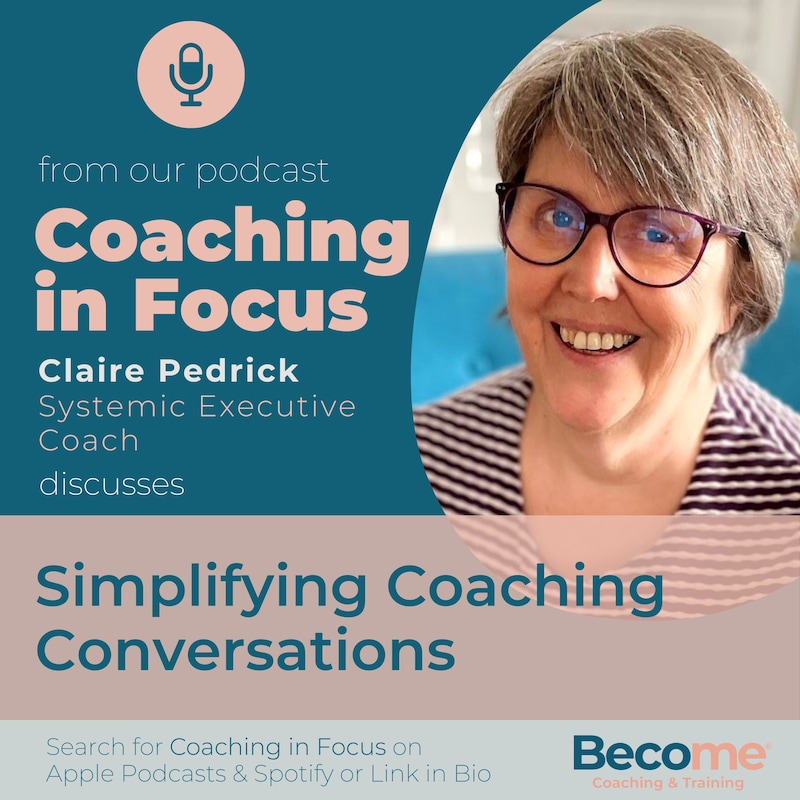
On this episode Joseph is in conversation with Claire Pedrick from 3D Coaching. Claire is a Master Certified Coach (MCC) who has been coaching for over 30 years. She is in demand as a systemic executive coach, mentor coach, coaching supervisor and as a trainer.
Her style is very simple and she is in demand in organisations to develop simplicity in their internal coaches. And that's what we discuss in this episode. The wonderful idea that Claire has in referring to clients as thinkers and losing the pressure to follow models.
Learn more about Become at https://tobecome.org
Transcripts
Hi everyone, and welcome to this latest episode of Coaching in Focus.
Joseph:I'm Joseph Grael host, and on today's episode I am talking to Claire Patrick.
Joseph:So I first found out about Claire when a lot of our trainees were talking about
Joseph:Claire's book, simplifying Coaching, and I took the opportunity to reach out to.
Joseph:And invite her to our podcast, which you very kindly agreed to.
Joseph:Now, this episode is great.
Joseph:We talk a lot about this idea of what we refer to our clients, what we call our
Joseph:clients, and Claire has got this wonderful way of referring to clients as thinkers.
Joseph:We also talk about why this is important and some of the issues,
Joseph:some of the subtle issues with naming clients as co cheese, for example.
Joseph:I also really like the way that Claire and I talk about being in the flow of a
Joseph:coaching session, so finding that flow with your client and really trusting
Joseph:your client with that process in a way that stops us from interfering,
Joseph:from getting in the way of the thinker going through that coaching session.
Joseph:So let's listen in to the conversation with Claire and myself.
Joseph:Claire, let me introduce you first of all, , because I'm here with Claire Prick.
Joseph:Um, Claire, you're a coach.
Joseph:You're a mentor.
Joseph:You're a supervisor.
Joseph:Um, over 30 years of coaching experience as well.
Joseph:And you have written one of my favorite books on coaching, which I have got here,
Joseph:and it's called Simplifying Coaching.
Joseph:And if you don't have it, please don't get a copied because it is
Joseph:so useful as a starting point.
Joseph:Can I ask what got you to write the book?
Claire:Somebody asked me to.
Claire:Ah,
Claire:. Joseph: I had this vision that
Claire:wanted to push forward with it.
Claire:. How did that happen though?
Claire:Tell me a bit
Claire:more.
Claire:Well, I'd had it on my computer in little bits and pieces for a long
Claire:time, and I didn't write it because, I kept learning more things that
Claire:would make me want to change it.
Claire:So I didn't wanna put something out in the world.
Claire:I'm not a perfectionist.
Claire:It makes me sound like a perfectionist, but I'm not a perfectionist.
Claire:But I kept, cuz I keep learning something, I thought, well if you put it in the
Claire:book, there's still more to learn.
Claire:So.
Claire:You know, when do you draw the line?
Claire:So we created a set of postcards with some simple principles
Claire:of coaching on like ask them.
Claire:Mm-hmm.
Joseph:cool, , cool thing to do,
Claire:right?
Claire:. And when it's over, it's over and be silent and ask questions where necessary.
Claire:And that kind of gave people a sense of what was the
Claire:simple principles of coaching.
Claire:Mm-hmm.
Claire:. So, so it was never then my intention to write a book.
Claire:And I kind of thought about it sometimes.
Claire:Yeah, I wasn't gonna do it.
Claire:And then an editor approached me at Con Conference and she
Claire:said, have you got a book in you?
Claire:So I went, well, funny you should say that,
Claire:, Joseph: because
Claire:, Claire: because I could have, yeah.
Claire:And it was a really easy book to write cuz it was inside me.
Claire:So all I needed to do was get it out.
Claire:I'm writing another one now that's not inside me, so that's harder.
Claire:well, it's sort of half inside me
Claire:. Joseph: Well, we look forward
Claire:When it comes out we'll put a, a note in our show notes
Claire:to one when it's out as well.
Claire:And I think you can really tell that one of the things I really like about
Claire:this book is the way that you have got these kind of snippets of case
Claire:studies or, or, or kind of specific language and how that can be changed.
Claire:And I think that is what makes it really helpful cause it moves from just a theory.
Claire:To very quickly you can picture the scenario that you're in.
Claire:I think what I know now that I didn't know when I wrote it mm-hmm.
Claire:, and that I didn't know before covid, and that I didn't know before I
Claire:started doing hundreds of webinars around the world, is that actually,
Claire:I don't think it's rocket science.
Claire:Mm-hmm.
Claire:to be able to communicate something that's complicated in a simple way.
Claire:But what I've realized is that perhaps.
Claire:More rocket science than it feels.
Claire:So this morning I was working with some internal coaches in an organization and
Claire:I said, you just need to be clear about when's the conversation moving forwards,
Claire:because it needs to be future focused.
Claire:And if you can feel it's going backwards, then you need to do something about it.
Claire:And they all went.
Claire:. That's amazing.
Claire:And they're going, that's so clear because now when I think
Claire:about my coaching, I recognize sometimes we are going backwards.
Claire:Mm-hmm.
Claire:. And I said, well, if they're going backwards and you are going
Claire:forwards, you're going to get stuck.
Claire:And they go, oh.
Joseph:It makes complete sense, right?
Joseph:But it's also the way that for us, I suppose, coaches, we, we've been
Joseph:trained to kind of think about the future, think about future, you know,
Joseph:the element of goal setting, et cetera.
Joseph:But we can get lost in the conversation because we focus so
Joseph:much on following a model for Yeah, particular, a particular structure.
Joseph:So in terms of, I mean, there's something, there's a few key areas
Joseph:in the book that I would like to.
Joseph:Uh, and the first one, which I think is so useful to think about is this
Joseph:idea around the coach trusting the process that is not about the culture.
Joseph:It's not about a technique, but it's about the process.
Joseph:But what does actually really mean?
Joseph:Do you see what I mean there?
Joseph:Like, what does actually trusting the process mean?
Claire:What it means is, That the clever things we do don't necessarily make
Claire:any difference . So if coaching is a conversation where somebody feels heard
Claire:and where they get new insights into their own stuff, we need to find a way
Claire:of them feeling heard, which coaches are good at, but then we need to find a way
Claire:of them moving forward in their thinking.
Claire:But once they're in flow, they're in.
Claire:Hmm.
Claire:And once they're in flow, it doesn't really matter what I do or don't do,
Claire:as long as I don't stop them being in flow, the flow will create the momentum.
Claire:So it's like a river, you know, if you can get that little stick in the middle of
Claire:the river, It's the river that carries the stick down the water and it's, it's the
Claire:river that allows it to do the distance.
Claire:And that's like trusting the process in coaching.
Claire:We need to find the flow together.
Claire:And once they found the flow, we found the flow.
Claire:We let them go in it.
Claire:Yeah.
Claire:And we stop interfering.
Claire:And that's
Joseph:what came to mind.
Joseph:I was noticing when I've been in sessions.
Joseph:And I've actually interrupted the flow, either because I've asked a convoluted
Joseph:question joining A, B, and C, for example, or when I took them back to something,
Joseph:you know, uh, so you can see when you're getting in the way of the process.
Claire:Yeah.
Claire:So let me share something I'm, I'm now able to articulate more clearly.
Claire:I think in every coaching session there is one moment.
Claire:And that's the moment when they get in flow and off they go.
Claire:But that could be all kinds of moments.
Claire:It isn't that there's one moment that we're aiming for this particular
Claire:spot, and at that spot it'll all.
Claire:Move forward it.
Claire:It could be any kind of a moment, but it is a moment.
Claire:Yeah.
Claire:Yeah.
Claire:And once they've done that, then they just get on with it.
Claire:But often just before that moment, it can feel a bit uncomfortable because we
Claire:feel as though we're not quite there.
Claire:And it's a bit tricky and it's a bit difficult.
Claire:And that's the moment where we are most likely to try and be clever.
Claire:And when we try and be clever.
Claire:What we can actually do is sabotage the moment where the flow will begin.
Claire:Yeah.
Joseph:And by trying to be clever, it could be things like in interrupting,
Joseph:introducing a model, or what do you mean?
Claire:Well, it could be, their idea is almost always better than my idea.
Claire:My job is to help them access their idea.
Claire:So yeah, it might be, oh, I've got a model that as, as they, as you're
Claire:talking, this model's emerging for me, and I'm sure that my model is
Claire:going to be exactly what you need to be able to get where you need to be.
Claire:But in the moment before the moment, the one thing that we've got to
Claire:do is to stop distracting them.
Claire:because otherwise they're on the way to flow and they'll turn
Claire:around and they'll look at us.
Claire:Mm-hmm.
Claire:. And that's what I mean by being clever because I think we sometimes
Claire:think we add value by what we do or what we're seen to do.
Claire:And actually we add value by what they do.
Claire:So it's so upside down.
Claire:It's quite difficult to get your head round, isn't it?
Claire:Yeah.
Joseph:Yeah.
Joseph:. Yeah.
Joseph:It's a conversation I have with DRA students.
Joseph:I've kind of, cuz they go, why shouldn't I tell them what to, I said,
Joseph:well, , because although I can see the, um, the intention is to help,
Joseph:but actually by telling somebody and sort of asking, you're not helping.
Joseph:You're in a way dehumanizing.
Joseph:You are making it easy for somebody not to get to their own answers.
Joseph:And then next time we're gonna be in the same situation all over.
Joseph:And they've not got anything outta it.
Joseph:And it's a tricky one, particularly because in organizations we have
Joseph:been trained to do that right.
Joseph:To problem solve, to manage, to tell people what to do in a way.
Joseph:Yeah.
Joseph:So it's a, it's unlearning what we, what we've been trained
Joseph:on and really focusing on that
Claire:person.
Claire:And we think that that's what makes a good c.
Claire:. Mm.
Claire:And suddenly we are saying that what makes a good coach is the ability to
Claire:let go and let someone else do the work.
Claire:Well, that's weird.
Joseph:Yeah.
Joseph:So also I'm thinking about my manager.
Joseph:So for example, I'm thinking about what made a good manager for me.
Joseph:, it's the manager that let me get on with it, that asked for my advice,
Joseph:that asked for my support, and they didn't tell me what to do, essentially.
Joseph:Yeah.
Joseph:They gave parameters around it, which is similar in a way, you know, in
Joseph:your book you talk about right-sizing.
Joseph:Yeah.
Joseph:Um, uh, and I really like that concept.
Joseph:You know, we do have, and correct me if I'm wrong here, but we do have some
Joseph:kind of boundaries or some structures that we can support in the session.
Joseph:but that shouldn't get in the way of the individual moving forward.
Joseph:No.
Claire:So we do the right sizing.
Claire:Mm-hmm.
Claire:. And then nine times out of 10 we discover that's not the work we need to be
Claire:doing, . But we know we're flying over the boundary because we set the boundary.
Claire:Mm-hmm.
Claire:. So then we can go, it seems that we need to do this.
Claire:What is it we need to do?
Claire:And then you can write size again, but without those boundaries, you
Claire:don't know if you're getting close to the edge or not, and then you
Claire:end up going all over the place.
Claire:That's why coaching sessions take three hours with some coaches
Claire:because it takes all that time to find out what the work is.
Claire:Now with some clients, that's true.
Claire:Some people need a three hour session because they need a three hour session,
Claire:but some people need a three hour session because we're so unclear what we're doing.
Claire:And if we'd asked them what we were doing at the beginning, we
Claire:could have had a 20 minute session
Claire:. Joseph: Yeah.
Claire:So would you say, going back to the moment earlier, one of the things that
Claire:a coach can try and develop themselves on is to understand when the moment
Claire:before the moment is happening.
Claire:And try to get there in a way, not early in the conversation as soon as
Claire:possible, in a way, I think, don't miss the moment.
Claire:Mm-hmm.
Claire:. So one of the things I'm learning about recordings is watching gallery view.
Claire:Mm-hmm.
Claire:the coach and the thinker in gallery view, which is tricky to record because
Claire:when you're recording you don't.
Claire:to see yourself.
Claire:Yeah.
Claire:So you have to put a book over yourself.
Claire:Mm-hmm.
Claire:, . But when you watch it back, you can see in gallery view whether
Claire:you are missing the moment.
Claire:And it's to do with, are you handing the conversation between you mm-hmm.
Claire:or are you, are you talking over there thinking or are you
Claire:thinking over there talking.
Claire:It's very interesting.
Joseph:Are you okay?
Joseph:Let me dissect that down.
Joseph:Are you thinking over your Yes, exactly.
Joseph:So your own thoughts are actually getting in
Claire:the way.
Claire:Yeah.
Claire:So, so while they're talking, you need to be looking.
Claire:Mm-hmm.
Claire:. So we need to be looking all the time.
Claire:And that's an amazing gift that online has given us because we can, we can
Claire:really develop the art of looking.
Claire:Online in a different way cuz onsite it can feel a bit St.
Claire:Outy.
Claire:. Mm-hmm.
Claire:Mm-hmm.
Claire:I hear you.
Claire:But, but you can take the learning from online and then you can move it to onsite.
Claire:, but the transformation is seen in the eyes, so we need
Claire:to be looking all the time.
Claire:And of course, culturally, there are cultures where looking, you know, isn't an
Claire:okay thing to do, but I'm staring you out now and you don't feel like that I hope.
Claire:No, no, no,
Joseph:no.
Joseph:It's a comfortable level.
Joseph:staring , but also because we've built up trust, right.
Joseph:As well.
Joseph:Yeah.
Joseph:I'm gonna pick on the point that you just mentioned now, the thinker.
Joseph:Yeah.
Joseph:A lot of coaches will talk about their clients in a way as a thinker or something
Joseph:that you mentioned in the book as well.
Joseph:Tell me a bit more about it.
Claire:Well, it started out when I started doing a lot of
Claire:work with internal coaches.
Claire:because when you are coaching a colleague, you cannot call
Claire:them a client cuz they're not.
Claire:They're a colleague.
Claire:And then I went to a conference where some people were talking about supervision
Claire:and mentoring and coaching, and my job at the conference was to do the keynote
Claire:at the end of the day, and they wanted me to have gone to lots of sessions.
Claire:To do a keynote at the end of the day, but also to connect to what was said
Claire:in other sessions through the day.
Claire:So I'm at this session and the people who are presenting are talking about
Claire:supervisors and supervisees, coaches and coaches, mentors and mentees.
Claire:And I've never felt back comfortable, but I was using those words.
Claire:And at the end of the session it was coffee, and I turned to
Claire:the guy next to me and I said, how did you find this morning's?
Claire:And he said, I came to this conference not because I'm a coach
Claire:or a mentor or supervisor, but because I think I might want one.
Claire:Mm-hmm.
Claire:, and I'm not an E.
Claire:So he had sat through an hour session with people talking about
Claire:him endlessly labeling him as a supervisee, a coachee, and a mentee,
Claire:and he felt quite insulted by.
Claire:And that made me really think, how can we call people a name when they're
Claire:not there, that we wouldn't want to call them when they were there.
Claire:And actually that name for me, and I know not everyone agrees
Claire:with me, but for me, I cannot.
Claire:I cannot label people like that because it feels as though
Claire:they're a small version of me.
Claire:So I'm a coach and you are a coachee.
Claire:Mm.
Claire:And I don't like interviewee or any, I don't like any of those words cuz
Claire:actually I'm a person and you are a person and we are in conversation
Claire:that happens to be about you and not about me, but I think we accidentally
Claire:disempower people by what we call them.
Claire:. Yeah.
Claire:And I'm very wise, you see, cuz I've got a lot of tools and techniques.
Claire:Mm.
Claire:Which I'll do to my coachee,
Joseph:and it's completely like, where's the partnership in there?
Joseph:You know, power control, all of these things that can get in the
Joseph:way just because of the word that we
Claire:use.
Claire:Yeah, we need to be equal enough.
Claire:Do you know?
Claire:There's a thing called One Upmanship that was created by a comedy writer
Claire:in 1952 called Stephen Potter.
Claire:And he wrote a funny book about one upmanship that then was
Claire:made into a sitcom in the uk.
Claire:And the thing about that is it's about being one up, but there's a real danger
Claire:in coaching that I'm one up because I'm a bit of an expert in this process.
Claire:Mm-hmm.
Claire:. But when I become one up, you become one down.
Claire:And then you start thinking, I'm an expert.
Claire:And then I wonder why.
Claire:The work isn't working and why you're not doing the work and the work isn't working.
Claire:And you're not doing the work because you think that's my job because you
Claire:think I've got more power than you.
Claire:So we've just got to equalize.
Joseph:And that's also tiring, right?
Joseph:As in, you know, when I'm working with my own, I was gonna say trainees,
Joseph:but now I'm thinking about this
Joseph:. Claire: Oh, sorry.
Joseph:. Joseph: Oh, our own, uh, coaches because
Joseph:Sometimes, um, they will say to me, that was a really.
Joseph:Session.
Joseph:It was tough not because of the content, because of how they felt.
Joseph:And I do ask the question, well, how much of it were you holding?
Joseph:And I think that power in a way, or this kind of a one up and chip means that
Joseph:we are, you know, a little bit more in control so we tire a lot more easier.
Joseph:It's kind of the opposite of simplifying coaching, right?
Joseph:Yeah.
Joseph:We are making the process harder for
Claire:ourselves and when we are doing more thinking than the thinker.
Claire:What are we doing exactly?
Joseph:That's the exact example.
Joseph:And I, and I would listen into the conversational, I'll view it, and you'd
Joseph:noticed that the coach would be asking question after question and the client
Joseph:or the thinker would be just going to taking a step back and waiting for
Joseph:a coach to do the thinking becomes a
Claire:pattern.
Claire:Yeah.
Claire:And we've got a terrible problem in coaching.
Claire:Mm-hmm.
Claire:. or a good challenge or whatever you like to call, call it.
Claire:Mm-hmm.
Claire:, and that's that people will answer the questions that they're asked.
Claire:Yes.
Claire:Even if they're not useful.
Claire:So we just need to be very careful, I think about what we do ask.
Joseph:Mm-hmm.
Joseph:. Bearing that in mind, what question could I ask you right now that you feel
Joseph:would be particularly useful, especially for people who are new to coaching?
Claire:Oh, my Gideon
Joseph:seizing the moment.
Claire:Can I just say I hate that question in coaching?
Claire:Cause sometimes the, sometimes the person who's being coached really responds
Claire:to that and sometimes they go, what?
Claire:Yeah.
Claire:Okay, so what question could I you ask me now that would support new coaches?
Joseph:If you're interested in becoming a professional I ICF coach,
Joseph:then we have a number of great programs that will help you get there.
Joseph:The first step tends to be our level one diploma in integrative.
Joseph:And this one is delivered over a number of evenings and Saturday
Joseph:mornings throughout the year.
Joseph:Typically, a program takes around three to four months to complete.
Joseph:You can then keep on developing yourself with our Level two Advanced
Joseph:program, and this one leads all the way to P C C accreditation by the icf.
Joseph:Furthermore, we have a number of different ways how we can support
Joseph:your development through C P D programs, such as our certifi.
Joseph:In career coaching, performance coaching, stress, animal being
Joseph:coaching and organizational coaching.
Joseph:We also have a number of supervision and mentoring programs for you.
Joseph:We'll leave a link into show notes if you're interested.
Claire:You see, I'm now thinking about what's the answer and then
Claire:I'm going, what's the answer?
Claire:And then therefore, what's the question you can ask me?
Claire:Which is ask me something else.
Joseph:Which is interesting itself.
Joseph:Right?
Joseph:Um, and I wonder whether that, cuz you mentioned that when we use that
Joseph:in a coaching session, . I wonder that would help the thinker think more, or
Joseph:whether they become more self-conscious, whether they become more, it depends on
Claire:the person, I suppose.
Claire:Yeah.
Claire:And it also depends on the moment.
Claire:Mm-hmm.
Claire:. So in the right moment they know what that is because it's emerging for them.
Claire:And sometimes it's, what's the question you don't want me to ask you right now?
Claire:Yeah.
Claire:And they'll be able to tell you that really easily.
Claire:Yeah.
Claire:But I think sometimes coaches ask that in a sort of, Mm.
Claire:So if you ask that as you are, as you are getting to the peak of the moment, They'll
Claire:know because you've both gone up that hill and you'll have a bit of a sense together.
Claire:But if you ask them in a lull, they won't have any better idea than you do
Claire:. Joseph: Yeah.
Claire:It's uh, if we're using it as one of those questions because
Claire:we don't know what to say, yeah.
Claire:Then yeah, it's getting in the way.
Claire:Can we also talk a little bit if that's okay, because something that I've.
Claire:Find really useful is to talk about endings.
Claire:I know that's something I find that sometimes coaches don't do as much,
Claire:and I really like these steps that you look at around ending, like it's
Claire:simple ending, ending in partnership.
Claire:So the ICF talk about ending in partnership.
Claire:None of the other professional bodies talk about it at all.
Claire:. Mm.
Claire:So there's a lot of talk about ending the relationship, but even the I C F
Claire:aren't, CL aren't, they're only a little bit clear on ending the session, but if
Claire:we don't end the session in partnership somewhere between the beginning and
Claire:the end, we fell out of partnership and it probably wasn't in the last minute.
Claire:Mm.
Claire:Yeah.
Claire:Yeah.
Claire:Yeah.
Claire:We've probably fallen out of partnership before.
Claire:Ending Well and checking in are completely, totally connected.
Claire:So the biggest challenge for, for really brilliant coaches is that
Claire:you are so good at creating trust and rapport that the thinker has
Claire:absolutely no idea what's the time.
Claire:Mm-hmm.
Claire:. So you are coaching me.
Claire:I don't know if we've been here for five minutes or five hours.
Claire:I have no idea.
Claire:And because I'm so engaged in the process, I'm not looking.
Claire:So every time you ask me a question, I kind of go deeper.
Claire:And this is a wonderful, deeply exploring, exploring thing.
Claire:And then you say, so Claire, we've got five minutes to go.
Claire:Um, we can't possibly do credit to your very big problem in this very short time.
Claire:You better come back next week.
Claire:Mm-hmm.
Claire:And I do exactly what you told me, which is stop thinking and
Claire:come back next week, . Yeah.
Claire:Yeah.
Claire:So, so checking in if, if we're going to stay in partnership, we have to check
Claire:in right the way through the convers.
Claire:And we need to talk about the end from the middle.
Joseph:Yes.
Joseph:Yeah.
Joseph:Yeah.
Joseph:Spot on.
Joseph:I, um, I, I think something is so important when I'm listening into
Joseph:sessions , it's quite funny also how it becomes a bit like an ultimatum.
Joseph:We've got five minutes to go , and you're like,
Claire:whoa.
Claire:Yeah.
Claire:And it's, it almost always sounds like scarcity.
Claire:Mm-hmm.
Claire:. And often you hear the thinker apologize.
Claire:Yeah.
Claire:So they'll go, oh, I'm really sorry I got carried away.
Claire:No, they have no reason to be sorry.
Claire:And they did not get carried away, but the coach wasn't clear enough where they
Claire:were in the process of the conversation.
Claire:Mm-hmm.
Claire:. And I think we often extend the middle because the person hasn't
Claire:got transformation and we think, oh, if we only extend it another
Claire:10 minutes, they'll get somewhere.
Claire:But they don't.
Claire:And they don't because transformation often happens when we start to end.
Claire:Yeah.
Joseph:What about transformation between sessions as well?
Joseph:Oh, what do you know that
Joseph:, Claire: I think it's the most wonderful
Joseph:time and I think we pretend it doesn't.
Joseph:Yeah.
Joseph:I mean it depends on the coaching school and ICF coaches do this.
Joseph:Although it still happens, where they say, well, we had an, we
Joseph:had a coaching agreement for six sessions and we were talking about
Joseph:confidence in being a leader.
Joseph:Mm-hmm.
Joseph:, so the coach says, we have a coaching agreement.
Joseph:So the coach picks up and says, well, last time, so the coach starts,
Joseph:who speaks first Power partnership.
Joseph:The coach says, last time we talked about this, we said that this time
Joseph:we were going to talk about that.
Joseph:So let's do that.
Joseph:That I'm afraid is leading.
Joseph:Yeah.
Joseph:Fair.
Joseph:Myself,
Joseph:. Claire: So number one, if you did a really
Joseph:they will have done some really good.
Joseph:after that, and you've no idea where they are now unless you say so.
Joseph:What insights have you had since last time and therefore,
Joseph:what do we need to do today?
Joseph:Hmm.
Joseph:And I did a, a demo this morning and it was a 10 minute coaching session.
Joseph:We'd only met once before.
Joseph:I've never coached her, and she had her insight with about 90
Joseph:seconds to go, which was high stakes because there were people watching
Joseph:What was absolutely clear was that she hadn't had time to land the insight.
Joseph:Mm-hmm.
Joseph:. So we ended the session, which was the right thing to do, and which I
Joseph:would've done if we'd been in a coaching relationship outside the training room.
Joseph:But then I said to her, I wonder whether you need to just spend five minutes
Joseph:on your own while the others go away and talk about what they learned.
Joseph:And the best bit of the coaching session happened in that five minutes.
Joseph:Of course it did, because she'd started to move and in that five minutes on her
Joseph:own, without me, she continued to move.
Joseph:Yeah.
Joseph:So I think yes, transformation happens outside the coaching process, but we
Joseph:need to, number one, acknowledge it and number two, encourage them that that's
Joseph:a thing, so that they make sure that they don't go into a ne into the next
Joseph:meeting one minute after the session.
Joseph:at which point they lose the learning that's about to emerge.
Joseph:Mm-hmm.
Joseph:. And also we need to be attentive to it when we pick up next time,
Joseph:because they need to go first.
Joseph:And not reporting back.
Joseph:What have you done since last time?
Joseph:I have eaten seven meals.
Joseph:No.
Joseph:On Monday I ate pasta, you know,
Joseph:, Joseph: you know, um, as a, as a, as
Joseph:you say that because it's something that I feel really passionate about,
Joseph:fashionly, about, like the idea about homework and, you know, like you do.
Joseph:Why are you doing all these things?
Joseph:A just adds more work and.
Joseph:It's not respecting the individual, right?
Joseph:It's not respecting the person that they can go out and do it.
Joseph:And if you had a great coaching session, they've gonna have not only
Joseph:got to where they want to get to, but they could have discovered all
Joseph:sorts of other different things in
Claire:the process.
Claire:Yeah.
Claire:And that's about who takes the notes and all sorts of things.
Claire:Ah, but the other thing that was really interesting this morning, mm-hmm.
Claire:in relation to homework.
Claire:So she said what she wanted and I said, have you got a pen?
Claire:Cuz it was clear that she was going to have to remember it.
Claire:And about 30 seconds to go, I said, have you got what you
Claire:need on your piece of paper?
Claire:And she said, I've got three things.
Claire:So she read out the three things that she'd got and they were all quite transac.
Claire:. Mm-hmm.
Claire:. And I said to her, what about the smile?
Claire:So there was a moment about a minute before where she'd done this really
Claire:beautiful smile, but not said anything about what was going on for her.
Claire:And what clearly had happened was the transformation had
Claire:happened in that smiling moment.
Claire:Mm, I dunno what it was, but what she'd, what she reported was on the
Claire:page, which I didn't ask her, she just told me, didn't sound like the.
Claire:And I said, it's the smile on the list.
Claire:And she laughed and she went, no,
Joseph:That, that's a, that's a great example of noticing, right?
Joseph:Like you noticed something.
Claire:Yeah.
Claire:And can I just say to your listeners, yeah.
Claire:If you think that was a great question, please don't write it down.
Claire:Cause it will never, ever work for anyone again, , because that was, that
Claire:was the right question in the moment.
Claire:Yeah, because I saw something move in the.
Claire:And then I saw her not take any notice of it.
Claire:? Mm mm.
Claire:But when you have a moment like that, it'll look, it'll look
Claire:different, and the thing you need to say will be different from that.
Claire:Yeah.
Claire:So please, please, please don't record that.
Claire:Yeah.
Claire:As in on a piece of paper and go, oh, Claire Pedrick asked that question.
Claire:I must ask it too.
Claire:. Joseph: Yeah.
Claire:It's a, it's, and it's a good example again, how to simplify the process, right?
Claire:Because otherwise you'd be thinking of the question, you're not
Claire:thinking about the person in front of you, and you're just trying to
Claire:shut the question in.
Claire:I honestly, and absolutely, truly believe that the best questions come from the.
Claire:They come from what we see and what we hear, and what we sense.
Claire:Mm.
Claire:And pretty much they don't come from anywhere else.
Claire:And on one level that's really simple.
Claire:On another level, that is the journey of a lifetime.
Claire:To be able to, to get skillful enough and I don't always see them, but we
Claire:need to stop thinking that the wisdom is somewhere else because the wisdom
Claire:is in the person that we are working
Joseph:with.
Joseph:You've also mentioned something that I think is key cuz sometimes for
Joseph:those of you who haven't perhaps read the book, this idea of simple.
Joseph:It's actually not easy.
Joseph:Right.
Joseph:, like doing something as simple does not equate to it being easy.
Joseph:Yeah.
Joseph:There is a difference between the two.
Joseph:Yeah.
Joseph:Um, yeah.
Joseph:Which you also refer to in the book, and I think it's a, that's
Joseph:an interesting kind of concept.
Joseph:Uh, what's an important one to bear in
Claire:mind, but the thing I like about it, Joseph, is that, so when I'm
Claire:training coaches, When I do a demo at the beginning of the training, they
Claire:go, oh my goodness, that's really complicated, and I could never do that.
Claire:And then at the end of the training, they watch a demo, they watch
Claire:another demonstration, and they go, I absolutely, totally and completely
Claire:understand everything that you're doing, and I'm not sure I can
Claire:actually do any of those things.
Joseph:conscious, um, incompetence, right?
Joseph:That's
Claire:the, but they.
Claire:But the thing I really, the thing I really, really like about that
Claire:is that they look at it and they totally understand all of it.
Claire:Mm-hmm.
Claire:, they totally understand where those questions came from and what made them
Claire:work, and all of those things that they can see the flow and then it's
Claire:much easier to g to continue on the journey to learning to be that simple.
Claire:Yeah.
Claire:Because you've seen it.
Claire:and you understand that there's a route to do that.
Claire:Yeah.
Claire:Um, because I think when we see things that look complicated and magic, we
Claire:are kind of grabbing things that make us think, oh, if I do that it will
Claire:work, and if I do that, it will work.
Claire:But we actually lose.
Claire:the focus on the main thing, which is this person feeling heard and getting
Claire:new insights into their own stuff.
Claire:Cuz that's all that this amazing thing that we do is it's not anything else.
Joseph:Yeah, yeah.
Joseph:It's not as, it's not as mystical or magical as sometimes
Joseph:other people, you know?
Joseph:It's, uh, it's a conversation.
Claire:Yeah.
Claire:And you know, when somebody goes, oh, that was amazing.
Claire:You know, that's a really lovely piece of feedback to get, but actually I
Claire:want what we have done together to be simple enough for them, for them
Claire:to recognize that that was them being amazing and that I, that accountability.
Claire:Yeah.
Claire:I was just here to, to support that to happen really.
Claire:And then get out the way.
Claire:Hmm.
Claire:I never want to be working with people where it feels to them as
Claire:I though I'm doing magical things.
Claire:Hmm
Joseph:mm.
Joseph:Because how much more wonderful is it for the thinker to know
Joseph:that they have created that?
Joseph:Yes, you supported them, you're a bit conduit to it,
Joseph:but it's it's them who did it.
Joseph:Yeah.
Joseph:And really believing that.
Joseph:Yeah.
Joseph:Yeah.
Joseph:And if, and if we're doing thing, you know, if we're getting into
Joseph:this one upmanship, we're putting too many structures in there, then
Joseph:that takes away from the individual.
Claire:It makes them think they can't do it without us.
Claire:And actually what I want more than anything else when I coach people is for
Claire:them to believe they can do it themselves.
Claire:And it may be that in a few months or years, they need to come back for a bit
Claire:more about something, but that's fine.
Claire:For now, I want them to be absolutely knowing that they've got this
Claire:. Joseph: That's a really wonderful place.
Claire:I'm, I, I am noticing the time talking about earlier when we said time
Claire:flies . I'm also noticing the time.
Claire:So, um, I think that's a lovely way how to start wrapping
Claire:our conversation, um, today.
Claire:Thank you Claire for pleasure.
Claire:You know, spending a little bit of time to talk about this and if you'd
Claire:like to, once a new book is out as well, uh, it'd be great to have you.
Claire:On the podcast, we get to some
Claire:themes and we'd love that
Joseph:and um, and I'll see you soon.
Joseph:Yeah.
Joseph:Great.
Joseph:I'm hoping you got a lot from this episode with Claire.
Joseph:I really enjoyed the conversation that we had, and one thing that will stay
Joseph:with me is his idea of the climb being the thinker and some of the challenges
Joseph:with calling the client a co chief.
Joseph:I found that really inspiring.
Joseph:The other part that I thought was.
Joseph:Is around questions and how Claire says, just because she asks a
Joseph:question, it doesn't mean that it is the right question to ask.
Joseph:And I think some of us, um, are quite guilty of that, that we
Joseph:hear a great question and then we tend to use it quite a lot.
Joseph:Um, but of course there isn't a right question in a coaching context.
Joseph:There's these curious questions.
Joseph:It's these, these questions that land well in the.
Joseph:But actually I think sometimes we all focus so much on finding that right
Joseph:question that it takes away from really being present with our client.
Joseph:Now, if you've enjoyed this episode, it would be fantastic
Joseph:if you could leave a comment or, um, tell your friends about it.
Joseph:Would love to spread the word about the podcast, and thank you for.