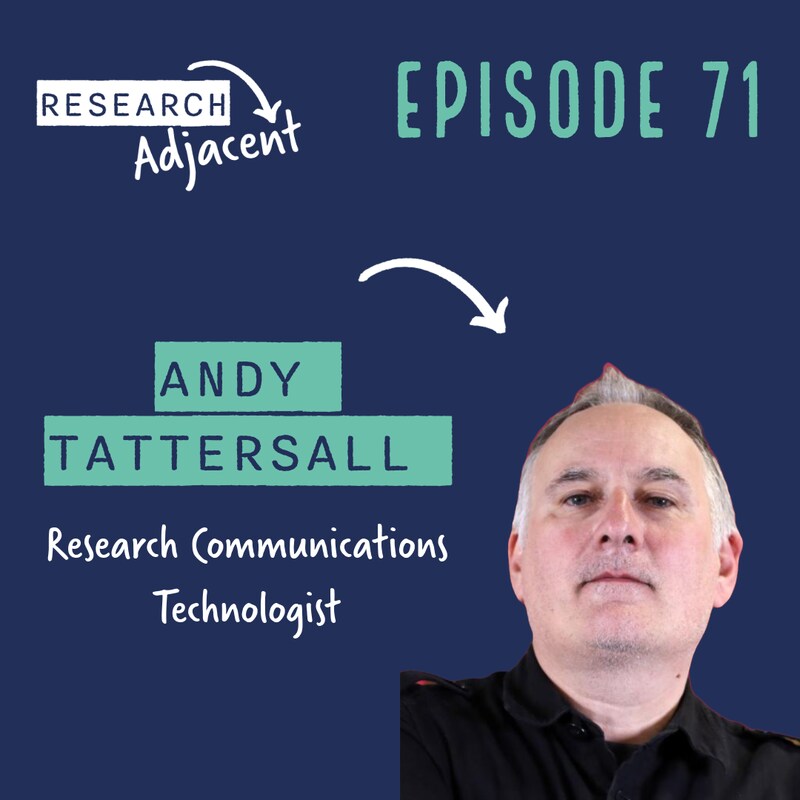
Shownotes
Andy is a communications specialist who embraces using technology to help share research.
Sarah and Andy talk about
- Making himself so useful that a job was created especially for him
- Using technology to solve problems and always trying to make things better
- How he evolved from bedroom radio host to pirate station DJ to podcaster
- Being a lifelong learner and why more CPD time would benefit everyone
Find out more
- Read the show notes and transcript on the podcast website
- Check out Andy's Linktree for all his podcasts and articles
- Connect to Andy on BlueSky
- Visit Andy's website
About Research Adjacent
- Fill out the research-adjacent careers quiz
- Sign up to the Research Adjacent newsletter
- Follow Research Adjacent on LinkedIn Instagram and BlueSky
- Email a comment, question or suggestion
- Leave Sarah a voice message
Mentioned in this episode:
Come along to our Manchester networking event
Join host Sarah McLusky and fellow research-adjacent professionals on Thursday 12 March 2026 at 5.30pm. Find out more and register here https://researchadjacent.circle.so/c/open-events/manchester-research-adjacent-community-networking
Member of the Month: Duncan Yellowlees, DY Training
Let’s put rubbish presentations in the bin – where they belong. Get in touch with Duncan for specialist research presentation skills training www.duncanyellowlees.com
Transcripts
Getting in early, picking on things, trying to play with it, find
Andy Tattersall:out if it works, you know, particularly at the moment with AI and then passing on
Andy Tattersall:that knowledge, I think is really useful.
Andy Tattersall:And it just takes one person to use it in a really fantastic
Andy Tattersall:way, and everyone goes, wow.
Andy Tattersall:Yeah.
Andy Tattersall:And that's always been the case with technology, isn't it?
Andy Tattersall:I think the really valuable professional services people are the ones who try and
Andy Tattersall:change their environment for the better.
Sarah McLusky:Hello there.
Sarah McLusky:I'm Sarah McLusky and this is Research Adjacent.
Sarah McLusky:Each episode I talk to amazing research adjacent professionals about what
Sarah McLusky:they do and why it makes a difference.
Sarah McLusky:Keep listening to find out why we think the research adjacent space
Sarah McLusky:is where the real magic happens.
Sarah McLusky:Hello, I'm your host, Sarah McLusky, and you are listening
Sarah McLusky:to the Research Adjacent podcast.
Sarah McLusky:In a minute, you'll be hearing from today's guest, Andy Tattersall.
Sarah McLusky:Now, depending on when you're listening to this podcast, Andy is
Sarah McLusky:either based at the University of Sheffield, or if it's after summer 2025.
Sarah McLusky:He's now freelance.
Sarah McLusky:Andy doesn't fit neatly into typical job categories.
Sarah McLusky:I first met him through podcasting, but I had also seen him writing
Sarah McLusky:a lot about the social media use and tentative rise of blue sky.
Sarah McLusky:Well, it turns out what he really specializes in is using technology
Sarah McLusky:to solve communication problems and suddenly it all makes sense.
Sarah McLusky:A late comer to education, he has evolved from a pirate radio DJ into
Sarah McLusky:a research communications specialist.
Sarah McLusky:We talk about his constant drive to make things better.
Sarah McLusky:While universities can be slow to adopt new technologies, his love of good
Sarah McLusky:conversation and why he would uses magic wand to improve CPD for everybody.
Sarah McLusky:Listen on to hear Andy's story.
Sarah McLusky:Welcome along to the podcast, Andy, it is fantastic to have you here as
Sarah McLusky:a guest and kind of on the other side of the microphone for you, although
Sarah McLusky:I'm sure we will get to that shortly.
Sarah McLusky:Could you tell us a bit about what it is that you do?
Andy Tattersall:Okay.
Andy Tattersall:So yeah, thanks for having me, Sarah.
Andy Tattersall:And, uh, what do I do?
Andy Tattersall:This is a tricky thing.
Andy Tattersall:Even some of my colleagues will ask me this, what exactly I do,
Andy Tattersall:and some, some have claimed in the past, all I do is mess about on the
Andy Tattersall:internet, but, what I do, I think in essence what I'm, is a troubleshooter
Andy Tattersall:and a creative ideas person.
Andy Tattersall:And my job title, which is what I came up with and finally
Andy Tattersall:managed to squeeze through at the University of Sheffield, was Open
Andy Tattersall:Research Communication Specialist, 'cause I think that's what I do.
Andy Tattersall:And before that I was an information specialist.
Andy Tattersall:So my work I think is between the sort of the intersection, of communications,
Andy Tattersall:'cause my first degree is journalism and information science, 'cause that's
Andy Tattersall:my master's degree, underpinned by a practical set of skills that allow me
Andy Tattersall:to make stuff, to solve problems and to help people primarily communicate
Andy Tattersall:their research, 'cause I work in health research at the moment.
Andy Tattersall:But as you'll know at the point of recording this, I will be
Andy Tattersall:leaving University of Sheffield in a few months time to go do
Andy Tattersall:this on my own for other people.
Andy Tattersall:So I think really that is it.
Andy Tattersall:And the way that people may understand it is that I see myself a bit of a research
Andy Tattersall:equivalent of a learning technologist.
Andy Tattersall:And I don't think I necessarily exist because people are either
Andy Tattersall:a marketing person or they're a learning technologist or they're an
Andy Tattersall:a, a scholarly communications person and I think I do bits of everything.
Andy Tattersall:I'm a jack of all trades and maybe a master of some.
Andy Tattersall:That's what I am.
Andy Tattersall:Yeah.
Sarah McLusky:So when you say you do lots of different bits, tell us a bit
Sarah McLusky:about some of those different kind of projects and things that you are
Sarah McLusky:working on or technologies that you use.
Andy Tattersall:Um, examples might be, so I was part funded by the NIHR
Andy Tattersall:in terms of knowledge mobilizing NIHR research into local government.
Andy Tattersall:Sort of like make some kind of an impact.
Andy Tattersall:So the kind of things that I've done there as part of that work is, is making
Andy Tattersall:infographic, it might be making animation that explains what we're doing, but also,
Andy Tattersall:uh, only this week I put together a public engagement event as part of a festival
Andy Tattersall:that runs over a month in Sheffield called Festival of Debate, where I had colleagues
Andy Tattersall:who I worked with on this project along with the Sheffield's Director of Public
Andy Tattersall:Health, Greg Fell, and I, I had those turn up and have a panel discussion about
Andy Tattersall:this topic in front of a live audience.
Andy Tattersall:And that event was totally put together by me.
Andy Tattersall:Now putting events together isn't something that I necessarily do.
Andy Tattersall:What I, I certainly do is I, I look at an area where I think people
Andy Tattersall:need to know about something.
Andy Tattersall:And I'll recruit speakers together.
Andy Tattersall:And I've done that for people like UKSG.
Andy Tattersall:So I'm not an event organizer 'cause I know that's your area.
Andy Tattersall:But I'm more like a I think of myself as a fantasy football kind
Andy Tattersall:of person that I think that'd be a great speaker and that'd be a great
Andy Tattersall:speaker and let's get them together.
Andy Tattersall:And I've come up with an idea of a way we can badge it.
Andy Tattersall:Uh, and such like.
Andy Tattersall:Other things that I've done, which are not necessarily technology enabled.
Andy Tattersall:10 years ago I started writing retreats.
Andy Tattersall:That was because I had to finish a book on altmetrics that I'd been commissioned
Andy Tattersall:to do, and I was struggling to do it.
Andy Tattersall:And the writing retreats called Write Club have run for the last 10 years.
Andy Tattersall:And I, I did a quick, um, check on on the data since lockdown,
Andy Tattersall:see how many people had attended from the University of Sheffield.
Andy Tattersall:And it was just shy of 600 people who had been to these sessions.
Andy Tattersall:And this is where people get together and write, and it's based on a Pomodoro
Andy Tattersall:technique where you take five minute breaks, you write for 25 minutes.
Andy Tattersall:We have yoga videos, we have meditation star and things like that.
Andy Tattersall:And some of 'em, I just play music throughout the day and people
Andy Tattersall:listen to music in the background.
Andy Tattersall:And it's a real good way to bring people across the campus together.
Andy Tattersall:That is a sort of what I would say is the kind of the antithesis of what I do,
Andy Tattersall:which is to kind of push out technology.
Sarah McLusky:Yeah.
Andy Tattersall:And to, to promote things.
Andy Tattersall:Whether that's altmetrics, whether that's the use of podcasting, whether that's
Andy Tattersall:the use of making videos, whether that's writing blogs, social media and such.
Andy Tattersall:Like, so I'm an advocate for all of those things, and I think that's
Andy Tattersall:what I'm kind of largely known for.
Andy Tattersall:But the kind of the Write Club was a byproduct.
Andy Tattersall:Some of the other things I've done is I started a series about 15 years ago
Andy Tattersall:called Bite-Size that still runs at Sheffield, which are 20 minute talks on
Andy Tattersall:Technologies to or ideas to help people work better.
Andy Tattersall:I was the first person at Sheffield to kinda spot massive online open
Andy Tattersall:courses, and we ran the first three of those I think in 2012, 2013.
Andy Tattersall:And we had 8,000 students sign up for them.
Andy Tattersall:Uh, and again, that was me spotting something.
Andy Tattersall:So, and getting, getting buy-in.
Sarah McLusky:It does sound very much, I think you said at the very beginning
Sarah McLusky:you're a bit of a problem solver.
Sarah McLusky:I think it also sounds like you're a bit of a magpie.
Sarah McLusky:You're just like,
Andy Tattersall:Absolutely.
Sarah McLusky:There's a thing over here and there's a thing over
Sarah McLusky:here and let's put them together and see what we can come up with.
Andy Tattersall:Absolutely.
Andy Tattersall:I've been definitely a magpie for about 15 years, and I, I'm a shambrarian
Andy Tattersall:as I've been told many times, so I'm someone who affiliates very strongly
Andy Tattersall:with the academic library community.
Andy Tattersall:I know loads of them.
Andy Tattersall:I've spoke at dozens of library conferences.
Andy Tattersall:I've given invited talks at, you know, CILIP and international Business
Andy Tattersall:Librarians Conference at International Clinical Librarians Conference.
Andy Tattersall:I'm not a librarian.
Andy Tattersall:I have probably a librarian's brain that I like to curate things.
Andy Tattersall:Put things in order and like to naturally share.
Andy Tattersall:And help people and solve problems, which I think is a
Andy Tattersall:lot of work that librarians do.
Andy Tattersall:But the other flip side is one previous manager said to me many years ago,
Andy Tattersall:I'm also a bit like a bull at a gate.
Andy Tattersall:And I've changed that because
Andy Tattersall:But the problem with the bull at the gate sometimes is that you rush in
Andy Tattersall:and you, you do get things wrong.
Andy Tattersall:And so I've sort of become a little more pragmatic.
Andy Tattersall:And maybe that's the thing with age, as you get older, you become a
Andy Tattersall:bit more, I won't say conservative.
Andy Tattersall:A little more
Sarah McLusky:cautious.
Andy Tattersall:Cautious, yeah.
Andy Tattersall:And I'll still take risks and I'll still push things out and I'm still prepared
Andy Tattersall:to annoy people because I think I might be right about something and I want them
Andy Tattersall:to come around to that way of thinking 'cause I think the evidence is there and.
Andy Tattersall:I'm a practitioner first and foremost, but I am strongly underpinned by evidence.
Andy Tattersall:So when I'm telling you to do something, then there is an evidence
Andy Tattersall:base hopefully behind a lot of it.
Andy Tattersall:Um, even though the evidence might be weak or not, not substantiated
Andy Tattersall:at the time 'cause it's early days I'm certainly not a futurologist.
Sarah McLusky:No.
Andy Tattersall:But I've always tried to lead from the front and I've always
Andy Tattersall:tried to bring people along with me and certainly work with the idea of bringing
Andy Tattersall:people along with me who want to come.
Andy Tattersall:Yeah.
Andy Tattersall:I. Many years ago that you can really try and, you know, you can take a horse
Andy Tattersall:to water but you can't get it to drink.
Andy Tattersall:And there are people in the academic world who unfortunately will never, ever change
Andy Tattersall:and they're not worth the investment of your limited time and energy.
Andy Tattersall:But there is this huge swathe in the middle, you know, the kind of
Andy Tattersall:on and that kind of, diffusion of innovation curve, there's that huge
Andy Tattersall:group of people who are interested.
Andy Tattersall:And I've been tried, I've tried to be attuned to the issues that impact
Andy Tattersall:them, the inequalities that impact them, the time issues, particularly
Andy Tattersall:if you're part-time, if you are, if you are female, you know, you
Andy Tattersall:take the caring responsibilities invariably and all those problems.
Andy Tattersall:So Write club is a good example of that because since I've run it.
Andy Tattersall:Um, and you know, I've had nearly 600 people attend since 2020.
Andy Tattersall:On top of all those who attended the five, six years before that,
Andy Tattersall:it is roughly 95% female attended.
Sarah McLusky:Interesting.
Sarah McLusky:Yeah.
Andy Tattersall:Yeah.
Sarah McLusky:They're the people who most need that space, perhaps
Sarah McLusky:that, that's somewhere to gather?
Andy Tattersall:I think so.
Andy Tattersall:I think that they're more likely to be they're more likely to struggle
Andy Tattersall:time-wise because of other demands.
Andy Tattersall:Also, I think are possibly more open to working that way as well.
Andy Tattersall:I think that might be a reason as to it that they actually think, there's
Andy Tattersall:nothing wrong about going into a room with a bunch of people to write together.
Andy Tattersall:I think there's a lot of blokes you might go, oh, you don't need to do that.
Andy Tattersall:Yeah.
Andy Tattersall:You know, a bit of, I think there's a little bit of that.
Andy Tattersall:But I think largely it is down to equity.
Andy Tattersall:And kind of cultural sort of reasons why.
Andy Tattersall:Women to attend those sessions.
Andy Tattersall:Yeah, so I, I, I'm, I'm pleased with that because I do want to bring
Andy Tattersall:equity to research communications because it's not just those who
Andy Tattersall:are resource poor, time poor.
Andy Tattersall:I think it's also that I. Research, particularly in institutions
Andy Tattersall:has a habit of very much going with the easy, big wins.
Andy Tattersall:And they might be that's won 10 million pounds, that
Andy Tattersall:project's won 10 million pounds.
Andy Tattersall:That project is going to solve this particular cancer, et cetera.
Andy Tattersall:And a lot of the very, very small projects that make some really, really
Andy Tattersall:decent societal impact and some change get overlooked because it's one person
Andy Tattersall:in a department doing one thing that just it's not seen hot or sexy enough.
Andy Tattersall:Yeah.
Andy Tattersall:Or attention grabbing.
Andy Tattersall:And I think that there's more to be done to give these people a leg up because
Andy Tattersall:these little seed investments of, of research and time and these little
Andy Tattersall:pots of money can lead to big things that lead to a wider societal impact.
Sarah McLusky:Yeah, definitely.
Sarah McLusky:And I think.
Sarah McLusky:Not only in terms of helping the research get, but like you say, the
Sarah McLusky:help that you can do to get that research out into the world and
Sarah McLusky:the difference that that can make.
Sarah McLusky:Because often the big projects will have a budget for things.
Sarah McLusky:They might even have a member of staff on the team who can
Sarah McLusky:do all their communications and get everything out there.
Sarah McLusky:But like you say, those little projects, if there's somebody who's working across
Sarah McLusky:the organisations, can give them a little bit of time, a little bit of help can
Sarah McLusky:make a big difference to them, can't it?
Andy Tattersall:A absolutely.
Andy Tattersall:You know, a little bit of money can go the right way if it's used right.
Andy Tattersall:And the problem with lot of big projects is when they put in bids, you know,
Andy Tattersall:historically anyway, and I think things are changing for the better slowly, but
Andy Tattersall:historically it was very much a tick box.
Andy Tattersall:We'll have a website, we'll use Twitter, we'll do this, and there wasn't really
Andy Tattersall:much thought for it or the alternative was, uh, we don't do anything.
Andy Tattersall:We get to the end and oh my goodness, we now need to start
Andy Tattersall:thinking about telling people.
Andy Tattersall:And the pot of money has been taken away from us now 'cause
Andy Tattersall:it's at the end of the project.
Andy Tattersall:Yeah.
Andy Tattersall:And we can't do anything.
Andy Tattersall:Uh, so it's a bit slap dash at times.
Andy Tattersall:It's Ill thought, I like the idea of, thinking about things in the
Andy Tattersall:longer term as a campaign possibly.
Andy Tattersall:And that's very hard to achieve.
Andy Tattersall:And I think that does take resource, but I think if people can think about
Andy Tattersall:that, and I think this is particularly important when you are working
Andy Tattersall:directly with the public, because one of the problems with research is it
Andy Tattersall:parachutes into a cohort in society.
Andy Tattersall:It does some work and it pulls out.
Andy Tattersall:And I think that these problems are often endemic.
Andy Tattersall:I, you know, working in health research, we, we are looking at
Andy Tattersall:often endemic problems that are very wicked, that can't be solved by one
Andy Tattersall:necessarily solution or, or person.
Andy Tattersall:And that thinking about campaigns extends that, and it also kind of,
Andy Tattersall:I think, helps with the civic duty
Andy Tattersall:Of what research should do.
Andy Tattersall:And one of the problems that we get is that stories are often told of
Andy Tattersall:in the frame of 5 million pounds won by the University of whatever.
Andy Tattersall:Yeah.
Andy Tattersall:And I think the, yeah, the money is so important.
Andy Tattersall:Obviously it allows you to do those things, but really the story is what's
Andy Tattersall:the impact and who's the lives and what's the breakthrough gonna be?
Andy Tattersall:Because I think that's what the public care about.
Andy Tattersall:They don't know if 5 million pounds is a lot of money it in, in a
Andy Tattersall:lot of cases obviously it isn't.
Andy Tattersall:Yeah.
Andy Tattersall:But what they want to know is, will my mom.
Andy Tattersall:Beat this illness.
Sarah McLusky:Yeah.
Andy Tattersall:Will my dad get well?
Andy Tattersall:Yeah.
Andy Tattersall:Will I, you know, and I think that's quite, that's the, quite
Andy Tattersall:the important thing, the money.
Andy Tattersall:I don't think newspapers are interested in the money usually.
Andy Tattersall:Yeah.
Andy Tattersall:They're interested in the, the actual impact.
Andy Tattersall:So, but I also think that for a large extent, and this is.
Andy Tattersall:This is across the board.
Andy Tattersall:Whether you're working as an individual trying to do things or working as a
Andy Tattersall:group who may have an administrator.
Andy Tattersall:I think it's all about little 1% increments, trying to make
Andy Tattersall:everything a little bit better.
Andy Tattersall:How can we make our comms a bit more visible?
Andy Tattersall:How can we make this bit of work a bit more impactful, how can we actually
Andy Tattersall:manage to reach this cohort of society?
Andy Tattersall:How can we manage to reach this policy maker?
Andy Tattersall:And they're all little 1% that you, you have to think about all the time because
Andy Tattersall:you know, you think about and um go into something in, in, in Sheffield I forgot
Andy Tattersall:the gentleman's name now, but he, he's a kind of a sports psych psychologist
Andy Tattersall:who worked with I don't wanna say his name 'cause I'll get it wrong, but,
Andy Tattersall:uh, um, he worked with British cycling.
Andy Tattersall:And the reason British cycling was such a huge success throughout the noughties
Andy Tattersall:was that he took this this idea.
Andy Tattersall:His, his business is called Chimp Management.
Andy Tattersall:Uh, I wanna say Steven Peters, I could be wrong, Steve Peters, but he went
Andy Tattersall:and they looked at 1% increments.
Andy Tattersall:And those increments could be washing your hands after you've been to the loo
Andy Tattersall:to reduce infection, because if cyclists catch a cold, they can't practice.
Andy Tattersall:Yeah.
Andy Tattersall:These little things like that.
Andy Tattersall:Yeah.
Andy Tattersall:Doing something to this piece of the technology to improve it.
Sarah McLusky:Yeah.
Andy Tattersall:Um, habits, habit forming.
Andy Tattersall:So I think that that's quite important.
Sarah McLusky:Yeah.
Sarah McLusky:And it all adds up over time, doesn't it?
Sarah McLusky:Absolutely.
Sarah McLusky:These, absolutely these little improvements here and there, you know, it
Sarah McLusky:doesn't always need to be about the big splash, about the big development, like
Sarah McLusky:you say, the things that get reported these big grant wins and things like that.
Sarah McLusky:And actually at the end of the day, it doesn't always make much difference.
Sarah McLusky:So one thing I think people will be really curious to know is how
Sarah McLusky:you got into doing this work.
Sarah McLusky:You mentioned.
Sarah McLusky:Having been, you know, doing learning technology and things like that.
Sarah McLusky:But yeah, tell us about your journey.
Andy Tattersall:So, well, first of all, I wanna clarify, it was Steve
Andy Tattersall:Peters, so I just wanna make sure.
Andy Tattersall:Excellent.
Andy Tattersall:I just did a quick Google search.
Andy Tattersall:Professor Steve Peters.
Andy Tattersall:He's the gentleman.
Andy Tattersall:How did I get into it?
Andy Tattersall:I. Was late.
Andy Tattersall:I, I completely flunked at school.
Andy Tattersall:I didn't have a great start to life.
Andy Tattersall:I was taken from my parents as a baby, so life didn't start
Andy Tattersall:great and I flunked to school.
Andy Tattersall:Had a good time throughout my teens and my twenties, and then decided needed to get
Andy Tattersall:an education and I went off to college.
Andy Tattersall:Cut.
Andy Tattersall:Long story short, went and did some A levels age 26.
Andy Tattersall:Felt massively outta my depth.
Andy Tattersall:Then managed to get a place at Sheffield on their journalism degree, which
Andy Tattersall:was at the time I think they had 1400 applicants, and I was very lucky to get
Andy Tattersall:on as a mature student and felt outta my depth, but it was an amazing experience.
Andy Tattersall:And then went off to be a journalist for a short while, sports journalist
Andy Tattersall:for the Press Association.
Andy Tattersall:And did journalism as well, doing journalism in the background.
Andy Tattersall:And I've continued to do that in capacity doing music and culture.
Andy Tattersall:But I, saw a job at the University of Sheffield.
Andy Tattersall:I went there doing their inter library loans.
Sarah McLusky:Okay.
Andy Tattersall:And it was a very overwhelming job.
Andy Tattersall:It was a, it was a paper-based job and after about a year I went off to
Andy Tattersall:a, an event and came back and said, I think we need to digitize the system.
Andy Tattersall:This was in my academic department and we were doing around 600 inter library
Andy Tattersall:loans, um, a month, which was quite a lot.
Andy Tattersall:And I digitized it.
Andy Tattersall:And we had a system for doing this.
Andy Tattersall:And I did that for a few years and started doing other things
Andy Tattersall:that were not part of my job.
Andy Tattersall:So I redesigned the library in Google SketchUp.
Andy Tattersall:In 3D and I started, um, doing just various stuff that
Andy Tattersall:were not part of my job and.
Andy Tattersall:The, this particular guy very esteemed academic in the evidence-based
Andy Tattersall:synthesis world and evidence-based librarianship he's led in that
Andy Tattersall:and innovated from the start.
Andy Tattersall:He's, he is, he is the kind of the godfather of, of, of a lot of stuff.
Andy Tattersall:Uh, Andrew Booth decided there was a job for me and he managed
Andy Tattersall:to get funding with another professor and Professor Wendy Baird.
Andy Tattersall:And in 2007, they created a job for me, which was basically looking at stuff like
Andy Tattersall:innovating the library and doing things around, you know, I started doing blogs.
Andy Tattersall:Started YouTube channel around 2008, 2009, and just was left to my own
Andy Tattersall:devices and have been for 18 years, very much under multiple managers.
Andy Tattersall:So I took the job exactly where I wanted.
Sarah McLusky:Yeah.
Andy Tattersall:Um, which has been a huge.
Andy Tattersall:I'm huge privilege.
Sarah McLusky:Yeah.
Andy Tattersall:And I've been trusted.
Andy Tattersall:It comes with an awful lot of downfalls and responsibilities and, and concerns.
Andy Tattersall:It's not, it's not all, uh, it's not all wonderful, but it's it has been, I've
Andy Tattersall:been blessed that I've been supported in that area to go off and do that.
Andy Tattersall:So what I would've said is, is that probably around 2007, 2008, I probably
Andy Tattersall:was a proto learning technologist.
Andy Tattersall:I was very interested in the learning side of things, so I was involved in the
Andy Tattersall:teaching and I was doing teaching myself.
Andy Tattersall:And it was around, I think around 2010, 2011, I remember sitting down with
Andy Tattersall:the guy who was the head of our, our sort of section at the time, professor
Andy Tattersall:Simon Dixon, who recently retired.
Andy Tattersall:He's a health economist and he said, you need to figure out what you want to do.
Andy Tattersall:Do you wanna go and do research or do you want to go and do teaching?
Andy Tattersall:'cause I was sort of straddling both to some extent.
Andy Tattersall:And I went away and thought.
Andy Tattersall:The learning technologists are starting to really take off in the institution.
Andy Tattersall:There were people there who'd been doing that for years before me uh, who'd
Andy Tattersall:been doing that in various capacities.
Andy Tattersall:And the whole movement was certainly really, really
Andy Tattersall:getting going on institutions.
Andy Tattersall:And I thought, actually there's nothing happening in terms of research.
Andy Tattersall:And I'm, and I'm talking about being a, a research technician.
Andy Tattersall:I'm not talking, I'm not talking about research communications.
Andy Tattersall:It was purely about the digital side of things.
Andy Tattersall:The digital literacy, that's everything from, Google apps and
Andy Tattersall:I was, I was very much the kind of the lead for Google at Sheffield.
Andy Tattersall:It, it implement, not implementing it, but certainly.
Andy Tattersall:Being the person for it to go out and speak to departments and show them.
Andy Tattersall:Because prior to us getting Google in around 2010, I was already
Andy Tattersall:using Google in the institution.
Andy Tattersall:And again, this is before we're thinking about information governance.
Andy Tattersall:You know, I was using the Google email to get set up accounts.
Andy Tattersall:Yeah, I'd got Blogger running, I'd got YouTube running, uh, I was
Andy Tattersall:using SketchUp and stuff like that.
Andy Tattersall:So I decided that I'd go down the research route, and that was
Andy Tattersall:where it, it was for me and that's really where I've been ever since.
Andy Tattersall:Underpinned by information and technology literacy.
Andy Tattersall:So, uh, people do invite me to give talks about technology and adoption and that's
Andy Tattersall:something I've learned a lot about.
Andy Tattersall:How do you get people to buy in stuff and what are the issues about that?
Sarah McLusky:Yeah, that's making me think of the work you've done recently
Sarah McLusky:about the move of organisations away from Twitter and towards other platforms
Sarah McLusky:and like you say, it's that period of adoption and what makes people move and
Sarah McLusky:when do they move and that sort of thing.
Sarah McLusky:Yeah, really interesting.
Andy Tattersall:Yeah, and what I've sort of learned is that universities are herds.
Andy Tattersall:They kind of follow each other eventually.
Andy Tattersall:And they sit and watch what others are doing.
Andy Tattersall:And there's not really truly that many that are truly freethinking or radical.
Andy Tattersall:You know, you'll get a university that'll go, we're gonna step
Andy Tattersall:away from these rankings.
Andy Tattersall:We're not gonna play part of that anymore.
Andy Tattersall:That's a very brave decision to do, and we're gonna, we're gonna do that.
Andy Tattersall:But I think they do follow, quite often in herds.
Andy Tattersall:I think they're very slow to move as a whole.
Andy Tattersall:I predicted that with Twitter when Elon Musk took over, I said, well,
Andy Tattersall:people are gonna jump 'cause you can make a decision as an individual.
Andy Tattersall:You can make it on an ethical choice.
Andy Tattersall:You can make it on a political choice.
Andy Tattersall:You can make it on a mental health decision or personal decision.
Andy Tattersall:But as an organisations, it's really tricky.
Andy Tattersall:And I, and I, and it's proven to be so with Twitter that they're they may be
Andy Tattersall:investing elsewhere, but the majority are still not jumping off that one yet.
Andy Tattersall:. Um, and, uh, I don't think things will change on Twitter, so it will be
Andy Tattersall:interesting to see how that one plays out.
Sarah McLusky:And then, and then you mentioned also looking at how things
Sarah McLusky:like AI might be starting to come in to organisations, what difference that
Sarah McLusky:makes in places like universities.
Sarah McLusky:What have you found there?
Andy Tattersall:Well, I'm really looking at it from the
Andy Tattersall:perspective of dissemination.
Andy Tattersall:'cause that's what I'm interested in.
Andy Tattersall:And what I found largely is, is if I was to sum it up, it would be
Andy Tattersall:let's not get carried away just yet,
Andy Tattersall:or not get ahead of ourselves.
Andy Tattersall:I think, uh, there are probably an awful lot of researchers out there
Andy Tattersall:who are leveraging it really well now.
Andy Tattersall:I think they're probably got some really good workflows
Andy Tattersall:and they're being very savvy.
Andy Tattersall:Whether they're telling other people about it will vary from person to person.
Andy Tattersall:Uh, but I think we're probably seeing for all of those, we're seeing
Andy Tattersall:a, a probably two or three more that are doing it very badly and
Andy Tattersall:potentially also in a corrupt way.
Andy Tattersall:So I, the issue I've got with AI is, uh, certainly from the platforms
Andy Tattersall:I've looked at, is it's being shoehorned into a lot of stuff.
Andy Tattersall:And I think it's detracting away from the quality of the said platform.
Andy Tattersall:And I think that people not necessarily are in a position to make a good value
Andy Tattersall:judgment as to whether that works well.
Andy Tattersall:Uh, so what would be good would be more conversations.
Andy Tattersall:It's something I wanna think more about, maybe even develop a course
Andy Tattersall:on, in terms of dissemination.
Andy Tattersall:Uh, I, I know initial, conversations and I get this, you know, you,
Andy Tattersall:you speak to perhaps people, media people, people who might work in press
Andy Tattersall:very cautious and nervous about it.
Andy Tattersall:Because they're worried about it, undermining their roles.
Andy Tattersall:And I, I get that.
Andy Tattersall:I get that why people in the arts and humanities are particularly wary of AI.
Andy Tattersall:But I do think that it is an opportunity in this area.
Andy Tattersall:I think it's an opportunity for accessibility.
Andy Tattersall:I think it's an opportunity to develop some very inventive
Andy Tattersall:and creative ways of working.
Andy Tattersall:You know, a good example would be you look at image creation just a year ago
Andy Tattersall:with something like Midjourney or ChatGTP, the quality of images were pretty crap.
Andy Tattersall:Even if you had a, a good prompt, if you wrote something quite
Andy Tattersall:decent, it still came out with wonky hands and skewed faces.
Andy Tattersall:Whereas now if you do something, you can get something that's quite.
Andy Tattersall:Decent with a relatively straightforward prompt.
Andy Tattersall:That's my experience of late.
Andy Tattersall:That's good.
Andy Tattersall:But again, I think it goes back to the issue of inequalities because with all
Andy Tattersall:of these AI tools, they've got to make money and, uh, to get the real good
Andy Tattersall:stuff you're gonna have to pay for it.
Andy Tattersall:It's the, it's the old web 2.0 world.
Andy Tattersall:That we had, you know, if you remember 2004 to around 2007 was a huge expansion
Andy Tattersall:of web tools that came out that just did everything and it was amazing.
Andy Tattersall:And then you realize actually a lot of them aren't that good.
Andy Tattersall:They don't improve your life and a lot of 'em don't work well.
Andy Tattersall:And then some of the ones that did work well are, have been created by a PhD
Andy Tattersall:student who realizes that he or she needs to get a an income and that's
Andy Tattersall:not paying them and it disappears.
Andy Tattersall:And I think we'll see this with AI.
Andy Tattersall:I think we'll see platforms rise fall, we'll see people who can't leverage
Andy Tattersall:it, make money and we'll also see an awful lot of gumpf out there.
Andy Tattersall:Yeah.
Andy Tattersall:As a result.
Andy Tattersall:So I think it's interesting times and it, I what the situation is for universities,
Andy Tattersall:but I. I would guess that many are taking very different approaches and some are
Andy Tattersall:trying to lock down as much as they can.
Andy Tattersall:They see it as an information governance issue.
Andy Tattersall:They see it as a literacy issue.
Andy Tattersall:And perhaps some of the students might even be better equipped than
Andy Tattersall:some of the staff in using these tools and finding ways to do that.
Andy Tattersall:And some of 'em might be running with it.
Andy Tattersall:And doing some really interesting stuff and some having some
Andy Tattersall:really interesting conversations.
Andy Tattersall:I know at Sheffield there's some really good people that are behind this, that
Andy Tattersall:are doing, doing some very interesting things, sharing things that I don't
Andy Tattersall:understand, you know, around data and code and how to carry out research.
Andy Tattersall:And they're doing, they're doing some really, really good stuff.
Andy Tattersall:But for the majority of academics, they probably are a little bit bewildered right
Andy Tattersall:now as to not just how do they use it, but what can they use it for, and I think
Sarah McLusky:I would say that's exactly
Andy Tattersall:how I feel so,
Andy Tattersall:And it just takes one person to use it in a really fantastic
Andy Tattersall:way, and everyone goes, wow.
Andy Tattersall:Yeah.
Andy Tattersall:And that's always been the case with technology, isn't it?
Andy Tattersall:You know?
Andy Tattersall:Yeah.
Andy Tattersall:Someone goes off,
Sarah McLusky:You don't know you need it, so then you don't
Sarah McLusky:see how it fits into your life.
Sarah McLusky:And it takes a while to, yeah, to actually figure out.
Sarah McLusky:It's like, it's like when they invented text messaging and they
Sarah McLusky:didn't think anybody would want it.
Sarah McLusky:Yeah.
Sarah McLusky:And then they, and then it just, and everybody went, oh,
Sarah McLusky:actually this is really good.
Sarah McLusky:Yeah.
Sarah McLusky:So,
Andy Tattersall:yeah.
Sarah McLusky:We shall see.
Sarah McLusky:We shall see.
Sarah McLusky:Yeah.
Sarah McLusky:Um, but one technology that you have really embraced is podcasting, isn't it?
Sarah McLusky:That's, and that's how our paths crossed, um Yes.
Sarah McLusky:In the first place.
Sarah McLusky:What is it that you find so interesting or enjoyable about podcasting?
Andy Tattersall:So again, going back many years, the journey starts when
Andy Tattersall:I was probably about 12, 11 listening to Radio Luxembourg under the covers
Andy Tattersall:as a little boy and fascinated by radio, and then becoming an avid
Andy Tattersall:record collector at the age of 11.
Andy Tattersall:Making my own radio shows called Tatt on Two.
Sarah McLusky:Excellent.
Sarah McLusky:Are there recordings of this anywhere?
Andy Tattersall:There isn't.
Andy Tattersall:They were on cassettes and they were given to friends along with Tatt on Two pens.
Andy Tattersall:Which were pens with the word Tatt on Two liquid papered onto them, and so I
Andy Tattersall:would've been about 13, 14 at the time.
Andy Tattersall:I'd record a record and then record a microphone and me
Andy Tattersall:talking in between and, yeah.
Andy Tattersall:Pause tape, do the do stuff.
Andy Tattersall:And then I got into DJing in the sort of mid eighties.
Andy Tattersall:I be, I became a hip hop dj and so I can scratch and do all that sort of stuff.
Andy Tattersall:Not as good as I used to.
Andy Tattersall:But, but I did all that.
Andy Tattersall:And um, and then in 1991, became a pirate radio DJ for six years.
Andy Tattersall:And, and was on a few stations, a couple of very infamous ones in, in Sheffield,
Andy Tattersall:very well known Fantasy FM and SCR, which when I've been featured in interviews, you
Andy Tattersall:get colleagues in meetings and they'll say were you the same person that was featured
Andy Tattersall:in this article that was in this magazine?
Andy Tattersall:Which is happened?
Andy Tattersall:It's like, yeah.
Andy Tattersall:So I did that and then I went to do journalism, which
Andy Tattersall:included broadcast journalism.
Andy Tattersall:And I then went sort of, uh, probably, the mid two thousands, I
Andy Tattersall:was approached by a radio station online, a hip hop radio station
Andy Tattersall:who was an international one known.
Andy Tattersall:And I was persuaded to kind of start doing a show, which I did for a few years.
Andy Tattersall:And then I moved on to another station and I did that.
Andy Tattersall:And the weird thing is I took quite a while to bring it into a professional
Andy Tattersall:setting . So I didn't do my first podcast until, I think my first ones around 2018,
Andy Tattersall:2019, and they're one person podcast.
Andy Tattersall:It's me talking about a thing scripted, right?
Andy Tattersall:Yeah.
Andy Tattersall:So it's talking about, so I did those and I, I didn't, I didn't, we didn't have the
Andy Tattersall:facilities, I don't think, at Sheffield at the time to really do anything properly.
Andy Tattersall:So I did that, but I found a report I wrote in around 2007 around
Andy Tattersall:customer relationship management and how we approached students and
Andy Tattersall:what other universities were doing.
Andy Tattersall:And I was asked to dig the report out a few years ago,
Andy Tattersall:about four or five years ago.
Andy Tattersall:And I looked through the conclusions and one of the key conclusions in 2007 was.
Andy Tattersall:We should be doing podcasts.
Sarah McLusky:Goodness me, that you even knew what, I don't think
Sarah McLusky:I'd even heard of podcasts in 2007.
Andy Tattersall:And so I was, it suggest there's very few
Andy Tattersall:recommendations and that was one of them.
Andy Tattersall:And it, this, this document is around 2007.
Andy Tattersall:It may even be slightly early, about 2006.
Andy Tattersall:But it took me about 12 years to actually do it.
Sarah McLusky:Yeah.
Andy Tattersall:And that's not like me.
Andy Tattersall:I'm normally quick at turning around.
Andy Tattersall:So I then started doing, um.
Andy Tattersall:Podcast called Research Records.
Andy Tattersall:Which is a cross between Desert Island Discs and The Life Scientific.
Andy Tattersall:And we've had Jim Al-Khalili from The Life Scientific as a guest, and that was
Andy Tattersall:with, um, Tony Ryan, who's a chemist, OBE, and um, Marie Kinsey, who's an
Andy Tattersall:emeritus professor of journalism.
Andy Tattersall:And it's a journey about music and academic life.
Andy Tattersall:And very proud of it.
Andy Tattersall:It's been a really good series.
Andy Tattersall:Uh, I presume it's come to an end as I step away from Sheffield as the producer.
Andy Tattersall:I don't think they hosts, I, I'm speaking on their behalf.
Andy Tattersall:I've told them that I'll find 'em another producer, but I think they, they
Andy Tattersall:don't want to continue with me going.
Andy Tattersall:So, I think they're very sad about me going if I'm honest.
Andy Tattersall:So, and I produced one of my own called Communicable Research, which is about
Andy Tattersall:health, communicating health research.
Andy Tattersall:And I also produce one called The Overnight Podcast.
Andy Tattersall:So that, so that's really my journey.
Andy Tattersall:I, after Sheffield, I have an idea for a podcast series,
Andy Tattersall:which I think will be good.
Andy Tattersall:If I can get the guests.
Andy Tattersall:I think it'll bring something.
Andy Tattersall:Extra to, you know, I think, you know, your podcast brings something
Andy Tattersall:different, and includes, you know, a wealth of really, really good guests.
Andy Tattersall:And, uh, and hopefully I can kind of contribute to that pool of podcasts.
Andy Tattersall:'cause I know you are advocate I love podcasts.
Andy Tattersall:Yeah.
Andy Tattersall:Ultimately.
Andy Tattersall:If you were to say to me, if you're on a desert island, what would you prefer?
Andy Tattersall:Having a radio or TV, radio wins hands down.
Sarah McLusky:Oh, me as well.
Sarah McLusky:Radio.
Sarah McLusky:Anytime.
Andy Tattersall:I still think it's very early days for podcasts because
Andy Tattersall:I think that, um, what I like about podcasts and I'm sure you, you
Andy Tattersall:know, you've found this experience.
Andy Tattersall:It's a, it gives a safe space for people to talk.
Andy Tattersall:It's not like working with the media.
Andy Tattersall:It's, yeah.
Andy Tattersall:It's, it is an opportunity and a safe space.
Andy Tattersall:And this is.
Andy Tattersall:I think it's quite an important point as, and I'm waffling on, but
Andy Tattersall:where universities really miss out on podcasting, and I think this is huge,
Andy Tattersall:and it's the same with video, is that for prospective students, it gives them a
Andy Tattersall:insight into the people who may teach them if they go to that institution because all
Andy Tattersall:they might see is a bit of text with no photograph on a staff profile or what they
Andy Tattersall:might see is a photograph with some text.
Andy Tattersall:Now I don't know if he or she's any good.
Sarah McLusky:Yeah,
Andy Tattersall:but if I hear them talking and I think these
Andy Tattersall:know their stuff, and that's the kind of person I wanna sit down
Andy Tattersall:in the lecture room and hear.
Sarah McLusky:Yeah,
Andy Tattersall:it's a massive opportunity.
Sarah McLusky:It is.
Sarah McLusky:And it, and you could, the little snippets, you know, just five
Sarah McLusky:minutes here and there could make a huge difference, isn't it?
Sarah McLusky:It doesn't have to be a huge, it doesn't have to be a huge commitment.
Sarah McLusky:So yeah, also a big fan of audio.
Sarah McLusky:Um.
Sarah McLusky:Well, I think we should keep an eye on the time, but I do like to
Sarah McLusky:ask all of my guests if they had a magic wand, what they would change
Sarah McLusky:about the world that they work in.
Sarah McLusky:So what would you like to use your magic wand for?
Andy Tattersall:That is a really, really tough question.
Andy Tattersall:'cause there is absolutely so much wrong in
Andy Tattersall:higher education, sadly, as we know, perennial problems.
Andy Tattersall:If I had a magic wand, I think, if I was like king for a day, I would
Andy Tattersall:absolutely, we would be in this position where everybody, absolutely, everybody
Andy Tattersall:has guaranteed time to carry out CPD.
Andy Tattersall:And I am lucky that I've been able to do a job where largely my job is continual
Andy Tattersall:CPD, so I'm continually developing and learning, and I got the bug for learning
Andy Tattersall:late in the day when I went to college and not and, uh, it's not left me since.
Andy Tattersall:And I think that there's an awful lot of people, and I think particularly, and I
Andy Tattersall:know a lot of people, you know, people you speak to work in professional services
Andy Tattersall:but a lot of their colleagues will not give themselves time for CPD or will not
Andy Tattersall:have the time given to them, and they'll have line managers who don't support them.
Andy Tattersall:And I think an organisation in higher education that does not carry out its
Andy Tattersall:own R and R and its own development, and I'm not talking about let's have a
Andy Tattersall:day out for wellbeing or a day out for dealing with difficult conversations and
Andy Tattersall:things like that, which are useful or resilience, which we're seeing often.
Andy Tattersall:But it's about the things that make you better at your job.
Andy Tattersall:And actually you care about your job more, because I think if you are
Andy Tattersall:better and then you care about the work, you take more interest in it and
Andy Tattersall:you try and develop it and change it.
Andy Tattersall:And I think the really valuable professional services people
Andy Tattersall:are the ones who try and change their environment for the better.
Andy Tattersall:So they don't just sit there and go, I do that because the person before me
Andy Tattersall:did it and that's the way they did it.
Andy Tattersall:You look at it and go, oh, right, that would work better if I did this.
Andy Tattersall:And I, I want the freedom to do that.
Andy Tattersall:And you do that by getting CPD and by given, giving the opportunity
Andy Tattersall:to train and to learn and to be given the protected time to do that.
Andy Tattersall:Yeah.
Andy Tattersall:I think the organisation for every hour of that, you get many more hours back
Andy Tattersall:in cost savings and I think that that would've been the magic wand because I
Andy Tattersall:think professional services increasingly, and there's been that problem for years
Andy Tattersall:around presenteeism, be at your desk.
Andy Tattersall:You can't take time out to go and do something that's gonna be beneficial
Andy Tattersall:for you and your colleagues.
Andy Tattersall:And I think sadly, that will only probably get worse as the current climate.
Andy Tattersall:But that's the thing I'd fix.
Sarah McLusky:Yeah, I think that's a fantastic suggestion and yeah, definitely
Sarah McLusky:this access to professional development has come up many times in this podcast
Sarah McLusky:with many different guests and also other conversations I've had and it does seem
Sarah McLusky:to be some seem to be a real problem and it's holding, holding people back.
Sarah McLusky:And, uh, it need not be, as you say, these are meant to be educational organisations.
Sarah McLusky:So, why don't they prioritise the education of their own staff?
Sarah McLusky:But yes.
Andy Tattersall:Yeah.
Sarah McLusky:Let's hope you are king of the world one day, and, uh,
Sarah McLusky:thank you so much for coming along.
Sarah McLusky:If people want to get in touch with you, find out about your work, where
Sarah McLusky:would you suggest that they go?
Sarah McLusky:Where do you hang out most online.
Andy Tattersall:I'm on BlueSky.
Andy Tattersall:I mean, the jury's still out as to whether that's gonna really take off.
Andy Tattersall:I think it's bubbling away at the moment.
Andy Tattersall:It'd be interesting to see how it goes.
Andy Tattersall:I hope it does.
Andy Tattersall:I hope it does pick up that, that needs organisations to get on there
Andy Tattersall:a bit more to to make that happen.
Andy Tattersall:But I've got a website, andytattersall.com.
Andy Tattersall:And there's a Linktree, so you'll find that on BlueSky.
Andy Tattersall:If you search Andy Tattersall, you'll find me, or you'll
Andy Tattersall:find a professor at Liverpool.
Andy Tattersall:And I'm not, I'm not in, and you're not that one.
Andy Tattersall:And hopefully I, hopefully I've largely got him knocked off the page rankings,
Andy Tattersall:like a good information professional.
Sarah McLusky:Fantastic.
Sarah McLusky:Oh well, I'll get those links, put them in the show notes.
Sarah McLusky:But for now, thank you so much for coming along and sharing your story.
Andy Tattersall:Thank you.
Andy Tattersall:It's been a pleasure.
Sarah McLusky:Thanks for listening to Research Adjacent.
Sarah McLusky:If you're listening in a podcast app, please check your subscribed and then
Sarah McLusky:use the links in the episode description to find full show notes and to follow
Sarah McLusky:the podcast on LinkedIn or Instagram.
Sarah McLusky:You can also find all the links and other episodes at www.researchadjacent.com.
Sarah McLusky:Research Adjacent is presented and produced by Sarah McLusky,
Sarah McLusky:and the theme music is by Lemon Music Studios on Pixabay.
Sarah McLusky:And you, yes you, get a big gold star for listening right to the end.
Sarah McLusky:See you next time.
