Shownotes
𝗦𝗵𝗼𝘄 𝗢𝘃𝗲𝗿𝘃𝗶𝗲𝘄
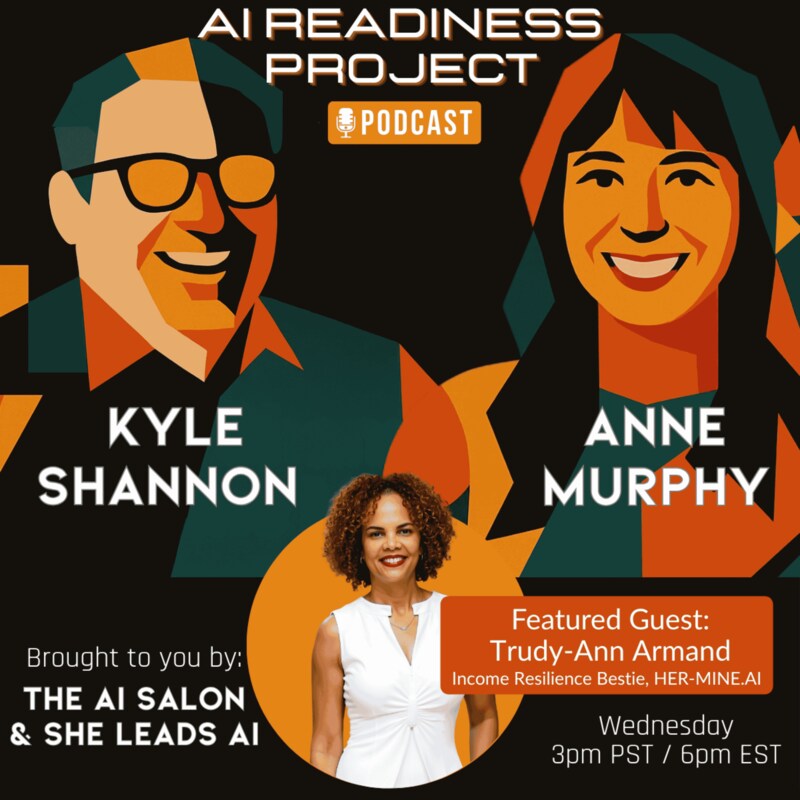
Layoffs, hiring freezes, reorgs — even women with “good jobs” are feeling how fragile a single paycheck can be. Trudy-Ann Armand is on a mission to make sure that when work shifts, women aren’t starting from zero.
In this episode of The AI Readiness Project, hosts Anne Murphy (She Leads AI) and Kyle Shannon (The AI Salon) talk with Trudy-Ann about why income resilience can’t wait, and how AI can become a quiet teammate in your corner — from the commute brainstorming session to your first “five to nine” offer.
Trudy shares the story behind HER-MINE, the aunt who inspired it, and what she’s learned working with hundreds of women founders and professionals who are tired, overextended, and still carrying a lot of financial risk. She walks us through her new Five to Nine Freedom cohort, where women admit (often for the first time) what they’re really capable of and start turning years of experience into paid, sustainable work.
We also get into the messy middle: imposter syndrome, AI that “sounds wrong,” chatbots giving bad answers, and why judgment and community still matter more than any model.
𝗞𝗲𝘆 𝗧𝗮𝗸𝗲𝗮𝘄𝗮𝘆𝘀
• Income resilience as Plan B, not a panic move
• Finding your hidden, billable skills with Trudy-Ann's GPT, Reva
• AI as a practice -- and a confidence builder
• Imposter syndrome reframed as "the monster"
• What AI is not good at -- and how to stay safe
• AI readiness: pick one tool and play
𝗢𝘂𝗿 𝗚𝘂𝗲𝘀𝘁
𝗧𝗿𝘂𝗱𝘆-𝗔𝗻𝗻 𝗔𝗿𝗺𝗮𝗻𝗱 is the “Income Resilience Bestie” behind HER-MINE.AI and the creator of the Five to Nine Freedom community. A longtime entrepreneur, corporate leader, and published author, she’s spent over a decade running an e-commerce company with her mother and mentoring women through programs like Goldman Sachs’ business initiatives. Now she helps women use AI to spot their hidden skills, build a real plan B, and create income resilience without burning out.
𝗟𝗶𝗸𝗲, 𝗦𝗵𝗮𝗿𝗲, 𝗦𝘂𝗯𝘀𝗰𝗿𝗶𝗯𝗲
Want to explore Trudy-Ann’s work ahead of time? Visit 𝗵𝘁𝘁𝗽𝘀://𝗵𝗲𝗿-𝗺𝗶𝗻𝗲.𝗮𝗶/𝗿𝗲𝘃𝗮 to learn more about her Income Resilience Bestie work and the Five to Nine Freedom community.
The AI Readiness Project airs every Wednesday at 3pm PST, where Anne and Kyle talk with guests who are putting people first while they figure out how AI fits into real lives and real work.
Transcripts
Kyle Shannon: And Murphy.
We, how are you? We have another bop. We have another bop. Do you like our bop? I like our bop. I
Anne Murphy: do like our bop because it, it's, it's a groovy bop.
Shannon: Yeah. It's, it's a [:Anne Murphy: modern, little modern, and our voiceover is, she seems a little bit more kind of like, she's got more gravitas, I think.
Yeah. I think the other, the other voice was more of like girl scout leader, like respectful and fun, but, and, and, and like, you know, resourceful, you know. Yeah. But this lady is like a docent or something.
Kyle Shannon: Yeah. I like it. One. We're in season one. So if you don't know previously, that was season zero. This is season one, yes.
And we, we've got some, we did some exciting changes we're gonna do and, uh, and, and exciting new guests. I'm super excited to get to get started today and bring Trudy up on stage conversation. How have you been
about a few things. I'm been [:I'm excited about Halima. Mohammad's new branding for the podcast.
Kyle Shannon: Yes. Isn't it beautiful?
Anne Murphy: It's bold. It's, um, it's, um, kind of worldly. It's different. It's different than all the other podcast thumbnails out there.
Kyle Shannon: Mm-hmm. So I thought you
Anne Murphy: did a beautiful job on that. And you and I have. Had some ideas, some, some little adjustments in the format of the show.
Yep. Um, we are, let's not forget, we are now on podcast players.
Kyle Shannon: I know. Which is exciting. It's very, it's very exciting. I don't mentally, I, I'm still just like, is this like you and I just sitting here talking and then, but I, I have to accept that, oh no, we're actually distributing this out to the world. Yes, yes.
e, so it's, we've been doing [:Anne Murphy: 31 episodes. Uh oh. We're we have a YouTube channel that the nice,
Kyle Shannon: oh, you just went muted again. Anne,
Anne Murphy: go ahead. You, you talk for a second. Let me, let me get my it in here.
Kyle Shannon: You're good. You're, you're back. Yeah, you're back. I dunno what
Anne Murphy: it is.
Kyle Shannon: I either something is going on, it's, you got some gr you got some gremlins in the, uh, in the studio.
Anne Murphy: It's like Chet GT five, just not sufficient. Yeah, it's crazy. Um, yeah, so we have the YouTube channel and that's exciting so people can still see us on camera even if we're not live.
Live that very day you'll Yep. Wait, you know, when we're live you can, you know what I mean? They can see the recording
They can listen to it. Yes. [:Anne Murphy: podcast. Yes.
Kyle Shannon: Yeah.
Anne Murphy: So that's exciting.
Kyle Shannon: That's good. Um, that's great. And then we also have Festivus coming up, which I'm super excited about.
We sure
do.
December 26th, December 27th. And. Last week. We put that together in two weeks and it was remarkable. And now we've got two months and it, and I am terrified that as too
me,
we have too much time. It's gonna,
Anne Murphy: I keep thinking of all, like, I've never seen a lily that I don't wanna guild. Right. And
um, and I keep telling myself, if it ain't broke, don't fix it. Because everybody loved what we did so much. I'm like, if it ain't broke, don't fix it. Yeah, yeah. But, you know,
Kyle Shannon: but that's how we are. We're
Anne Murphy: extra,
non: we're we're extra. More [:Well, so, um, so let's get started. So it, so it used to be this, this is one of the changes that we made and I'm quite excited about this. What, what, what we used to do in Season Zero is we would start the show out talking about how ready are we personally, uh, for, for AI this week. And we would talk about sort of where we were.
And, and one of the things, and I'm still happy to hear, like if you've got stuff going on you want to talk about, but what we wanted to layer in now is we have remarkable people in our communities and remarkable people that, that are, you know, putting. Being a human in front of ai, that, that, yes, you know who we are as people and what is our intention and what are our values and what are our ethics and leading with that and figuring out what we wanna do first, and then having AI support that.
e things in our communities. [:But, um. You met a lot of people in person and had some remarkable speakers, and so I feel like you should have lots of stories here to talk about. So, so in, in the context of, you know, how, how ready is the world for ai? What are some things, what are some stories? Who are some folks that you wanna talk about?
And I'll do the same. Um, that, that are, that are doing it right, doing it, you know, have, have the mindset, um, to, uh, that, that we both feel is, is the, is the the way to succeed moving forward.
efore that there will come a [:We will talk about. People and mm-hmm. Business ops and politics, you know what I mean? And it's all just gonna be like the redundancy, school of redundancy to talk to say ai, which begs the question about the names of our communities. But that's a branding project for another day.
Kyle Shannon: That's a good point.
It's good for now, right?
Yeah. It's, it's like, you know, if you ask someone today about, you know, what's their internet strategy? I'm like, well, the Internet's everywhere, right? There's internet strategy.
Strategy,
right. So yeah,
we're the,
Anne Murphy: we're the grand poops of MySpace. Um,
ing humans first and putting [:What we saw at the Create Conference was the very powerful, um, influence of relationships. Yeah, that was it. I mean, the women who came together in Salt Lake City, I'm convinced we could do anything. Not because, not necessarily because we're good at AI stuff, but because we understand priorities and what's [00:09:00] good for the good of the order, and we have the ability to influence positive change.
And we have goodwill among each other.
Kyle Shannon: Yeah. And I think, listen, I think, I think AI amplifies that intent and those values. Um, so, so I think that the role of AI here is as, as an amplifier, but AI is also a disruptor. And I'll tell you that, you know, I happen to, I was, I was at, uh, at TED ai, um, I ran into Vanessa there, um, and think, think with V on TikTok, um, who was there.
ians and technology and chip.[:Scalability and, and the, the message was some version of if we just have some better tech all we'll be right with the world.
Anne Murphy: Yes.
Kyle Shannon: And what, what the Create conference was, was tech was secondary or tertiary. Right. Like the tech was very much in the background from, Hey, we are human beings trying to figure this stuff out.
Um, and, and you know, the, the tech is an important piece of this, but it is secondary to the technology, right? Right. Yes. Um, this is about people and what we're doing and how we're impacted and how we use it and how we inspire one another and things like that. And so, um, I'm really glad I went to Ted, a, a AI as disappointed as I was.
ow is this impacting people? [:Um, I am incredibly grateful that these big tech companies have made these remarkable tools. Yes. And at the same time, these are things we're gonna have to confront. But, but for me, yeah, it just made it really clear that what we're up to is, is, is the right conversation from, from how I look at this stuff.
Anne Murphy: Yes. I totally agree. And I also like how in the spaces where you're, you're not under an umbrella of a big tech company or an organization like Ted, that's like kind of. A beast right at this point. So we're over here and you know, it was lovely, right? But it wasn't, you know, it wasn't what, you know, there wasn't a football field of an expo at our conference.
Kyle Shannon: Yes.
t. You know what I mean? Um, [:Kyle Shannon: the humble beginnings, right? Humble
Anne Murphy: beginnings. Um, I like, like that we can put on the table what oftentimes feels like worms that you cannot put back in the can. Right? There are some settings where if we bring up the oligarchy. We're gonna sound like man hating women, right?
Where we're subject to the tropes, and when we're together and we can have these conversations, it's very real. It's based on our lived experience. You can't argue with us about our lived experience, right? And we don't have to explain it to anybody. There's a, there's a shorthand. People who'd have that human, more human approach and were able to bring up the things that quite literally keep us up at night.
Yeah.
Kyle Shannon: What? That feels good.
d the event was there was a, [:And that's, that's really powerful. It's an, it's an incredible, you know, service that, that you did. Um,
Anne Murphy: yeah. Tell me. I'm very pleased. So what were,
Kyle Shannon: what were some of the, um, what were some of the stories that stood out from, for you, from the conference? Either from speakers or attendees? Like what were some of the things that were, this sense of.
People, you know, sort of creating a daily practice using ai. Mm-hmm. Um, you know, people putting, putting their humanity upfront. Like what were some of the stories that stood out from you? Um, from the events,
Anne Murphy: one of the [:None of whom were vibe coders. Right. Right. They signed up for a buildOn not knowing what are we even gonna build by then? Are they gonna be
Kyle Shannon: doing the coding for us? What's happening here? Right,
Anne Murphy: right, right. It was like, well, we're not coding vibe coding's cool. Still, maybe we're gonna vibe code. But they signed up sight unseen.
ai. So it pulled in all the [:Kyle Shannon: Yeah, yeah, yeah, yeah. You know, and
Anne Murphy: so she's like, and
Kyle Shannon: years, we'll, we'll know how to do this, but right now Yeah. 10
Anne Murphy: years from now after we've all, you know, missed, you know, underpriced and overpriced and gone through these negotiations, right? And so what she's able to do then with some pretty analytical people, right, is say, here's the math.
wanna say like K through six [:So she was working on this, on this application and ran out of credits with lovable, lovable somehow on the end, noticed all these new accounts had been set up in Salt Lake City. Mm-hmm. On the same day. And there was a lot of usage. So when they saw her run out, they were like, oh, I don't know how, I don't know what it looks like on their end, but, so they reached out to her and said, we see what you're building.
We don't want you to run out of credits ever again, and so therefore you won't. Here's a lifetime supply of credits and we might wanna sponsor your project.
Kyle Shannon: No?
Yes. That's amazing.
Anne Murphy: Yes. Shannon Seaverson.
Kyle Shannon: And what was, what was her project about again,
Anne Murphy: about Stu? About students? Oh, I think K through K
Kyle Shannon: through six. You said six
Anne Murphy: K through eight maybe? Yeah.
Kyle Shannon: Yeah. Amazing. [:And if you, if, if you look at the, if, if you're really generous with the numbers, about one and a half percent of people on the planet are engineers and coders and mathematicians and things like that, that means 98.5 at least percent of us are not that. Right. Exactly. And I think, I think it makes sense that lovable caught, I, I don't know how they monitor this stuff, but it's really cool that they are, yeah, I think you're probably right.
pps being built that are not [:Right. If you're doing heart led ideas that are then turning instantly into applications, it makes sense that what you were doing there was standing out to them. Um, and the fact that they said, Hey, we're gonna give you a lifetime supply of these. How awesome is that?
Anne Murphy: Yeah. I, I mean, that's the kind of affirmation that goes in really long way.
Um, along these same lines, I wanna just share one more vignette.
Kyle Shannon: Yeah.
when we did GPTs for Good. In:Yeah. And they are going at it with gusto. We had, uh, one woman working on a project for, uh, caregivers for parents with Alzheimer's disease, which by the way, you remember, we had, we had three or four of those at GPT for good. Um, we had two nurses solving for some of the acute challenges of being a nurse.
We had, um, a woman, uh, uh, one woman creating an app. For, uh, women to get through renovations of their home without killing their husbands. Essentially,
it's
Kyle Shannon: the husband version of that over in the AI salon. Know.
Anne Murphy: Exactly. Exactly. It's like, where is the nearest bunker?
Kyle Shannon: [:Anne Murphy: so everyone solving for a pain point and most of them very, very heartfelt and, and coming up against, you know, plenty of challenges that just seem easier to overcome when there's a why.
Kyle Shannon: A real one. Yeah,
Anne Murphy: yeah,
Kyle Shannon: yeah. And it's, you, you know where I go, where, where, where I like some of the insights that I've had, like even since we've started the AI readiness project is that
lves. Right. If there's, if, [:Like, who am I? What do I stand for? What do I want? What difference do I wanna make in the world? Right? If they had a job where they just had to show up and they did what they were told they were contributing to something, now all of a sudden they have to figure out, well, like, you know, how do I make money with chat GBT?
Or how do I make money with ai? Or how do, just, how do I make money in general? And now there's all these tools that can help them do that. But then the question comes back to what are you gonna do? What do you wanna do? What's important to you? And the one thing that I know I've started way too many. I mean, at this point I'm completely unhirable, right?
I've started lots company, lots, lots of companies in my, I cannot
Anne Murphy: imagine you as an employee. No way.
Kyle Shannon: Not a good one.
Anne Murphy: Oh my God. That would be a sitcom
Kyle Shannon: for sure. [:The initial adrenaline is super exciting, but then invariably you hit a wall or two or 10 or a wall a day, and how you survive those challenges is your heart has to be in it. So if you just start something to make money or you just say, oh, I wanna vibe, code something, and then you say, oh, that's cool. Let me go try to make money with that.
The minute you hit a wall, if your heart's not in it, it's just gonna sort of fade away and fall and fall apart. And so agree. How people are going to succeed is they need to actually get in touch with who they are. What are their value? Who are the people they care about? What's a problem they wanna solve?
, like deep in my soul, that [:And the, the tools, the AI tools will support them and amplify those ideas, but it's up to them to hold the fidelity of that vision. And so you have to have the vision in the first place. And that's the thing I'm, I'm most excited about. Um, for, for things like the Create Conference, because it really did establish, um, that as, as the, like, what do you want?
Who are you? Right? Yes. How are we connected? What difference do you wanna make? Let's get inspired by one another. Yes. Yep. Let's do that first. Yeah. And then we'll figure out next second. You wanna put that in a, in an app, come to divide coding thing. You want to do that with policy? Come to Daisy Thomas'.
Policy conversation. Right. There's all different
Anne Murphy: Exactly.
Kyle Shannon: Those ideas.
ause I definitely think that [:Kyle Shannon: it drags
Anne Murphy: too fucking hard.
But if you are passionate about something and you have a community mm, you can weather the storm. Yeah. I cannot imagine being a founder. By myself. I know it's the one person solopreneur million dollar unicorn. Well, I don't give a shit. I don't wanna, I don't wanna do all this by myself. I wanna have people around me to do this with and who I can borrow confidence from when things get impossible.
Right. Yeah. And who can do things that I don't know how to do and who we get to teach each other stuff and who just like, we can goof off and be fun and funny and, yeah.
Kyle Shannon: Yeah.
Anne Murphy: I just see [:I know I'm not alone here in what I see as it being more and more important as every day with AI goes by.
Kyle Shannon: I think it's more and more important. I think authenticity and human connection is more and more important. I think, you know, because we're in the early stages of this technological, this is, this is a shift a akin to the industrial revolution, right?
Like this is as big as the steam engine, right? You know, AI does for the brain what the steam engine did for our muscles, and this is, um, I, we can't possibly know how to use AI because it is transforming under our feet. Like you're, you're literally trying to build a building on top of shifting sands. And so being in community.
around people with different [:Right. So I think being alone at this point is just, I, I don't think you can, the tools are gonna let you do lots and lots of stuff, but I think those different points of view are critical for, for people to understand what's even possible. Right.
Anne Murphy: Absolutely. I heard that, um, from people who went to Tech Week in San Francisco of like, yeah, it's a really cool technology, but like.
What about like, what are you gonna do with like, how does that intermingle with human beings?
Kyle Shannon: Yeah, yeah. What happens
ed me to think about how you [:Yeah. We're doing a good job of being exactly the opposite of that.
Kyle Shannon: Yeah. And listen, I mean, they've gotta, they've gotta build the infrastructure for us to be able to use it, but in the end it's about how we, how we use the tech that's gonna be the most dramatic impact on people. So, um, why don't you tell the good folks about, she leads ai and then I'll do the same about, uh, AI Salon and then we'll bring up Trudy.
eally launched our, like our [:So that's 10 months ago. 11? No, 10 months ago.
Kyle Shannon: 10
Anne Murphy: months ago. Incredible. It's crazy. No wonder why I'm so exhausted.
Um, you know, so since then, yeah, we built up our community, which is lovely, and which is where we swap knowledge, really just like very transparency and very generously just like in the salon and. We also built out the AI Academy and put in place an executive director in Michelle Muncie Silva. Having the AI Academy has allowed us to launch our AI certified, our, um, sorry.
, an alum of the program. We [:Well now we've got 20 women in Nepal who want us to teach them. We've got two community colleges who want us to teach them like it's happening. You know, that's a, so those are the, those are the kind of things we do. We come together every Saturday from noon, from uh, 10 to noon, uh, Pacific time on Zoom, and it's just, right now we've created a body of work that if I look back on it, it's pretty cool.
And I can't wait to see what:Kyle Shannon: Beautiful. Beautiful. I love it. Um, so the AI Salon, um, we're coming up on our third year anniversary.
So we started the AI salon the week that chat. GPT came out.
Geez.
Um, yeah. Crazy. Um, we have not had an international conference yet, so you being 10 months old and having had one, and then us being three year olds old and not having had one, I'm not saying I'm competitive, but I think it's not
Anne Murphy: a competition, but if it was a competition, we're winning.
, launching right now, Anne, [:Tools to allow you on a daily basis to, to play with AI and learn and, and apply AI to problems that you're trying to solve. And then generously lead, you know, how are you sharing what you're learning with the community and how are you learning from the community and, and those sort of things. Doing that as a daily practice rather than just sort of the chaos and madness of trying to keep up with ai.
And I'm, I'm particularly the more I talk about this and the more I get feedback on it, the more powerful it becomes. So we're just launching that next week actually. I can't
wait. If you join,
[:We do that and what it means and super excited about that. So yeah, check out the salon.ai and, and, uh, please come join us. And then the final thing that we should, uh, we should talk about here is the AI Readiness Training Program. So we have Festivus coming up. The AI Readiness Training program was actually.
Gleaned from, pulled from, uh, the lessons that were learned during Festivus last year. And so if you want to shift your mindset, that's what this training program's all about. It's incredibly comprehensive. It's evergreen. It's got nothing to do with tools, it's got to do with how you succeed using AI and the kinds of ways we've been talking about.
So,
Anne Murphy: yep.
Kyle Shannon: Very excited about that.
t that you get a certificate [:I exist, I'm not. Right. I'm, I'm nice, I'm cool. I, I know people and, um, and I learn from others. And I am, I, you know, I have a curiosity, a curious mind. And so that part of it is really valuable too. Yep. Especially for anyone who is struggling with imposter syndrome, which seems to be just about everybody.
up here and let's start the [:Anne Murphy: Trudy is a. Multi-passionate and high achieving leaderly woman who is a pillar of the She leads AI community and it's been a joy to see how fast she's, um, kind of, she's like, shout out of a cannon with her new mission to, well, I, I won't steal her thunder.
She'll tell you about her new mission. Great. Um, that doesn't take away from her leadership in corporate America and doesn't take away from her her roles in e-commerce. She is just a powerhouse who can do many things. And what she's doing right now, we were talking about the importance of passion. I mean, she is surrounded by all of us just cheering her on because what she's doing is absolutely necessary.
And [:Kyle Shannon: Trudy, welcome, welcome, welcome.
Trudy-Ann Armand: Hi everyone. I'm so, I, you know, I'm nodding and, and laughing along, uh, backstage because you know, all the things you're sharing are, are so very important and really impactful and yeah, absolutely.
The idea that as, um, as business owners or even if you're, you know, endeavoring to do something, that passion is what'll get you through the hard days. And as you know, I've been a business owner, um, for over 10 years, and I think I've always been kind of had that entrepreneurial spirit, but. That's what gets you through the hard days.
mething, your why as to, you [:Kyle Shannon: Yes. Beautiful. Well, sorry, go ahead Anne.
Anne Murphy: No, I was, I was just taking it in.
Kyle Shannon: Oh, good. Beautiful. So why don't you, um, give us a good introduction of, you know, give us your background and, and you know, how you got into ai, why this is important, how you, you know, your philosophy of it. Like, you know, catch us up on your story and what, what you want folks to know about, about where you are in the journey.
Trudy-Ann Armand: Oh. So as far as a little bit about me, um, as I mentioned, I've been an entrepreneur for over 10 years. My mom and I started an e-commerce business, um, selling on Amazon. So we're a, I think now we're like Amazon OGs, right? Um, and, uh, people would ask us, you know, what do you sell? You know, you're on Amazon, what do you sell?
e, an, the Amazon landscape. [:She was an entrepreneur herself. Um, at one time she was the only black female architect in the state of Florida. Um, there was a law passed out because of her, um, where you can plant fruits and vegetables on your own property. Believe it or not, that was a thing. Wow. That story went around the globe. Um, there were people in New Zealand offering her land to come plant there.
r story as well as keep that [:And so. That is why our, um, gifting company was named Hermine, um, after her. And then, um, as I was working in that space, and I've done a number of different business accelerators over the years. I did Amazon's ex business Accel, one of their business accelerators. I've done Goldman Sachs, um, 10,000 small businesses, and now I'm a mentor for Goldman Sachs 1 million Black Women.
And so what I've discovered in working with women, including the women we worked with through her mind, um, we had women, all our boxes were filled with products from women owned businesses. So I had the pleasure of working with over a hundred women owned businesses. Um, and so what I saw as a common theme was the fact that a lot of times we're trying to do everything ourselves.
Or we [:And so I started really leaning into, into AI and seeing the force multiplier that it is. And so I started talking to some of the mentees that I've had about integrating AI into what they do. And so that's kind of was the genesis of, you know, marrying AI with, with supporting women with that mission and, and so on.
ered their why after they've [:Like, what are the, what are the shifts that you're seeing? Like how is it amplifying those businesses for those women?
Trudy-Ann Armand: So, so I think the, the idea that we can do things that, and we can create, um, agents for areas that we're not necessarily strong in, or that it's not our favorite thing to do. Um, that's one of the things.
ale and leverage their other [:'cause she was actually starting to at least pull away a little bit from AI, using it as much as she could because she was afraid it was sounding like AI and it wouldn't be, um, their voice. And so we were, you know, having that conversation. So I think on helping and seeing where women are, understanding how they can use it as a tool in their business to either do what they do better or you do what they may not be as great in and help them to, to build out that skill or leverage agents to help them do that better.
Kyle Shannon: Beautiful.
Anne Murphy: Go for it, Kyle.
p you've got? Because I feel [:Right. And so you talk about this idea of AI filling the gaps. Like what's, what have been some of those for you? Where it, it just feels like the game is, is different, better, you know, you feel like, oh, thank goodness, you know.
Trudy-Ann Armand: So content creation is one of those things, right? It is never been my strong suit.
Um, I am an introvert by nature, and I think people find that to be very surprising because I, I, I don't have an issue with public speaking, and I think the, the misconception is that, you know, you, you don't, you, you can't, you know, publicly speak if you're an introvert, right? It's really, you know, um, you know, how you get your energy and all of that.
number of different things. [:Um, I don't know. Uh, it, it, it lands better, I guess for, and also at scale, right? The ability to do that consistently. If you get writer's block, which is something I get from time to time, it gives you that ability to, to, to continue to, um, produce and get that, you know, and that's, that's what I'm using it for.
go in twice a week, but, um. [:Um, use it in that way. And, and that's, I think one of the most powerful things that I've been using it for is, is, is that as a strategic partner to kind of talk through things.
Kyle Shannon: Beautiful.
Anne Murphy: Kyle, I love how this particular use case is the AI as a practice, while it's also something else as a practice, like mm-hmm.
rithm has, you know, shined, [:And so I get to see Trudy a couple times a day, even when I don't see her on a, on a Zoom screen. Um, but that ability for AI to take out some of the, kind of takes out some of the like sharp corners of
Kyle Shannon: friction, right? The Yeah. Friction. The friction, yeah.
Anne Murphy: Yeah. It creates a little bit of a separation between you and the scary thing, I think, at least for me, it's like, well, this is what I'm supposed to say.
Right. I'm supposed to say a hook because I told my custom GPT that I have to have a hook. 'cause that's the way you're supposed to do it. It's not my idea. They told
Kyle Shannon: me I have to have a hook.
Anne Murphy: They, my custom gt that I,
ersonal and sometimes that's [:Kyle Shannon: Yeah,
Trudy-Ann Armand: that's for sure. Yeah. But, and this is, I'm sorry, KA
Kyle Shannon: No, no, please go ahead.
Trudy-Ann Armand: No, I was just gonna agree with Anne that Yes, absolutely put it, it allows me to put that structure, those reminders and keep that consistency, um, even with my message, because sometimes we tend to wanna go kind of all over the place and it keeps us kind of in on track.
Kyle Shannon: Yeah.
Mm-hmm. Yeah, absolutely. Do you find it, it gives you the, it the fact that it's good at those things that you might not have, have instinctively been good at. Do you find yourself, does it, does it give you a little confidence that wasn't there before? Like what's the, what's the, what's the impact on you, like, as you, as you, you know, leverage these tools?
calling it a monster now. I [:When you least expect it. Um, having that, it's almost like having a a, an expert in your pocket, right? That keeps reminding you, I'm here, I'm gonna keep showing up, I'm gonna keep giving you this information that's based on best practice. That's based on, you know, the, the, the things that supposedly work, like Anne said, like you're supposed to put a hook in there and things like that.
So you feel like you have that support, the expert that's helping you to be consistent, um, to produce things that, that, um, have been said to work and you continue to have that, that support with you at, at any time. Right? The same thing when I talked about strategizing. You know, at six o'clock in the morning I have my strategist that I can just say, Hey, you know, let's talk.
that. And so I've done that [:So when I show up, I'm ready.
Anne Murphy: Yeah.
Trudy-Ann Armand: That's great.
Anne Murphy: Yeah. I love how that same, um, approach to using AI can help us with conveying our ideas in environments where we otherwise might be afraid to. Right. But if you have vetted what you think is a dumb idea. Thoroughly before you're going to go, like, pitch your boss on something.
ould be liberating voices in [:That's what I'm, that's what I'm hoping for. Um, but I wanted to ask you about some of the women you work with who are in the middle of a pivot or adding that second, or maybe even third income stream, how you're seeing AI and give them the confidence that they need because of all the, like the trials and tribulations that we were alluding to before.
How is this helping them in that way?
Trudy-Ann Armand: Absolutely. And you know, this is one of the things I was mentioning a moment ago is, you know, the, the opportunity I had to talk about, um, the imposter syndrome. So I've just launched, uh, my first cohort for my five to nine freedom, uh, community. And during that conversation there, that idea of imposter syndrome came up.
ea that although we know how [:Kyle Shannon: Hmm.
Trudy-Ann Armand: And so we talked through that a bit because yes, it is absolutely real that. You may, even though, and, and we talk, the the other thing we talk about is many of the women have years of experience. Yeah. They're doing these, they're doing their jobs potentially with their eyes closed. Yeah. And so they have all this experience that they could run circles around people, but they in themselves are like, well, but is it really valuable?
rhouses in what they do. You [:Right. So, um, I built a GPT called Riva. Reva for revenue, and it has to identify those hidden skills based on your LinkedIn profile, based on your, your resume, based on the other things you're doing that you don't put on your LinkedIn profile because you, many of us know that, right? We don't put certain things on there to put all of that together and have it identify those hidden skills for you.
Also identify which one of these things are monetizable, and then what are some things that you can do to start, here's a starting activity that you can do so, you know, to, to use AI in that way. And then the next thing that we're, we're doing, um, next week in our next session is we're gonna identify the ICPs, right?
e identified the what, let's [:That's also it. And so I'm not telling anybody what, what their, um, their side thing or their, you know, their five to nine thing should be. They're coming up with this on their own. It's based on their skills. But now we're gonna talk about who do you serve or who would you like to see?
Kyle Shannon: I love that. I wanna, in, in the spirit of, you know, not wanting the show just to sound like an AI cheerleading, uh, session.
omise of it is amazing as we [:So how do, how do you deal with that and what, what's been your experience with that?
Trudy-Ann Armand: So I think one of the things that, and this is, you know, also, um, with the mentoring where, you know, I have kind of two schools of folks, some that want to figure out how to do AI more, faster, better, et cetera, and others that are adverse to using it at all.
Mm-hmm. And so one of the things to talk through is what is it good at? What are the things that it, it can do well in terms of, you know, those task-based things that you can identify, that you can have it, it do for you versus. Having these expectations that it, it, you know, the, the, the big issue nowadays is replacing people.
Kyle Shannon: Mm-hmm. Um, it,
Trudy-Ann Armand: it doesn't replace people. It does certain tasks and it can do them well, and it can do them at scale, but judgment is, is one of those things, right. Huge,
Kyle Shannon: huge.
Trudy-Ann Armand: [:And also it, you know, we talk about hallucination, it makes things up. So, um, you know, making sure that we have that kind of discerning ear. What is it giving me? Is it just feeding me what it wants me to hear? And I will tell mine, um, stop telling me what you think I want to hear. I need you to be more critical and give me, you know, blow holes in, in whatever it is that I'm talking to you about.
in the task that you should [:Um, at least that, that's the way that I kind of position it for folks that I work with.
Kyle Shannon: Yeah. Love that.
Anne Murphy: Do you find that the women are coming to the table with that same understanding or is it new information that it's not a easy, it's not an easy button and also. It's okay. 'cause we can work through the problems.
Like where, where are they coming in on that continuum?
Trudy-Ann Armand: Yeah, I think the, and I think the example that I gave of, um, thinking that it's not, um. It's not sounding like them, right? They, it's, so I think the idea that the, what they were sold or what they've heard or whatever is, you know, oh, I can use AI to create content.
, a session for, um, Empress [:One person in particular was having an issue with our chatbot that was giving wrong information to their clients and they were afraid that it was gonna be a problem and they're gonna lose customers and it's not as human as they want it to be and, and things like that. And I was explaining that. You know, there are certain constraints you need to put in place to make it not hallucinate, right?
Because having it hallucinate and they're in the healthcare industry, like having it hallucinate with your clients is a problem. And so making sure there are constraints in place, making sure that you're testing it, making sure that you're giving it, you know, information that it's using and nothing outside of that and, and things like that, so that you, but, but I think whoever was selling them this technology gave, let them believe that.
t picking up phone calls and [:But explaining that, yeah, that's great. And if you are not familiar, someone could sell you that bag of goods. Mm-hmm. But these are some of the things that you need to do. Yes. Can it do this? Yes. However, there's a lot more work involved. You know, you need to take the time to make sure you're, you're, uh, prompt prompting it correctly, et cetera.
So, yes, and I think we are, people are coming in at different stages with really high expectations of what it can do based on what they've heard and what they're, the, the, you know, the. Others out there are selling and then others that are coming in thinking that it couldn't possibly help me because, you know, my thing is so specialized or I'm yes.
could ever. So really have, [:Kyle Shannon: that That's great. So that, that sets us up perfectly. So, so one of the things we do here is we ask, um, all of our guests the same question. And, and so we're gonna ask you that question now, and I think in a lot of ways you, you've answered pieces of this, but the, the question is this, what does AI readiness mean to you?
And, and then what would you say to someone, you know, just getting started with this?
Trudy-Ann Armand: So, I think AI readiness to me means the, the very first step is being aware of the technology and what it can do to help you. Um, and then making sure that you, you, you focus on primarily one. Tool one LLM. And this was, again, something that came up this past week was, I ha I wanna get all these different tools and all these, the things that like, no, let's go deep, deeper, ongoing.
at you want it to look like, [:We want this to be enjoyable, play, see what the outcomes are. You know, you, your use case is different than, you know, someone else's. So play with it, see what you get out of it. And um, and that's kind of the, the basis of, of, you know, AI readiness in, in my, um, perspective. And so the same answer for the person who's brand new is pick a tool.
Open AI is a good one, right? Chachi PT is a good one. That's, you know, um, if you wanna play with that one and, and get, start becoming familiar. And then from there, decide you know where you want to go.
Kyle Shannon: Beautiful. Love it. Amazing.
Anne Murphy: Trudy makes everything plain. It's just clear, crisp. It's very, it's, it's such a breath of fresh air to work with you, Trudy, because you, you just make things easy.
You really do. [:Kyle Shannon: yeah. No, it, it, it's very powerful and uh, you know, I think, I think a lot of people be because AI historically has required you to be very technical, to be good at it, and now it doesn't require you to be as technical. Um, I think there's an intimidation factor.
So I think, I think the simplicity for how, with how you approach it is, is actually really important. I think, you know, giving people permission to, to understand that they might be able to do this too, is actually a bigger deal than, than it might seem on the surface. So, yeah. Ku, kudos to you for how you're approaching.
So thank you. Really fun to have.
Oh yeah. Really fun to have you. What do you want people to know about, I mean, obviously go visit your site, but do you have anything going on you want 'em to know about? Do you have any, you know, uh, anything coming up that, that they should be aware of?
t, it launched at the Create [:Um, this idea of, um, income resilience being such an important, um, uh, important topic right now and the need is even greater. We, we hear about layoffs every day it seems right now. And so I am the income resilience bestie. Um, and so I'm really, I, I'm really talking to women specifically, no shade for men, but women specifically about the importance of having a plan B.
And, um, I started my school community, uh, which is a five to nine freedom, um, community where we can help work through the steps to, to build that plan B, that, you know, thing that you have in the event that something goes wrong with your nine to five. So. I'd love for people to join me there. And, um, we, it's a supportive community and I have a framework to kind of help you start with your hidden skills and then how do you build that into something that can, uh, generate revenue for you.
So [:Kyle Shannon: that's what I'm working on. Beautiful. So
Anne Murphy: I think our first guest certainly hits the mark with human centered ai. What do you think, Kyle?
Kyle Shannon: Right down, right down the middle. It's all about PE right down
Anne Murphy: the middle. Nicely done.
Kyle Shannon: Absolutely beautiful. So, so nice to meet you. So nice to speak with you and congrats on what you're up.
Trudy-Ann Armand: You as well. Thank you so much for having me. Thanks Trudy.
Kyle Shannon: Cheers.
Trudy-Ann Armand: All right, everybody.


