Transcripts
Welcome to Live With The Pricing Lady.
Speaker:I'm Janene, your hostess.
Speaker:This show is all about helping you build a sustainably profitable
Speaker:business while making an unbelievable impact on your world.
Speaker:Learn from my 20 years of experience and from my guests as we discuss their pricing
Speaker:challenges, failures, and successes.
Speaker:Pricing is a way of being or behaving in your business.
Speaker:My mission is to help you confidently charge for the value you deliver.
Speaker:Pricing is either hurting or helping your business.
Speaker:Let's make sure it's helping you reach your dreams.
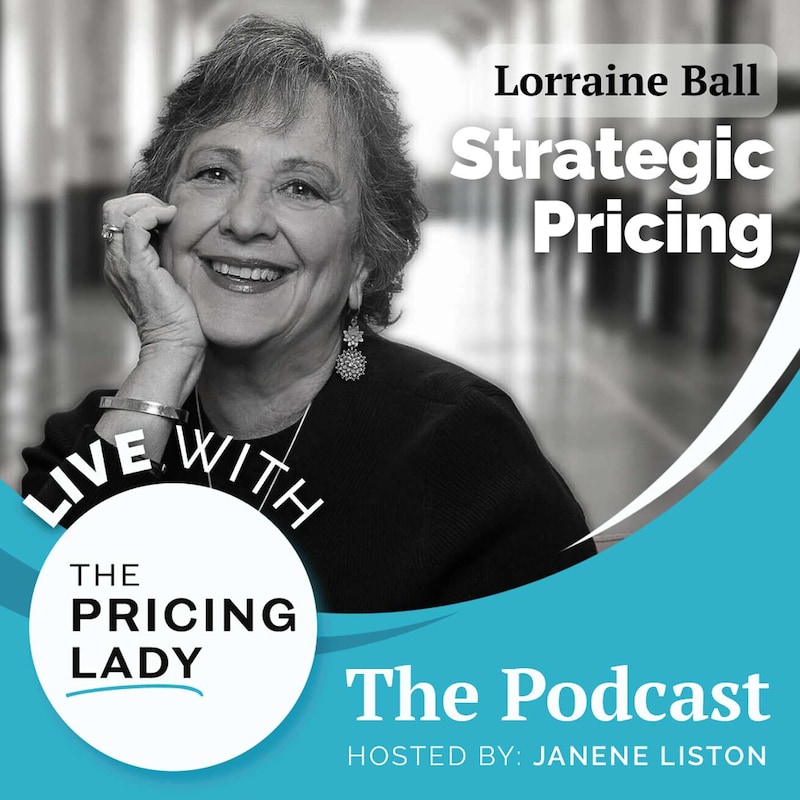
Speaker:Welcome and welcome to today's guest Lorraine Ball.
Speaker:Hi Lorraine.
Speaker:Hey, good morning.
Speaker:How are ya?
Speaker:I'm great.
Speaker:I'm super happy to be here with you today.
Speaker:Me too.
Speaker:I've been looking forward to this.
Speaker:So why don't
Speaker:we start with
Speaker:where you're calling in from this morning?
Speaker:Well, and you'll notice I'm saying this morning I'm in Indianapolis.
Speaker:And for those of you that are not familiar with the U. S. I'm about
Speaker:three hours south of Chicago.
Speaker:South of Chicago.
Speaker:I haven't been to Indianapolis.
Speaker:I almost moved to South Bend, Indiana once.
Speaker:Oh, wow.
Speaker:Okay.
Speaker:So isn't far?
Speaker:About a two hour drive north.
Speaker:South Bend is, is up near the lake kind of almost in Michigan.
Speaker:Indianapolis is literally dead center.
Speaker:Most of the world, your city capitals and your state capitals are built because
Speaker:there was a river and people came and settled or there were mountains and
Speaker:they didn't want to cross the mountains.
Speaker:Indianapolis.
Speaker:exists for none of those reasons.
Speaker:the territory became a state and they're like, okay, we have
Speaker:to have a state capital and we don't want to piss off anybody.
Speaker:So we are going to build a city dead center.
Speaker:We are dead center, north, south.
Speaker:We are dead center, east, west, but there's nothing here.
Speaker:Except for Indianapolis.
Speaker:So they, they laid out the city.
Speaker:They, it's, it's a very organized, plated city.
Speaker:Right.
Speaker:But, you know, You're like, Oh, well, we could go to the mountain.
Speaker:There's no mountains.
Speaker:There's a little river.
Speaker:There's, there's none of the natural things that make a
Speaker:city naturally interesting.
Speaker:So it's, it's kind of strange.
Speaker:Well, actually that's interesting in and of itself.
Speaker:I need to say, I did not grow up here.
Speaker:So I asked that question a lot.
Speaker:Why the heck is this city even
Speaker:here?
Speaker:Interesting.
Speaker:So Lorraine, what would you describe as your superpower?
Speaker:I think I have two that have served me really well in my career.
Speaker:And the first is, my original training was as an elementary education instructor.
Speaker:And so I have the ability to break down very technical,
Speaker:Concepts into Manageable Bytes.
Speaker:That has served me well when I have done marketing for Engineering firms and it
Speaker:of serves me well when I am trying to break down big topics for clients so
Speaker:we can manage them one step at a time.
Speaker:So I think that's definitely one and and the other is strategy just my ability
Speaker:to Look at a situation, step back, see a big picture and say, okay, we are here.
Speaker:There's all this here and this is where we want to be.
Speaker:How do we get there?
Speaker:How
Speaker:do we get there?
Speaker:Excellent.
Speaker:I love both of those.
Speaker:What's one interesting thing that you'd like to share with us that
Speaker:most people don't know about you?
Speaker:Think that I am, I'm a marketer, I'm a little bit of an artist, and I think
Speaker:it surprises people when they found out I was going to be a math major.
Speaker:That I really am a numbers geek.
Speaker:Now the people that know me best know the truth.
Speaker:The rest of the world just assumes that numbers would not be my thing.
Speaker:Interesting.
Speaker:Interesting.
Speaker:It's funny how we can make an assessment of someone without really knowing them,
Speaker:you know, in that context as well.
Speaker:Right?
Speaker:Absolutely.
Speaker:Absolutely.
Speaker:So Lorraine, why don't you tell us a bit about how you started in your business
Speaker:and what that was like when you, when you got there, when you started it?
Speaker:So I came out of corporate and I had a good run in corporate and I
Speaker:had two assignments in corporate that actually served me very
Speaker:well when I went out on my own.
Speaker:The first was I was running our dealer development programs.
Speaker:And so my job was to develop training and services for the small business
Speaker:owners who were selling our product.
Speaker:And so I had an opportunity over an eight year period to work hand in
Speaker:hand with Small business owners and put together classes and see how the
Speaker:theory applied in the real world.
Speaker:The second was I worked I ran a creative services team.
Speaker:And so I was running an agency inside a large corporation.
Speaker:And again, the systems and processes that we used to run that agency, when
Speaker:I started my business, it was just me.
Speaker:I mean, it was, it was just me and I still decided to implement
Speaker:the project management system that we had used in my corporate days,
Speaker:which at the time was ridiculous.
Speaker:It was way overkill, but we grew into it.
Speaker:So as I started as a consultant, And I had two products that
Speaker:I really was interested in.
Speaker:One was the really what I wanted to do was team building and creative
Speaker:thinking and working with managers.
Speaker:But I had always been a marketer.
Speaker:And so people kept saying, Lorraine, I know you used to do marketing.
Speaker:Can you help me with this?
Speaker:And one day I woke up and I went, you know what?
Speaker:I have a marketing company.
Speaker:And I as much as I really enjoyed the creativity and the other
Speaker:thing, I wasn't pricing it right.
Speaker:I wasn't selling it right.
Speaker:I, but the marketing services.
Speaker:They will line it up.
Speaker:Okay.
Speaker:Yeah.
Speaker:I think I know what my business is.
Speaker:I love how sometimes what you, you go in one direction and then
Speaker:all of a sudden you're like, wait, no, that's not what I intended.
Speaker:I'm happy to go over here, but that's not where I thought I was headed.
Speaker:, . Yeah, I think, I think it is.
Speaker:Well, and I think actually the businesses that succeed often, if you talk about,
Speaker:and this is not just small companies, look at the origin story of YouTube.
Speaker:You know what YouTube was?
Speaker:It was a dating platform.
Speaker:What's that was the original concept was you were going to shoot these
Speaker:videos and put them up there and different people would see them way
Speaker:before a lot of the other dating and yeah Oh, there was something else.
Speaker:I don't remember.
Speaker:I used to have a whole bunch of these.
Speaker:It just rapid fire because I would teach classes on on
Speaker:innovation on business management.
Speaker:And the reality is that very often business owners start businesses because.
Speaker:It's something they want to do.
Speaker:Right.
Speaker:Without figuring out if there's a market
Speaker:for it.
Speaker:Ding, ding, ding.
Speaker:All right.
Speaker:Why don't we come back to that?
Speaker:Cause I'm sure we will in this conversation.
Speaker:My next question is the first time that you had to sit down in your own business
Speaker:and set a price for what you were offering, what was that like for you?
Speaker:You know, it's kind of interesting because in the beginning, coming out of corporate.
Speaker:I knew what we were paying our consultants.
Speaker:And so when I was quoting the creative thinking presentations and the trade,
Speaker:the big stuff, that was actually easy.
Speaker:Cause I used the model that I had been paying when I was on the other side.
Speaker:, and I did that with confidence because I knew that's what they were paying.
Speaker:But when I was pricing for marketing services that I had not bought,
Speaker:I kind of would put a price out there and cross my fingers.
Speaker:And I will tell you most of the time it was too low.
Speaker:But I did, I didn't know at the time.
Speaker:How did it feel to you when you recognize that it was too low?
Speaker:So I had a couple of different moments in my career where I
Speaker:realized I was, I was too low.
Speaker:And it was funny because in my corporate days, I used to to teach
Speaker:pricing theory to other people.
Speaker:But when you have enough business, when you have enough leads, it's
Speaker:more comfortable when you haven't.
Speaker:So a couple of things.
Speaker:One, I had a mastermind group.
Speaker:And we were talking about different things and comparing pricing and
Speaker:we were in different industries.
Speaker:And I had three members of the group that are like, your price is too low.
Speaker:You need to raise it.
Speaker:I'm like, yeah,
Speaker:I don't think so.
Speaker:And the next month I come back and I'm going, yeah, I really would
Speaker:like to hire this person, but God, she wants this much money.
Speaker:And I really can't pay that.
Speaker:You could pay that if you would raise your price.
Speaker:And about the third month, they sat me down.
Speaker:They said, we're not talking about anything else.
Speaker:You need to, okay, I'm going to raise my price.
Speaker:Did you have that connection between, between your price and
Speaker:what you were paying for these other people to come on board?
Speaker:Or was that just something you didn't really pay attention to?
Speaker:In the beginning
Speaker:well, in the very beginning, it was just me.
Speaker:So I didn't, I really didn't have that connection.
Speaker:As I started to hire people I had in my head what the company hourly rate was.
Speaker:Okay.
Speaker:So I knew what it cost us, or I knew what we were selling at But I still
Speaker:really wasn't thinking it was more than I was paying in salary, but then
Speaker:there's, there's all the other expenses and we were making, you know, I was
Speaker:making payroll, I was making the bills, but I wasn't taking enough out for me.
Speaker:And that's really where a lot of business owners get trapped is they're
Speaker:paying their people, the organization's running, the customers are happy.
Speaker:But they're not happy at the end of the week when they're going home.
Speaker:And that's kind of where I was.
Speaker:Yeah.
Speaker:I think the second epiphany for me was really, I bid a project
Speaker:that we were ideally suited for.
Speaker:It was a web design, I knew that this was right in our wheelhouse.
Speaker:It was the right size project.
Speaker:And I put a good price around it.
Speaker:I even put in a little extra and I felt like this, this was gonna
Speaker:be that, that right project.
Speaker:We didn't get it.
Speaker:And I had, I called the guy and I said, look, I, you know, I appreciate.
Speaker:that you know, you made another choice and I respect that.
Speaker:Would you tell me why?
Speaker:And he says, well, honestly, I was concerned you couldn't do the work.
Speaker:And I was like, what do you mean?
Speaker:I have, I have these great designers.
Speaker:He's like, yeah, you know, and he told me what he paid.
Speaker:And what I realized in that moment was that my price was sending a signal
Speaker:about the value, the quality of my work.
Speaker:Yeah.
Speaker:And.
Speaker:I thought that ain't going to happen again.
Speaker:So what did you do about it?
Speaker:We raised our prices.
Speaker:And the rule always was we were comfortable kicking off
Speaker:because we were a small agency.
Speaker:So if we were kicking off four websites a month, and it took
Speaker:several months to finish, so we always had this rolling thing.
Speaker:If we were kicking off four websites a month, we were good.
Speaker:If we were kicking off five websites a month, we were working hard.
Speaker:And if we were kicking off six websites a month, it was all hands on deck.
Speaker:And it was, it was too much.
Speaker:So if I sold my four websites for a given month, my price went up.
Speaker:And so the next person I talked to, the price was higher.
Speaker:And if they were still interested, I was okay because I knew I could
Speaker:pay one of my part timers a few extra dollars to help fill the gap.
Speaker:Right,
Speaker:right.
Speaker:But the funny thing was that every time I raised my price and I'd start
Speaker:the next month, I never went back.
Speaker:So for me, capacity cause we talked about at one point hiring
Speaker:extra people and very wise.
Speaker:I still, I still laugh because Alison was 25, two years out of
Speaker:college, one year out of college.
Speaker:And I'm like, well, I, you know, we're busy.
Speaker:I think we should hire another person.
Speaker:And she's like, why?
Speaker:And I'm like, cause we're busy.
Speaker:And she's like, yeah, but we're only busy to hear.
Speaker:And if you bring her in, we're going to have to sell to here.
Speaker:Why don't you just raise our prices?
Speaker:We won't have as many customers, but we can do the, and I went, Oh,
Speaker:ding, ding, ding, ding, ding, ding.
Speaker:I actually, the building we were in, I actually renovated it.
Speaker:We were looking at new space and I renovated it and
Speaker:capped with that investment.
Speaker:I knew we were never going to move to a bigger building.
Speaker:Right.
Speaker:We were never going to move to a bigger building.
Speaker:I know this sounds strange now, four years past COVID, but back then
Speaker:everybody came into the office every day.
Speaker:You know, and we had space for everybody and, and it was a different environment.
Speaker:And so I knew I wasn't going to hire any more people.
Speaker:And I was like, okay, if these are all the people I'm ever going
Speaker:to have, I mean, I may replace somebody we can only do so much work.
Speaker:And if we can only do so much work, we need to be paid a premium for it.
Speaker:Right.
Speaker:Right.
Speaker:Right.
Speaker:So what challenges do you see businesses facing when it comes
Speaker:to their own pricing strategies?
Speaker:I think one of the things that we are not taught is how to talk about pricing.
Speaker:How to ask the questions.
Speaker:Like when I went through sales training, we did hours of practice on things like,
Speaker:tell me, do you have a budget for this?
Speaker:The answer is always no, no, no.
Speaker:We, we really don't know how much, how much is it going to be.
Speaker:And when they come back with that.
Speaker:My sales coach would always say, they're lying.
Speaker:He says, customers lie.
Speaker:He says, people don't lie, but customers lie.
Speaker:Okay.
Speaker:They have a number in their head.
Speaker:And what you need to do is you need to figure out what is that number.
Speaker:One of the ways that I learned to have that conversation, was to
Speaker:put out there a really big target.
Speaker:You know, we can build, and of course these numbers may not be as
Speaker:relevant today because I haven't built a website in five years.
Speaker:You know, we could build a website for 3, 000 or 15, 000.
Speaker:And it really depends on What you're looking for.
Speaker:So within that range and
Speaker:you know where you are.
Speaker:Oh, I knew what I liked to do.
Speaker:I, what I love to do is just give them an outrageous number.
Speaker:Can I imagine your budget is 20, 000 and they'll be like, oh no, no, no, no.
Speaker:And Yeah, information, right?
Speaker:So you can actually steer the conversation in a sense or get more
Speaker:useful information using such tactics.
Speaker:I love
Speaker:it.
Speaker:Well, the other one is that very simple question of, do you have a budget?
Speaker:I was quoting a project.
Speaker:I was talking to someone about a project and in the conversation,
Speaker:you know, I'm making mental notes.
Speaker:Okay.
Speaker:They want the logo.
Speaker:They want this.
Speaker:They want that.
Speaker:And I have a number in my head.
Speaker:And the number in my head is, 6, 000, let's say.
Speaker:My brother, the salesman, always told me he who talks first, loses.
Speaker:Do you have a budget in mind and the customer?
Speaker:And I remember the number in my head is 6, 000.
Speaker:The customer says, Well, We were kind of hoping to stay under 10.
Speaker:Oh, I can stay under 10 . What I knew, right, based on that is if I had said
Speaker:six, I would've lost the sale for the very same reason I lost that other sale.
Speaker:Yeah.
Speaker:He would've thought we couldn't do the work.
Speaker:We could do the work.
Speaker:If I said 10.
Speaker:That would be really pushing it and he wouldn't feel good about it.
Speaker:I think I ultimately said, I think we can be between 75 and eight.
Speaker:Do you think that's going to be comfortable?
Speaker:And we have to work through some of the details.
Speaker:And he was like, Oh yeah.
Speaker:And we got the
Speaker:money lady.
Speaker:He, I mean, yeah, he felt like he was getting a good bargain, but if I hadn't
Speaker:asked and I had put that number out there.
Speaker:One of my other tricks, because when somebody asks you about your hourly rate.
Speaker:And you know, it's 150 an hour.
Speaker:I have learned to say it's a buck 50, which is 1.
Speaker:50. For those of you that are not listening in the U. S., which is way less
Speaker:than 150, but they know when I say it's a buck 50 an hour, they know I'm saying 150.
Speaker:There's no question in their mind what I'm saying, but I'm not saying it.
Speaker:Right, right, right.
Speaker:And it's a
Speaker:mental game.
Speaker:It's really just, and it's more
Speaker:comfortable for you to say it, right?
Speaker:You know that there's a little bit of an implied joke in there.
Speaker:And so it kind of takes the edge off of having to say, to say the number.
Speaker:Yeah, it makes it more comfortable for you.
Speaker:Yeah, and more digestible for them.
Speaker:Yes.
Speaker:And, um, It is.
Speaker:There's, there's that little bit of joke.
Speaker:There's that little bit of attitude.
Speaker:It takes it.
Speaker:And that's my style to be a little less stuffy business.
Speaker:You know, I can't imagine a an expensive attorney.
Speaker:Saying it's a buck 50 an hour.
Speaker:You, you know, they will probably say, well, they might mean
Speaker:1,500 an hour
Speaker:Yeah, yeah, yeah, yeah.
Speaker:There, there is, there is that.
Speaker:But, but yeah, it is it, it makes it comfortable and it's very
Speaker:consistent with my personality.
Speaker:Mm-Hmm.
Speaker:. Mm-Hmm.
Speaker:. So I think that's again, learning how to have conversations about pricing.
Speaker:And the sooner you have the, do you have a budget conversation?
Speaker:Because if somebody says to me, yeah, yeah, we have 2, 000 into my head,
Speaker:I'm thinking this is a 6, 000 project.
Speaker:The sooner I can say, you know, We normally start around six.
Speaker:I respect that you're working with two, right?
Speaker:I don't think we're the right fit, but I can recommend some people
Speaker:who you might want to talk to.
Speaker:And so they walk away feeling good and very often, you know, if you're in
Speaker:business for the long haul three or four years later they're back and they're
Speaker:like, hey, I did build that first website for 2, 000 and I'm ready to grow up now.
Speaker:I just tell people the way I'm serving the client without them being a client.
Speaker:Yeah.
Speaker:So it's, it's a win win for, for both in that context.
Speaker:Oh, and, and you know, a lot of that I think when you're in a consulting
Speaker:business of any type, knowing where your competitors are price wise, knowing
Speaker:what they deliver for that, allows you to do that up and down recommendations.
Speaker:So it's funny in our conversation, we hit very briefly, and I want to come
Speaker:back to it before we wrap things up.
Speaker:We hit briefly on, you know, understanding your market and your customer.
Speaker:We hit on understanding your costs.
Speaker:We hit on the communication side of things, right?
Speaker:So we're kind of hitting a lot of the highlights here.
Speaker:At the very beginning, you said that, you know, a lot of businesses go into
Speaker:business without really understanding what they're trying to achieve, or even
Speaker:who they're, they're trying to achieve it for in terms of a customer base.
Speaker:How do you see pricing in relationship to understanding the customer themselves?
Speaker:I think when you really understand who your customers are.
Speaker:And what problem you solve for them.
Speaker:You can begin to have conversations around, what does it cost
Speaker:you not to fix the problem?
Speaker:What is the value if you do, and how much will buying my product or
Speaker:service help you save, help you grow.
Speaker:The more you can have those conversations and the more you can dig in and
Speaker:understand what the cost and the penalty is of not working with you.
Speaker:And the benefit if they do, now you know what the value of your product is.
Speaker:And value has absolutely nothing to do with what it costs to make.
Speaker:The hard thing for a business owner to get their head around
Speaker:is both sides of that spectrum.
Speaker:When the value is so big, you almost feel embarrassed charging 10, 000
Speaker:for a presentation, let's say.
Speaker:But if the audience gets the value, it's worth it.
Speaker:That's difficult, but you can overcome that.
Speaker:The one you can't overcome is when it costs you 500.
Speaker:to deliver a service, and the customer only values it at three.
Speaker:Right.
Speaker:Now what you have is No business.
Speaker:You do not, because no amount of marketing and no amount of pushing is going to
Speaker:change that dynamic and create value in the mind of the customer that isn't really
Speaker:there.
Speaker:Right.
Speaker:When you don't understand your company, Customer, you put yourself in the position
Speaker:of having to use hope as a strategy.
Speaker:I hope that they're going to be willing to pay this.
Speaker:I hope that, well, if they ask, I hope I'll be willing to accept a lower price.
Speaker:You know, it's like you, you kind of go into it, hoping all these things are
Speaker:going to fall into place, but the better you understand them, the better you can
Speaker:communicate around price with more ease and ask the questions, the more You step
Speaker:out of that strategy of hope and you have clear boundaries with yourself and
Speaker:the ability to communicate and do what needs to be done with more confidence.
Speaker:Absolutely.
Speaker:Oh, I, I, that is, I think that should be a bumper sticker.
Speaker:When you don't have information, all you have is hope.
Speaker:I had a boss years ago who used to always tell people, hope is not a
Speaker:strategy, but it's one many people use.
Speaker:Oh, it is.
Speaker:It is.
Speaker:You know, and You know, it's like, Oh, I've had those days.
Speaker:Yeah.
Speaker:Yeah.
Speaker:But the more that you know about your customers, the more that you know about
Speaker:your market and the better you understand
Speaker:what you're competing with.
Speaker:And the reality is you're not always competing with a company
Speaker:that does exactly what you do.
Speaker:Yes.
Speaker:You know
Speaker:Indirect competitor is usually more the competition than the
Speaker:direct ones, funnily enough.
Speaker:Yeah.
Speaker:Yep.
Speaker:And.
Speaker:until you know that you can't put together a good sales proposal because
Speaker:you're selling against the wrong thing.
Speaker:Interesting.
Speaker:All right.
Speaker:Let's start wrapping this up.
Speaker:If there's one thing you would like people to remember from our
Speaker:conversation today, what would it be?
Speaker:Raise your price.
Speaker:There you go.
Speaker:Yeah.
Speaker:Yeah.
Speaker:I, I, I really think that if you go into your next sales conversation
Speaker:and you raise your price 5%.
Speaker:You may get it, you may not, but if you do, you know what your new price is.
Speaker:And you'll be ready
Speaker:to do it again next time.
Speaker:Yeah, I like that.
Speaker:Thank you.
Speaker:What is a book or a tool that you'd like to share with people?
Speaker:It doesn't have to be pricing related.
Speaker:Something that's exciting you these days.
Speaker:I love my, my
Speaker:favorite, favorite book is Made to Stick, And now I'm drawing a blank on
Speaker:the authors, but you'll, if you search Made to Stick on Amazon, orange cover
Speaker:looks like duct tape across the center.
Speaker:It is a great book on Using the power of storytelling to sell your ideas.
Speaker:And I don't want to take anything away from it.
Speaker:And I would actually advocate the audio version of that.
Speaker:There's some books I love to read.
Speaker:This is a great listen.
Speaker:Yeah, I have, I have it on audio for years.
Speaker:I would reach behind me and I'd be like, Oh wait, it's on my phone.
Speaker:Cause I would forget.
Speaker:But I, yeah, I have it on, on audio book as well.
Speaker:And it is a really good lesson.
Speaker:Yes, I concur.
Speaker:Yeah, exactly.
Speaker:So Lorraine, if people would like to find out more about how to work with you,
Speaker:maybe they want to listen to your podcast.
Speaker:What's one place they can reach out to find out more?
Speaker:More than a few words.
Speaker:com.
Speaker:Okay.
Speaker:We'll put that in the show notes along with the link to the
Speaker:book so that you can find it.
Speaker:Lorraine, thank you so much for joining me today.
Speaker:It's been a real pleasure.
Speaker:Thank you.
Speaker:This is a lot of fun.
Speaker:All right, everyone.
Speaker:That's our show for today.
Speaker:Thank you for listening to this episode of Live with The Pricing Lady, the podcast.
Speaker:If you enjoyed the episode, rate, review, and subscribe to it, then share
Speaker:it with your friends and colleagues.
Speaker:I love hearing back from you listeners.
Speaker:If you've got comments, questions, or topic ideas, go on over to thepricinglady.
Speaker:com and contact me there.
Speaker:Not sure where to start when it comes to improving pricing and profits?
Speaker:At ThePricingLady.
Speaker:com you can download a copy of my Self Assessment Pricing Scorecard.
Speaker:Find out where it's going well and where you can begin improving.
Speaker:Or just simply book a discovery call with me.
Speaker:There we can discuss what's up with pricing in your business and
Speaker:how I might be able to help you.
Speaker:Thanks once again for joining.
Speaker:Remember, pricing can hurt or help your business.
Speaker:Let's make sure it's helping you reach your dreams.
Speaker:See you next time and as always, enjoy pricing.