Shownotes
Friendships don’t stop mattering as we get older — but they do change. And sometimes, building or maintaining those connections feels a little more complicated in this stage of life.
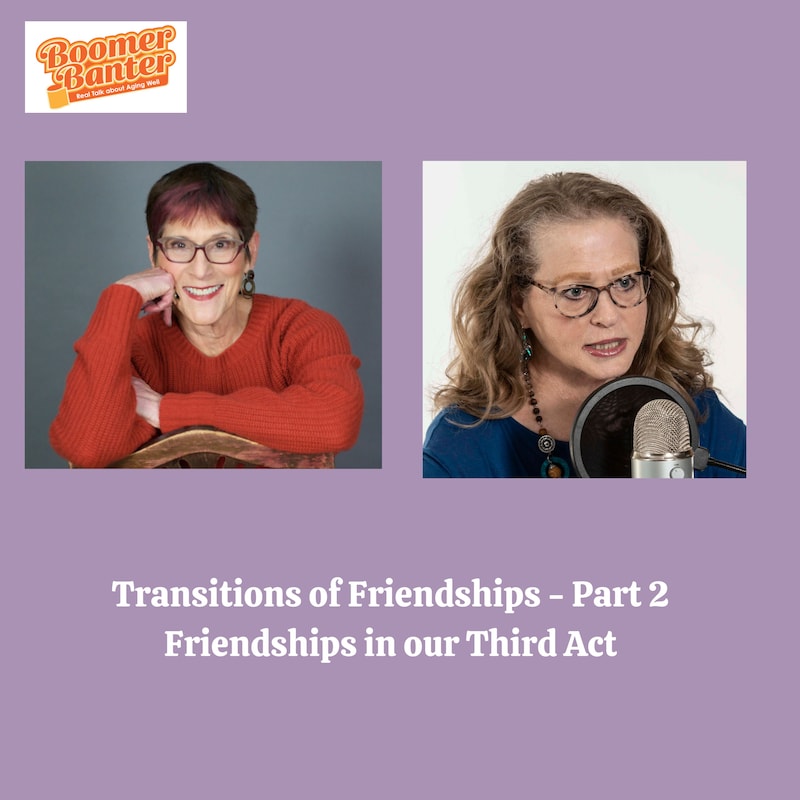
In this honest conversation, Jane Leder (host of Older Women and Friends) and I talk honestly about what friendships look like now — when life has taken us down different paths, when old friends have moved away, or when we simply find ourselves craving meaningful connection again. We open up about our own experiences — the friendships we’ve grown, the ones we’ve let go of, and the surprising places we’ve found new friends (even a few much younger than us!).
We also share some very real, practical ways to create and nurture friendships in your third act — even if your energy, mobility, or opportunities feel limited. From reaching out to someone new, to joining groups, to stretching just a bit outside your comfort zone, there are ways to build relationships that matter.
If you’ve ever felt like making friends “at this age” is harder than it used to be, you aren't wrong. It is different and doesn't seem to happen as naturally as it once did — and it’s never too late to create new connections that bring joy, laughter, and support into your life.
Takeaways:
- Friendship in later life will require intentional effort and adaptability.
- Cultivating new friendships necessitates stepping out of your comfort zone and being proactive.
- Intergenerational friendships can enrich our lives, providing fresh perspectives and shared experiences.
- We talked about the quality of friendships over the quantity of friendships in our later years.
- We shared many practical ideas for finding new friends, some of which may surprise you.
Links referenced in this episode:
- Jane Leder is host of "Older Women and Friends," which can be found wherever you listen to podcasts.
- Join the Boomer Banter email list for inspirational content. Go to heyboomer.biz and click on Age Well With Us.
- Join the AARP Ethel newsletter and join us next week as we explore friendships with The Ethels.
Transcripts
Hi, and welcome back to Boomer Banter, where we have a real talk about aging well, my name is Wendy Green, and today we are continuing our series on friendships.
And this time we're focusing on what friendships look like now at this third act of our life, maybe fourth, maybe fifth for some people, but in this later stage of our lives. And if you haven't listened to part one yet, I would encourage you to go back and give it a listen.
We looked at how friendships form in childhood and young adulthood and how those relationships shape us, how they fade and quite often leave their mark. But today is about this season of life.
Today we're going to talk about why friendships look different as we get older, what the research says about loneliness and connection in later life and how important we all know that is, and how we can find or deepen relationships even when energy, mobility, and opportunities seem limited. Because here's the thing. You're not too old to make a new friend, and you're not alone if it feels harder than it used to.
Before we dive in, a quick reminder. If you're enjoying these conversations and want a little extra inspiration, I want to invite you to to join my email community.
There you'll get links to new episodes, helpful resources, and some thoughts to help you navigate this season of life with purpose and confidence. So just visit heyboomer.Biz and click on Age Well With Us. Nice big orange button there.
It's simple, it's free, and I'd love to stay connected with you. So my host, co host today is Jane Leder, host of the Older Women and Friends podcast.
And Jane and I are going to share our experiences, our insights, and our different vantage points of friendships as we age. So my vantage point, I am a longtime single woman currently in a committed relationship and. And I'm in my early 70s.
Jane is coming from the vantage point of a longtime married woman looking at turning 80 in a few weeks. So let me bring Jane on and have her introduce herself and let's get started. Jane, I'm so happy to have you here.
Jane Leder:Well, here's my intro. Make new friends and keep the old. One is silver and the other is gold.
Wendy Green:Do you know I was singing that song to myself as I was walking the park?
Jane Leder:That was a Girl Scout, right? Yeah, either Girl Scouts, sorority, I don't remember. But. And that just came to me two minutes ago. So here we are talking about friendship.
Wendy Green:I know, and friendship is such a gift and not always easy. So let's just call it out. Loneliness is real, even if you're surrounded by people, even if you're in a relationship. I can testify to that.
to the U.S. surgeon General's:Not just loneliness, but measurable loneliness. What's more, chronic loneliness. And research shows this, it increases the risk of dementia, stroke, heart disease, and even premature death.
And adults over 60 are especially vulnerable, particularly after retirement, widowhood, or losing long term friends. So, Jane.
Jane Leder:Yes.
Wendy Green:Talk to me about loneliness. Have you experienced that?
Jane Leder:Only a lonely boy, girl. Of course. I am in a long term marriage and I have a son and I have friends, and then I have a lot of friends who are no longer friends.
Perhaps they moved away, they want to be closer to a grandchild, they don't like the weather where they are, and they want to go someplace warm or we're no longer on the same wavelength and it's not a supportive relationship.
And I do spend a fair amount of time, particularly since I've been doing the Older Women and Friends podcast and hearing all the experts talk about the importance of friendship. And I'm sitting there and sort of counting, well, okay, I've got her, I've got her. I don't know about that. So absolutely talking about loneliness.
And obviously, the older we get, the pool of people our age with whom we can become friends begins to shrink.
So we are in a position where we're looking at intergenerational friendships so that we are striking up friendships with women and men who are younger, sometimes real young, 52ish, or something. The age of my son.
Wendy Green:Yeah. And it's, it's interesting how that tends to work, being, it's what you said first about being on the podcast, being a host of a podcast.
It has also raised my awareness. You know, like you kind of bop along and you might be recognizing that you don't have the same pool of friends that you had.
You don't find the friends that you grew up with because we've moved, they've moved, you know, everything's changed.
But the more I've had people on the show, one of the reasons I created the collaboration group, Jane, for all of us, we have, you know that for podcasters, we have that collaboration group is because I wanted to be with like minded women who are trying to strive for more meaning and purpose in their lives as we get older and share ideas and, and share friendship and, and I feel like we have developed friendships in that group.
Jane Leder:Absolutely. I was thinking about that this morning, and you're Correct. We share podcasting. We are all women.
We are all older women, no matter how you define that age range. And for me personally, as with you, first of all, we have become friends.
Wendy Green:Absolutely.
Jane Leder:And it's via this collaboration. And by the way, Wende's done a fabulous, fabulous, fabulous job. No, sh. She didn't bring me on to say that. I promise, I'm not a paid guest.
I'm doing this for free. But the collaboration has been really positive and actually exciting.
And for me, and I'm sure for you too, Wendy, I've had a chance to meet some really incredible women who are wonderful at what they do. And it's like, ah, okay, I'd like to spend some time with you. And how about you? And how about you? So it's. It's been fantastic.
Wendy Green:Yeah. And that's one of the things that I hope people, you know, we.
We leave them with ideas, Jane, because one of the things that people say all the time is it's so much harder to find friends now. And so, you know, we none of us live close to each other, but we've become friends via zoom.
And so I think part of what being a friend is at this stage of our life needs some redefinition. You know, it's not the same friends that we grew up in high school with or that we were in college with or we raised our kids with.
You know, so I'm curious what you would you think you would need to find in a friendship at this point.
Jane Leder:Honesty. I don't want a rubber stamp, and I don't want to be, you know, someone who does that in reverse. I want. They can be constructively critical.
And I don't mean critical in a negative sense, but I want people. I want friends, and. And I want friends who have my back.
Friends whom I can call at 2 o' clock in the morning and saying, God forbid, you know, I need to go to the hospital or, you know, something's happened with my son and I need to talk to you or be with you. I know that I had one friendship. And after realizing that I could not depend upon her for that, our friendship frayed.
And I think I probably took the lead on that. And it was sad, but that's. That's the reality. And you want friends who are fun.
I mean, yeah, we're not in college anymore, and we're not necessarily, you know, rock and rolling every night, but you want to be able to laugh. I think laughter is a major, major component.
Wendy Green:Yeah. I'm trying to think if there's anything I would add to that, I think no. Having somebody that gets you and that would have your back is so critical.
And, you know, I think we've become more discriminating because, you know, it's funny, right? When you reach this stage of your life, you think, I'm going to have so much free time. The kids are out of the house. I don't have that nine to five.
And. But we become also a little bit more protective of our time also. I think we want to use it in ways that feel meaningful to us, feel important to us.
And so we're not. We're not indiscriminately just adding people to our lives just to have this posse of friends. You know, we're.
We're being very intentional about who we want to be friends with.
Jane Leder:And that posse idea, I can remember, oh, maybe in my 40s.
And it's like, I've got to invite every single person I've ever met on the planet to this party because I just want to be surrounded by hordes of people at this point as I'm getting ready to plan my 80th birthday. You are correct. I'm much, much more selective. Do I want that person? Am I going to love seeing them?
Am I going to just love hanging out with them and sharing stories and laughing and dancing and having a great time? So I. I get that. So that list that was maybe in the 40s or 50s is now down to maybe 20, and that's including the band.
Wendy Green:That's great. Well, I'll be there on Zoom.
Jane Leder:Okay. Yeah.
Wendy Green:So to make a friend at this point, it does require some intentional effort, and.
And that can feel hard when we have limited mobility or when you're grieving a loss, which does happen more often than we like to admit at this point in our life. If you've moved to a new town or, you know, sometimes we're just tired. Right. Emotionally or physically.
And so what is some of the effort that it takes to. To cultivate a friend and to keep that friend?
Jane Leder:I think first and foremost, we have to be willing to perhaps step out of our comfort zone. We're not necessarily used to being not aggressive, but assertive. I interviewed Melinda Brow. I think she spells her last name B R A, U.
And she's the author of the Wisdom Whisperers and those Wisdom Whisperers. And by the way, I bungle that every other time I say it.
Those women are older, and she talked about, you know, just being picked up in quotation marks at the tennis court by a Much older woman with whom she ultimately became good friends.
She also talks about if you pass somebody in the street or at the grocery store or whatever, excuse me, and you like their haircut or they've got on some funky shoes to just sort of say, wow, I really like that haircut. Where did you, you know, where did you go for that? And she emphasized that you have to be sincere in these requests and compliments.
It's not something that just, you know, comes from. From left field, but this idea that we really have to. We've got to get out there and do this, and it's. It's not always easy. It really isn't.
And to Sugarco it. I know there are people who say, oh, I've just got a million friends. And the older I get, the more people I have around me.
That hasn't been my experience. It may be other women's, but not mine.
Wendy Green:Yeah, mine either. You know, I'm. I. I'm kind of. People that know me probably think I'm more of an extrovert.
You know, I like to be out there dancing, and I talk to everybody when I go somewhere. But I am really very comfortable being home alone with my books, my cat, maybe a TV show if it's really good. And I.
I have to very intentionally, Jane, make a point to call a friend every once in a while, you know, because we've gotten so. It's gotten so easy. Just text somebody, and that's not. That's not a good way to communicate. That doesn't build a friendship.
So I make the effort to call or. Or to schedule a lunch date, you know, something. And new friends, too.
Like, I want to talk about, you know, when was the last time you made a new friend and where did you meet them? But it takes a while to get. You know, it's not magical that all of a sudden you're best friends.
Jane Leder:No. And you have to cultivate, like you do a garden in the city. And as you mentioned, it absolutely does take time. I have a kind of funny story.
I think my newest best friend on the planet is honestly the age of my son, 52. And she, in fact, was one of my doctors. In fact, she was a therapist.
I was dealing with an issue, and at a certain point, I said to her, you know, I think I'm good in therapy. I'd really rather be your friend. And, of course, I'd like to save the money. No, I didn't say that. I didn't say that.
Wendy Green:But you thought that.
Jane Leder:And it's really fun. She's a great person, she's smart. It is an even exchange of ideas.
And I also love to be in the position of where, when asked, I can share some of my experiences about aging. And she's all ears. She really wants to know. So it's been fun, reciprocal.
And I also happen to really like her son, who's ag, and so we've spent some really good times together. So that's my new friend. That's my story about my new friend.
Wendy Green:That's great. And my new friend is about in that age group, too. We met through podcasting.
She happened to be part of this marketing group that I was part of, Podcast Marketing Academy, call that out for Jeremy.
Jane Leder:And.
Wendy Green:She had just settled here in Greenville for a while. Greenville, South Carolina. And so we started meeting and, I mean, we really clicked. It was great.
And the fact that she was younger, she had a lot more ideas about podcast technology and promotion and all this kind of stuff, which we're still getting comfortable with. Right. But the sad thing is now she's going to move to. To Savannah. So. I know. So now I need to find.
But I have, you know, I do have other friends, most of whom are younger than me, which is interesting. And, and, and it's hard, you know, you. You find friends who are already in a group of friends. Right.
Like, I'm thinking of a couple of friends that are in the same church together, and I'm kind of coming into that group not through their church, but through another organization. And you're not invited to everything, you know, you're not part of the everything that they do group.
And so you have to make an effort to say, hey, let's do something together, all of us.
Jane Leder:And I think it's important to let people know that we still get our feelings hurt. I wish I could say that as I approach my 80th birthday, that I'm cool with anything that happens. And if I'm not invited or they don't call back and.
And I have to be the quote, unquote, aggressor. Yeah. I mean, it can whip by, but it's temporary, of course. But I'm dubious about people who say that because they're older, everything is great.
They have no issues. Their feelings, okay, fine, they can let things slide off their back. And yes, that is true. But nonetheless.
And as you mentioned, I've had the same situation where, ah, man, you know, I'm trying to establish a new connection, and she's not returning my phone calls or she's not returning my text And I can remember when I spent part of a winter in California, and I knew nobody in this little town where I was saying. And I just remember it felt like I'd go have coffee, even though I don't drink coffee.
But I go to a coffee shop, and if I saw anybody there that looked remotely interesting, I'd kind of sidle over, introduce myself. I acted in ways that I have never done before. And as I mentioned earlier, it's getting beyond your comfort zone. So it takes a little time.
And people say, well, how do we meet these new friends? And it may sound a bit repetitive, but how about joining a group like our podcast collaboration? How about taking a class?
I dance, and there are several women my age or younger with whom I've become very good friends. So take a class or volunteer. There are a lot of things that we can do as older women to create new friendships.
Wendy Green:Yeah, and I think you made a good point. When you talk about getting out of your comfort zone but finding places, I'm thinking about some people.
A friend of mine who has very limited mobility, so going out to do things is much more difficult. But we started this collaboration group, Jane. It's all online. We don't have to go anywhere.
There are other groups, in fact, I'm going to talk about one next week that are, you know, they.
Jane Leder:They.
Wendy Green:Some of them do have local meetings, but it's also a lot online. And so if you have certain interests, like dance, like art, like politics, like whatever religion, whatever it is, you can find groups.
You know, you can find them on Facebook, you can find them on podcasts, you can find them on the Internet in places where you don't have to go anywhere. And so even if you have limited mobility, I think you can still cultivate friendships. But it does take stretching that comfort zone.
Jane Leder:And the online connections befuddle me a little bit, because I know there are some people and that's the entirety of their friendships, and they're online and sharing their innermost feelings and so forth, but they've never met in person. They probably never will meet in person. And I sometimes say, really? So these guys have become very, very close, doing it all online.
But, hey, I guess people meet online and end up getting married, so why not starting a friendship? I mean.
Wendy Green:Well, and I think the important thing with that, too, is you want to see the person.
You know, it's like with online dating, if you're just talking to them on the phone, if you haven't met them via Zoom, or at least met them in person, I Wouldn't trust them at all. If somebody doesn't want to let you see who they are, don't go there.
You know, so a group where everybody's on the screen and you can see who's there. Okay. But don't let you know because people are with AI now too. They'll fool you. They'll fool you. So make sure you have face to face. Eye to eye.
We gotta.
Jane Leder:That's correct.
Wendy Green:Well, and you know, when you think about communication, right? I mean, just texting, I've been misconstrued so many times, particularly by my children. You know, you send a message and they're like, what?
No, I didn't mean it that way. So the visual communication is so important.
Jane Leder:And I got in a little kerfuffle and I never use that word. I don't know where that came from. I got into a little kerfuffle over the weekend and while.
And again it was because it was based on my having sent an email that was misconstrued. And then I happened to run into this person at a gathering over the weekend and I had no idea she'd be here.
And I said, ah, you know, what are you doing here? And she gave me a look and rolled her eyes and walked away.
And then accosted my husband and, and railed about this email that I had sent and said emphatically so I never want to speak to her again. It was like, oh, no, please. Now there were some health issues going on with a family member. I think she was stressed.
I think I became just an obvious punching bag. But let me tell you, I know what can happen when we can't see a person, when we can't hear them.
And as my husband, you know, advised me after this, Jane, do not put things in writing like that, you know, so, yeah, I get it.
Wendy Green:Yeah, yeah, it's hard. And, and you talked about losing a friend. You know, I also lost a long time friend. And we change, right? Life takes us on different journeys.
And she stayed in the same community for 30 years. And of course I've lived in several different communities and grown a couple of businesses. And so we change.
And I think learning how to let go of a friendship and recognizing when they've, the season of that friendship has expired, it's hard, it's sad, it's, you know, they've been in your life, but I think that is you.
I guess that the concern I'm trying to express here is when we're lonely, when we feel like I don't have other Friends, you know, it's really hard to let go of that one person, even if they're draining us, even if they're, like, toxic to us. But sometimes we have to make space for the new by letting go of some of that.
Jane Leder:And I think that comes with the wisdom that we do gain as we age and what it is that we really need and want and seek in a friend. And yes, it is very sad to lose a friendship like that.
I often used to say, well, if you look at the scales and if it's at least 50, 50, but when it starts tilting so that you seem to be giving all the time, you're listening, you're a sounding board, you're a pseudotherapist, and yet you're not getting anything. Return.
And in terms of older friends, what I'm trying to do now, in that case, for example, I'm trying to cherish the memories that I know that we share and the experiences that we shared and holding that and being grateful for that and being grateful that they were in our lives when they were. So, yes, go for the sadness, acknowledge it, feel it, don't run away from it.
But then in a sense, be grateful for the fact that you were able to see that this was not working well and that you were able to end it.
Wendy Green:Yeah, I love that, I love the way you put that. Because I think all of those friendships have left their marks on us. You know, they've, they've. We've built character through that.
We've learned through them. They've. They have left us with some very precious memories and some, some memories that we don't want anymore.
But, but, but gratitude, Gratitude is so important.
Jane Leder:And yeah, I am trying my best with gratitude. So I'm trying, I'm trying to lead with. I feel very grateful for. Fill in the blank they used to have when you had active listening.
And one of the tenants was, I feel this way because. So you, you feel in the emotional, the emotion, and yet you take it upon yourself. So it just, that's a side note.
It really has nothing to do with everything we're talking about.
Wendy Green:It does, it does, it does.
Because if you're not a friend with yourself first, if you're beating yourself up, you know, by saying, you know, I was a bad friend, I, I walked away from that friendship or whatever, you know, I don't, I'm angry at myself. That doesn't serve you. But to acknowledge the feeling and work through it and then move on, I think that is an important point.
Jane Leder:And if we're talking about friends who die, and I have lost several. And unfortunately, I mean, if we look at the statistics, I think the average life span for an American female is like 81.1 years.
And for men, it's less coming in at about 75.8 or something like that. Well, hey, so, you know, that circle is going to diminish by death, if nothing else.
And talking about grieving, and you were talking about grieving a friend, talking about a loved one who has passed away. And it's so, so important to not stuff it, to acknowledge it.
And we were talking about gratitude, and I'm saying, feel so grateful for the fact that that person was in my life. I will miss him or her desperately. But look what we were able to share during the time that we were together.
Wendy Green:Yeah. And, you know, I'm thinking back to the song you started with, make new friends but keep the old. One is silver and the other is gold.
So sometimes I hear people say, well, nobody's going to be a friend like my longtime friends. You know, they won't know my parents. They don't know my kids, you know, so it's just too much work to make a new friend or a.
It's never going to be like it was. What do you think about that?
Jane Leder:Well, I think the bottom line is that it does give us a clear slate, an empty slate, so you can fill it all in. And all of us have things that we wish we'd done differently or, you know, events that occurred that have affected us dramatically.
And, yes, we do wipe that slate clean. I mean, we. Yeah, we wet the slate clean. And we're able, in a sense, to start over again so we can recreate ourselves any way we would like.
And, you know, I'm sure we've all learned things along the way about being a good friend, about being a good person, about being supportive. And so, you know, there's a lot to be said. I know. I get it. I have friends, you know, they love my parents. They loved coming to my house.
They talk about it today, what, 60, 70 years later? And I go, really? You really. You liked my parents, huh? That's interesting, because I was having some issues, but you were a teenage girl.
Wendy Green:Of course you were having it.
Jane Leder:But they've been, you know, they've been gone for a long time now. And yes, I love hearing those stories, good or bad. But I also appreciate the opportunity to begin anew.
Wendy Green:Well, and that's what we do, right? On older women and friends, on boomer banter. We have both reinvented ourselves. Right. I mean, you were more of a writer.
Never grew up thinking you were going to be a podcaster, I would suspect, because we didn't have podcasts when we were growing up.
Jane Leder:That is correct.
Wendy Green:Right. And so we have reinvented ourselves. We are not the same people that we were 50 years ago. And.
And so I think we are bringing new energy and new ideas and new thoughts and insights and excitement and curiosity into potential new friendships.
Jane Leder:Absolutely. And, yeah, I mean, I never thought about being a podcaster. It's a crazy.
But the same therapist that I mentioned earlier was sitting with me, or we were on the phone, and it was my 75th birthday. What do you want to do? And I had a long list of things I didn't want to do. I didn't want to write another book.
I didn't want to have to write, you know, query letters about magazine articles. And I have no idea why the. Where that idea came from. And I just blurted out, I want to do a podcast now. Talk about a good friend.
She just absolutely started screaming, oh, my God, that's great. That's what I was thinking about. Yes, yes, yes. And, you know, I took a dive. I think the point of that little story is that a.
She asked a really good question that nobody else had really asked. That got my brain moving in a direction where it hadn't been. I came up with something that has now become a passion.
And again, I'm not sure that would have happened if I hadn't had a new friend with a different perspective who was looking at me and seeing a much older woman and maybe secretly saying, what the hell is she going to do now? I don't know. But yeah. And I have no idea what the lead in comment was to that, but.
Wendy Green:Okay, no, because I said we didn't grow up thinking we were going to be podcasters, but the point is that we are different people. And so, you know, those. Those new friendships, I'm not sure if those are the silver or the gold.
Jane Leder:Friendships, but make new friends and keep the old one is silver. Okay? It's the new friends are silver because gold rhymes with old.
Wendy Green:There you go. Right? And silver, though, is just as precious. It may not be quite as expensive as gold, but it's just as precious. Right. And so I think as we.
As we look out through our lens of.
It's okay to put yourself out there, to be a little bit vulnerable, to also recognize, you know, it's not so much about being judged for who we are now. It's about Being selective for who we want in our lives.
Jane Leder:Oh, I like that.
Wendy Green:Right. And so we are looking for people that. It's kind of the icing on the cake that make our lives richer and better.
And, and I don't know about you, Jane, but I don't need a lot of friends. I have many acquaintances, people that I truly love.
But as far as friends that I'm going to call at 2 in the morning that are going to sit there and hold my hand if I'm falling apart, I only need a couple, two or three at the most, because it takes energy to be that kind of a friend. And it has to be reciprocal. Right. Like, I can't expect they're just going to come sit and hold my hand if I'm not going to go sit and hold theirs.
Jane Leder:Absolutely no doubt about it.
So I, you know, and I interviewed someone, one of the guests, and I don't remember her name, I'm sorry, but she had an idea or she'd worked it out that we each need X number of really, really, really, really good friends. Then we need this number of people you really like and then acquaintances and then people you say hello to at the grocery store.
And I'm, I'm, you know, and for a while I'm sitting there and thinking, no, I don't have that number. Well, maybe the next. No, I don't have that either. And the initial response is, oh, boy, I better get cracking.
And then the other response that I come to is what you just shared, which is, we're much more selective. It's, here we go. It's not quantity, it's quality.
Wendy Green:Oh, man. Right. Weren't we told that when we were raising our children, too? Right? It's been quality time. It doesn't matter if you're there 12 hours a day.
But yeah, quality. And I think that's, I think that's key. That's critical.
I remember during the pandemic, you know, when I hadn't been out of the house in days, and I mean, I'm okay by myself for a while, but we're not islands, you know, we do need people. Whether we admit it or not, we do need people around us.
And I would go to the grocery store just to talk to the butcher, just so I would have somebody to talk to.
Jane Leder:With your mask on. And, you know, he had his on and you're, you know, barely can understand each other, but. Yeah, absolutely.
And I also know there, there are large groups of people who hang out at coffee shops. We have one just around the corner from our house. And it's another place.
Because if you see the same people there day after day, at a certain point, it can be, well, you know, what are you working on? Or, you know, I've seen you here and you've been reading voraciously. What. What are you up to? So that's another way.
And I can guarantee that a lot of the people there are also there for the same reason. They don't want to work at home. They want to be with other people. It's that need to be, as you say, surrounded by other humans.
That's how we are meant to roll.
Wendy Green:And other places I've met people. I'll go on a walk in the morning around this park by me, and. And you start to see the same people.
And so at first you're just smiling, saying, hi, good morning, and before you know it, you know, you've had a conversation with somebody not too long because you're still walking, but. And the same thing happens at the gym, but it takes a commitment to keep going. Right.
Because if you only see a person once, they're probably not going to become your friend. So I think finding those places where you can go and feel comfortable, you know, taking a walk is a lovely thing in the morning.
And hearing the birds, I love it.
Jane Leder:Buying a dog.
Wendy Green:Oh, gosh, thank you. But it does help.
Jane Leder:There was a fascinating opinion piece by Roger Rosenblatt in the New York Times several weeks ago, and I think he was turning 86. So he was sharing the 10 things that he has learned and wanted to share with his readers. And one of them was get a dog.
Not only for personal companionship, but a great way to meet other people. And you already have something in common and that can, you know, oh, your dog's so cute. What kind is it? A rescue. You know, where'd you get a.
Blah, blah, blah. And I have a garden, a beautiful garden in the front of our house. And I'm out there weeding or looking at it or watering.
And honestly, everybody, not everybody, but a lot of people walk by, they want to know what you're growing. What is that flower? What is this flower? And I've actually picked up two new friends that way.
Wendy Green:Oh, how nice.
Jane Leder:Yeah. So it's like, okay, you like my garden, then I like you.
Wendy Green:That's right. That's right. That's something you have in common.
Jane Leder:Right?
Wendy Green:So I think this is awesome. And I think that some. Let's just leave people with a little, like, challenge. Right?
What's one small step you can take this week to nurture or start a connection. So it may be calling somebody that you haven't spoken to in a while or sending a message to someone you'd like to know better.
Which means, of course, you'd have to have gotten their contact information or checking out a local event. Even if you feel nervous, like Jane said a couple of times, you know, push through your comfort zone just a little bit and go and see what it's like.
Because your third act. This stage of our life isn't just about looking back. It's about creating new moments, new memories, and, yes, new friendships.
Jane Leder:Hear, hear.
Wendy Green:And as we've talked about today, making new friends after 60 isn't always easy. But as I alluded to in our conversation, next week I'm flipping the script on that and I'll be talking with two women from the Ethels.
E T H E L S the eThels, that's AARP's community, where women are finding new ways to connect, support each other, and just have fun. And if you're still wondering, where do we even start, you'll definitely want to listen in. So thank you for being with me and Jane. Jane.
Jane Leder:Yes.
Wendy Green:You are a good friend. This has been so much fun.
Jane Leder:Same. Thank you so much for asking me.
Wendy Green:I am.
I am so glad that we did this and I appreciate your time and I hope everybody that listened enjoys this and you will share it and listen on the podcast and let everybody know that you liked it.
And if you're not already on our email list, it is a great way to stay connected and find out what's happening and have a little encouragement every week. So go to HeyBoomer Biz and click on Age well with us, and I hope to see you in the list. Jane, I will see you on the next collaboration meeting.
Love you.
Jane Leder:You.
Wendy Green:Thank you, too.
Jane Leder:Thank you, Wendy.
Wendy Green:Okay, bye.



