Shownotes
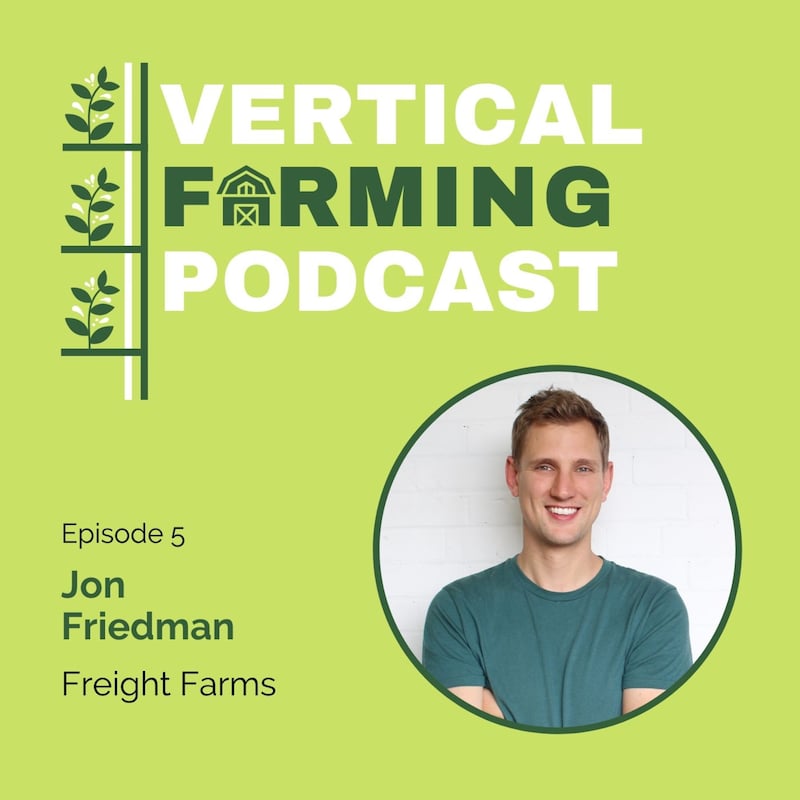
Jon Friedman is the COO and co-founder of Freight Farms, an organization that provides agricultural products and services that enable on-site commercial food production anywhere in the world. Join Harry Duran, host of Vertical Farming Podcast, as he and Jon discuss the growth of the AgTech industry, the value of marketing and the grant Jon and his team received from NASA to further their work with vertical farming.
Special thanks to our Season 1 Sponsor
IGS – https://intelligentgrowthsolutions.com/
Key Takeaways
- 00:01 – Jon shares his origin story of how he originally became interested in AgTech and the inspiration to start Freight Farms.
- 13:19 – Jon speaks to the importance of educating those looking to enter the industry in order to scale agriculture
- 20:25 – The value of having Standard Operating Procedures (SOPs) and marketing plans in place
- 25:58 – Jon expounds on Freight Farms’ latest model, The Greenery
- 29:13 – Jon talks about the grant he and his organization received from NASA
- 32:30 – Jon speaks to the trends that excite him about the future of AgTech
- 38:23 – Where listeners can follow and connect with Jon
Tweetables
“Admittedly, I don’t have a green thumb, I would say, but I have a green mind.” (00:52)
Links Mentioned:
Jon’s Twitter – @JonFreightFarms
Freight Farms’ Instagram – @freightfarm
Intelligent Growth Solutions
See omnystudio.com/listener for privacy information.
Mentioned in this episode:
2025 Precision Ag Report by iGrowNews
2025 Precision Ag Report by iGrowNews
Transcripts
$680 million poured into precision ag last year.
Speaker:Autonomous weeding robots dominated, and John Deere made 2 acquisitions in 3
Speaker:months. A food company, not an equipment maker, bought a
Speaker:robotics startup to protect its own supply chain. The deals are
Speaker:accelerating, the money is moving, and the winners are already separating from the
Speaker:pack. If you're investing, building, or buying in this space,
Speaker:you need the full picture before your competitors get it. The 2025
Speaker:Precision Agriculture Intelligence Report from iGrow News is now
Speaker:available. Get your copy today at
Speaker:igrownews.com/precision. Special thanks to
Speaker:our title sponsor this season, IGS. Founded in
Speaker:2013, IGS develops Industry 4.0 solutions in the
Speaker:global agtech and commercial lighting markets. As an industry innovator,
Speaker:they make revolutionary controlled environment growth products. For more information,
Speaker:visit intelligentgrowthsolutions.com. So if
Speaker:you are anybody who's interested in this, don't start until you have $1
Speaker:million in your pocket to get
Speaker:Welcome to the Vertical Farming Podcast, weekly conversations with
Speaker:fascinating CEOs, founders, and agtech visionaries.
Speaker:Join us every week as we dive deep into the world of vertical
Speaker:farming with your host, Harry Duran. Vertical
Speaker:Farming Podcast, welcome back, episode 5. If you are new to the
Speaker:show, then this is the podcast where we interview fascinating CEOs and
Speaker:founders of some of the leading vertical farming companies in the world.
Speaker:In case you missed last week's episode, I had a great conversation with Henry
Speaker:Gordon-Smith of Agritecture. If you haven't listened to it, I highly recommend you
Speaker:check it out, episode 4. This week I have the privilege of speaking with
Speaker:John Friedman, CEO and co-founder of Freight Farms,
Speaker:an organization that provides products and services that enable onsite
Speaker:commercial food production from anywhere in the world. It's one of the first companies
Speaker:I came across when I was looking at some of the things that were happening
Speaker:in the world of container farms. And so excited that I got the
Speaker:opportunity to have a conversation with John. We discussed the growth of
Speaker:the agtech industry, the value of marketing, and the grant that
Speaker:John and his team received from NASA to further their work. John has
Speaker:a great origin story, and we also speak about the importance of educating those
Speaker:looking to enter the industry now. He gives us a little bit of insight into
Speaker:the latest model of Freight Farms, the Greenery, and we cover some of
Speaker:the trends that are exciting him in the world of agtech. If you
Speaker:enjoyed this episode or past episodes, I'd love it if you leave a rating and
Speaker:review at ratethispodcast.com/vfp.
Speaker:Okay, let's get into this conversation with John. So John Friedman, thank you so much
Speaker:for joining us on the Vertical Farming Podcast. Thank you for having
Speaker:me. It's been a bit of a busy day for
Speaker:both of us in terms of scheduling, so I appreciate you taking the time. No
Speaker:problem, excited to talk. So when you— a bit of
Speaker:background I think would be helpful. I'm sure people who are listening to this podcast
Speaker:would likely know who you are, but I'm
Speaker:wondering if you could kick us off by giving us a bit of your background,
Speaker:how you ended up in agtech and your passion for agtech, where that might've started.
Speaker:Sure, sure. So I'm one of the co-founders at Freight
Speaker:Farms, and I take on a lot of the product role,
Speaker:but mostly operations. And that covers everything from
Speaker:sales and marketing, how we present the product, to how we support the
Speaker:product on the backend once they're in the field. But how I got into this
Speaker:was actually nowhere near farming. I
Speaker:have a— admittedly, I don't have a green thumb, I would
Speaker:say, but I have a green mind.
Speaker:I started in industrial design and systems engineering,
Speaker:and I really was attracted to how
Speaker:ecosystems and economies come together. And
Speaker:early start, I worked a lot with companies like Procter&
Speaker:Gamble, Unilever, and found my way into a
Speaker:company called Merck. And Merck, if you're familiar with them,
Speaker:they are a large pharmaceutical research company.
Speaker:And they're one of those companies that are so big you can't really tell exactly
Speaker:what they do, but you know it could be evil or it could be
Speaker:like saving the planet, one or the other, but definitely
Speaker:not both. And I got to work on some pretty exciting projects there.
Speaker:One team that I was on, basically what they do is they build
Speaker:these large metal vats and inside
Speaker:they try to create an environment to keep a living organism
Speaker:alive and that living organism is usually some type of virus. So they're
Speaker:trying to keep this virus alive for a long period of time so that they
Speaker:can test the virus against certain things that they're
Speaker:developing. So they want to keep this living, they call it a bioreactor. Okay.
Speaker:So they're keeping this bioreactor stable and
Speaker:the stable environment inside. And what my job was is to
Speaker:look at how the scientists are interacting with said bioreactor and make sure it's a
Speaker:safe and sustainable practice. So let's imagine that one of
Speaker:those viruses is something really deadly. We need to
Speaker:go to that bioreactor and we need to sample off a
Speaker:small volume of material. Well, to do that, there
Speaker:is a lot of risk of exposure to that penetrating the core of this thing,
Speaker:bringing it into a new vial, transporting that, and then taking smaller
Speaker:samples off of that. So a lot of risk areas. And the whole time we
Speaker:need to keep that thing alive. Man, I was so amped by this.
Speaker:This was like my dream job. It was so sci-fi, so
Speaker:cool. And a lot of the things that I was working on there
Speaker:really brought me into the world of workflow, process,
Speaker:and environmental control. And a lot of the
Speaker:fundamentals that I learned there on that pharmaceutical scale
Speaker:and that safety scale was really something that I didn't know then,
Speaker:but would play a big impact in the things we're doing now. As
Speaker:you can kind of make the parallel, we have a big metal box and we
Speaker:have living things growing inside of it. We want to keep that environment exactly what
Speaker:it wants to be and tune it to the different things that are growing inside.
Speaker:So that's the most direct work parallel I have. How we got into
Speaker:this as a business though, me and my co-founder were, we had
Speaker:previous marketing experience that we knew each other and we were
Speaker:around this school system that he was working at. And he had
Speaker:come to me and said, hey, you know, they're looking at doing this rooftop greenhouse.
Speaker:And we had done things like sound design, stage design for
Speaker:larger events in our marketing days. And we're like, you know, a greenhouse,
Speaker:kind of like a stage and like the, like all the electrical and lighting, like
Speaker:that's like right up our alley, dude. Let's do it. And so we threw our
Speaker:hat in the ring for it, and it was a school, so they were like,
Speaker:whoever wants to do it, we'll take it. We'll take the
Speaker:feasibility study as a start. We went down that road
Speaker:and we basically at the end came to them and said, don't do it. Here
Speaker:it is. Our recommendation is do not do this. It's
Speaker:not going to make sense. The square foot, the infrastructure you're going to have to
Speaker:put in place just to get something on top of this
Speaker:1920s building, nevermind how are the
Speaker:kids getting up and down? Like what volume of production makes sense
Speaker:for the scale that you're investing? We went through all this and then at the
Speaker:end we were like, if you're going to do this, do it for show. Don't
Speaker:do it for production. 'Cause they're not going to get that return that you, in
Speaker:your mind, makes total sense, but you're not thinking about all these other
Speaker:practical things. So years later, we come back to
Speaker:them as Freight Farms and we say, hey, we think we got what you want.
Speaker:And they became one of our first clients. Where was the idea for
Speaker:what would become Freight Farms? And I know there was an early iteration of what
Speaker:is now Greenery, but when did you see— because there's a lot of different
Speaker:ways, and obviously from all the research I've been doing for the podcast, obviously,
Speaker:if you think about Dickson's original thought about the skyscrapers, right, that's one
Speaker:avenue. And I had a nice chat with Henry Gordon-Smith about
Speaker:different views of what a vertical farm actually is. But I think what you're doing
Speaker:with Freight Farms and the container farms, was there someone that— or were
Speaker:there people doing it with containers specifically? Because I know the idea of
Speaker:repurposing containers is not anything that's new. So when did you sort
Speaker:of marry that, those 2 pieces together? Yeah, when we started,
Speaker:we were kind of— even urban agriculture was very young,
Speaker:that telling people who are into urban agriculture or even calling it agtech
Speaker:was a little bit laughable to the people we would bring it up to. We'd
Speaker:be with like, you know, startup accelerator folks and they're like, just don't say that
Speaker:out loud. That's not like a thing. Sounds like very jargony.
Speaker:Yeah, it does. But fast forward, agtech is a thriving
Speaker:genre. So back then, we were, you know, we were looking
Speaker:at the footprint, the impact, the
Speaker:production, the yield. And one of the things that just kept on coming
Speaker:back to is standardization is something
Speaker:that this industry so desperately needs so that
Speaker:people who are not experts can get into this field.
Speaker:We were talking to schools who, they don't want to become engineers,
Speaker:they don't want to become horticulture experts, they don't want to take their master's, they
Speaker:want to get people into this experience and see it as
Speaker:a revenue stream, but also a way that learning can happen at
Speaker:every stage of the process. So when we were starting out, one of the bigger
Speaker:things was, how do we take the cost out of a greenhouse?
Speaker:How do we take it out of a rooftop greenhouse? And so the vertical
Speaker:rooftop dream really had the biggest limitations of that
Speaker:structural frame is— there's like
Speaker:a barrier to entry with cost. So if you are anybody who's
Speaker:interested in this, don't start until you have $1 million in your pocket. And
Speaker:that's— to get into agriculture, that should not be the
Speaker:barrier. And so for us, it was, what can we standardize?
Speaker:And what can we look at that it's going to be the same here as
Speaker:it is in the islands, as it is in cold weather and hot
Speaker:weather? And how can we make something a universal
Speaker:starting point so that more data can be shared between
Speaker:this community of growers, right? Because they're all working on the same
Speaker:platform. So that was a big primer that we had going into this.
Speaker:And I was already looking at shipping containers for more of
Speaker:a home aesthetic. And I think around that time,
Speaker:one of the pillars of containers are cool was
Speaker:Puma City. It was this traveling pop-up shop that Puma
Speaker:made for, I think it was a boat race.
Speaker:There's, yeah, there's this boat race that goes around and they had come to Boston
Speaker:and it was It was just a thing of beauty. It was,
Speaker:I think, like 16 containers or something stacked on each other. And it was
Speaker:really an exercise in, can we do it,
Speaker:for them. But seeing what they were able to do with taking this and
Speaker:move it to city to city and just work very quickly because their
Speaker:framework was fixed really put us in a spot of saying,
Speaker:okay, what efficiencies can we actually gain by
Speaker:fixing the size and designing into something where we know we have
Speaker:a finite amount of space? Actually, how has some benefits to it.
Speaker:We're thinking about headspace, that space above where
Speaker:that human's interacting. Anything that's not growing in that space
Speaker:is just wasting energy. You're heating and cooling. The sun is
Speaker:a great free resource, but in Boston, at 3
Speaker:o'clock, it's dark. So, you know, if you want to be at a
Speaker:production yield level, you need to be at a place where sun is not
Speaker:creating more heat. sun is not adding like
Speaker:fluctuations to your light cycle and you are locked in. The second you
Speaker:lock yourself in with these, these parameters, it's
Speaker:much easier to find efficiencies and then balance across your systems.
Speaker:So talk to me about the 1.0 version and then what you learned from that,
Speaker:and then we can move into the greenery. Sure, sure. So the first, first
Speaker:iteration of Freight Farms was called the Leafy Green Machine, and
Speaker:we started out doing a Kickstarter in
Speaker:2011. We came out and said, hey, we're going to solve all
Speaker:the world's problems, no big deal. And unfortunately, everybody was
Speaker:like, oh yeah, prove it. And we're like, okay, we
Speaker:got to put, uh, put this to work. So, it was really exciting though,
Speaker:because through that, we started to understand the customers and the
Speaker:needs that are out there that are outside of urban
Speaker:agriculture. We really, by, by doing it this way and saying, hey,
Speaker:we've got this, Crazy idea. We want to know if people
Speaker:would actually want this, and we want your support if you think it's a good
Speaker:idea. We started to see that the problem wasn't so much
Speaker:farm-to-table, everybody wants that, and it just can't get it. It's
Speaker:really accessibility, and that the
Speaker:current food supply chain is not set up
Speaker:to support the entire globe, even though it's a very centralized global
Speaker:system. So, we really learned a lot about the pockets of the world that this
Speaker:is this is ideal for. And then along the way, found a lot more
Speaker:folks that actually were always finding new industries and new
Speaker:applications. So the original was really just that proof of
Speaker:concept that we built out of Kickstarter. And then our first production run
Speaker:was in 2014, and that was the Leafy Green Machine.
Speaker:And that was essentially what is the cutting-edge indoor growing stuff that
Speaker:we can integrate with each other at that time, at the price point
Speaker:that makes sense for a return on investment. And so, you know, there was a
Speaker:lot of integration that we had to do with certain vendors and find
Speaker:alternatives to make sure that it was a cohesive system. Fast forward till now,
Speaker:we have a completely built from the bottom up, everything is an
Speaker:OEM solution because to get those efficiencies, you can't take 2
Speaker:off-the-shelf things and just stick them together. You have to think about them in
Speaker:parallel. So we've come a long way since 2014,
Speaker:but also a lot of the technology has as well. I think we're
Speaker:still seeing more efficient indoor lighting
Speaker:applications as it comes to using power and then limiting heat.
Speaker:So for us, that's really important. And, you know, just having that software
Speaker:platform that we've built from 2014 till now growing and finding
Speaker:all the recipes that we can now give back to the network, that
Speaker:has really guided what we want to do with the hardware and the software
Speaker:combination. And that's Farmhand? Yes, Farmhand. Yeah. Okay.
Speaker:And was the thought initially, When you started and you
Speaker:had the Leafy Green Machine, was there always in the back of your mind this
Speaker:idea that it would have to work in parallel with software, like, like a farmhand?
Speaker:Because the value that you get in this environment is from the
Speaker:iterations of what works, what's not, how were the
Speaker:yields. And so I'm sure it feels like a bit cyclical, but you're getting
Speaker:feedback, which drives the software, which improves the software, which helps
Speaker:improve the container. Yeah, absolutely. Well, from a
Speaker:product development side, that's a huge piece for us. I'm a big believer in
Speaker:just constant feedback. But when we think about the
Speaker:classic vertical farming and some of the vertical farming applications out there,
Speaker:they're really moving forward with just the same thing as a field. It's
Speaker:like, find a big spot and grow as much as you can in that spot,
Speaker:and then get transit vans and packaging and distribution off of that.
Speaker:We're looking at a food system that looks more like 3D
Speaker:printing did for manufacturing, right? A distributed system
Speaker:that allows people who are earlier stage to get into
Speaker:manufacturing. So with 3D printing, you're basically saying you don't need to do
Speaker:bulk orders just to get the price point you want. You don't need to have
Speaker:a team of engineers just to get that first proof of concept out
Speaker:the door. And for us, that proof of concept is a specialty crop in a
Speaker:specialty market where you can prove your market and you can prove
Speaker:your cost and relationships, and then you can scale up
Speaker:from there. So for us, the smaller-scale distributed
Speaker:that was all connected was the way to go to bring
Speaker:more people who wanted access into the game and then use that
Speaker:network effect to build a community of growers. I know that part of what
Speaker:you do is also provide a lot of training for folks who are just getting
Speaker:started as well, because if you think of a typical farmer tilling the soil,
Speaker:you know, the concerns that you would have in your overalls and pitchfork in the
Speaker:past, you almost need a different skill set or at least a willingness to learn
Speaker:new tools if you want to be a farmer in this day and age, or
Speaker:at least, you know, participate in this type of tech environment. So how much
Speaker:or how important is the education aspect of what you guys are doing with
Speaker:all this? So our goal as a company is to
Speaker:continually lower the barrier of entry for anybody looking to get in
Speaker:or anybody looking to scale agriculture. What that means is, you
Speaker:know, there's a lot of pressure we put on products for this space
Speaker:that need to match products we see out in the world as consumers. And
Speaker:it's easy to navigate, the usability is very high. So
Speaker:that's the path we want to stay on. That being said, farming
Speaker:is work, and there's so much
Speaker:we can put into the product and new products as they go, and there's a
Speaker:real necessity to understand what the fundamentals
Speaker:of plant development and crop cycles and things
Speaker:around the life cycle really is.
Speaker:So we put a lot of, I wouldn't say importance, but a lot
Speaker:of entry points for people who are looking to learn in
Speaker:the decision-making process. Besides the Greenery and
Speaker:Farmhand, we have something called Farm Camp. So Farm Camp is a 2-day intensive
Speaker:that we'll do here at the Free Farms HQ. We'll be in the
Speaker:farm, we'll be doing classroom lessons, and we also do on-site
Speaker:visits for folks who are maybe larger institutions and they've got like a team
Speaker:of like 10 or 20. Well, actually, some of our team will go there and
Speaker:set up shop so they can work within your facilities as well. So that's a
Speaker:really cool thing that we've realized helps get over that.
Speaker:I've never farmed before. I don't have a green thumb. I'm a little bit
Speaker:intimidated. And just letting people like feel
Speaker:themselves in that space and getting through some of the fundamentals that they might not
Speaker:have needed, but gives them that comfort to really start from
Speaker:day one at full sprint. We also have something called Farmhand Academy.
Speaker:So we do have a lot of international clients and clients who just, you know,
Speaker:they're not going to see flying to Boston or a 2-day
Speaker:intensive as something that they might not have the budget for. So with Farmhand, we
Speaker:have the Farmhand Academy module. So that's everything you would learn in
Speaker:Farm Camp, but broken out into smaller bite-sized lessons
Speaker:that you can learn as you go. So if you run into something, I've never
Speaker:seen this before, how many do I seed if I'm seeding lettuce versus kale?
Speaker:What's the watering cycle for this versus that? If you want to know just the
Speaker:answer, we have the knowledge base there for you. But if you want to know
Speaker:the fundamentals behind it, that Academy course is right there for you.
Speaker:Have you seen a specific profile with folks that are coming in? Is it people
Speaker:that are looking to change their careers? Is it people that are coming in from
Speaker:traditional farming? What's that mix look like? Yeah,
Speaker:yeah. We've had an amazing outreach of folks
Speaker:from all different walks of life. And at first, we saw a lot of
Speaker:people who had an existing career. They might be looking to
Speaker:taper off that career or might be looking to make a full switch to
Speaker:something that's a lot closer to their community or a lot more
Speaker:engagement centered. So there are a lot of folks who
Speaker:are maybe in their thinking about retirement, but they want something that is
Speaker:steady income and gives them that 15 hours of work or
Speaker:15 to 20 hours with hands-on and with the
Speaker:community. We see a lot of folks also who are maybe looking for
Speaker:a second franchise opportunity where they are used to working
Speaker:on something that has SOPs and good
Speaker:frameworks in place and want to build up their brand
Speaker:as well as support some of their other businesses. So a
Speaker:lot of folks who are looking to be more of the face of the products,
Speaker:like the specialty lettuce or a specialty crop that they want to bring to
Speaker:market, we see a lot of people who have paths into
Speaker:that. They've got a connection of restaurants or they've got a connection of supermarkets where
Speaker:they see a critical need in that supply chain and they can fill that in
Speaker:a matter of weeks. So that's a big lane for us.
Speaker:We also see a lot of folks who are in areas where food security is
Speaker:a day-to-day mindset. When you're thinking about any of the island countries, you're
Speaker:talking about importing food. So they're looking at a high
Speaker:price for fresh and healthy food. And even though you're thinking, well,
Speaker:there's a lot of tropical places out there, why would they need this? Humidity is
Speaker:not always a good friend to crispy, fresh produce. Or
Speaker:hurricanes. Or hurricanes. You're absolutely right. Yes, you
Speaker:get it. So hurricanes and bugs and things like that. And
Speaker:so Well, it's a great environment for fruit. It is not always a
Speaker:good one for leafy greens, herbs, vegetables. And so there's
Speaker:a large need and the volume that they're getting imported is always
Speaker:coming in at a lower quality and higher cost than people want to pay.
Speaker:So that seems to be a pretty big market for us. And then schools are
Speaker:a constant opportunity for education, but also
Speaker:food sourcing on a local level. So I think there's
Speaker:a big wave of I'd say like the younger generation of
Speaker:environmentalists are here and they are going to college and
Speaker:they are looking to hold people accountable and looking to
Speaker:hold schools accountable, their food service providers accountable
Speaker:for being the example that things are going in
Speaker:the right direction. So, not only from a, what's in my cafeteria,
Speaker:but are you teaching the programs that are going to inspire
Speaker:and create the agronomists and the biologists of the
Speaker:future in a very Strong space. I think we see how much
Speaker:plant-based things are rising when it comes to our
Speaker:food and materials and things like CRISPR, things
Speaker:like different development around plant-based meats. There's, there's
Speaker:a lot of opportunity with plants and we're just starting to unlock them. So we
Speaker:do need to make sure that we're giving the foundation to the next generation
Speaker:of career people. It would seem to be top of mind for younger
Speaker:generations, millennials or whatever, digital natives or whatever the
Speaker:latest generation is. There seems to be more of a conversation around that.
Speaker:Obviously, you do You see the plant-based meats getting into McDonald's and Burger King now,
Speaker:so it's top of mind and there's awareness to be doing good
Speaker:for not only ourselves but the planet, and this seems to sort of lend itself
Speaker:to those types of efforts. Yeah, we've seen a lot of
Speaker:really interesting research along the way. We've seen folks who are
Speaker:doing this for more materials-based things where they think by
Speaker:growing a plant that can't grow in the wild, they'll be able to extract some
Speaker:component that will go into a medicine or a
Speaker:dye or something like that. And I think what we're seeing just
Speaker:through our customers is the supply chain is very
Speaker:reactive to climate change right now. And some of the larger
Speaker:suppliers who for years have just held up shop in these regions
Speaker:where the climate was perfect for this one type of crop, and they've decided to
Speaker:monocrop in that area, just the slight
Speaker:changes is putting that in jeopardy and they need to rethink how they're handling
Speaker:supply chain. It's funny you mentioned Unilever. In a past life, I did
Speaker:consulting work at a business intelligence company and my client was Unilever.
Speaker:So I spent a lot of time at the Unilever headquarters in New Jersey. So
Speaker:I met a lot of really interesting folks there. And then the other thing is,
Speaker:it's not often you get to talk about SOPs or that people know what they
Speaker:are, but I'm a bit of a systems nerd. So anytime we can
Speaker:talk about— and for the benefit of the listener, that's standard operating procedures. But yeah,
Speaker:this idea of like documenting things, having steps, I think to people
Speaker:who think that way, the fact that you have those outlined Like, these
Speaker:are all the things you need to do that you've shown can let
Speaker:you have a successful farm, I think is helpful for people who have that
Speaker:mindset and who think like that. Yeah. I think SOPs are
Speaker:kind of a missing thing in this space. There's a lot of tribal knowledge
Speaker:and generational knowledge that we've lost over the years, just in the
Speaker:consolidation of these family farms into bigger farms. And,
Speaker:you know, you think of what a farmer or master farmer is today, it's the
Speaker:the guy who somehow collected all that knowledge, and don't let that guy go
Speaker:because your whole greenhouse is going to collapse. And
Speaker:that puts a barrier on people thinking that this is
Speaker:a legitimate business avenue for them because it's so volatile when you
Speaker:have that as a framework. And I think when we think about plant
Speaker:growth is a very complicated science,
Speaker:and on the flip side, sunlight, nutrients, water, Like
Speaker:3 things and environment. So you have these, these 2
Speaker:very like opposite understandings of how, how our
Speaker:food works. How do we get to where we are? And I think
Speaker:building the processes that, that connect those dots are what helps more
Speaker:people see the easy and see the complicated as something that they're going to be
Speaker:able to get from point A to point Z. Are you working with the Square
Speaker:Roots folks as well? Yes, Square Roots were our customers a few years
Speaker:back. And we helped them launch their Brooklyn campus. And
Speaker:actually, one of our farm managers became their farm manager the first
Speaker:year of their cohort. So yeah, familiar with them. And so
Speaker:it's probably a mix. You would have bigger companies like Square Roots
Speaker:with a plan for how they want to move into specific locations, but you do,
Speaker:for lack of a better term, also appeal to a mom-and-pop farmer as well,
Speaker:would you say? Yeah. I think that's something that we don't ever want to
Speaker:move away from because getting started is the hardest part. I think
Speaker:once you what a lot of folks in this space
Speaker:look at first is, what's my ROI? What's the
Speaker:economics of growing? And if it works at that
Speaker:scale, scaling up gets a lot more realistic.
Speaker:So we always want to make sure that the entry point, or there is an
Speaker:entry point for folks who, they maybe they've been in the DIY
Speaker:hydroponic space for a while, maybe they went down to cannabis and they're
Speaker:like, this field seems saturated, but I love growing. I love being
Speaker:part of production, how do I take this to the next level?
Speaker:We want to continue to build that on-ramp for this
Speaker:industry. And at the same time, we want to make sure that people
Speaker:have next steps for scaling up. So Square Roots is a good example. There's a
Speaker:lot of other companies that come to us with a larger plan that need help
Speaker:getting into that larger plan on a distributed level. So
Speaker:I think that is, that's definitely the 2 paths that we want to keep on
Speaker:supporting, but mom-and-pops, it's a very large section of the
Speaker:world. So people who have done a lot of great things in their career
Speaker:and want their next career choice to be something that is local,
Speaker:sustainable, good for the planet, and turns an income that they can live on.
Speaker:And do you help them think through the marketing aspect of it as well? Because
Speaker:not only do you have to be a farmer in this day and age, you
Speaker:need to be an effective marketer and salesperson as well. Yeah,
Speaker:I think that's something that is easily overlooked when you meet
Speaker:somebody who has a lot of the passion for growing and passion for
Speaker:running an operation, that there is some face-to-face time that you can
Speaker:avoid by getting that done upfront. You know, going into your
Speaker:market and finding out what are those crops that there's a strong need for.
Speaker:You can develop, you know, either a single or double stream relationship, so you don't
Speaker:have to be going all around town. Or, if all around town is your jam,
Speaker:do you have the consistent output to bring these to different
Speaker:places? So, where does the produce go afterwards? That
Speaker:can be as complicated or as streamlined as you want it to be,
Speaker:but it does rely on some face-to-face relationship building.
Speaker:And that is something that I think nobody thinks about when they think about farmers.
Speaker:Farmers are probably the most lean business people
Speaker:and versatile business people in the world. And
Speaker:we think of them as just like, oh, alone on the farm, just like ho-hum,
Speaker:but they are very aware of their economics and they're very aware of their relationships
Speaker:and resiliency that they need to build in. And is that part of the Academy,
Speaker:helping them think about marketing, but even things like packaging as well, like how
Speaker:they're going to— all this sort of stuff that's important in the whole lifecycle?
Speaker:Yeah, at Farm Camp, we'll go through everything from starting your
Speaker:farm to selling your produce and whatever that means for
Speaker:your business. So we'll go through social media marketing, we'll go through selling, different
Speaker:pricing models, different packaging options to get the best price,
Speaker:and figuring out what price makes sense for your market and for your offering.
Speaker:We do a little bit of exercise on branding, but a lot of times people
Speaker:come to us with a brand in mind or some type of
Speaker:brand identity that they're looking to move forward with. But our team is always eager
Speaker:to jump in and tell you some best tips and tricks. So we do have
Speaker:class modules for almost every step of the
Speaker:Farmer experience. Can you talk a little bit about the
Speaker:technology and where you stand in terms of hydroponic versus
Speaker:aeroponic and where you've landed on At least in the short term, with
Speaker:Greenery. So Greenery is our latest model, and it took a
Speaker:lot of the learnings from the LGM and the
Speaker:Network and applied it to a more kind of
Speaker:unibody design, something that is built with every system in
Speaker:mind from the start. One of the things that has come with us is
Speaker:hydroponic baseline. We do use a drip
Speaker:hydroponic system, so their roots are still exposed to the open air,
Speaker:but they are— were classically I would say we're probably more
Speaker:classically hydroponics because we don't use sprayers. Sprayers are something that we feel
Speaker:offer a really good value to the plant, but creates a
Speaker:lot of work for the customers on, or the
Speaker:operators on, you know, maintenance. I think in
Speaker:large-scale or in commercial grade, you need to make sure that
Speaker:none of those are getting clogged up by nutrients. And with the
Speaker:amount of nutrients that is going through at any given time, the risk versus
Speaker:reward on something like a sprayer, we feel, It doesn't
Speaker:build people something that they can rely on and that they can stop thinking about
Speaker:how the system works. We really want to take that out of the equation. We
Speaker:don't want you to be going under the hood every 5 seconds to fix something.
Speaker:We want you to be growing your business. So we feel like hydroponics is the
Speaker:more reliable of the two at the scale that our customers
Speaker:need. Do you see a preference for— I know a lot of it is leafy
Speaker:greens right now in the beginning, but have you, have you seen some movement into
Speaker:other crops? What have you seen so far? So we
Speaker:started with the Leafy Green Machine. We called it that because
Speaker:we wanted to give people a benchmark of
Speaker:crops that have high turnover, that you could have a consistent
Speaker:revenue stream from, that almost every market has a need for.
Speaker:So not painting the picture that this thing can do anything at any
Speaker:time and everything, but really giving some people an eye level to
Speaker:look at. What happened was a lot of people grew different things in the Leafy
Speaker:Green Machine. And so we moved away from that name or anything that
Speaker:connotated that in the Greenery, because the Greenery grows
Speaker:even more things and it's built with a much more flexible and versatile design.
Speaker:So we have a lot more control on the light tuning.
Speaker:So when we think about growing things for more
Speaker:canopy or growing things for speed or growing things to
Speaker:flower, we now have that control in the lights and the temperature.
Speaker:We also have more adjustable rows, so we can actually physically
Speaker:adjust the rows to allow for things to grow out a little bit
Speaker:more, things that we want to trim rather than just harvest. So this, this
Speaker:is a model that has some of the most insane flexibility that we've seen in
Speaker:any system. We're really excited about that. Some of the cool things that— right now
Speaker:we've got a full farm, all flowers. It looks like—
Speaker:it looks insane. I'll send you a picture. It looks insane. And we've got
Speaker:folks who are growing kind of an array of things for CSAs.
Speaker:So So trying to really make it fit inside some of these
Speaker:more corporate programs that they can say, okay, every week they're going to
Speaker:get a different crop mix, but it's all growing in the same farm. So
Speaker:the variety within the same unit has now been greatly
Speaker:expanded as well. Let me shift gears for a second. You received a grant in
Speaker:2016 from NASA. Can you talk— I wanted to make sure we talked a little
Speaker:bit about that and the work you did there, because that sounded— that was really
Speaker:interesting. Yeah. So highlight of my life is the NASA
Speaker:STTR that we did. And so We had
Speaker:gotten word of a group within NASA that was
Speaker:focused on interplanetary sustainability with the
Speaker:parentheses of making self-sufficient infrastructure
Speaker:for Earth. So if you can make it self-sufficient here, you should
Speaker:be able to make it self-sufficient anywhere, but we shouldn't be focused on expanding
Speaker:into space before we fix our planet first. So that's their mindset. And so we
Speaker:were like, I like these guys. What do they got? So
Speaker:after a little bit of exploration, what we got down to was
Speaker:a premise that we can create a unit that is self-sustaining and
Speaker:requires no outside inputs as far as energy and
Speaker:water. So we can capture the water from the air and we can run
Speaker:this completely on solar power. So what that premise would allow us to do is
Speaker:say this could feed a crew over a period of time, no matter
Speaker:where it is, or in a third world country or after a
Speaker:disaster, you can put one of these down and you're not limited by access to
Speaker:water or a sustainable grid. So those are the
Speaker:things that we set out to solve. And what came out of it was a
Speaker:growing cycle with inside the unit that we basically used the
Speaker:leftover plant material to create the grow
Speaker:medium. We grew certain plants to seed while
Speaker:we grew certain plants for eating. So we'd always
Speaker:be able to sustain a crew of 7 because of the amount of plants
Speaker:that were being harvested, the plants that were turning to seed,
Speaker:and then the plants that were then being used for nutrient tea and for grow
Speaker:media. So this was really exciting to us because if that premise
Speaker:exists, then there's really no reason we need to rely on
Speaker:natural resources for feeding the planet. So that was
Speaker:what we did with them. And so you can read all about it. It's called
Speaker:SSCPU. It's a self-sustaining containerized
Speaker:production unit. And they published those results. And a lot of
Speaker:what the output of that turned into was the baseline for the Greenery. So
Speaker:the Greenery has a lot of the NASA-funded research in it, and that is through
Speaker:the LEDs and the spectrum that we needed to create something that went to
Speaker:seed, to harvest, and to grow a bigger mass
Speaker:of plant matter. How fun was it to work with NASA? Oh my God, so
Speaker:fun. It's so funny because we
Speaker:had another thing in common. I moderated a panel at a podcasting conference
Speaker:for NASA because I met one of the people who run the
Speaker:podcasting group there. So they have like 4 or 5 different shows, and so I
Speaker:was able to work them, but obviously because it's NASA, we had like a lot
Speaker:of meetings. It was only a panel, but we met like a dozen times
Speaker:just to get everything ready. And the feedback was really good because people were like,
Speaker:that's one of the best panels I've ever seen run. And just kind of speaks
Speaker:to like that NASA mindset of like— and I'm sure you probably experienced it working
Speaker:with them as well. Yeah, cross all the T's. I will
Speaker:say, you know, NASA is a really interesting organization because you go there
Speaker:and they forget that they're NASA sometimes. They forget how
Speaker:awesome the scope of work that they have worked on over the years
Speaker:is. So they're very casual about it. So we tried to act cool, but failed
Speaker:miserably. So as we start to wind down, what's got you
Speaker:excited and what are you finding? I imagine with a dataset like that, I'm thinking
Speaker:now from my consulting days, data scientist, business intelligence, you know,
Speaker:you start to collect all these data from all these greeneries and you start to
Speaker:probably see some trends that'll get— or I don't know if you're at the point
Speaker:where you're starting to see some interesting data come back. Yeah. So right now we
Speaker:have the largest network of farmers in the world.
Speaker:All that data is out there and cross-referencing that and
Speaker:saying, well, why is this person doing better than that person? And why are you
Speaker:getting better yields than this person growing the same thing? Those are things that,
Speaker:early days, you have to do manually and really have to go into the weeds.
Speaker:Now that we're through the phase of LGM to LGM at
Speaker:scale, now into the greenery, we have more intellect around the
Speaker:data that we have, so that structure provides us quicker results to know how
Speaker:can we help the customer get a better ROI? How can we
Speaker:help anybody who's operating a farm do it with less energy, but
Speaker:still get the same results? And then what different crops can we
Speaker:grow? And what are those recipes for those crops? And so all
Speaker:that data coming back puts us in a good position to apply some machine learning,
Speaker:always look for the best, the most efficient head of lettuce. And then
Speaker:if it looks good to us, we'll say, hey, network, guess what? There's a new
Speaker:most efficient recipe, download it if you want it. So those are the, those are
Speaker:the places we see some really exciting opportunities is the network
Speaker:starts to create this path forward to get efficiencies
Speaker:that with tribal knowledge or generational knowledge, one person might have and one
Speaker:person in the middle of nowhere might be the best, but does it really matter
Speaker:if that person can then pass that to hundreds of other people? And now
Speaker:on that recipe, they're competing for what is the even better
Speaker:one. We're going to start to see progress in Plant yield
Speaker:efficiency, and hopefully some labor efficiencies as well.
Speaker:Crowdsourcing. Crowdsourcing, yeah, pretty much. Yeah, it's
Speaker:interesting because you said download the recipes, so you would basically
Speaker:get the components or the settings necessary
Speaker:where that farmer had success with a specific crop, and you with your own
Speaker:greenery can say, okay, whatever the settings were that he had in terms of— is
Speaker:that then timing of like the lights and the water and all that? Is that
Speaker:the recipe? That's right. So, you know, when we think about
Speaker:how Farmhand's cloud IoT works,
Speaker:just like any other IoT system, you're basically saying there's all
Speaker:these components and how are they working in orchestra to get a
Speaker:desired result? And so we can do a lot with only sensor data. We don't
Speaker:need the user to like type in info. We don't need user
Speaker:data. We don't care if you're on Facebook or what you're doing there.
Speaker:It's really like, How efficient are these mechanisms? And
Speaker:what it helps our support team is if somebody's having a problem, we
Speaker:can see, okay, so you put this on this cycle and put that
Speaker:on that cycle, those are going to conflict. So they can help you kind of
Speaker:diagnose a problem from halfway across the world. So with
Speaker:this technology in place, it also gives people a little bit more
Speaker:comfort that they're not alone in like, okay, I forgot what settings I put
Speaker:it on. Like, I— Like, can I just Like, you can go back to default,
Speaker:but if you have something you like but you just can't figure out why, that
Speaker:allows our support team to say, hold on, okay, like, what's your farm number? I'll
Speaker:log in and see what, what you have going on. This way we can create
Speaker:a different conversation around farming and, and the best practices.
Speaker:I envision you having some sort of, well, NASA as an example, like panel of
Speaker:like all the different greeneries in the world. Like, you do have the world map
Speaker:on your site, which is really cool. Oh man,
Speaker:someday we're gonna have the NASA I
Speaker:touched on this a little bit with Henry Gordon Smith of Agriculture, but this idea
Speaker:of actually creating seeds for these specific
Speaker:environments as well, because they can only grow or
Speaker:flourish, like what we saw with the bunch cherry tomatoes, for example, in recent news.
Speaker:Are you seeing that as well, that the actual cultivation of seeds for
Speaker:these environments? Yeah. So that news with the cherry tomatoes was
Speaker:actually us with Cold Spring Harbor. And so Cold Spring Harbor had come to us
Speaker:and they had said, Listen, we have a lot of seeds that are on the
Speaker:shelf and we want to take them off the shelf. Like, they didn't work in
Speaker:traditional field-based, but the premise of them is awesome.
Speaker:Like, it's basically a smaller plant that kicks off a ton of
Speaker:produce. So using less energy on the plant and putting that all
Speaker:into the fruiting. And so we were like, 100%, sign us up, whatever you want
Speaker:to do. And just to understand the composition
Speaker:of the environment that we can create is something that can
Speaker:unlock something hidden in the plant's
Speaker:DNA is really exciting. To say, we've got these seeds
Speaker:that could feed the world at a whole different scale or have this
Speaker:property that we just can't get out with growing it in
Speaker:California, but if you could take the soil composition of California
Speaker:with the air quality of New Jersey, say, and the
Speaker:volcanic vibe of Hawaii, you mash them all together,
Speaker:you could pull out this naturally occurring thing on the seed. Wow,
Speaker:that's super exciting. And so for us to have,
Speaker:not even knowing that this is like a premise that they're on, have built
Speaker:this infrastructure to enable these seeds who
Speaker:I guess what you'd call dormant to come out and, and really celebrate
Speaker:these functions of their genetics, I think that
Speaker:is— there's a huge place for research and development there
Speaker:on the food side, but also just understanding what more we can do with
Speaker:plants. Well, a lot of exciting things on the
Speaker:horizon. So I want to thank you for taking the time to share with us
Speaker:everything that's happening. I'll probably follow up if you've got some ideas of where I'd
Speaker:see a good place for a farm, a greenery. My brother lives in New
Speaker:Orleans, and I saw that there was a— there's nothing in Louisiana right now. No,
Speaker:we got to get one down there. Yeah, we got to get one down there.
Speaker:So Where's the best place for folks to connect with you online and to learn
Speaker:more? Everyone can always go to freightfarms.com. There's lots
Speaker:of case studies and info about products and different
Speaker:classes that we offer. But if that's too much for you to hop onto a
Speaker:website, you can always catch us at Freight Farms on Instagram. Well, John, I want
Speaker:to thank you for giving us the update on what's happening. Lots of exciting things
Speaker:happening in this space, certainly. So I appreciate you taking the time. Awesome.
Speaker:Thanks a lot, Harry. So thanks again to John for sharing his insights
Speaker:about everything that's happening within Freight Farms and his
Speaker:excitement And for the agtech industry. Remember, if you enjoyed this
Speaker:episode or past episodes, please leave us a rating and review at ratethispodcast.com/vfp.
Speaker:As always, special thanks to our season 1 sponsor, Intelligent Growth
Speaker:Solutions. Podcast production and marketing provided by Fullcast. If your company
Speaker:would like to understand how a podcast can help build your brand, sign up for
Speaker:a free call at fullcast.co/chat15.
Speaker:Make sure you tune in next week for my engaging conversation with
Speaker:Dave Riddle of Clawson Greens. Thanks for joining us on this
Speaker:episode of the Vertical Farming Podcast. Here's to your health.
Speaker:Thanks for listening. To hear all past episodes and read the episode
Speaker:summaries, which includes any links mentioned in the episode, as well
Speaker:as a full show transcription, visit
Speaker:verticalfarmingpodcast.com. There you can sign up for our
Speaker:email list to be notified when new
Speaker:$680 million poured into precision ag last year.
Speaker:Autonomous weeding robots dominated, and John Deere made 2 acquisitions in 3
Speaker:months. A food company, not an equipment maker, bought a
Speaker:robotics startup to protect its own supply chain. The deals are
Speaker:accelerating, the money is moving, and and the winners are already separating from the
Speaker:pack. If you're investing, building, or buying in this space,
Speaker:you need the full picture before your competitors get it. The 2025
Speaker:Precision Agriculture Intelligence Report from iGrow News is
Speaker:now available. Get your copy today at
Speaker:igrownews.com/precision.




