Transcripts
Creativity isn't a linear
process. It's cyclical.
Speaker:What are the gifts that
came into your life?
Speaker:What have you realized about yourself?
Speaker:All of these things are the
true fruits of your labor.
Speaker:Hello and welcome back
to Remember Why You Here,
Speaker:a podcast for seekers and sensitives
where you can relax, receive,
Speaker:reconnect to yourself, and remember
that most important thing of all,
Speaker:why you're here. I'm Asia Suler, author,
Speaker:earth intuitive and teacher,
Speaker:and someone who's very much
taking my own medicine this month.
Speaker:And what I mean by that is that at the
beginning of this month for my intuitive
Speaker:reading for June, I talked about this
month as one of creative impulses,
Speaker:following the creative impulse,
Speaker:really letting your creativity
out to let your creative
Speaker:life force nourish you to allow
yourself to play with what
Speaker:is coming through for you,
Speaker:to really dabble in
authentic self-expression.
Speaker:I've been going for it this month,
Speaker:specifically over on the
new Substack that I started.
Speaker:Remember Why You Are Here.
Speaker:It is a companion piece to the podcast.
Speaker:It's a place where I've been sharing
a lot more writings than I've been
Speaker:sharing, especially on social media.
Speaker:I've been really opening
the floodgates over
Speaker:there.
Speaker:I've been opening up the inner sanctum
and it's been so special to connect with
Speaker:some of you over in that space.
Speaker:So if you're interested to see the way
in which I've been taking my own medicine
Speaker:and sharing in deeper and more
intimate ways and more connective
Speaker:ways, you can head on over to Remember
Why You Are Here the Substack,
Speaker:and I would absolutely love to
connect with you there. So for today,
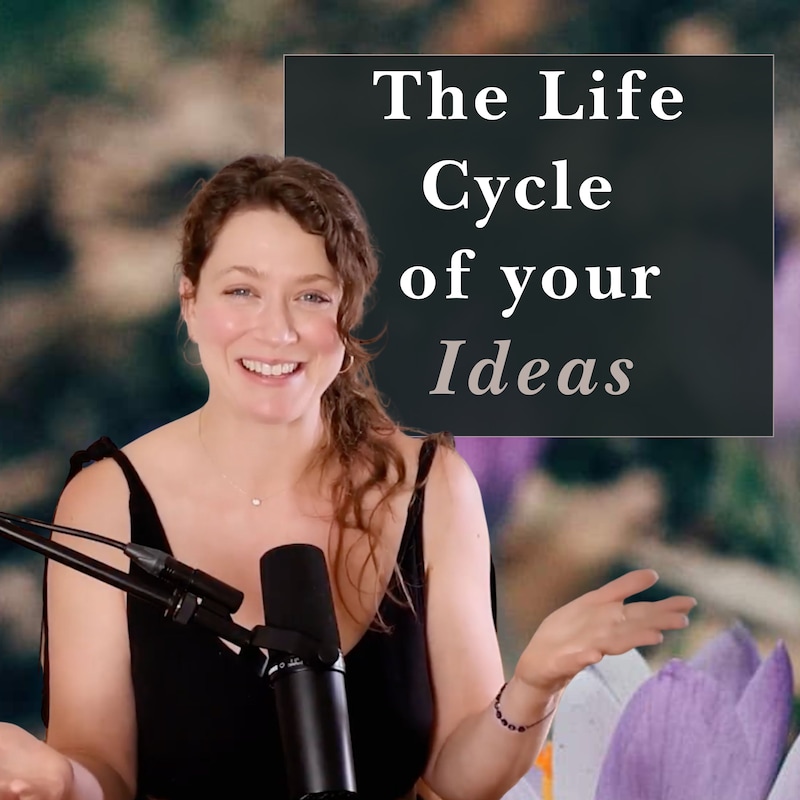
Speaker:I wanted to revisit this video
that I made a couple years ago,
Speaker:this transmission that came through a
couple years ago called The Life Cycle of
Speaker:Your Ideas. And really when
I first recorded this video,
Speaker:I was kind of in a winter of my creativity
and I really needed to be reminded
Speaker:that there is a life cycle to
our creativity, to our ideas.
Speaker:And so it's helpful for me
right now as I'm really in a ...
Speaker:Oh, I don't know what I would call it.
Speaker:I'm throwing a bomb of wildflowers
out on the side of the road and I'm
Speaker:just seeing what blooms. And
it feels so good. Actually,
Speaker:it feels so good to allow
myself to be a little less
Speaker:controlled or structured or
strategic, just being like,
Speaker:we are just going to see the whole side
of this highway and see what blooms.
Speaker:So that's where I'm at right now and
I'm curious to hear about where you
Speaker:are at. So let's dive into this
recording where I talk about the
Speaker:lifecycle of your ideas and you will
get a very clear picture as to where you
Speaker:are at in your own process
of creativity right now,
Speaker:whether you are in seeding,
fruiting, harvesting, composting,
Speaker:wherever you are at is a rich place to be.
Speaker:And this recording will help you
pinpoint exactly where you are.
Speaker:Creativity is a mystery and yet one
of the greatest feelings on earth
Speaker:is being in the midst of a creative flow.
Speaker:But creativity isn't a linear
process. It's cyclical.
Speaker:It's a cycle. And when you can
understand where you're at on the cycle,
Speaker:you can know what to expect next.
Speaker:There's lots of different ways
to look at the creative cycle,
Speaker:but I love seeing the creative
cycle through this lens of the plant
Speaker:cycle, the cycle of seed to fruit.
Speaker:So this will help you understand where
you're at with your creations right now
Speaker:and because you can understand
what stage you're in,
Speaker:you can be prepared for what might be
coming up for you right now and what's
Speaker:coming next. So let's
start with the seed phase.
Speaker:This is probably one of the most exciting
phases is when the idea first comes
Speaker:in. This is when you have
that spark, that ignition.
Speaker:This is when you get all
those seed packets in the
mail or you're going through
Speaker:the seed catalog and you're just so
excited. You order all the seeds,
Speaker:you get them all in line
and you think, "Yes,
Speaker:I have endless ambition and excitement
for this idea." So we all know this
Speaker:phase. We all love this phase. Many
of us want to stay in this phase,
Speaker:but this phase always seems to
move on. So what comes next?
Speaker:Germination. Now this is a
little bit more work, right?
Speaker:We get all these seed packets
in the mail and we think, "Yeah,
Speaker:I'm going to grow 10 different varieties
of tomatoes." But then when it comes
Speaker:down to it, we realize, okay,
Speaker:actually I only have space
for five different varieties
and I only have time to
Speaker:tend these different varieties.
Speaker:But germination is also still a fun
part of the idea cycle and the idea
Speaker:process. So in the germination cycle,
Speaker:this is often when we're taking those
first seeds, those first inspirations,
Speaker:and we're laying the groundwork.
We're digging them in,
Speaker:we're watching them grow, we're
seeing all these seedlings come up,
Speaker:but here's where we often hit one of the
first roadblocks and that's thinning.
Speaker:So when you are growing seeds,
Speaker:one of the first things you're going
to have to do is thin your seedlings.
Speaker:If you seed a whole tray, what
you'll notice is that many, many,
Speaker:many of those seeds will come
up. That's awesome and exciting,
Speaker:but you cannot grow all of
those seeds in your garden.
Speaker:You're going to have to
choose the strongest ones and
thin out the ones that are
Speaker:just going to crowd out
the plants themselves.
Speaker:So the same is true with your creative
ideas with the lifecycle of an idea.
Speaker:You need to be willing to weed out
the stuff that might be growing,
Speaker:might have taken root,
Speaker:but ultimately is crowding out your
vision for what you want this creation to
Speaker:look like or what this
garden is asking to be.
Speaker:So this is one of the first challenges
that come up on the lifecycle of a
Speaker:creative idea is this need to prune,
Speaker:this need to choose what you're going
to focus on because we can't grow
Speaker:everything in our gardens. We can't
make every idea come to fruition,
Speaker:but we do often need to sow our wild
oats in order to see what sticks.
Speaker:So it's okay in this phase to be trying
a bunch of different things based on
Speaker:your idea to see what works,
Speaker:but you do also need to be willing to
cut out what's not working at that time.
Speaker:So when I was writing my
book, Mirrors in the Earth,
Speaker:I had all these different stories
that I knew wanted to be in the book.
Speaker:I had these ideas and inspirations come
in and when I was in the germination
Speaker:phase,
Speaker:it was really exciting because I was
gathering these stories and I was putting
Speaker:them all into place. But at some
point I had to get real with myself.
Speaker:Not all of these stories
can be in the book. A,
Speaker:they're not all going to fit and B,
Speaker:they don't all flow together for the
greater narrative arc that I was looking
Speaker:for. So I had to get real and
cut some of those stories,
Speaker:cut some of those whole chapters because
it didn't actually feed the greater
Speaker:vision of my book. The next
phase is the maturation.
Speaker:So this is where the rubber meets the
road and this is for many people their
Speaker:least favorite part of the
creative process. In the garden,
Speaker:the maturation moment of the
life cycle of that seed when you
Speaker:transplant the seedling out into
the garden and you take care of it,
Speaker:this is a very exciting moment,
Speaker:but often the glow starts to fade
once that plant gets in the ground.
Speaker:This is where the hard work comes in.
Speaker:This is where you have to stay
on top of pests. Diseases,
Speaker:you have to keep the plant weeded and
mulched and watered. In the growing year,
Speaker:this would be like the height of summer.
And as any gardener will tell you,
Speaker:this is kind of the most miserable
time to be gardening in some ways.
Speaker:You're not yet to the
fruits of your labor,
Speaker:but you're not in that beginning phase
when everything's so fresh and exciting
Speaker:and manageable. Often this is when
things start to feel unmanageable,
Speaker:overwhelming, tedious, stay with it.
Speaker:You might be in this phase right now
with your idea or your creation where you
Speaker:feel like I'm just plugging
away, where is this going?
Speaker:This is so much work. I know I felt
that way for years with my book,
Speaker:Mirrors in the Earth.
Speaker:It was all about showing up every day
to sit down in that desk and write.
Speaker:And for me, it really
helped to set a timeframe.
Speaker:I'm going to write for one hour
every day this year. One hour,
Speaker:Monday through Friday,
Speaker:I'm going to show up at that desk
and I'm going to do the work.
Speaker:And the same strategy helps me in
the garden. I normally say, okay,
Speaker:one hour when the sun's lower in the sky
and it's a little less intense for one
Speaker:hour every day five days a week,
I'm just going to get out there,
Speaker:do a little bit of gardening,
do a little bit of weeding,
Speaker:do a little bit of mulching.
And the thing is it adds up.
Speaker:So oftentimes this stage can feel
overwhelming because when we neglect it,
Speaker:like when we neglect a garden,
it can get out of hand.
Speaker:If you do a little bit every day,
Speaker:this phase is going to feel
so much more manageable.
Speaker:You don't have to have your
creation complete in a week.
Speaker:This is not going to be the kind of thing
that you normally will work on in one
Speaker:day and finish your opus. No,
Speaker:this is something you need to spend a
little bit of time each day helping grow,
Speaker:helping to flourish,
Speaker:helping to come into the
next stage of its creation.
Speaker:So what is that next
stage? Well, in the garden,
Speaker:that next stage would be
the flowering of this plant.
Speaker:Now this is an exciting moment.
It's also a very vulnerable moment.
Speaker:So when is the flowering and the life
cycle of a creative project or an idea?
Speaker:That's when you start to share it with
the world. That's when you're like,
Speaker:"Okay, I think I'm ready.
Speaker:I think I'm ready to put this out
there in some way." So for me,
Speaker:when I wrote my book, this is when
the book came out into the world.
Speaker:It's when it first hit the shelves.
Speaker:The thing about flowering is it's
often when we plant the seeds.
Speaker:It's often the thing we're most
excited about. We think, "Oh,
Speaker:when that plant flowers, everything
in my life's going to be perfect.
Speaker:My garden's going to be full of roses.
Speaker:I'm not going to have any problems
anymore." The reality is when that plant
Speaker:flowers,
Speaker:you kind of realize that the whole purpose
actually of growing this plant was to
Speaker:be with it every step of the way.
Speaker:That flowering is just one part of the
journey and that it isn't even the end
Speaker:destination at all.
Speaker:Flowering in the life cycle of a
plant is a very vulnerable time.
Speaker:Everything has to go just right in order
for that flower to cross pollinate with
Speaker:other flowers, to have its seeds develop,
Speaker:to move on to the next
phase of its existence.
Speaker:So if you're feeling really vulnerable
at this stage, know that it's okay.
Speaker:It's okay to feel nervous.
Speaker:It's okay to feel fragile when you
put your creation out into the world.
Speaker:When I garden,
Speaker:oftentimes the flowering phase of
the garden is a really fragile phase.
Speaker:I have to baby the
plants during that time.
Speaker:Some plants need a lot of
extra care. For example,
Speaker:in the growing of the orchids
that make vanilla beans,
Speaker:those vanilla beans often
have to be hand pollinated.
Speaker:So people who grow these orchids will
hand pollinate each one of them in order
Speaker:for the vanilla beans to grow. Some
of our creations are like this.
Speaker:They need high touch. They need this
extra gentleness, love, and support,
Speaker:and you might need that too at this phase.
Speaker:So if you're getting ready to put whatever
your creation is out there and you're
Speaker:feeling a little bit fragile and you're
wondering, why am I feeling like this?
Speaker:When I was looking forward
to it the whole time,
Speaker:know that this is such a
natural part of the process.
Speaker:In the lifecycle of a plant, the flower
is when the plant fulfills its mission.
Speaker:It is able to finally give its gifts
to the world and those gifts are
Speaker:spectacular. They're
designed to be attractive.
Speaker:They're designed to call in
the pollinators to create more,
Speaker:to gather interest.
Speaker:And I guarantee you your project is too
in this flowering phase is all about
Speaker:bringing in those energies that are ready
to interact with this idea you have so
Speaker:lovingly nurtured. But this is
not the last step in the cycle.
Speaker:The last step is the fruit
or seed of this creation.
Speaker:So once you put your idea out there,
Speaker:once you share it with the world
and cross pollination can happen,
Speaker:then the fruits of your
labor come in. Now,
Speaker:when gardeners are planting the seeds,
Speaker:normally they're looking for either
two things, flowers or fruit.
Speaker:And this is often the goal. So if
you're growing tomatoes, you're like,
Speaker:"I want bushels and bushels of fruit."
And you often think to yourself,
Speaker:"This is the marker of true success,
Speaker:is how much fruit I grew."
But I'm going to tell you,
Speaker:over my years of gardening and
over my years as a creative,
Speaker:I have realized that what's
really successful is that
I learned along the way,
Speaker:that I had an experience,
Speaker:that I showed up every day for this
and that the process of creation
Speaker:taught me something about myself,
Speaker:that the process of gardening
taught me something about myself.
Speaker:The same is true for the
fruits of your labor.
Speaker:This is often the moment that people
expect to be overwhelming and it's bounty.
Speaker:Once I put this idea out there in the
world, people are going to rush in.
Speaker:All the opportunities
are going to be there.
Speaker:I'm going to have a pantry full
of food for many winters to come.
Speaker:Because we place such high expectations
on the yield of our creative projects,
Speaker:it can sometimes feel disappointing when
you put something out there and Oprah
Speaker:isn't knocking at your door.
This is just the way of it.
Speaker:And how we deal with this is
by changing our focus that
Speaker:it's not so much about
quantity, it's quality.
Speaker:What are the quality of the connections
that you made through seeing this
Speaker:idea to its full fruition? What are
the gifts that came into your life?
Speaker:What have you realized about yourself?
Speaker:What have you realized
about your creative process?
Speaker:All of these things are the true fruits
of your labor because ultimately we
Speaker:aren't following these visions.
Speaker:We aren't putting these inspirations
out in the world for affirmation or
Speaker:accolades. We're doing it because it's
a soul journey. It's a soul request.
Speaker:Part of our spirit new is important
for us to go on this journey.
Speaker:The same is true for gardening.
Speaker:We are called the garden not because we
want X amount of fruit in the pantry.
Speaker:We're called to garden because it's
a process of coming to know the land,
Speaker:of coming to know ourselves and
of coming to know these plants,
Speaker:the creations that we're
here to tend. That said,
Speaker:the harvest of this time
can also be magnificent.
Speaker:So if you are having bounty come your way,
Speaker:this is a time when you learn how to
receive, when you learn how to let it in,
Speaker:how to be nourished,
Speaker:you can kick back and relax and
just let it all flow to you.
Speaker:And the other side of the harvest is the
true final phase of a creative project,
Speaker:which is the compost.
Speaker:No creative project or no ideas
complete until you reach this phase.
Speaker:The compost is when you can take a look
at the whole season of your creation
Speaker:and really look at what
worked, what didn't,
Speaker:what did you love about the experience?
What could be different next time?
Speaker:What do you want to take with you
versus what do you want to let go?
Speaker:This compost is important.
Speaker:In the aftermath of an experience
of bringing an idea to light,
Speaker:you need to take this time to look at
it and understand what did I like about
Speaker:that process? What did that bring to me?
Speaker:What do I want to bring with me into
the next creative project and what do I
Speaker:want to let go?
Speaker:This can often be a fallow feeling time
where you're just kind of taking stock
Speaker:of where you've been.
Speaker:Maybe the pantry is full with fruit at
this time and you're just going to kick
Speaker:back and see who you are now and
what wants to come through next.
Speaker:I know that when I put my book Mirrors
and the Earth out into the world,
Speaker:I was five months postpartum and though
I was very excited to put energy behind
Speaker:this book, once the book was launched,
Speaker:I was ready to take a step
back and really look and see,
Speaker:really pay attention to what had worked
for me and what didn't to take that time
Speaker:to rest,
Speaker:be in this new phase of my life and really
give myself spaciousness for what is
Speaker:going to come up next. I wrote
that book in a particular way.
Speaker:It took me 10 years to write
and often in the beginning,
Speaker:I didn't know what I was writing. I didn't
know what the overarching theme was.
Speaker:It really took me the years of writing
it to understand what was trying to come
Speaker:through.
Speaker:Now I loved that process and I'm
excited to try a different process next
Speaker:time.What would it be like to have a full
idea and outline of the book when you
Speaker:first start writing? It's a different
experience. It's not better or worse.
Speaker:It's just different. So for me,
Speaker:it felt really nourishing to compost
some of that process to let it go
Speaker:and to make space for what
was ready to come in next.
Speaker:So where are you at in your
creative cycle right now?
Speaker:Do you have an idea that
you're working with?
Speaker:Where in this season of
growing is this idea?
Speaker:Do you have some clarity on that
now? And if you haven't read my book,
Speaker:Mirrors in the Earth yet don't wait
any longer. Go get yourself a copy.
Speaker:That book is such an awesome guide
for you in your creative process,
Speaker:in your process of unfurling.
Speaker:I've loved talking a little bit about
what it was like creating it behind the
Speaker:scenes and I'm so excited to keep sharing
this book with like-minded hearts
Speaker:like yourself.
Speaker:So I am truly curious where are you
at in the life cycle of your ideas?
Speaker:What is coming out for you this month,
this month that at the beginning of it,
Speaker:I very much implored you to follow your
creative impulse, whatever that is.
Speaker:The creative impulse though
can be planting seeds,
Speaker:just willy-nilly being like a Johnny
appleseed, or it can also mean being like,
Speaker:"I'm going to rip this up.
Speaker:It is time for this to be
done so something new can
take root." So I'm really
Speaker:curious to hear how this has been
unfolding for you this month.
Speaker:I'm going to continue to plant
all kinds of seeds over on my
Speaker:Substack, over in the Remember
Why You Are Here Space,
Speaker:and I would love for you
to enter that garden there.
Speaker:So as we move into the last week or
Speaker:so of this month, this month
of what has felt for me,
Speaker:really like this creative explosion, it
might feel a little different for you,
Speaker:but as we move out of June and
the next little bit and into
Speaker:July, I'm really curious if you can
just allow yourself to be where you are,
Speaker:to allow your creations to
flow the way they want to flow,
Speaker:to let yourself find delight
in the creative process
wherever you are at in that
Speaker:process and may this journey of being
Speaker:in relationship to the lifecycle of
your ideas help you remember that most
Speaker:important thing of all, why you're here.
