Shownotes
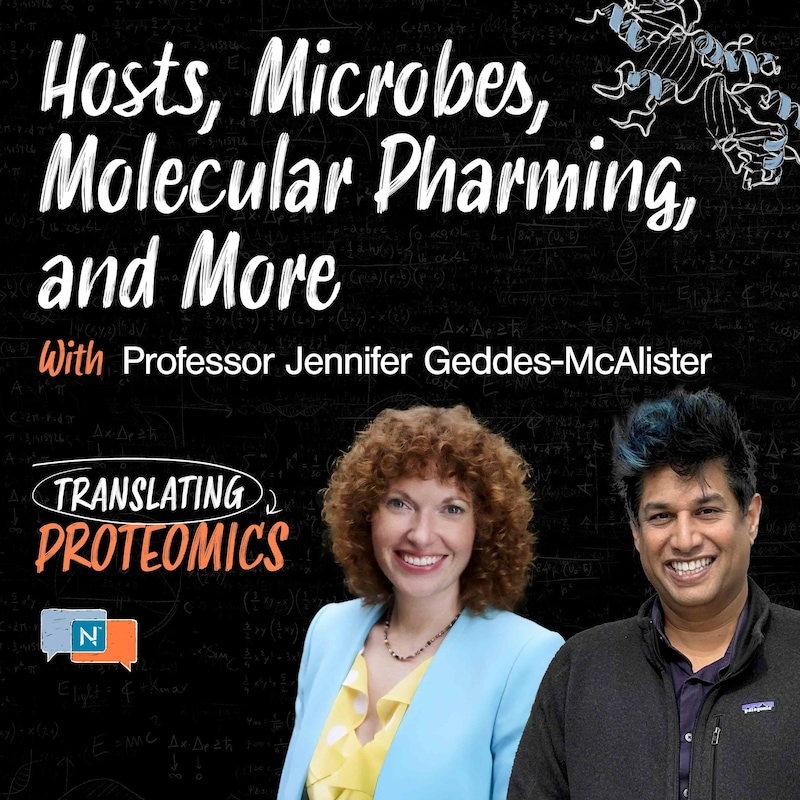
On this episode of Translating Proteomics, Parag speaks with Professor Jennifer Geddes-McAlister from the University of Guelph. Professor Geddes-McAlister is an expert at using proteomics to study host-microbe interactions from a systems biology perspective. Her exciting work spans studies of pathogenic fungi all the way to engineering plants to produce pharmaceutics (so-called “molecular pharming"). On top of all that, Professor Geddes-McAlister also founded “Moms in Proteomics” to support and encourage an intentional focus on the inherently unique physical, emotional, and biological commitments of Mothers, and the ensuing balance required to excel within the diverse STEM fields encompassing Mass-Spectrometry-based proteomics.
Dive into this episode to:
- Learn why it’s critical to study hosts, pathogens, and molecular pharming from a systems point of view
- Discover what Professor Geddes-McAlister is excited about for the upcoming Human Proteome Organization (HUPO) conference
- Find out what “Moms in Proteomics” has planned for HUPO
Chapters
00:00 - Intro
01:39 - Professor Geddes-McAlister's initial interest in host-microbe interactions
06:13 - Why it's important to study host-microbe interactions
08:10 - Pathogens vs helpful microbes
10:06 - Thinking about microbes through the lens of "One Health"
14:34 - Why Professor Geddes-McAlister works primarily in proteomics as opposed to other omes
19:44 - Professor Geddes-McAlister's favorite thing that she's learned from the proteome and couldn't learn from the other omes
24:56 - Molecular pharming
29:35 - The need for accessibility in proteomics
34:09 - The need for all-in-one workflows in proteomics
36:08 - HUPO 2025
39:56 - Moms in Proteomics
42:36 - The future of proteomics
43:59 - Outro
Resources
Geddes et al., 2015. Secretome profiling of Cryptococcus neoformans reveals regulation of a subset of virulence-associated proteins and potential biomarkers by protein kinase A
https://pubmed.ncbi.nlm.nih.gov/26453029/
Some of Professor Geddes-McAlister’s early work using proteomics to study pathogenic fungi
Prudhomme et al., 2024. Bacterial growth-mediated systems remodelling of Nicotiana benthamiana defines unique signatures of target protein production in molecular pharming
https://onlinelibrary.wiley.com/doi/10.1111/pbi.14342
Researchers from Professor Geddes-McAlister’s lab use multiomic techniques to discover factors impacting the production of a pharmaceutical in an engineered plant
Woods et al., 2023. A One Health approach to overcoming fungal disease and antifungal resistance
https://wires.onlinelibrary.wiley.com/doi/full/10.1002/wsbm.1610
Review on the importance of incorporating “One Health” principals into efforts to fight pathogenic fungi
Moms in Proteomics website
https://momsinproteomics.ca
Learn all about the Moms in Proteomics initiative and its international community
Transcripts
Foreign welcome back to Translating Proteomics.
Speaker A:Today I am delighted to welcome Dr. Jennifer Geddes McAllister, who's an associate professor in the Department of Molecular and Cellular Biology at the University of Guelph in Ontario, Canada.
Speaker A:Professor Geddes McAllister did her master's work with Brent Selinger at the University of Lethbridge, her PhD with Jim Cronstad at the University of British Columbia, Columbia, and her postdoc with Matthias Mann at the Max Planck Institute of Biochemistry.
Speaker A:She is a leader in applying proteomics and systems biology techniques to understand host pathogen interactions and is a strong voice for moms and proteomics.
Speaker A:Some of Professor Geddes McAllister's recent work focuses on how we can expand crop productivity and human health by better understanding the dynamics of fungal disease and resistance.
Speaker A:In a similar vein, her lab is leveraging proteomics and systems biology to learn how we can engineer plants to efficiently produce small molecules used to treat human disease.
Speaker A:This is a fascinating field of molecular farming.
Speaker A:That's farming with aph.
Speaker A: Human Proteome Organization's: Speaker A:I'm, I'm sure we're both very excited to connect with researchers of all types and backgrounds and learn how the field's advanced in the past year.
Speaker A:Jennifer, thank you so much for joining us and welcome to Translating Proteomics.
Speaker B:Yeah, thanks for having me.
Speaker B:I'm super excited.
Speaker A:There's so many fun things to chat about.
Speaker A:I'd like to start off by going back in time and understanding a little bit about how you got interested in host pathogen interactions in the first place.
Speaker B:For sure.
Speaker B:I, during my undergrad I was doing biochemistry and with a heavy lean towards biology and started working at the Agriculture Agriculture and Agri Food Canada Research center, which was really very much focused on crop improvement, food quality, food safety.
Speaker B:And I was working on fungal pathogens, which I always found very fascinating because a lot of work is on bacterial pathogens.
Speaker B:A lot of at that time, it wasn't that long ago, but long enough.
Speaker B:A lot of kits and things that were all designed for bacterial work and not fungal work.
Speaker B:So I just really love the challenge of it.
Speaker B:And that's when I first started doing proteomics and really starting to look at things differently.
Speaker B:So what makes pathogen a pathogen?
Speaker B:Why is it infecting a cereal crop?
Speaker B:How is the crop defending itself?
Speaker B:All those dynamics I found just very fascinating.
Speaker A:That's really interesting.
Speaker A:So you're Right.
Speaker A:I mean, my own background, I started studying first a very esoteric bacteria called Pyrobaculum erophyllum, and then moved into studying pathogens like tuberculosis and Leishmania.
Speaker A:But the interactions between the pathogen and human, or the pathogen and plant, that seems like an incredibly.
Speaker A:Like.
Speaker A:Studying the pathogen alone is hard.
Speaker A:Studying the human alone is hard.
Speaker A:Studying the two together seems like just incredibly, incredibly challenging.
Speaker A:And so was that part of what was exciting to you was just the extreme unknown?
Speaker B:I think so, I think for sure, because you can understand one side and understand, we know infection occurs, we know disease occurs.
Speaker B:And during my PhD, I studied the pathogen and I really focused on that and how it adapts to its environment.
Speaker B:And then during my postdoc, I was in a systems immunology subgroup.
Speaker B:And so that really started to bring about the host side of things.
Speaker B:And whether it be in a crop or in a.
Speaker B:A host, like a human host, the concepts are very similar.
Speaker B:You have your innate defenses, you have your adaptive defenses, all sorts of mechanisms at play.
Speaker B:And I think gaining that new knowledge of immunology and kind of being empowered to understand the host perspective, that's what really, like, led me to get to where I am now, looking at both the host and pathogen.
Speaker B:And you're absolutely right, one of them is challenging, so two is going to be even more challenging.
Speaker B:So I think you can learn a lot of things.
Speaker A:Yeah.
Speaker A:So maybe let's actually just go way back in time instead of talk about Cryptococcus neoformans and.
Speaker A:Or however one is meant to pronounce that properly.
Speaker B:You got it.
Speaker A:Oh, great.
Speaker A:Fantastic.
Speaker A:And.
Speaker A:And so tell me a little bit about how, how you came to study that particular pathogenic yeast.
Speaker A:Why.
Speaker A:Why it's an important thing to study.
Speaker A:Walk me back there?
Speaker B:Yeah, absolutely.
Speaker B:I think from my undergrad and my master's, that's where I studied Fusarium the AG.
Speaker B:And then for my PhD, I wanted to shift.
Speaker B:I still wanted to study fungi, but I wanted to look at the human relevant pathogens.
Speaker B:And so at the University of British Columbia, Jim Cronstad was a researcher there studying Cryptococcus.
Speaker B:There are not many fungal researchers.
Speaker B:And so I reached out to him and I was very passionate about studying and so he invited me to join his lab.
Speaker B:And I think it's an amazing pathogen because it's quite fascinating to study and it has global importance and relevance infections around the world and with immunocompromised individuals and kind of that.
Speaker B:The dynamic, the importance and dynamic that the host health plays on whether the fungi is a Pathogen or not was a very intriguing question for me.
Speaker B:And so that's what led me to study that pathogen.
Speaker B:And then when I started my own lab, I was able to bring the two of them together in the sense that I'd say half or a third of my lab studies crop relevant fungal pathogens and then another two thirds studied the human relevant fungal pathogens.
Speaker B:So I didn't set out to, you know, kind of have those two arms going within my research program.
Speaker B:But it's worked out beautifully and it allows me to kind of keep the, all the things I found interesting along the way.
Speaker B:I can keep going with them.
Speaker A:That's great.
Speaker A:Well, so maybe for those of us that are sort of new to this space, can you give me the headline kindergarten explanation of why and why we really need to understand host pathogen interactions and why studying host alone and pathogen alone isn't sufficient.
Speaker B:I would say that it's really important for us.
Speaker B:So each individual has their own immune system, their own way to respond to infections and the environment that surrounds them.
Speaker B:And that's based on genetics.
Speaker B:It's based on what you're exposed to on a daily basis, many different factors.
Speaker B:And so a pathogen does not know that.
Speaker B:A pathogen does not know what the host is going to be like.
Speaker B:Right.
Speaker B:It's not a relationship until they become together within the host environment.
Speaker B:And so I think that's why is because each system is its own operating component separately.
Speaker B:And when they come together, you can either fight it off and be healthy and get over a cold or, you know, get over an infection, because your body is built to do that or you don't.
Speaker B:And for those that do not, then there's a lot of implications downstream and you know, healthcare costs and quality of life, compromise, compromising and compromisation.
Speaker B:And so it's, I think, understanding that, you know, a pathogen is one aspect of the picture, the host is the other aspect.
Speaker B:And when they come together, we don't know the answer.
Speaker B:And each individual has a different mechanism or a different way to respond.
Speaker B:And so that means that each, we can learn a lot from every, every individual's situation and response.
Speaker B:And I believe that's part of why it's important to study both, because we can make treatments on a population basis, but if it doesn't work for one individual or one pathogen, it's not really that useful.
Speaker B:And so we need to be able to understand in many different layers.
Speaker A:That makes a lot of sense.
Speaker A:One thing that I'd like to understand a little bit more is when you think about Pathogens.
Speaker A:And I realize much of your work is on fungal pathogens, but what really is differentiating a pathogen from a helpful microbiota that is just part of our life?
Speaker B:Yeah, it's a great question.
Speaker B:And it really ties into that host pathogen interaction.
Speaker B:Right?
Speaker B:Because for Fusarium and Cryptococcus, they're not typically within the host, and so you can become colonized with them upon exposure from the environment.
Speaker B:But if we consider bacteria within our gut, or fungi within our gut, or microbes on our skin, of course we're not constantly infected with them.
Speaker B:So what is that trigger?
Speaker B:And there is a lot of research that goes into understanding, you know, how do they survive together and how do they adapt, and when is that dysregulation.
Speaker B:So one of the examples for fungal pathogens that I often think about is that if you're put on antibiotics for bacteria, bacterial infection, of course, then there might be side effects that come along.
Speaker B:Oral thrush is a common one where you have yeast that are able to grow in the absence of bacteria.
Speaker B:And it is a real, tangible observation of the competitiveness that goes on between microbes in our body.
Speaker B:Those microbes exist all the time, and yet we do not have the symptoms the same way all the time.
Speaker B:So it's this balance and it's disruption to that balance, and that's where you get the response.
Speaker B:And hopefully within a healthy individual or an immunocompetent individual, your body can bring you back to that equilibrium.
Speaker B:And again, each person has their unique equilibrium.
Speaker B:So it's fascinating to study the interactions of microbes together and then that switch to a pathogenic phase and as well as how external factors like antibiotics can impact that.
Speaker A:Yeah, that's really interesting.
Speaker A:And how much, when we think about interactions on a macro scale, we're often talking about ecology, talking about, you know, large animals interacting with other large animals.
Speaker A:How, how much, from your perspective, do those principles of ecology or systems ecology come out when studying these questions of.
Speaker A:Of biota interactions, Biota host interactions.
Speaker B:I think the.
Speaker B:I want to go with the principle.
Speaker B:So I.
Speaker B:My research program is kind of is built around a one health concept.
Speaker B:And when you talk about ecology and you talk macro scales, that's what comes to mind.
Speaker B:Because the principle of one health is that you're looking at the interaction across human health, animal health, and the environment.
Speaker B:And so you might be studying one microbe that is important for, you know, for a crop to thrive or within the soil, something like that.
Speaker B:But how is that microbe impacted by the whole environment?
Speaker B:And so that's what I think about when I think about ecology.
Speaker B:And one of the examples that ties into the work we do is looking at fungicides that are applied in the field to prevent fungal infections of wheat, for example.
Speaker B:Those fungicides then reset reside in the environment.
Speaker B:And if we look at that on a grand scale, the microbes within the environment are exposed to those chemicals.
Speaker B:And if it is a fungal microbe that is then, you know, infects a human, for example, we may be unable to treat it or it might be difficult to treat because it's already been exposed to these fungal drug or antifungal agents or, or fungicides.
Speaker B:And so kind of that whole systems approach as to how, you know, something that we, that we do that apply to the field so we have better food and food security and safety can actually harm how we treat infections in the clinic.
Speaker B:And that big picture concept is it's nice umbrella that helps us to stay with the vision of what we're doing and how important that minor discoveries in the lab can really have implications far beyond that.
Speaker A: really lovely paper in maybe: Speaker A:And so maybe walk us through a little bit where that concept emerged from.
Speaker A:When did you first see it?
Speaker A:How did you first interact with it?
Speaker B:Yeah, I would like to say that it was intentional, but it was not.
Speaker B:So what happened was, is that through my training, when I was studying agriculture health and fungal pathogens and agriculture and I bring that into my lab and then I'm studying human fungal pathogens in the clinical side and I brought that into the lab.
Speaker B:It was very much so that I could pursue multiple avenues for funding.
Speaker B:You can have industry partnerships.
Speaker B:It was very strategic in that sense.
Speaker B:But it.
Speaker B:They were two very separate programs.
Speaker B:And then being at Guelph One Health is a term that they really promote and advertise, but it's a very difficult to grasp term because a lot of people either feel excluded because they're not doing One Health research or it can be defined in like a million different ways.
Speaker B:And.
Speaker B:But that's also kind of the beauty of it.
Speaker B:And so with the flagship and Guelph Calgary is also doing a lot of One Health.
Speaker B:There's institutes in Switzerland.
Speaker B:It's becoming more of a globally known term.
Speaker B:And so when I was reading about it and this review kind of came up and we were looking at antifungal resistance and realized that these fungicides in the field, these azoles are what we use commonly to treat cryptococcal infection.
Speaker B:And it was kind of this serendipitous aha moment that I was like, oh, my whole program can center around this one health umbrella.
Speaker B:And, and I remember pitching that to some of my colleagues and they were like, oh, that's a good, that's a good idea.
Speaker B:And I'm like yes, it is, isn't it?
Speaker B:But it was, it was very much from the literature and, and reading what's been done and trying to find our own niche that, that it came about that that's.
Speaker A:I love hearing these stories of serendipity because that there is so much.
Speaker A:You're receiving inputs constantly and influencing your perspectives.
Speaker A:And so this sounds like a place where you really were able to synthesize multiple inputs to come up with a really unique thesis.
Speaker B:Thank you.
Speaker A:I'd love to dive in.
Speaker A:At the core of a lot of your research is proteomics as part of these studies.
Speaker A:Even going back to that sort of first, some of your first work and I'm curious why you could, you could study any ohm you like, you could, you do in fact study many ohms together.
Speaker A:But why did you choose to focus on proteomics in this space of host pathogen interactions?
Speaker B:Yeah, I, I probably do a lot of self reflection on this question for, for some reason, I don't know why, but for some reason I often think like why proteomics?
Speaker B:And I absolutely love it.
Speaker B:And, and I.
Speaker B:It's the technology, it's the discovery that goes with it, it's the computational advances.
Speaker B:Like it's, it's just something that has really grasped, grasped me from the very beginning with research.
Speaker B:And I remember I started doing 2D gels.
Speaker B:That was the first introduction to Cardiomyx and they were so difficult and I remember like endless times washing the 2D gel plates and you'd come in the next morning when they're dry and they'd have like soap residue on them and you'd have to start all again and it would be a day and the electrophoresis wouldn't run properly, all these things.
Speaker B:And when I think back to those days I'm like, why did I ever keep going with this?
Speaker B:Like it doesn't make any sense.
Speaker B:But I think it was the fact that I could tangibly see something on a screen like the dots from the 2D SCS page gels and then measure those on the mass spec and get an idea of what is going on biologically.
Speaker B:It was the, it was that aha moment for me as a student because, because everything else had been textbook or in a lab where it's very set up for you.
Speaker B:And the question is there.
Speaker B:This was the first time that I was able to kind of discover on my own.
Speaker B:And, and so I knew that no matter which questions I was asking or which pathogen or host system, proteomics was the technology that I wanted to, to use and apply.
Speaker B:And that's, that's what I've done.
Speaker B:Wow.
Speaker A:No, that, that's great.
Speaker A:It's amazing how these early choices can shape our, our path because it's possible that you might have, your very first technology might have been a fish assay or something like that, and then you would be doing transcriptomics for the rest of your life.
Speaker B:Oh, no.
Speaker A:Well, I guess just going down this theme, I'm curious, is there a question that you've encountered throughout your career where you look at it and you're like, you know what?
Speaker A:If I had tried to answer this with doing genetic knockouts or looking at transcript, I wouldn't have been able to.
Speaker A:The proteomics in particular was critical for answering this question.
Speaker B:Well, I could say that about any project, especially if I'm writing a grant, that would be easy, but I would say so we use proteomics a lot for discovery in my lab and then we follow it up with a lot of biological findings.
Speaker B:So genetic knockouts, as you say, sometimes we have to do RNA and QR codes, TPCR transcriptomics, it's not my favorite, but we do it sometimes to validate and see different aspects.
Speaker B:And so for me, if we, if we don't get kind of a thread of interest, where to start with proteomics, then we change the research question.
Speaker B:And that's because I think there's a lot of power there to, in looking at the proteins.
Speaker B:But that being said, with some of our biggest studies, one recently we were looking at antifungal resistance.
Speaker B:We also are very cautious to not say proteins are the most important or the only aspect.
Speaker B:We also do whole genome sequencing on our different isolates.
Speaker B:We may look at transcript changes across to see if it's a, you know, a consistent change in the protein or a post translational modification.
Speaker B:So we're like always open to using complementary approaches to further our argument.
Speaker B:And whether it be that the protein was the best way to do it or not, one of the most recent applications where proteomics really empowered our research, I would say, is, is a paper on the blood proteome and looking at diagnostic markers of cryptococcal infection.
Speaker B:And we wouldn't be able to find that with with genomics or, or transcriptomics.
Speaker B:And the idea of where we want to take this is into, you know, real world diagnostic approaches that are affordable and non invasive because right now a lot of them require spinal fluid taps and collection of cerebral spinal fluid to diagnose infection.
Speaker B:So if we can use proteomics to identify potential proteins for an ELISA assay that we could apply, that would be really empowering for our, for our group, but also for how we detect the pathogen and the infection.
Speaker A:Yeah, that's really, that's, that's a really powerful example.
Speaker A:One of your earlier studies was looking at the secretome and that's often a place where transcript simply doesn't know what is secreted or how that's changed.
Speaker A:And so I'd love to hear, you know, what is your favorite, your favorite study that you've done or like, wow.
Speaker A:I understand that all the ohms are important.
Speaker A:I'm a systems biologist also.
Speaker A:However, every now and again you look at something and you're like, wow, that the protein was the key driver of X.
Speaker A:And so I'd just love to hear what your favorite example of that is.
Speaker B:That's a good question.
Speaker B:It's like picking your favorite child.
Speaker A:I know, it's very challenging.
Speaker B:You do always have a favorite, so it's okay.
Speaker B:I would say our recent story on antifungal resistance is probably the kind of the most exciting in a sense, but also like the most intriguing because antimicrobial resistance, antifungal resistance is often tied to genetic factors, the mutations in genes.
Speaker B:And that is definitely a driving factor of it and how the pathogen evolves upon exposure to drugs, but it's not always the case and there's a lot of heterogeneity in resistance.
Speaker B:So we wanted to use proteomics to look at antifungal resistance in Cryptococcus.
Speaker B:And we identified, I think, six proteins that were higher in clinical isolate and our lab evolved isolate.
Speaker B:And so that was a cool moment where I thought, like, this is neat.
Speaker B:We never would have seen this.
Speaker B:And it's also not consistent.
Speaker B:So like a gene mutation stays once it's there, it usually stays unless it evolves differently.
Speaker B:But the protein level would go up and down depending on exposure to the drug.
Speaker B:And so it shows you the dynamics of a system and the dynamics of that resistance.
Speaker B:And so we showed that if we inhibited the protein, we could actually reverse resistance, which was really cool.
Speaker B:And we could turn it on and off so we could have the strain that's resistant inhibit the protein.
Speaker B:Then it's Susceptible.
Speaker B:And then we take, you know, change the media, it's growing in and now it's resistant.
Speaker B:So just that new understanding and kind of that new idea of where proteins can really play a role.
Speaker B:That's my favorite one so far.
Speaker A:That's really amazing.
Speaker A:And the dynamism, I think that's one of the aspects that's so special about the proteome is that it's, it operates at multiple different timescales.
Speaker A:Things like truncations or degradations.
Speaker A:PTMs are very fast and then you have turnover mediated things that require translating a protein and that can take a very long time for the signal to make it all the way back again.
Speaker A:And so those cycles that you're describing or changes per environmental context, dependent behaviors are, are so neat when you see them in the proteome.
Speaker A:I guess maybe carrying this on further, just thinking about you've done a lot of work in metabolomics and gene expression, et others.
Speaker A:How do you think about integrating the different OHMs together?
Speaker A:Every lab has their own style of way that they try to think about how the OHMs interplay, how they try to bridge the data.
Speaker A:How do you integrate the diversity of omics technologies together?
Speaker B:Yeah, it's challenging, right?
Speaker B:And I think every lab that does systems biology or does that integration, as you said, has their own way of doing it and that's usually through a lot of trial and error.
Speaker B:So you had mentioned the molecular farming study and that was one of the first ones where we integrated the two approaches.
Speaker B:We had proteomics of the plant and then looking at metabolites as well that were produced.
Speaker B:What was funny, not so funny for my PhD student, but kind of funny in hindsight is that, you know, we have the proteome and we can identify thousands of proteins.
Speaker B:And he was like, oh, what happens when I get so many metabolites and I don't know what to follow up on.
Speaker B:And I think in the end he got 14 that he was like looking at.
Speaker B:And so we were both very deflated because we thought we're going to have this like keg map of all these pathways and we're going to do all this amazing stuff.
Speaker B:And then he's like, I can just do this manually annotate it.
Speaker B:So I think the reality of systems biology is immense and enormous and exciting or maybe the thought of it is.
Speaker B:And then the reality of it is that it really comes down to your question and what you want to find.
Speaker B:So for some things looking at one metabolite can be enough because it's A promising antifungal candidate that you want to pursue for others.
Speaker B:You want to understand the whole pathway and how those compounds interact with others and that's much more dynamic.
Speaker B:So I think bringing the two together is a very conscious thing that we do from the outset of a project.
Speaker B:It's like we're going, this is going to be a metabolite focused project and we're going to complement it with proteomics or it's going to be proteomics all the way.
Speaker B:And we're going to see if we get a compound that we're going to then test out and see what the diet, what the target is that helps us to bring them together in kind of a sensible way.
Speaker B:Because otherwise it's, it is very challenging to mold it all together into a story that makes sense.
Speaker A:Yeah, I'd love to double click on this aspect of molecular farming.
Speaker A:Just how much can we do with molecular farming?
Speaker A:Biopharming?
Speaker B:Yes.
Speaker B:I'm not an expert in the area.
Speaker B:I would say this was a really neat opportunity to work with an industry partner.
Speaker B:When I first started my position, they wanted do proteomics.
Speaker B:And being new, I was like, yes, I can do that, no problem.
Speaker B:And so we set up a project and it was a four or five year project, this collaboration.
Speaker B:I had a PhD student working on it and it was not something I had ever explored before.
Speaker B:I had no idea what they were doing.
Speaker B:And the concept is, it's again taking this whole systems level approach in the ecosystem is that within the natural environment, agrobacterium bacteria infect plants, specific plants, and they cause these tumors.
Speaker B:And that's by, they inject their own DNA into the host and then they have the host produce proteins that they need to survive.
Speaker B:And so it's this, you know, fundamental concept that occurs in nature.
Speaker B:And so there's scientists that are then harnessing this as we do for many different kind of scientific innovations.
Speaker B:And so, but you could have a plant produce an antibody, for example, or a biologic or you know, another compound that you'd like.
Speaker B:And within a plant system you also are not, you don't have the same considerations perhaps as with like I'm thinking lifestyle choices like veganism, for example, they may not want to use components that come from a cell system or an animal model.
Speaker B:And so using the plant model, it's a, it's a different opportunity there.
Speaker B:And so companies that are doing molecular farming, they want to produce an antibody injected into plants using a natural process of this bacteria infecting the plant.
Speaker B:And then you collect the leaves, leaves extract it out, it's a very crude product and then you can purify it.
Speaker B:And so we were using proteomics to kind of understand each level, each layer.
Speaker B:So, you know, how's the best way to grow the bacteria?
Speaker B:What happens when you infect the plant?
Speaker B:Which, how do the bacteria respond and then how much product do you get at the end?
Speaker B:But how could you improve that output?
Speaker B:And that was our question with the paper was really can we help companies improve their molecular farming pipeline and get better yield fields?
Speaker B:And so we identified proteases from the plant that actually degrade the target antibody.
Speaker B:So we showed just a proof of principle.
Speaker B:It was a very early study for us to show if we knock down these proteases or one in particular, then there's more antibody produced.
Speaker B:And the particular example was a breast cancer drug.
Speaker B:Trastuzumab is the one that they were, the company was using as their flagship.
Speaker B:So it was such a neat way to, you know, kind of look at this natural infection.
Speaker B:But then how can we use it for health?
Speaker B:That I had never, I wasn't aware of before this opportunity.
Speaker A:It seems miraculous.
Speaker A:I and I.
Speaker A:One of the things that really stood out for me in the paper was that flask grown versus bioreactor grown bacteria actually had an impact on the, on the plant uptake behavior.
Speaker B:Yeah, it was really cool, isn't it?
Speaker B:It's so neat because you like the bacteria are primed to infect if they're growing in the bioreactor.
Speaker B:So it's this neat idea that they're ready.
Speaker B:So when you put them in the plant, they just go for it and they can do the infection really quick.
Speaker B:And yeah, it's not something I'd ever thought you'd see a difference of and how proteomics would allow us to see that difference.
Speaker B:It was very discovery and neat to see.
Speaker A:Yeah.
Speaker A:I mean, naively it makes sense post facto that these environmental factors change the proteome.
Speaker A:We see that in cancer all the time.
Speaker A:But in a bioreactor environment is different than how pathogens might grow naturally.
Speaker A:Microbes might grow naturally.
Speaker A:So I wonder also if there are other forces beyond what's secreted.
Speaker A:Maybe there are even things like density based effects, mechanical effects that drive those changes in behavior.
Speaker B:Absolutely.
Speaker B:And we only studied a few of them.
Speaker B:Right.
Speaker B:We had a very specific bioreactor system and then a specific flask system and just compared a few parameters.
Speaker B:But you could absolutely expand it and the size of the bioreactor would also likely.
Speaker B:Right.
Speaker B:Because then you have different quorum sensing and all different components.
Speaker B:So yeah, there's a lot, a lot to be done.
Speaker A:That's really neat.
Speaker A:Well, so I'd like to change gears a little bit.
Speaker A:We've talked about different ohms and proteomics and I'd like to put you on the spot a little.
Speaker A:And the technologies we have today are amazing and they're powerful.
Speaker A:But what is something that you wish you could do with your available platforms that you can't do today or that is hard, hard today?
Speaker B:Yeah.
Speaker B:Yes.
Speaker B:I think one of the biggest things would be accessibility of instrumentation.
Speaker B:So if I think about, for my own lab and you think about buying a mass spectrometer and you know, state of the art mass spectrometer and you're spending a lot of money on these instruments, the odds of having an undergraduate student being able to use that instrument or even a grad student being able to use it are very low.
Speaker B:And I know for myself, I did not have hands on, on a mass spectrometer until I was in my postdoc.
Speaker B:And so I learned so much within the first week and I gained so much confidence and more knowledge of how things were working and what a peptide actually meant in that week than, than I had in years.
Speaker B:And it was because I could actually touch the instrument, change the capillary, you know, understand when things were really hot, like a simple stuff stuff.
Speaker B:But, but that's really hard when we have instruments that are so expensive and that puts a lot of pressure on them operating all the time.
Speaker B:And so I think it would be nice to have, you know, you buy a big new shiny instrument and then you get like an older model that would be for testing and for training.
Speaker B:And it's like a two for one.
Speaker B:That would be.
Speaker B:What I would ask for is so that you can actually have everyone in your lab, hands on training, training on that piece of equipment so when they want to go get a job at a company, they can say, I've worked on your mass spec before, that would be really empowering.
Speaker A:Yeah, no, that's really interesting.
Speaker A:That's a, that's an aspect of the conversation that doesn't come up very often, which is just the accessibility of the tools and availability of the tools.
Speaker A:And I'm curious actually just to go a little bit deeper there because you mentioned as you got hands on with the mass spectrometer, it changed your understanding of the workflow and process of proteomics.
Speaker A:Can you just say a little bit more about that?
Speaker A:Because I think this is a place where oftentimes people coming from other domains, their assumption is, okay, well, you walk up, you press go, and proteome comes out.
Speaker A:And that's not actually what happens.
Speaker A:And there's a lot of detail and understanding.
Speaker A:And so I'd love to just go to that moment in your life where you weren't reliant on other, other folks as much and you were there face to face with the instrumentation yourself.
Speaker B:And you're absolutely right.
Speaker B:It has a huge role in, you know, how I see things and how I do things, how I teach now, whether it be, you know, at the instrument or it's theoretical.
Speaker B:Because when I didn't have access to the instrument, it was very much a black box.
Speaker B:And I never thought that I would be able to understand it.
Speaker B:I never thought that I'd be able to explain it or know what's going on.
Speaker B:And it's not because people wouldn't teach me, but it was because I had no visual connection to it.
Speaker B:So I remember early studies you mentioned about the secretome and there were some aspects of targeted proteomics in that, in that assay.
Speaker B:And I remember we were supposed to look at quadruples, but it meant nothing to me.
Speaker B:Right.
Speaker B:And, and these peaks, they meant nothing.
Speaker B:And so it wasn't until my, yeah, my first week during my postdoc when I was actually allowed to clean an instrument that I saw a quadrupole and I was like, oh my goodness, it's exactly what it looks like in the images and this is how it works.
Speaker B:And it really helped it click.
Speaker B:And I think that it works on both sides because yes, it's a very high end instrument and proteomics does require expertise to some level.
Speaker B:But really anyone can gain that expertise.
Speaker B:And especially now instruments are very automated.
Speaker B:So it can be a push this button, but you still want to know how it's working and what it's doing.
Speaker B:And I think the other aspect of that is the mass spectra, the de novo sequencing and understanding what a mass spectra is.
Speaker B:That's always been a very amazing aha moment for me when it came to mass spectrometry is it's like these peaks and what do they mean?
Speaker B:And you can actually interpret it.
Speaker B:So I think empowerment training, all of those aspects really make proteomics more appealing to more people if they know they can do it.
Speaker A:Yeah, that makes great sense.
Speaker A:And maybe just one more digging in a little bit deeper here as well.
Speaker A:Just about the data that you're able to produce, the questions you're able to ask, where are the boundaries of there if you could invent your magical perfect system to answer questions that you're like today, it's just difficult.
Speaker A:What would, what would that be able to do that you can't do today?
Speaker B:What is difficult now is probably the entire pipeline.
Speaker B:Like, so if I'm thinking about drug discovery, for example, and if I think about all the different layers that we use in my lab and all the different aspects and so if you use like computational ways to predict or design drugs and then you want to synthesize them and produce them in the lab and, and kind of each of those is its own individual piece.
Speaker B:But it would be really neat to have it all together in one workflow and have it so that it's like a given, it's like an automated system, right, where you have this amazing mass spectrometer, you have your data analysis tools, you've got the upstream, the downstream all together in a pipeline.
Speaker B:And that is my kind of dream of what I would like to build and incorporate.
Speaker B:That would all of the little barriers that exist in each of those pieces would no longer be there.
Speaker B:It would be one.
Speaker A:Yeah, just a whole integrated.
Speaker A:I think that's definitely something that we've seen in our lab as well, is that there is a lot of domain knowledge that's required.
Speaker A:Switching from X tandem to pick your favorite sequence analysis tool, they each behave just a little bit differently.
Speaker A:And so understanding how they connect together, there are a lot of little places where they're just tiny little friction points along the way that sort of coalesce into adding up into barriers to having more and more people joining us in the field and saying, yes, proteomics is a go to tool for me.
Speaker A:Switching gears entirely.
Speaker A:Let's talk about Hupo and then I want to talk about moms and proteomics.
Speaker A:What are you most excited about hupo that your lab is going to be sharing with with the rest of the world?
Speaker A:This, this conference.
Speaker B:So I'm very excited for HUPO to get started.
Speaker B:It's a lot of meetings in preparation for it and a lot of anticipation of the conference itself.
Speaker B:One of the most exciting things is that I have multiple people from my group coming from the agriculture health aspect, which they would typically not ever go to Hupo and I would not think to send them to hupo.
Speaker B:We have different conference proteomics, plant proteomic conferences that they would go to and more biologically relevant agriculture ones.
Speaker B:And so I'm super excited of the breadth that HUPO is bringing this year with and we have the theme One Health powered by Proteomics, but really having that take effect and come to play, where you have sessions dedicated to environmental health and session to clinical health, the integration with veterinary and animal health as well, and making sure that everyone still feels like it is Hupo and that it's the Hupo they know and love.
Speaker B:But we're also bringing in new aspects and new people, and I think that's super exciting.
Speaker A:That's really neat.
Speaker A:I mean, expanding the tent to your point earlier, all these things that live in agriculture affect humans and vice versa.
Speaker A:So that concept of bringing these pieces together is definitely a really exciting one and an opportunity also because it's closer to your backyard this year here.
Speaker B:Yeah, for sure.
Speaker A:And I guess are there other stories from other labs that you've heard snippets of that you, you're hoping to see more of at HUPO this year?
Speaker B:I think definitely the computational side.
Speaker B:Last year at Hupo, those rooms were not even standing room only.
Speaker B:They were out the door only.
Speaker B:So I think the hearing the latest of what people are doing with computational platforms and AI, of course, there's different chat bots now and agents that are supporting proteomics analysis and visualization.
Speaker B:So that side of it, I think is really cool and I'm definitely looking forward to seeing that and also having my students see the components that are, that are changing.
Speaker B:And the other aspect I would say is being able to kind of showcase the breadth of what's in the technology of where things are at and where they've been, where companies are going, you know, pushing the limits.
Speaker B:So I like, I enjoy going to the, the sessions as well, by sponsors and industry partners, so that you really get to see like, what is happening at the next stage and what can we look forward to?
Speaker A:Yeah, that's great.
Speaker A:Well, and just Hupo is such a distinctive meeting for, for you.
Speaker A:What is it that you like about hupo?
Speaker A:What's your, what's your favorite part about it as a conference?
Speaker A:There are so many conferences in the world.
Speaker B:World.
Speaker A:Why is Hupo.
Speaker B:Yeah, and, and each conference has its own place for sure.
Speaker B:In its own.
Speaker B:You know, I think with Hupo, it's the fact that it is a large conference.
Speaker B:It's our, you know, our largest proteomics conference that we have globally.
Speaker B:And yet it feels like a small meeting.
Speaker B:You, you know, it's a very connected network, very collaborative.
Speaker B:You get to see friends, you get to see colleagues from all over the world.
Speaker B:I love that it's so international that it rotates across the regions that you have, have so much it's so consciously diverse and that's not something that we typically see.
Speaker B:And it, so it exposes you to all different science and researchers and also gets feedback on your own science and exposes what you're doing to the world.
Speaker B:So just a great platform.
Speaker A:My last question in this line for you is about Moms and Proteomics.
Speaker A:For folks who aren't familiar, what is Moms and Proteomics?
Speaker A:Where did it come from?
Speaker A:And, and then I'd love to hear more about what Moms and Proteomics has planned at Hoopoe.
Speaker B:Yes, for sure.
Speaker B:Moms and Proteomics is an international initiative and now an international community.
Speaker B:We have close to 250 members from around the world and it's very much dedicated to supporting and recognizing mothers and women in STEM.
Speaker B: came about actually from Hupo: Speaker B:There was a call for hot topics in proteomics.
Speaker B:And at the time we were coming out of the pandemic and I had two young children at home and I was like, you know, what's a hot topic?
Speaker B:Caring for children while being an academic.
Speaker B:That's a hot topic.
Speaker B:And, and being a mom and trying to navigate everything.
Speaker B:And so I pitched this idea to, to the workshops and they were like, we were thinking like technology and things and I was like, trust me me, we can, we can do this.
Speaker B:And, and so they really gave me that first opportunity to build it into something and showcase it.
Speaker B:So it was very much a grassroots, bottom up community building.
Speaker B:And since then it's, it's, I've had different events, different activities.
Speaker B:We actually had a virtual coffee networking event this morning and, and now at Hupo, it's part of the program and every year we have different sessions.
Speaker B:And so this year I'm very excited we have our first time, we're bringing in an invited speaker to discuss resilience building and inclusion within the mass spec, the proteomics biology community.
Speaker B:So it's on the program I think for Tuesday included with registration and I think I'm really looking forward to it.
Speaker A:Oh, that's so exciting and very inspirational that you had this notion and were able to bring it into the world and now it's a thriving community.
Speaker A:That's, that's, I think that speaks volumes also just about how welcoming the proteomics community is to new ideas and that you can say, you know what, hey, this is hot, let's do this.
Speaker A:And it's a huge important part of the conference.
Speaker A:So for people who haven't been there, it really has become a very central part of Hupo and something that I'm so delighted is supported.
Speaker A:My last question for you is really very forward looking and I'd like you to put on your future.
Speaker A:Future you hat and you're 10 years from now, 20 years from now.
Speaker A:What is the thing that you look at?
Speaker A:Then you're like, okay, this is what I've learned, this is what I've been able to accomplish.
Speaker A:This is how proteomics has shaped my world.
Speaker B:Yeah, I think looking into the future, I would like to, you know, in all of our grants, when we write, you know, we're going to change the world, we're going to make a difference.
Speaker B:I would like that to actually be true and not just be a statement that I include the last line and really translate some of our early findings into tangible applications.
Speaker B:And whether that be in the agriculture field or whether it be in the clinic, entrepreneurial startup company and supporting my students through that journey as well because many of them are very interested and passionate in industry and translation knowledge.
Speaker B:Translation.
Speaker B:And so I think looking forward that, yeah, moving things from discovery into where we actually produce it or we provide this translatable application, that would be the probably the most rewarding component.
Speaker A:Well, I look forward to seeing that come into reality.
Speaker A:I totally believe that is coming and we're seeing it all over the place throughout our community.
Speaker A:Thank you again so much.
Speaker A:This has been so much fun.
Speaker A:I'm really grateful that you were able to join us today.
Speaker B:That's wonderful.
Speaker B:Thank you.
Speaker B:I really appreciate it.
Speaker B:We hope you enjoyed the Translating Proteomics podcast brought to you by Nautilus Biotechnology.
Speaker B:To contact us or for further information, Please email translating Proteomicsautilus.Bio.
