Shownotes
Data is everywhere in manufacturing. Competitive advantage comes from turning it into action, where the work happens.
In this episode of the Auto Supply Chain Champions Podcast, Jan Griffiths and Tom Roberts sit down with Tom Luttrell, CIO of CSP, to discuss what it takes to modernize technology inside an automotive manufacturing company and why the future belongs to companies that move beyond systems of record and embrace systems of action.
With more than three decades of experience leading technology transformations across automotive manufacturing, Tom shares how he approached his first year at CSP by listening first, understanding business problems before technology solutions, and building a roadmap centered on simplification, automation, and employee empowerment.
The conversation explores the realities of disconnected systems, fragmented workflows, and siloed data that slow execution across manufacturing organizations. Tom explains why modern ERP platforms, AI-powered workflows, and agentic technologies can place critical information directly in the hands of maintenance technicians, operators, and frontline teams when they need it most.
Rather than focusing on technology for technology's sake, Tom emphasizes a people-first approach. Success comes from making employees' jobs easier, reducing friction, improving decision-making, and creating tools that respect human expertise while accelerating action.
In the latter part of the episode, QAD's Tom Roberts reflects on the shift from systems of record to systems of action, the role AI plays in uncovering the "why" behind operational issues, and why technology leaders must communicate in business terms rather than technical language.
Themes Discussed in This Episode
- Why manufacturing leaders must move from systems of record to systems of action
- Building a data-first culture that drives execution, not just visibility
- Modernizing legacy technology without disrupting the business
- Using Agentic AI to put knowledge in the hands of frontline teams
- Empowering maintenance technicians and operators with real-time decision support
- Making manufacturing execution systems work for the people doing the work
- Designing technology around human behavior and user adoption
- Eliminating friction between data, decisions, and action
- Balancing cybersecurity, productivity, and business outcomes
- Leading enterprise transformation through trust, relationships, and business alignment
This podcast is powered by QAD RedZone.
Featured Guest
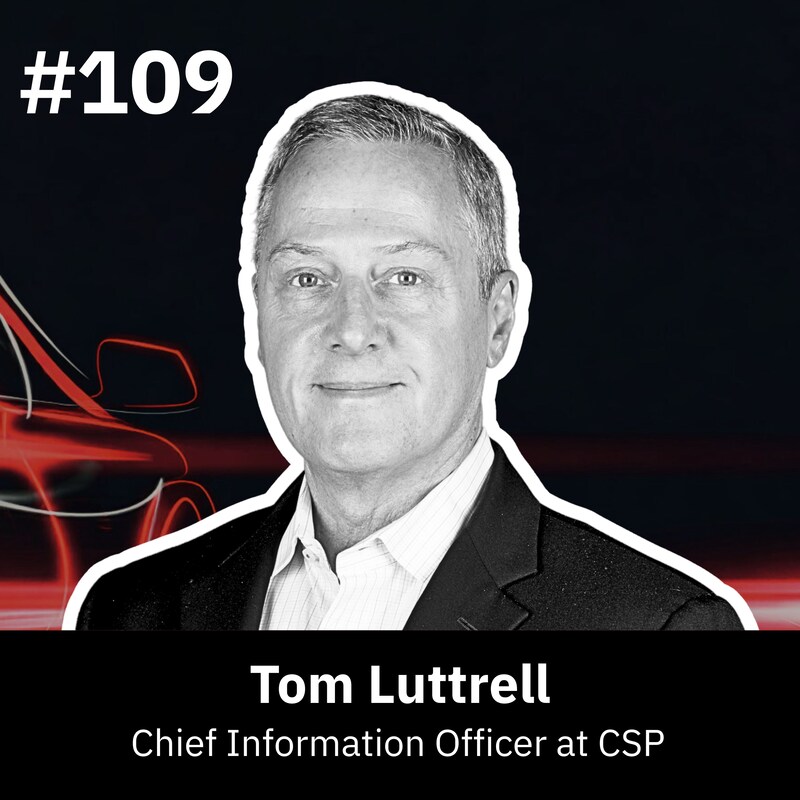
Name: Tom Luttrell
Title: Chief Information Officer at CSP
About: Tom is Chief Information Officer at CSP, bringing more than 30 years of experience leading digital transformation, ERP modernization, cybersecurity, and business growth initiatives across the automotive and manufacturing industries. Prior to joining CSP, he held CIO leadership roles at RealTruck, Shiloh Industries, and Masco Cabinetry, where he led large-scale global technology transformations, ERP integrations, and operational improvement initiatives. He holds degrees in Computer Information Systems and Business Administration and continues to advance his expertise in cybersecurity and risk management.
Connect: LinkedIn
About Your Hosts
Jan Griffiths
Jan is the host and producer of the Auto Supply Chain Champions Podcast and The Automotive Leaders Podcast. A former automotive manufacturing and supply chain executive, Jan is recognized as a Champion for Culture Change in the automotive industry. She brings direct, grounded conversations to leaders navigating execution, disruption, and transformation across the global automotive ecosystem.
Tom Roberts (Co-host)
Tom is Co-host of the Auto Supply Chain Champions Podcast and Vice President of Strategic Industry Development at QAD. He works closely with automotive and industrial manufacturers to close the gap between insight and execution, helping leaders move from visibility to systems of action that drive real operational outcomes.
Episode Highlights
[02:17] Building a Data-First Culture: Tom explains his mission at CSP: modernize the technology foundation, create a data-first culture, and make it measurably easier for employees to do their jobs.
[03:23] Listen Before You Lead: Technology transformation begins with understanding the business. Tom spent his first ninety days assessing systems, processes, talent, and trust before making changes.
[06:40] From Systems of Record to Systems of Action: Traditional ERP systems capture transactions. Modern systems sense issues, trigger action, and help teams respond in real time before problems escalate.
[08:30] AI for the Frontline: Instead of searching through hundreds of documents, maintenance technicians could use AI-powered tools to instantly access answers and solve problems faster.
[10:46] The Point of Impact: The greatest value comes when critical information reaches the person closest to the problem, enabling faster decisions and better quality outcomes.
[12:18] Reimagining the Shop Floor Experience: Tom outlines his vision for manufacturing execution systems that provide real-time visibility, automate routine transactions, and simplify work for operators.
[13:46] Technology That Works for People: Whether through automation, scanning, image recognition, or AI-driven workflows, technology should remove friction rather than create it.
[15:39] Speaking the Language of Business: One of Tom's biggest leadership lessons was learning to frame technology initiatives around business outcomes, not technical specifications.
[17:42] Cybersecurity Without Creating Friction: Security matters, but successful technology leaders balance risk mitigation with maintaining productivity and enabling business operations.
[21:08] The Power of Systems of Action: Tom Roberts explains how AI can move organizations beyond reporting what happened toward understanding why it happened and what action should happen next.
Top Quotes
[02:52] Tom Luttrell: “ The reason why I came in was to modernize our technology foundation for the company and to build a data-first culture, and to make it measurably easier for our employees to get their jobs done.”
[10:55] Tom Luttrell: "You're putting the information in the hands of what I would call the point of impact, which would be the maintenance tech at that specific press looking at that specific problem."
[16:20] Tom Luttrell: “ You have to primarily come at things from what problem are you trying to solve from a business perspective.”
Follow the Auto Supply Chain Champions Podcast for real conversations with leaders who are making hard choices, focusing their bets, and leading with intent.
🎧 Follow the podcast:
🔗 Learn more about QAD Redzone: https://www.qad.com/
Transcripts
[Transcript]
[:[00:00:30] Tom Roberts: Great to be here, Jan. What I see every day is simple: manufacturers don't have a data problem, they've got an execution problem. This show is about how artificial intelligence, systems of action, and empowered teams can help close that gap.
[:Hello and welcome to another episode of the Auto Supply Chain Champions podcast. And today, we are excited to talk to a CIO. Now, we've had a few episodes where we've talked to VPs of supply chain and leaders in the automotive industry within the supply chain space and we've talked about their journey, but today is special because we are gonna talk to the person, the leader, who has to actually make it happen. We talk on this podcast all day long about moving manufacturing from a system of record to a system of action. Our guest today is actually making that happen.
Today we're gonna talk to Tom Luttrell, the CIO at CSP. Tom has spent three decades as a CIO inside automotive and manufacturing with Federal-Mogul, Masco, Shiloh, RealTruck, and now CSP, so he knows this space. And Tom's gonna talk to us about his mission at CSP, and why putting real data in the hands of the people closest to the work is how manufacturing wins. Tom, welcome to the show.
[:[00:02:14] Jan Griffiths: So, tell us a little bit about CSP. How long have you been there?
[:So, when I came in about a year ago, the reason why I came in was to modernize our technology foundation for the company and to really, as to your point, Jan, around data, to build a data-first culture. And last but not least, is to make it measurably easier for our employees to get their jobs done.
[:[00:03:23] Tom Luttrell: Sure. So, I started, as any leader, regardless if it's technology, marketing, sales, whatever. When you join a new company, you have to start by listening. So, you have to understand the business problem you're trying to solve, right? That's what I did. Before building anything, before making any changes, I spent the first sixty to ninety days doing an honest inventory of the technology, the talent, the business processes, and most importantly, the trust that the organization had in the IT team.
So, from a technology standpoint, we had a very large portfolio of applications, and none of them talked to each other. So, if you think about trying to execute a business process like quote to launch across six or seven different applications that don't talk to each other, systemic waste existed. So the data was siloed, and the workflows were fragmented, and we ran a lot of risk because these systems were disconnected, and many of them were not supported. So again, my mandate was clear: reduce risk, improve the workflows, and simplify through consolidation.
Before starting anything, you have to understand why do those systems exist? It's not as though people woke up one day and said, "Hey, I wanna implement ten different systems," right? There was a very real business reason why the organization did what they did, and that's really where the work began. So, that inventory and then developing that strategy on how to meet the mandate, which was simplification, risk reduction, and automate, as much automation as possible.
[:[00:05:05] Tom Luttrell: Sure. Well.
[:[00:05:13] Tom Luttrell: Well, I guess I would start with, relationships matter right? At any level within an organization. And the reason why I joined CSP was because I had previous relationships with many of the executives that the CEO brought on board to this company. I knew their leadership styles. We had operated together. We had gone through the battles of ERP implementations together. So, there was an inherent trust that existed that I had of them, that they had of me, and that opened the door for me to go get in and start looking at business processes and coming at it though from the business angle. Not coming in and saying, you know, "Let's talk about how you're hosted," or, "let's talk about technical things." It was more around, hey, how do these systems that exist, how do they support your business processes? Not only today, but where we want to go as a company. And the reason why I'm here is because we want to build, right? We wanna build something very sustainable. We wanna improve the value of the company. Again, the business folks were like, "Yeah, we understand that the technology might not serve us, and these are the gaps that we see in the technology or even in the business processes."
[:[00:06:40] Tom Luttrell: So, the traditional view of systems were right that they were master data based. And master data is extremely important, getting it right and having it drive your business processes are important, but the traditional ERP systems, that's all they really did, right? They were transaction processing systems. So, what we're doing is we're upgrading our transaction processing system to QAD adaptive, which is really gonna be that system of action, right? Which is, how do you set up agents? How do you have it sense when things are out of tolerance, and how do you have it notify you so that you can take action to improve an out-of-tolerance condition real-time when it's happening versus some reporting that happens at the end of a week or a month? So, that's how we're doing it.
[:[00:07:54] Tom Luttrell: Sure. And I would just add on to that, Jan, that not only are we doing our ERP system, but we're touching pretty much every other system that exists from a core business perspective. So we're either upgrading, replacing, or integrated everything that exists. So it's a pretty broad initiative over the next eighteen months. So, when you are going about that, you have to start with at least making sure that the new tools do what the old tools did. Not exactly, but at least in a familiar way, right? You don't wanna have any technical downgrades. We wanna make sure that the capabilities exist. So, I think that's the first thing is trying to create some degree of familiarity between the old and the new. And then you can start talking about, well, if it could do X, Y, or Z.
So, an example would be, in our main-maintenance management area, they have massive amounts of documentation around FMEAs, PFMEAs, you know, process controls. And the way they serve it up to our manufacturing facilities is document-based, right? So, if you have an issue, you have to go out and search some PDFs, right? So, when we think Agentic AI, what we wanna do is we wanna create an automated help desk solution for them, right? That they can query it, they can talk to that massive treasure trove of process data, and they can have it answer questions. So, if something's out of tolerance, they can say, "Have you ever seen blistering before?" Right? "And what would be the process control parameters that we would have, you know, that we would wanna tweak to make that blistering go away?"
So, to answer your question directly, it's around AI finding use cases or ways of using the technology that are maybe familiar, or if they're not familiar, that there's a analogy or corollary somewhere that it would be like, "Oh yeah, I've seen that somewhere else," where I go out to a bank website, and I can talk to an agent or things like that. Again, you're trying to bridge that gap between, this maybe the transactional systems that exist today and then some of those advanced capabilities that are gonna be existing with Agentic AI, Agentic ERP, and things like that.
[:[00:10:46] Tom Luttrell: Yeah, for sure. And we would even say from a quality perspective, you fix it quickly and upfront versus making a bunch of parts that might have that same defect in them. So again, you're putting the information in the hands of what I would call the point of impact, which would be the maintenance tech at that specific press looking at that specific blistering or whatever it might be. So, to your point, yes, it's faster. There's a bottom-line impact. There's also a customer impact where we're not releasing parts to them that might have defects in them.
[:Now, you're coming in as the CIO, and you're thinking, "Okay, so now I need to put actual data in the hands of the shop floor." 'Cause so often, we just have whiteboards on the shop floor, and then you can't read the writing, or there's a document that somebody has to print with the status of that line or the status of the machine or the quality problem. And sometimes it's updated, and sometimes it isn't. We've seen those problems time and time again. Tell me about your vision for the shop floor employees.
[:Our vision for them is to make things as visual as possible. So again, when we're talking about a press and what's the standard throughput for that press, right? How is it running? Is it running efficiently? Is it running ahead? Is it running behind? Making it very easy and visible for an operator to walk up and be able to assess the condition of his or her operation. So, that would be one part of it.
The other part is, if there is transactional data that needs to be entered, finding ways to do it as efficiently as possible, through scanning, through automated counting. Instead of having somebody counting production, have the PLC count and report back production to the MES system.
So ways that we can take maybe some of the less value-added or non-value-added transactional data and get it automated. Scrap data, right? So, if a part is scrap, have it be detected, automated in an automated way, and have the operator, if they have to look at it and say, "Well, this is the scrap reason code," make it easy for them. Not have three hundred different codes, right? Have the strategic view so that they can report scrap and categorize it correctly, so then again, going back to the maintenance tech, they can come back, and look at it and say, and even in the maintenance tech, the operator could take a picture of it and have that create an automated work order for the maintenance tech to say, "Hey, we have this condition going on at this press."
[:[00:14:12] Tom Luttrell: Sure. I would agree with you on that. It's hard though, right? I mean, you know, as technologists, we focus a lot on trying to do things right and implement things flawlessly and the capabilities, more and more capabilities within the solutions versus, hey, what are the strategic few things that we can deploy to make the operator or the employee's life easier?
[:[00:15:39] Tom Luttrell: That's a great question. So, I grew up in technology, from an early day of being a programmer, making it into leadership positions. And then, I realized that coming at things always from the technical standpoint, I would lose my business counterparts. So, I would come in just excited about a new program that I wrote that would satisfy their needs, and I remember one of my users at Federal Mobile was, he would look at me and he'd say, " I have no idea what you're talking about." Right? So, he said, "Come back in here and talk about things in a way that I can understand."
So, it's really about framing the issue in the business context. So, that's what I coach my son on this, right? I would coach any of the leaders that I work with in the IT spaces. You have to primarily come at things from what problem are you trying to solve from a business perspective? 'Cause that's where you win. If you can win 'em over to say, "I understand you. I understand your pressures. I can't feel them directly, but I can conceptualize them, and I will bring you solutions or capabilities to help relieve those pressures." So, always come at it from a business perspective, either talking about ROI, time, consolidation, expense, speed, whatever it might be, efficiency. Those are the terms that business leaders understand.
[:[00:17:42] Tom Luttrell: Yeah, and I think cybersecurity is a perfect example of where bridging that gap is so critical, right? I've been through cyber events in my career, and what we tend to do as IT folks is we tend to slam in a bunch of technical controls after an event. We lock things down. That's never gonna happen to us again. So, the good news is, yes, we've mitigated risk. The bad news is the business can't get anything done because everything's so locked down so tight. So trying to find ways of bridging the gap between a technical control and what business outcome or what is it mitigating, and then relaxing where the risks are maybe less, right? Or finding analogies in their personal life that they can understand. For example is, you would never share a password for your bank account. You want multi-factor authentication when you're doing banking transactions, right? So, we would wanna train or treat our business transactions with a similar level of concern because they're just as important from a business context.
[:[00:18:48] Tom Luttrell: You're welcome, Jan. It was a lot of fun and hopefully I'll be invited back at some point in the future.
[:[00:18:58] Tom Luttrell: I'm absolutely up for that.
[:[00:19:00] Tom Luttrell: You're welcome.
[:[00:19:27] Tom Roberts: There's a lot here, Jan. And coming from a career in IT before I joined QAD, I would have a lot of the same points. And I think he brought some new things to this. One of the things that really stuck out to me was, obviously using QAD and talking about your ERP and QAD as a system of action, not a system of record. I was having a conversation with a longtime colleague yesterday, and we were talking about core ERP. And again, I was in another ERP solution before I joined QAD. I've seen a number of them. A lot of the core functionality outside of what I think we're seeing in AI, I don't know if it's really changed a whole lot since I first saw ERP in the late nineties.
Now, I know everybody's gonna bristle at that, but what I mean is you could create a journal entry then, you can create a journal entry now, and I don't think all of the transactional capture is vastly different. You can run an AR aging report back then, in the mid-two thousands, you can run one now. And there's some good different dimensionality characteristics in there now that might not have been there, and the reports are probably easier to create now, but the end result of what it's showing you, thirty, sixty, ninety, M and S too, you know, it's a lot of the same things that we saw many years ago before the advent of AI.
Now, when he talks about system of record becoming a system of action, well, now, not only do you get the what, like I have scrap. Well, now you can get why, because you have the intersection of so many different data sources, and you can say, "I have scrap because I worked in a certain area that required a certain temperature in the plant or certain settings on the machine, and they weren't calibrated to the correct settings, and it generated scrap."
Or the user wasn't trained on the machine, and it tells me, "This user was logged in, who performed the action, was not certified for the machine. It's likely that the probability is high that this contributed to the scrap." You get the why. Then, it can get to the, now go take this action or even jump in front and say, "Hey, we're preventing this particular scenario." And I know this is really sensitive one in automotive. You don't necessarily wanna stop the line, but you have the option to maybe create some of these preventative scenarios to say, "Hey, the way that the data lines up to AI right now is not a good scenario, so maybe we need to warn somebody."
So, I really appreciate what was being said about that. Frontline over dashboards. And again, in IT, I will admit, you always want to bring the wow factor. You have to bring the nuts and bolts, you have to bring the ones and zeros, but you do, at the end of the day, you know, IT can be sometimes, kind of a back office function. And you wanna do something that shows, "Hey, we really are capable of giving some great dimensionality, some great information and action," but often, it's just get the shop floor better. We're trying to get products out the door. We're trying to get quality products out the door on time without incurring premium freight at optimal cost, and it's the shop floor that runs all. So again, that really resonated with me, Jan, as well.
[:[00:22:46] Tom Roberts: Yes.
[:[00:23:03] Tom Roberts: Absolutely. Absolutely. I think that is the key. Yes, we've been working on Pokey Oaks for many years, trying to funnel people into a very specific process and different things. But when you do have the process discipline, but you have the ability to see data and report out on other data points, when you can bring both of those together, that's when I think you can really shine because you have a very disciplined process, but when you get exceptions to that process, you need to be able to collaborate. You need to be able to get information back to the community around you in the plant so that other people can act. So again, incredibly important.
The other thing I think that really stuck out was, he talked about the career lesson that sells AI internally. So, he learned something earlier in his career. He actually mentioned Federal Mogul. A Federal Mogul user said to him, "I have no idea what you're talking about." So, tom is trying to explain something to the user, and he was too technical. He felt-- I think he was a little too wonky or a little too, just far too much into the weeds in the technical area, and the person just didn't speak the same business language.
So, what he was saying is frame everything in business terms: ROI, time, speed, efficiency. If you're talking with people in finance, internal rate of return, stick with the things that are applicable to the people that you're talking to. And again, I've had some good days and where I think I did well in IT, and then there were other days where it was just too technical, and I needed to direct myself and my organization to make sure we're speaking in business terms. And again, I really appreciate those comments.
[:[00:24:49] Tom Roberts: Fantastic. Incredible.
[:[00:25:06] Tom Roberts: Thanks, Jan.
[:
