Shownotes
Healthcare doesn’t struggle because of a lack of data or innovation.
It struggles because of admin.
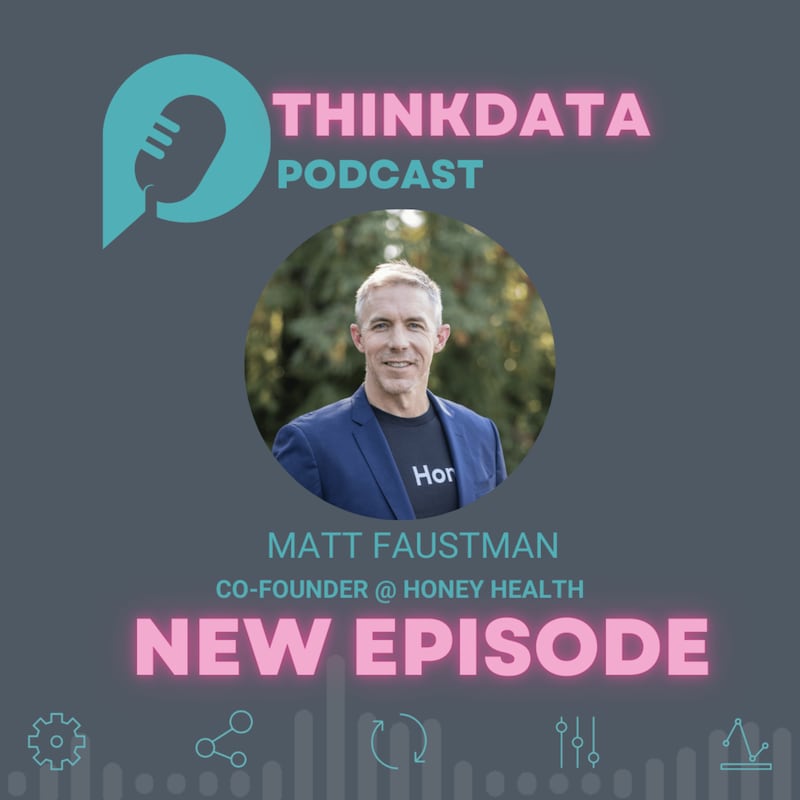
In this episode of the ThinkData Podcast, I sit down with Matt Faustmen, Co-Founder and CEO of Honey Health, to explore why back-office operations are the real constraint in modern healthcare, and how autonomous AI agents can finally unblock them.
We talk about:
- Why EHR add-ons and traditional automation fall short
- How Honey Health decided which customers to go after first, and what they got wrong
- What makes AI agents fundamentally different from workflow tools
- Where Honey’s real competitive advantage comes from
- And the company Matt is actually trying to build over the next five years
This is a grounded, operator-level conversation about building AI for real systems, real constraints, and real outcomes, not demos.
If you’re building in healthtech, AI infrastructure, or regulated industries, this one’s worth your time.
Transcripts
Welcome to the Think Data podcast brought to you in partnership with Mydataworks. If you want to stay up to date with the latest breakthroughs and trends in the world of data and artificial intelligence, and if you're curious about some of the strategies that companies and founders use to launch data and AI products, then you're in the right place. Our aim is to bring together a diverse lineup of fantastic guests from the founders, through to accomplished leaders and product owners at some of the most fascinating data and AI companies worldwide. They will each offer you their own unique insight into what it takes to launch and scale a great data business. Thanks for tuning in, and I hope you enjoy the episode. Welcome to the Think Data podcast, and this morning I have the pleasure of speaking to Matt Faustman. He's the co-founder and CEO of Honey Health. Honey Health, they build autonomous AI agents that plug into healthcare systems. And their solution really is to automate all of the back office admin, cut costs and free up clinicians to ultimately focus on what's important, the patient care. Obviously, taking a look at Matt, your kind of background beforehand, I did notice this kind of this one line on your LinkedIn bio, which I hope you'll give the listeners a... a small insight into who we've got on, kind of math geek, to biochemistry, to lawyer, to founder, to product leader, and again, back to founder. So yeah, it seems like you've been there, seen it, done it, and are doing it again. So I'm glad to have you on. And for people who haven't come across you or obviously Honey, can you kind of bring us up to speed with who you are?
Matt Faustman:Yeah. So as you implied, it's been a very non-linear journey. But I think as you get older, you start to realize. None of our paths are really linear. They make sense as we look back. But I've had the opportunity to work across a lot of different things here in Silicon Valley. But, you know, for the last two decades, I've been working in products and startups and also within big tech. Big focus there has been on AI, right? And this is what AI looked like 20 years ago versus 10 years ago versus what it looks like today is very different. All of our team came together at LinkedIn and Microsoft, and we had been working on a number of AI initiatives across those two massive organizations. And one of these ideas that we started to come up with this was kind of an idea of an AI staff, right? The ability to deploy something that could truly work autonomously in the background. Now, you could apply that to so many different types of organizations, logistics and real estate, all of these. different types of industries that have huge administrative work or paperwork that kind of makes the industry work. For all of us, we have been impacted or have been impacted by chronic disease. Every one of us in the early team. Myself, I was diagnosed with type 1 diabetes 10 years ago. My brother, 30 years ago. My dad, 40 years ago. So when we started to think about, where can we really deploy this? new technology. For us, what piqued our curiosity was our own experiences within healthcare and seeing how much administrative work had just bogged down our care and bogged down kind of the lives of our providers and the organizations that we were working with. So that's what really brought us into healthcare. So we're newbies when it comes to healthcare, where we are really strong from a team perspective. perspective is actually in AI, just given all of our backgrounds, having worked in it for the better part of two decades.
Alex Hutchings:Interesting. And you touched on something really, which is slightly unusual and different to hear from a family, not necessarily from the sector you're trying to solve problems within, which is quite unique, obviously, from a technology standpoint, from an AI product standpoint, and you're very kind of in tune. But how did you therefore understand and know there was a problem to be solved here because ultimately as a patient we're hopefully not realizing the the pain that's going on the back office right they want we want to focus on being made better and heal but in terms of the administrative side the back office the bottlenecks how
Matt Faustman:do you know what to tackle first and how big the problem was yeah so it actually started uh one evening we all went down to downtown mountain view this is a street called Castro Street, which is very famous. We were talking about our experiences with healthcare, and it was very patient-centric, right? But when we started to peel back the layers, we started realizing that it was actually more about... the piping in the background, which that was exciting for us. Like we were actually looking for big problems like that infrastructure problems and, and administrative problems, which were, which is what we thought this technology would be really fantastic at tackling at this point in time. And, you know, everyone had a story, uh, like, like mine where, just recently I had to check into the emergency room. to get insulin. Insulin can't sit in a warm area for too long. And I had left mine, like a big box of it in the car on a really hot day, you know, here in the Bay Area. And so it basically got cooked and couldn't be used. I need to get a refill. That refill, I found out later, got put at the bottom of this fax queue that was like 2000 faxes deep. Then It had to get sent for a prior authorization over the weekend, which took way longer than it needed to. Then it got put in a refill queue of several thousand refills, right? So what should have taken less than 24 hours took almost a week. And so I had to go check into the hospital just to get insulin to keep my body kind of running normally for a few days. That's all administrative work in the back office, right? It's not my provider. It's not my doc. it was because of this administrative work. Everyone had a story like that. So that is what made us really curious and ultimately dive in. And, you know, the next week we got in contact with a hundred plus providers, you know, independence, health system providers, et cetera, and started going through this. Then we got connected to the directors of operations, the COOs of these companies, because everyone said, you need to go talk to those people. And that was in week three, week four of us really exploring this. And before we knew it, we started to realize like there is a whole world that sits behind the curtain when we go and see our doctor. And it is a complete mess. Even at some of the most sophisticated organizations in the world, it's a complete mess. That to us was music to our ears from a product and entrepreneurial perspective, because that represented a massive problem to go and tackle. which had altruistic outcomes if you get it right, which is that it could actually help speed up care for patients, which that gets us excited every single day that we come into the office because it really hits home for what we have to deal with every day, living with chronic conditions.
Alex Hutchings:Yeah, that's really interesting, actually. That's, I suppose, the product manager in you, right? You're kind of doing those interviews, the research, and then you're thinking, we've got a great idea here. Let's go and find the use case. Let's go and find the problem statements. And then we'll spin up an MVP or take something back to them and say, would this add value? And would this solve that problem? Because there's a lot of people listening. And certainly I'm fortunate enough with these podcasts to have amazing founders on. And Agentsic AI and robotic process automation is obviously one of the hottest tickets in town. But a lot of people always look at this as a, oh, this just means my job's being displaced. What would you say to those folk that think, well, That just means operations staff in hospitals are going to be out of work now. Because obviously I've got one opinion, but what's your opinion on that?
Matt Faustman:Yeah, so generally around AI, right? I believe that it will absolutely impact labor. I definitely think there are whole areas of work that will be replaced by AI short term. Next five years, next 10 years, right? I think that's absolutely going to happen. I think it's a whole other discussion in terms of how that's going to impact us as a society.
Alex Hutchings:Yeah.
Matt Faustman:When we think about healthcare, I think one of the things that was really interesting to us about this particular problem, which made us believe the adoption of AI in this area of the back office was going to move really fast, was not just that the administrative work has been. going up dramatically over the last several years and the cost to address it have gone up. But there was actually a massive labor problem that was also brewing and is getting even worse. It is really hard to find high quality and keep these people as well, folks in the back office. Right. So it's never been harder to find and retain back office talent. You have. individuals that are retiring. You have a lot of folks that are just completely leaving the industry altogether to seek out higher paying jobs or just jobs that are more fulfilling. Right. A lot of these back office jobs, they don't involve interacting with patients or actually providing care. It is reviewing faxes all day or doing prior authorizations all day. That's not fulfilling work to a lot of people. So that problem actually compounds with the rising administrative work. Right. People cannot hire people fast or organizations can't hire back office talent fast enough to scale care. And they're dealing with a mass attrition problem. So they are, I think in healthcare, we actually need to adopt AI faster in the back office to keep up with scale, right? There actually is a labor shortage problem that we are contending with less of a, oh, we're going to be replacing jobs with AI problem. I think that exists in other industries. In the back office of healthcare, less so.
Alex Hutchings:Yeah, I can agree more. And I also think... even deeper on that it's like it's also freeing up people that to do the job that they parts of the job they enjoy the most because actually let's be honest the administrative high data entry high you know just logistical minefield of working in a in a large health system actually they can free themselves up to actually progress their career in other ways and ultimately it's just going to change the way the
Matt Faustman:workforce is shaped i think a hundred percent and you know from uh Care perspective, certainly. And work fulfillment perspective, certainly. But you also, when you think about it from an organizational perspective and what's going to drive change, there also is revenue implications as well, right? When I can redeploy or reorient a staff that might have been working on very manual, mundane tasks in the back office, if I now can orient them towards care. A lot of that can translate into increased revenue over time as well. Maybe it's better scheduling and intake to bring more patients in and to better accommodate their needs. A lot of those have downstream revenue impacts on an organization. And so it can be both care and a business impact that can result from reorienting some of your staff that was otherwise working.
Alex Hutchings:uh on this basically cost center yeah no it makes sense as the business model works it's very clear on the benefits on both parties here but you've obviously got the you got the product you've got the use case you've got the need but in terms of that kind of attacking health care you know for listeners here in the u.s it's it's a solely private industry it's it's multi-billion dollar business where you've got health system provider groups you've got different sizes you got the payer model How do you decide what to focus on first?
Matt Faustman:Yeah. So you know this better than anyone. Go-to-market is, especially once you have your product, is as important. And some days it's probably more important than product, right? It is so critical just because healthcare is more complex. Right. And it's not as straightforward as different types of maybe SaaS sales to startups, as an example. So focus is actually really important. And actually, it's more important for a company like us because from day one, we were what's called a compound solution. Right. Our hypothesis was, all right, the back office staff typically doesn't do just one thing. They typically do in a given day, one person will do three or four different things. We targeted those three to four different things. So today we actually have five what we call AI staff, and you can hire each one individually or as a team. And they will go in and work on kind of big swaths of work throughout the back office, whether that be fax, prior authorizations, referral intake, refills, et cetera. So we were already working on a lot on day one. So who we went after on the go-to-market side, like our ICP, was so critical. And so what we did in the beginning is we definitely went very wide and said, OK, who does this fit best with? So we were working with micro practices, midsize practices, very large practices. We started working with a couple of hospitals. And what we started to realize after working on... a number of different segments for six months is that actually the best product market fit for us in this moment in terms of speed, adoption. pull of the product was really the middle of the market. So midsize, large independent practices, MSOs, roll-ups, smaller hospitals. That was a really great fit because the back office for them was really palpable in terms of the investments they were making. Financially, they were all very motivated to improve margins and to... right-size their business in many ways. So the ability and the motivation to move fast was there. And there was also just less red tape in terms of implementing these things in the back office. All of those things together, we started to really feel the momentum. And I think any founder will see this if they're experimenting with our segments. The momentum started to really pull us in that direction. So we stopped targeting micro practices. We stopped targeting the largest health systems uh and we really started to lean in on that set of uh or that icp and momentum just kept speeding up every single week as we began to lean into it that's
Alex Hutchings:when we knew we had a really great market or icp for our current product yes it's like it's like a constant reiteration isn't it they're kind of testing the experimentation and then actually doubling down on that niche and then once you're in a niche then obviously you're going to the events you're speaking to the same people in that then the referrals the recommendations the introductions the use cases the relevancy of your cross-selling everything just becomes more not easier but it's it makes it a bit more straightforward yeah
Matt Faustman:exactly and then the question ultimately becomes is how big is that niche and how long can you how long can you farm in that niche in health care Right. That. The niche we're talking about, our ICP, I mean, there are nearly 100,000 organizations in the U.S. that meet that definition. And it accounts for, you know, hundreds of billions of dollars in back office spend, right, that they're effectively deploying. So not only is it, there's a large number of those organizations, but the addressable TAM there is quite large. Like you can build. a massive company by just focusing in on that segment of the market. And even within that segment, we have our own micro segments that we go after and we think about from a specialty perspective or a actual, you know, how are you structured, whether it's an MSO or a provider group, those all change how we target and how we speak to those individual micro segments of our
Alex Hutchings:Yeah. I don't know where you're on the kind of funding journey, but ultimately from an investor standpoint, they always look at that TAM, don't they? They always say, well, actually, what is the opportunity here? Where is that, you know, kind of upper level? But if you're looking at hundreds of billions and over 110,000 potential customers, it's a pretty healthy TAM, right? Yeah.
Matt Faustman:Yeah, exactly. And then it's just a matter of how do you go after that in a certain timeframe, right? Because you actually can't go after all 100,000. on day one, right? You have to split it up. And within that, you have your own rivers of gold or ideal customers in terms of sub-segments that you would effectively target and go deeper on until you have a much bigger team, right? Like you can solve a lot of this with bigger sales teams where you can deploy like multiple individuals for different segments of your market. When you're an early stage team, you're sub 20, you have to be very tactical about who you're specifically targeting, even within your ICP.
Alex Hutchings:Yeah, makes complete sense. But I think, look, you're in the right space. And as I mentioned earlier, that RPA space, agentic AI, the kind of, you know, you're solving a genuine problem, but you're also competing with, you know, you've got the EHR add-ons, you've got some really big players in agentic AI and AI agents right now. And obviously you're a small business. You've come from LinkedIn, your team's from LinkedIn and Microsoft. You've obviously got big tech background. How did you define and ensure that the Honey solution could stand up against the bigger players out there? Because ultimately you're competing with multi-million dollar budgets in terms of marketing spend. So your product really needs to stand out. So what was it, what is it about the product that kind of gives your customers the kind of light bulb moment? Things, hang on a minute, that's different. That's really what we need.
Matt Faustman:Yeah. Yeah. It's a great question. We spent a lot of time. on this. First off, when you think about going into this space. The TAM is massive. So there are going to be big businesses created within large tech companies. And there are going to be a number of very large winners within, I think, the new entrants to the market. So that's something that we definitely thought about when we went into this, right? Is it a big pond that we are effectively entering into? but differentiation. is incredibly important. And kind of your competitive mode is incredibly important, especially now, you know, a 15 year old can create competitive products overnight. Right. And so we wake up every morning with a healthy amount of paranoia about what other companies are entering into the space. But there was a few things that were really important to us as we talked to kind of our early... collaborators and thought partners in terms of building this. The first one was a overabundance and an exhaustion when it came to point solutions. Point solutions have run rampant in healthcare for a very long time, namely because integrations have been so problematic, especially with EHRs, that people could only get out one solution. But the back office, right, you have one or two individuals to do three to five things throughout the day. So if I just took on one thing, I'm not actually creating any labor leverage for that organization, right? So our hypothesis day one is we actually have to take on multiple things in the back office. That's really challenging, by the way. Most startups, right? Most companies, and this is just Silicon Valley conventional knowledge or wisdom, is that you start with one thing and then you expand from there. We started realizing was that our customers were sick of just one thing. They wanted something that they could use across the entire front office or the entire back office. And they were actually trying to consolidate all of these point solutions. So that was one of the biggest things that we kind of walked away from. And I think we had the technology backgrounds to execute on a multi-product platform. Because that's actually really hard to go and do. So that was the first thing. The next thing was around integration time and costs and how that changed the workflow for individual teams and thus reduced adoption. And so part of our hypothesis around this like AI staff was that it would just log in to your system. And this is, you know, it has some resemblance of RPA, but what. really sets it apart is what's in the background doing the actual thinking. And basically what we've done is for every AI staff we spin up for an org, you have your own brain. Like we create an individual brain for that org. We're not actually calling to the models that often. It's calling to the individual brain that we've created for that org. And we stuff it full of memories about maybe they're on Athena or, you know, eClinicalWorks or whatever EMR they're using. every other system they use, and we stuff it full of memories related to that EMR, that particular specialty. Now it's able to just log in directly to their systems, no API integration time, and just start doing work. Just like you were to onboard me, right? What do you do? You give me a login, right? You give me credentials, and then you give me maybe some workflow documentation. We're up and running with organizations now in two to three weeks. A lot of organizations are still taking six to eight weeks to get up and running and they charge you $10,000 to $20,000 for onboarding. We have zero onboarding fees. So that was, but that was very deliberate. Like that was incredibly deliberate based on what they're seeing effectively in the market. And then the next thing is ROI, right?
Alex Hutchings:Yeah.
Matt Faustman:We knew we had to prove ROI on day one. And this is. Part of kind of the whole strategy in the sense that by being a compound solution that could take on multiple things, quick onboarding could easily implement into existing workflows. We were able to prove cost savings within three months and more cost savings within six months. There's not a lot of organizations right now that are able to prove that or like point to that and say we're having that big of an impact. So that is how we thought about really standing out within an increasingly competitive landscape. And we continue to lean in on that strategy. It's unique though, and therefore you need a team. And I think our team is well suited for this. They can go and execute on something like that.
Alex Hutchings:Yeah, it's really, really smart. And obviously having that real unwavering commitment to the business model is obviously healthy. Within that journey though of kind of constant reiteration, the testing, the client feedback, what's the one bit of feedback you got? early on that stood out and really defined the path that you took?
Matt Faustman:Oh, it's a, that's a great question. I actually vividly remember the conversation.
Alex Hutchings:I can tell by your smile.
Matt Faustman:Yeah, I remember, I remember the conversation. So we had built a, it was our first AI staff that we had built. And it was really around data fetching and interoperability, like going out and grabbing missing patient data before appointments. and bringing it back to the EMR. And one of the physicians that we worked with, he runs one of the largest metabolic and endocrinology practices in the Southeast of the States. He said, hey, you know, Matt, team, this is great, but it saves me some time in the morning, but I can't really, like, I don't know where the ROI is going to be because I can't, if a staff member were to leave, I would still have to replace them because this only does a fraction of what one of my staff members does in the back office.
Alex Hutchings:Right.
Matt Faustman:If I were to add revenue producers, I would still have to add probably the same number in terms of ratio of back office staff, because this just does, it does a third of what one of my staff members does every day.
Alex Hutchings:Okay.
Matt Faustman:That's what really led us to the next question, which was, okay. What else do they do? Right. They also manage, you know, 2000 faxes coming in every single day. They help me manage our refills. They help manage these other things. That's what led to launching our second AI staff member and our third AI staff member. And by the time we started to reach our third and fourth, that's where we had organizations saying, basically, the work that's being done by three of these. AI staff members is equivalent to one FTE. That was the unlock. And that's where it really started to move because people could start to say, all right, I just lost two team members this last quarter. I probably only need to backfill one of those. And there are more extreme numbers that we saw from organizations where they had five people managing the fax inbox. And now it's a fraction of that. And they've deployed, to your point, that team to working on revenue generating activities. Right. So that one conversation obviously led to many other conversations that we were having at the time. But that was a huge insight about this is cool, but I won't be able to justify the additional spend here because of what my team is actually doing every single day. That was a huge insight for us and ultimately what led us to this compound strategy.
Alex Hutchings:Amazing. Yeah. And as I say, they're the best providers, isn't it? They're kind of the people on the front line, the ones that the problem you're trying to solve, but they're giving you that feedback and the fact you've listened and ultimately projected your business even further because obviously now you can show the ROI. And I think, yeah, really interesting. I'm keen to close out with... kind of the next few years because obviously you've been you've not been around for long or just under a couple of years the business is obviously flying you've got some really good customers some great use cases as they working in a really hot space but over the next kind of three to five years if you can't even look that far out what does the business look like and kind of what would make you kind of take take note and think yeah we're building something here yeah
Matt Faustman:so i think we're i think there's more of a macro view um first is that we are in the them. very, very early innings of autonomous AI, truly autonomous AI. And our belief is that that will forever change, not just healthcare, but so many different industries. And when I mean autonomous, I quite literally mean you don't need to prompt it. You don't need to tell it what to do. It already knows and it's logging in and just doing the work every single day. Very few people. very small percentage of healthcare providers are actually using autonomous AI. That is the whole premise or massive pillar, I should say, upon which we're built. So for us, I think the next several years will be about a pretty... massive and fast adoption of autonomous AI that is doing this with very little human in the loop, that's going to free up so much time for healthcare providers, for our revenue producers, for other staff members. And I think it's going to open up a lot of possibilities for organizations, but we are in the really early innings of that. So I think for us, it's actually building into and making sure that we are rapidly moving in the direction that that puck is moving. And I think if I had a prediction for 2026 and 2027, which is more short term, it will be adoption of autonomous AI. And we just had the launch of Claude Cowork, which I think is like very early stages of what that could effectively look like. But now you start applying it to some of these big problems in healthcare. It could have a pretty serious impact on care, on financial performance. That, I think, is going to be what really occupies us as an organization for the next, you know, at least three years, if not longer.
Alex Hutchings:Exciting. Really exciting. I think the journey you've had and what you've achieved in such a relatively short period when you look at other people in this space is remarkable. And it's obviously because you're generally solving a problem that needs solving. cutting edge tech but yeah fully autonomous ai yeah let's uh let's see when that's going to happen but i think it's uh be here before we know it i think that's what we will need to be aware of yeah yeah and it's the early stages are here yeah uh and
Matt Faustman:and now it's about having that for certain areas i think in clinical and a few other areas it's going to be slower moving but i think for back office for other aspects front office of health care i think you're going to see it move pretty quickly.
Alex Hutchings:Amazing. Well, I wish you and Honey all the best will in the world because it's obviously going very well. And yeah, thanks so much for coming on this morning, Matt. It's been super interesting. I know this will be a very popular episode. So thanks again.
Matt Faustman:Yeah, thanks for having me. This has been great.
Alex Hutchings:My pleasure.



