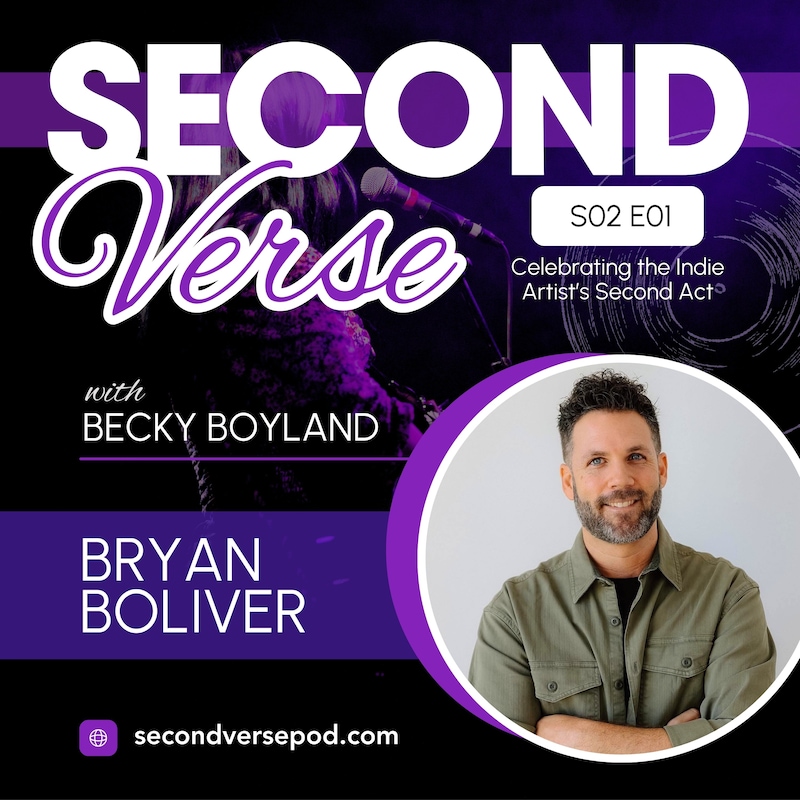
Shownotes
https://youtu.be/8f2Z06_8-9Q
Trusting the Long Winding Road with Bryan Boliver: Embracing Creativity and Faith in Music
In this episode of Second Verse, host Becky Boyland speaks with Bryan Boliver, a singer-songwriter, worship leader, producer, and content creator. Bryan shares his inspiring journey from rock band dreams to worship ministry and full-time music production, emphasizing the importance of enjoying the craft of creating. The discussion highlights overcoming perfectionism, the role of technology in enhancing abilities, and the value of collaboration. Bryan's story underscores that God's timing is perfect and that each detour can be part of a bigger plan. The episode concludes with a new worship song, “New Covenant,” by Rock Harbor Worship.
CONNECT WITH BRYAN:
- https://www.bryanbolivermusic.com/
- YouTube: https://www.youtube.com/c/bryanboliver
- Instagram: https://www.instagram.com/bryanboliver
- https://open.spotify.com/artist/2xdw8Aa0DRetWarKBDZlwi?si=AIqSBidBSfGp-f-76n2Bog
- https://open.spotify.com/artist/6SdDJBb9TYPG2wAHAs7iXP?si=sXMjikYQT96WnF3sj4QRyw
Sponsors:
- Attitude Creativity: https://attitudecreativity.com/blueprint
- Singing / Straw: https://secondverse.com/singingstraw (affiliate link, 10% coupon auto-applied, or use code “secondverse”)
Featured Song:
- ”New Covenant” by Rock Harbor Worship, written by Bryan Boliver, Chase Buchanan & Aaron Hoskins. Used with permission. All rights reserved.
Timestamps:
- 00:00 Bryan Boliver Interview Teaser
- 00:14 Introduction
- 01:55 Welcome, Bryan Boliver
- 02:12 Early Musical Influences
- 04:13 Aspirations and Early Band Experiences
- 05:54 The Turning Point: Meeting Suzy
- 07:59 Return to Music and New Opportunities
- 11:36 Navigating the Music Industry
- 15:18 The Importance of Flexibility and Relationships
- 19:55 The Creative Process and Overcoming Perfectionism
- 27:51 Faith, Music, and Purpose
- 32:41 The Emotional Power of Music
- 33:48 Discovering a Path in Music
- 35:24 Sponsor: Attitude Creativity
- 36:45 Sponsor: Singing / Straw
- 37:42 Journey into Music Production
- 40:13 Transition to Full-Time Music Production
- 44:52 Navigating Visual Impairment in Music
- 52:09 Encouragement for Aspiring Musicians
- 55:46 The Importance of Capturing Inspiration
- 01:00:47 Where to Find Bryan Online
- 01:02:15 Coda
- 01:03:51 Featured Song: "New Covenant”
Playlist:
Stream all the released music from Second Verse any time! Add the official Songs from the Second Verse Podcast playlist to your Spotify now! https://open.spotify.com/playlist/5lPUAY9uBYVVg9fmy03Bj3?si=5211c2db80334285
Starting your own podcast? Sign up with Captivate to host your show today! https://fas.st/t/ZHbLxEpe (affiliate link)
Transcripts
BRYAN BOLIVER INTERVIEW TEASER
BRYAN BOLIVER: As creatives, enjoying the craft of creating, I feel like, is the most important thing. And I know that that may not ever make you $20 million, but I don't know, I think it's more important than, than the money or the success is actually enjoying the gifts that we've been given to use.
INTRODUCTION
BECKY BOYLAND: Welcome back to Second Verse, where we celebrate indie artists making music their next act and help you build the creative life you were made for. I'm your host, Becky Boyland. I'm a singer-songwriter, producer, and someone who knows what it's like to build a new chapter in music after life took a few turns.
Today we're kicking off Season 2 with someone who embodies everything this podcast is about.
Bryan Boliver is a songwriter, worship leader, producer, and content creator. But more than that, he's someone who knows what it means to trust the long winding road. From rock beginnings and pursuing a label deal with his first band to laying down the dream, falling in love, and then being called back into music through worship, songwriting, and production — Bryan's story is a powerful reminder that God's timing is often different than ours, but always better.
We talk about the pivotal moment that changed Bryan's musical direction forever. Why perfectionism is the enemy of creativity. How technology for the visually impaired has actually enhanced his ability to create and lead. And the importance of letting go of "the one right path" in music.
Oh, and our new favorite life analogy, the pinball machine.
Whether you're full-time in music, dreaming of a new beginning, or figuring out how all your gifts fit together, this episode will inspire you to start where you are, use what you have, and keep going. Let's dive in.
WELCOME, BRYAN BOLIVER
BECKY BOYLAND: Thanks, Bryan, for being here today on Second Verse.
BRYAN BOLIVER: Glad to be here. Thanks for the invite. It kind of started at the retreat this year, and so now for us to be sitting down and doing it, I'm excited to be here, so thanks for inviting me.
BECKY BOYLAND: Absolutely. And I can't wait for people to hear more of your story. And let's just dive in.
EARLY MUSICAL INFLUENCES
BECKY BOYLAND: I don't think I've said this before, but you started as a bass player.
BRYAN BOLIVER: Bass is best. Okay. So, uh, yeah, I started as a bass player back when I was a teenager. My dad was in a surf rock band, which was amazing. They were called Offshore, which is the most apropos surf band name of all time, I think. And so my friend played electric guitar and I was like, well, we wanna be in a band so I shouldn't learn guitar, so I'll learn the guitar with the fat strings on it, you know.
And so the bassist from my dad's band had an extra one, and he let me borrow it and I hated it ' cause it destroyed my fingers so bad and I put it under my bed and I was like, well, I'm not gonna do that. I guess career is over. But then, at that point, one of my favorite bands at the time was Green Day and they have this song called Brain Stew.
And I was like, man, that sounds pretty easy. So I picked it up and I was able to play along in that simple descending bassline or whatever, and I was like, I'm basically in the band now, so I'm gonna keep doing this. And I honestly have just never stopped. And that was like 30 years ago.
BECKY BOYLAND: Gotta love it. My first instrument was not anything that I play currently,
BRYAN BOLIVER: Okay.
BECKY BOYLAND: but it did help me out a lot. No, I started playing trumpet and I had to learn how to transpose by sight for a music festival when I was a, a senior in high school. And when I picked up guitar and wanted to learn it, I didn't wanna just be stuck with the same two or three songs until I knew all the chords to move on. So I just thought, I'm going to take this skill that I had to learn literally for one event and make this my thing so that I can have this huge repertoire of songs, even if they're in keys that I wanna play.
And that has served me extremely well for about that same amount of time.
BRYAN BOLIVER: Yeah, I, I mean I played bass for a long period, but it wasn't until I started getting interested in like songwriting, I was like, this seems like a more efficient tool for songwriting with a guitar than bass. 'Cause bass is great for a lot of things, but writing songs, I don't know if it's the best.
BECKY BOYLAND: That is true. That can be really challenging.
ASPIRATIONS AND EARLY BAND EXPERIENCES
BECKY BOYLAND: So what were your aspirations when you first started playing bass?
BRYAN BOLIVER: It was quite literally just to be in a rock band with my friends. Simultaneously, I was in a kind of a church band, so it was me and the drummer of my rock band were in a small church band at the Methodist church I grew up in. And we were called Jaw Dizzig, and we would just play a bunch of random songs of the day, like Third Day and Burlap to Cashmere and POD, and just a wide range of " ecclessity" back then.
And so that was it. I just, you know, for me the vehicle was, okay, I wanna figure out how to do music for all the time. And I don't know what that looks like, but naturally it was like, be in a band, get a record deal and go. So that was kind of the aspiration back then.
BECKY BOYLAND: Yeah, for for sure. But since this is Second Verse, we know there was a gap in between. So talk about what happened.
BRYAN BOLIVER: Yeah, so I chased those dreams for, it was honestly about seven years. It was my full focus. That's all I wanted to do. That rock band, we recorded some music poorly, you know, as we often do. And kept going, kept going. You know, a couple of members came in and out. By the end of it, basically we were at a crossroads of, okay, we're going to pay this producer in Jacksonville.
He had discovered and got the band Red Jumpsuit Apparatus — I don't know if you remember that band — um, signed and, so he was like a friend that we had worked with 'cause when we would record, we'd go up to Jacksonville to do that.
So he was kind of offering us this production deal and basically it just didn't pan out. We didn't come up with the money we needed, the full band wasn't committed as we hoped. And at that point it was like, man, I've just kind of dragged this along as long as I could.
THE TURNING POINT: MEETING SUZY
BRYAN BOLIVER: Around that time too, that's where I met my now wife, Suzy, of 16 years, actually through MySpace. I invited her to come see that band play at a local venue, and she didn't actually come to the show, but it worked out. It was fine. Uh, so, so that was when I, I know this sounds like a little, a little corny, but it's completely, the truth is, you know, I'd kind of avoided dating. I just didn't care. All I cared about was music and pursuing it. But like when I met Suzy, that was a whole different kind of love that I had not experienced yet. So, you know, as that apex all happened where I met her and then, you know, we couldn't figure out this last thing and this last ditch effort of the band, I was like, I'm just gonna focus on her and kinda let the music stuff go because for the first time in my life, it wasn't like my soul focus was the music thing.
So that kind of what caused the gap to happen was just falling in love.
BECKY BOYLAND: Oh, you have to blame love. But it sounds like that was actually a really good thing. So what was the next catalyst? What brought you back to music and how did you come back around?
BRYAN BOLIVER: There was one important experience before kind of, the band disbandment occurred. My parents were also in worship teams and stuff at that Methodist church that I grew up in. And they had a worship leader named Matt. And he was just a great guy and still is a great guy. For a short period of time, I think I was helping him like with a roof on his house, which is pretty funny. And we were up there on the roof. I remember this so clearly, and he said, I know that you've got a lot of gifts and talents and, well, I can't quote him 'cause it's gonna make him sound mean. But essentially what he said is like, you know, until you kind of dedicate all of this to the Lord, it may not pan out the way that you hope it will. And I was like, yeah, whatever, dude. I'm 16 years old and I am right. And you don't know what you're talking about. You know? And so, looking back, I do feel like that's why I found so many closed doors. 'Cause we, we had like, you know, business cards of Warner Brothers A&R reps, and this is back in the day where that kind of stuff was much more important than it is today. So we had a lot of close calls with getting signed and all that stuff.
RETURN TO MUSIC AND NEW OPPORTUNITIES
LIVER: But, so got married in:That was the thing.
BECKY BOYLAND: Yeah, that's for sure.
BRYAN BOLIVER: And now rap. Yeah. And now rap is country, I guess. So now, and everyone loves it. So who maybe they just needed to blend them back then and we all would've loved, I don't know. But, so that got me playing again because Suzy loved country. She was like a big fan of country. So ended up getting into the, into that band and that it lasted about a year.
The coolest thing we have to do is we got to open for Easton Corbin, who was like, at the time, he was like a chart topper back in the day. So it was kind of fun. But because so much of that band was rooted in this local church, that led me to my friend, mentor Page. He asked me if I wanted to like, fill in bass for this men's event, men's breakfast, and then another like worship kind of thing. And I hadn't played in that way in a long time. So I went and I remember I had this very significant thing happen where I was playing bass for Sunday morning service, and all of a sudden I felt like I was levitating. And it was really strange. And I'm a pretty grounded person, but I was like, am I flying? What is going on? And what I kind of discovered in that moment and that kind of brought me back to what Matt had told me on the roof all those years earlier, is like, God's like, I need you to play for me and watch what I'll do. You know? So that kind of got me reintroduced to church music.
And at that time, Suzy and I had found a local church here that we started to attend. And then it was probably a couple years in, you know, I sheepishly asked who I assume was the leader of the band at the church that we were attending, like, Hey, you ever need a backup bass player? We live like a mile away and I'd be happy to do it.
And that kind of started this whole thing where, you know, I jumped in the rotation there and then they foolishly gave me a microphone at some point. So I was doing like background vocals and bass. And then I eventually became like the first hired gun worship leader at this church where I was there for six years.
And then, yeah, so that's, that was kind of a little ahead of the story, but that's where that gap ended. It was about a two year period where I was pretty sure I was like, all right, I love music, but it seems like it just wasn't working out for me to be a thing.
BECKY BOYLAND: What I love about that story is the fact that it's not to say that the country music or any other genre of music was a bad thing. It was just not the thing that was going to be the path that you were supposed to be on. And sometimes when we do have those other experiences or other interests, then it's just so easy to either hyperfocus on something and then be crushed when it doesn't work out, or spend a lot of time in confusion like, what am I supposed to be doing?
Because I could be doing all these other things and yet none of them is really doing what I hoped for.
BRYAN BOLIVER: Yeah, yeah, exactly.
NAVIGATING THE MUSIC INDUSTRY
BRYAN BOLIVER: You know, and that's something that I've learned so much about music is the flexibility is like key because if you set your mind and your vision on one thing, I mean, it could definitely happen. I know people that have said, I'm moving to Nashville to do this thing, and it actually happens, and I'm like, man, that is not how it's gone for me.
For me, it's been a pinball machine of, of, of twists and turns and ups and downs, but ultimately, you know, like, God has been faithful through it all, and, and I am doing it. You know, I am full-time in music in some capacity for the past 13 years, and it's not, none of that had to do with getting a record deal, you know?
But, but that was one of the vehicles to push me into, you know, where we are now.
BECKY BOYLAND: And I think that's a really important thing for anybody who is so passionate about music and they want to have a career. If you have one picture in your mind of what that career looks like, it's gonna be really, really hard because you can't anticipate at this point because the music industry changes so often and so much, and is so dramatically different from when we were younger.
And so to try to even project what that's gonna look like is, is just a recipe for heartbreak, but it also doesn't allow you to see the different paths. However winding or pinball, I like that. There are opportunities that if we're just singularly focused on one thing and that it's only going to be one thing forever that's gonna be really hard to, manifest or manufacture and all those other things might just get missed in the whole process that could have been amazing, or it could have been an on-ramp that came back around and crossed the path that you're looking to take.
BRYAN BOLIVER: Yeah. Things are so seasonal, you know, as you're saying that, it reminded me of when I was back into the church world and I was hired as a worship leader, eventually worship pastor, I wasn't even thinking about writing songs for the church necessarily. Songwriting is something that I just did and I just enjoyed it.
I always just write wherever I'm at. You know, when I was in the country band, I was writing country songs. I'm sure they weren't good, but they were, they were, you know, and when I was in the rock band, you know, so eventually I did begin to write some kind of worship or what songs I thought that were in that genre as we call it now.
But, then eventually once I started taking trips to Nashville, then I got more serious and realized there was a whole world out there of professional songwriters that I didn't know about. And somehow I seemed to like click with some of these people and they were kind of much more normal than I had thought.
So eventually then I started looking into like, well, what is Spotify? What is, what is this digital music? Because you know, in the band growing up, like we would just burn CDs and print 'em and sell 'em at our gigs and stuff. That's what you did. But I feel like specifically, I know probably everyone says this, but I feel like especially like right now in time, we've seen the music industry change like every six months drastically.
I feel like it was pretty much the same. Maybe the format was different back in like the fifties or forties, like from the wire, which still blows my mind. How do they put music on a wire? I do not understand it. You know? And then the different sizes of records and then 8 tracks, cassettes, CDs, like all that stuff is like that was the main change, but it was kind of the same thing. But then once digital happened, it's like now with like AI, it's been like wild how much has actually changed in this specific period of time. So yeah, just trying to be open handed with it and realize that like if something's really working today, it very well could change drastically like actually tomorrow.
THE IMPORTANCE OF FLEXIBILITY AND RELATIONSHIPS
BECKY BOYLAND: Yeah, and that's why it's really important to focus on the music itself, the quality of the music. And I think the other huge element is just relationships, because you really touched on that, about going to Nashville and clicking with people and learning how Nashville's songwriters write and how that works.
Because especially when we start with an instrument, it's a while before we even get to the idea of writing. And I had that kind of experience too, because I never thought about writing anything for the longest time until a song just really burned in me. And then I thought that, well, that's the only way I can write.
It's gotta be complete inspiration. So it explains massive gaps in my songwriting until I started to realize that that's not the entire recipe. And so going from being an instrumentalist or a vocalist or instrumentalist to instrumentalist and vocalist, and then to being a writer and collaborating and, and building all of those things.
Those are all part of the progression for those who wanna take that more artist path. But it could also be leading to ministry if that's, uh, your calling and your passion. And there are different ways that all of those things come together into a beautiful buffet.
BRYAN BOLIVER: Yeah, it's certainly a soup and there's no one mold for any of it. Everything is so vastly different and I think, the forward facing stuff, like we see the big, you know, Elevation or Bethel or you know, Dua Lipa or Drake or whatever, like, you know, the big artist in the genre, it's like, oh, well if I wanted to do this, I have to be like them.
But more and more now Spotify'll play some random song and you'll be like, That was cool. Who is it? And you'll go and they've got like 1.5 million monthly listeners and I've never even heard of them. And they probably have a career because 1.5 million monthly listeners, you're probably getting a few thousand dollars a month off streaming alone, which is, you know, possible to build something off of.
And this is someone that we've never even heard of, so like, yeah, just going like traditional path, which is funny to even think about it 'cause it's, completely not important anymore is like realizing that like you have a path cut out for you and I don't know, maybe it's just for me, but like if I try to copy somebody else's path, it does not go well.
I've tried, and especially I've gotten, you know, older. I just feel like one of the most critical things we can do as creatives and artists is actually try to enjoy creating. 'Cause I'm always like, okay, well if I'm gonna do this, where's it gonna go? What's the lane? What's the output? What's the purpose of this? And that, that's important. And I, that's how I create, is like, I need borders, I need lanes. The scariest thing to me is a blank page, because like, well, it could literally be about anything. Like, I want, I want a direction, is it, it's a fast song, slow song, church song, pop song, you know, like whatever.
But at the end of the day, like we have to just try to enjoy it as we do it, because that's really all we have. That's that hevel process, you know, that talks about in Ecclesiastes: life is hevel. You know, life is meaningless. Meaningless is hevel, which means vapor. So like the summation of Ecclesiastes is just fear the Lord your God, and basically enjoy what you're doing in the moment.
'cause that's the only thing you can certainly have is this moment. So as creatives, enjoying the craft of creating, I feel like, is the most important thing. And I know that that may not ever make you $20 million, but I don't know, I think it's more important than, than the money or the success is actually enjoying the gifts that we've been given to use.
BECKY BOYLAND: Right, and aside from those who had that one giant hit that just happened to pop off, it happened to hit at just the right time, for the average person who is doing this with longevity and successfully, they have to love what they're doing, and they've discovered that that is the secret sauce because when we just get so focused on the numbers and especially the numbers that don't come and it's so sad. And then you remember, well wait a second, why did I do this in the first place? And actually, that's something I've been thinking about really recently. And it's a very grounding thing to recognize that, wait, this had a purpose.
And even if it ends up only feeling like it's "for me" to help me to put out what I'm passionate about, what I love, and to get excited about sitting in front of the DAW, or even just a piece of paper and holding my guitar, if I don't like it, if I don't love it, if I am trying to achieve some goal that's beyond that, it's just never gonna happen and it's not gonna be fun.
THE CREATIVE PROCESS AND OVERCOMING PERFECTIONISM
BRYAN BOLIVER: Yeah, and honestly I feel like the biggest plague of creativity is just perfectionism. And I know that's like a played out topic, but really I know so many people that are like almost songwriters and not because they don't have the skills, it's because they won't finish a song because they want it to be perfect.
And it's like the, the way that I don't, it's certainly a numbers game. The way that it works is just outputting a lot like our song "People," right? Like that was one song. Me and Ross have done 13 or 14 virtual songwriting retreats, which means that I've written personally, I've written 28 songs just on those virtual songwriting retreats, like hundreds, if not thousands, more, not hundreds of thousands, but probably a lot, probably over a thousand songs.
And then this one song that we did on this one day that I thought, this track that had gotten rejected by the earlier write, it was just this random song that it's you and the rest of the group liked. We wrote this song and it's been like the most heat on anything I've done in the film and TV world.
And it only exists because we just did it. We wrote it, we finished it, and we just moved on. And then, because we've got some bulldogs in the group that been pitching the songs and stuff, it continues to get noticed. But that wouldn't have happened if we're like, ah, you know that line in let's say verse two 'cause that's the podcast, right?
If that line in verse two wasn't working, like, uh, we, we, we'll come back to it. And it just sat there. No one would ever have heard it. I think it's so important for creatives to just like, get over this thing where it's like you have to write the perfect song or else you don't finish.
I just feel like that's not the point. The point is just to keep going to the well over and over again. That's how you get better is by just doing it, even if it stinks, which it probably doesn't 'cause you'll love it for at least 20 minutes. Like, just, just finish it and then go to the next one.
BECKY BOYLAND: That's for sure, and I've been in so many situations where writers will worry a song to death and literally to the death of the song or revisit something months later and say, I think we really need to redo this lyric. And maybe, but oh my goodness. If we do that with everything, you're right. We will never finish anything.
And I've had songs that maybe my co-writers thought needed some additional tweaking or something like that, and I'll share it with somebody else and they're like, this is so great. This is just such a good song. And I'm like, I know, I'm just trying to convince them. I'm trying to get some feedback so that they understand that this really is okay.
And there's something really, especially for those who haven't collaborated to get into a room, whether it's physical or virtual, with people who are used to writing fast, I think is one of the most helpful things to do because, and that's not just a matter of just randomly go write with some varied people, but try to write up, as they would say, try to find some people who are, even if you end up just watching and, and listening and then contributing a little bit, that experience of knocking it out really fast is so beneficial because that helps you to realize, one, it can be done. And, and then after that, that may not be the way that you write all the time, but when you know that it can be done, then you start to look at it a little bit differently. And when the pandemic first started, I was actually prerecording and doing the mixdown of two weeks worth of worship music for our church.
And so I would have sessions that were 45 minutes long.
BRYAN BOLIVER: Hmm.
BECKY BOYLAND: And I'll tell you, after doing that for a really long time, going back and working on a three minute song didn't feel hard.
BRYAN BOLIVER: Yeah, that's good. Yeah. I mean, Well think about the song we wrote at the retreat. You know, we had people, two people, there was us, and then two people that had literally never co-written in their entire lives. All right. But we've got a song, which actually I'll, I need to send you the guys, the demo.
I've got a demo for it,
BECKY BOYLAND: Oh yeah.
BRYAN BOLIVER: We're gonna, we're gonna sing this song and probably record the song next year and that's not necessarily the case for everybody, but like their first song they ever co-wrote is, is gonna be probably recorded on a church album next year because they showed up and they did it.
And, I don't want people listening to this to think like, oh, well just like, do some bunch of junky work just to get through it. I don't mean it like that. My thing is like, just get in the practice of completion. 'Cause one of my favorite quotes, and I heard it from Jason Ingram, um, he's just one of the most prolific songwriters of our generation, secular or sacred. I just think he's awesome. But I saw him speak at a conference one time. I don't even know where it was. I've seen him a few times speak, but he basically said like a difference between an amateur and a pro songwriter is an amateur writes when they're inspired and a pro writes until they're inspired.
And I think like the technicality and the mechanism of songwriting, when you learn that by doing co-writing, you know, by just completing songs, you learn the technical aspect. That means that you don't have to just write when you're feeling it. And honestly, you can write until you feel it. 'Cause I could sit down at any moment for better or worse and if I have a target, I could write something and finish it because I have the practical skills to be able to do that. Now am I gonna be super stoked at the end of it and think it's the greatest song ever? Well, maybe. 'cause usually as songwriters we do think whatever our newest song is is our greatest song ever, you know?
But it's just having those skills and it's, it's enjoyable to be able to flesh out an idea. 'Cause like back to the song we wrote at the retreat, I brought you guys kinda this weird abstract idea that as we were doing it, I was like, well maybe this is a little too like heady for some brand new songwriters.
But guess what? They threw out lots of ideas and we got something that I think is really cool. So it's like, because half of the room in this scenario had a bunch of experience, we were able to figure out how to honor the varying levels of the group, but also figure out how to get something and say something that was profound and meaningful in the moment.
BECKY BOYLAND: Yeah. And I love that song. And, true confession, I did do an acoustic version of it already at church.
BRYAN BOLIVER: Sweet. Oh, I need to, I need, did you guys record? I need to hear the video.
BECKY BOYLAND: Yes, yes. I'll find the clip for you and I'll send it to you.
BRYAN BOLIVER: We'll trade, I'll trade a demo for your live performance.
BECKY BOYLAND: Awesome. Awesome. That will be perfect. And what I love about it was, and this does happen to me a few times, but when I feel really great about a song, when I woke up the next morning and we'd of course done a song in between, that was our first session. We had an afternoon session. I woke up the next morning and that song was in my head. And, you know, I knew it for all of what, an hour. So that's always so super exciting. And, when you do go in there and you don't hold things really preciously, then you can literally work on it till there is that inspiration behind it.
I had heard that quote before and it's so, so important and so powerful because especially when we think I wanna do this professionally, whatever that may sound like, or be, you know, in reality, in that person's life, whether professional is this is the only thing you do, or that you want to make it a serious part of your life as a hobby or as a side gig, whatever it is, you still have to treat it like work.
Because I don't wanna go to an emergency room and have the doctors work on me if they feel like it.
BRYAN BOLIVER: Hmm. Yeah, that's true.
BECKY BOYLAND: What we're, and what we're doing is not life or death. So, um, but how much more should we
BRYAN BOLIVER: Yeah, yeah,
BECKY BOYLAND: That's true. That is true. That is true.
BRYAN BOLIVER: Yeah. That's a great point. Yeah, because his quote was geared towards songwriters, but really that's true in any, I mean, if you're a tax person, you can't just work on taxes if you feel like it, if you wanna have a job, you know, you have to figure out the mechanics of performing something well based on your knowledge.
FAITH, MUSIC, AND PURPOSE
BRYAN BOLIVER: And then you do that thing until you feel amped about it and yeah, especially in my opinion, I feel like music was created, you know, as an act of worship, a form of worship. And of course that's not everybody's, you know, genre or story. But I do feel like that is what the purpose of music originally was and, and is, but you know, with that, so if you are doing faith-based stuff, like it's a responsibility because we're given this gifting, this calling.
So to be able to share that and yeah, potentially do save people's lives in a way, it's not something that we are meant to like, keep in our hard drives, you know? Uh, a lot of people get, nervous about marketing as a, you know, faith-based artist or whatever, you know, faith-based, anything.
It's like, oh, we're not supposed to, 'cause it's about ourselves. And I always go back to the Parable of Talents, you know, and in that parable, the only guy who got yelled at, you know, was the guy who buried it and brought it back as it is. You know, the two who took what they were given, brought it out to the world, AKA marketed it, in a sense, right, and then made more, they were blessed by the king, blessed by the ruler to do that. And that's a Jesus parable that we're supposed to take a work given and multiply it in this place. So I feel like that applies directly to creating music as well.
BECKY BOYLAND: Yeah, and, and of course the scripture also says that how will they know unless they're told.
BRYAN BOLIVER: Mm-hmm.
BECKY BOYLAND: And so if we're taking our calling seriously, and also any artist, if you're taking what you have to offer the world seriously, then you can't just sit back and hope that it gets found because anything else that's out there in the world, I mean, you may have a favorite restaurant.
Well, that restaurant, if people didn't tell other people about it, and if they didn't put out ads and if they didn't put their, this is gonna really date me phone number in the phone book. If they don't have a website, no one knows any of this stuff exists and they're not going to be in business. And so it is our responsibility to at least figure out whether we're the ones doing all the work or we're finding support and help to make that happen. If we're not getting that message out, then not only is there no way for people to know, but there should be no expectation on our part that it's going to get heard and have the impact that it was designed for originally.
BRYAN BOLIVER: Especially now that there's like wild amounts of now human and not so human music fighting for every eyeball and every, you know, tap of a screen. So to think that anyone's gonna find it ever without any effort is just literal impossibility. And I guess my heart behind this is like, we're not saying, Hey, we're so awesome. Listen to what I create because you're gonna be so pumped by how great I am. It's not about that at all. To me, it's the message behind all of it. It's our own lane. It's our own voicing of what, you know, God has put in us to share.
It's not about us, it's just the way that we can share the gospel, you know, it just in our own way. I mean, I used to think that, oh, well, I'm not like a missionary, you know, I would do terrible if I went out into the rainforest to try to build something. I would hurt myself and not help anyone. So I'm not a real faith-based person, but like, no. We're all given gifts and talents of our own and you know, people listening to this podcast are probably into music like we are. And so that's a way that we can do that. We can share, you know, our faith, we can share light, we can share positivity into this dark and dying world.
So why wouldn't we try to get it out there and let people know about it?
BECKY BOYLAND: Yeah, and music is so ubiquitous for a reason because it is something that nurtures who we are as people and so whatever your background is, whatever you feel like your purpose or your calling is, it's always going to be out there, so why wouldn't we want to speak into that when we know that we have something that can specifically meet needs and sometimes that need simply is entertainment, and that's totally fine.
We really do, for our own mental health, we need entertainment. And so there are so many different aspects, so many different roles that music can play and it is a necessity and I've come to understand that more and more the older that I get. And what's funny to me is when people wanna fight me on that, and then I point out all the places where music is and how awful it would be if there just wasn't any.
BRYAN BOLIVER: Every single video we watch, of course there's some just talking head videos where there's not music, but you know, there could be, but like, what makes a movie trailer want you to go see the movie? Sure. It's the visuals, but also it's that epic score.
THE EMOTIONAL POWER OF MUSIC
BRYAN BOLIVER: That's what's actually pulling you in 'cause music is made, is created to evoke an emotional response. That's what it does. And it's, it's a wide range, 'cause we have a lot of emotions, but it might lift you up. It might make you feel mad. It might make you question. Whatever it is, music is created to make us feel, it's made our senses to be like magnified, focused on. So, yeah, without music it would just be a bunch of people talking, you know, or like clanks and clacks, I don't know. It'd be, it would be, it would be like, music has such a power. There's nothing like it. And I know that's for a reason, is because, I often say like, when we, especially in faith-based music, it's like when we're communicating the truth of God through song. So when you mix the truth, God's word, the truth of God with the emotional impact of music, it's like a superpower, you know?
So yeah, I think it's here for a reason and for us to be able to understand we get to understand a creator when we create at a deeper level. So there also is that. There's just so much I could talk about it for days.
DISCOVERING A PATH IN MUSIC
BECKY BOYLAND: I totally get it, and I don't think I even realized that music was going to be my trajectory within the church when I first started studying. And then once I finally realized that and embraced that and followed that path, I kind of thought, how could it have been anything else? And the other realization I had that was amazing to me was that not everybody wanted to be a musician. And I could not fathom that, but that helped me to realize how special that was. Because there are a lot of other things out there in the world that I have no interest in doing.
They're wonderful, they're necessary. They may be even services that I partake of, but I don't wanna do 'em.
BRYAN BOLIVER: Yeah. Yeah. It's definitely a gift, and it's specific to us because the songs that, you know, you write are meant for you to write, and the ones you collaborate on, you know, it's within. 'cause the two songs we've written are very different from each other. You would never know that they came from the same people, but that's just how those concentric circles work, right.
So like, yeah. I can't imagine people who are just like, oh yeah, music's cool. Oh, it's another TikTok sound, or whatever. It's like. That's it? That's all you care? 'Cause, you know, Suzy, she said growing up they didn't really have music on in the house. I can't imagine it. 'Cause my parents, I'm, one of my favorite memories is my parents woke us up on Christmas morning with "Give Me Shelter" cranking in the stereo.
You know, like there's all these like, little musical moments and the way that music can bring you back to moments. It's just, I don't know. There's something about it that's just, it's this special gift that we've been given. So, yeah, I'm a fan.
BECKY BOYLAND: Me, me, me too.
SPONSOR: ATTITUDE CREATIVITY
BECKY BOYLAND: We'll be back with more after this break.
Second Verse is sponsored by Attitude Creativity.
Many indie music artists don't have a website that grows their audience and reflects who they are, so they get lost in the noise of streaming. Marketing and brand messaging with Attitude Creativity helps boost your brand and build a site that hits all the right notes. You wanna be an artist who stands out from the crowd, and to do that, you need your music to be heard.
If your website doesn't reflect who you are or make an impact, you feel like a singer who's been handed a pair of drumsticks instead of a mic. You deserve a website and brand messaging you can be proud of, and that doesn't take time away from your music. As an artist like you, I understand how overwhelming websites and marketing can be, and that's why putting on my other creative hat, I put my decades of marketing and development experience to work for you.
You'll no longer have to apologize for your website. You'll look and feel like a professional with a custom StoryBranded website you can be proud of. And right now you can get a headstart with my free downloadable EPK blueprint and start building your electronic press kit to promote your music. Head to attitudecreativity.com/blueprint to get your copy.
That's Attitude, A-T-T-I-T-U-D-E creativity.com/blueprint.
SPONSOR: SINGING / STRAW
BECKY BOYLAND: Second Verse is brought to you by Singing / Straw.
Ooh, oh, you caught me in the middle of a vocal warmup. This is one of my favorite ways to wake up my vocal cords before a singing session or even a nice long conversation for the Second Verse podcast. It's the Singing / Straw, a simple but powerful tool for straw phonation, a vocal technique that promotes healthy vocal cord closure, and a gentle but mighty way to increase range and identify areas to work on. For me, it was key to regaining my voice after vocal cord paralysis, but you don't have to wait until a vocal injury to use it. In fact, I recommend that you don't. Make the Singing / Straw part of your daily routine. And you'll be amazed what your voice can do.
Check it out at secondversepod.com/singingstraw.
JOURNEY INTO MUSIC PRODUCTION
BECKY BOYLAND: So talk about now the different aspects of what you are doing because you are not only a singer songwriter, worship leader, you're a producer, and so you're working with a lot of different people and having that interesting impact in a number of different ways and, and also a content creator.
So talk a little bit about all of that.
BRYAN BOLIVER: Oh boy. Uh, yeah. Yeah. Uh, I say, oh boy. 'cause I, as I was, you know, filling out your questions, preparing for it was actually a cool experience. 'cause I was like, I could, I was seeing how God is actually working all this stuff together, you know? So I. I'll do this rapid fire, but like, you know, we talked about the beginning of the story where I got back into church, so that became like a worship pastor.
ad started producing music in:So I used to just record in my acoustic, you know, songs of the day and I was just like, well, I'm doing it to a click, you know, it's just a vocal and acoustic. And I was like, what if I just start adding stuff to it, you know? And I know that sounds so basic, but I could, and for the first time in my life I could start to hear what I would only be able to listen to in my head previously. And I just never stopped doing that. So, as I was at the church, I started going to Nashville. So I looked at my trips to Nashville, was like I was collecting seeds. I'd go up there, I'd learn all this stuff, I'd write some songs, I'd bring 'em back here and I'd start producing 'em. So there was a period when I was teaching myself how to produce. I eventually upgraded to Logic Pro 'cause it's basically was Garage Band, just on steroids. Now they're even more similar than they were back then. But, there was a period where I was producing like a song every single week. And, you know, at that period it wasn't like a full fledged production like I do now, but it was like creating something new, over and over again.
I would basically get off of work at the church at like four o'clock. At that period. We had like, younger, younger babies, so Suzy would go like, put the kids down and she would like lay with them and do, do mom stuff. And I would just come in here and I would just like work on music production for like three or four hours, like every night, you know, which was great.
But also it was bad 'cause I would get really excited and then I couldn't go to sleep, you know? So then I'd get up and, and I'd do it again.
TRANSITION TO FULL-TIME MUSIC PRODUCTION
BRYAN BOLIVER: So, that basically led me to create a bunch of songs and Suzy encouraged me to start, like, how do you release songs? So that's where I mentioned, I started trying to figure out Spotify.
ble. They're all done. So, in:And I was like, I did, like, can you do it for me? And I was like, I think I can, you know, so, and at that point too, it wasn't nearly as common to do like, remote collaborations either. This is pre 2020, so it was like, I can do it, but how am I gonna get your vocal at my house? You know, like, how am I gonna do that?
taking trips to Nashville in:It didn't matter if you're in Nashville or not, you're still doing remote production. So we did that for two and a half years. Then we were always kind of looking to move to Nashville, but not trying to force it. Because I didn't want to move there and realize we shouldn't have done this, you know, 'cause a lot of reasons, but we just didn't force it. So, the fall of 2023, I got like a text message from a mom of a, a youth that I used to lead in the, the youth team at the previous church. And they're like, Hey, this church down south in Melbourne Beach is looking for a worship leader. Do you know anybody?
And I immediately felt God say, "You." And I was like, "No, not me. You know, we're moving to Nashville, remember God, the whole thing we talked about a lot, you know, that, that whole thing." Uh, so I begrudgingly after a few days, filled it out. And so I got hired at the church I'm at now, which is amazing. So...
film and tv. Um. But that was:You know, getting to lead worship. I, before our call now, I just created an audio track for a 60-second countdown video. So in a way that's like sync production, you know? Um, and then we're releasing music as the church. So like everything I've ever done musically, I'm actually getting to do now all through Rock Harbor.
And so that, it always brings me back to like Matt Bouthillier on the roof when I was a kid telling me, until you do it for the Lord, it's not gonna turn out the way you want it to. Well, now I'm doing it for the Lord, and it's all right here.
BECKY BOYLAND: That's incredible. That's, that's so good.
BRYAN BOLIVER: It's wild.
BECKY BOYLAND: Now, your story is so motivating and so powerful and should be very inspiring to a lot of people who are trying to figure all these pieces out and have these myriad interests, or have these myriad opportunities.
NAVIGATING VISUAL IMPAIRMENT IN MUSIC
BECKY BOYLAND: But what amazes me is that you also are visually impaired and you're doing all of this.
BRYAN BOLIVER: Yeah, so I have a visual impairment called Stargardt's disease, which is, this is as nerdy as I can get with it, but it's the adolescent onset of macular degeneration. So, which means I have no central vision, only peripheral vision. So, which means I can't drive a car, you know, I can't read regular print, which at this point, who even has print, it's all digital.
So it's been like very, uh, convenient with the rise of technology because everything has become so zoomable and so, speak to text and all these dictation, all this stuff, so everything I'm doing, I'm kind of doing through the lens of, actually a blurry lens, you know, so when it comes to like, leading worship, I do it from memory, you know, all the music stuff, all the production work, there's so many accessibility features built into Mac products that people don't realize 'cause they don't need to know they're there.
But I know they're there 'cause I use 'em all the time. You know, I've created a couple of music production like courses all through accessibility features. They're not using accessibility features, but I was using them during the creation process, so, yeah, I've created lots of content.
I have a podcast with a hundred plus episodes and just, it's a part of, you know, my story and one of my life verses is 2 Corinthians 12:9, where part of that verse says, God's power's made perfect through our, our weakness. And so that verse says two things to me. One, we all have weaknesses, otherwise how is God's power gonna show up through it? You know, because we're not perfect. And, and secondly that, when God calls us to do something, he'll give us what we need to be able to do it. Because people are like, always amazed that I can memorize music. And I'm like, well, think about it. If God had given me the brain to be able to do it, like I literally couldn't do this. I have to be able to do it. So like there's, there's certain aspects like if this computer didn't zoom in, I couldn't use it. So like there's aspects of, you know, technology, but also just like gifting and calling that whatever it is that God's called you to do, like he's given you the tools to be able to do it.
So I think that's another thing that causes me to just feel so, you know, um, inspired personally to do it is like, well man, if I'm able to do it, then I'm gonna do it to the best of my ability and it's not gonna be pretty, you know, it's gonna be a lot of wrong turns. Like I said, the pinball analogy, I kinda like that.
I've never thought about that before. It really is like a pinball machine. It's, it's just wild. Uh, but yeah, so that's definitely a part of the equation for me. But, I've been asked to speak at conferences, you know, I've flown around the country to, to do that and all with this thing that people might consider to be this impairment that I should kind of be sad about.
And of, of course there's, there's times where it's annoying, you know, and it's like, ah, man, if I could just like plug in the toaster easily, that'd be great right now, you know. But I've actually created a secondary social media channel called The Blind POV, and that's completely separate of, of music, but it's just kinda like how I use technology to kind of get along in the world.
BECKY BOYLAND: That is amazing. And I actually was gonna ask, you know, some of the questions about how are some of these things to work with and what are these great features? And I, I was reading about with being a web developer, the importance of accessibility and how a lot of times we just blow past that and don't think about it at all.
But the fact is that things being accessible still will benefit those who don't necessarily need those accommodations. But then the following effect of that, that is not, you know, built into the system is the fact that accessibility makes your gifts more accessible to us.
BRYAN BOLIVER: Hmm.
BECKY BOYLAND: I think that all of those are reasons why we should think about how important it is to make sure that people have the resources that they need so that we can receive from them the resources that they're designed to give to us.
And I think that's key.
BRYAN BOLIVER: And you know, I know that Apple gets a bad rap sometimes being like the evil empire. Yeah. Yeah. Not, not, not here, you know, but I used to use Windows and stuff and I was actually like an Apple hater. I don't even know why. It was just, maybe it was cool back then, but like once I realized that Apple just builds all this stuff in, and it's just such a high level technology to where like, it just seamlessly works. I used to use this thing called ZoomText back in the day on PCs, and it was like, it would make the screen enlarge, but it was like super, it was like playing Minecraft all of a sudden, you know?
It wasn't, it wasn't great, but the way that, you know, apple, integrates it all. It's just like, it's amazing, you know? So like I, I'm not ready for the price tag and I don't think the technology is exactly where I need it to be yet for like the Vision Pro, but I'm certain that at some point in the near future I'll be able to produce in Vision Pro and just like Zoom in my world and do all my editing and stuff, and I have a 27 inch Studio Display here. So it's, it's great, you know, but like, I know the technology is evolving in such a rapid way. Like, I mean, there's already cars driving people around, driverless cars. Like it's not that far away, you know? So I may or may not be like healed physically, but technology will be able to help me do things in a way that, 'cause when I was in school, you know, I'd get like large print textbooks and it was super embarrassing 'cause it was just like volumes, you know, kids would pull out their like textbook and I'd have like, which volume do I need today, teacher, you know, and like now it's all tablet based and you know, it's so much smoother.
And the other thing too that's nice is like everybody and their mother literally has an iPhone. So it's like I don't have this weird magnifier anymore. Now I might be using my iPhone as a magnifier. Or as you know, as a, as an accessibility tool, but it's such a normal part of culture that like, it even helps it seamlessly integrate in that way.
BECKY BOYLAND: That's amazing, and it's something that we just don't really think about. But I love the fact that it's all built in and, uh, that really is, is a very powerful thing that they have been so conscious to make that a value. And I have used, you know, minimal certain features. I had, um, shoulder surgery, uh, actually on both shoulders at different times, but when I had it on my dominant side and couldn't type, I was glad for dictation built into a Mac because on any other device at that point, it was super clunky.
It was achievable and easy to implement in a way that I couldn't have done on any other, you know, Windows computer or any other device. And it was just, it was just there, it was just ready and waiting for when I needed it.
BRYAN BOLIVER: It's just a part of, it's no different than like the, the messaging app. It's just a part of the system. Now it's a bit more under the hood because not everyone needs to zoom in, but the functionality is just, it's not like, oh, we have to dig into the accessibility. It's gonna get all weird. It's like, I can use it on the Apple TV, I can use it on the iPad, I can use it on the Mac Studio, whatever.
It's just, yeah, it's just there across all platforms and like I said, if it wasn't there, I couldn't do any of this stuff. So I'm really glad it's there.
BECKY BOYLAND: Yeah, yeah, for sure. And so am I.
ENCOURAGEMENT FOR ASPIRING MUSICIANS
BECKY BOYLAND: So talk about for those who are sort of in that, I don't know what to do, but I love music and I, I don't know where to start or can I even do this? What would be your encouragement, maybe some advice to them?
BRYAN BOLIVER: Hmm. Start, and yes, you can. Like we've talked about before, like, it does take a level to be a professional. You need to be able to like create until you're inspired, but it, it has to start with inspiration. So wherever you're at, if you're like, Hey, I really wanna write a song, just do it.
I'm always the person that's like, not quantity over quality, but I'm like, you just gotta do it. do not let pressures or FOMO or like fake competition with other people. Like, oh well I'll never be as good as that person. Like, who cares? 'Cause they're saying the same thing about someone else.
Just, if it makes you feel like alive, then you have to do it 'cause it's, it's put in you so that you can feel alive. So why neglect yourself from that feeling? 'Cause it's easy to deprioritize. That's one thing that's been interesting about like, doing music professionally is then it's no longer just when you want to do it. If I'm coming in here to do vocal editing on an artist project, I know it's gonna take a while and it's not gonna be super fun, but like, that's just part of the gig. So like, also understand you don't have to be fully reliant on music to be fully fulfilled by it.
It can just be something that's like a hobby that fills your soul. And if that's the case, then just do it. Do it at the best and highest level you can. If you want to be like a hobbyist, then still go and get some courses on songwriting or you know, go check out, you know, my page 'cause I'm constantly making content that I'm hoping to inspire people to do that, you know, whatever.
Do it at the highest level because I think people get in the trap of oh, well I could never do it at that level, or I could never, and that may be true, but that doesn't mean you shouldn't do it at any level. You know, because you're neglecting your soul. 'Cause like, if I don't come in here and, and work on something, then I will feel it.
If I don't write a song for a few weeks, I will feel it and I'll feel like more down, I'll feel more whatever, you know, I'll feel more just burned out with life. Like it is a gift and if it's in you. It's a well that's meant to be drawn from. So we just have to do that.
BECKY BOYLAND: If we just get stuck and don't really continue to do anything with it, then that gift's gonna just pull away and it gets harder to get started again. And after I started releasing music more frequently, I'd have a couple of people come up to me every once in a while and say, well, I wrote this one song, but I, I don't wanna show it to you.
And I'm thinking, well , when is that going to happen? And why don't you just write more songs? Like just keep it going. And it does feel really hard when you have that first one and you get really precious about it. But what happens when you actually start doing this regularly? And again, whether they're great or they're just clearing the path for the next good one, you have to build those muscles. You have to work 'em out just like you would at the gym and keep it going, because waiting for that next lightning bolt of inspiration is, is just going to make it that much further away and trying to reach that goal... it's just gonna get harder and harder and you may not start again. And if it's all in that one song, then any critique of that song, anything about that song that isn't exactly what you imagine about it is, is gonna break your spirit.
So just keep, just keep going and then you're not so precious about it.
THE IMPORTANCE OF CAPTURING INSPIRATION
BRYAN BOLIVER: Yeah, and I kind of gave like heart stuff there, but like in a practical way, just if you think of something, put it in a note. Keep a list of titles. Voice memos. We talk about technology a lot. Sing in your chorus hook when you've got it in, in Walmart or whatever, like put it in your phone, because then, this is actually one of the tools to how do you write, you know, work until you're inspired. It's like you do have a starting point. Like, remember that one day I was at Walmart and, and I was buying paper towels and I got that cool hook idea, like, let's go to my voice memo. You might hear it and it'll reengage. Oh yeah. Because that is part of the soul exercising of doing this.
Another thing too is, is collaboration is really important. 'cause I, I don't usually write solo at this point because for one, I just feel like when I write with others it's just better, you know?
And two, it's, it's more fun and it's faster and it's, it also too gives the song a lot more possibility of Yeah. 'cause like with "People," right? If I would've written it by myself. You guys wouldn't have been pitching it at all 'cause you wouldn't know it existed. And it, for one, I probably, I wouldn't have been able to do it anyways 'cause we all collaborated a lot on that song. So it's like, if I've got a song idea, like I've got a song called "Heavy Is the Crown" and I wanted to write this like big kind of church song and it's like, who do I, and I've thought, okay, Chase and Sophie, I wanna write it with them. And so like, but I thought of that title probably six months earlier.
And it wasn't until we had a co-write scheduled and it was a Zoom write on the calendar. It's like, oh, I'm gonna throw this title at them and see what they think. You know? So it's like, it's just, it's all in the reps, like you said. I feel like the gym is the perfect analogy for it.
You know, there's a, there's that Ed Sheeran documentary called Songwriter. One of the things he said is like, songwriting is like a, a water pump. And when you first pump it, it's just like a bunch of like mud, you know?
But eventually you keep pumping the pump and you get to like the clean water, you know? And the thing that's cool too is like, I feel like it's, it's a ebb and flow, but once you get to like a certain level, and it could be good or bad depending on how you look at it. Like now that you know better, your song bar keeps continuing to raise.
So like, it's not like you're gonna write like a, a year one song at year five, you know? Like you have a new level. So your year 10 songs, you can't even imagine 'cause at at year five you're like, this is the greatest stuff I've ever done. It's like, my hope is when I listen back to my songs from the past, I'm like, Ugh, I love it. But I can definitely beat that now. And even now, like whatever the next song I do, in a year from now, it's like, ugh, I can beat that. And I'm glad that it exists. And I love all the songs. We love all of our songs. We just do. But the more you do it, the more you level up. It just be actually becomes more enjoyable 'cause I knew that I could write the "Heavy Is the Crown" song with Chase and Sophie. And then when I sang it at church, it was amazing. It was a big moment. And we can't wait to record that one next year. And it's gonna be like a great song, you know? And I am excited to do all that. But like if I hadn't written a thousand songs before that, I would've never have had the ability, the technical ability to like be as excited about that one as I am.
And that's the case with all of our music. We just have to keep doing it.
BECKY BOYLAND: Yes, and voice memos are such a huge, huge thing. I wrote a song last year that the hook, the entire hook was on my phone for three years,
BRYAN BOLIVER: Yeah.
BECKY BOYLAND: but it was not until that point that that was the right time to write that song for a lot of different reasons. And it would not be what it is. And I love going back and just scrolling through and, and I've been really good about trying to rename those voice memos 'cause they're all generically or in order or location based or whatever.
So it's all this random stuff and, and I understand the purpose for that, but for a songwriter it's more like, okay, better go rename all that stuff. And then I found, and they actually have folders too. So I've started arranging things in folders. But it helps me a lot to go back through that because if you capture those things in the moment, you'll never remember them if you just try to hang onto it. But you can go back and say, oh my goodness, this has been sitting here, this little bit of gold. And it's just a delight to find this and then you now can build on that. You can write that next great song.
BRYAN BOLIVER: Yeah. That's what happened with "We See You." I had this little idea, and it was probably a month or two before the retreat, and I just put it into the phone. And then when the four of us were sitting there on that first morning of the retreat, it came to mind.
I was like, oh, let's, let's throw this out and see what they think. But if I hadn't recorded that little idea, which wasn't anything, I think it was just the "we see you," da da da da, it was like, then it was like mumbles, you know? But like, but then we, like, we did it and it became this thing and it'll, it has it have a life beyond that.
But it all started with that little glimpse of inspiration and then just making sure to document it.
BECKY BOYLAND: Yes. Yes. 'cause as much as we think we'll remember it,
BRYAN BOLIVER: We won't.
BECKY BOYLAND: We won't remember it.
BRYAN BOLIVER: No, no, we won't.
WHERE TO FIND BRYAN ONLINE
BECKY BOYLAND: So how can people keep up with what you're doing, follow you, and find you online?
BRYAN BOLIVER: So many ways. So I have bryanbolivermusic.com. That's where I host my, you know, production services, songwriting services, coaching services. Also there's Christian Indie Artists and songwriters, which is where, you know, Becky and I kind of convened in our paths.
So that's a Facebook group slash podcast that is meant to resource — it's in the name: Christian Indie Artists and Songwriters and also of course, worship leaders in, in that community. On Instagram, TikTok, YouTube, @bryanboliver is where you'll find me. And then my main focus, other than the artists that I'm working with, of course, but like my personal artistry is mostly coming through the Rock Harbor worship stuff.
Now, that's where most of my attention's going. So we've been releasing a song, you know, I think we've released five or six songs this year, all kind of leading up to a nine or 10 song project at the end of the year. And then we're gonna do like a first worship night of, of 10 or 11 new songs, which "We See You" will be one of those songs for sure, uh, next year. So yeah. So @bryanboliver or @rockharborworship.fl is kind of the two main hubs at this point.
BECKY BOYLAND: Well, this has been amazing. Thank you so much, Bryan. I've really had a blast talking to you and, of course, co-writing with you and we've got some good stuff, good stuff that's coming out.
BRYAN BOLIVER: Yep. Thanks for having me. Glad to be here and hope that it encourages somebody.
CODA
BECKY BOYLAND: What an incredible conversation. Bryan's story is one of faithful creativity, patient endurance, and using every detour as part of the bigger plan. A few things really stood out. Creative excellence requires action, not perfection. Bryan reminded us that finishing songs, even if they aren't flawless, is the pathway to growth.
Inspiration isn't something you wait for. It's something you work toward. His quote from Jason Ingram was pure gold. Amateurs write when they're inspired. Professionals write until they're inspired.
And from a brand messaging perspective, Bryan is clearly someone who stepped into the role of guide, not just for his church community, but for artists, writers and creators who might feel stuck.
So if you're listening today and wondering whether your music matters or if your creative life is too messy to make sense, let this be your encouragement. Your path doesn't have to look like anyone else's. What you create is valuable. Keep showing up.
And now I'm thrilled to share a song that reflects Bryan's heart and purpose in this season. It's from Rock Harbor Worship, his church's music ministry. And it's called "New Covenant." It's a moving new anthem for celebrating communion. Let it inspire you and remind you that grace, like creativity, is a gift. Here's "New Covenant" by Rock Harbor Worship, written by Bryan Boliver, chase Buchanan, and Aaron Hoskins.
FEATURED SONG: "NEW COVENANT"






