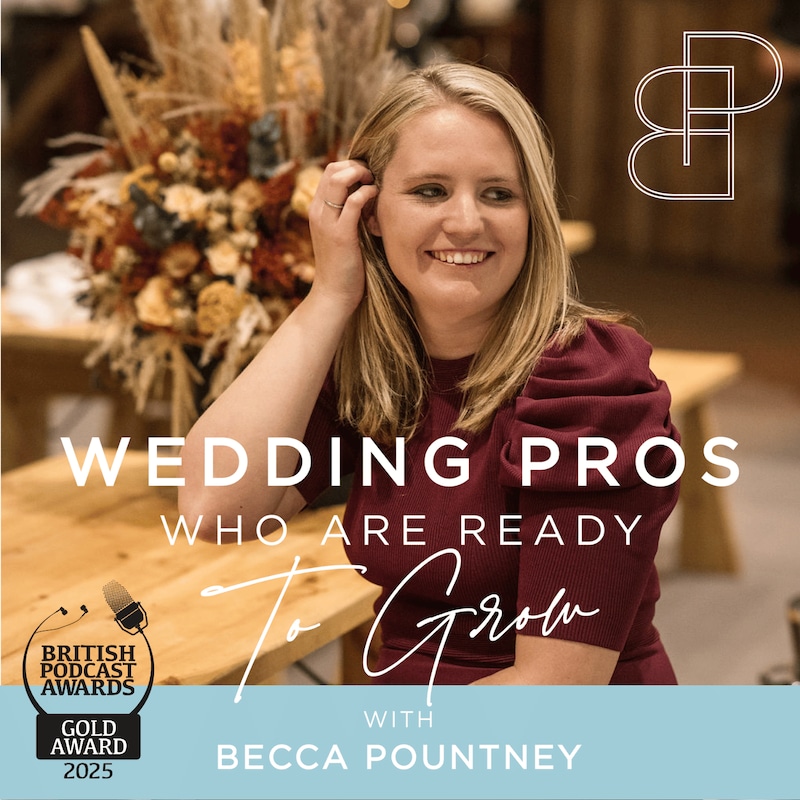
Shownotes
In today's episodes I have dug into the Wedding Pro Members lounge archives to bring you an interview from back in 2019 (excuse the sound quality, my equipment has improved a lot since then)
In this episode you can hear an interview with my accountant Emma Bail from Evolve accounting. She answers questions on everything you need to know when it comes to the finance side of your wedding business. From which records to keep to what you can claim for in your tax bill, this interview answers all your questions.
Want to join the wedding pro members lounge? Use the coupon PODCAST to get the first month in the club for just £1.
Click to join the wedding pro members club now
Find out more about Emma and how to hire her as your accountant here:
Transcripts
Today's podcast episode is gonna be a little bit different.
Becca:In today's episode, I'm digging into the wedding pro members' lounge archive.
Becca:Every month in the members' lounge, I bring in the best experts to
Becca:teach my members so that they are always stay ahead of the game.
Becca:Inside the club, there's a library of over 50 training videos, and today I've
Becca:dug into the archives and I'm bringing you a training from back in 2019.
Becca:In this session, I interviewed my own accountant, Emma Bail, from
Becca:Evolve accounting to ask her all the ins and outs of what we need
Becca:to know as small business owners.
Becca:The little questions that sometimes we just don't know the answer to.
Becca:To warn you, this was recorded three years ago, so the sound quality
Becca:isn't as good as usual, but the information makes it worthwhile.
Becca:So just bear.
Becca:If you need help to grow your wedding business with access to my knowledge
Becca:and my expert training sessions, then do check out my Wedding Pro member's lounge.
Becca:At only 20 pound a month is an absolute bargain and really great value to help
Becca:you always stay ahead of your game.
Becca:The link is in the show notes.
Becca:Enjoy today's episode back from 2019 where I talk to my accountant, Emma.
Becca:I'm Becca Pountney, wedding business marketing expert, speaker and blogger,
Becca:and you are listening to The Wedding Pros who are Ready to Grow podcast.
Becca:I'm here to share with you actionable tips, strategies, and real life
Becca:examples to help you take your wedding business to the next level.
Becca:If you are an ambitious wedding business owner that wants to take your passion
Becca:and use it to build a profitable, sustainable business doing what you
Becca:love, then you're in the right place.
Becca:Let's get going with today's episode.
Becca:Hi Emma.
Becca:Thank you so much for coming and joining us in the members club this morning.
Becca:We're really excited, um, to have you.
Becca:I know people have been looking forward to the session a lot, so I
Becca:just wanna be helpful if you just introduce yourself, tell us who you
Becca:are, what you do, where you work.
Emma:Um, so my name's Emma Bail, I am a co-owner for a small accountancy
Emma:practice based in Wyboston near St.
Emma:Neots.
Emma:My husband and I run it and we have, uh, part-time Louise who works with us.
Emma:We, we've been going about five years, although I've been an accountant for over.
Emma:20 years, which makes me seem really old.
Emma:Um, we specialize in small business, so Exactly.
Emma:People like you and actually people like us.
Emma:So, um, a lot of our clients are, um, mums who have, uh, chosen to, to start
Emma:their own businesses after having their children or people who have chosen to
Emma:move away from more traditional work and, and freelance or have their own small.
Emma:Fab
Becca:so you are the right person for us to be talking to, because we
Becca:are all small business owners and I know because I've worked with you
Becca:before, that you keep everything really simple as well, which is what we like
Becca:about you don't make it complicated.
Becca:So I'm gonna go straight into the questions we've got.
Becca:As I said, if any of you've got extra questions as we go along
Becca:or comments, please leave them.
Becca:Um, and I will keep an eye on them as we go through.
Becca:So, First question, let's keep it really basic to start with.
Becca:What records should we be keeping, if any at all?
Emma:Please do keep records . So.
Emma:It's income and expenditure for your relating to your business.
Emma:So the records of anything that you sell.
Emma:So that could be copies of invoices that you give to clients or if you
Emma:are dealing in cash, you might have a cash receipt, but, but as much
Emma:detailed record as you can on the income you receive for your business.
Emma:And then also business related expenses.
Emma:So anything that you purchased directly related to your business, that could
Emma:be, you know, if you make chairs, that would be the wood and the nails
Emma:that you buy to make your chairs.
Emma:If you provide a more service type business, then that could
Emma:be your laptop, stationary maybe software, things like that.
Emma:So anything that's related directly to your business.
Emma:You need to keep your receipts, um, either electronically or in paper form.
Emma:Um, hmrc like you to keep those for seven years so that you can prove what you've
Emma:earnt and what you've, what you've bought.
Emma:And there's lots of different ways that you can keep those records.
Emma:You can either have a sort of very paper based way of doing that, or
Emma:you can be a bit more clever about it and have a more electronic, But
Emma:the most important thing is to keep for everything that you purchase and
Emma:everything you sell, to keep some sort of record receipt hard, copy yourself
Emma:to prove that that transaction happened.
Becca:Perfect.
Becca:So we should be keeping everything for seven years.
Becca:Yes.
Becca:. Wow.
Becca:Okay.
Becca:That's good to know.
Becca:I've got mine, I promise.
Becca:Right.
Becca:Okay.
Becca:So next question.
Becca:This one always throws people off.
Becca:So what is the difference between net profit and gross profits?
Emma:Ah, I love this question.
Emma:So that can kind of slightly depend on what business you're in, um,
Emma:what's included in net and gross.
Emma:But we'll use a really easy example.
Emma:So if you make chairs, You will sell your chairs to your customers, but
Emma:you will have, um, materials that you need to purchase to make your
Emma:chairs, and that would be wood, nails and maybe you might employ someone
Emma:direct labor to make those chairs.
Emma:So your gross profit would be your sales less.
Emma:Those costs of those sales would give you gross profit.
Emma:Then you take away your overheads.
Emma:Overheads are things like rent rates, um, you know, electricity.
Emma:The office running costs, so your computers, your software, your
Emma:stationary, all of those things, and that brings you down to your net profit.
Emma:So your gross profit is everything that directly relates to your sale.
Emma:Net.
Emma:Net profit includes those overheads, which are the
Emma:overrunning costs of your business.
Emma:So the theory is if you have no sales, you would have no cost of sale, but you would
Emma:still have those overheads because you'd still need to pay your, you know, your
Emma:rent and your electric and your overheads.
Emma:And that's how it works.
Becca:And which one should we be paying the closest attention?
Emma:Both.
Emma:Um, and, and so what I like to do is look at a percentage on both your gross profit.
Emma:You can work out a percentage, so your gross profit divided by your sales,
Emma:and you can compare that year to year.
Emma:That's why it's really nice building up nice sets of accounts that are, that
Emma:have a good enough amount of detail because you can see if that gross
Emma:profit percentage is going up or down.
Emma:So what sometimes we see, thinking about our chair manufacturer, we
Emma:might see that, that the sales.
Emma:Perhaps, but that the gross profit margin goes down.
Emma:And so actually it, they might have lost control of their costs.
Emma:Um, so suddenly they're, because they're really busy and they're making
Emma:loads of extra sales, they're not paying attention to where they're
Emma:buying their wood and nails from, and those costs are increasing.
Emma:So for every pound of sale, they're not getting the same amount of gross profit.
Emma:So that's a really important.
Emma:, but that net profit's really important as well because that's showing
Emma:where your overheads are going.
Emma:Is your electricity going up?
Emma:Are you spending too much money on stationary and it's that net profit
Emma:that's gonna give you a better indicator of how much tax you're gonna pay.
Emma:Okay,
Becca:perfect.
Becca:That's really helpful.
Becca:Thank you.
Becca:Okay.
Becca:Now lots of people in the members club, um, have another job as well,
Becca:either full-time or part-time.
Becca:So how does that affect their account keeping
Emma:so it doesn't affect your, your business accounts at all?
Emma:Um, your pa y e work.
Emma:It's not included in your business account, so we still
Emma:do your sales less your costs, bringing you to your net profit.
Emma:But when we come to calculate your tax, we will also include any other income that
Emma:you receive, you know, from your part of full-time job that you're doing, P A Y E.
Emma:We'll combine all of those.
Emma:Um, incomes together, calculate how much tax you need to pay on the
Emma:total income, then with less any tax that you've already had deducted.
Emma:And if you're on a PAYE scheme, if you are, if you are in employment
Emma:somewhere else, they may well have deducted tax and then it'll be that
Emma:balance at the end that you have to pay.
Emma:So, effectively, you are just paying tax on the extra income
Emma:you've received from your.
Emma:. Becca: Okay.
Emma:And if we have an accountant, presumably they help us or that, I mean, they, I mean
Emma:from a very practical point of view what you need to do is you, you,
Emma:you, you'll keep your business records as we've just talked about, but you'll
Emma:also give your accountant, hopefully me, your, your P 60 or your P 45.
Emma:So your P 60 is a document your employer gives you at the end of the year, which
Emma:is a total of everything you've earned and anything that they've deducted in tax.
Emma:P 45 is if you've left a, um, an employer during the year, they'll give you your
Emma:P 45 when you leave, and that again, will be a summary of how much they
Emma:paid you and how much tax is deducted.
Emma:So you'd give those documents along with your business records to your
Emma:accountant, and then the, the calculation that I've just described would,
Emma:would be done to make sure you're not paying any more tax than you have.
Emma:. Becca: Perfect.
Emma:Thank you.
Emma:That's really helpful.
Emma:Okay, so we talked at the beginning about the fact we need to keep records.
Emma:So have you got any practical tips about how should, how
Emma:should we keep our records?
Emma:How should we keep track of spreadsheet?
Emma:What should we be doing?
Emma:It, it, it, there, there's two things that drive this.
Emma:How techy you are and, and how big your business is.
Emma:So if you are a fairly low tech person, you're not really into spreadsheets
Emma:or softwares, but your business is quite small, then you would, you would
Emma:completely get away with a folder.
Emma:Um, with some dividers in it.
Emma:And you'd have one section for your bank statements, one section for records of
Emma:your income and one section for, you know, all your receipts for your expenses.
Emma:And I've got, I would say probably 40, 50% of my clients work on that
Emma:basis and it works really well.
Emma:And once a year they come to my office with their folder with everything
Emma:in it, and then we do the techy stuff, we enter it into software
Emma:for them and do the bookkeeping.
Emma:And that works really.
Emma:If your business is a bit bigger and you have a higher number of transactions,
Emma:you might find that a bit difficult to keep track of, um, you might
Emma:want to then move to a spreadsheet based, uh, bookkeeping system.
Emma:So, and there's lots of different ways we can do it, and I can, I provide templates
Emma:to my clients for those who want one.
Emma:But really you still need to keep that the paperwork that we've talked about
Emma:in the folder, but then you'd also enter that information onto a spreadsheet, all
Emma:of your sales, less all of your costs.
Emma:The good way about, the good thing about doing that is then you yourself can
Emma:keep a bit of a track throughout the year of how much profit you're making.
Emma:It's not gonna be the exact accounting profit that your accountant's gonna
Emma:come up to at the end of the year because they'll do some accounting
Emma:adjustments, but it'll give you a rough idea so you'll know if.
Emma:Any money and you'll be able to have roughly a bit of an idea how much
Emma:tax you need to be putting away.
Emma:So spreadsheets for that smaller business can, but, but that's maybe
Emma:a little bit too big to just have a paper based system works really well.
Emma:As you get bigger, you might start to think about, um, software.
Emma:So the more transactions you've got, the more kind of unwieldy or gets and you can
Emma:end up with, you know, I've got clients who sort of turn up quite often builders
Emma:turn up with a bin bag full of receipts.
Emma:Um, you know, and it can take me a day to sort them out.
Emma:Those sorts of clients really should be doing their, their, their record
Emma:keeping on, on some sort of software.
Emma:Um, and again, it really depends how techy you are.
Emma:There's some really complicated softwares out there.
Emma:There's some really user friendly stuff.
Emma:Um, but really it's about inputting that information into the software and
Emma:then your accountant will be able to log in and kind of police that and check
Emma:that you're doing everything right and pull the information off that you need.
Emma:and which
Becca:software would you recommend?
Becca:Would you, have you got anything that you think's better for small businesses?
Emma:It really depends on you as a business.
Emma:There's lots of great software out there and, you know, I could, we could
Emma:talk about this for, you know, we could do a whole separate hour on software.
Emma:A lot of it depends on your business and what your requirements are.
Emma:I like zero.
Emma:Um, zero has become very fashionable recently.
Emma:Um, I like zero because it's web based.
Emma:And what's great about that, it means that you can access it anywhere.
Emma:You can access it on your phone, um, you can access it on your laptop.
Emma:Um, as your accountant, I can log in and access it so we
Emma:can have a phone conversation.
Emma:We're both looking at the numbers together and you can get lots of reports off it.
Emma:Um, so I really like Xero from that point of view.
Emma:It is quite user friendly.
Emma:and I'm actually just about to become a Xero partner, which means I'm
Emma:doing some extra training with Xero to make sure I'm, you know, extra
Emma:knowledgeable in that particular software because I really like it.
Emma:But that, that's just a personal preference.
Emma:QuickBooks is a good, it's a really good bit Kit as well, and
Emma:works very similarly to Xero.
Emma:Um, it's been around on the market a lot longer than Xero.
Emma:And it worked in a very similar way.
Emma:It is web based, so you can log onto it wherever you are.
Emma:I could log onto it too as your accountant and we can both look at it together.
Emma:Um, How you choose between the two, it kind of then becomes a
Emma:little bit more business specific.
Emma:Um, I personally think the Xero stock management system is a
Emma:little bit better than zero.
Emma:So if you were my client and you had a lot of stock, maybe you were a wedding dress
Emma:shop, you know, I might say maybe zero's gonna work for you a little bit better.
Emma:But that, again, that's more of a personal preference.
Emma:So, you know, we'd look at those two bits of software together.
Emma:There's also some much cheaper software out there.
Emma:There's things like kpm and you know, various different softwares like that.
Emma:If you want to go a little bit lower cost, and if your business isn't too
Emma:complicated, if you haven't got high levels of stock, if you haven't got,
Emma:you know, those sort of, um, more complicated, uh, transactions that you
Emma:need to record, then you might not.
Emma:Feel that you need to invest in, in them in Xero or in QuickBooks.
Emma:And also with a lot of these softwares, they have different levels.
Emma:So they'll, most of them will have a basic free or very cheap, um, version,
Emma:and then a sort of mid range one, which most people use, and then a sort of
Emma:more expensive, much more complex one if your, if your business needs it.
Emma:Um, so it's really about sort of shopping round, figuring out what
Emma:it is that you need and seeing which of those softwares fit in with you.
Becca:Perfect.
Becca:That's really helpful.
Becca:Someone's commented, I can't see who it is, but they've said, Emma,
Becca:Don't bring all my receipts in a bin bag when I met with her.
Becca:So , it's clearly someone that's pin to me with you, me
Emma:Don't, bring all your receipts to me in a bin bag.
Emma:I've got, I always say this, I've got a couple of clients, they're
Emma:always builders, Bless them.
Emma:They're always sort of my best and my worst clients at the same time.
Emma:They're always come in and we have a bit of a laugh, but, um, it's those
Emma:clients you do, they're literally, I think they open their van doors.
Emma:Scrape all the receipts into a bin bag and hand them to me
Emma:once a year and that's fine.
Emma:Um, I think that you are always gonna pay an accountant a lot more money for that
Emma:type of service because, I have to spend a day on the floor dusting concrete off
Emma:the seats and getting them in an order before I can even start doing my job.
Emma:But I think if you are a business owner yourself, if you are, if you're
Emma:keeping records in that way, you get to the end of the year and you will
Emma:genuinely have no idea whether or not your business has been successful.
Emma:You'll genuinely not know have I made a profit of a loss or, you know, So I.
Emma:I do worry about businesses that sort of keep their records like that.
Emma:It always just feels a bit that they're running those businesses on instinct.
Emma:Um, rather those businesses that use software or um, you know, a
Emma:spreadsheet tend to have a lot better track of kind of where they are with
Emma:their business throughout the year.
Emma:Perfect.
Becca:Um, just to let everyone know, I can see you've got
Becca:some questions coming in.
Becca:I'm gonna come back to them at the end, so we're gonna keep going and
Becca:I'll come back to your questions.
Becca:So I haven't ignored them, but I will come back to them.
Becca:Okay.
Becca:Here's the golden question, Um, which the answer to this one we
Becca:met last time really scared me.
Becca:So can I just do my tax return myself?
Emma:Um, you can absolutely, you can.
Emma:Legally, there's absolutely nothing to stop you doing your tax return yourself.
Emma:And lots of people do.
Emma:Um, and lots of people don't, and lots of people do and get it horribly
Emma:wrong and get themselves into trouble.
Emma:It really comes down to your own personal capabilities.
Emma:So I think you have to ask yourself the really honest question.
Emma:do I have the competency to do this?
Emma:Do I really understand what's being asked of me?
Emma:Do I really understand HMRCs compliance?
Emma:Um, you know, do I understand the tax rules?
Emma:Do I understand what I can and cannot claim for?
Emma:And if, honestly, honestly, the answer is yes then, then yeah, do it.
Emma:But what I do see quite often, I'm actually working on, on a piece of
Emma:client work at the moment, and he.
Emma:He did his, his own tax return for the last two years, and then his tax bills
Emma:are incredibly high and he's paid them, but he's sort of had this niggling
Emma:feeling that it, it's not right somehow.
Emma:And so he's asked me to go back over the last two years and
Emma:redone it, and I've just saved him about 800 pounds worth of tax.
Emma:Um, You know, so it's, it, it's one of those kind of, it, it's a risk.
Emma:Um, I've also got another client at the moment who did her own tax return,
Emma:um, and has now come to me because she's been compliance checked by HMRC
Emma:and they're trolling back through the last seven years of her records, um,
Emma:which is incredibly stressful for her.
Emma:So the answer is, Yes, you absolutely can do it, but I think, you know,
Emma:with anything in life, only do it if you've got the competency to do it.
Emma:You know, for the same reason why I wouldn't do my own website,
Emma:because I'm just not technically minded enough to be able to do that.
Emma:Um, but there are other things that I do do myself because I, because I can.
Becca:Yeah, I think that the thing that kind of, I guess, scared me when
Becca:we talked before at the master class was that more the compliance check.
Becca:That's actually, they can come back to you and talk to you about anytime
Becca:in the last seven years, and you have to be able to show a really
Becca:good, um, record of what you've done.
Emma:Yeah.
Emma:You, you need to have a really good audit trail of that.
Emma:And, um, yeah, it's, It is, it is frightening for, for clients when that
Emma:happens, when we, you know, I mean, there's a couple things to consider.
Emma:The first thing is if, if you are, if you have an accountant and your
Emma:accountant submits your tax return on your behalf, hmrc know that.
Emma:So you are statistically a little bit more likely to be compliance checked
Emma:because HMRC know that if an accountant's done it, it's more likely to be correct.
Emma:So they, they tend to focus a little bit more on people
Emma:that have done it themselves.
Emma:That doesn't.
Emma:If you have an accountant, you definitely won't be compliance checked.
Emma:But it also means, you know, when I'm doing accounts for clients, I'm thinking
Emma:about several things at the same time.
Emma:Firstly, about getting the accounts right, um, and making sure that
Emma:we are compliant with rules.
Emma:Secondly, making sure that I'm minimizing the tax liability for the
Emma:client, because at the end of the day that that's the name of the game.
Emma:But, but doing that legally and doing that, using the provision
Emma:that we have available to us.
Emma:And thirdly I've always got in the back of my.
Emma:If a hm, r c inspector was here looking at this right now,
Emma:do we have that audit trail?
Emma:You know, can we prove, are we demonstrating that
Emma:these are accurate accounts?
Emma:Um, and I think it's really important that all those sort
Emma:of boxes are ticked as your, as you're going through your year end.
Emma:Perfect.
Becca:So here's the next question that we are all thinking.
Becca:If we don't have an accountant, is it expensive to have an accountant?
Becca:Like I know when we talked again before, I had absolutely no idea how
Becca:much it costs to have an accountant.
Becca:So is it expensive?
Emma:It depends how big a business you are.
Emma:I mean, our starting rate for Sole Traders is 150 pounds.
Emma:Um, for the year end accounts, that's the, the accounts, the tax return,
Emma:tax calculations, all the advice, you know, face to face with me, et cetera.
Emma:And then whatever help you need through the year, obviously that goes up.
Emma:Um, our most, you know, our, I think our biggest client pays something like
Emma:five grand in the year, but they're a big limited company, you know, with
Emma:payroll and all sorts of things, and we've got lots of clients in between.
Emma:You know, for the average small, um, you know, sole trader running
Emma:some sort of business from home, you're going to be typically
Emma:looking between 115 and 300 pounds.
Emma:You know, depending, um, and I think then you've got a way in your mind is, you
Emma:know, what are you getting for that money?
Emma:Um, you know, firstly I think you're certainly getting that piece of
Emma:mind that, you know it's correct.
Emma:But then thinking about that piece of client work, I've been working,
Emma:you know, on the last couple of days while he has had to pay me some money
Emma:to do the work, he's actually saved six, 700 quid in Tax as a result.
Emma:Um, so no, I don't, I don't think an accountant is, is
Emma:particularly, um, expensive.
Emma:I think that there, it depends who you use.
Emma:There are lots of different types of accountants.
Emma:So there are some very large accountancy firms out there who are geared
Emma:for, towards the very large client.
Emma:and their fees will be higher.
Emma:And you do find, as a small sole trader, if you go to the very large practices,
Emma:you end up sort of paying big practice fees, but you are paying for the luxury.
Emma:And they have a receptionist, you know, they have the fancy paper.
Emma:They, you know, they've got their range rovers parked in the, in the,
Emma:in the car park, outside, you know, they've got somebody else from the
Emma:phone and all that sort of thing.
Emma:If you go to a smaller practice, either just a single, um, so trader,
Emma:you know, some, some accountants, but, you know, run their businesses from
Emma:their home, which is how I started, you know, we've got premises now.
Emma:But you know, I answer my own phone.
Emma:I post my own letters, so, you know, we don't have those overheads.
Emma:So, you know, I think sort of it's about finding the accountant that matches you.
Emma:So I think small, small accountants tend to work better for small
Emma:businesses and big accountants tend to work better for, for big businesses.
Emma:Okay.
Emma:And I think
Becca:it's worth every penny to take away the stress . Okay, Now we're gonna
Becca:talk now about things that we can claim.
Becca:I know this is something that lots of people like and
Becca:have lots of questions about.
Becca:So we'll do some basic rules, um, and then we'll go through some specifics.
Becca:And I've seen a few people asking the comments as well.
Becca:So quick roundup of basic rules, what we can and can't, we claim against.
Emma:So, so the, the umbrella ruling onto all of this is, is, is the
Emma:expense wholly for the purpose of your.
Emma:So there was lots of things that are really, obviously, again, thinking
Emma:about our chair manufacturer.
Emma:You know, if you make chairs, then your wood and your nails are very
Emma:obviously, um, for your business.
Emma:If you are a wedding dress supplier, then obviously the purchase of wedding
Emma:dresses and, and accessories for resale are very obviously for your business.
Emma:You know, if you are buying, you know, the, the pen and the, and the
Emma:notepad that I've got in front of me at the moment, you know, that's
Emma:a stationary cost for my business.
Emma:That's all pretty obvious stuff.
Emma:There are some things that people tried to claim, which
Emma:are just absolutely outrageous.
Emma:I mean, a couple of couple of years ago, a client who works from home wanted to
Emma:expense all of his new patio furniture.
Emma:The argument was that, Oh, I sometimes sit outside in my garden and do my work.
Emma:You know, the answer to that is really, you know, it.
Emma:Could you have that conversation?
Emma:If Hmrc a tax inspector was sitting in front of you, could you honestly,
Emma:with a straight face argue that, is a genuine business expense
Emma:and the answer is probably not.
Emma:So most of it's pretty obvious.
Emma:Um, you know, have you bought it for your business?
Emma:Yes.
Emma:Then it almost certainly is a business expense where you get some wooly areas
Emma:where people aren't really quite sure.
Emma:It's things like phone and mileage and, you know, sometimes people ask me things
Emma:like, Well, what about my glasses?
Emma:, you know, because I need my glasses to work on the computer.
Emma:So are they a taxable business expense?
Emma:And the answer is no.
Emma:Um, because they're for you personally, for, they're for your eyes.
Emma:You haven't bought them to actually trade in your business.
Emma:Um, And there are areas, of course, like, um, mobile phones.
Emma:So yes, of course you need your mobile phone to run your business.
Emma:Um, if that is your own mobile phone and you use it for business and
Emma:personal, then we'll take a percentage.
Emma:Normally 50% for your business, 50% for personal.
Emma:If you're using your car, um, for your business, then record
Emma:your mileage and we'll do a mileage calculation based on that.
Emma:Um, So, yeah, expenses, really the, the key question is, is it
Emma:exclusively and holy for your
Becca:business?
Becca:Perfect.
Becca:So I'm working in my garden now,
Becca:I wish I was . Okay, so let's go into some of the specifics
Becca:that people asked about then.
Becca:So I know Rachel asked this earlier.
Becca:So she is a videographer.
Becca:Um, basically she wears all black to do a wedding.
Becca:Lots of photographers do can, She claim back on the clothes that
Becca:she buys for wearing at those
Emma:events.
Emma:I'm afraid not.
Emma:So there was some things you can, but generally no.
Emma:So if it's a uniform, so if you've got like a polo shirt with your business
Emma:logo across it, then you can do, um, likewise if it's specialist clothing,
Emma:so if you're a chef, then your chef hat and chef jacket would be tax deductible.
Emma:Um, anything specialist or safety.
Emma:So if you had safety goggles or safety gloves, all those sorts of
Emma:things, they are tax deductible.
Emma:If it's just clothes, then no.
Emma:And there was a, there was an interesting case a couple of years ago.
Emma:With HMRC, it was a, it was a lawyer and she wanted to claim her suits
Emma:that she wore for work as a tax deductible expense, and her argument
Emma:was, well, You know, in everyday life I wouldn't wear a black smart suit.
Emma:I'd be in my jeans and t-shirt.
Emma:I only buy and wear black smart suits for work, therefore it's work expense and,
Emma:and they took it to court and HMRC won..
Emma:And what the judge, actually, he used a lovely phrase, which was,
Emma:you have to clothe your naked body.
Emma:And that was the ruling by the judge is that, you know, you'd.
Emma:You have to wear clothes in the course of your day.
Emma:Okay.
Emma:You're choosing a particular style of clothes to, to match your job, but you
Emma:do still actually need to wear clothes.
Emma:Um, so on that basis, no.
Emma:Your black t-shirt trousers, things like that are not tax deductable.
Emma:Not
Becca:tax deductable.
Becca:Okay.
Becca:Put a logo
Emma:on it and then it is, and then its okay.
Becca:Okay.
Becca:We talked about phone.
Becca:Oh, that's giant.
Becca:Um, we can, so we can claim for our phone, but we work out a percentage is.
Emma:Yeah, so you can do a couple of things.
Emma:Um, if you have, I mean, I have two phones.
Emma:I have my personal phone and I have my business phone.
Emma:And I did that um, a couple of years ago cause I got fed up with people
Emma:phoning me up at 11 o'clock at night wanting to talk about accounts.
Emma:So I have a separate business phone, so my separate business phone is 100%.
Emma:Um, a business cost, a lot of people use their phone, the one phone
Emma:for business and for personal.
Emma:And so on that basis, we work out a percentage.
Emma:So if you were to say to me, Well, I, it's about half and half, then
Emma:that's what we, that's what we do.
Emma:50 50, um, split between business and work and home.
Becca:Okay.
Becca:Perfect.
Becca:Okay.
Becca:Someone's asked this question, so I'm gonna bring it in.
Becca:Um, if I buy a laptop and use it half for work and half for personal use,
Becca:how does that work as a business?
Emma:Exactly as that you described.
Emma:So we charge half of it to work and half of it to personal.
Emma:So we just put half of the cost into the business.
Becca:Okay.
Becca:So if you have a laptop and you use it for anything other than work, then
Becca:you have to split it as a percentage.
Becca:Is that right?
Emma:You should do.
Becca:Okay, . Perfect.
Becca:Right, Let's go to the next one.
Becca:Someone else asked about this as well, so I'll put it up.
Becca:So if I'm meeting a potential couple, obviously in the wedding
Becca:industry, we go out and meet people that might end up booking us, show
Becca:them photos, that kind of thing.
Becca:Can we claim the food and drink that we buy for them at that
Emma:meeting?
Emma:It's not a tax deductible expense, so, um, what we can do is we
Emma:can put it in your accounts.
Emma:So when we produce your accounts, your profit and loss account,
Emma:you've got your sales less, all of your costs down to your profit.
Emma:It can be really useful to put that in.
Emma:It's called, it's classified as client entertaining, and it can be really
Emma:useful to put it in your account so that you can see as a business.
Emma:How much you're spending and what the impact on your profit is as a business.
Emma:That's good to know.
Emma:However, when we come to calculate your tax, that cost cannot be
Emma:included in the tax calculation.
Emma:Um, the client entertaining just isn't the tax deductible expense.
Becca:Okay?
Becca:So don't wine and dine your clients too expensive cause you can't claim it back.
Becca:Okay.
Emma:Well some businesses, I met with a client the other day, um,
Emma:who runs a PR business and for her, that's a, that's actually her, her
Emma:client entertaining spend is, is huge.
Emma:Like, she spends a lot of money every year doing it, but she wouldn't
Emma:have a business if she didn't.
Emma:So she has to do it, She has to spend it.
Emma:We record it in the p and l, we track it year to year.
Emma:You know, we have a look at how, what the impact on sales is and things like
Emma:that, but we take it out for tax purposes.
Emma:So, yeah, it, it's not, I think, There's a bit of a myth out
Emma:there that it's tax deductible.
Emma:So people say, Oh, I can spend this cuz it's on the tax line and that isn't true.
Emma:So it's worth kind of thinking about how much you're spending
Emma:and keeping in control on that
Becca:spend.
Becca:Spend.
Becca:Quick question from me on this subject.
Becca:So I was thinking about this the other day.
Becca:So if we are buying stuff like that, so say I go to Costa for
Becca:meeting and I buy the drinks and I know that's not tax deductible.
Becca:Should I be still keeping the receipt or not worrying?
Emma:It, it doesn't matter from a tax point of view, it just isn't relevant.
Emma:Um, you as a business owner may want to keep that and put that in
Emma:your, you know, in your QuickBooks and have it in your p and l.
Emma:So you are keeping a track of, you know, how much I'm spending for my business.
Emma:It's less important about keeping the receipt because we're taking
Emma:it out for tax calculationsanyway.
Emma:So hmrcs, and we'ree talking about sole trader.
Emma:It's slightly different if you're a limited company, but I mean from
Emma:your, But if you're gonna keep all your receipts and all your records
Emma:and record all of this anyway.
Emma:I mean, you might as well, but it, it doesn't, you know, HMRC
Emma:not as important, be compliant.
Emma:If you had to be compliance checked, HMC would not want to look at the receipts
Emma:for that because we're not including that in the tax calculation anyway.
Emma:Perfect.
Becca:Okay.
Becca:Um, okay.
Becca:Lots of us work from home, so can we claim anything from working from
Emma:home?
Emma:Yes, you can.
Emma:There's two ways of doing it.
Emma:HMRC provides some rates, which is simplified expenses, which are
Emma:according to how many it might be 10 pound a month or 20 pound a month
Emma:according to how many hours you do.
Emma:And that's the simplest way.
Emma:And, and that's quite good for people who just kind of work on
Emma:their kitchen table or whatever.
Emma:Um, if you have a, a dedicated room, So you've converted your
Emma:spare room into an office and you use that dedicated for business.
Emma:The better way to do it would be to actually calculate the cost.
Emma:So we would take, if you are renting your property, the rent, if.
Emma:I, if you own it, then we take the interest element of your mortgage plus
Emma:all the running cost of your house.
Emma:So electric, gas, water, all of those overheads.
Emma:And then we would allocate, so we would work out what percentage that
Emma:room is of your house and we'd, we'd work out a working from home allowance
Emma:and that can actually work out quite beneficial if we end up coming
Emma:up with a cost of say, 700 pound.
Emma:If that 700 pound is tax deductible, that reduces your net profit by 700 pound and
Emma:therefore reduces your tax liability.
Emma:So it's worth doing.
Emma:Yeah, that is worth
Becca:too.
Becca:And if you, if you, um, if you buy like a, you know, like when you get a
Becca:summer house or a shed for your garden to work from, can you claim anything on
Emma:that or not?
Emma:I'm afraid you can't.
Emma:No.
Emma:So that, that falls under the category of capital spend.
Emma:So anything that's deemed as an improvement to your house
Emma:and because that's a structure.
Emma:HMRC view that as an improvement.
Emma:No, that's not you.
Emma:You could, but you get into this really sticky sort of capital gains sort of,
Emma:you know, territory when you come to sell the house and stuff, so, you know.
Emma:No, really.
Emma:Okay.
Becca:All right.
Becca:Next question.
Becca:How should I log and claim my mileage?
Emma:It depends what system you're using.
Emma:If we are going back to our paper based system where you've got your folder
Emma:and you're doing it all paper, then get yourself a notepad and just write every
Emma:day the date, the purpose of the journey.
Emma:Um, so it might be the name of the client or that you're going to Tescos
Emma:to buy stationary or coming to see your accountant, um, postcodes number of miles,
Emma:and just record that throughout the year.
Emma:If you are using a spreadsheet, then put a tab on your spreadsheet and exactly the
Emma:same date, Purpose of my, a purpose of.
Emma:Um, postcodes and number of miles.
Emma:It's the round trip.
Emma:Um, if you're using software, quite a lot of softwares
Emma:actually provide, um, a method.
Emma:So, um, QuickBooks, certainly the self-employed part, has a, has a
Emma:mileage log in there that you can record, but certainly keep, keep
Emma:records of that mileage because again, it's all, it's all tax deductible.
Becca:Perfect.
Becca:Okay.
Becca:Right.
Becca:This is the last official question from me, and then I'm gonna take a few of the
Becca:questions that we got from the comments.
Becca:Um, so if we're doing really well, um, with our self assessment and our business
Becca:is booming, at what point do we then consider becoming a limited company?
Emma:It really depends on your reasons for wanting to become a limited company.
Emma:There are lots, there are financial and non-financial reasons.
Emma:Um, there are some tax benefits to becoming limited, but only
Emma:once you're a certain size.
Emma:Um, And that certain size, it kind of varies from one business to the next, but
Emma:it's roughly, roughly that 30 k profit.
Emma:So not sales, but profit.
Emma:The way you pay yourself, the way you take money out of a limited company
Emma:is very different than how you take your money out of a, of a sole trader.
Emma:And there are some tax benefits.
Emma:You will save tax, you'll pay less tax, but.
Emma:You'll pay your accountant quite a lot more money for doing all of that for you.
Emma:You'll have payroll costs and accountancy fees because there's
Emma:a lot more work involved.
Emma:So you need to find that sweet spot where the tax that you are
Emma:saving outstrips the extra money that you're paying your accountant.
Emma:And usually, typically that's around that 30 K profit.
Emma:Profit.
Emma:But there are lots of other reasons why you become a limited company that's
Emma:got nothing to do with tax and I'd certainly, I'm not really an advocate
Emma:of only making that decision based for just to save tax and for no other reason.
Emma:And you need to think about what's right for your business.
Emma:So, um, for some, for certain industries, being a limited
Emma:company, um, it's good for image.
Emma:So some of your clients might prefer to work for you if you're work with you,
Emma:if you're a limited company, because it, it makes them feel a little bit more
Emma:secure that you are a proper business.
Emma:It, it's all about perception.
Emma:It's not a real thing, but you know, for, you know, you certain
Emma:industries certainly find that easier.
Emma:Some people feel a little bit more protected working in that
Emma:limited company structure.
Emma:Um, so you do have that limited liability.
Emma:So if you are to take, um, finance or loans out in the name of your
Emma:business, that does protect your personal assets in a way that you
Emma:are not protected so much if you take out business loans in your own name.
Emma:But I think.
Emma:There is a bit of a myth out there of just how much protection that
Emma:you get as a limited company.
Emma:It doesn't protect you from anything and everything, so you
Emma:are still personally liable.
Emma:You know, you'll see on the news every now and again, directors going to prison
Emma:for, um, you know, large companies going to prison for, for negligence.
Emma:You know, you are still responsible for the work that you do, so you can't provide
Emma:company so that there's lots and lots of reasons why you might want to, and I
Emma:think the first step is always to sit and look at the numbers with your accountant
Emma:and talk through all the reasons you know, why you would wanna do that.
Becca:Perfect.
Becca:Okay.
Becca:Let's take a few questions from people that are coming in.
Becca:If you've got any last questions, pop them up now before we finish.
Becca:So this person says, Am I right in saying you can't climb mileage from
Becca:home to place of work, such as if you have a studio or a lockup to go to?
Emma:Correct.
Emma:So I'm sitting here in my office that I rent in Wyboston, I cannot
Emma:claim the mileage here because it's my regular place, place of work.
Emma:However, if I now go and see a client, I can claim that mileage.
Emma:Or if I go to the stationary shop to go and stock up on folders,
Emma:I can claim that mileage.
Emma:But if you are somebody that sort of floats around and does you, if you're
Emma:a mobile hairdresser and you're going to lots of different places, then, then
Emma:all of that mileage is, tax deductible.
Becca:Perfect.
Becca:Okay, next question.
Becca:Can we claim for food we have to buy whilst working away from
Becca:home for an all day wedding?
Emma:Not all day, but if you're away overnight, then you can
Emma:do, But if it's just, you know, HMRC would, If you think about.
Emma:Going back to my days before I had my business, when I worked in
Emma:London, I would get on the train at seven in the morning, go to London.
Emma:I wouldn't get home till seven o'clock, eight o'clock at night.
Emma:I couldn't, you know, all of that food cost.
Emma:I bought my lunch when I was out in London.
Emma:That was all my own cost.
Emma:So, hm.
Emma:R c argue, that's exactly the same.
Emma:If you are a business owner, if you work away overnight.
Emma:Obviously then that's a, that's for your business.
Emma:So we go back to that wholly and exclusively for your business,
Emma:and then your evening meal and your breakfast becomes tax
Emma:deductible and your overnight stay.
Emma:Yes.
Emma:And your overnight stay.
Emma:Absolutely.
Emma:Your, your hotel costs.
Emma:Cool.
Emma:Okay, next.
Emma:Oh, sorry,
Emma:sorry.
Emma:I was gonna say there isn't a limit on that interestingly.
Emma:So, um, the wording is something like, you know, reasonable.
Emma:Um, and HMRC always makes me a bit nervous when they say things like that
Emma:because this objective, you know, I might feel that reasonable would be, you
Emma:know, a five star hotel and a, you know, a slap up, you know, 150 pound meal.
Emma:Hmrc might look at that and not feel quite the same way.
Emma:So I think it's always been trying to be a little bit sensible about,
Emma:about what you do with that.
Becca:Okay, next question.
Becca:Does it matter when you submit your tax return?
Emma:It does.
Emma:Um, so the, the, the year end is the 5th of April, so we've just come
Emma:through our year end now, the 5th of April, which is the year 1819.
Emma:That tax return is due the 31st of January next year if you do it online.
Emma:In theory, you can sit on it and you can submit it on the 31st of
Emma:January if you like to do that.
Emma:Um, and it's legally, there's nothing to stop you doing that.
Emma:That always makes me nervous.
Emma:Um, I, I'm a, I'm a big fan of doing it early.
Emma:I, you know, I think those clients that come in in these
Emma:early months, are usually.
Emma:Less stressed, um, a little bit more organized.
Emma:We can do your tax return now-ish or over the summer.
Emma:I can tell you how much a tax bill is.
Emma:You still don't need to pay it until January, but at least then, you
Emma:know, you can tax plan and you know what, uh, what expense to expect.
Emma:Um, I, you know, seen, had very stressed clients in my office before now who've
Emma:you've chosen to leave it until that December and January been given a tax
Emma:bill that they weren't perhaps expecting.
Emma:And then they've got no time to save for that, and they're in the
Emma:middle of Christmas and all that time when it's really expensive.
Emma:So I personally get it, get it done early, um, but then don't actually pay
Emma:it until the January when it's due.
Becca:Perfect.
Becca:And I'm a big advocate for getting it done early and last year we ran, um, in
Becca:the Engage Group a tax return challenge to everyone to get their accounts
Becca:up to scratch by the end of June.
Becca:Um, so I, and someone won some Prosecco who took part, so I think we
Becca:might do something again like that.
Becca:Um, so keep your eyes out guys, cause I think that was fun.
Becca:It motivated us all to get our accounts sorted out.
Emma:I love it.
Emma:I, I think it just, there's such a difference in, you know, those clients
Emma:that pop in there with their accounts, they're relaxed, they're feeling a bit
Emma:small cause they're getting it done early.
Emma:You know, it's a very different feel.
Emma:I hate January cause I'm just surrounded by really stressed out people who, because
Emma:it's been so long since their year end, they've lost half of their receipts.
Emma:Like, you know, they dunno what their tax bill's going to be.
Emma:They're really aware that they're running.
Emma:Time and it just doesn't, it's not very comfortable position.
Emma:So yeah, get it, get it done.
Emma:Get outta the way.
Emma:Everybody else like running around like headless chickens in January.
Emma:You can just sit back and be really smart knowing that you are done.
Becca:Okay, this is a personal question, so I don't know if you can
Becca:answer it, but I'll ask it and then see what you can or can't answer.
Becca:Okay.
Becca:It says, Can I ask something about tax?
Becca:My hubby is paye, works for a large company, but now tax people have told
Becca:him he needs to do self-assessment too.
Becca:We're a bit confused as he's also been given a tax bill for year 1718.
Emma:I'd need to look at details of that.
Emma:That's a bit . Um, I mean, just as an overview, there's lots of
Emma:reasons why a pa, somebody on PAYE may need to do a tax return.
Emma:It might be that their salary is over the limit to do it.
Emma:It might be something to do with child benefit.
Emma:It could be, um, if you're over a hundred k salary and you need to do it anyway.
Emma:There's lots of different reasons.
Emma:It might be something to do with P 11 DS not being far properly.
Emma:There's a whole host of reasons, but, um, whoever that is, if you want to give a
Emma:ring, Happy to have a look at it for you.
Becca:Perfect.
Becca:Okay.
Becca:Is it true that all businesses will have to be doing accounts online
Becca:by some point fairly soon, e.g.
Becca:On Xero or QuickBooks?
Emma:Yeah.
Emma:I mean, it doesn't have to be Xero or QuickBooks, but what we've got
Emma:coming in now is making tax, tax digital, which is causing a bit of
Emma:a hoo-ha in the world of accounts.
Emma:They're phasing it in.
Emma:So basically what they're trying to get away from people doing is just
Emma:doing everything on paper or just doing everything on spreadsheets.
Emma:They want everything really digital.
Emma:And so then those digital transfers to be directly out the
Emma:software up into, um, into hmrc.
Emma:So the VAT mtd making tax digital for that has come in now.
Emma:Um, and that's for all businesses that have a turnover of over 85,000 pounds.
Emma:So for, for a lot of people it doesn't really affect them.
Emma:For my clients who do have businesses that.
Emma:The changes that I've got, I'm thinking of one client, particularly, they keep
Emma:all their records on a spreadsheet.
Emma:Um, and that causes, poses a problem in terms of how making touch digital works.
Emma:Um, in that, really what they need to be doing is putting the information
Emma:directly into a software, and I'm uploading it directly, um, into hmrc.
Emma:There are some solutions like bridging software and things like that, which
Emma:I don't think today's really the time to look at that, but it's, um,
Emma:you know, it, it, it is changing the way that people are working.
Emma:For a lot of people, it doesn't really matter if you're already somebody that
Emma:uses Zero or QuickBooks or any of the other, um, MTD compliance softwares.
Emma:It kind of doesn't really matter.
Emma:It's really more a thing for your accountant will just slightly
Emma:change the way that they do things if you are a business.
Emma:And, and it's, it's surprising they do exist.
Emma:I have a client, a new client who's, um, turnover is over a hundred
Emma:thousand pounds and they're doing everything handwritten on a notepad,
Emma:which to me just blows my mind anyway.
Emma:And, um, That, uh, you know, and they are not making tax digital
Emma:compliant for their VAT purposes.
Emma:So we are having, they're having to go through a massive learning
Emma:curve at the moment where we're moving them onto software.
Emma:They're having to learn how to use it.
Emma:Everything that they're doing is, is different, and
Emma:that's really hard for them.
Emma:Um, so, so it is kind of, it's a bit hard on some people.
Emma:For most people, the transition's been quite easy.
Emma:Making tax.
Emma:Digital is going to be rolled out sort of to everybody, so it
Emma:will impact, um, self-assessment people, soul traders as well.
Emma:I think what hm, r c are doing is bringing it for the over 85 K.
Emma:Um, V a t clients at the moment, bringing that in, ironing out any problems.
Emma:You know, those are the clients that are more likely to be on
Emma:software at this point anyway.
Emma:Um, and then they'll roll it out to, to you guys, I guess.
Emma:Um, and they're looking at around 2020.
Emma:But I don't know, you know, within the accountancy community there's a lot
Emma:of talk of whether or not that will be delayed and how that's gonna work.
Emma:And I think a lot of it's kind of up in the air.
Emma:The key thing, I think, really, is that your accountant should be working with
Emma:you as you get closer to that, you know, and informing you and letting you know
Emma:if you, if you need to make any changes.
Becca:Perfect.
Becca:Couple more quick questions.
Becca:If you have a van for business use only, do you need to record
Becca:mileage or just keep fuel receipts?
Emma:Fuel receipts.
Emma:Okay, So you don't need to record the mileage.
Emma:100% percent for business.
Emma:You don't use it for anything else.
Emma:Every single thing that you, So you need the purchase of the van, your fuel
Emma:receipts, your m OT bill, your repairs bill, you know, new tires, all of that.
Emma:Just keep all of the receipts for all of those costs relating to that.
Becca:And is credit card evidence acceptable as sometimes
Becca:I don't get receipt for fuel?
Emma:Um, it, it is, it's not ideal and certainly if you get into a V
Emma:A T position, so if, if you are, if you become VAT registered, um, you
Emma:need to have the VAT receipt that actually details the VAT on there.
Emma:Um, as a sole trader, it, it's, I don't like it, but if you, if that's the
Emma:only, you know, if you don't have a receipt, then you don't have a receipt.
Emma:Having said that, you know, get I don't know of any garages that don't give a
Emma:receipt if you don't, if you ask for one.
Emma:So
Becca:only when the receipt machines broken at the pump, it's go inside.
Becca:Maybe.
Becca:I dunno.
Emma:It, it's, it's a, Yeah, I mean, you can do, um, HMRC do
Emma:provide for incomplete records.
Emma:So there are occasions where people have lost their receipts or, you know, things
Emma:have gone wrong and your accountant will be able to, should be able to build up
Emma:those accounts for incomplete records.
Emma:Um, if it's the odd receipt that's missing and it's on the bank
Emma:statement, then that's kind of fine.
Emma:But, you know, sometimes we get to clients who literally, they've lost
Emma:all of their receipts or half of their receipts or something, and then it, it,
Emma:it becomes a little bit trickier then, and then we have to declare to HMRC
Emma:that's that some of it's estimated, so as much as you can keep those records.
Emma:But yeah, of course, you know, I've done it.
Emma:I've lost receipts before.
Emma:Now, you know, it happens.
Emma:Um,
Becca:Okay.
Becca:Can we claim for an overnight stay if we're attending a course directly
Becca:related to improving our business, like a training course or only for a wedding?
Becca:Yep, you can.
Becca:Perfect.
Becca:And final question, cuz I know you've gotta go, How can
Becca:we get in touch with Emma?
Becca:Someone's asked?
Becca:. Emma: Oh, I should have like,
Becca:you'd be able to see my business
Becca:card.
Becca:Well, I can post your details in after.
Becca:Yeah, I'll post them.
Emma:Becca, You've got my details.
Emma:Um, give me a ring.
Emma:We've got a Facebook page, We've got, um, uh, a website, um, or phone.
Emma:And you can speak to me directly.
Emma:Um, you know, just give me a ring or email and we can have a chat.
Emma:What I'd like to do is just have a quick chat on the phone, um, just
Emma:get a bit of an initial idea of.
Emma:Are we what you're looking for?
Emma:You know, can we help you?
Emma:And then I always like to get people in, really come and have a cup of tea and
Emma:sitting out, I've just been decorating our office so you can come and admire
Emma:on your window blinds and, um, you know, just sort of get to know each
Emma:other and work out a quote and work out how that's gonna, you know, what
Emma:service we can provide going forward.
Emma:It's, we try and keep it quite kind of relaxed and easy.
Emma:Perfect.
Becca:Thank you so much, Emma.
Becca:Thank you.
Becca:Take care.
Becca:I hope you found that episode from back in my Members' Club archives really helpful.
Becca:Remember, if you are a member, you can go back and watch any of the video training
Becca:sessions in the archives whenever you want, and if you're not a member yet and
Becca:you're thinking about it, go and check out all the information in the show notes
Becca:and find that special offer that I have for podcast listeners there as well.
Becca:I'll be back next week.
Becca:In the meantime, go sort out your accounts and I'll see you soon.



