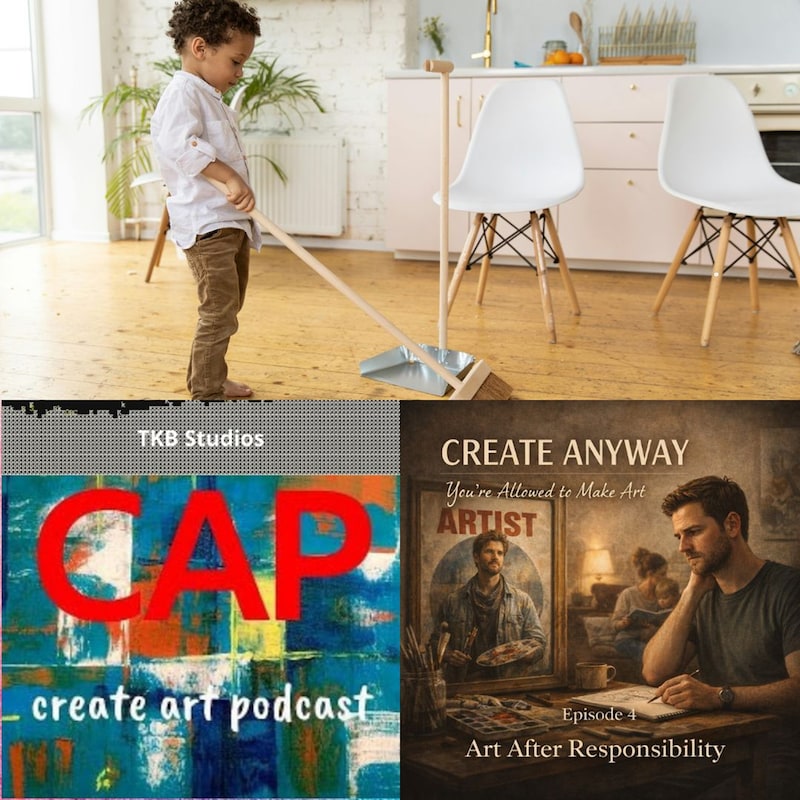
Shownotes
Art doesn’t have to take a backseat when life gets busy; in fact, it might just be the secret ingredient to making our responsibilities more bearable! This episode dives into the juicy idea that art and responsibility can totally coexist without you feeling like you’re sacrificing your sanity. We’re chatting about how creativity doesn’t have a designated time limit, and yes, you can still be an artist while juggling a career, family, and all those delightful adulting tasks. Whether you’ve been waiting for the “perfect moment” to get back into your creative groove or you think it’s too late, we’re here to tell you to throw that notion out the window! Join us as we explore how embracing your artistic side can actually enrich your life, not complicate it. So grab your paintbrush, your pen, or whatever floats your creative boat, and let’s get our art on!
- The Order We Were Taught
- The idea that art belongs to youth, freedom, and risk
- Why responsibility is framed as the end of creativity
- How people internalize the belief that they “missed their window”
2. Responsibility as Disqualification
- How careers, family, and stability become creative guilt
- Why wanting art after building a life feels selfish
- The silent shame of wanting something just for yourself
3. What Responsibility Actually Gives You
- Emotional depth, patience, and lived experience
- Why art made later in life carries more truth
- How limits can sharpen creativity instead of killing it
4. Letting Art Live Where You Are
- Making art without escaping your life
- Creating inside real schedules, real energy, real constraints
- Releasing the fantasy of “starting over” to start now
5. Redefining Commitment
- Art doesn’t need sacrifice to be valid
- Presence matters more than intensity
- Choosing continuity over urgency
Takeaways:
- Art and responsibility can coexist harmoniously; your creativity can thrive alongside life's demands.
- Just because you have a family and career doesn't mean you can't pursue your artistic passions.
- Feeling guilty for taking time to create is common, but it's important to prioritize your art.
- Making art later in life can bring deeper emotional truth and enrich your creative expression.
- Your lived experiences enhance your art, giving you unique insights and perspectives to share.
- Understanding that art is not just for the young helps liberate your creative spirit at any age.
How do I get such great guests?
PodMatch I use Podmatch to get the best guests on the show. Check out PodMatch if you want to be a guest on other podcasts or if you have a podcast and need guests for your show. Guests from Podmatch
Want to be a guest on Create Art Podcast? Send Timothy Brien a message on PodMatch, here: https://www.podmatch.com/hostdetailpreview/createartpodcast
Make Sharing your podcast easier
Use Podcast Beacon for the best NFS products to share your podcast while out and about or at conferences.
Reach Out To The Podcast
To reach out to me, email [email protected] I would love to hear about your journey and what you are working on. If you would like to be on the show or have me discuss a topic that is giving you trouble write in and let's start that conversation.
- Email: [email protected]
- YouTube Channel: Create Art Podcast YT Channel
- IG: @createartpodcast
- Twitter: @createartpod
Create Art Podcast Newsletter
Special Message
If you have found value in this podcast, please share it with a friend, as that is the best way to discover new podcasts. I want this to be a 5-star podcast in your eyes, so let me know what you would like to see.
Speaking about sharing with a friend, check out my other podcast Find A Podcast About where I help you outsmart the algorithm and find your next binge-worthy podcast. You can find that podcast at findapodcastabout.xyz.
For all of my projects, check out my portfolio website TKBPodcaststudio.com, where I help my clients through quiet professionalism lead through the noise.
This podcast uses the following third-party services for analysis:
OP3 - https://op3.dev/privacy
Transcripts
Somewhere along the way, many of us learned a quiet rule.
Speaker A:Art comes before responsibility.
Speaker A:And once you choose a career, a family, and a stable life, art is supposed to fade out.
Speaker A:But what if that isn't true?
Speaker A:What if responsibility doesn't disqualify you?
Speaker A:What if it actually gives you or gives your art more depth?
Speaker A:Now, in this episode, we're talking about making art after responsibility without undoing your life, without guilt, and without pretending that you're someone you're not.
Speaker A:Because art doesn't end when life gets real.
Speaker A:And sometimes that's when it finally happens.
Speaker A:Foreign.
Speaker A:Hi there.
Speaker A:This is Timothy Keem o', Brien, your head instigator for Create Art podcast, where I use my over 30 years of experience in the arts and education world to help you tame your inner critic and create more than you consume.
Speaker A:Now, I want to welcome you to our next episode in the Create Anyway series and just want you to take a moment and think about this.
Speaker A:You know, there's a moment a lot of artists hit that no one really warned you about, and it's a moment when responsibility shows up.
Speaker A:That's career, family, mortgage, expectations.
Speaker A:I have all of those.
Speaker A:And suddenly art feels like the thing that you're supposed to outgrow.
Speaker A:And maybe you were creative once and maybe you still are, but there's always something more important demanding your time.
Speaker A:Now, in this episode, we're going to talk about art after responsibility.
Speaker A:Now, creativity changes when life gets heavier, and why making art later in life is an effect, failure, or a delay.
Speaker A:Now, choosing to create now might be one of the most responsible things you can do.
Speaker A:Now.
Speaker A:If you ever thought, I'll get back to art someday, this conversation is for you.
Speaker A:All right, so let's start off from the beginning, and let's start off with, you know, the order in which we were taught.
Speaker A:And there's an idea that art belongs to the youth, art belongs to freedom, risk, all that stuff.
Speaker A:And no, it belongs to all of us.
Speaker A:Doesn't matter where you're at in your life, whether you have a career and a family and a mortgage and other expectations, it belongs to you right now.
Speaker A:Not when you were young or when you didn't have all these responsibilities.
Speaker A:And a lot of people think art is risky.
Speaker A:Well, it can be risky because you're putting yourself out there.
Speaker A:And, you know, when we think about all of our responsibilities, we think, okay, this is the time when we grow up and, you know, we don't have all this freedom.
Speaker A:And so that's when we're going to end our foolishness of creating art.
Speaker A:Well, guess what?
Speaker A:I'm 53 at the time of this recording, and I'm still a fool.
Speaker A:I'm still creating art, you know, and it maybe not each and every day, but when I do sit down to create, when I have time, and when I make time to sit down and create, I'm goofy about it.
Speaker A:I freely admit.
Speaker A:I am goofy about it, and I don't care because it's freedom for me.
Speaker A:It's an expression of what's inside me, and it's a reaction to what I'm seeing in the world.
Speaker A:Now, a lot of people internalize a belief that they miss their window.
Speaker A:Well, you know, when I was younger, I didn't do art, and now it's too late.
Speaker A:You can't teach an old dog new tricks.
Speaker A:Guess what?
Speaker A:Wrong.
Speaker A:You can't teach an old dog new tricks.
Speaker A:I'm teaching myself how to paint using acrylic paint.
Speaker A:Again, I'm 53, so you can do this.
Speaker A:You know, for a lot of time, a lot of my life, I was like, I can't do watercolor.
Speaker A:Well, guess what?
Speaker A:I have a watercolor set up right in the back here.
Speaker A:And when I'm done with the acrylic paints, I'm going to teach myself how to do watercolors.
Speaker A:So, yeah, you can teach yourself this stuff.
Speaker A:It's a lot of.
Speaker A:Well, first off, it's a lot of fun to create things.
Speaker A:And second off, it allows you to express yourself and allows you to connect with the outside world and say, hey, this is what I'm thinking about.
Speaker A:This is what I'm seeing.
Speaker A:This is what you're seeing.
Speaker A:And you can do that at any age, no matter how many responsibilities that you have, any age, you can do this.
Speaker A:So we're going to talk about how responsibility does not disqualify you from being an artist.
Speaker A:Now, creative guilt happens when we think about our careers or family and the stability that we have created.
Speaker A:You've put in a lot of hard work for that, so congratulations to you on that.
Speaker A:I have, too.
Speaker A:I've got a family, I've got a house.
Speaker A:I've got, you know, my job.
Speaker A:But I'm still creative, and I still find time to be creative because that's what feeds me.
Speaker A:That's what keeps me energized in order to protect all the things that I have around me.
Speaker A:And isn't that a great thing to teach your kids is, you know, you can build all this stuff up and you can still be you.
Speaker A:Now, it can feel selfish, and I'M guilty of this too.
Speaker A:Sometimes I feel selfish when I take time to create my art, when I, you know, put a pause on everything else and go time to create some art.
Speaker A:I do, I feel a little guilty about that.
Speaker A:Why is that?
Speaker A:Well, it really, you know, goes back to, you know, how we were raised, you know, how I was raised.
Speaker A:You do your work first, you know, you do your family so that, you know, you do the work to support your family.
Speaker A:And maybe if there's time at like three in the morning and you don't want to sleep, you can do your art.
Speaker A:Why not, you know, take time out and do the art?
Speaker A:I feel guilty sometimes about taking time out of doing the.
Speaker A:And doing my art.
Speaker A:But you know what?
Speaker A:There's no reason to feel guilty about it.
Speaker A:No reason to feel selfish about that.
Speaker A:You know, that silent shame, that's just for you.
Speaker A:That's not for the people looking at your art.
Speaker A:That's just for you.
Speaker A:That's something that you've got to overcome and something that I have to overcome too.
Speaker A:But just because you have responsibility does not disqualify you from being an artist.
Speaker A:You are an artist.
Speaker A:It.
Speaker A:End point, stop.
Speaker A:That's it.
Speaker A:And then you have other things that you do, but being an artist, that's who you are, and that's what you do.
Speaker A:So don't feel selfish about that.
Speaker A:It's okay.
Speaker A:So now we're going to talk about what responsibility actually gives you.
Speaker A:First thing is it gives you emotional depth.
Speaker A:You know, you can, with your job or with your life, some of it can be emotional.
Speaker A:And you can put that into your art.
Speaker A:You can get rid of some of that excess.
Speaker A:Emotion also gives you patience.
Speaker A:You know, dealing with my kids, dealing with my wife, dealing with my coworkers, I have to have a lot of patience because not everyone is seeing things the way I see it.
Speaker A:And I am interested in how they view things.
Speaker A:And then incorporating that into my work, you know, I'll put something out, see what they think about it, and take their feedback from that.
Speaker A:It also gives you lived experience.
Speaker A:And that lived experience is something that you can use in order to.
Speaker A:To have inspiration, to create different works that are out there.
Speaker A:Now.
Speaker A:Why does art made later in life carry more truth?
Speaker A:Because you have.
Speaker A:You were exposed to more.
Speaker A:You have more experience.
Speaker A:You have more to draw upon.
Speaker A:And, you know, just because you're older doesn't mean that you're wiser.
Speaker A:Sometimes I'm pretty foolish with things, and I'm 53, so it doesn't necessarily bring that wisdom But a lot of times it does bring the wisdom because you've seen things before, you've done things before, you bought the T shirt and you moved on.
Speaker A:And, you know, having all these things compete for our time is, is limiting.
Speaker A:So that can sharpen your creativity so you have less time to do it.
Speaker A:So you do it, you do it quicker, do it faster.
Speaker A:So Instead of having three hours to do a painting, you got 15 minutes go.
Speaker A:You're going to have to get everything set up, ready to go.
Speaker A:So that way, you know, you have that 15 minutes that you can do that painting in and knock it out.
Speaker A:Or you, you know, put in 15 minutes here, half hour there, 20 minutes there, and then you get that three hours.
Speaker A:But that limiting can really help you focus on your art and your creativity.
Speaker A:Next, I'd like to turn to letting art live where you are.
Speaker A:Art doesn't have to be escapism.
Speaker A:It can be certain elements of it can be escaping because, you know, you're not necessarily dealing with a mortgage and the career and the family while you're creating your art, but you're influenced by it, you're getting ideas from it, but you're not necessarily escaping it because it's right there, right back where it was when you left to go do your art.
Speaker A:Now, I'm not saying, you know, go away for months on end and don't let anyone know where you're at and everything will be hunky dory.
Speaker A:What I'm saying is we're finding ways to make art when we have limited time and limited resources.
Speaker A:And having that can sharpen your creativity and really make you focus.
Speaker A:You know, it'll help you make create real schedules with real energy and with real constraints, and it'll help you be more present when you're creating your art.
Speaker A:And isn't that a good thing?
Speaker A:You know, you're ready to go.
Speaker A:You know, you only have 15 minutes or a half hour.
Speaker A:So you get everything lined up, ready to go and then knock out your art for whatever it is, and then life is going to be there for you.
Speaker A:It's going to be there.
Speaker A:So it's a good thing.
Speaker A:These constraints are a good thing because they really sharpen us and they focus us.
Speaker A:And we also need to release the fantasy of starting over.
Speaker A:You know, maybe you painted before or wrote poetry before, dance before.
Speaker A:This is not a start over.
Speaker A:This is a start.
Speaker A:Now you're starting that creativity process and that journey.
Speaker A:Now you're not starting it over.
Speaker A:It's like riding a bike.
Speaker A:You did it before you're going to do it again.
Speaker A:And if we approach it as, you know, we're starting now versus starting over in our mindset, that's a better way to be.
Speaker A:Because if you're starting over, you're starting from zero, but you're not starting from zero.
Speaker A:You have all these experiences, you have all this wisdom that you have compiled over the years, all of this, and to influence you.
Speaker A:So do it.
Speaker A:Make that art and make it now.
Speaker A:So for this last section, we're going to redefine commitment.
Speaker A:Okay?
Speaker A:Your art doesn't need to sacrifice anything except for maybe a little bit of time from these different areas in order for it to be valid.
Speaker A:One of the things that I've been thinking about this year, and that is integration.
Speaker A:So I integrate my art with everything.
Speaker A:I integrate it into my schedule.
Speaker A:So that way I'm always creating, I always have something to do.
Speaker A:And when we have these limitations, when we have these things that are really, you know, really important, that we need to focus on certain times of the day, it means that when we do get the chance to create our, we're a lot more present versus a lot more intense.
Speaker A:Because that intensity you can burn out really quick from.
Speaker A:But if you're present in your art, people are going to see that.
Speaker A:And we choose continuity over urgency.
Speaker A:So it's like it's, you know, oh, I've only got 15 minutes to do it and get really intense about it.
Speaker A:Hey, I have 15 minutes to work on this piece that I've been working on for the past month or two.
Speaker A:I'm going to keep on working and I'm going to find, you know, another 15 minutes later on in the day to work on that piece some more.
Speaker A:And it's the continuity, because the continuity won't burn out.
Speaker A:You'll be able to add it into your schedule and not burn out from it.
Speaker A:So think about that for yourself.
Speaker A:You are committed to your work.
Speaker A:It's not a marathon.
Speaker A:I'm sorry, it's not a sprint, it's a marathon.
Speaker A:All right, just a closing reflection here for you.
Speaker A:You know, art isn't a reward.
Speaker A:You earn after responsibility, the responsibilities that you have, mortgage, family, career, that needs your art.
Speaker A:It's going to help fuel your soul in order to be fantastic at all these other things.
Speaker A:If you're creating, it releases a lot of that energy, a lot of that anxiety, a lot of that pent up frustration, and it can actually help those areas in your life.
Speaker A:You know, art is something that grows with you, grows alongside of your responsibilities.
Speaker A:Not in spite of, but beside it.
Speaker A:And you know you're always allowed to make room.
Speaker A:So if you don't have the 15 minutes.
Speaker A:Okay, cool.
Speaker A:I don't have the 15 minutes today.
Speaker A:Maybe I have it tomorrow, so.
Speaker A:Oh, tomorrow I might have a half hour.
Speaker A:So cool, then I'll just do the half hour tomorrow instead of the 15 minutes every day.
Speaker A:Not a problem.
Speaker A:Make room, not excuses.
Speaker A:Make it a priority for yourself.
Speaker A:Wanted to leave you with that because I know a lot of you need that.
Speaker A:A lot of you need that permission.
Speaker A:So that's all I have for you here today.
Speaker A:I want to thank you so much for joining me here on the podcast.
Speaker A:If you'd like to reach out to me, you can do that.
Speaker A:Timothyourpodcast.com would love to hear your thoughts, your ideas for shows.
Speaker A:If you want to be on the show, that's the best way to contact me.
Speaker A:I'm also on Pod Match.
Speaker A:You can have my link right there in the show notes and you can join up with Pod Match and do it that way.
Speaker A:I do a lot of my interviews through them, so that's why I bring that up for you.
Speaker A:Now if you got something out of the show, please feel free to share it with a friend or if you have somebody that you know that is doing the whole man, I've got too many responsibilities.
Speaker A:I don't have time for art.
Speaker A:Let them listen to this or have them watch it on YouTube.
Speaker A:Whichever way works for you.
Speaker A:It'll be a great gift to them.
Speaker A:Speaking about sharing it with a friend, I run another podcast called Find a Podcast About.
Speaker A:That's where I help my listeners there find their next binge worthy podcast and outsmart the algorithm.
Speaker A:You can go to findapodcast about XYZ to see all the episodes that I have there.
Speaker A:And also in 2025 I started up a new company called TKB Podcast Studio.
Speaker A:You can find it at tkb podcast studio.com and that's where I help my clients lead through the noise with quiet professionalism by helping them make the very best podcasts that they can.
Speaker A:Check it out, go to the website, you can see what I've done for others.
Speaker A:And let's start that conversation with you.
Speaker A:If you you'd like to start a podcast, I'd love to help you out.
Speaker A:All right, that's all I got for you today.
Speaker A:Thank you so much for listening.
Speaker A:And remember, go out there, tame your inner critic.
Speaker A:Create more than you consume.
Speaker A:Allow yourself to have some time to create some art because you're going to create art for somebody you love yourself.
Speaker A:I'll talk to you next time, Sam.
