Shownotes
Audio • Season 2 • Episode 1 • Series 2 Episode 1 - The killing of a Queen. - Shorter listen.
© 20 26 The Rise of the Protestants., Author, Shaughan Holt.
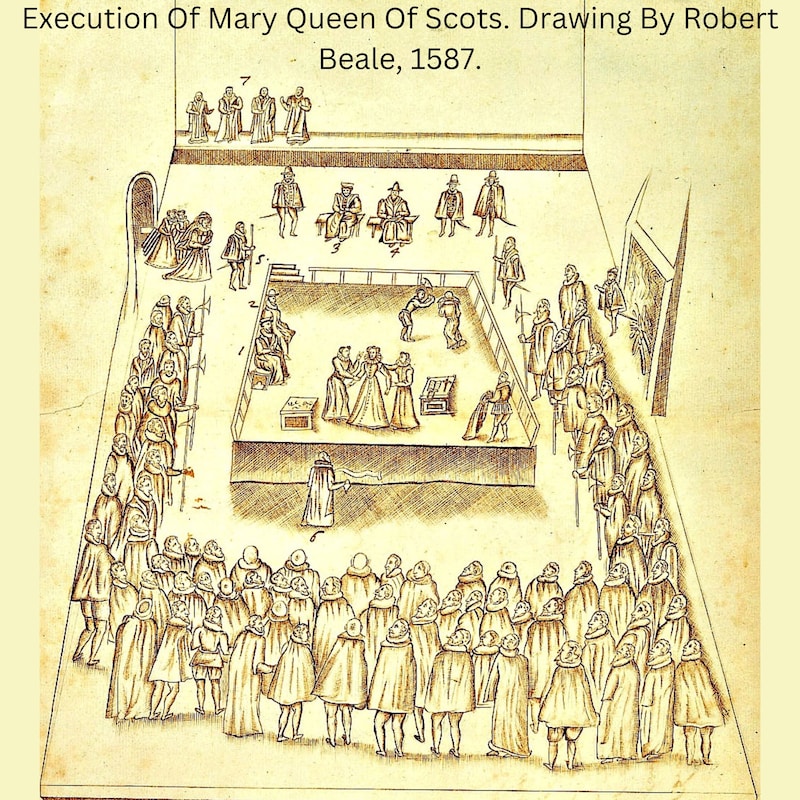
Artwork • The Execution of Mary Queen of Scots at Fotheringhay Castle on 8 February 1587, drawn by Robert Beale (1541-1601), Clerk of the Privy Council to Queen Elizabeth I, who wrote the official record of the execution to which he was an eyewitness.
The evening before the execution he had read-out to Mary her death warrant and informed her that she was to be executed the following morning.
Key to numbers: George Talbot, 6th Earl of Shrewsbury and Henry Grey, 6th Earl of Kent are seated to the left (1 & 2) and Sir Amias Paulet, one of Mary's guards, is seated behind the scaffold (3)
Music 1 • Christum wir sollen loben schon, 1586 · Württemberg Chamber Choir. Lyricist: Martin Luther. Composer: Lukas Osiander.
Martin Luther initially adapted his melody from the Latin hymn melodies associated with 'A solis ortus cardine' by Caelius Sedulius to make it suitable for his German verse. The chorale text and melody first appeared in print in Erfurt 'Enchiridion' in 1524.
Music 2 • Miserere Mei. Composer: Gregorio Allegri (c. 1582–1652)
Composed for the Sistine Chapel Choir to be sung during the Tenebrae services of Holy Week.
"Miserere mei" is Latin for "Have mercy on me, O God," the opening words of Psalm 51. The phrase is most famously known from the Gregorio Allegri motet Miserere (c. 1630s), a sacred choral piece and known for its complex polyphony and use of a high, soaring vocal line.
There are some writings which Seethe, with a barely concealed anger, even after more than four centuries.
Two memoranda by Robert Beale, Clerk to the Privy Council under Queen Elizabeth the first, exemplify this; in them, he expresses his outrage at Elizabeth’s efforts to shift the blame for the death of Mary Queen of Scots.
After agreeing to the assassination of Mary, Elizabeth would later blame Secretary of State William Davison and the Privy Council, for executing the very death warrant, she had signed.
© 20 26 The Rise of the Protestants., Author, Shaughan Holt.
"All rights reserved. No part of this podcast may be reproduced, translated, distributed, or transmitted in any form or by any means, including photocopying, recording, or other electronic or mechanical methods, without the prior written permission of the copyright holder, except in the case of brief quotations embodied in critical reviews and certain other non-commercial uses permitted by copyright law".
Requests regarding translation, licensing, or republication should be directed to: [email protected]
Your feedback matters, send me an email at [email protected], with any comments, suggestions, or criticisms.I read every message
Transcripts
© 20 25 The Rise of the Protestants., Author, Shaughan Holt.
"All rights reserved. No part of this podcast may be reproduced, translated, distributed, or transmitted in any form or by any means, including photocopying, recording, or other electronic or mechanical methods, without the prior written permission of the copyright holder, except in the case of brief quotations embodied in critical reviews and certain other non-commercial uses permitted by copyright law".
Series 2.
Episode 1.
The killing of a Queen. - shorter read.
The year is 15 86.
There are some writings which Seethe, with a barely concealed anger, even after more than four centuries.
Two memoranda by Robert Beale, Clerk to the Privy Council under Queen Elizabeth the first, exemplify this; in them, he expresses his outrage at Elizabeth’s efforts to shift the blame for the death of Mary Queen of Scots.
After agreeing to the assassination of Mary, Elizabeth would later blame Secretary of State William Davison and the Privy Council, for executing the very death warrant, she had signed.
Mary Stuart became the Queen of Scots on 14 December 15 42, just six days after her birth, following the death of her father, King James V, at Falkland Palace in Fife.
Nine months later, as the only surviving, legitimate heir to the Scottish throne, she was crowned in a ceremony at Stirling Castle, conducted by the Catholic Cardinal David Beaton.
During her childhood, Scotland was governed first by James Hamilton, the Earl of Arran, and later by her mother, Mary of Guise.
As England embraced the Protestant Reformation, English forces repeatedly invaded Scotland.
To ensure her safety and reinforce the old Alliance, five-year-old Mary was sent to France in 15 48.
Growing up at the court of King Henri the second and Queen Catherine de’ Medici, she received an education alongside the French royal children.
In an effort to secure a dynastic claim to the Kingdom of Scotland, King Henri, planned to marry the young Mary to his eldest son, the even younger Dauphin, François the second.
On 24 April 15 58, Mary Stuart, Queen of Scots, married François at Notre Dame Cathedral in Paris.
Though both were teenagers, their union was politically significant, as any heir would have claims to the thrones of France, Scotland, and possibly England.
On 10 July 15 59, Henri the second sustained a fatal injury during a jousting tournament, when a wooden shard of a shattered lance pierced his right eye, resulting in a severe intracranial infection.
Following this tragic event, François took the throne.
François, was crowned King of France on 21 September 15 59, at Reims Cathedral, by his uncle, Cardinal Charles of Lorraine.
His reign was marked by political and religious turmoil, as the powerful Guise family, used him to suppress the Huguenots.
Tragically, the French monarchy, was destined to face, still more sorrow.
On 5 December 15 60, François, the young king of France, died from a septic ear infection in Orléans at the age of just 15. His wife, Mary, who was 17 at the time, was heartbroken. Their marriage was intended to strengthen ties between France and Scotland; however, due to their ages, it is believed that the marriage was never consummated.
Mary summed up the contemporary ideal of a Renaissance Princess with her tall, slender figure, red-gold hair, and amber eyes. Raised at the court of King Henri and Queen Catherine de Medici, she viewed herself more as a Frenchwoman than a Scot.
However, following the death of her husband, Mary was advised by the Guises, to return to Scotland.
St Giles' Cathedral, also known as the High Kirk of Edinburgh, is a notable parish church of the Church of Scotland, situated in Edinburgh's Old Town.
Founded in the 12th century, it was elevated to collegiate status by Pope Paul II in 14 67. In 15 59, during the Scottish Reformation, Scotland became Protestant under the leadership of John Knox.
Mary returned to Scotland on 19 August 15 61, during a tense time, when Protestantism, led by John Knox, was growing. As a Catholic queen raised in France, she encountered significant hostility. Settling in Holyroodhouse, her Catholic practices only increased tensions. Knox criticized her, stating, "A single mass is more fearful to me than 10,000 armed men," leading Mary to summon him to defend his sermons.
Despite confrontations, Mary initially ruled moderately. In 15 63, a heated exchange with Knox over her potential marriage to Don Carlos of Spain escalated tensions. Knox warned against marrying an “ungodly” Catholic. Mary, in tears, realized reconciliation was impossible and never met with him privately again.
Mary's marriage to Lord Darnley in July 15 65, started with promise, but quickly turned scandalous.
The murder of her secretary, David Rizzio, in March 15 66, Darnley's suspicious death in February 15 67, and her subsequent marriage to the Earl of Bothwell, led nobles to force her abdication, in favour of her infant son, James VI, in July 15 67.
Imprisoned at Loch Leven Castle, she escaped to England, seeking support from her cousin, Queen Elizabeth. Instead of sanctuary, Mary spent the next eighteen years moving between noble households and castles under guard.
As Mary Stuart's influence waned, so the number of her enemies multiplied.
In 15 86, Anthony Babington and the Jesuit priest John Ballard, plotted to assassinate Queen Elizabeth the first, and put Mary Queen of Scots on the throne, to restore Catholicism. They sought Spanish support for an invasion, but Elizabeth’s intelligence chief, Sir Francis Walsingham, uncovered the plan and captured Mary on 11 August 15 86, thereby removing her as a potential heir.
The content of these letters, made it clear, that Mary had authorized the attempt to assassinate Queen Elizabeth.
At age 46, Mary Queen of Scots had already endured much of her eighteen years of confinement, at Sheffield Castle and Sheffield Manor.
She was now moved to Fotheringhay Castle, a journey that lasted four days, and concluded on 25 September. Fotheringhay Castle, was a grim Norman Motte-and-Bailey structure, located north of Oundle, a market town in Northamptonshire.
In October 15 86, Mary Stuart faced a tribunal of thirty-six noblemen, including Cecil and Walsingham, on charges of treason. Her two-day trial, saw her vigorously deny the allegations, claiming she had been denied access to evidence, and legal representation.
Mary argued, that as a foreign, anointed monarch, she was not an English subject and could not be guilty of treason. As a result, the court suspended Mary's trial for private deliberations.
Four days later, they reconvened in the Star Chamber at Westminster, but this time Mary was not invited. On 25 October, Mary Queen of Scots was sentenced to death, with only Lord Zouche opposing the verdict.
Queen Elizabeth hesitated; knowing that executing a fellow monarch could set a dangerous precedent, and provoke retaliation from Mary's son, James VI, or other Catholic powers.
Seeking deniability, she discreetly asked Sir Amias Paulet, Mary's custodian, to find a way to shorten Mary's life. Paulet, however, refused to risk his conscience or legacy.
Queen Elizabeth took over two months to decide on signing Mary's death warrant, ultimately yielding to William Cecil's pressure. She signed it on 1 February 15 87, giving it to William Davison for safekeeping, mistakenly believing everything was secure.
However, on 3 February, without either’s knowledge, Cecil convened a Privy Council meeting to push for Mary's execution.
On the evening of 7 February 15 87, Robert Beale, Clerk of Queen Elizabeth’s Privy Council, informed Mary Queen of Scots, at Fotheringhay Castle, that she was to be executed the next morning.
In her final hours, she spent time in prayer, distributed her possessions, and prepared her will.
Before dawn, at 2 a.m. on 8 February, just six hours ahead of her execution, she penned a heartfelt letter to King Henri.
The letter, written in French, is addressed to King Henri The Third, of France, the younger brother of her first husband, François The second, who died from an ear infection at the age of 16 in 15 60.
The entire letter is included; this is the English Translation.
Mary, Queen of Scotland.
8 February 15 87.
Sire, my dear brother-in-law, having by God's will, for my sins I think, thrown myself into the power of the Queen my cousin, at whose hands I have suffered much for almost twenty years, I have finally been condemned to death by her and her Estates.
I have asked for my papers, which they have taken away in order that I might make my will, but have been unable to recover anything of use to me, or even get leave either to make my will freely, or to have my body conveyed after my death, as I would wish, to your kingdom, where I had the honour to be Queen, your sister and old ally.
Tonight, after dinner, I have been advised of my sentence.
I am to be executed like a criminal at eight in the morning.
I have not had time to give you a full account of everything that has happened, but if you will listen to my doctor and my other unfortunate servants, you will learn the truth, and how, thanks be to God, I scorn death, and vow that I meet it, innocent of any crime, even if I were their subject.
The Catholic faith and the assertion of my God-given right to the English crown are the two issues on which I am condemned, and yet I am not allowed to say that it is for the Catholic religion that I die, but for fear of interference with theirs.
The proof of this is that they have taken away my chaplain, and although he is in the building, I have not been able to get permission for him to come and hear my confession and give me the Last Sacraments, while they have been most insistent, that I receive the consolation and instruction from their own minister, brought here for that purpose.
The bearer of this letter and his companions, most of them your subjects, will testify to my conduct at my last hour.
It remains for me to beg Your Most Christian Majesty, my brother-in-law and old ally, who have always protested your love for me, to give proof now of your goodness on all these points: Firstly by charity, in paying my unfortunate servants the wages due them - this is a burden on my conscience that only you can relieve.
Further, by having prayers offered to God for a queen, who has borne the title Most Christian, and who dyes a Catholic, stripped of all her possessions.
As for my son, I commend him to you, in so far as he deserves, for I cannot answer for him.
I have also taken the liberty of sending you two precious stones, talismans against illness, trusting that you will enjoy good health and a long and happy life.
Accept them from your loving sister-in-law, who, as she dyes, bears witness of her warm feelings for you.
Again I commend my servants to you.
Give instructions, if it please you, that for my soul's sake, part of what you owe me should be paid, and that for the sake of Jesus Christ, to whom I shall pray for you tomorrow as I die, I be left enough to found a memorial mass, and give the customary alms.
Written, this Wednesday, two hours after midnight.
Your very loving and most true sister, Mary Regina.
To the most Christian king, my brother-in-law and old ally.
In late 15 87, Mary's physician, Bourgoing, travelled to France to report to Henri The third, likely delivering the letter at the same time.
Philip II of Spain authorized payment for Mary’s servants, managed by his ambassador, Bernardino Mendoza.
The letter, likely remained in the French royal archives, before being given to the Scots College in Paris, becoming a relic of the martyred queen.
It changed hands multiple times, and was part of collector Alfred Morrison's collection, before being purchased by subscribers in 19 18, and presented to Scotland through the National Art Collections Fund.
It has been held in the National Library of Scotland since 19 25.
When you visit Fotheringhay Castle today, you can walk where the privy lodgings and Great Hall once stood, with the inner bailey boundaries clearly marked.
On that cold February morning in 15 87, Mary entered the hall to the sound of a crackling fire and the chatter of witnesses.
The scaffold, set up at the high end of the Great Hall, was two feet high, twelve feet broad, draped in black cloth, and furnished with a block, a kneeling cushion, and stools for Mary and the Earls of Shrewsbury and Kent.
The executioner, Mr. Bull, and his assistant knelt before her, seeking her forgiveness, as was customary.
The iconic, posthumous portrait of Mary, depicting her as a Catholic martyr, details her garments.
She wore an "uppermost gown of black satin", with a ground-length train, and long sleeves trimmed with jet and pearl buttons. The design features, purple under-sleeves, symbolizing the liturgical colour of martyrdom in the Catholic Church.
As her servants, Jane Kennedy and Elizabeth Curle, as well as the executioner, helped her disrobe, she revealed a kirtle of black velvet with a crimson satin bodice and skirt.
Mary smiled, and remarked that she had "never had such grooms before, nor ever put off my clothes, before such a company."
In a gesture of care, her servant Jane Kennedy, blindfolded her, using a white veil adorned with gold embroidery.
A drawing titled "The Execution of Mary Queen of Scots at Fotheringhay Castle on 8 February 15 87," created by witness Robert Beale, shows the execution layout and sequence, with spectators around the platform.
Mary, is shown three times: entering with two women, attended by her ladies-in-waiting, and kneeling by the block as the executioner's axe is raised.
Kneeling on the cushion, she slowly positioned her head, on the block before her.
Stretching out her arms to the side, her last words were, "In manus tuas Domine, commendo Spiritum Meum"; into thy hands O Lord, I commend my spirit.
Unfortunately, the executioner did not behead Mary Queen of Scots with a single strike; his first axe blow missed her neck, striking the back of her head instead. The second blow severed her neck, except for a piece of sinew, which the executioner followed through, sawing through it with his axe. Afterwards, and in keeping with tradition, the executioner held Mary's head aloft, declaring "God save the Queen."
At that moment, the auburn tresses in his hand turned out to be a wig, and the head, falling to the ground, revealed that Mary, aged 45, had very short grey hair.
And so, it was on 8 February 15 87, that Mary, forever to be known as the Queen of the Scots, lost her life.
Mary, had requested, that she be buried in France, but Elizabeth refused to allow it.
For nearly five months, her embalmed body remained in a led coffin, until she was finally laid to rest in a Protestant service, on 5 August 15 87 at Peterborough Cathedral.
When news of the execution reached Elizabeth, she asserted that her Secretary of State, William Davison, had disobeyed her orders. To distance herself from Mary Stuart's execution, she placed the blame on Davison. Although acquitted of malicious intent, he was still found guilty, fined, and imprisoned.
Mary Queen of Scots remains, were exhumed in 16 12 by her son, King James I, for re-burial in Westminster Abbey, opposite Queen Elizabeth’s tomb.
More than four centuries later, the death of Mary Queen of Scots still resonates, as a tale of ambition, betrayal, martyrdom, and the brutal politics of royal rivalry.
