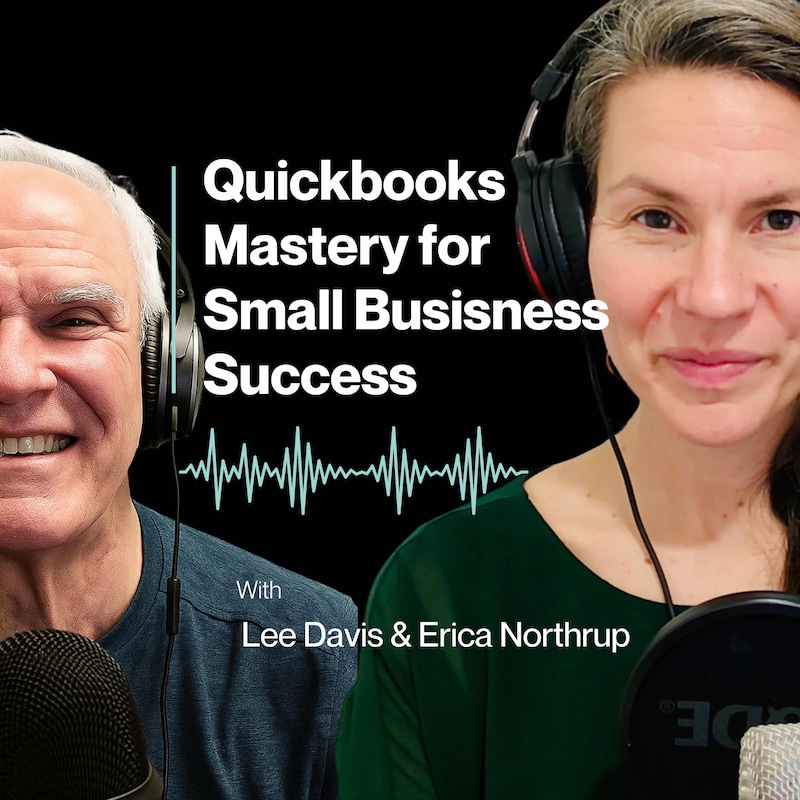
Shownotes
Episode 41: Can You Trust Your QuickBooks? The Monthly Health Check Every Business Owner Should Do
Before you hire an employee, buy equipment, or decide how much you can pay yourself, can you trust the numbers behind that decision?
In this episode of QuickBooks Mastery for Small Business Success, Erica Northrup and Lee Davis walk through a practical monthly QuickBooks health check for small business owners. The goal is not perfect bookkeeping. It is understanding whether your financial reports reflect what is actually happening in your business—and knowing which questions to ask when something does not make sense.
From bank reconciliations and old bank feed transactions to accounts receivable, accounts payable, payroll liabilities, and your Profit & Loss, this conversation gives you a repeatable way to review your books. You will also learn why unexplained balance sheet balances and rising expenses deserve attention before you use your reports to make a business decision.
Key Takeaways
- Reconcile every bank and credit card account. A connected bank feed is not the same as a completed reconciliation.
- Investigate old or unexplained bank feed items rather than assuming the books are current.
- Review accounts receivable for money you realistically expect to collect and accounts payable for bills you actually owe.
- Understand payroll liabilities. A balance is not automatically wrong, but its timing and amount should be explainable.
- Look at the balance sheet as well as the Profit & Loss. Negative balances, old balances, and unfamiliar accounts can signal questions worth asking.
- Compare your Profit & Loss with what happened in the business. Look for missing costs, unexpected changes, and expenses that have crept up.
- Treat “I don’t know” as a useful starting point. Write down the question and work through it with your bookkeeper or accountant.
- Finish with the question that matters most: do you trust these numbers enough to make a business decision?
Questions to Reflect On
- Which report or balance do you currently find hardest to explain?
- Does your receivables total represent cash you expect to collect—or invoices that need attention?
- What costs have increased without you noticing?
- What decision are you postponing because you are unsure about your numbers?
- Who will help you investigate the first “No” or “I don’t know” on your monthly check?
Mentioned in This Episode
- The 10-question Monthly QuickBooks Health Check.
- Bank and credit card reconciliations and bank feed review.
- Accounts receivable and accounts payable reports.
- Payroll liabilities, balance sheet warning signs, and Profit & Loss comparisons.
- Mystery balances, uncategorized transactions, and Ask My Accountant accounts.
- The free QuickBooks Clarity Scorecard.
Recommended Resources
- Monthly QuickBooks Health Check PDF
- Free QuickBooks Clarity Scorecard
- Lee Davis and Company
- Questions or support: [email protected]
Timestamps
00:00 - QuickBooks Mastery Podcast Intro
00:56 - Episode 41: Can You Trust Your QuickBooks?
03:20 - Trustworthy QuickBooks Does Not Mean Perfect QuickBooks
07:27 - Start the Monthly QuickBooks Health Check
09:29 - Bank Feed Warning Signs and Unexplained Transactions
11:29 - Accounts Receivable: What Will You Actually Collect?
13:58 - Accounts Payable and Cash Planning
15:40 - Payroll Liabilities and Balance Sheet Red Flags
19:33 - Does Your Profit & Loss Pass the Common-Sense Test?
22:15 - Cost Creep: What Has Changed?
23:44 - Mystery Balances and Uncategorized Transactions
25:23 - Can You Make a Business Decision From These Numbers?
26:59 - The 10-Question Monthly QuickBooks Checklist
32:05 - Your 30-Minute Challenge and the Free Clarity Scorecard
36:09 - Closing and Podcast Outro
Call to Action
Set aside 30 minutes this month and answer the health-check questions with Yes, No, or I don’t know. Choose one item to investigate, identify who can help, and set a follow-up date.
Start with the free QuickBooks Clarity Scorecard, and email [email protected] with the question you would like us to cover next.
Follow QuickBooks Mastery for Small Business Success in your podcast app and share this episode with a business owner who wants more confidence in their numbers. If you leave a review, a few words about what helped—or what could be clearer—give us useful feedback for future episodes.
Transcripts
Welcome to QuickBooks mastery for small business success.
2
:I'm Erica Northrup.
3
:Lee: And I'm Lee Davis.
4
:Erica: I handle the tech, and he
handles the numbers, and together
5
:as a father-daughter team, we bring
decades of experience helping small
6
:to medium-sized businesses thrive.
7
:Lee: We know that as a business owner,
your time is best spent mastering
8
:your craft and growing your business,
not getting lost in QuickBooks.
9
:Managing finances can be confusing,
and you don't have hours to waste
10
:sorting through spreadsheets
or fixing bookkeeping mistakes.
11
:That's where we come in, helping
you streamline QuickBooks so you
12
:can focus on building your business.
13
:Erica: Each week, we break it all
down into simple, actionable steps
14
:so you can focus on growing your
business, not fixing your books.
15
:Lee: Let's embark on this journey together
16
:Erica: Welcome back to QuickBooks
Mastery for Small Business Success.
17
:I'm Erica Northrup, and I'm here with
my papa, Lee Davis, and this is episode
18
:41, Can You Trust Your QuickBooks?
19
:The monthly health check every
business owner should do.
20
:So Papa, I want to start today with a
question that I think every business
21
:owner should be able to answer.
22
:Imagine you're about to make a
major decision in your business.
23
:Maybe you're thinking about
hiring another employee.
24
:Maybe you're considering buying
a $50,000 piece of equipment.
25
:Maybe you're deciding whether you
can afford to increase your own pay.
26
:Maybe you're wondering whether the
business can handle another location,
27
:or maybe you're simply trying to
understand why you feel like you're
28
:working harder than ever, but there
never seems to be enough money left over.
29
:So you open QuickBooks, you pull
up your profit and loss, you look
30
:at your balance sheet, and now you
have to decide, do I trust these
31
:numbers enough to make the decision?
32
:Because I think that's really
what everything we've been talking
33
:about over the last several
episodes has been leading toward.
34
:We've talked about the chart of accounts.
35
:We've talked about reconciliation.
36
:We talked about what happens when
something needs to be corrected.
37
:We've talked about payroll and
why the amount leaving the bank
38
:isn't the whole payroll story.
39
:We've talked about watching expenses and
costs creep, but none of those things
40
:matter very much if, at the end of the
day, you still look at your financial
41
:reports and think, "I have absolutely no
idea whether these numbers are right."
42
:So today, I don't want to teach
another isolated QuickBooks feature.
43
:I want us to step back and
look at the entire file.
44
:If you were doing a monthly
health check on your QuickBooks,
45
:what would you look at?
46
:What are the warning signs?
47
:What are the questions a
business owner should be asking?
48
:And most importantly, how do you know
when your QuickBooks is healthy enough
49
:to actually help you run the business?
50
:So Papa, let's start with the big
question for today, for this episode.
51
:When you look at a client's
QuickBooks file, what makes you
52
:feel confident that the numbers
are reasonably trustworthy, Papa?
53
:Lee: It's a very good question because
recently we had a client who was
54
:planning to do a major expansion of her
business, and, you know, she looked at
55
:her QuickBooks, and she knew she could
not make the decisions she needed to- Mm
56
:based on the information she had.
57
:So I think the first thing to
understand is that trustworthy
58
:doesn't necessarily mean perfect,
and it could mean a lot of things.
59
:Like, you've stared at something long
enough on your QuickBooks file- … and
60
:you know you're kind of working around it.
61
:Erica: Mm-hmm.
62
:Lee: But it's just not complete.
63
:Mm-hmm.
64
:And there's a lot of information
that needs to be cleaned up.
65
:Mm.
66
:There may be transactions
that need to be reviewed.
67
:There could be the question, like
this particular client wants to
68
:know whether they should start over.
69
:And, you know, we've
talked about that before.
70
:That's a very real question that, in
some cases, will be important to answer.
71
:But, you know, whether you're
looking for a complete re-overhaul-
72
:Mm … or you can work with exactly
what's happening in your business.
73
:So you, you wanna actually be able to
get a hold of your data that will support
74
:what's happening in your business.
75
:Erica: Mm.
76
:Lee: Are the bank accounts accurate?
77
:Are transactions being recorded correctly?
78
:Are the major balance
sheet accounts reasonable?
79
:Erica: Mm.
80
:Lee: Do accounts receivable and
accounts payable make sense?
81
:Are payroll liabilities
being handled correctly?
82
:Does the profit and loss reflect the
income and expenses of the business?
83
:And are those accounts
being reviewed regularly?
84
:The more regularly you review those
things, the more confidence you will
85
:have in the financial information.
86
:There are some key reports that we
should start exploring to begin to
87
:analyze how your business is doing,
such as the profit and loss comparison.
88
:You know what, I'd also suggest reviewing
your accounts receivable reports.
89
:I know we're gonna talk
about accounts receivable.
90
:And a report we haven't discussed, and
it's beginning to be that time of the year
91
:where people should start thinking about
their:
92
:expenses on a weekly or a monthly basis.
93
:A client that I just recently
met with felt like that, you
94
:know what, he needs a budget.
95
:He needs to project his income and
expenses, and it needs to be looked at
96
:on a monthly, if not a weekly basis.
97
:He wants that report used.
98
:Erica: Mm.
99
:Absolutely.
100
:No, I like that because I think
my books have to be perfect can
101
:become another reasons business
owners avoid looking at them.
102
:I know I feel like that about my own life.
103
:If I feel like something has to be
perfect, for instance, going to the gym,
104
:if I don't have 45 minutes to go to the
gym or exercise or whatever the case
105
:may be, sometimes I won't even do it.
106
:Where now I've gotten to
a mindset, you know what?
107
:Five minutes is better than no minutes.
108
:Mm-hmm.
109
:Yep.
110
:And sometimes you can get a lot
accomplished in five minutes more than
111
:you think you can get accomplished.
112
:Lee: Absolutely.
113
:I think starting somewhere
is better than going nowhere.
114
:Erica: Yes.
115
:Absolutely.
116
:Oh, so good, Papa.
117
:Okay, so we're not saying every
transaction has to be flawless before
118
:you're allowed to look at a report.
119
:We're saying there should be
a process for knowing that the
120
:major pieces are accurate and for
identifying the things that aren't.
121
:Isn't that what we're saying, Papa?
122
:Lee: Uh, yes.
123
:I think financial records should help you
understand and manage the business, and
124
:I think as we work with clients that are
going through this process of cleaning
125
:up, many of them would like it done right.
126
:It starts with the foundation,
the chart of accounts.
127
:So the financial records should help
you understand and manage your business.
128
:You need to answer the questions that
are being asked and be able to feel
129
:confident that you're building toward
that answer, even if you're not there yet.
130
:Erica: Absolutely.
131
:You know, and maybe that's the distinction
between bookkeeping being something that
132
:happens to your business versus QuickBooks
becoming an actual management tool.
133
:Lee: Absolutely.
134
:Erica: Yeah.
135
:You know, I suppose the financial
report should help you understand and
136
:manage the business, shouldn't it, Papa?
137
:Lee: Absolutely it should.
138
:Erica: Yeah.
139
:Okay, so let's build our
monthly health check.
140
:If I'm sitting down at the end of the
month and I want to decide whether I
141
:trust my QuickBooks, what's the first
thing, Papa, you want me to look at?
142
:Lee: So I'd start with the bank
and credit card transactions.
143
:Are there any of these transactions
that may need attention?
144
:Are they ready to be reconciled?
145
:We've talked about reconciliation
before, but it's foundational because
146
:you're comparing what QuickBooks
says happened with an outside record.
147
:Mm-hmm.
148
:The bank or the credit card company.
149
:If your bank statement says you have one
balance and QuickBooks says something very
150
:different, you need to understand why.
151
:Erica: You know, and I want
to remind people of something
152
:we talked about in episode 37.
153
:Having the bank connected to
QuickBooks is not the same thing as
154
:reconciling the account, is it, Papa?
155
:Lee: That's correct.
156
:Erica: Yeah.
157
:Lee: The bank feed helps you
bring in and process transactions.
158
:Reconciliation verifies that
the activity in QuickBooks
159
:agrees with the bank statement.
160
:So, you know, if information is
still sitting in the bank feed-
161
:Mm … that could definitely be
a indicator that there could be
162
:some information that needs to get
corrected, or some needs to get entered.
163
:It's a really a good indicator that
there needs to be some work done.
164
:Erica: Absolutely.
165
:So our first monthly question
is, are all my bank and credit
166
:card accounts reconciled through
the most recent statement?
167
:And if the answer is no,
that's a yellow flag.
168
:Would you call that a yellow flag, Papa?
169
:Lee: Yes, or maybe a red flag.
170
:Especially if you're significantly behind.
171
:Erica: Yeah, absolutely.
172
:Because if I'm six months behind,
I'm now trying to figure out
173
:something that happened six months
in the past, six months ago.
174
:Lee: Exactly.
175
:Erica: Mm.
176
:Lee: You know, that's much more
difficult than reviewing transactions
177
:that happened in the last 30 days.
178
:Erica: Yep, so good.
179
:Okay, so our bank accounts are reconciled.
180
:What's next, Papa?
181
:Lee: I think you have to understand that
you want to, while your accounts may be
182
:reconciled, there may be transactions
that are still sitting in the bank
183
:feed, and that could be either have been
categorized incorrectly or unmatched.
184
:There could be a problem still sitting.
185
:If you've got additional transactions
and you've reconciled your
186
:accounts- You have some transactions
that either don't belong there-
187
:Mm-hmm … or need to get addressed.
188
:There could be old transactions
that have been ignored.
189
:There could be duplicates.
190
:There could be activity
that nobody understands.
191
:Yep.
192
:And this could be a red flag that some
transactions haven't been entered,
193
:or they've been entered incorrectly.
194
:In some cases, some people have
opened up other bank accounts.
195
:Mm.
196
:You know, they just had
decided to start over.
197
:Yep.
198
:And, you know, instead of trying
to fix their old bank account, they
199
:just opened up a new one, so now
they've got extra bank transactions
200
:sitting that need to get addressed.
201
:Erica: Absolutely.
202
:You know, I think this one is sneaky,
because your QuickBooks can look like
203
:everything is current until you click
into that bank feed and realize there
204
:are 147 transactions waiting for review.
205
:That can be a little
overwhelming, can't it, Papa?
206
:Lee: Uh, yes.
207
:And, you know, everybody has a
story to tell about in some cases
208
:they could have forced the bank
reconciliation- Mm … to balance,
209
:but QuickBooks has an audit trail.
210
:I can quickly see that, you know, so
that, yeah, that's information that
211
:hasn't necessarily been completely
dealt with in the accounting records.
212
:Erica: You know, and I want business
owners to ask another question here.
213
:Do I recognize what
these transactions are?
214
:Because if I see a vendor I've never
heard of, a subscription I don't remember
215
:signing up for, or something that's
twice the amount I expected, that isn't
216
:just bookkeeping information, that's
management information, isn't it, Papa?
217
:Lee: Absolutely.
218
:Erica: Yeah.
219
:Okay, so let's move to
accounts receivable.
220
:What are we checking there, Papa?
221
:Lee: Accounts receivable should represent
money your customers actually owe you.
222
:Mm.
223
:So I look at the aging report.
224
:You know, I think-
Okay … that's a great report.
225
:Who owes you money?
226
:Yeah.
227
:How long has it been outstanding?
228
:Are there old invoices that
aren't going to be collected?
229
:Are there customer credits that
haven't been applied correctly?
230
:Are there balances you don't understand?
231
:And if you've got invoices sitting there
from two or three years ago that nobody
232
:expects to collect, then your accounts
receivable isn't really telling you the
233
:truth about what you're likely to receive.
234
:If you've created estimates for
clients and they have been prepared
235
:and accepted, then do you need
to take care of that invoicing?
236
:Can I be more efficient in creating
invoices that happen each month?
237
:So looking at your accounts
receivable, both from a what's coming
238
:in perspective, but also are you
invoicing timely and efficiently?
239
:Erica: Yeah, you know, that phrase
is so important because technically
240
:QuickBooks can say your customer owes
you $180,000 But if 60,000 of that
241
:is old, uncollectible garbage nobody
cleaned up, I don't actually have
242
:180,000 coming to me, do I, Papa?
243
:Lee: I think that's right.
244
:And, you know, you don't wanna
keep going over and over reports
245
:that have bad information.
246
:No.
247
:So you need to take a look
at it and get some cleaned up
248
:Erica: And now that bad information
can start influencing decisions.
249
:I might think we've got plenty of
cash coming in, when in reality
250
:some of that money isn't coming,
and you can make some really bad
251
:decisions based on that information.
252
:Lee: Well, exactly, and you want
your financial reports to be able
253
:to be used by the people who are
going to help you make decisions.
254
:Mm-hmm.
255
:So it's really important to have good
information, and because we're talking
256
:about accounts receivable, that's the
lifeblood of the company, of what you've
257
:got coming through the door in the
next month, two months, three months.
258
:Uh- Mm … so it's really important
that the information is correct.
259
:Erica: Yeah, so health check
question number three becomes, does
260
:accounts receivable represent money
we reasonably expect to collect?
261
:And then who owes us money, and are
we actively doing something about it?
262
:Lee: Absolutely.
263
:Erica: Yeah.
264
:Okay, so let's look at the
other side, accounts payable.
265
:So what can you tell us
about accounts payable, Papa?
266
:Lee: It's the same.
267
:When we look at accounts payable,
it should tell the business how
268
:much is owed- Mm … to its vendors.
269
:Again, I look at the aging.
270
:Mm-hmm.
271
:Uh, do those bills actually belong there?
272
:You know, have some already been paid,
but the payment wasn't properly applied?
273
:Are there duplicate bills?
274
:Are there vendor credits
that haven't been applied?
275
:Are there old balances
that no longer make sense?
276
:Mm.
277
:So it's really important to handle
both your accounts payable and your
278
:accounts receivable on a kind of a
month-end basis to look at them- Mm
279
:and be able to deal with
those issues timely.
280
:Erica: Yeah, and this one matters for
cash planning because if QuickBooks
281
:says I owe $80,000 over the next 30
days, I need to know whether that's real
282
:and that I actually owe that because
I gotta come up with that $80,000.
283
:Lee: Absolutely.
284
:Erica: Yeah, and the opposite is true too.
285
:If QuickBooks only shows $20,000 due,
but we've got another $60,000 in bills
286
:sitting on somebody's desk that were
never entered, now QuickBooks is making
287
:the business look much healthier than
it actually truly is, isn't it, Papa?
288
:Lee: Yeah, that's correct, and if you
wanna run a cash flow report, you've
289
:gotta be able to know money in, money out.
290
:It's the foundation for QuickBooks.
291
:Erica: Right.
292
:Absolutely.
293
:So now we have, does accounts
payable accurately represent
294
:what the business owes?
295
:Not what we hope we owe, not what we
remember owing, what do we actually
296
:owe, and I think that's where the
rubber hits the road, doesn't it, Papa?
297
:Lee: Absolutely.
298
:Erica: Yeah, so let's talk payroll
because we just did an episode explaining
299
:why payroll isn't simply one expense.
300
:What should somebody look at in a monthly
health check in regards to payroll?
301
:Lee: You want to be able to look
at the payroll liability accounts.
302
:If you've withheld taxes or other
amounts from employee payroll-
303
:Those amounts may be sitting as
liabilities until they're paid.
304
:You want those balances to make sense.
305
:If you've got old payroll liabilities
sitting on the balance sheet that should
306
:have been paid months ago, there's
something you need to investigate.
307
:And that same thing applies to
retirement contributions and
308
:other payroll-related liabilities.
309
:Erica: Yeah, and I feel like the
balance sheet is where a lot of
310
:business owners stop reading.
311
:They look at the profit and
loss, they, then they open the
312
:balance sheet and think, "Nope."
313
:Not doing this.
314
:Not happening And then
315
:Lee: that's probably true because it
could have been two bookkeepers ago- Yeah
316
:… that those liabilities were created, you
know, and, and no one knows what happened.
317
:So yeah.
318
:Erica: But this is exactly why we
keep saying the balance sheet matters,
319
:because the profit and loss can tell
me, "Here's what you spent on payroll."
320
:The balance sheet can tell me,
"By the way, here's the payroll
321
:money you may still owe someone."
322
:Is that correct, Papa?
323
:Exactly.
324
:Exactly.
325
:Yeah.
326
:Yeah.
327
:So let's stay on the balance
sheet for just a moment.
328
:If I'm not an accountant, which we
know I'm not, but I am getting better.
329
:I'm learning.
330
:So if I'm not an accountant, what am
I realistically looking for, Papa?
331
:Lee: Well, you don't have to understand
every technical accounting detail to
332
:notice something that doesn't make sense.
333
:Yeah.
334
:You know, look at the bank accounts.
335
:Do the balances look reasonable?
336
:Are there old bank account
balances just sitting there?
337
:Look at the accounts receivable
and accounts payable.
338
:You know, look at the payroll liabilities.
339
:Look at loans.
340
:Have you reconciled those loan balances?
341
:Here's where you may find some
expenses, such as interest,
342
:that needs to be entered.
343
:Do the loan balances roughly
agree with what you know you owe?
344
:Just eyeballing them.
345
:Mm-hmm.
346
:Uh, look for negative balances
where you wouldn't expect them.
347
:Mm.
348
:You know, if your cash has
a negative balance, then you
349
:know something is not right.
350
:Erica: Yeah.
351
:Right?
352
:So true.
353
:So true.
354
:You
355
:Lee: know, if you look for
unusually large balances, then
356
:oftentimes that's very helpful.
357
:Mm-hmm.
358
:Look for accounts you don't recognize.
359
:You know, say, "I, I
don't know what that is."
360
:Right.
361
:Well, it's time to research it,
and look for the balances that
362
:haven't changed in a very long time.
363
:And you might find that if you compare
the activity from the previous year.
364
:Uh, that's oftentimes a very good
indicator that balance has been
365
:the same for a year or two years.
366
:So-
367
:Erica: Right.
368
:That's-
369
:… Lee: a balance
370
:… Erica: that's definitely a problem.
371
:If the balance- Mm-hmm … stays
the same for two years, we need
372
:to have a conversation, for sure.
373
:Right.
374
:Okay, so now I'm not asking a business
owner to audit their own balance sheet.
375
:I'm asking them to develop enough
familiarity that they notice
376
:when something looks strange.
377
:And you know your business.
378
:If something does not look right,
follow that intuition, follow that
379
:gut feeling and, and look into it.
380
:Dig into the big rocks, right, Papa?
381
:Lee: Exactly.
382
:Erica: You know, it's the
same way I know my house.
383
:I may not be an electrician, but if I walk
into the kitchen and half the lights are
384
:flashing, I know something isn't normal.
385
:I was actually thinking about that
with our lights in our front house.
386
:We're having just issues.
387
:We've had issues since we moved into
there with the lights, and, you know, I'm
388
:ready to do something about the flickering
of our lights in that front house.
389
:But yeah, I don't have to be
an electrician to know that
390
:something isn't working.
391
:You know your business.
392
:You know when something isn't right.
393
:Lee: Yeah, that, that's a good analogy.
394
:Erica: Yeah.
395
:You know, and that's really what
we are developing with QuickBooks,
396
:financial pattern recognition.
397
:Isn't it, Papa?
398
:Lee: Exactly.
399
:Erica: Yeah.
400
:Okay, now we finally get to
the report everybody likes
401
:the best, the profit and loss.
402
:What should I look at there, Papa?
403
:Lee: They really need to ta- look
at, first of all, the income.
404
:Mm.
405
:Does the amount make sense on
what you know about your business?
406
:Then look at the major expense categories.
407
:Mm.
408
:Are all costs reasonable?
409
:Rent, advertising, insurance,
software, materials, cost of
410
:goods sold, professional fees.
411
:Y- you don't need to memorize every
number, but what you're looking
412
:for are changes in unusual items.
413
:Erica: Mm.
414
:Lee: Here again, to run
a comparison report.
415
:I, oftentimes I was just working with
a client last week, and they feel
416
:like they can't compare their numbers
to the previous year because they
417
:had perhaps some theft that went on.
418
:Erica: Mm.
419
:Oh dear.
420
:Mm-hmm.
421
:Lee: So I think when you're looking
at your profit and loss, you need
422
:to look at it through the lens
of, what do I know is correct?
423
:Mm.
424
:And go from there.
425
:Erica: Yeah.
426
:Absolutely.
427
:You know, this ties directly into what we
talked about in our cost creep episode.
428
:I may not notice one vendor increasing
from 499 a month to $599 a month, but
429
:if I compare periods, those changes
start showing up, don't they, Papa?
430
:Lee: Absolutely.
431
:And I think what you want to
be able to compare is- Mm-hmm
432
:this year to last year, actual-
Yeah … results on what you expected,
433
:and this gives you some sort of context.
434
:Erica: Yeah, absolutely, because a
profit and loss with no comparison
435
:is basically one photograph.
436
:A comparison starts giving
me a movie, doesn't it, Papa?
437
:Lee: That's a good way to put it.
438
:Erica: Yeah, absolutely.
439
:And here's another question I
think business owners should
440
:ask themselves, does the profit
QuickBooks is showing feel believable?
441
:If QuickBooks says we made 300,000 this
year and there's never any cash, that
442
:doesn't automatically mean the profit and
loss is wrong, but it certainly gives me a
443
:reason to investigate where the cash went.
444
:Lee: Exactly.
445
:I think with that kind of illustration,
about $300,000 in profit, there should
446
:be something that needs to be looked at.
447
:Mm.
448
:In other words, particularly
if you've got cash flow issues.
449
:And because it could be that you're
running the reports on the accrual
450
:basis, it could very well where that
sits is in your accounts receivable.
451
:So it's not that the
information may be not correct.
452
:It may be that you've got some
underlying issues like we've talked
453
:about in the accounts receivable.
454
:Erica: Absolutely.
455
:Okay, so let's make this one
its own checkpoint, because
456
:I think this is important.
457
:What has changed?
458
:Lee: Yeah, absolutely.
459
:I think looking at what's changed is
an excellent question, because when you
460
:review expenses and looking at cost of
goods sold, are vendors charging more?
461
:Have subscription costs increased?
462
:Has a discount expired?
463
:Have material costs changed?
464
:Has insurance increased?
465
:I was working with a client who was
looking at their profit and loss
466
:report, and their analysis is that
they were in trouble and needed-
467
:Mm … to make some significant
changes on their benefit plans.
468
:This is a good time of year to
review your health insurance- Yes
469
:and the options, right?
470
:Erica: Yeah, absolutely.
471
:Lee: And are there services you're
paying for that you don't need anymore?
472
:Mm.
473
:And then ask whether you, your own
pricing has kept up with those increases.
474
:Erica: Yeah, because that's
how profit quietly disappears.
475
:It isn't necessarily one
dramatic $50,000 mistake.
476
:It can be 20 expenses that each
creep up a little bit at a time.
477
:Lee: Exactly.
478
:Erica: So part of our monthly health check
isn't only is QuickBooks accurate, it's
479
:also what is QuickBooks trying to tell me?
480
:You know, are you paying attention?
481
:Are you listening to the information
that QuickBooks is dishing out for you?
482
:Lee: Yeah, that's right.
483
:And when the accounting starts
becoming useful- For management.
484
:Erica: Yeah.
485
:So here's one that drives me crazy, Papa.
486
:If I open QuickBooks and see
something with a name I don't
487
:recognize, what do I do?
488
:Lee: I think you need to
investigate it, right?
489
:Erica: Yes.
490
:Look into it.
491
:Lee: If you don't want mystery balances
sitting in the books indefinitely,
492
:if you have an account called Ask My
Accountant, for example, and it has
493
:continued to accumulate transactions,
somebody needs to determine what
494
:those transactions actually are.
495
:Look at the uncategorized transactions,
transactions without payees.
496
:Undeposited funds is a good place to look.
497
:Yeah.
498
:Sometimes money just sits there.
499
:Yeah.
500
:And unapplied payments.
501
:Somebody says, "Well, what's
an unapplied payment?"
502
:Good question.
503
:Yeah.
504
:Right?
505
:Yes.
506
:Unapplied payments need to get addressed.
507
:Mm.
508
:Um, as well as unapplied income.
509
:So making sure that you investigate
those, what you call mystery balances-
510
:Erica: Mm
511
:… Lee: could lead you to more accurate data.
512
:And if you see uncategorized income or
uncategorized expenses, investigate those.
513
:Mm.
514
:The goal is to understand what
makes up the financial statements.
515
:Erica: I think that's such a
good monthly question, Papa.
516
:What in my QuickBooks do I not understand?
517
:Mm.
518
:Not can I pass an accounting
exam, just what balances or
519
:transactions can nobody explain?
520
:Lee: Exactly, and those are the
things that you can work through.
521
:Erica: Absolutely.
522
:Okay, we've reconciled the accounts.
523
:We've cleaned up bank transactions.
524
:We've reviewed receivables,
payables, payroll liabilities,
525
:the balance sheet, profit and
loss, costs, mystery transactions.
526
:Now I think we get to the most
important question of the whole
527
:episode, can I actually make a
business decision from these numbers?
528
:What does that mean to you, Papa?
529
:Lee: It means you've
taken some positive steps.
530
:Erica: Right.
531
:Lee: You're now using the information.
532
:Can you see whether the
business is profitable?
533
:Can you see whether
expenses are increasing?
534
:Can you see who owes you money?
535
:Can you see what you owe?
536
:Mm-hmm.
537
:Do you understand your cash position?
538
:Erica: Yeah.
539
:Lee: Can you identify
areas that need attention?
540
:Can you compare performance over time?
541
:Can you use that information to decide
what the business should do next?
542
:That's ultimately where you wanna get.
543
:Erica: Yeah, because that's
the entire point, right, Papa?
544
:I don't think anybody starts a
business because they're passionate
545
:about reconciling bank statements.
546
:I mean- … unless you're an accountant,
that's probably- Right … not
547
:what you're passionate about.
548
:Lee: Right.
549
:Even accountants, I don't think,
are passionate with reconciling bank
550
:statements, but yeah, probably not.
551
:Erica: Yeah.
552
:They start the business because
they want to build something.
553
:They see a problem in the marketplace,
they see a need in the marketplace, and
554
:they have a solution, and they wanna
help people fix things or answer that
555
:need for that particular solution.
556
:Like, this is why we get into business.
557
:You know, they start the business because
they want to build something, serve
558
:customers, create jobs, support their
family, make money, grow, and QuickBooks-
559
:is supposed to help them understand
whether the business is actually
560
:accomplishing those things, isn't it?
561
:Yeah.
562
:I mean, that's one of the driving
reasons for using QuickBooks.
563
:Lee: Exactly.
564
:Erica: Yeah.
565
:Okay, Papa, I'm gonna bring all of this
down into 10 questions, and honestly,
566
:if you're listening, this is the
part I would write down, and I will
567
:drop it as a PDF in our show notes.
568
:You can always download it as
well, but at least once a month,
569
:ask yourself these 10 questions.
570
:Number one, are all of my bank and
credit card accounts reconciled?
571
:Number two, is there anything old or
unexplained sitting in my bank feeds?
572
:Number three, does accounts
receivable represent money we
573
:realistically expect to collect?
574
:Number four, does accounts payable
accurately reflect what we actually owe?
575
:Number five, do my payroll
liability balances make sense?
576
:And number six, is there anything unusual
on my bank sheet, negative balances, old
577
:balances, or accounts I don't understand?
578
:Number seven, does my profit and
loss make sense compared with what
579
:I know happened in the business?
580
:Number eight, what expenses
or costs have increased?
581
:Number nine, are there mystery accounts
or transactions nobody can explain?
582
:And finally, number 10, do I
trust these numbers enough to make
583
:a business decision from them?
584
:So Papa, if somebody could confidently
answer those 10 questions every
585
:month, how much stronger would their
understanding of their business be, Papa?
586
:Lee: I think if you looked
at those 10 questions-
587
:Erica: Yep
588
:… Lee: and whether you reviewed them
monthly, quarterly, or even annually-
589
:Erica: Yep
590
:… Lee: you would…
591
:It would help you and lead you
to say, "I've got a few other
592
:questions I want to get answered."
593
:You might want to check for
personal transactions that could
594
:be business-related or not.
595
:Mm.
596
:You might see something that you paid
out for your business that's, that
597
:you know didn't get in the books.
598
:You want to review your loan payments.
599
:Oh, yeah.
600
:Or you want to review cash transactions.
601
:Um-
602
:Erica: Mm
603
:… Lee: so all of those can help you,
along with those 10 questions.
604
:Yep.
605
:They can help you really get
a good feel for your business.
606
:Mm-hmm.
607
:And because now you're actually
engaging with financial information,
608
:instead of simply accumulating
transactions inside of QuickBooks.
609
:Erica: Yeah, so good.
610
:Now, let's talk to the person listening
who just went through our 10 plus
611
:questions and thought, "I don't know.
612
:I don't know whether we're reconciled.
613
:I don't know what
accounts receivable says.
614
:I've never looked at payroll liabilities.
615
:I don't really understand
the balance sheet.
616
:I don't know whether the
profit and loss is right."
617
:What do you want that
person to hear, Papa?
618
:Lee: I think they need to start somewhere.
619
:Erica: Yeah.
620
:Lee: You don't have to fix everything
at once, but you do need to
621
:begin understanding the financial
information in your business.
622
:Find out whether the bank accounts
are reconciled, review your
623
:receivables, look at the balance sheet.
624
:Mm-hmm.
625
:Ask questions about things you don't
understand, and get help when you need it.
626
:Mm-hmm.
627
:The important thing is not to continue
running your business indefinitely
628
:without understanding the numbers.
629
:But, you know, just start.
630
:Erica: Just start.
631
:Just-
632
:Lee: Take it…
633
:Yeah, just put a stake in the ground.
634
:Right.
635
:And say, "I'm gonna work
on this this month."
636
:Erica: Mm-hmm.
637
:You know, I think that's
exactly right, Papa.
638
:This isn't supposed to
be a shame checklist.
639
:This is not, "You're doing
things wrong, people."
640
:No, it's a clarity checklist.
641
:It's showing you where you understand
your QuickBooks and where you don't.
642
:Lee: Exactly.
643
:Erica: Yeah, and I want to zoom out,
because we've really built something
644
:over these last several episodes.
645
:We started with the chart of accounts.
646
:That's the structure
underneath QuickBooks.
647
:Then we talked about reconciliation.
648
:Does QuickBooks actually
agree with the bank?
649
:Then we talked about adjustments.
650
:When something is wrong, how
do you fix it appropriately?
651
:Then payroll.
652
:Why isn't payroll simply one expense?
653
:Then we started looking at costs
and how profit can disappear
654
:when nobody is paying attention.
655
:And now we've gotten to the
question, can you trust the whole
656
:picture that you're looking at?
657
:And I think this is where QuickBooks
stops becoming bookkeeping software and
658
:starts becoming a business management
system, almost a partner in your business
659
:that can help you- Mm-hmm … really
make the right decisions and make
660
:the right choices for your business.
661
:Lee: I think that's exactly right.
662
:Erica: Absolutely.
663
:Okay, so my big takeaway
from today is this, Papa.
664
:You don't need perfect QuickBooks,
you need trustworthy QuickBooks.
665
:Trustworthy means the bank
accounts are being reconciled.
666
:Your customer and vendor
balances make sense.
667
:Your liabilities aren't full
of things nobody understands.
668
:Your profit and loss passes
the common sense test.
669
:You're watching what's changing, and
when something doesn't make sense, you
670
:investigate it instead of ignoring it.
671
:But most importantly, you can use
the information to make decisions
672
:because if QuickBooks is only where
transactions go to die until tax
673
:season, we're missing most of the
value of QuickBooks, aren't we, Papa?
674
:Lee: Yeah, absolutely you are.
675
:Erica: Okay, you guys.
676
:So here's your challenge for this week.
677
:Set aside 30 minutes.
678
:Doesn't have to be 30 minutes every day.
679
:Just set aside 30 minutes in your work
week and open QuickBooks And go through
680
:the 10 plus questions we just gave you.
681
:You don't need to fix everything.
682
:You're simply answering
yes, no, or I don't know.
683
:And I actually think I don't know may be
the most valuable answer because now you
684
:know where your next question needs to be.
685
:And if you're listening to this episode
and thinking, "This is exactly my problem.
686
:I use QuickBooks, but I don't
really know whether I can trust
687
:it," I don't want you to just close
this episode and forget about it.
688
:Take the next step.
689
:We created the QuickBooks Clarity
Scorecard specifically to help business
690
:owners figure out where they stand.
691
:It walks you through the major areas
of your QuickBooks and helps you
692
:identify where things are working,
whether there may be gaps, and
693
:where you need more clarity, and
it's completely free, you guys.
694
:Completely free, and you'll find it
in the link in our show notes, or
695
:you can head over to our website,
which is leedavisandcompany.com,
696
:and look for the QuickBooks
Clarity Scorecard.
697
:Take the assessment.
698
:Don't guess about it whether
your QuickBooks is healthy.
699
:Find out for sure because the sooner
you know where the gaps are, the
700
:sooner you can start fixing them.
701
:And Papa, I think this episode probably
explains better than almost any
702
:episode we've done why we're building
the QuickBooks training because we've
703
:been working on that behind the scenes
because somebody can hire a bookkeeper
704
:to enter transactions, or they can hire
an accountant to prepare a tax return.
705
:But I still think the business owner
needs to understand what their numbers
706
:are telling them, shouldn't they, Papa?
707
:Lee: Absolutely.
708
:The owner needs enough understanding to
ask good questions and use the financial
709
:information to manage their business.
710
:Erica: And that's really what
we're building towards, you guys.
711
:Not memorize every QuickBooks
button, not become an accountant,
712
:but understand your QuickBooks well
enough that you can trust your numbers
713
:and use them to run your business.
714
:We're working on something much more
comprehensive around exactly what
715
:that idea is, and we'll be sharing
more about it as we get closer.
716
:But if that sounds like something you
need, start with the Clarity Scorecard.
717
:That's your first step.
718
:And we've got a lot more
coming on the podcast.
719
:We're going to continue moving beyond
simply where to click in QuickBooks
720
:and spend more time talking about how
you actually use the information in
721
:QuickBooks to make better decisions.
722
:So if you've been following along with
this series, make sure you're subscribed.
723
:There's a lot more we're going to
build on from this point going forward.
724
:And Papa, if you could leave our
business owners listening today with
725
:one question to ask every single
month, what would it be, Papa?
726
:Lee: Guess, do I understand these
numbers well enough to trust them?
727
:And if the answer is
no, then find out why.
728
:Erica: Yeah, I love that
because ultimately, that is
729
:what QuickBooks should give you.
730
:Not more confusion, not a
pile of transactions, clarity.
731
:And clarity gives you the
confidence to make better decisions.
732
:If today's episode was helpful, share
it with another business owner who uses
733
:QuickBooks, but isn't quite sure whether
they can trust what they're seeing.
734
:Make sure you're subscribed to QuickBooks
Mastery for Small Business Success.
735
:And you guys, we would love to
know your feedback on this podcast.
736
:We would love to hear from you.
737
:And most importantly, go grab the free
QuickBooks Clarity Scorecard in the
738
:show notes or at leedavisoncompany.com.
739
:Don't just assume your
QuickBooks is working.
740
:Find out whether you can trust it.
741
:Thanks for hanging out with us today.
742
:It was so, so much fun.
743
:Great job, Papa.
744
:You have embraced this whole podcast
thing, and I think it's awesome.
745
:Lee: Yeah.
746
:Well, thank you, Erica.
747
:Great job today.
748
:Erica: Yeah, absolutely.
749
:Okay, we'll see you next week.
750
:Bye for now.
751
:Thanks for tuning in to QuickBooks
Mastery for Small Business Success.
752
:Lee: If you enjoyed this episode,
hit subscribe and stay connected
753
:with us at leedavisoncompany.com.
754
:Erica: We know QuickBooks can
be overwhelming, so we've put
755
:together a free resource to
help you get started right away.
756
:Grab your copy at leedavisoncompany.com,
757
:and when you do, you'll also get
access to our VIP email list, where
758
:we share exclusive QuickBooks tips,
business strategies, and support.
759
:Lee: And we'd love to hear from you.
760
:If you have a QuickBooks question
or a business challenge, send it our
761
:way at [email protected].
762
:We might feature it in a future episode.
763
:Erica: We're here to help you
simplify QuickBooks and grow your
764
:business, one step at a time.
765
:See you next time.




