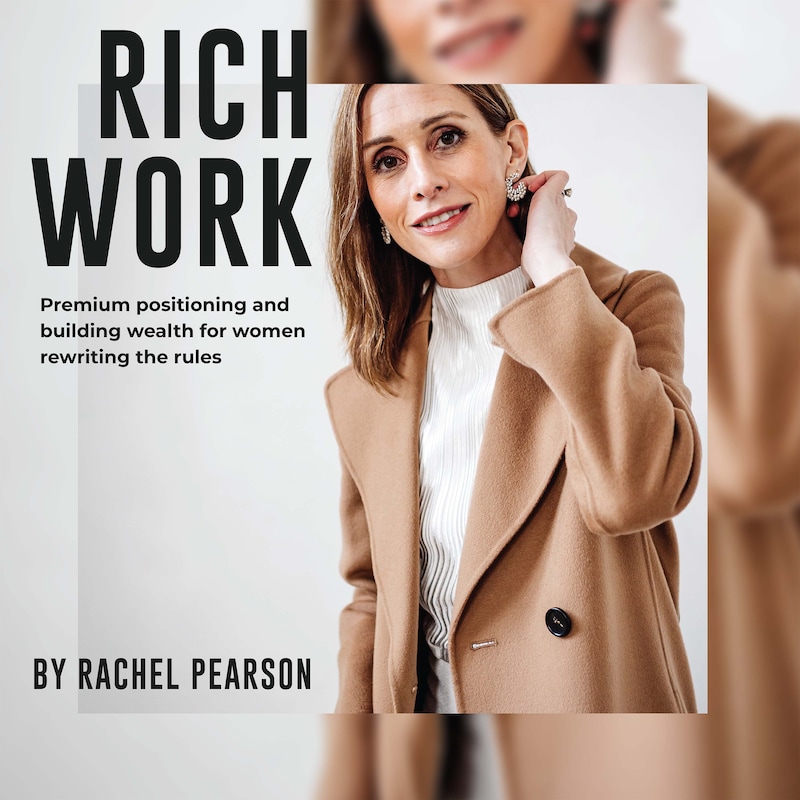
Shownotes
Building an authentic brand doesn't require you to share everything. I've worked with billionaires, celebrities, and people whose names you'd recognise, and the ones who built the most respected, enduring reputations weren't the ones who overshared. They were the ones who knew exactly what they stood for and let you decide if that was for you.
In today's episode I'm sharing my story, but probably not in the way you'd expect.
You'll hear why I've never sold through vulnerability, what working with extremely wealthy and high profile people taught me about money, identity and premium positioning, and why showing up online with boundaries and standards is actually the most powerful storytelling in business tool you have.
If you've ever felt the pressure to be more raw, more relatable, more exposed online in order to attract clients, this episode will challenge that assumption completely.
And if you've ever wondered whether you can build a premium brand without performing, the answer is here.
Topics covered on Building an Authentic Brand:
- Why authentic brand building doesn't require you to expose everything and what to do instead
- What working with billionaires and celebrities taught me about money, identity and premium positioning
- The real meaning of detachment in business and why it's the most underrated embodied leadership skill
- Why selling through vulnerability can be the most inauthentic thing you do when showing up online
- How storytelling in business is less about what you share and everything about what you choose NOT TO
- What really attracts premium clients and why your standards matter more than your most vulnerable moment
- How to build a brand with boundaries that creates real loyalty without chasing relatability
Connect with Rachel:
Come say hi on Instagram │Facebook │LinkedIn
Resources mentioned in this episode:
INFLUX: https://rachelpearson.kartra.com/checkout/INFLUX
Related episodes you may enjoy:
Are You Building for Rich or Wealthy? The Difference Between Rich vs Wealth Mindset] [ep. #5]
Mentioned in this episode:
She Sets The Standard
The room where women who are already extraordinary stop pretending you're available for anything less. Friday 13th November 2026 | Central London
Transcripts
And I thought, yes, it would. I know this is a key reason why I listen to podcasts. I want to hear about the person behind the information, behind the insight. I want to hear their story. We are all human. We are all nosy. We want to go into those details.
So I've always had it on my list of episodes to share my story and share more about why I think this way about business and why I think this way about wealth. Why am I even bringing this podcast forward to you all?
[:
There are certain aspects of my life and my story that I won't ever share in public. Where it's ended up is that this is going to be an episode about my story. You're going to learn more about what I've done in the past and why I think the way that I do, but I'm also going to share it from my truth.
[:
The Criticism I Get Most About My Authentic Brand (And Why I Take It as a Compliment)
[:
So I'm going to be sharing in this episode about me, but it's also about why I don't sell on connection and what I do instead. I think this distinction really matters more than me sharing my vulnerable story with you. I think it'll help you to understand and relate to how I see business.
[:
One of the key things that came through when I was planning out how to share my story here is that I don't feel a need to share my story in order to prove anything. And I know that can sound quite egotistical, as in "oh, I've got nothing to prove, I'm so amazing at what I do." But I want to share where this comes from.
[:
I have worked with celebrities over my marketing career before this business. I have worked with billionaires, several multimillionaires, people that have a lot of money, people whose names you'd recognise, who are living a really, really different world to a lot of other people.
[:
[:
Why the Most Emotionally Detached Person in the Room Is Usually the Best Leader
[:[:
[:
[:
It's not something I've read about. It's something I've watched happen. It's something I've experienced working with people when they've had huge amounts of money coming in and huge amounts going out. So it's why, when I'm working with my clients now, I'm not interested in what they're earning.
[:
I'm interested in what they are attaching to, either what they desire or what they earn right now. Because when I understand that, I can see what their true ambition is. But I can also see where the gaps are and what work we can do together to enable money to flow more easily to them, enable them to enjoy their business, and enable it to be more fulfilling.
[:
It's that I don't let that emotion make every decision from that point forward. I have been very activated by things that have happened in business where I'm like "I don't agree with that, I'm going to do it this way," or people telling me I can't do something and I'm like "watch me." When people underestimate me, that's when things get really interesting.
[:
And it's the same when I'm working with clients. I can see when somebody is pricing from fear rather than from the value they hold and the transformation they know they bring. I can see when a business model is built around proving something rather than sustaining something. It's about hustling to get what they want rather than coming from a place of "I know what I'm creating overall and I'm just continuing to be the best version of myself to attain that."
How Detachment Gives You Clarity Your Competitors Will Never Have
[:
It's not me being arrogant, as in "I can walk into any business and see everything." It's that because I'm not chasing a revenue amount, because I'm not expecting a client to get a certain result by working with me, I'm not performing. I'm not trying to prove anything. I'm not seeking validation through them.
[:
When we talk about being detached from the outcome, what I'm inviting you to think about is that it's not just about you being detached from the outcome in your own business. Being detached from the result is a leadership piece. It's about how you hold yourself.
Embodied leadership isn't about being unemotional. It's about being able to hold the emotions in something and then detach from them to make the decisions moving forward. I call it a leadership piece because when I am working with clients, I need to be detached in order to work with them in the way I've said I can, to hold them to a higher standard, and to notice when they're dropping out of that standard.
[:
The Question to Ask Yourself If You've Never Been in a Room With Billionaires
[:
This is something I've experienced from an early point in my childhood, where money had to become something I became very detached from. And it has grown as I've grown in my career and had experiences with people that have a lot of money. I've leaned into that more over time.
[:
The point is, where are you still putting somebody or something on a pedestal right now, where you feel like "this is how this has to happen in order for success to be valid"? Maybe it's a money amount. Maybe it's a client that comes into your DMs and your first thought is "how am I going to work with someone at that level?" Maybe it's somebody who challenges an opinion of yours and has a larger community.
[:
If money, title, success, years in business, or follower count is not the thing that marks the success of that person right now, then how am I choosing to show up in this conversation? Because then you bring it back to how you want to show up for your brand, for the way you see things, for the way you lead conversations. You are not doing it as a reaction to a perception of somebody else's success.
What Premium Clients Are Actually Looking For (It's Not You Crying on Your Stories)
[:
I'm just going to call it how I see it, and some people might disagree with me. I have nothing against being vulnerable. I have nothing against sharing a story from whatever truth you hold. I just don't agree that it has to be the way you share your story, or that you have to share everything in order for people to feel your truth and your authenticity.
[:
For me personally, the most inauthentic thing you can do, the thing that will create a disconnect and coldness, is if you manufacture a moment of vulnerability to make somebody else feel something. That is the most inauthentic thing I could personally do.
[:
Why Storytelling in Business Doesn't Have to Mean Telling Everyone Everything
And I wanted to share this because I think it's a really key part of how you position yourself as a leader in this space, as somebody building a premium business, or when I say premium business, a business built for longevity. One that clearly marks out the clients it's for and the clients it's not for.
[:
That's the way I choose to show up for my story and in my content. I'm a hundred percent transparent about the way things have worked and the way things haven't worked. Nothing is glossy. I'm not trying to create a perfect image of my life or my feed looking incredible all the time. Bad things happen. Things go wrong. That's the truth.
[:
They need someone who has done the internal work without needing to share it in order to monetise from it. They are looking for clarity. They are looking for my standards. They are looking for the way that I hold myself and the way that I move.
[:
I started this episode by saying it's very much about me thinking through how I wanted to share my story. And what became really apparent when I was planning it out is that I didn't want to do an episode that is a highly vulnerable share about things I've overcome in my childhood, or things I've overcome when I've been knocked back, or defining moments that have led to where I am now.
[:
And that might sound very flippant. But I think it's a really important message if you're listening to this and you struggle with showing up online sometimes because you want a sense of privacy. Because there are moments of your life where you want to be present outside of content. You want to spend time with your kids, your dog, go on holiday.
The Walk Around the Lake That Explains Everything About How I Build My Brand
[:
But I wanted to be in that moment. I didn't want to take a picture of it and say "look at me, I'm choosing to step away from my business because I have this flexibility." I didn't take my phone out with me. I didn't record any content.
[:
This is also part of how I move and how I hold myself, and I know it's a standard that attracts clients to work with me. I'm very boundaried about my time. I'm very conscious of how I'm building this business. And it hasn't been the fastest way, I'll be honest with you. I could have made a lot more money by this point by doing things I fundamentally don't agree with. But it really attracts the clients that I know share those values.
[:
I choose to go for a walk without my phone in the same way that I will say to a client "I think you need to get out of your head and into your body right now." I think that showing up online in a way that actually feels good, and being able to share that on stories, is so much about getting into what brings you joy right now and then sharing from that place.
[:
So I haven't showed up in this podcast episode to share my whole vulnerable story. But that's really the point of this episode. This is what I offered. This is how I see things. This is enough, and I trust that it's enough for the right people listening in.
You Don't Have to Perform to Build an Authentic Brand People Trust
[:
But what I want to invite you into is that you don't need to do that in order to build the business, build the brand, build the connection. The real trick, if I'd call it that, for being able to show up in the most authentic way is that you detach from whatever status you think that gives you.
[:
It's the detachment from what you think has to happen in order for the results to come. That is the key thing I have learned. Not only through my experience in this business, but through my experience working with people that have a lot of money, that have the titles, that have a lot of things people think are the markers of success.
[:
So this has been a different episode to what you might have listened to before in Rich Work. It's been less about teaching strategy. But there is gold in this if you choose to find it.
[:
If you've listened to the last episodes, you already know how I think. Hopefully now you know a little bit more about what I stand for, and you know my approach and the why behind it. I'm Rachel Pearson. This is Rich Work. I'll see you in the next episode.






